SRG "Super Director": Tibère Adler is the favorite

There is a front-runner to succeed SRG Director General Armin Walpen: Edipresse CEO Tibère Adler.

He is the most promising candidate on a list of the election committee of the SRG Board of Directors. According to the Sonntagszeitung, this was reported by people familiar with the process. FDP National Councillor and media entrepreneur Filippo Leutenegger and former Federal Councillor and ex-Novartis manager Ruth Metzler are also being considered as candidates. Walpen himself would apparently like to be succeeded by Gilles Marchand, head of SRG's French-language programs.
Jürg Wittwer, head of Elvia Versicherung, is no longer in the running. He was supported by a group of right-wing politicians led by Aargau SVP National Councillor Ulrich Giezendanner. He regrets that his candidacy was not considered, he told the Sonntagszeitung newspaper.

Zeta designs new website for Migros Museum of Contemporary Art

The Zeta agency has developed a new online presence for the Migros Museum of Contemporary Art in Zurich.

The new Website underlines the values of the Migros Museum, which is both an exhibition zone, a place of research and a playful field of experimentation, the agency writes in a press release. The image content overlaps and thus stands for the complexity and interdisciplinarity of the museum. The typography, on the other hand, is characterized by clarity and tidiness.
Responsible at Migrosmuseum für Gegenwartskunst Zurich: Heike Munder, Judith Welter. Responsible bi Zeta, Zurich: Ibrahim Zbat (CD/graphics). Programming: Taywa, Zurich. Programming: Taywa, Zurich
img100207_zeta

Bluespirit: Pitch for Chevrolet mandate won

Blue Spirit Communications is now developing electronic press kits for Chevrolet Europe for European media representatives.

These websites are developed and built especially for trade fairs and launches of new vehicles for the media, according to a press release from the agency. The first application will already be on display at the Geneva Motor Show.

Last but not least: How Hänschen becomes a social networking specialist

What you don't learn as a child, you'll never learn as an adult—according to researchers at a Belgian university, this also seems to apply to social networking.

The researchers have developed the so-called "Twoddler" - an activity center from Fisher Price that has been turned into a Twitter machine using sensors and pictures of the child's relatives and friends so that Hans can practice tweeting as a baby. The baby's activities are registered by the sensors, which then activate the software. If a child plays with a picture of its mother for a certain period of time, for example, a predefined text such as "Hans misses his mother" is automatically published on the corresponding Twitter account. But don't worry, dear twitterers: for the time being, the Twoddler is a prototype that is not for sale - so there are no reports of your neighbor's crying offspring to worry about in the near future. And if the time does come: A few more nonsensical tweets probably won't matter.
img100203_twoddler

Will Roman Kilchsperger also host the follow-up show to "Deal or No Deal"?

According to the newspaper *Sonntag*, it has been announced who will host the follow-up show to «Deal or No Deal»: Roman Kilchsperger. But if *Sonntagsblick* is to be believed, the host will have to behave a good deal more politely than he has in the past.

According to an SF insider, Ueli Haldimann has promised his protégé Kilchsperger that he can present the new quiz show with knowledge questions, as the Sonntag newspaper writes. The show will also be broadcast on Wednesday evenings on SF 1 from the fall at the same time as "Deal or No Deal".
If the Sonntagsblick is to be believed, Kilchsperger will have to be a lot more civilized in the follow-up show than before: in addition to a continuously declining market share, the presenter's comments are also said to have led to the cancellation of "Deal or No Deal". According to internal SF circles, Haldimann had feared a loss of image for Swiss television due to constant complaints from viewers about the slogans. The SF ombudsman confirmed to Sonntagsblick that there had been a number of complaints in recent years. Most of them criticize Kilchsperger's comments. These were too brash. Others complained that he did not take the candidates seriously. A member of the audience council known to the SoBli editorial team is said to have confirmed this; from the very beginning, SF has had to deal with accusations of sexism in this program. The silver wigs had degraded the money girls to interchangeable objects. Their outfits were then adapted. In the short term, they even tried using Moneyboys - which did not suit the production company Endemol.
According to Sonntagsblick, the entertainment department of Swiss television is already dreading Haldimann's next prank: the cancellation of Sven Epiney's quiz show "5 against 5". It is expected that after more than 1,000 broadcasts, the end could come soon, according to the audience council.

Unimase: New Head of Advertising and Strategy

Oliver Widmer has been Advertising & Strategy Director at the Zug-based advertising agency Unimase (United Marketing Services) since the beginning of the year. In this role, he will be responsible for advertising and strategy consulting and will join the team led by Managing Director Harald Jacksties.

Oliver Widmer previously worked for Rüegg Werbung, Advico, Young & Rubicam and Branders Group in Zurich. Before joining Unimase, he worked for clients such as: Swiss Post, Postfinance, BKW, Basellandschaftliche Kantonalbank and Novartis. As a former project manager for branding at Manor, Widmer worked for advertising agencies as well as for advertising clients. He studied social and communication sciences in Zurich and Lucerne.

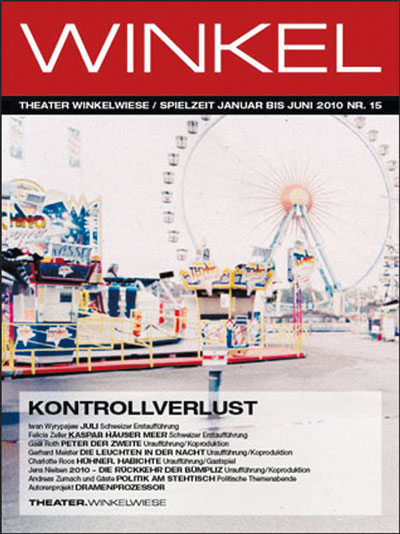
Lost control

Vizner Borel backstage at the Winkelwiese.

The Theater an der Winkelwiese has been a reliable source of new discoveries in German-language auteur theater for years. The avant-garde is particularly in demand. Several exciting premieres have also been announced for Theaterfrühling 2010. The theme of the season is "Loss of Control". The Swiss premiere "Kaspar Häuser Meer", directed by theater director Stephan Roppel, can currently be seen. The program is being promoted by ViznerBorel. The agency, which has been working for Winkelwiese for some time, has produced posters as well as a season magazine "Winkel".
1290581093_img100205_viznerborel1
1290581093_img100205_viznerborel2
img100205_viznerborel3

In-game advertising - advertising medium of the future

In Switzerland, in-game advertising is still a niche market. This is shown in a bachelor's thesis from the Fribourg School of Business.

In today's multimedia society, people are confronted with a plethora of advertising messages every day. The recipients of advertising messages usually react by avoiding advertising in order to reduce cognitive overload. In the battle for the attention of potential customers, advertisers are therefore increasingly faced with the problem of customers avoiding the messages and thus not achieving the advertising objectives. Against this backdrop, program-integrated forms of advertising such as in-game advertising are becoming increasingly popular with advertising practitioners, as they can circumvent the recipients' selection and defense mechanisms. A bachelor's thesis at the Freiburg University of Applied Sciences examined the possibilities and limitations of in-game advertising. Specialists from Germany and abroad were interviewed.
In-game advertising - facts and figures
In-game advertising is the planned, systematic integration of advertising measures into the virtual game world with the aim of achieving the advertising company's communication and/or sales targets.
On behalf of IGA Worldwide, Nielsen Bases and Nielsen Games surveyed 1,300 PC game users for the study "Consumers' Experience with In-Game Content & Brand Impact of In-Game Advertising". The most important results include the positive reaction of players to advertising in video games: 82 percent find a game with advertising just as entertaining as one without. In addition, the positive perception of all products advertised in the game increased by 61 percent on average. With a potential of up to 20 million gamers between the ages of 14 and 39 and around 3.7 million online gamers in Germany alone, one in four people pick up a gamepad.
The average gamer in the USA today is 35 years old, in Germany 33 years old. Last year, 26 percent of Americans over the age of 50 played games, compared to just 9 percent in 1999. 40 percent of all US gamers are women, compared to 33 percent in Germany. It is therefore logical that the Game
community is also an interesting target group in terms of advertising.
How can in-game advertising be used?
In-game advertising is an innovative marketing instrument in the context of communication policy that can be used to address attractive target groups. However, the use of in-game advertising to make a brand known should be avoided. Advertising in games is perfect for conveying a brand message, getting a brand talked about and anchoring it more firmly in people's minds. The same mechanisms that are responsible for the success of viral marketing are often used here.
However, it is also important to ensure that the game does not lose its authenticity through the use of advertising, which could result in a loss of image for the advertiser. When used in moderation, in-game advertising can enhance the enjoyment of the game. If too much advertising is integrated into a game, on the other hand, there is a risk of advertising overload, similar to TV. Last but not least, in-game advertising is used in the area of public affairs in politics during elections. Last year's campaign by Barack Obama in the US presidential election can be mentioned as a successful example.
Markus Buchs and Max Meister
Further results of the work
1. only dynamic in-game advertising will "survive" in the future.
2. only high-reach games with interesting and focused target groups are promising.
3. in-game advertising offers excellent targeting opportunities.
4. creative productions are possible.
5. the target groups' acceptance of suitable brands and productions is very high. User resistance is surprisingly low.
6. intensive contact possibilities with the advertising medium with image-building character.
Future
Here in Germany, advertisers often still have a certain inhibition threshold when it comes to using in-game advertising. This is in stark contrast to the UK or Germany, for example. But sooner or later there will be a rethink here too. In the Swiss market, it will be crucial to create standards and have requirements certified. Only in this way can in-game advertising be made palatable to advertisers as a serious marketing and communication channel.

Medidata transports 50 elephants

Medidata, headquartered in Root (LU), transmitted 20.15 million documents electronically in 2009. This represents a 16 percent increase over the previous year.

The company is thus asserting itself as the leading full service provider for electronic data exchange in the Swiss healthcare sector, according to a press release issued on Friday. The average size of a document is 2.6 A4 pages. If the total weight of the 20.15 million documents is calculated, this amounts to around 261 tons. According to the press release, this is roughly equivalent to the weight of 50 elephants. Daniel Ebner, CEO of MediData: "Together with our partners, we are thus reducing administrative costs in the Swiss healthcare system. And we are also protecting the environment." In addition to service and premium invoices, X-ray images and reminders are also transmitted electronically between service providers and insurers.

Is CS (crowd sourcing) the CD (creative director) of the future?

Agencies don't need to fear the outsourcing of creative intelligence, but they can't just sit back—they need to be able to deal with it.

As early as the 1960s, the aim was to conduct precise research into young people's attitudes, not least in order to draw conclusions for the marketing of certain consumer products. So they asked 12 to 14-year-olds in England: "Who are you?", and received the unequivocal answer: "We are rebels." Even though it may be a cliché, the answer could not have expressed the zeitgeist of that era any better.
Almost 50 years have passed and in the survey inflation of the 21st century, the same question to today's 12 to 14-year-olds could of course not be missing. There is not even a hint of the spirit of rebellion left, but a new self-image is clearly emerging, because the respondents say they are "connected", "networking" is their passion and they see themselves as "creative". Not really surprising, but anyone who earns their money with advertising should think a little about this self-image of the Web2 generation. To paraphrase Andy Warhol's famous quote, you could say "in the future everybody wants to be a creative for 15 minutes". And if you surf the web, you will discover tons of cyber garbage as well as great creative flashes of inspiration. Of course, this has not gone unnoticed by marketing and communication managers in companies and they are already starting to make use of "crowdsourcing".
For example, the Bild newspaper called on web surfers to get creative with the Bild brand and make suggestions for an advertising campaign. The professionals only came into play as a jury, which had to select the best from the thousands of suggestions. And the list of companies that crowdsource is getting longer and longer. The retailer Tchibo or the jewelry manufacturer Swarowski allow customers, creative people or simply anyone to collaborate on product development. An approach that the Zurich Transport Association (ZVV) has also been practising for some time.
Invisible talents on the net
In autumn 2007, Cisco organized an external innovation competition called "I-Prize" to find an idea that would become a billion-dollar business for Cisco. The company wanted to break out of its tunnel vision and find ideas that had previously eluded it. More than 2,500 people from 104 countries created 1,200 different ideas, which were analyzed in an elaborate process and the most promising were selected. As the quintessence of the ideas competition, Cisco developed an intelligent power grid equipped with sensors. Those responsible openly admitted that this "public" way of finding ideas was much more complex than they had expected and resulted in an enormous internal effort. Nevertheless, they rated the crowdsourcing as a complete success, especially because every company and every industry tends to see the world from the same perspective, which can be challenged by a different point of view.
Entrepreneurs, marketing and communication managers are increasingly flirting with the idea of not simply awarding contracts to specialized suppliers, but turning to the invisible talents on the net, who seem more inspired and cheaper than professional creatives. This development is also being encouraged by the fact that agencies are increasingly being downgraded to suppliers and the close, trusting partnerships of the past, which have always led to outstanding creative solutions, are being lost.
Tapping into the creativity and inspiration of the many may be much more difficult than communication managers looking for new models might imagine, but we advertisers should quickly stop resting on the laurels of the past and assuming that in 30 years' time there will still be a professional group that identifies itself on its business card as a creative under a fancy-sounding agency name. Otherwise, it could happen that creative directors will no longer meet at the ADC when judging their own campaigns, but in the jury that has to assess the most creative ideas from crowdsourcing.

Striking

This time, *Werbewoche* took note of the launch campaign for EgoKiefer’s new line of windows, as well as the new editorial rhythm of the satirical magazine *Nebelspalter*.

Eager for Ice Cream to Help Fight Climate Change
If you want to survive in the Arctic, you have to be really good at it. Polar bears, penguins, and arctic foxes, for example. And to prevent these animals« habitat from melting away even further, we need to reduce our energy consumption. The Swiss window and door manufacturer EgoKiefer is also really good—because with its new high-tech »AllStar” window line, it reduces energy loss through windows by up to 75 percent. This gave the Freicom agency the idea to feature polar bears, seals, and kingfishers as the focal point of the launch campaign for EgoKiefer’s new window line. For the campaign, light artist Gerry Hofstetter traveled to the Arctic and projected photos of these masterful animal survivors onto icebergs. In just six months, Freicom developed the campaign’s visual identity and produced a new brochure concept, numerous printed materials, and EgoKiefer’s exhibition at Swissbau 2010.
1290581092_img100205_aufgefallen1

Nebelspalter with 10 special issues
The Swiss satirical magazine *Nebelspalter* is doubling the number of its annual issues and, with ten additional issues, shortening the wait between main issues. With this new schedule, *Nebelspalter* is responding to the widespread demand for more timely political satire, cartoons, and commentary. Nebelspalter has a circulation of 80,000 copies. The first «Extra» issue will be published on February 18.

1290581092_img100205_aufgefallen2

Plus TV and Internet

According to the Goldbach Index (Gemi), TV and the Internet posted gains in December of 7 and 6 index points, respectively. For the year as a whole, they recorded increases of 19 and 209 index points, respectively.

E-media increased by 6 index points to 463 (457) in December. TV increased its advertising pressure by 7 index points to 469 (462), while the Internet gained 6 index points to 578 (572). Radio maintained its pace with an increase of 2 index points to 261 (259), while Teletext lost a further 4 index points to 139 (143). Adscreen recovered with a gain of 8 index points to 188 (180).
All media published by Media Focus remain at 183 index points. The overall changes achieved in 2009 are as follows: TV +19, radio +15, Internet +209, Adscreen -79, Teletext -16, e-media +32, all media -10 index points.
img100205_gemi
get_footer();