The CD carousel turns

The economy is picking up, and with it, the career merry-go-round is starting to spin a little faster again. A reshuffling at Advico Young & Rubicam has been described by many as spectacular.

Philipp Skrabal has moved from there to Wirz. After Ruf Lanz and a period as a freelancer, Thomas Schöb has joined Y&R. At Jung von Matt/Limmat, Livio Dainese and Fernando Perez have been promoted to CD after successful gold wins. At TBWA Switzerland, Magnus Sambo takes over creative leadership. We may find out where his predecessor Urs Schrepfer is moving to at a later date, as well as Matthias Freuler from Wirz.
1290581030_img100310_kdw_dainese
1290581030_img100310_kdw_perez
1290581030_img100310_kdw_sambo
1290581030_img100310_kdw_schoeb
img100310_kdw_skrabal

Adcom Event: Driving Gold Bunnies at Lindt & Sprüngli

During the upcoming Easter days, Lindt's Gold Bunny Smarts will embark on a roadshow throughout Switzerland, delighting young and old alike. Adcom Event was responsible for the entire project.

A convoy consisting of 5 golden smarts with golden ears and golden bell together with an Easter nest on wheels including a 2.4 meter high golden bunny will stop at the most important points of sale and shopping centers during 11 days. After an intensive preparation, planning and development period, the vehicles were handed over to Lindt & Sprüngli by Adcom Event on March 3.
1290581033_img100310_smarts1
1290581033_img100310_smarts2
img100310_smarts3

The cheapest tariff

The people of Lys caught red-handed advertising for PostMail.

The agency in flagranti in Lyss won the mandate for a sales-promoting product campaign for PostMail's DirectMarketing service bundle. The campaign focuses on the InfoCard rate, the cheapest postage in Switzerland for advertising postcards, and DirectFactory, the online tool for making your own postcards. The campaign ties in with PostMail's umbrella campaign and shows examples of bad advertising, in each case with the resolution that direct marketing is more efficient, effective and measurable. The main medium is - of course - mailings. The main target group of SMEs is contacted on a sector-specific basis. There are also banners and advertisements. pan
1290581033_img100310_postmail1
1290581033_img100310_postmail2
img100310_postmail3

Cannes Lions: Facebook founder is Media Person of the Year

At this year's 57th Cannes Lions International Advertising Festival, Mark Zuckerberg, founder and CEO of Facebook, will be honored with the title of Media Person of the Year. This award honors personalities who are currently influencing the media and communications landscape.

With Facebook, Mark Zuckerberg has succeeded in building a platform on the internet in a very short space of time that has not only changed the way we communicate, but has also created new possibilities and opportunities for the advertising industry, according to the statement. Mark Zuckerberg founded Facebook in 2004 while studying computer science at Harvard University. Based in Palo Alto, California, Facebook now has more than 400 million registered users.

Econ Awards: Innovations wanted

On March 22, 2010, the fourth edition of the Econ Awards for Corporate Communications competition will begin. Companies and agencies from Germany, Luxembourg, Austria, and Switzerland can submit their work by May 7. For the first time, the jury will also evaluate submissions in the «Social Media» category.

The launch of the new "Social Media" category is justified by the fact that the use of Facebook, Twitter and other social networks has become indispensable for contemporary dialog. Entries can be submitted in the following categories: Strategic corporate communications, annual reports, sustainability/CSR reports, corporate books, image brochures, films/interactive media, websites/web specials, magazines/newsletters, PR activities - and now social media.
The Econ Awards are committed to the search for innovation. "We want to bring a breath of fresh air into corporate communications. Of course, we also recognize professional implementation and the effectiveness of campaigns. But first and foremost, we want to be a platform for innovative ideas," Klaus Rainer Kirchhoff, jury chairman and publisher of the Corporate Communications Yearbook, is quoted as saying in a press release.
The award ceremony will take place on November 18, 2010 in Berlin. The winners and shortlisted entries will be published in the Yearbook of Corporate Communications, Volume 04, which will be published in mid-November 2010.

AYR: Single-family house on wheels

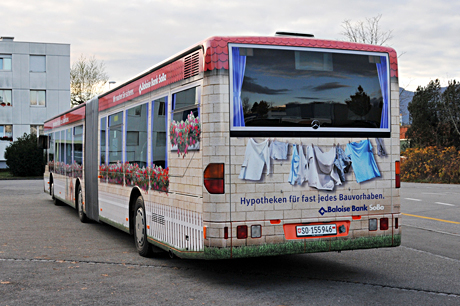
To promote its mortgage offerings, Baloise Bank SoBa had buses wrapped with advertisements. Advico Young & Rubicam transformed the vehicles into small, mobile single-family homes.

The message is: mortgages for almost every building project. The buses have been running in Solothurn, Grenchen and Olten since the beginning of November 2009.

Responsible at Basler Versicherungen: Jürg Moosmann (Head of Marketing), Marc Hallauer (Head of Marketing Communications), Marco Sauser (Baloise Bank SoBa, Head of Products and Marketing), Beatrice Mätzener (Head of Advertising, Sales and Marketing), Nicole Capobianco (Project Manager, Marketing Communications). Responsible at Advico Young & Rubicam: Markus Gut (overall responsibility), Philipp Skrabal (ECD), Andi Portmann (text), Isabelle Hauser (AD), Annik Weber (graphics), Pablo Koerfer, Tanja Mezan, Tom Hubli (consulting), André Reymond (image processing), Blue Horizon (litho).

1290581036_img100309_soba1
1290581036_img100309_soba2
1290581036_img100309_soba3
1290581036_img100309_soba4

USA: Cracking authoritarian regimes with the Internet

The U.S. aims to use the Internet to pressure authoritarian regimes into allowing greater freedom of expression. The Treasury Department in Washington has authorized U.S. companies to export software and provide access to web services such as instant messaging, chat rooms, email, and social networks in Iran, Cuba, and Sudan.

The aim is to promote the free exchange of information in these countries. The move will make it "easier for people in these countries to use the Internet to communicate with each other and with the world", said US Treasury Secretary Neal Wolin on Monday. According to a report in the New York Times, US software and internet companies such as Microsoft and Yahoo have so far not offered these services in such countries for fear of violating US government sanctions. However, there has been growing political pressure, including from Congress, to lift the restrictions after internet services such as Facebook and Twitter became central means of communication for the opposition during the post-election protests in Iran.

Last but not least: Tracking down the potential iPad buyer

Apple recently lifted the veil of secrecy and unveiled its latest creation, the iPad. Until now, it was unknown who would be purchasing the smart device. Thanks to the social media specialist Rapleaf and Facebook, however, this too has now been clarified.

Rapleaf examined the profiles of Facebook users who have joined one of the three large iPad fan groups. This showed that women and men are equally interested in the iPad. The iPad fans are considerably younger than the typical Facebook user, namely between 18 and 25 years old. In addition, potential buyers are more "social" than others. 33 percent have more than 300 friends on Facebook and eight percent even have more than 500! Many of the potential buyers on Facebook are also fans of Starbucks, Coca-Cola, YouTube, Lady Gaga, Michael Jackson or Twilight. Finally, probably the biggest surprise: potential consumers are social media savvy. This is all the more surprising given that the data was collected via Facebook. Incidentally, Apple did not want to comment on the analysis to the industry service Pressetext. They did not want to restrict the target groups in any way. Reasonable.

A Media World Turned Upside Down: The Weak Are Arming Themselves…

Central Switzerland is bucking the trend and launching an interesting experiment. By Karl Lüönd, freelance journalist and author.

The Basler Zeitung can no longer survive on its own in what is currently Switzerland’s strongest economic region and is selling itself to investors. And a week later, in Central Switzerland, the project for a new Obwalden Nidwalden Zeitung (ONZ) emerges as a countercyclical phenomenon. While the entire industry laments the crisis as if there were no tomorrow, a new newspaper is announced—and this, of all places, in structurally weak Central Switzerland, where the Neue Luzerner Zeitung has dominated the media landscape for years and where there is no shortage of competition from local advertising papers. And it’s not just any idealists behind the ONZ project, but local businesspeople and investors with a proven track record.
A media world turned upside down? It seems that way, but only at first glance. Small may be beautiful, but that’s not enough of an explanation. Have we, in the midst of all this crisis hysteria, overlooked something? The people in Nidwalden and Obwalden who are now seeking three million to launch their newspaper into orbit are certainly shrewd businesspeople. Urs Gossweiler, one of Switzerland’s few innovative publishers, is demanding generous payment—in advance—for his assistance across the Brünig Pass.
Anyone who buys ONZ shares may view part of the investment as a way to support their local community. And yet it looks like a good deal. That’s because the small and medium-sized newspapers—the B and C-tier titles of the Swiss press—have, on the whole, weathered the crisis far better than the big ones everyone talks about, simply because the latter never tire of complaining. Time and again, I see income statements that show positive figures for advertising revenue even for the past two years—or, if there are negative figures, they look far less dramatic than those of the big players.
The explanation is actually logical. Local and regional newspapers are not dependent on individual major advertisers or specific industries—and they are less severely affected by economic fluctuations because their advertising clients have fewer alternatives.
As far as ONZ is concerned, despite many decidedly positive signs, there are of course still question marks that should be viewed as residual business risk. The most important unanswered question: Is the market large enough to cover the project’s fixed costs? And secondly: Is it wise to publish the print edition twice a week, given that it’s well known that retail sales are concentrated primarily in the second half of the week? Finally: Will the Central Swiss manage to turn the costly online venture into a profitable business? (They would be the first to do so.) And, above all, will they manage to do so within a reasonable timeframe? After all, even the three million in venture capital won’t last forever.
The ONZ is an interesting field experiment, because there have long been many indications that reaching small, manageable communities through print media can indeed be profitable—provided that costs are kept under control. Last fall, I was invited to speak in a larger municipality in the Zurich Oberland, where a vibrant and well-produced village newspaper has been published for years—and remains profitable because the municipality is wise enough to provide only a modest financial contribution without interfering in its operations.
The savvy Oberlanders invited six similar newspaper models from the rest of Switzerland to present—and the presentations all painted the same picture: It’s possible, provided that editorial costs, in particular, are kept as low as possible.
In some places, this certainly borders on self-exploitation—which, admittedly, is a left-wing metaphor. To stick with this line of thinking: One could also speak of «citizen journalism,» a concept that has been touted in the online sphere for years but has never really taken off anywhere. However, this seems to be possible in good old print media. The experiment in Nidwalden and Obwalden will show whether such a business model is sufficient to provide decent compensation for journalistic work.

This article is from the current print edition of *Werbewoche*.

News1.ch: News portal fails to make the breakthrough

With News1.ch, seven media companies in German-speaking Switzerland sought to compete with automated news portals such as Google News. But now, after one year, the project has been scaled back to a minimum, and the two online editors have been laid off.

News1.ch's headlines and thematic focuses will be generated automatically until further notice, as Norbert Neininger, who is responsible for the project, confirmed in a report by Persoenlich.com. The main reason for this is that the NZZ subsidiaries Neue Luzerner Zeitung, St. Galler Tagblatt, Zürichsee Zeitung, Zürcher Oberländer and Zürcher Unterländer have pulled out. The NZZ Group intends to push ahead with its own platform from fall 2010, as confirmed by spokeswoman Barbara Schibli. The editorial team of NZZ Online will be responsible for the content, while the regional publishers will contribute their regional news. In addition to the NZZ Group, the Mittelland Zeitung, Schaffhauser Nachrichten and Südostschweiz are participating in News1.ch. They now have to decide whether they want to join the NZZ Group with their online portals.
Keeping up with the existing news portals is difficult. News1.ch did not manage to gain sufficient publicity within a reasonable period of time, as the latest figures from the internet research institute Net-Metrix from February show. While news portals such as Blick Online, 20minuten.ch and Newsnetz (with Tagesanzeiger.ch, Bernerzeitung.ch, Baslerzeitung.ch and Derbund.ch) received 16 to 18.7 million visits per month, News1.ch recorded just 35,700. NZZ Online recorded 8.6 million visits. Bluewin.ch has by far the most readers with 45.4 million visits.

Billag: Back payments from defaulting companies not a priority

Companies that do not pay TV and radio reception fees even though they use television and radio do not have to expect harsh persecution by Billag. The collection agency's priority is to persuade companies to pay in future.

As the Federal Council writes in an answer to a question from Christoph von Rotz (SVP/OW) published on Tuesday, the Federal Office of Communications (Bakom) instructed Billag to concentrate on providing information and registering companies liable to pay fees and not to collect fees from previous years. From a purely legal point of view, Billag could claim unpaid fees from the five years prior to the discovery of unpaid radio and TV usage. The limitation period for reception fees is five years. At present, the proportion of registered establishments is too low in relation to the actual number of reception devices. According to the Federal Council, one of the reasons for this is that companies are poorly informed about the obligation to pay fees.

Study: SRG online portals largely compliant with the license

The SRG’s online portals largely comply with the requirements set forth in their radio and television licenses. This is the conclusion reached by researchers at the University of Zurich, who analyzed 2,000 websites and 500 links selected at random.

According to the concession, the content and links on the SRG portals must have a direct chronological and thematic link to the radio and television programs. In 90 percent of the cases analyzed, the online portals of Swiss television, Swiss radio and the TV channels of French-, Italian- and Romansh-speaking Switzerland complied with these requirements, according to the study published on Tuesday on behalf of the Federal Office of Communications (OFCOM).
More than two thirds of the offerings were even classified as clearly compliant with the license. In ten percent of cases, however, it was not clear whether the conditions had been complied with because it could not be proven whether or not the content was program-related. Bakom writes that interactive websites should be assessed critically. In the case of blogs, for example, it was not possible to prove the broadcasting reference required in the license.

get_footer();