BBC Storyworks, the content marketing arm of BBC Advertising, is currently testing new ways to understand the emotional impact of content-led marketing initiatives. This involves measuring the subconscious reaction of consumers to campaigns on BBC.com. In a study released Thursday titled "The Science of Engagement," the in-house insight team, in collaboration with facial coding experts Crowemotion, combined traditional market research metrics with facial coding to explore how brands can use content-led marketing to effectively engage with consumers. BBC Advertising plans to offer this information to premium clients as part of campaign reporting to help them truly understand how content-led marketing impacts consumers and the value it can bring to their brands.
According to this study - the first of its kind - well-executed and clearly labeled content-led marketing in a high-quality environment is considered trustworthy and persuasive, and has a strong emotional impact on the brands involved. Content-led marketing can significantly improve positive attitudes towards brands (77 percent more explicit after the advertising campaign compared to before). In addition, the study captured the second-by-second facial expressions of people experiencing the content to measure the true interaction and implicit reaction of respondents. The results showed that advertising can increase subconscious positive attitudes by 14 percent.
Richard Pattinson, SVP Content, BBC Advertising and Head of BBC Storyworks: "At a time when advertisers are increasingly investing in content-led marketing, they also need to be sure of its effectiveness and understand the significant positive impact this content has on their brand. We believe this research will improve advertisers' understanding and increase their confidence in these campaigns and the value of quality content marketing in a premium environment."
Other important study results:
Transparency and quality are the most important factors for interaction with the target group.
64 percent were willing to read content-led advertising as long as it was clear which brand was behind it; 64 percent were willing to read it as long as it was clearly labeled.
Among those who already know the medium well, this increases to 82 percent and 83 percent respectively. In this group, 80 percent agreed that they would share the content; 80 percent believe it works in addition to editorial content.
In the facial coding study, the rejection of content clearly presented as from brands was 7 percent below average, while the rejection of unlabeled content was 18 percent above average.
63% of respondents did not mind seeing the content as long as it reflected the quality of the provider's editorial content. In addition, 59% found the content informative, 55% found it interesting and 57% said they would share it.
Consumers are up to 30 percent more likely to believe that content-led advertising from premium news providers is more informative and accurate than from other news providers.
Content-led marketing improves brand awareness - the brand becomes 10 percent more trusted and its image 14 percent more positive on average between the test and control phase. It also helps to strengthen the brand - with 14 percent more recommendations and 16 percent more attention.
Integrating the brand leads to more emotional response, while referencing the brand within the narrative frame yields better results for the advertiser. Integrated content leads to a +109 percent increase in explicit brand positivity and a 32 percent increase in implied brand positivity. Integrated content also increases important call-to-action measures in terms of recommendations (+21 percent) and attention (+20 percent).
The four-week study was conducted in October 2015 on the premise that traditional performance metrics only partially measure the success of a campaign; but that when combined with the measurement of both conscious and subconscious consumer response to brand content, they provided a more comprehensive picture of the effectiveness of content-led marketing campaigns.
Speaking about the decision to test emotion recognition techniques, Pattinson said: "BBC Storyworks wants to use Crowemotion's innovative facial coding methods to prove that, when done transparently and correctly, brands can use content marketing to increase emotional engagement and improve brand awareness among consumers."
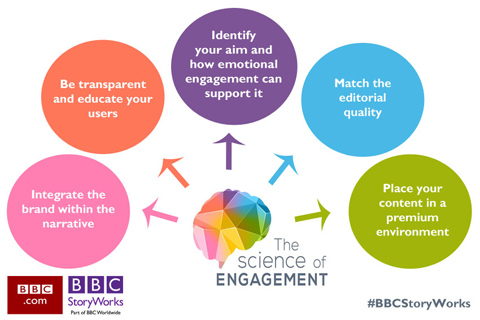
The key findings of the BBC Storyworks study have shown that there are Five general principles for content-led marketing gives:
Be transparent and educate your users;
The quality must be adapted to the editorial content;
Communicate clearly what the content is intended to achieve and how emotional interaction can support this;
Integrating the brand within the narrative framework has a positive effect on the brand;
Placement in a premium environment makes content more credible and successful.
Methodology:
5153 digital consumers of English-language international news in six markets were surveyed: Australia, Hong Kong, Singapore, USA, Canada and Germany. The focus was on three main measurements - a quantitative online survey, facial coding and implicit response testing. To measure subconscious reactions, facial movements were recorded every second and then coded into six possible emotions: Sadness, Confusion, Happiness, Fear, Rejection and Surprise.
To better understand their emotions, a panel of 20 media experts, ranging from media agency executives to major international advertisers to academics from around the world, put the facial coding results into a logical context. The experts looked at the content tested in the study and rated it on several important factors, e.g. entertaining and light, profound, intellectual, etc. These results were then combined with the emotional response to show why consumers reacted in certain ways.