Greece flop will be expensive for Affichage

The failed expansion into Greece has already cost the Geneva-based advertising company Affichage about 150 million francs. This amount includes the initial investments and subsequent operating losses.

The management at the time may have been too optimistic about its growth plans abroad. This was said by the new Affichage CEO Daniel Hofer in an interview with the French-speaking Swiss newspaper Le Temps. In the specific case of Greece, mistakes were also made in the selection of business partners.

Other foreign activities were also unsuccessful in 2010. Affichage posted a loss of CHF 52.3 million in 2010 due to corresponding value adjustments. Nevertheless, the advertising company intends to continue its activities outside Switzerland in the future. According to Hofer, negotiations are currently underway with potential partner companies in several countries. Talks are also being held with potential buyers.
 

Best of Swiss Web Award Night - Migipedia is Master of Swiss Web 2011

The Master of Swiss Web 2011 is Migipedia, the open online dialog platform by and for Migros customers. The winner of the Master of Swiss Web was also awarded gold in four of ten Best of Swiss Web categories.

On Migipedia, customers can discuss their concerns online with Migros and the community, rate products, and help develop them. Migros, including Ex-Libris, had five candidates in the running for the Master award. Migipedia was implemented by Liip and Jung von Matt, Limmat. Another sensational three Goldboien - the award for the winners - went to the Department of Construction, Transport and Environment of the Canton of Aargau.

Four times gold for Migros
In addition to the master's title, those responsible for the Migipedia project also took home gold for exceptional performance in the Online Marketing and Digital Performance Campaigns categories from the Best of Swiss Web Award Night at Zurich's Kongresshaus. First place in the Technology and Digital Branding Campaigns categories also went to Migros, with the Oceanmania (Technology) and "Migros Chocolate and the Wild Chickens" (Digital Branding Campaigns) projects. The contractor for Oceanmania was Station, and for "Migros Chocolate und die wilden Hühner" Jung von Matt, Limmat.

Three gold medals for the canton of Aargau
The Department of Construction, Transport and the Environment (BVU) in the canton of Aargau was also busy collecting golden buoys - the award for the category winners and gold winners. The online spatial development project "Zeitraum Aargau" won three times, in the categories Public Affairs, Creation and Innovation. The contractor was Hinderling Volkart.

One gold each for SonaPro and Möbel Pfister
Finally, Möbel Pfister won in the Usability category with the relaunch of its online store, and in the Business Efficiency category the Sona Pro project, the online platform of the Sonova Group (Phonak) start-up of the same name. The online store of Möbel Pfister was implemented by Unic, SonaPro by Namics.

SRF with gold in the special category Digital Natives
In the 2011 "Digital Natives" special category, first place went to SRF and the trimedia children's program Zambo. The project was clearly convincing and shows what young people expect from the web today. The jury consisted exclusively of digital natives - people born after 1983 who were born with cell phones and computers. The contractor was SRF.

Viennese comedian Alf Poier and DJ Stiebeltron provided entertainment and a good atmosphere at the Best of Swiss Web Award Night. The laudations of the juries for the individual category winners are available on the website of the Best of Swiss Web also the names of the silver and bronze winners.

The jury considered 306 project submissions. The jury nominated 12 projects for the master selection.
 

New head of photography for Blick Group newsroom

The Blick Group's newsroom has a new head of photography: Tobias Gysi. He succeeds Tony Merlotti.

Tobias Gysi will take up his position in the newsroom on August 1, 2011. He has been working at Limmatdruck in Spreitenbach as Head of Photography for Migros Media since 2008. Gysi leads a team of 10 photo editors and image editors and is responsible for the publications Migros Magazine, Saisonküche, Vivai and Migros Babyclub. Prior to this, he spent four years gaining broad experience in the field of photography at Keystone. Gysi completed his basic training as a polygrapher at Tamedia, where he worked on the editorial teams of Facts, SonntagsZeitung and Das Magazin.
 

Trade association files suit against Tamedia: Market abuse in French-speaking Switzerland

The Swiss Trade Association (SGV) is calling on the Competition Commission (Weko) to launch an investigation into the Zurich-based media group Tamedia for violations of the Antitrust Act. The investigation stems from advertising rates in French-speaking Switzerland.

Following the takeover of the Edipresse publishing house by Tamedia and the subsequent merger of the free daily newspapers 20 minutes and Le matin bleu, the SGV criticizes the massively inflated advertising prices demanded by SMEs in French-speaking Switzerland. According to the SGV press release, advertising prices in 20 minutes rose by 45 percent in 2010. This year, they have been raised by a further 10 percent.

Tamedia considers the 20 minutes advertising prices to be fair and attractive, as Group spokesman Christoph Zimmer told SDA on request. Compared to other daily and weekly newspapers, the price of an advertisement per reader reached is significantly lower. Before the merger, the two free newspapers were in the red, not least because advertising prices were significantly below the market price. Before approving the newspaper merger, the Competition Commission examined whether another media company could have taken over one of the two papers. However, none were willing to do so.

SGV: SMEs at a disadvantage
The trade association sees small and medium-sized enterprises (SMEs) in particular as victims of the price increases at 20 minutes. Large customers receive much better conditions for their advertisements thanks to volume discounts and other advantages. In the opinion of the SGV, the price jumps are a clear abuse of the dominant market position of the Tages-Anzeiger empire. The ComCo must now scrutinize the dominant market position of the free newspapers in French-speaking Switzerland and the price abuse. (sda)
 

Refreshment with a Swiss accent

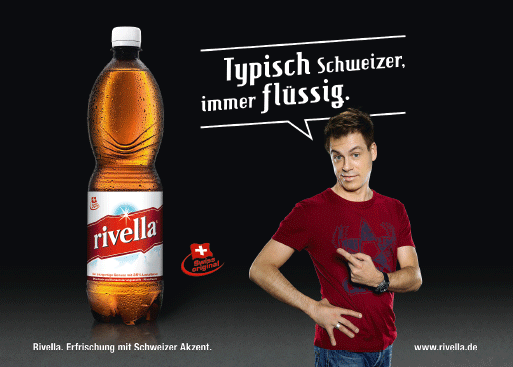
Jung von Matt/Limmat relies on Michael Mittermeier as a testimonial for Rivella in Germany.

Rivella is expanding its distribution in Germany. In addition to Munich, Stuttgart and Berlin, Rivella is now also available to buy in Hamburg. The offensive is accompanied by Jung von Matt/Limmat and relies on comedian Michael Mittermeier. He is following in the footsteps of Emil Steinberger, who acted as the testimonial for Rivella's successful previous campaign in Germany. For Mittermeier, this is the first time he has made himself available for advertising. The campaign starts with a teaser. Alleged amateur recordings appear on YouTube and Mittermeier's Facebook fan page showing the comedian in everyday life, babbling pseudo-Swiss gibberish. The speculation fueled by this is dispelled with a film entitled "Police check". It shows what happens to Michael when he drinks Rivella. The campaign continues with four cinema and TV commercials, five Internet films, six radio spots and various advertisements to accompany Mittermeier on his further experiences with Rivella and the Swiss. pan

rivella
 

Deadline Goldbach Award 2011 expired - online voting ongoing

The deadline for submissions to the 2011 Goldbach Award for Cross-Media and Social Media has passed. The 36 cross-media campaigns submitted are now available online, and anyone interested can vote for their favorite.

A total of 36 cross-media campaigns were submitted for the Goldbach Award 2011. These can now be viewed at Goldbachaward.ch. Parallel to the evaluation by the jury, interested parties also have the opportunity this year to vote for their favorite until April 13, 2011. The result of the voting will be taken into account by the jury during the main judging at the beginning of May. The vote for the best social media campaign will follow in 14 days.

The winners will be announced at the Goldbach Award Night on May 10, 2011 in a festive setting at Kaufleuten in Zurich. The award ceremony will be hosted by Melanie Winiger.
 

Dialog Marketing Award: The nominees are known

It remains to be seen who will win the coveted awards at the Swiss Dialog Marketing Prize 2011. The jury has already decided on the shortlist in the 12 categories.

The Swiss Dialog Marketing Prize is awarded in twelve categories as well as various special prizes. There were almost 17 percent more entries for this year's awards than last year. It remains to be seen who will win the awards. The jury has now determined the nominees for the categories.

Also, fewer certificates have been awarded this year than last year. The winners will be honored at the Award Night on May 27, 2011. Tickets for the award ceremony will be available from April 1 at Get-your-metal.ch.

The nominees

Swiss Dialog Marketing Award
The Swiss Dialog Marketing Prize has been awarded once a year since 1999. Prizes are awarded for the best dialogue marketing work in the categories "Addressed mailings from 25,000 copies", "Addressed mailings from 251 to 24,999 copies", "Addressed mailings up to 250 copies", "Printed, non-personalized advertising media", "Dialogue strategies", "Integrated dialogue campaigns", "Digital dialogue measures", "Ambient measures", "Art direction", "Production" and "International".

Campaigns for non-profit organizations can be awarded a special prize and the Audience Award is chosen from all submitted campaigns. The Platinum Award is a special honor. This can be awarded by the chairman of the jury as well as a representative of the sponsoring association SDV and the main sponsor Swiss Post and honors the most outstanding work of a year. The SDV Junior Award has also been presented since 2009 and honors the best young talent.


Top of the week 1: AZ Medien turns a profit again

After three bad years, AZ Medien AG, publisher of the Aargauer Zeitung, is back in the black. In the 2010 financial year, the Group achieved a consolidated result of CHF 3.2 million.

In 2009, a loss of 14.8 million Swiss francs was recorded. A slight economic recovery from autumn 2010 and, in particular, the cost-cutting measures from synergy programs, some of which were already initiated in the 2009 financial year, had a positive impact on the 2010 financial year, as the company announced. Operating income of CHF 234.4 million was at the previous year's level after structural adjustments. However, it is not directly comparable with the previous year due to the company's own marketing of advertisements (from the beginning of 2010) and the no longer fully consolidated participation in Radio Argovia, according to the statement. On a comparable basis, operating income from newspaper publishing improved by CHF 6.1 million (+1.5 %), from magazines and books by CHF 0.6 million (+1.7 %) and from radio and TV by CHF 0.5 million (+3.6 %). In contrast, printing and distribution recorded a decline of CHF 3.9 million (-8.4 %).

Women would buy weapons

It's time for companies and marketers to finally target their consumers, says Diana Jaffé. According to the gender marketing expert, whether a woman, a man or both should buy a product has a major influence. This is because the sexes communicate differently, feel addressed by different messages, images and colors, prefer different media and have fundamentally different consumer habits. And now?

Men are different. So are women. Most of us have understood that by now. In this respect, Diana Jaffé's message is no longer particularly surprising that the consumer behavior of men and women also differs greatly. But there would be no need for a gender marketing specialist like Jaffé if the truth were not a little more complicated. And Jaffé would have nothing to do if all companies had already understood this truth.

The truth is: men and women think and communicate in fundamentally different ways. They like different colors, symbols and images, prefer different communication channels and therefore feel addressed by different products, services and marketing measures. Gender marketing works with this awareness. It aims to market products and services with a particular focus on gender. "Knowing where the needs and requirements of women and men are similar and, above all, different has an impact on the entire marketing mix," explains Diana Jaffé. One of the most serious differences between women and men is that women are empaths, men are systematizers. This means that women are interested in faces and focus on people, while men focus on objects, systems and functions. These preferences are innate. They are formed hormonally from the eighth week of pregnancy and accompany us throughout our lives - unless we undergo a sex change, including a complete change of our hormonal system. So not only our body, but also our brain has a gender. "This manifests itself in career choices, communication behavior and how we interact with other people," says Jaffé.

Take a closer look

But that's not all the differences. Women think first and then act: they are queens when it comes to weighing up and comparing, they simply want the best of a multitude of products and study the functional descriptions of individual appliances, for example, until they believe they have an overview. And then it's all about functionality, sensory impressions, colors, aesthetics and a good feeling in their stomach. Men act first and then think: it is usually enough for them if things fulfill their basic expectations. Only when it comes to status symbols and hobby items do men want to make the best choice. Then they try out the various functions of the tools thoroughly until they think they have understood the devices. "It's not worth explaining things to men," says Jaffé. "Men need to understand a product and how it works, that's what gives them their kick."

Paradoxically, however, it is often advertising that is aimed more at women that serves male analytical needs: For cleaning products, the chemical formula is explained; for mascara, it is explained why the special shape of the brush gives the eyes a special effect; for diapers, the extraordinary absorbency of the diaper core is scientifically demonstrated with a cross-sectional drawing. A woman is not at all interested in this. She wants to see results that express themselves in the form of emotions. That convinces her: The man rewards the sparkling clean floor with the desire to be allowed to take a shower, the look in the eyes puts the store detective at ease, and the dry bottom lets baby sleep so contentedly that mom has time for a little spin in the convertible. Clever advertising for women could be so simple. However: "Simply emotionalizing advertising for women, as has been propagated for years, is complete nonsense," warns Jaffé. "We know from brain research that women and men make equally emotional decisions and that people with impaired emotional centers cannot make any decisions at all. In certain product areas, men even behave much more emotionally than women, for example when it comes to cars or football."

The path to accurate advertising therefore requires more than a quick shake of the wrist. First and foremost, a close look: Who is my target group? What are their wishes and needs? And what are my competitors doing? Companies, marketers and advertisers need to know who they are talking about, for whom they are developing their products, services and ultimately campaigns and who is competing with them. Then they can also find arguments for why their product is relevant for their target group, why it not only fits into the lives of those being advertised, but why it absolutely belongs there. Ideally, this insight should already precede the development of a new product. Sounds obvious. But what Jaffé says is sobering: "I have yet to come across a company that has analyzed how many of its customers are female and how many are male, which products the female customers buy and which the male customers buy, and that has questioned why this is the case. This also applies to companies that have an excellent database, such as insurance companies or banks. Because so many key positions are held by systematic people, no one thinks to look at who exactly they are dealing with and take a serious customer-oriented approach. But that's where it should all start. People tend to draw conclusions about others from themselves. And when men make assumptions about women, we have a problem."

Shave times two

The secret of products and advertising that meet the needs of both men and women is a perfect fit. For example: men buy wet razors. Women do too. For the same purpose. Does that mean that men's and women's razors look the same? Not at Gilette. Men's razors are made of metal or plastic with a metallic look, silver, chrome-plated or black and are called Power, Fusion, Gamer or Mach 3. Women's razors are coated with soft plastic, light green, light blue or pink and are called Venus Divine or Embrace. Anyone who is honest has to admit that the functionality of men's and women's razors is exactly the same, even if manufacturers and advertisers claim the opposite. Nevertheless, business is booming at Gilette. Because men would never bring one of the bright blue Ladyshaver to their weather-beaten adventurer's face, and women won't let a cowboy stubble trimmer anywhere near their freckled legs. It's not just gender marketing that has worked for Gilette. The completely different needs of the male and female target groups were already present in the minds of those responsible during product development, pricing and sales. That's exactly how it should work.

Bosch achieved a similar feat with the launch of its 300 gram, handy and quiet Ixo cordless screwdriver. The device was not sold 300,000 times a year when it was launched in 2003, as is usual for such tools, but - take a deep breath - 1.5 million times. With around 50 percent of buyers being women. How was that? Bosch had recognized a new trend: Women no longer leave drilling, screwing and working to men, they want to do it themselves. They also like to decorate and design. However, conventional, heavy drills with a lot of thrust and a nasty, high-pitched drilling noise are not suitable for small female hands and sensitive female ears. What's more, they are completely oversized for the planned tasks. The Ixo filled a gap in the market and is now in its fifth generation. However, the patented cordless screwdriver was and is not only bought by women, but also half of the time by men. This is because Bosch avoided making a cardinal mistake: simply downsizing the "men's drill", giving it a pink casing and selling it as a women's drill. "Following a broad-based market study, Bosch focused strongly on customer needs without wanting to develop separate product ranges for men and women," explains Jaffé. Instead, they wanted to offer a product that specifically meets the needs of both men and women. This strategy fits with the fact that Bosch advertises its products very differently in women's and men's media, i.e. in a target group-oriented way. "The success proves Bosch right," says Jaffé. "This example gives the lie to all those who claim that you can't make products that appeal equally to men and women and then advertise them to both men and women. Bosch has even managed to do this in an area that is anything but typically female."

Well-intentioned, stupidly done

These positive examples make us forget for a moment that the majority of companies still completely disregard the gender factor in their marketing measures. Advertising and marketing today are predominantly geared towards men. Exceptions are special segments such as decorative cosmetics, which are by definition a bastion of women. Even advertising for particularly attractive lingerie often seems to be aimed more at the men of creation - even though it is the ladies who are supposed to buy and wear the lingerie. There is a simple explanation for this very masculine look in advertising: most campaigns are made by men. Admittedly, quite a few women work in advertising agencies and marketing departments. However, those who ultimately decide which advertising measure is implemented are usually men. "The oft-repeated argument that advertising is often done by teams of women simply doesn't hold water," says expert Jaffé. "After all, these women are already trained by men and only present proposals that they know their boss won't immediately reject because they don't work from a male perspective. There are various reasons why advertising ultimately becomes male. It starts with the fact that many marketers and advertisers talk about the customer who supposedly wants this and that. But they have no idea who the customer is, what gender they are or what their needs are. This was the case 20 years ago and has not changed to this day. Even companies that know for a fact that 100 percent of their customers are female still talk about the customer. It's amazing that it never occurs to them to change the wording at least once. Because that changes a lot in people's minds."

Over 70 percent of all new products flop. The reason for this is often that companies do not communicate in a way that is appropriate for their target group. "52% of the world's population is female and has little or no interest in technology," Jaffé points out. "Anyone who wants to appeal to these 52% and makes 'technology' their message is completely missing the mark." Sportswear manufacturer Nike, for example, launched its global "Men vs. Women" campaign in 2009. Equipped with a small running computer that records distance, time run and calories burned, male and female hobby joggers were to compete against each other. The values of all runners taking part in the competition were added together on a website belonging to the campaign to create an overall female and male value. Nike clearly defined female runners as a very important customer group - but obviously without knowing them. In its campaign, the company forgot that most women are much less competitive than men. It came as it had to: significantly more men than women took part in the contest, the men had an easy win, and Nike's brand disaster was perfect.

A few years ago, Mercedes had actually tapped into a new, affluent female target group for its CLS. With a clever commercial in which a bellboy named Olivier drives the CLS of a female hotel guest and breaks dozens of women's hearts before the owner in a business suit takes the keys from him, the company succeeded in getting women excited about the elegant yet sleek car and its features. The CLS was bought well by women. Older, male Mercedes regular customers bombarded the company with protests, Diana Jaffé knows. They didn't want to see their cool, masculine engineering brand as fresh, casual and feminine as in this commercial. As a result, Mercedes masculinized the CLS again. In the current commercial, a half-wild dropout suddenly steps out of his log cabin, clean-shaven and wearing a suit, because he has seen a CLS on some country road. Since then, he has only wanted one thing: to get out of the forest and drive a CLS. Oh well. Women still appear at Mercedes. In the commercial for the SLK, for example, there is one who behaves like a guy, races bikers and even gets into trouble with the police. Machos, i.e. systematic men, are sure to love that. Women, on the other hand, drive other cars. A pity, really. Because Mercedes could have filled a gaping hole in the market with a vehicle for the style-conscious career woman. "Women will soon realize how important a company car is when they have to climb the career ladder and assert themselves against their predominantly male colleagues," says Jaffé. "Mercedes could have occupied this field with an elegant alternative to all the other luxury cars, which are simply aggressive." A missed opportunity.

Coffee with a Porsche feel

Of course, there are products and services that men are more interested in per se than women, and vice versa. But with the right marketing idea, marketers could perhaps even sell vases to men and weapons or high-pressure cleaners to women. Jaffé is also convinced of this: "With the right marketing, you can quickly sell something to people. The only question is how useful it is. Because it's hardly worth the effort if the customer is gone forever after the purchase because they've realized they've bought rubbish."

But there is also a wide range of products in which both men and women are equally interested. Here it depends on the marketer's judgment and skill whether he or she succeeds in tapping into one or more loyal target groups. For example, what should a coffee machine that is bought by women look like? And what would one that is bought by men look like? "As in many other areas, there are far too many comparable and constantly new products when it comes to coffee machines," says Jaffé. "Nevertheless, a coffee machine from Siemens with a Porsche design has been available for many years. Siemens has obviously found a design and a brand partner that triggers desire among men." A coffee machine for women is a more difficult task. After all, a technical device is never particularly feminine, and all machines are user-friendly these days. Jaffé: "A coffee machine for women would certainly have to be easy to clean hygienically and meet high standards in terms of design and materials. Women's haptic sense is finer than that of men, they like to touch things. Such an appliance should therefore appeal to the sense of touch - an aspect that is hardly ever taken into account when developing products today. You have to be careful with colors, because the appliance has to fit into different living environments. A targeted design language would therefore be more promising."

Competition against emotions

Anyone who had hoped that there were ten golden rules of gender marketing which, if quickly applied, would ensure the success of any product with men and women will be left disappointed and somewhat perplexed. Not only are the needs of women and men too different, but the inclinations and preferences within the sexes are also too variable. After all, there are old and young, affluent and less affluent, singles, married people, etc., among both women and men, who also go through different phases of life with changing needs in the course of their lives.

Nevertheless, there are guidelines that you can follow if you want to promote men and women in a targeted manner. In her new book, Jaffé has compiled a few that will make the path to successful gender marketing less rocky. At the top of the list: Women are focused on people, men on things. For advertising, this means that women rarely respond to pure product presentations. A naked cell phone, a car, an iPod, a drill - that doesn't appeal to women. At most, women will be taken in by product images if they depict objects of high aesthetic value: Flowers, for example, works of art or jewelry. Otherwise, women prefer to see people who demonstrate the feeling they would have if they bought the product. Men, on the other hand, love cut-outs. They want to see the product they are supposed to buy, preferably in full size. Faces and people only distract them from the essentials. However, according to Jaffé, there are two cases where it can make sense to use celebrities as advertising media for men: If they are either supposed to illustrate the value of an item, like Roger Federer did with his Rolex, or if the well-known face is supposed to enhance the value of the item on sale, like George Clooney, who gilds Nespresso capsules with his charm.

Arguing with women using figures, data and facts usually backfires. They don't want to know how much horsepower a car has, they want to feel what it feels like to drive this car, they want to find out how the car suits them and their life. Attributes such as "cute", "round" and "the perfect shopping cart" are rather inappropriate, even if they may well apply to a car like the Renault Twingo. Women prefer subtlety. Men, on the other hand, love values that demonstrate performance and power. Plain and simple. A high engine speed, lots of horsepower and plenty of decibels stand for power and strength, for aggressiveness and assertiveness and really warm the hearts of men. Even when men use cosmetics, they are not concerned with beauty, but with youthfulness, performance and assertiveness. Competition is omnipresent for men.

Women talk, men too

Jaffé's comments on the role of social media for men and women are also fascinating: "Women communicate symmetrically, men asymmetrically," she explains. "Women build relationships through speaking and seek dialog; for them, communication is something very unifying. For men, communication is a way of consolidating their status and setting themselves apart. They communicate one-sidedly and like to trumpet their achievements. Men think that anyone who listens is one step lower in the hierarchy." Men therefore primarily use the public sphere to present themselves. They like to tweet and write comments in online media much more often than women. This allows them to spread their opinions without having to expect much resistance. Women tend to use dialog-based media such as Facebook, blogs and discussion forums and also seek advice and tips there, which men almost never do.

What does this mean for marketing? That a company must choose different channels depending on whether it wants to appeal to women or men. "Absolutely," says Jaffé. "We all know the old discussion about who talks more, men or women. The truth is: both talk the same amount if they can speak in their preferred setting. The preferred setting for women is the private sphere, for men it's the public sphere. This also applies on the Internet. Men see no reason whatsoever to become active in the private sphere, because they have no direct benefit from it." Is that why men are horrible? "Only from a woman's point of view," Jaffé qualifies. "From a male perspective and also from an evolutionary biology perspective, this behavior makes perfect sense. Anyone who only ever looks at the opposite sex from the perspective of their own value system must find it hideous or simply stupid." It's no different for men with women. But rather than judging the behavior of the opposite sex, it would be more helpful to try to understand it. Perhaps this would not only increase sales and marketing success, but also reduce the divorce rate.

"When it comes to gender marketing, it is crucial that you don't get carried away with clichés or things that work in some markets," warns Jaffé. "Pink, for example, has a different meaning in the USA and Asia than in Europe. You also make a mistake if you think that women only look at the design, that they want frills or other frills." It is better for a company to look at the quality features of its product, usability, manageability and weight and ask itself whether the different physique of a woman compared to a man, her brain architecture and her social behavior are relevant for the product. If not, that's fine too. "Gender marketing is not the answer to all marketing questions," says Jaffé. "But it will be impossible to imagine marketing without the gender factor in the future."

Anne-Friederike Heinrich

In a nutshell

Diana Jaffé (41) was born in Latvia and grew up in Israel and Germany. She studied business administration and communications and has worked in marketing since 1990, including for Adidas, Allianz Versicherung, Langnese, Jenoptik, Bankgesellschaft Berlin, Deutsche Bank, Documenta, ARD, Deutsche Welle and the German Federal Ministry of Economics. In 2001, Jaffé founded Bluestone AG in Berlin, which advises companies on all aspects of gender marketing, and became Europe's first gender marketing expert with her own research. She also coined the term "gender marketing". American marketers have been practicing "marketing to women" since 1989, but it is only aimed at women. Gender marketing, on the other hand, deals with both genders, and the comparative component is a central aspect of this discipline. www.bluestone-ag.de

jaffee

Reading tip:

Diana Jaffé/Saskia Riedel (2010): Advertising for Adam and Eve. Addressing target groups through gender marketing communication. Wiley-VCH Verlag, 55 francs.


Who will look after Franky Slowdown one day?

The iconic angel character will soon have a quarter of a million fans on Facebook and is making videos exclusively for the Facebook community.

The "Slow down. Take it easy" campaign has attracted a great deal of attention from the public and the advertising industry alike. It is also setting standards in the use of social media channels and is the top hit on WEmad.org in terms of fan numbers on Facebook (around 230,000).

The use of social media was planned from the outset, even if it was still largely uncharted territory for everyone involved when the campaign was launched in October 2009. Peter Matthys, who is responsible for campaigns at the Swiss Council for Accident Prevention (bfu), reports that he always believed in social media, but did not expect "that it would take off like this". For him, Facebook is now a "perfect platform" for communicating with specific target groups - in this case 18 to 30-year-old men who drive cars and motorcyclists who should pay more attention to the speed limits on the road.

The first season of TV commercials had barely finished when the iconic angel character "Franky Slowdown" already had 13,000 Facebook fans at the beginning of December 2009, a number that doubled every week from then on. David Schärer, partner at Rod Kommunikation and co-responsible for the campaign, attributes this to a clear, integrated strategy: the campaign popularized the angel character and the song "Slow Down. Take it easy" into the hit parade and thus into the car radios. However, it is not possible to explain exactly what triggered another significant growth spurt in Facebook figures last summer: "Viral processes can be encouraged with a clear strategy, but they cannot be timed precisely. A strong message outlasts any media plan." Schärer explains that it is not least because of the consistent implementation that the core message "Slow down. Take it easy" is well received and liked, which is why Facebook users like to decorate their own profiles with it. And that is why it is also clear to him that a brand that does not resonate emotionally has a bad chance in the social media sector from the outset. This is because the environment on Facebook is "highly competitive" and the large number of brands looking for fans has an inflationary effect. However, he is convinced that it is worth investing "not only energy but also money" in a social media presence.

While for many other social media engagements it is debatable which key figures are decisive for measuring success, for a prevention campaign it is simple: the more people take the step to join the campaign on Facebook, the better the message has been received. However, once lightning has struck, further growth is not guaranteed and must be earned: This includes regular messages from Franky, delivered in casual West Coast style in English and not with an admonishing finger. Schärer is convinced that when communicating on Facebook, one should not fall into hyper-activism and want to attract the attention of users with daily campaigns. This is why the accident prevention angel posts an imaginative and humorous contribution once or twice a week, which must be relevant to users and have a useful value. The work is always creative. For example, when an elephant escaped from the Knie Circus and went on a tour of Zurich on its own, Franky was on the spot on Facebook with a quickly produced triangular danger signal for elephants. So much so that a series of TV webisodes has now been produced with Franky, which will only be broadcast online.

Rod now devotes around 20 percent of its workforce to the day-to-day management of Franky's community on Facebook. Schärer is pleased that his client allows the agency to act largely independently here. When asked about this, bfu-Matthys says that this is not entirely unproblematic and requires a lot of time for briefings and trust in a good partner. But he praises the Rod people, who have developed a good sense of when to ask him about which sensitive topics. Because he knows: "Facebook is a fast medium and you have to react quickly."

The success of Franky on Facebook has led David Schärer to a new realization: Campaigns continue to run on social media platforms after the campaign ends. This is why clear exit scenarios are needed for future campaigns. Responsibilities need to be regulated and a plan is needed as to who is involved and how. Because it would be a shame to abandon the potential and simply leave it to its fate could damage the successfully established brand.

When it comes to the future of Franky on the internet, Peter Matthys reveals that the bfu wants to take over the "Slow down. Take it easy" brand after the end of the campaign and then manage it itself. The necessary know-how was not initially available, but has since been built up, and the bfu also has other platforms that already require daily support.

It is particularly useful for prevention campaigns if they can still have a lasting effect on social networks even when they no longer appear in the media. Matthys and Schärer agree that they have now laid a good foundation, but that the campaign will ultimately be successful if there are fewer deaths and serious injuries on the streets. It is therefore now a matter of working on people's attitudes, and this is a long-term process that will take at least three years. The bfu has therefore not only decided to adopt Franky and his Facebook presence one day, but also intends to extend the campaign, which was originally limited to three years with a budget of CHF 6 million, by one year "in all probability", according to Matthys.

Christoph J. Walther

slowdown
slowdown1

Mini Case Studies

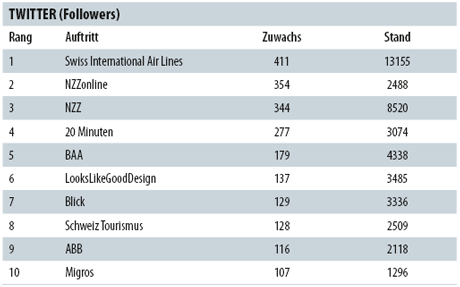
Topics relating to the professional use of social media are omnipresent. Much is new, and proven recipes for success are in short supply. This is why Werbewoche is publishing a series of mini case studies to provide insights into the daily work with social media channels and thus contrast the pure numerical statistics relating to fans and followers.
The article in this issue marks the start of the social media portrait series.


Printing center in Oetwil has had its day

The printing presses in Oetwil am See, ZH, have been idle since early Thursday morning. After the last newspapers published by Zürcher Oberland Medien were printed, the plant was shut down.

The Zürcher Oberländer, the Anzeiger von Uster, and the weekly newspaper Regio.ch are now printed at the Tamedia printing center in Bubenberg, Zurich. The same applies to the Zürichsee-Zeitung and the Zürcher Unterländer. The relocation of the printing facility took place in stages.

The Bubenberg printing center prints, among others, the *Tages-Anzeiger*, *20 Minuten*, the *Sonntagszeitung*, *Finanz und Wirtschaft*, the *Landbote*, the *Tagblatt der Stadt Zürich*, and *Migros-Magazin*. The printing capacity is more than sufficient to handle the additional regional newspapers, said Christoph Zimmer, Tamedia’s media spokesperson, in response to a query from the SDA news agency. Only minor investments were required to make adjustments to the post-press process.

Tamedia had the Closure of the DZO This was already announced last October. At the time, the move was justified by the generally significant overcapacity in newspaper printing throughout Switzerland. This overcapacity is particularly pronounced in the Zurich area, said the Tamedia spokesperson. Operating two printing centers in such a small area therefore does not make economic sense.

In addition, production at the Bubenberg printing center can be carried out more cost-effectively than before. Printing costs there are down by a double-digit percentage, as Zimmer explained. For daily newspapers, which are under pressure due to a decline in advertising revenue, this is a significant contribution to profitability.

Only three printing centers left
The closure of the printing center is part of a long-term printing strategy by Tamedia and the French-Swiss media company Edipress, which will be fully integrated into the Zurich-based media company in 2013. Newspaper printing will be concentrated at the three printing centers in Zurich, Bern, and Bussigny in order to produce as close to customers as possible and keep transportation distances short. Soon, some of the printing presses from Oetwil am See will also be located in Bussigny. The goal is to upgrade and modernize the printing center in French-speaking Switzerland, Zimmer said. As recently as 2005, DZO had invested around 30 million francs in a new printing press.

The closure of the DZO affects 96 employees. Of these, 16 took early retirement, and 18 were offered positions at the Bubenberg printing center. It remains to be seen what will happen to the production facilities in Oetwil am See. Negotiations with specific interested parties are not currently underway, Zimmer said. However, Zimmer added that there is still time, as dismantling the printing presses will take several months.
 

"We have a new cooperation with almost all newspapers"

Hanspeter Rohner, President and CEO of PubliGroupe, explains in an interview with *Werbewoche* how far the new business model has progressed.

p

Two years ago, PubliGroupe CEO Hanspeter Rohner announced a new Publicitas business model with the following key points: 1. Publicitas (P) charges cost-covering prices for (small) advertisements. 2) P offers services "à la carte", publishers choose what they want. 3) P stops universal placement: publishers only receive from P what they pay it a commission for. 4) P sets up a digital settlement platform.

WW: Mr. Rohner, how much of the announced business model have you been able to implement to date?
Hanspeter Rohner: The targets we had set ourselves in this regard for 2010 have all been achieved. Around 95 percent of the plan has now been implemented. What the new Publicitas crew under CEO Beat Roeschlin has achieved since May 1, 2010 is impressive: it was able to conclude cooperation agreements with all major publishers on the new commercial basis.

What exactly has changed?
There have been fundamental changes. The main point is a new pricing model. Our commission now consists of a so-called base amount per advertisement, plus, as before, a volume- or turnover-dependent share. The base amount is, for example, 60 francs per advertisement - regardless of its size - which is of course a huge amount for a small advertisement of 200 francs, but almost nothing for an advertisement of 10,000 francs. In short: from the publishers' point of view, small advertisements have become massively more expensive in percentage terms, while large advertisements have become cheaper. Previously we had the same or similar commission rates for both types of advertisement, but now they are far apart.

How do you justify this basic amount?
With our business realities. If a professional advertiser in Sion provides us with a ready-made PDF for a full-page advertisement in the NZZ that we can send with a click, we actually have less to do than if a private individual comes to us with a hand-knitted small advertisement for the Tages-Anzeiger, which we may still have to translate and layout.

Do the small ads now cover your costs more than before?
They are now just as attractive as other advertisements across the entire P-Net, across all titles and media categories - newspapers, magazines, online. This was not the case before.

Do all publishers in Switzerland pay a uniform basic amount?
We use the same calculation principles everywhere (including a transaction fee), but then of course apply these to the individual negotiation situation. Depending on the order volume, sales mix of advertising types, etc., our offer differs from publisher to publisher. We also calculate on this basis for the still numerous directing contracts.

What does this mean for local newspapers, for example, where a single-column small ad might only cost 50 francs?
In individual cases, our commission is actually higher than the insertion price. We no longer do it for less. However, as local papers only have relatively few small ads, this is not a significant factor for us. More important to us are the 20 or so large daily newspapers, which absorb around 95 percent of the small ads market.

Meanwhile, is the modular service offering for publishers also in place?
Yes, we still have an umbrella agreement with the large publishing houses, but at the same time we have specific contracts with their individual titles with an emphasis on job advertisements and local or national advertisements. Generally speaking, the big publishers want to work with the big advertisers and agencies themselves. In the classified section, however, they have realized that the higher P-commission for the small ad from Sion is still cheaper than doing the work themselves. That's how we found each other again.

Are there publishers who do without advertisements via P altogether?
Not in the area of relevant media. But some trade journals actually no longer wanted to work with us.

And if a customer still wants to advertise in such a title?
Then our employee calls the title and says that we will process the order for a certain commission. If they refuse, we cannot process the order.

So universal mediation is dead?
In principle, yes, but it is pleasing that we have a new cooperation with almost all newspapers. In contrast, things look very different for some of the trade journals.

More and more publishers are offering advertising placement services for third-party publishers, such as Tamedia, Basler Zeitung Medien or AZ Medien. Can you feel this in the market?
In individual cases, it has happened that a publisher who found the P-offer too expensive then approached large publishers with their own marketing organization. It is also possible that their offers are cheaper than ours. However, a small publisher must then ask himself how this is possible and whether the big publisher is simply trying to make him dependent. With P, he knows where he stands and that we are not interested in buying up his title.

No more...
(smiles) We have never bought up titles...

Let's move on to the digital settlement platforms: What is the status here?
Of the 1.5 million advertising transactions that went through P in 2010, we processed 70 percent digitally via the myPublicitas, PrintOnline and Publisherconnect channels. In the meantime, we have invested a lot of money in developing another platform for much larger volumes, which is now ready for operation. It would also be able to handle the proprietary volumes of large publishers. As Tamedia also needs a processing platform, we offered to let their volumes run through our platform as well - in order to utilize it more, but above all to implement an industry solution. Of course, it makes a difference whether 95 percent or only 60 percent of the Swiss print volume is processed via the platform. Discussions are now underway.

Would you set up a joint company with Tamedia for this purpose?
No, we would do this as a service provider for Tamedia.

Which means that you have won back the largest independent publisher as a customer.
We have that anyway, the cooperation agreement is in place. But we can also handle the entire volume of advertisements for you.

And you would have tied Tamedia back to you through the back door.
(laughs) Such an agreement only comes about if it is profitable for both parties.

What's next? Publicitas now has 600 employees and 25 fewer branches than three years ago. The more you cut back, the less you can serve the market and the more publishers ask themselves why they should work with P at all.

We still have 65 branches and are still present in all cantons. However, the online platforms are now the largest P branch, so to speak, and the trend is increasing. At the moment, we are very happy with this solution. In the medium to long term, I could theoretically see us further reducing the number of our own branches, but at the same time massively increasing the number of drop-off points/entry points - for example in drugstores or post offices. In Ticino, a trial is underway with Swiss Post.

Where will P position itself in the value chain between clients, agencies and media providers in the future?
There are no longer any reserved places along the entire value chain. This applies to us as well as to the media and advertising agencies and also to the clients. Take Migros: it is one of the five largest media companies in the country and at the same time a very large client. With e-commerce and online platforms, the roles are shifting more and more. It is possible that Migros will suddenly have completely new needs that no one is meeting yet. The question then arises as to who will be the first to do it. This requires creativity. We have the ambition to be at the forefront.

How does the new business model change Publimedia's relationship with agencies and clients?
We will offer our major clients the full range of services, in particular all digital-oriented services. This expanded range of Publimedia services is intended to strengthen our market position and also bring economic benefits to clients and agencies that cooperate with us extensively.

When does this apply?
This is the Publimedia philosophy that is now being implemented and will be an important part of our new service concept. Our partners will soon be informed about the strategic reorientation.

Interview: Markus Knöpfli

get_footer();