Maxomedia: Microsite for new cloud from Swisscom

With Mycloud, Swisscom has created an online storage solution for private customers. Maxomedia designed and realized the independent microsite, which provides information about the new Swisscom service, in just one month.

With Swisscom's Mycloud solution, customers have their digital life with them wherever they go: data is automatically and securely stored on Swiss servers, where it can be easily organized and managed via a web application or smartphone app. Users also have the option of sharing their experiences digitally.

1_mxm_Swisscom_myCloud_Header

Maxomedia presents on the microsite Welcome.mycloud.ch focuses on the benefits of the service for end customers and uses a user story to illustrate the product benefits. The dynamic introduction with the Swiss mountain massif is intended to emphasize the Swissness of the service as well as the unlimited freedom and security of the unlimited and free storage solution, according to the press release. A group of four protagonists then guide the viewer through the modular story: photos, videos and documents are safely stored on Swisscom's servers in the heart of Switzerland, and uploading and organization is quick and easy.

2_mxm_Swisscom_myCloud_Slider

Animations and video streaming are intended to strikingly illustrate the advantages of Mycloud and emotionally involve the viewer, whereby the image and video material was produced especially for the microsite in collaboration with Swisscom. The resulting digital storytelling of the microsite provides comprehensive information about the product and the service can be experienced by the user.

3_mxm_Swisscom_myCloud_Slider
4_mxm_Swisscom_myCloud_Slider

Responsible at Swisscom: Cédric Marville (Senior Communication Specialist). Responsible at Maxomedia: Bernhard Herzig (overall responsibility), Mike Keller (consulting), Frank Salathé (conceptual and technical management), Philipp Gfeller and Stefan Schärmeli (technical implementation), Diego Martinez (art direction/concept), Antonia Bekiaris and Anouk Karrer (text/concept), Stefan Cecere (concept and design).
 

Last but not least: On your mark, get set, hop

The Media Markt bunnies are on the run again. This year, a Swiss representative will also be competing.

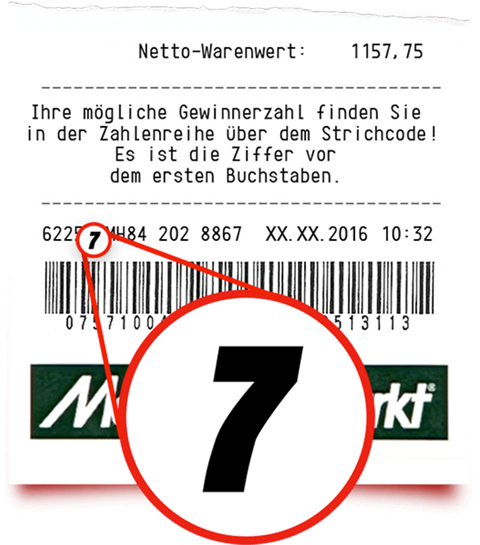
Last year, the Easter Bunny campaign caused a sensation far beyond Germany's borders, earning Ogilvy silver and bronze at Cannes. The bunny race was broadcast on major German private stations in 2015 and mobilized a total of 22 milllion viewers, according to W&V. Those who had the winner's number on their receipt received half of the purchase amount back. Unsurprisingly, the electronics retailer is now breathing new life into one of its most successful campaigns.

Unbenannt-18_41

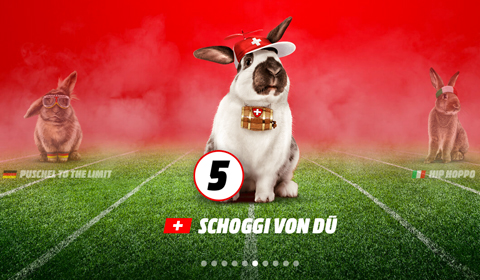
With Zum roten Hirschen not only the responsible lead agency has changed - the 2016 edition also brings with it a few changes. The most interesting one is that the campaign is no longer limited to Germany, but now covers the entire DACH region. In other words, Switzerland can not only watch from afar, but also participate. In addition to the Swiss-German advertising windows, the 15 broadcasting stations also include La Télé, Léman Bleu and Tele Ticino. But that's not enough luck: Switzerland even gets its own bunny, "Schoggi von Dü". Someone who rescued three Berhardins from the avalanche can't be a bad runner.

Bildschirmfoto-2016-03-21-um-14.12.51

https://www.youtube.com/watch?v=cRaU9oJypk4

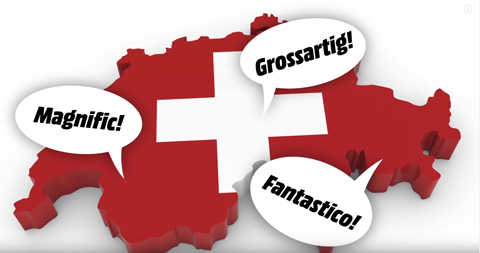
Almost hit: Ticino. Fantastico! Or was the Bergell meant?

Bildschirmfoto-2016-03-21-um-14.51.46

In the European Championship year, the nations compete in the Euro Easter Bunny race and even Austria has qualified with Löffeler Tony - this time without any Swiss help at all.

https://www.youtube.com/watch?v=ZSl8QpPEYu4

By the way, from an animal welfare point of view, there's little to worry about with the main characters. To take the wind out of the sails of potential critics, Media Markt is making the info video available right in advance this year - and not, as in 2015, only as a reaction to criticism that has arisen. The topic (and the video) can also help to clarify the situation: in Switzerland and Austria, for example, keeping animals individually is prohibited by law, but in Germany (amazingly enough!) it is not. A little more DACH would also be desirable in this question.    

https://www.youtube.com/watch?v=N8SgYsV1IFQ

Incidentally, the campaign has been given a fitting face in soccer coach Ralph Hasenhüttl. Not only does he bring the ideal name to the table, but he is also the coach of FC Ingolstadt - the Bundesliga club that Media Markt has been supporting as a shirt sponsor since this season. (hae)

https://www.youtube.com/watch?v=4UROXm6iQ0k

On March 23, 24 and 26, 2016, the Euro Easter Bunny race in Switzerland will be broadcast live and simultaneously at 20h12 by 15 TV channels - RTL, SUPER RTL, RTL NITRO, RTL 2, VOX, N-TV, Sat.1, ProSieben, Puls4, Kabel Eins, Sixx, ORF 1, La télé, Léman Bleu and Tele Ticino - as well as on the Internet, including on Easter fun.mediamarkt.ch and Youtube, broadcast

Maz with successful business year thanks to communication courses

Last year, for the first time, the Swiss journalism school Maz generated more revenue in its communications department than in its journalism department. Journalists still make up the majority of participants.

They make up around two thirds of course participants, as can be seen from the Maz annual report published on Monday. A third of the course days are booked by communication specialists. Maz offers study courses, further training, compact courses and seminars, for example. The profit of 40,000 francs in 2015 was achieved thanks to increasing demand for the courses on offer. Turnover rose by 6 percent compared to the previous year to 4.75 million francs. Costs remained stable. Turnover in the Journalism department fell by 5 percent. One reason for this was the photography course, which was completed in spring 2015 and will not be resumed until 2016.

High demand for online courses

In contrast, the Maz achieved strong sales growth in the Communication division. "The online communication services in particular enjoyed great popularity," said CFO Sonja Döbeli Stirnemann. Maz continues to finance over 80 percent of its operations on the open market, with the remaining money coming from donors, cantons, the federal government and sponsors. The only downer last year was the poor performance of the financial investments. The plunge on the stock markets meant a loss of around CHF 75,000 for the Maz. 2015 also marked the end of an era for the Swiss School of Journalism: Iwan Rickenbacher stepped down as President. With Res Strahle, the institution is now presided over by a journalist for the first time. (SDA)

Futurecom: New online presence for IAB Switzerland

Futurecom created a mobile-friendly website using WordPress for IAB Switzerland, the association representing the digital advertising industry.

The goal of IAB Switzerland is to promote and further develop interactive and digital forms of advertising. A contemporary web presence is not only a central communication tool for the IAB, but also a proof of competence, according to a statement. Futurecom has therefore IAB website underwent a fundamental relaunch. The focus was on mobile suitability and more efficient management of the extensive information offered by the IAB office. Based on WordPress as content management system and a responsive web design, Futurecom developed a functional website with a contemporary aesthetic. Special attention was paid to the presentation of the further education offer "IAB Academy" as well as the numerous professional events.

IAB-Switzerland-Website-Screenshot-2016-03-18

Responsible at IAB Switzerland: Roger Baur (client), Marina Domazet (project management, content). Responsible at Futurecom (Member of Y&R Group Switzerland): Louise Zöckler (Art Direction), Alexandra Wegener (Screen Design), Lisa Lonoce & Charlotte Petri (Project Management), Martin Sauter (Consulting), Robert Seidl (Programming).
 

FCB Zurich/IPG: New Zurich car campaign

FCB Zurich implemented a launch campaign for Zurich Insurance's new auto insurance product.

Zurich is launching a completely new car insurance policy on the Swiss market. It abolishes the premium level system. This offers drivers the great advantage that the premium is not automatically increased in the event of a claim. In addition, accident-free driving is rewarded with a reduction in the deductible after three and six years.

Knitted_Car_TVC

FCB Zurich is responsible for the cross-media launch campaign. The key visual makes people smile: a car protected by an oversized blue bobble hat. It conveys the message in TV commercials, online banners and on the zurich.ch/auto microsite: If you really love your car, take out Zurich's new car insurance. Accompanying radio spots are used, at train stations there is a prize for guessing how many balls of wool were needed for the car cap, and Zurich customers are also made aware of the new offer with a direct mail. The launch campaign is also making a stop on social media channels, where knitting grandmothers are the stars of a short documentary.

https://www.youtube.com/watch?v=1mgab-ZoypE

https://www.youtube.com/watch?v=oq2FwK1FTGU

Responsible at Zurich Insurance: Priska Kaspar, Philipp von Schulthess, Petra Mosberger, Gian Gartmann, Marie-Sophie Teyssier, Tania Moghrabi Cook. Responsible at FCB Zurich: Dennis Lück (CCO), Flavio Meroni (CD) Nemi Gajic, Kelsang Gope (text), Fabian Rietmann (art direction), Carmen Köll, Stephanie Schmutterer (consulting). Photo: Nick Meek . TV: Fish Film Productions (David de la Flor). Media: UM Media (Martin Osen, Cici Steinmetz).
 

"The Teachers": B&B Endemol Shine produces new Swiss sitcom

«Die Lehrer» is the new Swiss comedy sitcom. Starting in late fall 2016, it will air exclusively on Myprime, UPC Cablecom's streaming platform, and is also scheduled to air later on a Swiss free-to-air TV channel.

B&B Endemol Shine is producing the eight episodes from July 2016 on behalf of UPC Cablecom. The script was written by the two 34-year-old Zurich natives Adrian Aeschbacher and Eric Andreae, who are also directing.

Die-Lehrer_1
The two authors and directors Eric Andreae (left) and Adrian Aeschbacher (right); Photos: Lea Becker

You remember that moment in your school days when you first met a very special kind of person: the teacher. An incisive as well as formative experience. All the more so because this teacher had a legendary place of retreat where you were never allowed to go as a student: The teachers' room.

Unbenannt-1_114

The eight-part sitcom "Die Lehrer" (The Teachers) finally reveals the secrets of the teachers' lounge and shows what goes on there. The focus is on the everyday absurdities of the teaching profession: Why is the coffee machine broken again? Who distributes exam solutions on the Internet? And why do two teachers often disappear together in the cleaning room? "The Teachers" provides answers in a witty and entertaining way and gives an insight into the life of this very special breed of human being.

Die-Lehrer_2
Shooting in the teacher's room

B&B Endemol Shine is producing the series. For the first time since the huge success of SRF's school soap Best Friends, Switzerland's biggest production company is back in the fictional business. "Fictional programming is a discipline all its own and is particularly fun," says producer Pea Weber. "It's super to be active in this area again after Best Friends - the fact that UPC Cablecom has awarded us the contract makes us very happy."

Die-Lehrer_3
Eric Andreae directing

Adrian Aeschbacher and Eric Andreae from Zurich are responsible for the scripts and the direction. The two series fans got the idea from their private environment, of all things. "We have friends in common who are teachers and have been telling us amusing anecdotes from their everyday working lives for years," says Adrian Aeschbacher. "Teachers, after all, are in a peculiar dilemma. Society expects them to be role models. At the same time, they are also very normal people with weaknesses and vices. There's a lot of comedy in this contrast," adds Andreae. In short, the subject matter of "The Teachers" is a perennial favorite. School and education leave no one cold. And where there's a lot at stake, there's also a great dramaturgical fall. Perfect conditions for a modern and humorous series.

Die-Lehrer_4
Adrian Aeschbacher directing in the classroom

Unbenannt-2_132
 

Xerox study: companies will be largely paperless in 2018

A Xerox study predicts that by 2018, paper will have largely become obsolete in 90 percent of companies. The fully digital company is on the horizon—but there is still a long way to go.

Today, data is already the lifeblood and backbone of most companies. The art lies in the analysis: enormous amounts of data need to be interpreted so that they can provide important insights and findings. This is no easy task - as shown by a recent study by Xerox, which was conducted among a total of 600 IT decision-makers in large European and North American companies. The "Digitization at Work" report from Xerox shows that the switch from paper to digital information is just around the corner - but many of those affected are still far from ready. Paper-based processes are time-consuming. Above all, costs and security are major concerns for 42 percent of those surveyed. According to the study participants, only around nine percent of important processes will be carried out using paper in the next two years.

However, 55% also admit that paper still dominates in their companies at the moment. At 29 percent, almost a third rely on paper-based media instead of email or social media for customer communication. This is despite the fact that 41% agree that digital workflows would be much more cost-effective - and 87% have the necessary skills and resources.

"Companies certainly have an idea of the lean, agile digital enterprise - but in reality, this is still largely a dream of the future. There is undoubtedly a significant gap between aspiration and reality, mainly because the key steps are simply not being taken yet," explains Andy Jones, Vice President, Workflow Automation, Large Enterprise Operations at Xerox.

Automation comes first

With regard to process automation, almost three quarters have already looked at possible areas of application in their company. These primarily include accounting (38 percent), cost accounting (37 percent), accounts payable (36 percent) and customer care (35 percent).

However, the survey also shows that some basic requirements still need to be met in order for digital workflows and a corresponding degree of automation to become a reality in key areas of the business - and that this is precisely where there is still some catching up to do.

- 40 percent of respondents have not yet implemented any solutions for mobile workplaces.
- 47 percent are not yet up to speed with cloud services.
- 45 percent do not yet have the necessary tools to make reliable predictions using big data analyses.

In many cases, the digitization or redesign of paper-based processes can significantly improve the situation even before the actual automation. For example, a precise analysis of employee behaviour with regard to printing documents can provide important information on how high paper and printing costs can be reduced by digitizing certain areas. Here, 90 percent of respondents stated that they had suitable tools and methods to analyze printing behavior - however, only 45 percent actually use these tools to their full extent.

Financial sector and public sector: change takes time

The following picture emerges for selected sectors: In the financial sector, 56% of companies mainly rely on paper, for example for invoices. 17% have not yet taken any steps towards digitalization - although well over 40% are convinced that digital processes save costs and increase productivity. Nevertheless, 78% of respondents from this sector have already identified key areas for digitalization.

In the public sector, two thirds of study participants expect paper to be completely replaced by digital processes by 2018. Here too, the proportion of those who expect this to result in faster processes in particular is comparatively high at 58%. 43% of respondents consider paper-based solutions to be too expensive - and 41 also consider them to be too risky in terms of data protection. Almost two thirds have already selected the functions that would benefit most from automation.

Xerox offers Workflow Automation Services as part of its Managed Print Services. They can significantly support companies on their path to digital transformation and higher productivity. Xerox is also developing automation tools across its entire portfolio - including customer care centers, finance and accounting processes and the healthcare sector.

About the study

In the second half of 2015, Coleman Parkes Research conducted a survey of 600 IT decision-makers from various organizations in the USA, Canada and Western Europe (Benelux, France, Germany, UK). The aim of the study was to gain in-depth insights into approaches, challenges and initiatives with regard to digital transformation and paper-based processes. The respondents' areas of responsibility included their companies' digitalization strategy, solutions and infrastructure. The respondents come from the public sector, the financial services industry and from companies. The entire Xerox report on the study can be downloaded at here can be downloaded.

Leo Burnett: Colorful Easter in Sihlcity

Leo Burnett is hiding eggs for Sihlcity as part of a colorful Easter campaign.

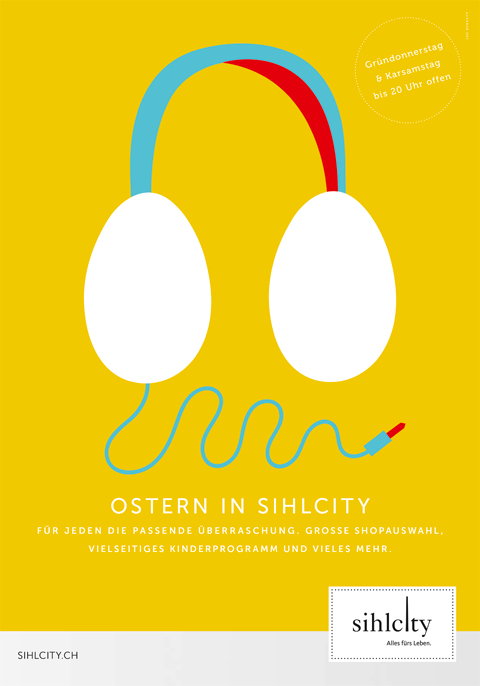
Leo Burnett dug deep into its color pots for the new Easter campaign. The result is brightly colored posters, ads, flyers, and banners for Sihlcity - all with a visual surprise.

Plakate_Sihlcity_Ostern2016_F200-1
Plakate_Sihlcity_Ostern2016_F200-2
Plakate_Sihlcity_Ostern2016_F200-3

And there's also something extra for the ears: radio spots that amaze listeners and Sihlcity customers.

Responsible at Sihlcity: Corine Maissen (Head of Marketing), Corinne Wiederkehr (Marketing Specialist). Responsible at Leo Burnett Switzerland: Barbara Hartmann, Anna Leudolph (creation), David Fischer (CD), Martin Stulz (ECD), Christoph Schwarz, Ingrid Zumkehr (consulting), Erasmo Palomba (art buying), Olimpia Zagnoli (illustrations), Hastings (audio).

Mediafisch produces new TV cooking show

In the new TV show "Beef Club" produced by Mediafisch, young chefs prove their creativity and passion.

"Beef Club" is an urban cooking show and a "fight for recognition and innovation," according to the announcement. Mediafisch offers young chefs a platform to demonstrate their skills and benefit from the feedback of the jury.

Unbenannt-5_135

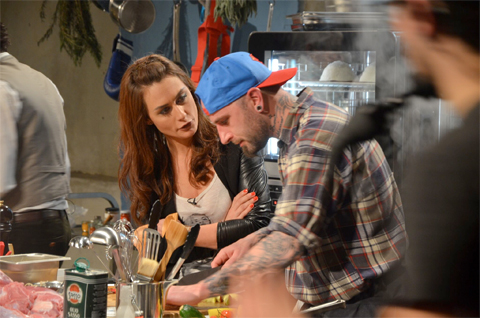
Two young chefs enter the ring per show and compete against each other. Under time pressure, they have to cook a menu based on three main ingredients and convince a jury. Celebrity chef Jacky Donatz, "Marmite" editor-in-chief Andrin Willi and food stylist Diana Krauss decide on victory and defeat.

Unbenannt-4_147

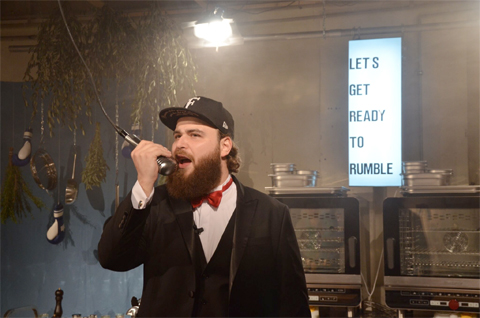
The focus is on quality products from Switzerland, expertise and innovative creations. Each round is introduced by event host Kenny Thomson. He leads through the show.

Unbenannt-7_136

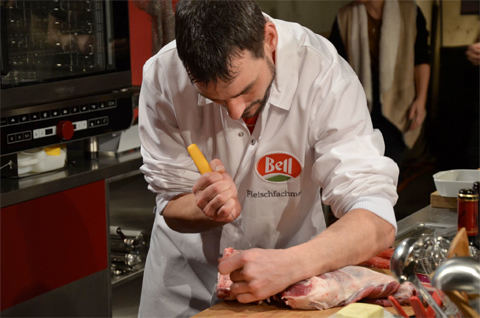
Before it's "Ready to Rumble" for the chefs, Bell meat expert Philipp End presents the meat ingredient at the beginning of the show. Bell is a sponsor of the show.

Unbenannt-6_127

The TV format is conceived and produced by the production company Mediafisch in Zurich, which was founded by Swiss TV presenter and entrepreneur Björn Hering.
The five episodes were filmed at the Giesserei Oerlikon. For this, the premises (of the foundry) were transformed into a cooking ring. Since March 17, 2016, the 14-minute show "Beef Club" has been broadcast every Thursday at 7:55 p.m. on Sat.1 Switzerland and repeated every Saturday and Monday.

Unbenannt-3_132
Unbenannt-8_103


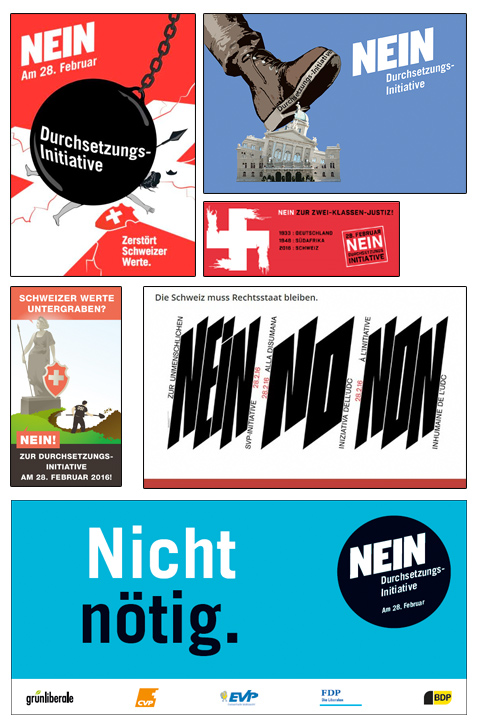
DSI opponents invested 2.8 million francs

According to Media Focus, the “No” camp spent twice as much as the initiative’s proponents on the enforcement initiative. Nevertheless, it was a relatively inexpensive campaign.

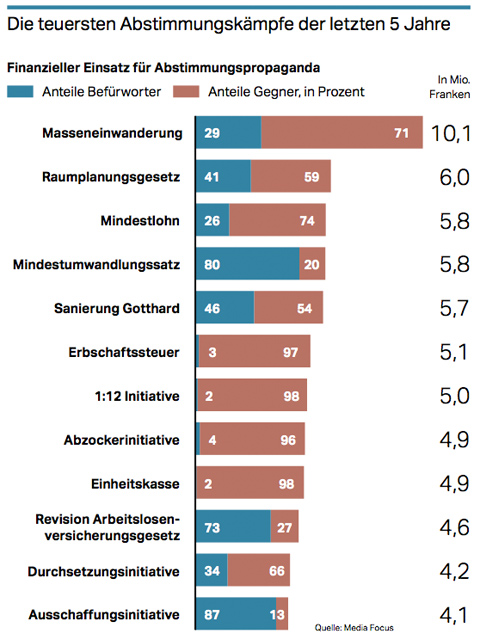
A total of 4.2 million gross advertising francs are said to have been spent on advertising in connection with the enforcement initiative (DSI), writes the Sonntagszeitung, referring to figures from Media Focus. CHF 2.8 million from the No camp, CHF 1.5 million from the supporters' coffers.

Unbenannt-15_50

This expenditure is relatively low. For example, CHF 5.7 million was spent on the Gotthard tunnel referendum, which took place at the same time. A total of CHF 10.1 million was mobilized for the mass immigration initiative - the most expensive referendum campaign of the last five years. Over 70 percent of this was spent by the opponents, who were nevertheless unable to prevent the initiative from being adopted.

Bildschirmfoto-2016-03-20-um-12.28.11
Graphic (screenshot): Sonntagszeitung / Data source: Media Focus

The overview published by the Sonntagszeitung and based on Media Focus figures shows that traditional political advertising does not seem to be enough to mobilize voters, let alone win votes. For example, the initiative to revise the Unemployment Insurance Act only attracted 35.9% of voters to the polls - even though more money was invested than in the DSI, which mobilized a sensational 63.1% of voters. In the case of other initiatives such as 1:12, inheritance tax or a single health insurance fund, the proponents achieved impressive results, although the opponents were overwhelmingly outspent. Just as important as advertising and financial resources appear to be factors such as how concerned citizens are, private commitment in everyday life and in the social media. (hae/SaS)
 

Twitter turns 10

Crisp messages in a maximum length of 140 characters, fast and authentic: Twitter's promise sounds tempting. Ten years after its founding, however, the short message service is facing major challenges.

Unbenannt-16_48

Twitter turns ten on Monday, but the short message service has little to celebrate on its first birthday. Recently, the number of active users declined slightly for the first time, the balance sheet is deeply in the red quarter after quarter, and the share price is stuck in the basement, well below the issue price of the IPO in 2013. Twitter has changed the world, creating a unique channel. "Anyone can share their ideas and information instantly and across borders," is Twitter's official motto. But building a profitable business out of it is proving extremely difficult. When Twitter was launched ten years ago, it wasn't initially about founding an online service to make money. The service came about more by accident than by chance. The small company Odeo in San Francisco actually wanted to develop an audio service for the web. During a brainstorming session, developer Jack Dorsey suggested sending short status messages to all team members via SMS so that everyone would know what the others were working on. In two weeks, a prototype emerged. "Just setting up my twttr," was the first short message from Dorsey that can still be found today, on March 21, 2006. The influential U.S. blog "TechCrunch" discovered the service three months later. Twitter then achieved its breakthrough at the SXSW Interactive tech conference in Texas in March 2007, and the company Twitter Inc. was founded a month later.
 

Twitter is always there

In the meantime, there is hardly a major event that does not take place on Twitter. The emergency ditching of the passenger plane near New York in January 2009, the huge demonstrations during the "Arab Spring" starting in 2011, the bombing of the marathon in Boston and the subsequent hunt for the perpetrators, the horror of the terrorist attacks in Paris. And these are just a few historical moments that would have been perceived differently without Twitter. But where does Twitter go from here? At some point, every company has to make money. Co-founder Jack Dorsey faces a daunting challenge in his second go-round as Twitter CEO. He has to fix the short message service - but must not upset the millions of satisfied Twitter users in the process. And certainly not the "power users" like journalists, politicians or celebrities, for many of whom Twitter has become almost vital.

Internet entrepreneur Sean Parker, who once co-founded the music exchange Napster and was involved with Facebook in its early years, sees this as a problem. The media's enthusiasm made Twitter grow quickly in the early years, he explained in Vanity Fair magazine. "But that came at a price: that users did not become a tight-knit community." Under pressure, Dorsey seems to be turning every screw he can find. Two months ago, he hinted that the 140-character limit per tweet, initially introduced because of SMS as a base, could fall (Werbewoche.ch reported). Now he said on TV that the limit will remain.

Strategy missing

In recent years, it has often seemed that Twitter's top management lacked a clear strategy. First the founders dispensed with advertising altogether so as not to scare users, then business was to be done and paid tweets and "trends" suddenly appeared in the news stream. Such advertising accounts for the bulk of Twitter's revenue. But the question is how much more of this can be expected of today's Twitterers. At the end of last year, Twitter had 305 million active users, if you exclude subscribers to an SMS service. That was two million fewer than just three months earlier. Together with the SMS service, the number stagnated at 320 million. The world's largest online network Facebook has 1.6 billion active members and is still growing fast. This is also the basis for higher advertising revenues. At the same time, Dorsey says, you actually have to add more than 500 million other users who get to see tweets - and also ads - without being logged into Twitter. (SDA)


The first tweet of the advertising week. At Discover.twitter.com/first-tweet you can get the first tweet from any user with one click.

Twitter Chronology:

- March 2006: Co-founder Jack Dorsey writes the first Twitter message that can be found today: "just setting up my twttr," he types. "just setting up my twttr".

- March 2007: Twitter's big breakthrough comes at the South by Southwest digital conference in Austin, as the digital elite discover the service.

- April 2007 The company Twitter Inc. is founded.

- October 2008: Dorsey hands over the helm to co-founder Evan Williams. Twitter has around three million users.

- April 2009: Actor Ashton Kutcher and the TV station CNN are in a race to see who can reach one million subscribers on Twitter first. Kutcher wins.

- April 2010: Twitter introduces "sponsored tweets," which can be placed in users' news streams by advertisers.

- October 2010: Dick Costolo becomes Twitter CEO.

- January 2011: Demonstrators in the Middle East use networks such as Twitter and Facebook to organize their resistance to repressive regimes. In the course of the so-called "Arab Spring," heads of state are overthrown in Tunisia, Libya and Egypt.

- September 2011: Twitter has 100 million monthly active users.

- February 2012: Twitter launches a self-service platform that allows companies to advertise.

- January 2013: Twitter launches the Vine service for short videos.

- November 2013: Twitter goes public. The initial proceeds of the IPO amount to $1.8 billion. According to the company, more than 230 million people use the service.

- March 2015: Twitter confirms purchase of live streaming provider Periscope

- April 2015: Investor disappointment with the latest quarterly figures shaves off around one fifth of the company's value in a single day. The share price has not recovered from this to date, but has only gone lower.

- July 2015: Jack Dorsey initially replaces Costolo as acting chief and takes over the job permanently in the fall.

- August 2015: Twitter shares fall below the issue price of 26 dollars at the IPO for the first time. At its peak, it once cost over 60 dollars.

- January 2016: Current figures show that the number of active users fell for the first time in the final quarter of 2015; if an SMS service is included, it stagnates. (SDA)

SSF is at the end

Sport Szene Fernsehen (SSF) ceased broadcasting on Friday and the production company responsible filed for bankruptcy. The station had been struggling with problems since its inception.

Since Friday, a still image has informed viewers that broadcasting has been "suspended until further notice." According to Schweiz am Sonntag, employees were told on Thursday that there was no money to continue operations. And customers were informed "that the marketing manufactory and all related parts of the company" had filed for insolvency.

SSF was founded in 2008 as a window program of Star TV as "Schweizer Sport Fernsehen" and got its own channel one year later. In 2012, the loss-making station was passed on to Tom Mörker by entrepreneur Peter Weigelt and investor Giorgio Behr and renamed "Sport Szene Fernsehen" (Werbewoche.ch reported). However, the concept of sports clubs paying to have their matches shown on the channel didn't work. Mid-2013 saved Webcom TV SSF before the announced Closure. The Winterthur production company is part of the Marketing Manufacture, which also organized the Afro-Pfingsten festival, for example, which will not take place in 2016.

Neither SSF Managing Director Tom Mörker nor Marketing Manufacture CEO Roger-René Müller wanted to comment on the bankruptcy to Schweiz am Sonntag. According to unconfirmed rumors, Stav Jacobi, the wealthy president of the volleyball club Volero Zurich, was interested in a takeover - but refrained from doing so after taking a closer look at the business figures. (SaS/hae)
 

get_footer();