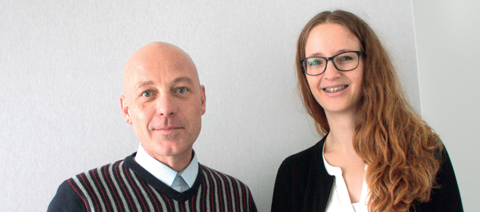
Migros Club School is expanding its practical and networked training courses in the digital field - and is thus responding to the current needs of the world of work. Switzerland's leading private educational institution offers courses and training programs that are at the cutting edge of technology and allow direct transfer into practice. It has been recognized that companies such as Airbnb in tourism or Uber in the transport industry are putting established business models under pressure due to their meteoric rise, says Ursula Brunner, Project Manager "Management & Economy" at Migros Club School. For many companies, finding new solutions and making profitable use of the rapidly developing technology is an existential question. The development of an individual's professional career is also determined by whether the employee's knowledge meets the demands of the digitalized working world.
Werbewoche: Migros Club School is offering a new range of courses. Why exactly now?
Ursula Brunner: The structural changes in various industries due to digitalization were the trigger for us to question our offering. What do we offer and how do we contribute to ensuring that professionals at Migros Club School can prepare themselves specifically for change? The digital transformation is not a temporary phenomenon. It affects society as a whole and the world of work in particular. The change is affecting entire professional areas and the requirements in the world of work are constantly changing.
The offer is called "Digital Business". What does that mean?
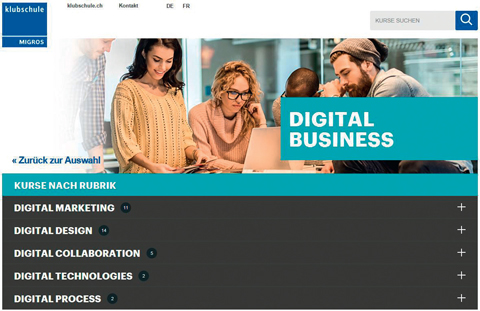
Wolf Kammerlander: Digital business is not a protected term; it can mean many things. The main point is the combination of business and technological expertise. Our aim is to give the whole thing a profile. We have organized the courses within the subject areas of Digital Marketing, Digital Design, Digital Collaboration, Digital Technologies and Digital Process. Our aim is to provide course participants with the digital training they need to be successful in their day-to-day work in the future.
Brunner: For us, the word business clearly stands for professionalism. It is about professional skills and their further development. The term digital, on the other hand, refers to all the technological developments. Digitalization leads to new opportunities and requires new skills. Professionals are increasingly confronted with new work processes. The use of new technologies must be learned.
What does the new range of services look like - what training structure will be offered?
Kammerlander: We offer a variety of new training courses in the field of digital business. The offer ranges from courses and advanced courses to shorter units and introductory courses. On the website Klubschule.ch/digitalbusiness we have clearly presented the entire range of products.
How else will the new training opportunities change?
Kammerlander: We are currently analyzing what we already offer in the area of digital business and where we can meet needs even better. This is taking place in our "Management & Business" and "IT & New Media" areas. In "IT & New Media", the expanded offerings focus primarily on technology, such as tools and applications. The "Management & Business" area covers the range of skills and processes.
Brunner: The interfaces between the "IT & New Media" and "Management & Economics" departments were actually the starting point for the whole change. These two departments are overlapping more and more. Since Wolf Kammerlander has been in charge of the web design course and I have been in charge of the online marketing course, we have become increasingly aware of this. Instead of assigning the courses at these interfaces to one of the two departments, we have created a vessel that covers these different areas of expertise.
Kammerlander: The focus is increasingly on topics such as digital marketing and design. On Club school. ch/digitalbusiness this is easily recognizable. New ideas are also constantly being added, which we are examining. However, all offers are categorized in the six subject areas already mentioned.
Where should the Digital Business range of services go in concrete terms?
Kammerlander: We are in the process of launching cross-divisional offers and adapting them to customer needs. We want to equip our customers with skills so that they are prepared for future requirements and can manage their day-to-day work. Even at home, people often use several devices, such as a smartphone and a laptop. This requires assistance with synchronization, for example. In a company, other aspects such as data security need to be taken into account.
Nationally or internationally recognized diplomas are not a priority at Migros Club School. Is this also the case with the new training program?
Brunner: In the marketing sector, many employees already have a specialist title. Digital business is about the question of how digital possibilities can be used sensibly in your own environment: What suits my strategy, my goals and my target group? For this, a degree is less important than professional practice. It is very important to us to enable our customers to apply this directly.
Kammerlander: On the one hand, we offer user courses and basic courses. But we also offer advanced courses and courses leading to the DIPLOMA qualification, which is recognized throughout Switzerland by the Migros Club School. The range is therefore relatively broad as far as the level of training is concerned. But the basic aim is for customers to acquire job-related skills that they can apply directly. Of course, graduates of an e-publishing course are not yet graphic designers, but they are able to design letterheads in accordance with graphic design standards. But even as a graphic designer, you never stop learning. The Adobe Photoshop program alone is constantly changing. Knowledge needs to be constantly developed. We are also already thinking about how we can cover the whole area of e-commerce. In the future, more and more private individuals will want to implement their own ideas as small businesses and offer their products online. In addition, there will be those who have been working in their field for some time and suddenly realize that they are confronted with new digital structures and processes. Digital business should be at the cutting edge. Our range of services is flexible and expandable. In view of our 50 locations throughout Switzerland, we will of course also tailor training courses to regional needs.
What are the advantages of such a range of training courses?
Brunner: Our lecturers are all professionals themselves and can therefore bring experience directly from the relevant industry. The fact that they receive practical know-how directly is a great benefit for our participants. In addition, there is the exchange with other professionals during the course. We are currently seeing this in the Content Marketing course, which started last fall. Our customers really appreciate this exchange - all the more so when they come from different industries and are confronted with similar problems and structures. I experience this myself in my training: it is not only the lecturers who impart knowledge, but often also the participants themselves. We will definitely continue to improve and expand the transfer of practical knowledge. This is also a personal concern of mine. Under no circumstances should we just teach theory. We want our customers to learn how to apply what they have learned directly in their day-to-day work.
Kammerlander: In future, we will definitely not only offer courses that contain between 50 and 150 lessons. The aim is to filter out fundamental digital issues in a company and address them specifically in individual courses - sometimes in shorter units. For example, we might present the specific possibilities and issues in a course without going into depth. One example of this would be the cloud. In an advanced course, we present the various options. Skills in using the tools selected can be developed in further in-depth courses depending on interest. Many people like to learn a lot. As a professional, however, you are often happy to gain new perspectives through compact further training formats ... This gives you the opportunity to decide for yourself which specialization you want to choose. This can also be done in other ways.
The digital market is flooded with tools and software offerings. Which tools does Digital Business focus on, and do you also work with agencies?
Brunner: We offer some training courses in cooperation with agencies. Our seminars on Facebook marketing are conducted by specialists from Hutter Consult GmbH. We run the Google AdWords courses in collaboration with the Webrepublic agency. For longer training courses, such as the Online Marketing Manager, where various lecturers are used, we have the quality of our training checked and certified by the industry association IAB (representative of the digital advertising industry).
Kammerlander: In addition to working with industry associations, we also have partnerships with Swisscom and Hostpoint. This allows us to exploit synergies. We also cooperate with major product manufacturers such as Adobe. Here we have good license offers for our course participants at favourable conditions. I think it is extremely important that we can also make various tools available to our customers. We are also generally open to specific tools. We don't want to reinvent the wheel, but rather follow certain trends. If many customers are interested, we are happy to take this on board. However, it is important to clearly distinguish whether a trend has a certain consistency or whether it has disappeared from the scene after a few months. Selection is not always easy. We are in a constant process of development with our Digital Business range and I am excited to see how things will continue.
Interview: Ursina Maurer
Taking advantage of new job opportunities
Since last fall, the Migros Club School has been offering two new courses. The content marketing course enables participants to develop new communication strategies as a supplement or further development of traditional advertising measures. Even companies with smaller budgets can advertise successfully if these strategies are implemented consistently. The "Desktop Publisher with DIPLOMA" course not only teaches in-depth specialist knowledge in graphic design, but also how to use the necessary computer programs Adobe Photoshop, In-Design and Illustrator. The two courses are examples of how skills for digitized work can be acquired through practice-oriented learning. Other courses also provide implementation-oriented specialist knowledge in web design, AdWords campaigns, search engine optimization and working in the cloud. The klubschule.ch/digitalbusiness website offers guidance. Organized by category and learning content, you can find the right training course from the Digital Business overview. The courses are divided into Digital Marketing, Digital Design, Digital Collaboration, Digital Technologies and Digital Process.