Fumetto with new Head of Communication & Fundraising

The board of the Fumetto association has appointed Geesa Marie Tuch as its new Director of Communications & Fundraising. She succeeds Andrea Leardi.

Geesa Marie Tuch will take up the position on April 1, 2016 and will assume all of Leardi's duties following this year's festival. The 37-year-old Geesa Marie Tuch studied journalism and communication science in Berlin and was responsible for public relations at the Cinema CH network, among other things. She organized various cultural festivals as a sideline, such as in Zurich in 2015  

Last but not least: Alien cow

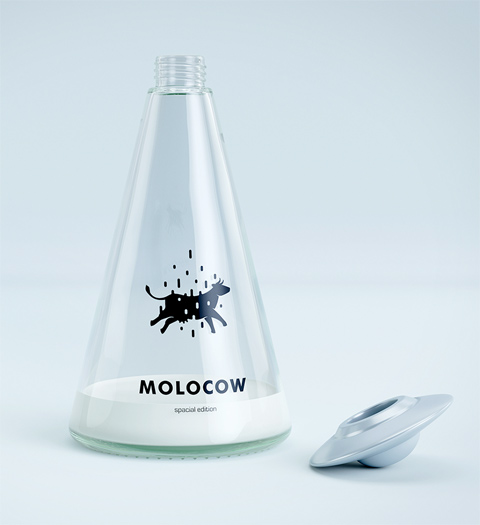
An agency from Kyrgyzstan shows how milk can be packaged ingeniously. Without any Tetra Pak or sloppy bag.

In 1896 and 1897, a veritable UFO hysteria took place in the USA: Numerous witnesses reported sightings of a mysterious "phantom airship" in various states. In April 1897, airship fever reached its peak with the report of a Kansas farmer: Alexander Hamilton claimed that the mysterious airship had abducted one of his cows. Although Hamilton's account was debunked as pure fabrication by a witness in 1976, the image of the alien cow abduction persists in people's minds to this day. Perhaps people just like it too much. The agency I-Media from Kyrgyzstan for sure. Because it brings back the legend of the "sucked up" cow with the packaging design concept "Molocow" worth seeing. Even lactose-intolerant people probably wouldn't be able to resist this piece of jewelry in the store... (hae)

Unbenannt-1_117
Unbenannt-2_136
Unbenannt-2_137
Unbenannt-2_138
Unbenannt-3_134

Case Study: "My Coke Music Soundcheck

In collaboration with the agency Mediacom, Stailamedia conducted a campaign for its client Coca-Cola Switzerland that was run as an A/B test. This resulted in a case study.

The aim of the online campaign was to raise awareness of the "My Coke Music Soundcheck 2015" project among the relevant target group of music-savvy young people in Switzerland.

stailamedia_teaser

For the test, Stailamedia's semantic targeting technology was used to avoid wastage simultaneously via a socio-demographic as well as via an interest targeting "people with music affinity" generated individually for the campaign.

stailamedia0

On behalf of the client, the ROI for the investment in individual interest targeting was to be validated. For this purpose, two target group segments were exposed to the same advertising pressure. The same parameters were used in each case, such as frequency capping or the same creatives. For both user groups, the engagement rate was measured and the resulting cost per engagement (CPE) was determined.

stailamedia

The engagement rate for users from the target group segment "people with an affinity for music" was 36.5 percent higher on average than for users from the comparison group. The CPE was reduced by around 17.8 percent through the use of targeting.

Interest Targeting

The usage behavior of over 30 million unique clients with an average of 20 contacts per month is continuously recorded and evaluated on the Stailamedia Data Exchange - Using the data pool of over 100'000 websites on the Stailamedia Data Exchange, a group of users is identified who optimally reflect the desired affinity (in this case "people with an affinity for music"). These represent the core target group. For all other users, an affinity score can be calculated, which indicates how similar the user's usage behavior is compared to the core target group. Depending on the affinity score, the accuracy of the interest targeting can be adjusted.
 

The British newspaper market is on the move

The media market in the United Kingdom is in flux. After 30 years, the final print edition of *The Independent* was published on Saturday. Elsewhere in London, however, people believe in the future of print and are launching a new newspaper.

"Conservatives try to halt sterling's slide": The first headline of the British Independent, from October 7, 1986, would not surprise anyone today either. Except that Margaret Thatcher had to deal with it then, and David Cameron has to deal with it now. Almost 30 years later, this Saturday marks the end of the print edition: The Independent, which can be politically classified as center-left, is going completely online. For owner Evgeny Lebedev, the matter is clear. "We had a choice: manage the ongoing decline of the print edition or transform the digital foundation we have built into a sustainable, profitable future." The daily newspaper and the Sunday edition are therefore going online, and he is selling the "i" offshoot.

The Independent was not alone in the decline of print editions. Generally speaking, the circulation of national British newspapers has fallen over the past few years, while the number of users of online portals has risen. "You can't just say that newspapers are dying, it's a change in user behavior," says a spokeswoman for the Audit Bureau of Circulation (ABC), which monitors circulation figures. Media are still testing how they can make money online. Paywalls have been around longer and more widely in the UK than on the continent, for example. This applies to everything from the tabloid The Sun to the Financial Times.

Money for good content

"I don't understand how magazines can function in a world where you don't have to pay for content," says Zanny Minton Beddoes, editor-in-chief of the weekly Economist. And adds: "But the content has to be good enough." Even though the weekly magazine will remain the heart of the Ecomonist brand "for the foreseeable future", Minton Beddoes is focusing on social media and the website. "In a time of digital upheaval, we can't assume that people will only want to read us weekly." She does not want to say whether and when print will be completely replaced by digital. The number of print subscriptions is falling and the number of online subscriptions is rising. "But we still have many subscribers who receive a printed edition, and I expect that to continue."

The Independent takes a different view. "The readers made the decision for us," says Christian Broughton, Editor-in-Chief of the online Independent, in the "Mediafocus" podcast. Only one percent of readership still came from the print edition and the website has been profitable for three years.

New newspaper without website

Into this atmosphere, a new newspaper is causing a stir - one that doesn't even have a website. The New Day is the first independent, nationally published daily newspaper since the Independent launched in 1986, boasts the publisher Trinity Mirror, which produces politically left-wing tabloid journalism with the Mirror. The new paper is aimed primarily at women and is said to be "optimistic" and politically neutral. The decision to launch New Day was made out of necessity, editor-in-chief Alison Phillips tells the Guardian. In order to win back Mirror readers, the newspaper would have had to be turned upside down. A new paper seemed easier. However, New Day did not get off to a particularly successful start. Despite an introductory price of 25 pence, sales figures did not climb to the hoped-for 200,000. They are currently said to be around 90,000. Editor-in-chief Phillips nevertheless believes in the future of print, as she says. People who look at the screen too much have a guilty conscience. "It's completely different with print. People still associate it with being something good." (SDA)

Von Engsberg supports charity project

Summits 4 Hope and EMC Computer Systems AG are using their team’s participation in the Zurich Marathon to encourage donations for clean drinking water in Africa. Von Engsberg is supporting the aid organization.

The PR agency supports Summits 4 Hope with press and public relations. Summits 4 Hope is a project of Gilbert Fisch. Within the framework of extraordinary fundraising events, he collects money for people in need, especially for children. On April 24, 2016, 12 teams with 48 runners will run in the Zurich Marathon to raise funds for clean drinking water in Africa. The participants will go to the start with a yellow water canister on their backs and thus draw attention to the global water crisis.

This project is supported by a celebrity team. All the money raised will go to the charitable organization Charity Water. The proceeds will be used to build at least one new well with clean drinking water in Africa. "Millions of girls and women still travel many kilometers every day to fetch water from distant wells and puddles. Canister after canister, they haul the water in," says Fisch.

Summits4Hope

For von Engsberg, the project is a matter of the heart. "Gilbert Fisch convinced us immediately with his commitment," says Roman Buff, event manager at von Engsberg. "Donors are becoming increasingly critical. People want to know what happens with their money. With Gilbert Fisch's projects, we know exactly where the money is going." Fisch still has a lot in store for the next few years. "We are fortunate to have the support of Engsberg. From this, we hope to further increase the proceeds of donations to be able to help even more people."
 

Ruf Lanz: Hiltl Sihlpost makes its mark

Ruf Lanz supported the opening of the new Hiltl restaurant at the Sihlpost with a launch campaign.

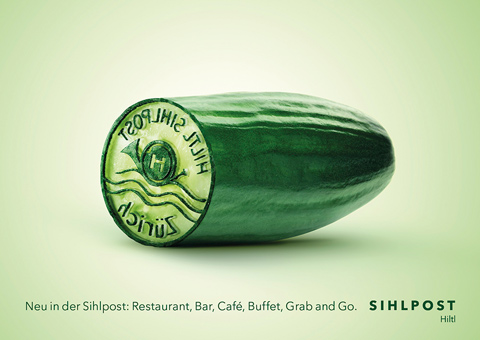
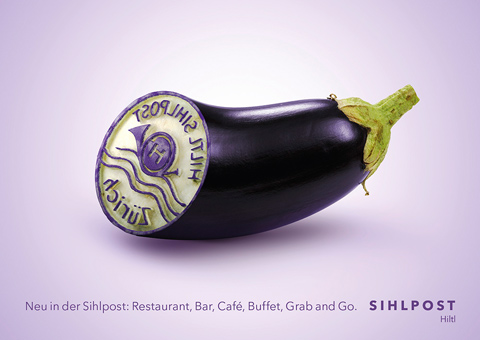
According to Guinness World Records, Hiltl in Zurich is the oldest vegetarian company in the world. It was founded in 1898 by Ambrosius Hiltl and is now run by Rolf Hiltl in the fourth generation. In March, Hiltl opened its latest restaurant in the time-honored Sihlpost building near Zurich's main train station: with a bar, café, buffet and "Grab and Go". Ruf Lanz put its creative stamp on the launch campaign, in keeping with Hiltl and the unique location in the Sihlpost. The creative agency has been responsible for Hiltl's multiple award-winning campaigns since 2006. In March 2016, the Art Directors Club Switzerland presented Hiltl and Ruf Lanz with the Evergreen Award for ten years of creativity and continuity.

Hiltl_Sihlpost_Kartoffel
Hiltl_Sihlpost_Gurke
Hiltl_Sihlpost_Aubergine

Responsible at Hiltl: Rolf Hiltl (overall responsibility). Marsha Lehmann, Amber Turgeman (project management). Responsible at Ruf Lanz: Markus Ruf, Danielle Lanz (Creative Direction), Isabelle Hauser, Grit Wolany (Art Direction), Florian Birkner (Text), Laura Hofer (Graphics), Pascal Trütsch (Consulting). CGI: Tobias Stierli, Simone Vogel.

Management duo of SRG Deutschschweiz is complete

On March 23, 2016, the Regional Council confirmed the current Vice President Niggi Ullrich in office.

After the Regional Council elected Andreas Schefer as the new President of SRG Deutschschweiz in September 2015, it now caught up with the election of the Vice Presidency for the 2016 to 2019 term of office at its spring meeting. The body confirmed the previous Vice President Niggi Ullrich in office, who has held this position since 2010. This writes SRG Deutschschweiz in a statement.

niggli

Until his resignation in 2014, the trained director was cultural commissioner of the canton of Basel-Landschaft and lecturer at the University of Basel. Since the beginning of 2016, he has been president of the Swiss professional association for theater professionals ACT and a member of the board of trustees of the international Fondation Rhénane pour la culture transfontarlière. The 64-year-old cultural worker has been president of SRG Region Basel since 1997. In this function, Niggi Ullrich heads one of the seven member companies of SRG.D and is particularly committed to Basel as a media location. Within SRG.D, he represents his company on the Regional Council and the Regional Board. In SRG SSR, he is a member of the Assembly of Delegates.
 

The Swiss film producer Christian Davi is dead

Producer and filmmaker Christian Davi passed away in Zurich on March 19, 2016, after a serious illness, shortly before his 49th birthday. The Swiss film industry has lost a passionate producer with a remarkable international filmography and career.

Throughout his life, the co-founder of the film production company Hugofilm has also worked as a networker in film policy committees on behalf of Swiss film. With Hugofilm, Davi was also specifically committed to a younger generation of Swiss filmmakers. Most recently, Hugofilm produced two internationally acclaimed Swiss film debuts, "Chrieg" (Simon Jaquemet) and "Aloys" (Tobias Nölle). With his documentaries and the films he has produced, Christian Davi leaves behind an extensive body of work that has been shown and honored at film festivals around the world. Davi, born in Zurich in 1967, studied environmental sciences at the ETH Zurich and worked as a co-author and actor in various theater groups in Zurich as well as an assistant director at the Schauspielhaus Zurich. From 1991-1996 he studied film in Lausanne and then worked as a freelance director and producer as well as a lecturer at the ECAL in Lausanne.

In 2002, Davi founded Hugofilm Productions, Zurich, together with Christof Neracher and Thomas Thümena. The first film produced by Hugofilm, "Vitus" (2006) by Fredi Murer, is still one of the most internationally successful Swiss films. "Vitus", starring Bruno Ganz as the grandfather of the highly talented pianist played by Theo Gheorghiu, won several awards. In addition, "Vitus" made it onto the shortlist of the 79th Academy Awards and was exploited in cinemas in around 40 countries. This was followed by outstanding, unconventional films such as "Pepperminta" by Pipilotti Rist, "Harry Dean Stanton: Partly Fiction" by Sophie Huber and "Lovely Louise" by Bettina Oberli.

As a director, Christian Davi has worked on the collective films "ID Swiss" (1999) and "Downtown Switzerland" (2004) and directed the documentaries "Gopf in Africa" (2001) and "Die Regierung - Montag, Dienstag, Mittwoch und zurück" (1998). He won the Swiss Film Award for the latter. In addition to his cinematic work, Davi was committed to film policy issues throughout his life. He was a member of the Swiss Film Academy, a board member of several industry associations and was repeatedly appointed to national film commissions as an expert.

As a producer, he has always been committed to supporting young talent. Thanks to his support, numerous young filmmakers have found their own independent style with great international success. (pd)

Photo: Swiss Films

Aggressive investor expands dispute with Yahoo

New York-based financial firm Starboard is stepping up its confrontation with the leadership of Internet company Yahoo. In an open letter on Thursday, Starboard called for the complete replacement of Yahoo's board of directors.

Nine new members have been proposed for the control and strategy board, including Starboard CEO Jeffrey Smith. Starboard says it holds 1.7 percent of Yahoo. The financial firm has been at loggerheads with Yahoo's management for a long time and is demanding, among other things, the replacement of group CEO Marissa Mayer. In just over three years, she has failed to get Yahoo's advertising business off the ground, while competitors such as Facebook and Google have made significant gains.

Investors are also angry about the zig-zag course in the still unfinished separation from the billion-dollar stake in Chinese online giant Alibaba. (SDA)
 

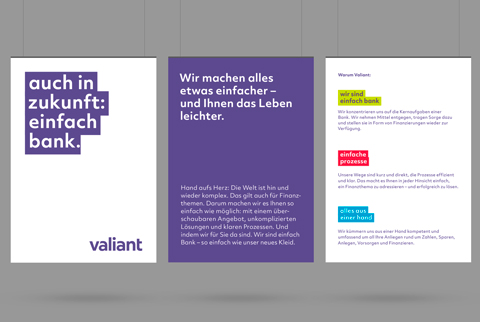
Meta Design sharpens Valiant's brand presence

Meta Design has revamped Valiant's brand identity. The new look is intended to reimagine simplicity.

Valiant is a Swiss bank with a clear focus on SME and retail business. In the course of strategy development as well as increasing digitalization, the question arose as to the future direction.

In close cooperation with the management and the board of directors, Meta Design revised the brand positioning. It focuses on Valiant making life easy for its clients in all financial matters. This includes a clear offering, uncomplicated solutions and clear processes. And excellent personal service. With the goal of living simplicity for its customers.

Valiant_MetaDesign_Logo_Alt_Neu

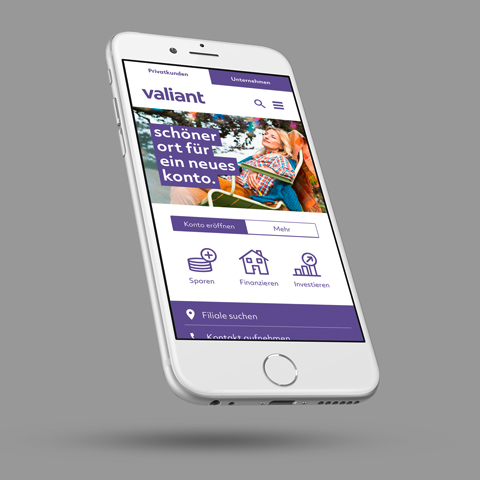
The concept is expressed in the revised brand identity: A logo with consistent lowercase letters replaces the previous, sometimes unwieldy word mark. It appears friendly and accessible - not least on digital platforms. The tried-and-tested corporate color purple is complemented by large white areas. Compressed verbal messages and simple language underscore the brand's aspirations.

Valiant_MetaDesign_Logo

Over the next weeks and months, the new appearance will be introduced step by step at employee events, in campaigns, on the web and via other applications.

Valiant_MetaDesign_Mobile_Screen

Stephan Michel, head of marketing and corporate communications at Valiant: "We are building on our strengths: simplicity and customer proximity. We were able to fully rely on Meta Design for everything - strategic positioning, creative concepts, visual identity and copywriting expertise. The team challenged and accompanied us at the same time. We are very pleased with the result and are proud to present ourselves to the market in this way.

Valiant_MetaDesign_Poster_dBotschaften

Alexander Haldemann, CEO Meta Design: "Valiant is resolutely pursuing its chosen path. The company is thus creating a unique position for itself in the Swiss market. That is impressive. We are convinced that the new appearance is the right step into the future."

Swiss: Jürg Christen appointed Head of Sales Switzerland

Initiative aims to digitally connect senior citizens

A joint initiative by the Swiss Federal Institute of Technology in Lausanne (EPFL), Pro Senectute Vaud, and the Leenaards Foundation aims to better connect seniors through digital technologies. The focus is on the design of user interfaces.

The loss of social contacts impairs physical and mental well-being. Especially in old age, many people are at risk of becoming lonely. Reasons for this include decreasing mobility, loss of sight or hearing, the death of loved ones, distance from family and friends and the inability to use new means of communication. However, an initiative by EPFL, Pro Senectute Vaud and the Leenaards Foundation aims to use precisely these new communication technologies to break the isolation of senior citizens, as EPFL announced on Tuesday. The project focuses in particular on the design of user interfaces in order to adapt them to the needs of older users.

In collaboration with senior citizens

The project began with collaboration with so-called "solidarity neighborhoods", supervised by Pro Senectute Vaud. Over several months, the scientists held workshops with senior citizens to find out how they would like to interact and which user interface and language would be suitable. As Nicolas Henchoz from EPFL explained in the press release, the enthusiasm of the senior citizens involved showed that the perceived problems with digital means of communication are mainly due to the fact that existing offers do not meet their wishes and interests.

Interactivity and user-friendliness

Among other things, the interactivity and user-friendliness of the services for older users are crucial, as initial results from the project have shown. At the same time, researchers at the Royal College of Art in London are also working with local senior citizens' associations to identify needs and additional usage options. Ultimately, the aim is to rethink user interfaces and digital services so that they fit even more seamlessly into everyday life, EPFL wrote. (SDA)


get_footer();