Part-time work: What do I need to consider?

More than half of working women and about 13 percent of men work part-time—and the trend is on the rise. But part-time work isn’t just popular among employees—it also offers advantages for employers, as it allows for more flexible use of the workforce. By Irmtraud Bräunlich Keller, lic.rer.pol., editor and labor law expert at the Beobachter Advisory Center.

Part-time work is expensive - or so you might think. This is because many personnel costs are incurred regardless of how many percentages an employee works. But this is only true at first glance. Part-time employees also offer advantages that more than compensate for the additional costs. Experience has shown that part-time workers are very productive and take fewer breaks, as they are away from their work anyway. The days off work increase motivation and creativity and reduce absenteeism. Studies have shown that part-time employees often work more than their workload allows. And with modern means of communication, the availability of part-time employees can also be organized satisfactorily.

Please note the following if you employ part-time staff:

- You are free to choose whether you want to employ your part-time staff on an hourly or monthly wage. The difference: with hourly wages, the salary paid naturally varies each month. Short absences (such as visits to the authorities, funerals) and public holidays do not have to be paid (with the exception of August 1, provided it falls on a working day). Vacation and sick leave, however, do. In this case, the exact amount of time that would have been worked must be paid.

- Working hours can be freely agreed. However, if a fixed workload has been agreed or has been established over a longer period of time, this is binding. Even hourly workers cannot simply be sent home unpaid if there is nothing to do. If the part-time employee works more than the agreed number of hours, they work overtime and must be paid accordingly (Art. 321c CO).

- In the case of irregular part-time work, vacation pay may be paid as a supplement to the hourly wage. Four weeks of vacation correspond to a wage supplement of 8.33 percent, five weeks to 10.64 percent and six weeks to 13.04 percent. The vacation pay must be shown separately both in the written contract and in each payslip. A flat-rate wage "including vacation" does not meet this requirement.

- You must register part-time employees with social insurance in the same way as other employees. Only annual salaries under CHF 2,300 can be exempted from the AHV contribution obligation. If you work less than eight hours a week, you are only insured against occupational accidents. And only employees who earn at least CHF 20,880 per year are subject to compulsory pension fund contributions.

- Part-time employees are often referred to as temporary staff. What is meant by this is not regulated by law. In the specialist literature, temporary or casual work refers to employment that only lasts for a short period of time, usually no longer than three months. In the case of such short employment relationships, there is no compulsory pension scheme and no continued payment of wages in the event of illness is owed. However, so-called temporary workers also have the same rights and obligations as other part-time employees.

Unbenannt-6_1

Do you need legal advice?
The Beobachter Advisory Center offers you and your employees expert advice by telephone on legal issues relating to your company - 6 months for only CHF 99. Order the consulting package for SMEs at www.beobachter.ch/kmu or 0800 83 0800.tel.search.chAll telephone numbers, private and business addresses with relevant detailed information such as directions, product descriptions and services, web links,
 

Steve Jobs has died

Steve Jobs died on Wednesday at the age of 56. The co-founder of the computer manufacturer Apple had been battling cancer for a long time.

On the Apple homepage, the usual colorful links to the products (Mac, iPod, iPhone, iPad) have given way to a black-and-white portrait from better times. The US President paid tribute to him as one of the greatest US inventors. The world has lost a visionary, Obama said in a statement.

Steve Jobs only stepped down as head of Apple's business in August. He could no longer fulfill his duties, Jobs wrote at the time. However, he remained with the company as head of the Supervisory Board.


Seriously ill Apple CEO Steve Jobs resigned - New CEO Tim Cook

Ringier Print: New Head of Marketing and Sales

Thomas Akermann will become the new Head of Marketing and Sales and a member of the Executive Board at Ringier Print effective November 1, 2011. Akermann succeeds Michael B. Norton.

After more than seven years at Ringier Print, Michael Norton has left the company at his own request. Ringier Print wrote this on Wednesday. Norton will bring his experience to bear in a new challenge outside the company.

Thomas Akermann has experience in the publishing and print industry. He is a qualified business economist specializing in marketing and is completing his Executive MBA this year.
 

Wetlands in the workplace

Die Werbeanstalt has revitalized Oxymount's brand messaging as a fresh water provider.

Oxymount is a leading Swiss company for the treatment of drinking water in the workplace. The advertising agency came out on top against five agencies in an agency evaluation and was awarded the contract for the communicative relaunch. From now on, the company not only shines with a new logo and a new, strategically correct claim, but also shines with an all-round new communication presence.

In keeping with the claim "No water is fresher", the word refreshment was taken literally. People are depicted in the working environment, working in water and, thanks to their freshness, have longer breath for efficient work. The pictures were photographed by Tobias Stahel and the image processing was carried out by Felix Schregenberger. The underwater world has been consistently implemented on posters, advertisements, in a company brochure, on company vehicles and soon also on the website. pan

Unbenannt-1_3

Weber expands team

Weber has hired Katharina Dunigan as the head of the communications agency, effective September 1, 2011. In this new role, she will also assist the company’s management and, in addition to her consulting and leadership responsibilities, oversee publishing projects.

As Head of Marketing, Katharina Dunigan brings a broad range of experience in service and product marketing. Her career has been shaped by major Swiss companies such as Ascom, Manor and diax (now Sunrise). She acquired her in-depth multicultural and global understanding thanks to 10 years of business management in the USA, the agency said in a press release.
 

Slogan out of its slumber

Ammarkt launches a revival of the traditional Happy brand.

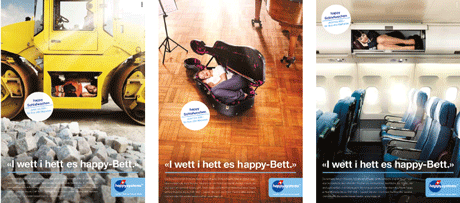
It was a classic in Swiss advertising for years: ≪I wett i hett es happy Bett≫. But in recent years, things have gone a little quiet around the traditional brand. Now Happy Systems is making a comeback. Following an agency evaluation, Ammarkt in St. Gallen has been entrusted with the revival and a comprehensive communications package. The creatives around CD Martin Fuchs and Sascha Fanetti focused on current trends and even jokingly hoped to help give birth to a future fashion with their idea. First the mass phenomenon of ≪Planking≫ was on everyone's lips, then ≪Owling≫ and ≪Batmaning≫. What comes next? Ammarkt believes in ≪Sleeping≫! Because in Happy's new sales claim campaign, the protagonists sleep in the most unusual places. But public daytime sleeping is not just a tongue-in-cheek homage to the zeitgeist. After all, Switzerland has a real problem, as consultant Marcel Odermatt knows: one in three people sleep poorly at night - and therefore only dream of a nap during the day. pan

Unbenannt-5_1

The Impact Check of Werbewoche

We show how current campaigns are performing with consumers.

In terms of awareness, the Migros délifit ad by the advertising agency Wirz ranks first, followed by the Credit Suisse ad by Euro RSCG and the Manor ad by Rod Kommunikation. The ad for IKEA by Wirz takes first place in the “Uniqueness” category, ahead of the Rhaetian Railway ad by Erdmannpeisker and the ad for Swiss Farmers by the agency Jung von Matt. In the “Brand Fit” category, the Swiss Farmers ad takes first place, ahead of the Nescafé Gold ad by the advertising agency Publicis and the Modissa ad by Cavegnwerbung. Schweizer Bauern also topped the rankings in the “Likeability” category, followed by the Rhaetian Railway ad and the IKEA ad.

> To the results at a glance (PDF)

> To the detailed results (PDF)

Question and methodology

Method: Computer Assisted Web Interviews (CAWI).
Instrument: Online interviews via the Marketagent.com reSEARCH platform.
Target group: Web-active people from German-speaking Switzerland between the ages of 14 and 65.
Sample size: n = 502 net interviews, random selection by quota.
Survey Period: 16. 09. 2011–25. 09. 2011.

Questions:
- We introduced you to some ads at the beginning of today's survey. Which of these ads do you remember? Please name the advertising companies or the brands advertised. (Awareness)
- In your opinion, to what extent do these ads stand out from other advertising in newspapers, magazines and journals? Please rate each from 1 (= does not stand out at all) to 6 (= stands out very much). (Uniqueness)
- To what extent do these ads fit the image you have of the respective brands/companies? Please rate each from 1 (= does not fit my image of this brand at all) to 6 (= fits my image of this brand very well). (Brand Fit)
- To what extent do you like the following ads? Please rate each from 1 (= I don't like them at all) to 6 (= I like them very much). (Likeability)

The values printed are the top box ratings "lifts" and "lowers".
stands out very strongly", "fits very well with my image of the brand", "I like it very much".

The author of the representative study "Switzerland's advertising favorites" is the company specializing in online advertising.
Marketagent.com Switzerland, which specializes in market research and has a registered panel of
20,000 people willing to participate in surveys in German-speaking and French-speaking Switzerland. Marketagent.com Switzerland is a subsidiary of the leading Austrian
market research company Marketagent.com online reSEARCH GmbH and the
Swiss communications agency Contract Media AG.
 

TKF goes to the opera with Rüdisüli

To mark its 20th anniversary, the Open Opera association is staging the musical theater production «Rüdisüli at the Opera—Something Fabulous.» To promote the opera production, the TKF agency drew inspiration from the original nature of printing and produced an old-school wood-type poster.

tkf_openopera_2011_programmheft

However, the piece is not simply a piece of musical theater, but consists of four short operas. Four completely different stories and compositions that had only one thing in common - a fabulous cast: Miss Bear, Mr. Wolf, Mrs. Fox, Mr. Finch and "Rüdisüli", who was completely exposed to nature and the fable characters in four different roles.

Responsible at the Open Opera Association: Markus Gugger and Hansueli Trüb. Responsible at TKF Tachezy Kleger Fürer, St.Gallen: Ivan Sedleger (consultant), Alexander Fürer (concept), Rosario Florio (art direction), Ladina Bischof, Eveline Graf (DTP). Print: Martin Amstutz (Point Jaune, St.Gallen)

Crossmedia for 15,000 Jesus

Spiked: Coming and going

Pierre C. Meier, editor-in-chief of *Werbewoche*, on maternity leave and name changes.

In the last issue of Werbewoche, she bid farewell to her well-deserved maternity leave. We are talking about Anne-Friederike Heinrich, who joined the Werbewoche editorial team on December 1, 2008 - at that time still under her unmarried name Wilhelm. Friederike is a thoroughbred journalist who, in addition to her technical skills and irrepressible curiosity, also has a great sense of humor. She loves writing, formulating and playing with language. She also loves finding new and unusual topics, playing with themes and, unlike many of our colleagues, she has no fear of new media. She led Advertising Week into the Twitter age and constantly reminded us to really make use of the opportunities that Kooaba offers. Friederike also worked intensively with our art director on the layout of her articles. She was also a valued source of advice and discussion partner for our online editors. We will miss Friederike. Personally, I will also miss her because she was great for politically incorrect banter outside of technical discussions.

People have to be lucky. During my summer vacation, I received an e-mail from a former colleague who had worked at Werbewoche for five years. She had started as an editorial assistant in 2000, then moved to the editorial team as a trainee and later became an editor. She left us in 2005 to combine her great hobby of traveling with journalism. Her last position was as Editorial Director of Traumhaus magazine.

It's Simone Fankhauser, who was still called Keller in her Werbewoche days. (Always these name changes!) Loyal readers may still remember her. Simone asked me if I might have a job for her because she wanted to return to journalism after her maternity leave (sic). A happy coincidence!

Simone started with us on September 1. In the last issue, she already wrote several articles on new campaigns. This week she is writing her first major article on Swiss political advertising. We would like to welcome Simone to the Werbewoche editorial team and look forward to working with her again.
 

One heart, one fire

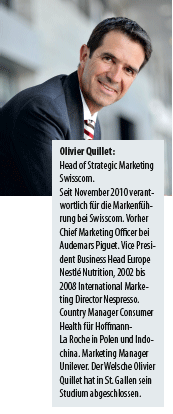
Swisscom has been pursuing a single-brand strategy for three years. Saatchi & Saatchi won the lead on the account in a pitch in June 2011. Now the first umbrella campaign is on the air. Olivier Quillet, Head of Strategic Marketing at Swisscom, explains some of the background.

WW: SBB has been using the same name for years. Your company's products were previously offered under PTT, Swiss Telecom, Swisscom, Bluewin and now Swisscom again. Is it difficult to manage a brand for a product that changes as quickly as communication options?
Olivier Quillet: It's actually getting easier and easier because technology is promoting convergence. There was a time when we could make a clear distinction between television and telephone. With the Internet, people are thinking less and less in terms of technology and more about access to the digital world. Regardless of what is consumed afterwards - TV program or phone call: technology makes the whole job easier.

The one-brand strategy has been around for three years. Was this a good time or should we have started earlier?
Difficult to answer. It could hardly have been launched earlier. The technology wasn't ready yet. Real convergence has only taken place in the last few years. Before that, we were still on different tracks. Bringing them together under one umbrella brand would have been a huge challenge.

Bluewin is a very popular and well-established brand. What's next for it?
Bluewin no longer officially exists at the moment. The brand is still visible in the e-mail addresses and on the Bluewin portal. I don't yet know what will happen in the future. There are two possibilities: You force the death of this brand or you keep the option open for a specific activity. Bluewin is still a strong brand for many people in Switzerland. At best, it could be revived for something new if that makes sense or proves necessary. Perhaps when completely new media come along ...

Saatchi & Saatchi became the new lead agency for the current campaign following a pitch. What will happen with the previous Contexta and Jung von Matt?
We believe that the breadth of our activities makes it necessary for us to work with several agencies. This also results in a healthy stimulation of creative potential. This means that we will continue to work with Contexta and Jung von Matt/Limmat - but based on the same creative approaches.

Saatchi & Saatchi has also developed a single platform for communication for One Brand. What possibilities does this offer?
I hope all of them! The aim of the exercise is to have a platform and not just a campaign that allows us to communicate the full diversity of Swisscom. This is still too little known, especially among private customers. We are the company in the digital sector that offers the widest range - from IT services for industry and products to telephone and TV for private customers. Whether IT services in the office or Swisscom TV at home: in the end it is the same person, the same customer, who can benefit from our services. That's why we want to make this consistency visible in our advertising.

How can you describe this platform?
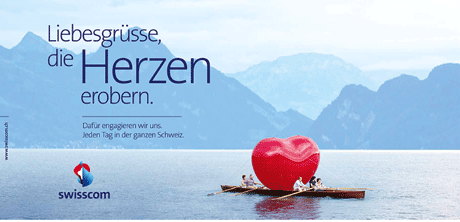
We wanted to show people how irreplaceable and valuable our services are in everyday life. I can see a very clear development over the last 30 years. You used to be able to spend a whole day without a phone. Those days are gone, our services are now irreplaceable. Our customers want to be reachable anytime and anywhere and be able to use the technical possibilities. With our advertising, we want to ensure that this value of our services comes to the fore again among customers. People should no longer just think about the price, but understand it: I can really connect with my world thanks to these services - be it in business or in my private life, because I can always and everywhere rely on Swisscom. That was the approach and we used it to develop the first pillars for our platform. The oversized objects such as the heart or the wind turbine symbolize the emotional added value of the product or service that we offer our customers. We also used our employees for the campaign, which shows the contribution that each and every one of us makes for our customers every day.

What role does Swissness play in this concept?
As a third pillar, Swissness is absolutely important to me. This has perhaps been lost sight of a little in recent years. Swissness is our strong differentiating factor compared to the competition. We have a history closely linked to Switzerland and are one of the few companies that physically connects the whole of Switzerland and brings people together in all their diversity. And we have been doing this for around 150 years. Quality, reliability and customer service are absolutely paramount. This is what our customers give us back and we wanted to build on this. In addition, there is also the fact that we invest an enormous amount in Switzerland. Every year, we invest over a billion francs in our network and infrastructure. No other company invests that much in this area. That is our contribution to Switzerland. It is also thanks to our performance that Switzerland is so attractive internationally as a business location.

In the new campaign, it cannot be overlooked that Publicis also carried out a casting with Orange employees in the last major image campaign. They were then allowed to conjure up lighting effects in the sky. At Saatchi & Saatchi, Swisscom employees are now allowed to carry symbols through the landscape. Is it difficult to find an independent visual language for an almost identical product range such as the communication options?
It is generally difficult to be truly independent in advertising. There's nothing that hasn't been done before. For us, the focus has always been on our employees - and that is a personal conviction: Employees should be a brand's best ambassadors. You have to work hard to ensure that they can stand behind it with complete conviction - including communication. One way to do this is to ensure that employees can really play a physical role, get involved and thus gain a much greater sense of identification. That's how the idea came about.

Will this employee capital also be used in other ways?
With our new communication platform and this approach, we will always have new opportunities - be it in the classic way with commercials, but also online. There are many opportunities here. For example, we have a very lively online support community in which our employees can contribute. Involving our employees will certainly be an important pillar of many future measures.

Is there an internal employee branding at Swisscom?
I would say yes - but I would go one step further. There shouldn't really be a difference between internal and external branding. It has to be a single brand. A brand that radiates absolute coherence and consistency both internally and externally. In today's world of communication, if you do something different internally than you do towards your customers, it will be revealed immediately. The world has become much more transparent.

How has the campaign been received internally?
Very good. We aroused a lot of interest with the internal casting. A lot of employees signed up. Everyone talked about it in their own circles. The filming was a unique experience. We also showed the new commercials internally before they were released to the public.

How real are the rather spectacular scenes, for example in the mountains?
They are all real. We actually found people who carried the heart to the summit of the Titlis. That was in August at minus 10 degrees in this rainy summer. But everyone had a lot of fun.

On the subject of technology: Where does Swisscom stand in terms of development compared to the competition?
Swisscom is in a very good position compared to its competitors and has a very good network in both the mobile and fixed network areas. We are constantly expanding our network so that we can continue to offer our customers the best quality, the best service and the best network in the future. For example, we are constantly investing in our mobile communications infrastructure and pushing ahead with the expansion of fiber optics. This means we are equipped for future services. We also have the advantage of being able to offer our customers everything from a single source, from mobile telephony services and landline connections to Internet and television.

In which area do you invest the most or what is your core business: telephone, Internet, TV, B2B?
You can no longer make such a strict distinction. We will always invest in the quality of the connection. Convergence will mean that a customer will ultimately only need one connection. Service will therefore be important for us. As a Swiss company, we can deliver unique quality in Switzerland, which will position Swisscom at the forefront.

Does the Swisscom brand also offer international potential?
As a traditional Swiss company, Swisscom's brand stands for quality and service. The stability of Swiss politics, legal certainty and the high requirements for data security also offer international potential; Swissness with its trust bonus is particularly important for cloud services if, for example, foreign companies want to host their data in Switzerland with Swisscom.

Interview: Andreas Panzeri

Unbenannt-1_1
Unbenannt-2_1
 

Media Trend Journal: Attractive wallflowers

They are hardly recognized as a media genre, yet they command a great deal of attention from their readers—and they still have potential in the advertising sector as well. Christoph J. Walther

Together, the 50 or so local papers in German-speaking Switzerland have a weekly circulation of around 500,000 copies - outstripping the three regional Sunday newspapers. Their reach is also good, as the papers have been anchored in the population for generations and often reach two or more readers. These local weeklies often also function as official publication organs, but have their own editorial offices and are mainly distributed to subscribers, especially in more rural areas.

> To the article (PDF)

get_footer();