Butz's Motz: Big on format, small on layout

The example of Nespresso at Zurich main station shows just how bad things are in the design sector.

What it's all about: Over the Christmas and New Year period, a Nespresso poster measuring at least 30×10 meters hung in the venerable Zurich train station concourse. This campaign with George Clooney is one of my favorites in terms of concept. But the way this image idea with the halo was placed and designed on this format is amateurish. According to research, this billboard costs just 80,000 francs for one month. But the apprentice was probably commissioned to come up with a clever design.

My theory: I estimate that 100,000 people pass by Zurich station every day. I asked 30 of them whether they had seen the idea of the halo on Clooney's head. None of them noticed it. McCann Paris had sent the idea and the artwork to the stores. The consultant or the media manager or perhaps the client then decided to make a billboard in the station. A desktopper then quickly redesigned the artwork to this special 30×10 m format. The result: everyone only understands the station, if at all.

This is easy to explain: The superfluous coffee machine distracts from the too-small halo, as do the logos and texts in various typos. Less is more. I have tidied this up. See picture.

The content is the most important thing. If it's not right or has fizzled out, even the hefty price for an advertising poster is money down the drain. My point is that I have often grumbled about this phenomenon.

I suggest that in future SBB let a kind of FIFA decide whether a poster is "authorized to play" or not. They should consider whether it should even be possible to put up such large and ugly posters in this venerable hall. What does Nicki de Saint Phalle have to say about it? Or the architect Röbi Hausmann, who tidied up this hall and restored it to its original splendor? The passengers who hurry through the hall every day concentrate primarily on their platform or on the bar on the left or the Federal or on the treasure they pick up under the clock. Only then do they see the advertising. And if it's not reduced and funny, then, I repeat, of the hundreds of thousands, they'll only understand the station.

The upside is that this year, as an exception, I have decided to write a column entitled "What Theophil liked" instead of "Der Motz von Butz".

Theophil Butz, once a star advertiser (Ringier), now an inspirer and, as of now, a mothballer. "Not an easy role, but a necessary one, which I perform here every fortnight." Please send any relevant information to [email protected].

This poster costs 80,000 francs a month. Probably not a penny was spent on an optimal design. Above the original, below my correction.

motz
 

The Eyecatcher strengthens its consulting with Annina Iten

Annina Iten is joining the Zurich-based interactive agency The Eyecatcher, thereby expanding its consulting team.

With Annina Iten, the eyecatcher has once again expanded its consulting team. The experienced project manager will primarily be responsible for supporting the client Orange Communications SA. She will also take over the management of various other customer projects. Annina Iten already knows Orange from her previous work at Cinergy, where her client portfolio included SBB, Bluewin and local.ch as well as the telecommunications company.

When asked what she particularly likes about her new role, Annina Iten said: "The combination of exciting projects and a creative environment - and a really friendly team."
 

Grayling cooperates with Oehen PR

Grayling brought the agency Oehen PR on board at the beginning of January. Stephan Oehen, the agency’s founder and owner, has joined the Zurich team as Executive Director, working under the leadership of Managing Director Bettina Gebhardt.

Grayling and Oehen PR entered into a cooperation at the beginning of January 2012. This gives Oehen PR direct access to Grayling's international network and the opportunity to actively utilize it and expand the services of its existing portfolio accordingly. On the other hand, Grayling is strengthening its expertise in the areas of internationally active Swiss SMEs, financial services and public affairs. Oehen PR is moving into the Grayling office at Niederdorfstrasse 88 in Zurich.

"With Stephan Oehen, we can strengthen our expertise in the area of internationally active SMEs", comments Hanning Kempe, CEO Grayling Switzerland and Germany, on the cooperation. "Grayling offers small and medium-sized Swiss companies with international connections ideal conditions for their communication activities. Thanks to Stephan Oehen's network, we can position ourselves even more strongly in this area."

Stephan Oehen has more than 15 years of PR experience and a solid client base. His core competencies include strategic consulting in the core areas of corporate communications, public affairs and crisis communications. Before setting up his own business, Oehen PR Schweiz AG, in 2006, the lawyer and former journalist pursued a classic consulting career and was most recently managing partner at the PR agency Klaus J. Stöhlker AG.
Stephan Oehen is delighted to be part of Grayling: "Grayling is the perfect partner to drive forward the further internationalization of my portfolio. Both my existing clients and Grayling will benefit from the resulting synergies."
 

Publica Data: Radio usage 2nd semester 2011

In the second half of 2011, listeners in German-speaking Switzerland listened to more radio than residents of French-speaking Switzerland or Italian-speaking Switzerland. DRS 1 is the most-listened-to public broadcaster, and Radio 24 is the most-listened-to private radio station.

In the second half of 2011, 88.8% of the population aged 15 and over in German-speaking Switzerland listened to the radio for an average of 127.7 minutes on an average day. Both reach and use of the medium are slightly lower in the other language regions: 85.6% of people in Suisse romande listened to the radio for around 114.6 minutes a day. In Svizzera italiana, radio reached 87.7% of the population aged 15 and over and was used for 123.4 minutes per day.

Among public broadcasters, DRS 1 is in first place in German-speaking Switzerland with 37.9% (net reach), followed by DRS 3 with 28.9%. Radio 24 leads the private radio stations. With 6.6% of net reach, it is the most listened to private radio station in German-speaking Switzerland. Energy Zürich, Argovia and FM1 follow in descending order. The private cable radio stations are led by Eviva with a net reach of 2.1%.

Note: From the second half of 2011, the usage data for all radio stations will only be shown per language region. The listeners of the cross-border stations Canal 3 (German), Canal 3 (French), Radio Fribourg and Radio Fribourg are therefore shown separately in the regions of German-speaking Switzerland and Suisse romande.

The complete usage data for German-speaking Switzerland can be found here.
Further information can be found at www.publicadata.ch
 

A new generation of television: Sunrise TV

Sunrise is making a big splash: On January 23, it will launch its digital TV service nationwide, making it the only private telecommunications company in Switzerland to offer mobile, landline, internet, and TV services all under one roof.

With Sunrise TV, the latest generation of entertainment is making its way into Swiss living rooms: Sunrise's TV offering provides customers with a wide range of innovations that turn watching TV into a whole new experience. These include, for example, the largest selection of HD channels in the basic package, the "ComeBack TV" and "Live Pause" functions, and a unique variety of channels with over 160 TV and more than 80 radio stations.

Sunrise's digital TV offering comes with a number of innovations that enable viewers to become program directors themselves. Particular emphasis is placed on user-friendliness. Market analyses show that a major customer need is to be able to watch TV independently of time. Sunrise TV focuses on this need.

Since entering the market 15 years ago, Sunrise has been the only private telecommunications provider in Switzerland to continuously invest in mobile communications and the expansion of its infrastructure, offering customers an alternative to the market leader. With the launch of Sunrise TV, Sunrise will become the only private telecommunications company in Switzerland to offer mobile telephony, fixed network, Internet and digital television from a single source from January 23.
 

Jung von Matt/Limmat: The Smart has an extremely high capacity

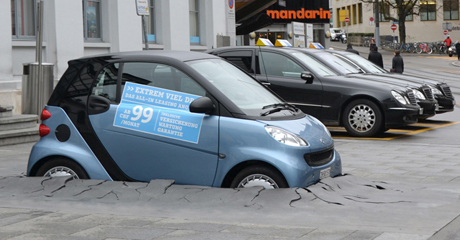
That's quite a sight. At the Stadelhofen train station in Zurich, a Smart car has sunk into the ground. Why? Because there's just so much packed into a Smart.

A Smart car has sunk into the asphalt in front of Stadelhofen station. At least, this is the illusion created by a current installation by Jung von Matt/Limmat for the Smart brand. A disruptive sticker on the car makes it clear: there is an extremely large amount in a Smart. Namely, an all-in lease including insurance, maintenance and warranty.

The lower part of the car was sawed off for the action. The deceptively real cracks around the car and the curvature in the asphalt were simulated with a special mat. With the installation at Stadelhofen station, Smart presents itself as an urban mobility alternative to 135,000 people every day. The sunken Smart can be seen until January 21 at 5 pm.

smart_stadelhofen_1

Responsible at Smart: Carmen Mola Galván (Brand Manager smart). Responsible at Jung von Matt/Limmat: Lukas Frei (Creative Direction), Samuel Christ (Text), Maurus Zehnder (Art Direction), Aude Kohler (Graphics), Deborah Herzig (Art Buying), Dominic Daeppen, Ariane Sonderegger and Pascal Schwager (Consulting), Max Rudolph (PR) and Inqubator (Production).
 

Bernmobil: Makes passengers smile

Anyone who observes Swiss men and women on public transportation will see the same thing everywhere: sullen faces. Yet, given the many benefits of Bern’s public transportation system, passengers would have every reason to smile.

Bernmobil has taken advantage of this idea for its new service and performance campaign: In a series of subjects, shots of grumpy passengers are juxtaposed with precisely those advantages, such as the elimination of the tedious search for a parking space.

The shots all originate from real life: The unsuspectingly photographed protagonists were asked for their consent after the snapshot was taken. The fact that a surprisingly large number of those asked agreed is proof that our compatriots at least have a healthy dose of self-irony.

The campaign includes numerous motifs and will be seen throughout the year on streetcar trailers, in advertisements and in various accompanying media in and around Bern.

Responsible at Bernmobil: Roman Gattlen, Head of Marketing and Monika Schweiwiller, Head of Marketing Communications. Agency: New Lgk.
 

Martin Wagner becomes BZM Group Attorney again

Effective immediately, Martin Wagner will become the new general counsel of Basler Zeitung Medien. This decision was made by Filippo Leutenegger, chairman of the BZM board of directors.

"He is a specialist in media law and knows Basler Zeitung Medien, so for us he is the right person for this important post," Leutenegger was quoted as saying in a statement on Thursday evening. Wagner had been BZM group lawyer for many years before he took over 25 percent of the capital from the long-time BZM owner family Hagemann in February 2010. Tettamanti held 75 percent. The duo installed Blocher intimate Markus Somm as editor-in-chief after six months, which, according to SDA, caused a lot of fuss about the Baz change of course. In November 2010, Wagner and Tettamanti capitulated after waves of protest continued and sold BZM to Moritz Suter. The latter threw in the towel at the end of 2011 when he fell out with his backers and returned the shares to former Federal Councilor Christoph Blocher's daughter Rahel. She then sold again to Tettamanti. Blocher is still involved with a deficit guarantee.

(Photo: Keystone)

SFLB: Only the best goes into the tea bag

SFLB's new campaign highlights the special pleasure of drinking Twinings tea. This is illustrated by three different images that show the tea bag in its «usual setting.».

Twinings stands for the finest tea enjoyment. The traditional English company has been using the best tea leaves, herbs and ingredients for over 300 years. This is also communicated in a series of new subjects developed by Spillmann/Felser/Leo Burnett and integrated into the tea landscape world of the existing TV commercial. The campaign will be used in advertisements, samplings and other media.

Responsible at Twinings: Christof Stulz (Marketing Manager), Angelika Leemann (Brand Manager Twinings), Michèle Ernst (Area Manager Austria). Responsible at SFLB: Matthias Fürst, Katja Wölfel, Pablo Schenke, Johannes Raggio (creation), Fiona Gottwald (consulting), Suzana Kovacevic (art buying), viennapaint (image processing).

How independent publishers are undermining Publicitas

Eight years after Tamedia launched a direct booking fee (DBE), this instrument has established itself on the market: More and more independent newspaper publishers are trying to use such compensation to persuade media agencies to book directly with them instead of via Publicitas. Pure magazine publishers are now also taking part. However, not all publishers are laying their cards on the table.

If a media agency books its advertisements directly with the publishers and does not have this task conveniently carried out by Publicitas, it incurs additional costs - not only for booking, but also for controlling and invoicing. In 2005, Tamedia therefore began to reward large agencies and major customers who booked directly with Tamedia titles for this additional work by granting them a direct booking fee (DBE). To this day, Tamedia refunds customers a certain percentage of the DBE volume booked each year.

Goal: Bypassing Publicitas

Of course, Tamedia did not introduce the DBE out of altruism, but in the wake of the NZZ Group's decision to place its titles under Publicitas management from 2005. Tamedia feared that it would subsequently be disadvantaged by Publicitas as an independent title. The new DBE was therefore intended to motivate agencies to bypass Publicitas and contact Tamedia directly. With two advantages for Tamedia: The publisher gained more direct customer contacts. And with every directly placed advertisement, it saves the advertising commission that it would have to pay to Publicitas under the terms of the commission contract. These are annual amounts in the millions that Publicitas has lost and continues to lose. But this was just the beginning. Other independent publishers soon also introduced a DBE. Many other publishers also broke away from the P-directorate - and the new DBE idea made this step easier for them. To this day, the problem is that publishers only launched a channel battle with the DBE: direct booking versus booking via Publicitas. Market share can hardly be gained in this way.

Publishers have very different approaches

This is what the specific DBE offers look like: Tamedia and Tamedia Publications Romandes (previously Edipresse Suisse) each grant a separate 1.5 percent discount on the booked volume - with a minimum annual turnover of one million francs per language region. If the previous year's volume is exceeded in a language region, the customer there receives 2 percent on the additional volume. While the DBE applies to all Tamedia titles in French-speaking Switzerland, bookings in the Tagblatt der Stadt Zürich are excluded in German-speaking Switzerland, explains Group spokesperson Christoph Zimmer. However, bookings in the Landbote and Winterthurer Stadtanzeiger are also included. Ringier has also had a DBE for several years, but this was significantly increased in 2010. Originally it was 1 percent, applied to 15 titles and required a minimum volume of half a million francs. For a year now, customers with a volume of CHF 2 million or more receive 1.5 percent. And anyone who exceeds their previous year's turnover will even receive 4 percent on the additional turnover. AZ Medien, in turn, offers 1.5 percent on all its newspapers and special interest magazines, with a minimum annual turnover of 500,000 francs. Axel Springer Switzerland has the same offer on all its titles. Basler Zeitung Medien also offers 1.5 percent on the three titles Basler Zeitung, Baslerstab and Vogel Gryff, but does not require a minimum volume. The Walliser Bote also waives this requirement. However, it only grants the DBE of 1.5 percent if it is booked as an individual title. If it is included as part of a newspaper bundle, it is not subject to the DBE.

There is still a lot going on when it comes to DBEs. For example, Kimedia is currently considering a DBE of 1.5 percent for nine Konsumenteninfo AG titles (including K-Tipp). "The decision will be made soon," said Peter Salvisberg, member of the Executive Board. Fachmedien Mobil AG, which bought the Automobil Revue from Tamedia last year, has already joined the DBE providers. "There is a DBE with a major media agency," writes marketing assistant Claudia Gerber. "However, we have agreed not to disclose the content and conditions." No precise information is available on the DBE of Südostschweiz Medien either. However, Thomas Kundert, head of the advertising company Südostschweiz Publicitas, confirms that the publisher has been offering a DBE to media agencies with certain minimum volumes for two years. A piquant fact: Südostschweiz Medien is not a 100 percent in-house publisher. Kundert: "Publicitas has a 50 percent stake in Südostschweiz Publicitas and thus indirectly in the DBE."

Secrecy surrounding the DBE

However, there are also independent publishers that do not grant DBEs - these include Agefi, WochenZeitung WoZ, Schaffhauser Nachrichten, Coop-Zeitung and Zeitlupe. Others have not provided any information for years, such as Weltwoche, Freiburger Nachrichten, Migros-Magazin, W. Gassmann (Bieler Tagblatt, Journal du Jura) and Zürcher Oberländer (ZO). With regard to the latter, however, it was learned that bookings for the ZO within the combination of Zurich regional newspapers also fall under Tamedia's Swiss-German DBE. Markus Knöpfli

NZZ WITH "HANDLING COMPENSATION"
In 2007, the NZZ - under Publicitas management since 2005 - also introduced a type of DBE. However, because this was not intended to circumvent Publicitas, but on the contrary to reward bookings via it, the discount was called "handling compensation" (HE). The HE was a reaction to the fact that from 2007 all major business publications as well as SonntagsZeitung and SonntagsBlick granted a DBE. This meant that NZZ was the only title in the Zurich business press segment and in the Sunday market without a DBE - and at a disadvantage.

Since then, the HE has amounted to 1 percent and is paid to customers and agencies whose annual BK/JUP-eligible turnover from commercial advertisements and supplements in NZZ titles amounts to at least CHF 500,000. The HE applies to bookings in NZZ, NZZ am Sonntag, Magazin Z, NZZCampus, Bücher am Sonntag, NZZ Folio and NZZ Chronik, but not in NZZ Online. Other publishers under Publicitas management have not yet resorted to this method. (mk)

LITTLE JOY AMONG PUBLICITAS AND ADVERTISING CLIENTS
"There's no question that Publicitas is still not happy about the DBE," says Othmar Fischlin, Head of Marketing at Publicitas. And he points out that the DBE idea emerged at a time when newspaper publishers were staring at the online business and tended to pay less attention to generic marketing for print - traditionally a Publicitas task. This had consequences. "In the last five years, newspaper publishers alone have lost around CHF 400 million in advertising revenue, a loss that they were not nearly able to recoup through other channels despite bypassing Publicitas," Fischlin points out. In a defensive market environment, however, generic marketing and other services related to print advertising, such as those offered by Publicitas to the advertising industry, are "clearly being revalued", says Fischlin. "Today, Publicitas has a commercially sound basis for cooperation with most publishing houses." The Swiss Advertising Association (SWA) was also not enthusiastic about the DBE. It took the view that the DBE was a discount and belonged to the client, not the agency. The SWA also demanded full transparency from agencies that became DBE-eligible. It also drew up new model contracts for its members for discussions with the agencies. To this day, however, the question of who is allowed to collect the DBE is regulated individually between the client and the agency. (mk)


Clear Channel with New Business Department

Lena Martschenko will join Clear Channel Switzerland on February 1 as a member of the executive board and head of the newly created New Business department.

With a doctorate in business administration from the University of St. Gallen, she has many years of experience in marketing, communication and business development in the IT and telecommunications industry. Most recently, she was Head of Marketing Analytics at Swisscom IT Services. Lena Martschenko will report directly to CEO Jürg Rötheli, who has headed Clear Channel's New Business Department on an interim basis since September 2011.
 

How do I know my client is going bankrupt?

If your client goes bankrupt, you’ll lose a lot of money. Keep an eye on them to make sure it doesn’t come to that—after all, a company doesn’t go bankrupt overnight. By Michael Krampf, lic. iur., attorney, lawyer, and editor at the Beobachter Advisory Center.

Every year, around 5,000 companies go bankrupt due to insolvency - and the trend is rising. With each bankruptcy, suppliers and other business partners of the affected company lose a lot of money. Sometimes so much that they themselves run the risk of becoming insolvent.

To avoid this risk, it is important to recognize payment difficulties with the customer in time, because a company does not go bankrupt overnight. The crisis often begins in secret, but there are usually signs. The first ones are, for example, the change of the payment method or a late payment: Your customer, instead of paying immediately and taking advantage of the discount as before, now claims the whole payment period. Or he pays your invoice slightly late for the first time. If you even have to send him a reminder, this may be a sign of impending insolvency. Then, at the latest, you should keep a closer eye on your business partner and collect all information that could provide information about payment difficulties or even insolvency. Such indications may be:

- The bank account will be changed. Thus, you lose the possibility of placing a hold on the previously used customer account in the event of non-payment.
- The deliveries, which have never been complained about before, are suddenly complained about for no reason (so-called tactical notice of defects).
- Contract conditions deteriorate
- For example, your customer suddenly wants to pay a lower price than originally agreed.
- Deliveries are requested later than usual or even a delivery block is issued.
- You obtain a current excerpt from the debt collection register using the form at www.betreibungsschalter. ch and discover several debt collection proceedings that have only recently been initiated. Or even worse: your customer has already been pursued for taxes, VAT or social security contributions.
- You are replaced by another supplier, even though their contract terms are no better than yours.
- Employees of the customer are laid off, staff is reduced.
- The management and the board of directors change or the auditors, if any, have resigned. The quickest way to find such information is to visit www.zefix.ch.
- Branches and operating units are closed.
- The registered office is relocated.

Each of these signs can be harmless on its own and seem plausible. But if several of them occur at the same time, you can no longer completely rule out the possibility of your customer going bankrupt. Then you should no longer deliver against invoice, but switch to cash or advance payment or insist on cash on delivery.

Do you need legal advice?
The Observer Consulting Center offers you and your employees tele - phone expert advice on legal issues concerning your company - 6 months for only Fr. 99.-. Order the consulting package for SMEs at www.beobachter.ch/kmu or 0800 83 0800.

Book tip
Successful as an SME. Crisis-proof in dealing with customers, staff, suppliers and lenders Plan liquidity, collect receivables, get new money, draw up contracts correctly, maintain and win customers, use employees optimally. This book helps before the going gets tough.
248 pages, Fr. 45.-. 1st edition, 2010 ISBN 978-3-85569-435-8 Observer Book Publishing.

buch_0
 

get_footer();