Last but not least: When the Valentine's Day interview gets out of hand

It was actually supposed to be just a little Valentine's Day survey—the kind that almost every local station is conducting these days. But things turned out quite differently.

Surely he has a sweetheart at home, the young reporter opens the conversation with an elderly passer-by. The gentleman does not put up with this. He rejects these insinuations, he counters. It was a journalistic trick. Such insinuations should not occur in a free and democratic constitutional order. And what follows could easily be an excerpt from a good cabaret - the man talks about the dictates of the date, the trembling of the globe and the neuroses of the reporter. American holidays in general go against the grain, the leap year also annoys him, and the opening hours of the banks anyway.

The YouTube clip has already been viewed well over 500,000 times. Anyone who thinks the man is an actor is wrong. When asked by Spiegel.de, the local broadcaster TV Leipzig assured us that the man was a normal passer-by who the reporter, herself a working student, happened to get in front of the microphone during her street survey. They had not seriously considered offering him a regular program slot for his tirades - they didn't even know the man's name.
 

Peter Schmidt: Annual report realized for Actelion

The Zurich-based branding agency Peter Schmidt produced Actelion’s 2011 annual report. Titled «Turning Research into Results,» the report aims to portray the Allschwil-based biotech company as a pioneer in research.

The molecular snapshots were created by Peter Schmidt Suisse with the help of special software, as the agency writes in a press release. The cover page appears in six different colors. A new visual principle was developed for the presentation of the drug pipeline as an infographic. Selected images from the annual report were implemented by Peter Schmidt Suisse as banner animations for the Actelion website.

Peter Schmidt Suisse was responsible for the concept and overall design of the annual report. Litho, typesetting and production of the printed version as well as the PDF of the digital annual report were realized by Linkgroup.

gb1
gb2
gb3
gb4
gb5

Google may swallow Motorola

After a thorough review, the European Commission has approved Google's acquisition of Motorola Mobility. The competition authority sees no antitrust concerns, but it will continue to monitor the handling of patents in the industry.

Google wants to take over Motorola for 12.5 billion dollars in order to strengthen the patent arsenal behind its Android smartphone operating system. This will enable Google to manufacture its own smartphones and tablet computers in future. Mobile phone manufacturer Motorola holds various patents - including many that are considered indispensable for the implementation of wireless standards such as UMTS. According to The Verge, Google is still waiting for the green light from China, Israel and Taiwan before it can finalize the deal. (SDA/20min.ch)
 

German WSJ: Sobering initial results

The German Wall Street Journal went online more than a month ago. Time for Meedia.de to take stock.

The initial results are quite sobering for the business news offering, according to Meedia.com. In terms of traffic, with 53,000 unique visitors in January, it is a mini, it can hardly be found in search engines and it does not yet play a role on Facebook and Twitter. For example, @WSJDeutschland currently only has around 1,300 followers on Twitter, and the corresponding official account on Facebook only has 741 friends so far. Even more important is the fact that the Wall Street Journal has not yet published any content that has spread quickly and frequently on Facebook and Twitter. Analysis tool Topsy counts for Wallstreetjournal.com currently has around 100 daily tweets containing a link to the WSJ website - a figure that many medium-sized blogs would also achieve.

Of course, it is impossible to say at such an early stage whether a new website will be successful in the medium or long term, relativizes Meedia.de. Nevertheless, the sobering figures for Wallstreetjournal.de are a clear indication of how difficult it has become for even world-famous brands to launch a new website.

> To the detailed analysis on Meedia.de

> Wall Street Journal: German online edition planned

> Wall Street Journal launches German offshoot

Russia: Radio Ekho Moskvy fears for its future

As one of the last bastions of freedom of expression in Russia, the anti-Kremlin broadcaster Ekho Moskvy fears for its future. Under pressure from the state-controlled holding company Gazprom-Media, the editor-in-chief resigned from his position on the station's board of directors.

However, Alexei Venediktov will remain in office as editor-in-chief, Venediktov announced on Tuesday. Less than three weeks before the presidential election, Kremlin candidate and head of government Vladimir Putin had his spokesman deny that the critical stance of the broadcaster was the reason for the change in the board of directors.

Gazprom-Media, a company owned by Gazprombank, which is controlled by the state energy giant Gazprom, is the main shareholder of the channel, which is otherwise owned by the journalists and Venediktov, with a 66 percent stake. At a meeting with Venediktov in January, Putin made unusually crude remarks about the broadcaster. "Am I angry with you when you pour diarrhea over me from morning to night," the head of government said.

Important for everyone

Putin's spokesman Dmitry Peskov said that "unfortunately it has to be said that this criticism is often dominant at Ekho Moskvy". Nevertheless, this has never been an obstacle to an objective relationship between the head of government and the station's management. He warned against linking business decisions at the station with politics. In contrast, reporters critical of the Kremlin and the opposition were convinced of political reasons. Ekho Moskvy announced that it intended to stick to its editorial line.

Info-Radio is considered one of the most important sources of political information in Russia. Media experts explain the "survival" of the channel, which is critical of the Kremlin, by the fact that the state leadership also wants to know what is actually being thought in the country. (SDA/DPA)
 

Sisley launches new global campaign

Sisley is launching its new global advertising campaign under the slogan «Be Independent.» The campaign features six photos and six short films by Belgian artist Kurt Stallaert.

The campaign images, which will appear worldwide in the most important fashion magazines and on the Internet, will be accompanied by six 15-second commercialswhich are shown both online and in Italian premiere cinemas.

Belgian artist Kurt Stallaert, winner of numerous Eurobest Awards and ranked among the ten best advertising photographers in the world by Luerzer's International Archive magazine, captures six episodes of eccentric independence with the subtle humor that has always characterized his work.


Comqed Dialog defends GE Money Bank account

The development of a new website was put out to tender by GE Money Bank Switzerland as a pitch. Comqed was also allowed to take part in the competition as the existing lead agency. The agency successfully defended the account.

Good market and customer knowledge as well as conceptually and creatively convincing ideas were decisive for the decision, the agency writes in a press release. Comqed will therefore continue to design the advertising campaign for GE Money Bank. The first works will be seen in April.

Responsible at Comqed Dialog, Erlenbach/ZH: Tomas Rozas (CD), Bettina Dührkoop (strategy), Roman Steinacher (consulting). Responsible at GE Money Bank, Zurich: Femi Macaulay (Chief Marketing Officer), Marco Giardina (Brand & Marketing Communications Leader).
 

Facebook wants to conquer the Chinese market

After a three-year hiatus, Mark Zuckerberg is once again attempting what Google, Amazon, and others have failed to achieve: conquering the Chinese market. In particular, he is trying to convince investors of the social network’s growth potential.

"The biggest problem is the government's regulations. If Internet companies want to gain a foothold in China, they have to accept certain censures, which in turn contradict the image of the companies," explains Barbara Trionfi, Asia consultant at the International Press Institute , to Pressetext.

National networks easier to control

Half of the 500 million Internet users in China have already found their network. The market leaders are Renren and Sina, which operates Weibo, the Chinese version of Twitter. "Facebook is actually a bit too late. It is quite difficult for the network to compete with an offering that is different from what is already there," explains Elinor Leung, analyst at CLSA.

"Facebook enjoys great popularity in Southeast Asia precisely because of its international reach," says Trionfi. This is a major advantage over national networks. These, in turn, are easier to control by the public authorities. It can therefore be assumed that China will not give in so easily when it comes to censorship regulations.

Fear of a Chinese spring looms large

In 2009, the government in Beijing blocked Facebook for the first time, as the People's Republic feared that the network would enable the organization of demonstrations following unrest in the province of Xinjiang. Twitter and YouTube are also blocked by the communist leadership. The censorship measures were also a reason for Google to abandon the market. "It's a vicious circle. On the one hand, the government wants to control information and on the other, the population. The aim is to influence public opinion," says Trionfi. There is great fear of a Chinese equivalent of the Arab Spring. According to experts, it was platforms like Facebook that got the ball rolling. (Press release)
 

The advertising week on Star TV: A visit to McDonald's in Glattzentrum

From bright, eye-catching yellow to classic, stylish brown. Learn more about the family restaurant's transformation and priorities regarding the environment and technology.

Communications Manager Aglaë Strachwitz and Marketing & Communications Director Thomas Truttmann give a tour of the modern McDonald's restaurant in the Glattzentrum in Wallisellen and explain the company philosophy.

"The Advertising Week" always on Tuesdays at 7:15 p.m. on Star TV.

startv_19


Brain2: The boss recommends Esso

For its loyalty programs, Esso Switzerland has been relying on Brain2’s creative work for the past ten years. The current campaign was also developed by the Zurich-based agency.

Brain2 combines stylish product presentation with promotional messages, the agency writes in a press release. An eye-catcher designed to turn spontaneous buyers into customers. The program was developed by TCC in Zug. The campaign will be used on posters and at the POS.

Person in charge at Esso: Marc Wettstein, Tim Zwiesigk. Responsible at TCC: Max Widmer, Tobias Schlipf. Responsible at Brain2: Oliver Kindhauser, Piotr Müller, Urs Maurer (photo).

esso

Cover of the year 2011: "Loriot - A bow"

The first year of the "Cover of the Month" competition, organized by Hamburg-based New Business Verlag, has been completed. First place went to the Spiegel cover 35/2011 "Loriot - Eine Verneigung".

Stefan Kiefer, Head of Cover Design at Spiegel-Verlag, on the creation of the Loriot cover: "We didn't even try to compete with the grand master of German humor. But we remembered that he had already drawn a cover for Der Spiegel in 1976 - and even gave the original, one of his famous bulbous-nosed men, to the editorial team at the time. So this drawing was used again on the Spiegel cover. This time, however, with a black instead of a black and white bow tie. And a mourning border. And a 'bow' to a great man, which is quite unusual for Der Spiegel."

> All winners on Cover-of-the-month.de

loriot

Publicis: New campaign created for Orange

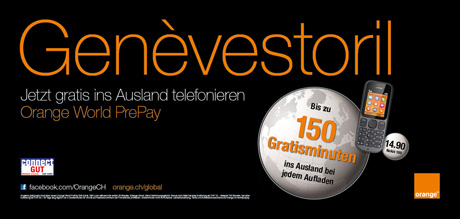
The agency Publicis has realized a campaign for Orange, which is to make known that you can call abroad cheaply with Orange.

Gone are the days when you had to use the fixed network at home to make an international call for cost reasons, Publicis writes in a statement. With Orange, it is now possible to make cheap calls from Switzerland to numerous cities within and outside Europe. To communicate this, the agency has developed a concept that combines Swiss cities with foreign city names. In this way, new city names are created that reflect the connection from Switzerland to foreign countries. The combination of city names is geared to the nationality that is most strongly represented in the respective region. For example, a particularly large number of Germans live in the Zurich area. The headline "Zürichamburg" is intended to address this target group directly.

The campaign will run from February 13, 2012 on billboards, eAds, online and at POS. In print, ads will appear in Turkish.

Responsible at Orange: Andrea Rutishauser (Director Marketing Communications); Martin Zehnder (Advertising Manager); Caroline Spörri (Project Manager Communication), Sabine Kuszli (Online & Customer Communication Manager), Jiri Kral (Online Communication Manager), Sven Jasper (POS & Trade Manager). Responsible at Publicis: Peter Rettinghausen (CD), Tom Kees, Nicolo Giunta (AD), Marianne Zweifel (text), Gabriel Bodmer, Monika Leu, Michael Ottinger (consulting). Responsible at Blue Spirit: Susan Bosshard (consulting), Enrico Bachmann (CD). Responsible at Webguerillas: Jessica Kayser (Consulting), Christian Caroli (CD). Responsible at Mediaxis-MPG: Thomas Koller (Media Planning).

orange1_2
orange2_2
orange3_1
orange4
 

get_footer();