best YET 2012: All cheese in Oslo

The best YET competition for young talent kicked off in Oslo on Thursday. Over the next 24 hours, the young creatives—including four Swiss participants—will have time to develop a concept for a newspaper campaign.

After advertising Belgian beer in Leuven (2010) and ads for neckties in the Croatian city of Zadar (2011), the host country Norway, where the best YET is being held this year, is called upon to give readers a taste for Jarlsberg - a Norwegian cheese holed like Emmental and with a secret recipe that the Norwegians guard as well as Appenzellers.

On Friday afternoon, the teams have to present their ideas in English to the international creative jury and media representatives. The winners will be announced at a dinner on Friday evening. Not only do they receive the title of "best young European team," they also get to take home two tickets to the international advertising festival in Cannes, which takes place in mid-June in the southern French port city.

The participants
Two teams from each of ten European countries will take part in this year's best YET, having previously been selected in the countries' own creative competitions. For Switzerland, the winners of "Das kann nur ein Inserat" from the Swiss Media Association will start: Gaël Tran and David Moret (Euro RSCG Genève) as well as Silvio Seiler (Silvio Seiler Graphik und Design), who will be supported by Othmar Küng, Managing Director Pixeldisko.

You can find a list with all participants here.

bestyet1
 
After the briefing, before the work. The two Swiss teams (from left to right): Gaël Tran and David Moret (Euro RSCG Genève) as well as Othmar Küng (Pixeldisko) and Silvio Seiler (Silvio Seiler Graphics and Design).

The jury
A jury member from each participating country also traveled to Oslo. For Switzerland, it is Andreas Prokesch, who has been part of the competition for many years and judged the works as jury president at "Das kann nur ein Inserat".

You can find a list with all jury members here.

Werbewoche has followed the Swiss creatives to the north and informs online as well as on Twitter about the events and the outcome of the competition. 
 

Isabel Imper

"Only an ad can do that": the winning subjects are known

Anything but classic

Viral campaigns, word-of-mouth marketing, social media and seeding. At Webguerillas, alternative forms of advertising determine the agency's everyday work.

Phone junkies hanging on the receiver for over 40 hours - this is not a new attempt to get into the "Guinness Book of Records", but alternative advertising. The competition organized by telecoms provider T-Mobile, in which participants make phone calls until they fall off their stool with the prospect of winning 10,000 euros, is widely publicized and gains media attention thanks to PR work. Numerous blogs pick up on the contest and the lifestyle magazine "Taff" from Pro Sieben and Spiegel online also feature the telephone marathon. Advertising for T-Mobile. The Munich agency Webguerillas, which specializes in alternative forms of advertising, came up with the idea for the campaign. The Guerilleros have also had a presence in Switzerland since fall 2011 with a Zurich branch and want to surprise the target audience with unconventional ideas from here. Under the leadership of Managing Director Philippe Stuker, concepts for guerrilla, word-of-mouth and mobile marketing as well as social media activities are created at Stauffacherplatz. At Easter, the agency ran an online campaign for Migros encouraging people to virtually "egg-toss", for Mammut it called on people to climb a mountain peak and for Cardinal it launched the Cardinal Draft and Blond brands via a social media strategy with a Facebook page, the "Spin the Bottle" app and a new website.

Campaign success with the target group

The starting point for advertising projects at Webguerillas is usually media monitoring. By observing online and social media environments such as blogs, forums and communities, the agency clarifies how and where brands and products are communicated about and who the multipliers are. Using predefined keywords - for example product names or core values of a brand - the internet is scoured. Based on the results of the analysis, the team then determines the advertising strategy: which target group is addressed and how or via which channels communication takes place.

In the case of viral campaigns or referral marketing, the multipliers or seeders through which the campaign is launched are also selected via monitoring. The seeders are contacted directly by the agency and then spread the advertising message by blogging about a product, a company or a commercial, distributing a video, posting messages on Facebook or leaving comments on websites.

This is not an uncontroversial approach, after all, seeding users place advertising messages but still pretend to be normal users. Stuker sees no problem in involving the target group as an advertising medium. Seeders are not paid, nor are they told what they should communicate. They simply receive the product or service and communicate about it in return. The point is to get authentic statements about products or brands. "Alternative advertising is honest. How the target audience talks and about what is partly beyond our control." However, receiving genuine responses also means that customers have to expect negative reactions or comments. While companies benefit from individual negative feedback - for example when they are made aware of their product's weaknesses - the fear of a shitstorm is likely to give some marketing managers sleepless nights. Stuker does not have a one-size-fits-all solution, but is reassuring: the risk of negative publicity is kept to a minimum through careful selection of the seeders and a proactive crisis plan. And if something negative does emerge, you can react to it. The decisive factor is how you deal with any criticism and what you make of it, says Stuker. If seeders are well selected and the campaign concept is well thought out, alternative advertising can be effective. The Webguerillas achieved this with the viral campaign for the Mini car brand, for example. A commercial was created in which a daredevil is catapulted to extreme heights. The question at the end "Not extreme enough?" links to Mini and invites viewers to test the manufacturer's new racing version with "Try this!". The commercial, which was distributed via various video portals, reached more than 500,000 views after just a few days and over a million views after just under two months, and also secured the agency awards at Eurobest and the New York Festivals. There is no guarantee for clients that a communication avalanche like the one in this example will be triggered. However, as the multipliers are selected and the viral campaigns are also pushed through banner formats and display advertising, the probability of success is very high, says Stuker.

Unused potential

Despite such campaign successes, many companies are still reluctant to use alternative advertising. It currently accounts for just 5% of advertising budgets in Switzerland (GfK study: 2011). "Switzerland is lagging somewhat behind. In Germany, almost 15 percent is spent on alternative forms of advertising," says Stuker. He is convinced that the new forms of advertising will attract increasing attention. "I think that in a year's time we will no longer be talking about 5 percent, but at least 10 percent." Thanks to the clear target group approach and dialog with customers, alternative forms of advertising are a good complement to traditional advertising. "When you see how many people can be found on online media, it's a channel that can't be left out," says the business economist. In any case, the Webguerillas can't complain about a lack of demand. Since its launch last October, the agency has been able to increase its workforce to 23 employees, a threefold increase. Isabel Imper

Unbenannt-4_9
 

WS Communication: Second Round Manor Grill Competition

The Manor Grill campaign is entering its second round. Manor is launching a contest with a Facebook app conceived and designed by WS Kommunikation.

Is grilling purely a man's job or do women stand their ground at the grill? With a grill picture and a reason why you grill better than the other sex, can be participated. The contest lasts until the end of May, the 10 photos with the most votes can win prizes.

The contest is advertised in the department stores (leaflet and posters) and on Facebook advertised. Webgearing is responsible for the programming.


World Media Festival 2012: Intermedia Globe Awards

Several Swiss agencies were able to pick up an Intermedia Globe Award at this year's World Media Festival. The Grand Prix was won by Element P, with "Die eine Sekunde" for the Zurich Cantonal Police.

The film agency was also able to accept an Intermedia-Globe Grand Award in the Public Relations category for the same film. Three other Swiss agencies were awarded Gold at the Intermedia-Globe Awards: Inhalt&Form received a Gold Award for Credit Suiss' entrepreneur magazine Global Investor 2.2011, in the Corporate Print category. In the Public Relations category, Gold Awards went to Seed Audio-Visuals Communication for "Eeine Ode an die Nähe" (An Ode to Proximity) for the Zürcher Kantonalbank. The second Gold Award in the Public Relations category went to Element P for "Die eine Sekunde" for the Zurich Cantonal Police. Another Gold Award went to Inhalt&Form in the Web category, for Credit Suisse's Global Investor knowledge platform.

A Silver Award went to the agency Inhalt&Form in the Corporate Print category, for Credit Suisse's Bulletin Holz 4/2011, with service partner Swisspinters Zurich. The Swiss agency IP Media received three Silver Awards: In the Web category for Internettv.ch, and in the Web TV category for Airporttv.ch of Zurich Airport and for Arosatv.ch of Arosa Tourism.


The Motz from Butz: Swisscom has an advertising disease

No sooner had Swisscom’s heart-and-soul campaign (see Motz, Oct. 7, 2011) been launched with much fanfare than it found a new home.

What is at stake here: Swisscom, one of the largest advertising clients in Switzerland, does not know what it wants to represent. No positioning, no advertising idea, just trial and error is the motto. Our money is simply thrown out of the window. After all, Swisscom has once again called for an advertising round, and it has now also chosen a new agency: Heimat Berlin. They are now going to reinvent advertising. A punch in the face for the Swiss advertising scene, as if Dr. Spillmann, Dr. Bodin, Dr. Ruf, Dr. von Matt, Dr. Collioud or I hadn't figured out where Swisscom was ailing and what kind of prescription it needed.

My advertising theory: First, we should find out what it is that Swisscom has an image problem. Does it have a bacterial or viral disease, or is it a cancer? Based on this finding, a treatment method or an advertising strategy and a precise briefing must be created.

The advertising doctors are then to find out from this the most effective medicine against this finding. In other words, find a long-term, creative implementation that gradually advances the healing process. The most decisive part for a recovery is continuity. As an advertising doctor, I would prescribe this medicine for at least ten years. Swisscom has undergone far too many facelifts in recent years. We know from practical experience that this has not always turned out favorably. You can see how unsuccessful the new Swisscom logo looks. But that's just it: First you operate, and then you have to make corrections.

The new campaign launched seven months ago and praised to the skies by Swisscom executives as the optimal advertising solution has thus turned out to be the wrong treatment method. Now the advertising agency Heimat from Berlin has taken care of the patient Swisscom and also brought the budget to their sanatorium. Heimat is not a bad agency. Whether Swisscom has been inspired by the quirky Hornbach campaign? We'll see, but we can't hope. I'm not sure that the Swisscom problem can be cured with advertising. Swisscom is upsetting the Swiss hotel industry and acting as a brake on free surfing in hotels. Bad for tourism. On the other hand, it lowers the surfing and telephone charges incurred abroad from 80 to 75 centimes/minute. From European providers like Vodafone or Telecom, surfing offers are up to four times cheaper. In any case, I wish you a speedy recovery. My pick of the week is the FCB, which is continuing to churn away cheerfully and successfully despite winning the championship.

Theophil Butz, once a star advertiser (Ringier), now an inspirer and now a mothballer. "Not an easy role, but a necessary one, which I perform here every fortnight." Please send any relevant information to [email protected].

Unbenannt-2_6
 

Off we go through the middle with Cruiser and Bella!

With an entertaining animated film, Suva is raising awareness about safe driving behavior at roundabouts. Seed Audio-Visual Communications led the project, and the film was produced by Boutiq.

What many people don't know: Bicycles are supposed to ride in the center of the lane in single-lane roundabouts! Suva now wants to raise awareness of this among the general public through a new animated film.

http://www.youtube.com/watch?v=gj9sAEXR01E

Cruiser and Bella are the stars of the adventure film «Ab durch die Mitte!» For about ten years, Suva has emphasized helmet use in its cycling campaigns. The message has gotten through. Traffic experts are now satisfied with the helmet usage rates. In fact, helmets have increasingly become a fashion «must-have» among kids and athletes alike.

But there are other dangers lurking in road traffic as well. To raise awareness of these, Seed Audio-Visual Communications and Suva have now developed two characters. As Felix Courvoisier of Seed explains, Cruiser and Bella could be used in the future to teach various traffic rules in an educational and engaging way. A sort of pilot video focuses on safe riding in roundabouts. The rule here is that bicycles are allowed to ride in the center of the lane in single-lane roundabouts. Today, most cyclists and drivers are unaware of this rule. As a result, many cyclists ride along the right-hand edge of the roundabout. This puts them in danger because they are easily overlooked by drivers.

Role Reversal in a World Turned Upside Down

Cruiser is a bike with a wind-swept quiff—a bit self-absorbed, but full of charm. Bella is a cute little car; she’s not exactly an early riser, but once she’s out on the road, she’s always up for an adventure. With Cruiser, for example. And: In the world of Cruiser and Bella, everything is upside down—because there, the bikes are the big ones and the cars are the little ones.

In «Straight Through the Middle!», Cruiser witnesses Bella getting into a serious accident at a roundabout. Luckily, she’s back on the road in no time. But when she approaches another roundabout, she starts to get scared. Cruiser, however, finds the solution: get into the right lane before the roundabout and then go right through the middle!

The film, which is comparable in style to major international animated films, was produced by a highly ambitious team in Switzerland—a requirement set by the client, Suva. Seed Audio-Visual Communications in Zurich took the lead, and the film was produced by the animation specialists at Boutiq under the direction of Mike Huber. Suva is showing this heartwarming animated film online, where it is expected to generate as many clicks as possible—if the adventures of the duo Cruiser and Bella are to continue. A trailer version will also be shown this summer at select open-air movie theaters. Andreas Panzeri

Unbenannt-3_8


Scatter plot: Peace, joy, egg ravioli

Zurich-based BTL agency Streuplan has implemented a national POS campaign under the slogan "Peace, Joy, Egg Ravioli". The campaign is communicated via top signs, on pack leporellos and online.

The participation mechanism is multi-stage and takes place via an SMS-to-email tool developed by Streuplan. By sending an SMS with "Hero" and your e-mail address, you are automatically entered into the main draw for a vacation account worth CHF 10'000. Immediately after sending the SMS, you will receive an e-mail that refers you to an additional monthly competition on the homepage. There you have to find out where the Hero Ravioli can is currently located on its tour through Switzerland. Seasonal prizes will be raffled. The newsletter subscription to the monthly competition is intended to serve as a sales-promoting reminder.

Streuplan has been Hero's responsible communications agency since 2010 and last year realized the 125th anniversary campaign as well as the new homepage.

Responsible at Hero: Christian Schenk (Business Unit Manager Consumer), Flavio Pellegrini (Product Manager). Responsible at Streuplan: Thomas Back (overall responsibility), Marco Schlatter (consulting), Caroline Schmid (AD), Stefanie Fink (AD), Dalibor Tihi (web development).


Empty Phrases and True Values

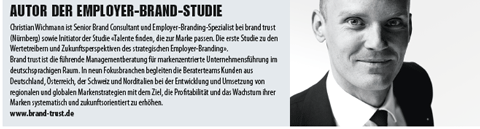
Finding talent that aligns with the brand: The management consulting firm Brand Trust presents the first study on the value drivers and future prospects of strategic employer branding.

WW: The cover of your employer branding study, «Finding Talent That Fits the Brand,» features a tattooed back. Why did you choose this image?
Christian Wichmann: Some people find tattoos repulsive, while others find them beautiful and aesthetically pleasing and see them as a unique, individual trait. In short: Tattoos polarize opinion. And that’s exactly what employer branding is all about: being extremely attractive to the right talent while discouraging unsuitable candidates from applying.

So does employer branding mean attracting and deterring people at the same time?
Exactly. It’s about strategically positioning the corporate brand in the job market to find the right employees for the company. The goal of employer branding is to honestly and authentically highlight what tangibly sets the employer apart from other companies. HR marketing—which is often mistakenly equated with employer branding—is the operational implementation of employer positioning.

What Makes for Successful Employer Branding?
There is a difference in appeal between companies that have a clear brand identity and express it through employer branding, and those that offer their applicants only a generic, interchangeable image. Today, the majority of companies have defined values such as «openness,» «transparency,» «willingness to provide training,» or «ability to work in a team.» However, these are basic virtues, not corporate values or differentiating factors.

What factors are crucial for employer branding?
First and foremost, a company must clarify who it is and what it truly wants. With a vague profile, a company has a much harder time recruiting. Here’s an example: Current job postings everywhere say they’re looking for employees who are «resilient and team players.» What job doesn’t require you to be resilient and a team player? The result: a flood of interchangeable applications. In other words, only when a company knows what it does particularly well and what it stands for can it communicate this specifically and clearly—starting with the job posting itself.

In what other ways can a company effectively communicate its values to the outside world?
At every stage of the HR process chain—from talent marketing through recruitment, onboarding, and talent development all the way to termination or alumni networks. At every HR brand touchpoint, it must be clear what the employer stands for and what values it upholds. Meaningless advertising campaigns, clumsy social media platforms, and purely image-driven communication do not lead to strong and lasting employer branding.

How does a company determine whether a candidate is a good fit?
Values are the most appropriate yardstick: What matters is whether an individual’s personal values align with those of the company—not primarily their professional qualifications. After all, an employee’s performance can be improved, for example, through training. On the other hand, if an employee lacks commitment to the brand and its values, no amount of coaching will help. Conversely, when choosing an employer, the majority of employees first consider whether their personal values and attitudes align with those of the company; only then do they compare their professional qualifications with the requirements of the position.

How far have Swiss companies come in defining and communicating their values?
Swiss companies are making a strong effort to focus first on their performance as employers and to position themselves differently from the competition, rather than creating communication hype. Swiss Life, Credit Suisse, and Nestlé are drawing attention to themselves with strong core brand values. Nestlé, for example, offers an increasingly diverse range of services, products, and brands and must manage this diversity. Nestlé turns this «necessity» into a virtue and consciously leverages the value of «diversity» for its employer branding. This is evident in its diversity management—for example, through initiatives to promote women in leadership positions—as well as in the various brands, products, countries, and people scattered across the globe who work together for the world’s largest food manufacturer.

Do well-known companies have a better chance of attracting the right employees?
No, employer attractiveness is currently tied far too closely to brand awareness. In our study, brand awareness ranked second to last—28th—when respondents were asked about the most important criteria for a company. For job seekers, a good work environment, a fair salary, job security, and appreciation and recognition are what matter most. It’s really about genuine employer quality and appeal. And that can certainly include small and medium-sized enterprises (SMEs), which may not have a large marketing budget but do offer attractive benefits and support services for their employees—from daycare to the option to work from home.

In your opinion, why should employer branding be given greater priority in the future?
Demographic change is in full swing. A lack of young talent and a severe shortage of skilled workers are already being felt by 60 percent of those surveyed. This makes the need for workers—from the CEO to the doorman—so essential. Added to this are issues such as poor employee retention and the loss of knowledge as qualified employees leave the country. Therefore, the focus must not only be on attracting employees but also on retaining them. Furthermore, in a service-based economy where the majority of value creation no longer comes from machines or unskilled laborers, the employer brand is becoming one of the strongest drivers of success. Those who attract and retain the best skilled workers are the ones who succeed in business. Interview: Andreas Panzeri

Unbenannt-5_9
 

Advertising agency: Soft advertising for Weleda

The advertising agency has created a campaign for Weleda to promote its Combudoron medication. The campaign is designed to highlight the gentle nature of holistic medicine.

To visualize the naturalness of the product, the advertising agency relied on a calm, atmospheric visual language. Amidst the medicinal plants contained in the product, the product symbolically grows out of a handful of earth. The key visual is used on F200 posters, roll-ups at the POS, streetcar trailers, advertisements, a promotion card and carrier bags. An online competition on the Internet rounds off the classic advertising measures.

Responsible at Weleda, Arlesheim: Andrea Meyer (Group Brand Manager Pharma), Franziska Niedermann (Brand Manager Pharma). Responsible Advertising Agency, Switzerland: Reto Dürrenberger (Strategy), Sarah Hiltebrand (CD), Michel Bozikovic (Text/Concept), Karin Beerli, Daniele Pucci 8 Art Direction), Reto Dürrenberger, Martin Wyss (Consulting), Andi Laub (DTP), Rohner Retouche (Image Editing).


IDG hands over marketing of Digitalliving.ch to Adextra

The Swiss consumer electronics platform, Digitalliving.ch, is transferring all online advertising marketing activities to Adextra effective immediately. The advertising offerings include traditional display ads and integrated promotional spaces.

The Adextra portfolio already includes the websites Sbb.ch, Homegate.ch, Nationalleague.ch, Car4you.ch, Ttraildevils.ch, Swissfriends.ch, Jobwinner.ch, Jobup.ch, and Piazza.ch.


The grass is always greener on the other side …

Is envy a bad thing? Not necessarily: Some see it as the highest form of recognition. By Uwe Tännler, President of Swiss Marketing (SMC).

When envy clouds our judgment, not only does the grass look greener, but our neighbor’s money also seems more colorful, and the paint on his or her VW Golf shines in Ferrari red. Envy is a (far) too common emotion—even in many marketing departments—and some people feel helpless when they see it flash in a colleague’s eyes. How should one deal with envy in a constructive way? Of course, this question is purely rhetorical—but the answer is not. It is: not at all. If you believe psychologists, envy is rooted in a feeling of inferiority. On the surface, it may seem to be about external trappings that provoke envy—the faster car, the more expensive watch, the more luxurious apartment. In reality, envious people are simply dissatisfied with themselves. Philosophers have also explored this topic. Arthur Schopenhauer concluded that envy is the highest form of recognition—which I find to be a charming thought. If you’re the object of envy, you should accept it as a compliment and wish for as many envious people as possible, because they ultimately confirm your abilities. Only those who find no envious people around them have reason to worry. Those who are criticized, on the other hand, must be doing something right. Religious people even consider envy a mortal sin. But I believe it would be a mortal sin not to give your best, just to avoid having envious people around you. To illustrate this with an analogy from soccer: You only attack the player who has the ball. That’s why I can only advise you to stay on the ball when you’re envied, because even envy has to be earned.
 

Radio 24: Social media now managed by Gerry Reinhardt

Starting in August, Gerry Reinhardt will be joining the Radio 24 team as the head of social media. Over the past 20 years, Gerry Reinhardt has worked at various private radio stations.

Most recently, he was in charge of Radio Zürisee's social media platforms Facebook and Twitter for a good 5 years and was responsible for the content of the Zürisee website Radio.ch. He was also
presenter and held the position of deputy head of music at Radio Zürisee. "I am looking forward to many interactions with the listeners. Radio 24 should listen and also provide answers," says Reinhardt.


get_footer();