RSS Media School: New Training and Editorial Manager for Video Division

Stefan Pulfer is taking on the newly created position of Head of Training and Editorial Director for «Video» at the RSS Media School. He will supervise course participants in day-to-day editorial work and help develop the training program.

Pulfer worked in human resources and was responsible for training at DHL Switzerland. He has been working as a VJ and presenter for Tele Top for three years.

The RSS Media School has been offering radio training courses at the training station Toxic.fm for over ten years. From February 2013, it is now expanding its range and offering a video course for the first time (Werbewoche.ch reported).
 

Double-entry advertising accounting

Beat Hürlimann is an advertiser and creative strategist for social media campaigns. He reports exclusively in Werbewoche on insights from advertising and social media. Today it's all about clarifying Henry Ford's 50 percent question.

Most companies practise a kind of dual advertising accounting. They separate their measures into those for image cultivation with traditional advertising and those for achieving sales with online advertising. Campaigns, budgets and entire departments are managed twice. Why is that? After all, we are living in an economic crisis. Henry Ford, co-founder of modern marketing, was already of the opinion that 50 percent of marketing expenditure could be saved. Entire generations have been dealing with the 50 percent question ever since. Now it's our turn. And the prospects of finally finding out are better than ever. This is because the shift of the opinion-forming process to digital, mobile and social communication channels makes it possible to disclose the decision-making process when making a purchase. From the first contact to the final purchase decision. Let me explain the 50 percent savings question using the current health insurance advertising. Fall is contract time. There is currently a great deal of acquisition fever in the specialist departments of the health insurance companies. The insurers have realized that customers have turned to new sources of information. Online portals, for example. At an online advertising event, the online manager of a large health insurance fund presented performance figures for the current nationwide campaign. He showed the number of contracts concluded and from which media channels the impulses came. In general, only a few contracts were concluded despite the wide range of media used. The performance of the 30-second commercial was also measured. The commercial did not contain any references that would have offered interested viewers the way to further information. A web address, for example. The online boss said with a shrug of the shoulders that image and sales targets were consistently separated. The advertising department, which operates separately from the online department, had made this decision. At SF1, the 30-second spot achieved four contracts after one week of prime time. The performance measurement took place for the first time, and it will be interesting to see which advertising measures the insurance company decides on in 2013. Back to the economic crisis. The message is to achieve more impact with fewer resources. There are a few reasonably tried and tested applications from which five rules can be derived.

Rule 1 - Integrated impact requires an integrated organization.

Duplicate campaign and department management drives up costs and slows down the impact. TV-dominated image advertising and online-dominated trade and sales advertising should therefore no longer be managed as separate organizational units. If a merger is not immediately possible at departmental level - people are attached to their little gardens - then you can do so by running fully integrated performance campaigns from now on and joining together in cross-divisional project groups as a makeshift solution.

Rule 2 - After five contacts, it's over.

After three to a maximum of five contacts, you should have reached the recipients of your advertising message. Anything more is wasted contact effort and far too expensive. This is the result of a study by the American market research institute Edelman. If your stakeholders have still not seen or understood your message after five contacts, this is due to the content not being interesting enough, the distribution not being precise enough or the creation not having enough impact. In the words of Rivella CEO Erland Brüngger, the concern about a lack of contact efficiency sounds like this: "In terms of advertising, the big challenge is to reach tomorrow's consumers at all in an increasingly heterogeneous and medially complex environment." So if you want to persuade people to change their health insurance or drink Rivella, you don't have to address them ten times with the same advertisement. You need to confront them with the right incentive as few times as possible at the right time.

Rule 3 - The personal experience is paramount.

The annual study conducted by the renowned Reputation Institute provides evidence that the direct personal experience of a stakeholder with a brand is the strongest relationship driver. Therefore, the primary goal of every measure must be to provide people with a personal brand or product experience. The antithesis of the authentic experience is the constructed advertising message. Today, the value of advertising promises can be verified for everyone in real time with buyer testimonials. Personal experiences, on the other hand, require no further verification on the part of the recipient. The value of positive testimonials cannot be outweighed by any marketing message, no matter how expensive and elaborately staged.

Rule 4 - Messages must be narratable.

Have you already landed your first retweets? It's a great feeling when your Twitter message spreads among a third party's followers via a retweet. There is hardly a more efficient form of communication at the moment. Provided your retweeter has a few followers who are potential buyers, employees or investors for you. "Not a single advertising franc, but many surprising stories", is shown in MK issue 10/12 using the Freitag brand as an example. The bags made from recycled material exude "the poetry of the highways" and have "a past life that makes them unique". What is your "Freitag story"? Anyone who thinks that narrative advertising substitutes are reserved for trendy brands with an urban audience is seriously underestimating their own brand portfolio. The best thing to do is to listen to your own customers. They usually have the best success stories to tell.

Rule 5 - The added value is the chocolate on the biscuit.

Do you like Kambly biscuits? "In an environment of increasing interchangeability, a flood of regulation and anonymity, consumers are longing for clearly differentiated, credible and authentic offers with recognizable added value," Oscar Kambly is quoted as saying in Promarca. You can pull out all the stops of modern marketing, follow all the rules listed here and still fail miserably. That is, if you do not offer your stakeholders the prospect of added value in the sense of Oscar Kambly. Working on added value is a team effort across all departmental boundaries. It is the result of collaboration between product developers, product managers, salespeople, marketers and others. With a convincing added value, you have solved half of Henry Ford's 50 percent question. Are you still at 50 percent or are you already approaching the optimum output? I am interested in your strategies, tactics and measures to increase efficiency. Get in touch with your views at www.huerlimanncc.com.

Beat Hürlimann

aghgagag

New partner members at Perikom

Axxaris, a Switzerland-wide network of communications specialists and organizational developers, and Standing Svation, a Zurich-based company specializing in the design, planning, and execution of events, conferences, incentives, and visual communication, are now partner members of the Perikom professional association.

According to the press release, the association now has eleven partner members. They regularly hold evening events for HR and communication managers to exchange experiences.
 

Ringier Print in the INCQC

125 newspaper titles from 28 countries have been granted membership in the International Newspaper Color Quality Club (INCQC). Ringier Print has now earned this distinction for the seventh time thanks to the print quality of *Blick*.

With this club membership, Ringier Print is one of the selected newspaper printers for the years 2012 to 2014 that meet the highest quality standards in terms of printing results in an international comparison. The International Newspaper Color Quality Club quality printing competition has been held every two years since 1994 by Wan-Ifra Kurt Hegele, Head of Newspaper Production, received the certificate at the World Publishing Expo in Frankfurt.

Ringier Print has also been a member of the "Star Club" since 2010. All newspaper printing plants that have successfully taken part in the INCQC competition at least five times are admitted to this club.
 

Models made to measure

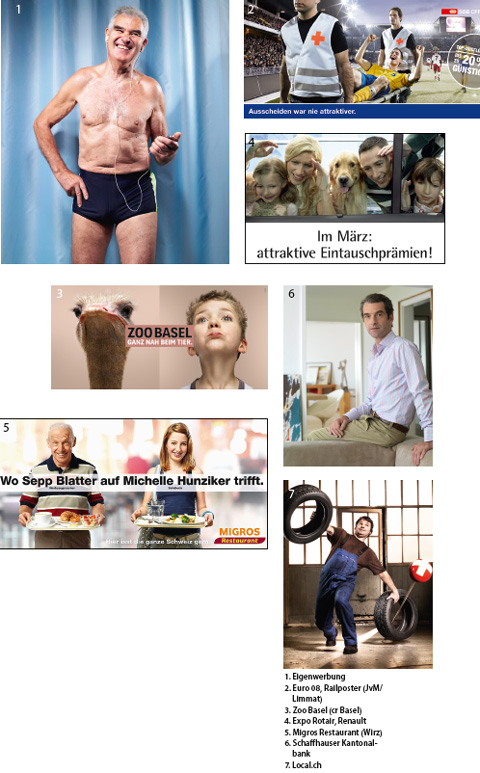
Jung, alt, dick, dünn, klein, gross, mit Locken oder Glatze. In Werbung und Kommunikation sind die unterschiedlichsten Charaktere gefragt. Gefunden werden sie von Agenturen wie Streetcasting.ch.

It all started with Andrea Sponring looking for suitable models for photographer friends. On the street, in the streetcar or on the train, she looked for people who could not be found in the conventional agency directories. A long jumper, for example, or a Chinese businesswoman. Photographers - and soon agencies - were increasingly hiring the microbiologist as a streetcaster, so she finally decided to expand her range of services. In 2005, the native Austrian founded her model agency Streetcasting.ch in Basel. It was a small-scale start. "I programmed the first website myself," says Sponring, who also works as a stylist. Streetcasting.ch, now based in Zurich, now has a pool of around 1000 amateur models: children, teenagers, women and men of different ages, looks and backgrounds. Even entire families - including pets - can be booked through the model agency.

In demand: Business type between 35 and 50

In certain areas, the database is so large that Sponring and her two back-office assistants can immediately pull out the right people when they receive an inquiry. There is a large supply of young women and men, who often do not even have to be searched for, but apply to Streetcasting.ch on their own initiative. Students in particular want to earn extra money with modeling assignments.

In other segments, Sponring has to become active itself and find the model types that match its profile via streamcasting, online portals or its network of contacts. Senior citizens, for example, are difficult to inspire for modeling assignments. Not seniors per se, but those who fit the image that advertising wants to convey. They should be "sprightly", "but still look like seniors." Sponring is also always on the lookout for middle-aged business men. A type that is currently in high demand. There are trends in general. Sometimes Sponring receives a lot of requests for teenagers, then again older men are more in demand. At the moment, it is mainly 35 to 50-year-olds.

In her search for these sought-after types, the stylist is constantly surprised. "Ask younger people," Sponring is often told when she wants to recruit a senior as a model. "Many people struggle to see themselves as attractive in old age." With younger men, on the other hand, it is not uncommon for her request to be misunderstood. "Some think it's a flirting ploy."

Sometimes Sponring receives particularly tricky or exotic assignments. Some time ago, for example, a South Indian rower was in demand. The stylist had to find him in Switzerland. Not easy at all. Firstly, the pool of suitable candidates (of South Indian descent and also suitable for rowing!) is manageable and secondly, once found, the candidates also have to accept the modeling assignment. The stylist capitulated. "I said it would probably be easier to shoot the photo shoot directly in South India." While Streetcasting.ch used to be requested mainly by photographers or their representatives, agencies now increasingly want to book models themselves. Some search for candidates directly via a filter on the website. Male or female? Hair: blond, dark, red, gray or bald? Stature: lanky, normal, muscular or tall? Other clients leave it up to the agency to make suggestions.

The all-rounder versus the special one

For some projects, Sponring only provides the models, for others she is also booked as a stylist. This is an advantage because she knows the models personally and can assess which clothes might be suitable and for which setting a model is suited. There are the all-rounders who can play different roles, "from barbecue master to business type to snowboarder to father". Others seem destined for a special role. One man from the file, for example, is perfect at impersonating the Pope, as the stylist explains. He is booked for this again and again.

Sponring describes her role at Streetcasting.ch as an interpreter who mediates between photographers or agencies and the models. Most of the amateur models don't know what to expect when they go on a job. The stylist prepares them for their assignment, explains what they need to look out for, but also what their photos will be used for, when and where they will appear. "The models always know what happens to their photos," she emphasizes. Last but not least, the stylist has to gain the trust of the laypeople and eliminate any uncertainties. Thanks to TV casting shows, many of them know a little better these days. "Everyone now knows what a casting is. And nobody pays 5,000 francs for a casting anymore on the assumption that they'll make it as a model afterwards," she jokes. However, the fact that some people are still willing to pay money for dubious offers is shown by certificates of meaningless modeling courses that Sponring receives from applicants from time to time. At Streetcasting.ch, candidates do not have to pay anything to be included in the database or for the castings. They receive money when they are booked for a project.

The encounter with the amateur models is also what makes the profession so fascinating for Sponring. Working in an agency with professional models did not appeal to her. "I work with all kinds of different people. Sometimes I place a train driver from Biel, then again a scene DJ from Basel. That's what makes the job so special."

Isabel Imper

agas
 

City of Zurich awards concessions for billboards

Four companies will share the public poster spaces in the city of Zurich over the next six years. According to the tender criteria, the use of the approximately 1,400 commercial billboards will go to the highest bidders.

A total of six companies have applied to manage the commercial, cultural and political poster sites. The city council has awarded the poster leases in public spaces, as detailed in a press release on Thursday. Four lots were awarded to Allgemeine Plakatgesellschaft APG. Clear Channel Switzerland will receive two lots. The individual locations were awarded to APG, Clear Channel Switzerland, Glattal Media and Publicitas.

The most economically advantageous offer was considered from the total of 417 municipal cultural poster sites. This was awarded to Clear Channel Switzerland. With the new contracts, the City of Zurich will be able to increase its annual revenue by around 33% to around CHF 2.6 million between 2013 and 2018 compared to 2011. The free political and official billposting and the discounted billposting options in the F4 world format will be continued.

Around 200 poster sites on public land were removed as part of the tender. This corresponds to 10 percent of the total volume. These poster sites are of little interest in terms of advertising and no longer meet the aesthetic requirements.

For the past six years, two companies have shared the billboard space in the city of Zurich. (SDA)
 

Last but not least: Hangout with Gölä and Google+

Gölä fans who didn't get a ticket for the "Ängu u Dämone" concert in the Hallenstadion can follow the concert live and free of charge on Google+ today, Thursday. The gig will be shown as a Hangout on Air on Gölä's Google+ account from 8pm.   

Fans log in with a Google+ account Plus.google.com/+Gölä and join us live from 8 pm. A Hangout is a video conference in which up to ten people can communicate at the same time, whether from home, on the computer or on the move with the mobile Google+ app. A Hangout can be held "on air". This means that the Hangout is broadcast live on YouTube and can be followed by anyone around the world.

Bastian Baker, the Klitschko brothers and various internationally renowned personalities such as US President Obama and the Dalai Lama have already made contact with their fans in this way. Now Göläs Göläs' "Swan as white as snow" also floats across the stage. Here you can be there live.

Wirz: New spots for Pretuval in the can

The pharmaceutical company Bayer Switzerland has commissioned the Zurich-based agency Wirz to create a campaign for Pretuval film-coated tablets. The campaign is intended to emphasize that these tablets are particularly suitable for taking at the office.

Anyone who drags themselves to work with the flu thinks to themselves, "It can't get any worse." But wrong thinking. It can get worse, much worse - because flu symptoms such as headache, aching limbs, cough, cold or sneezing can get you into a lot more trouble than you might imagine. The three new TV commercials show this in just seven seconds each. In them, the viewer sees what the symptoms mentioned can do to you.

Responsible at Bayer Switzerland: Luca A. De Vito (Head of Marketing), Simone Kurmann (Brand Manager), Susanne von Rohr (Medical Manager Cough&Cold). Responsible at Wirz Advertising: Philipp Skrabal (ECD), Hanspeter Schweizer (CD), Rob Hartmann (Art Direction), Marietta Mügge (Text), Karin Krummenacher, Flurin Hardt (Consulting), Fabienne Huwyler, Sebahat Derdiyok (Agency Producing). Responsible at Pumpkin Film: Jon Barber (director), Alex Kirschner (sound design). Media: Mediacom.

Emotional branding pays off

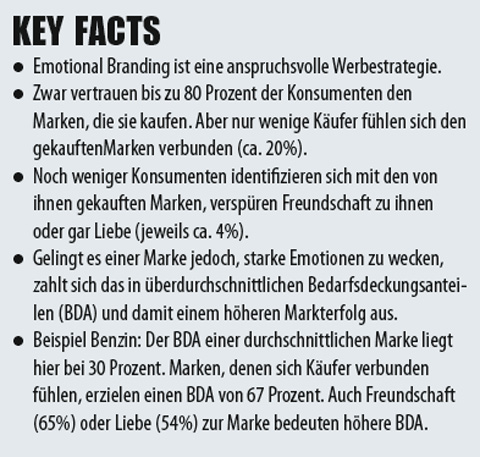
Emotional branding - the creation of positive brand emotions - is a challenging but also very promising advertising strategy.

A new Australian study, for which Murdoch University, the University of Wollongong and the Interactive Television Research Institute surveyed 1025 consumers, shows that only relatively few brands succeed in arousing strong emotions in buyers. However, brands that manage to do this are clearly preferred - they achieve above-average market success.

The first part of the study looked at the extent to which brands evoke positive feelings in buyers. Brands were surveyed in four different product categories: Men were asked about beer and petrol brands, women about coffee and detergent brands. It was analyzed whether customers trust the brands they buy, whether they feel a connection to the brands, identify with them, see the brands as friends or even love them.

It turns out that only a few brands manage to arouse the stronger emotions - attachment, identification, friendship or love. Only around 20 percent of study participants feel connected to the brands they buy, i.e. they describe the brands they buy as "theirs". Identification, friendship and love are even rarer, with only around 4% of customers feeling these for the brands they buy. The situation is different when it comes to trust in a brand. Four out of five women surveyed trust their detergent brand, for example. Similarly, 69 percent of men have confidence in the beer brands they buy. In short: comparatively many consumers trust the brands they buy. However, only a few brands are able to arouse stronger emotions.

Emotional branding is therefore clearly a sophisticated advertising strategy. This raises the question of whether it is worth pursuing such an approach at all? The second part of the Australian study, which examines how emotions affect consumers' purchasing behavior, provides some clues. The study participants were asked to allocate their total purchasing volume to different brands in the product categories examined. For example, they had to indicate how their expenditure on beer was distributed across different beer brands (= demand coverage percentage, BDA).

The answers show that consumers clearly prefer brands with which they feel connected, which they regard as friends or for which they feel something like love. These brands clearly achieve above-average shares of demand coverage. Brands that are "only" trusted or with which consumers identify, on the other hand, do not achieve above-average BDA. An example: according to the study, men spread their spending on petrol over three brands on average, i.e. the BDA of an average petrol brand is 30 percent. In comparison, petrol brands that arouse strong emotions achieve significantly higher shares of demand coverage: Brands that men feel connected to achieve a BDA of 67 percent, feelings such as friendship or love also result in above-average BDAs (65% and 54% respectively). Strong emotions also have a similar effect in the other product categories. Overall, it can be seen that the degree of positive emotions a brand arouses correlates to a high degree with the extent to which a brand meets demand (correlation coefficient 0.67).

Clemens Koob

em_0
em02
 

Publishers under pressure

In an interview with *Werbewoche*, two pioneers of real-time advertising explain why publishers will not be able to avoid this trend sooner or later.

publisher01_300x170
 

WW: When it comes to trading online advertising space in real time, so-called real-time advertising (often referred to as real-time bidding), a trading desk is a central concept. What was the motivation for your company to become active with a trading desk?
Prince: The realization that these technologies are already being used in the USA and the UK. And so, about two years ago, we started looking around for technologies that could be used in Switzerland. It was a long process until we found a partner like App Nexus and were able to really get started. The breakthrough came when it became possible to buy cross-border traffic automatically from Switzerland. We've been using this for a year now and it's going extremely quickly.
 
Did you also start at Mediaschneider two years ago?
Semmler: A little later, although the basic considerations were similar. Another point was all the foreign networks that were pushing into Switzerland, buying the same traffic from each other and then selling it to the advertiser at ten times the initial price. We wanted to at least partially eliminate this with a more intelligent purchasing system and better targeting.

Read the whole interview in the current print edition of Werbewoche.

Exact! records new customers

Bern-based advertising agency Exact has won a new client. The new customer is the Swiss mail order company Wullehuus.

The agency's main task will be to increase awareness of the Wullehus and to develop new customer segments. Through close strategic cooperation, various measures will be analyzed and implemented - classic communication, online activities, PR and direct marketing.
 

TBWA\Zurich heralds autumn for McDonalds

Fall is Swiss Weeks time at McDonald’s. This year’s national campaign will feature last year’s guest favorites during the promotional period from October 22, 2011, to December 23.

While the McZüri and McRaclette in the TV commercials delight the whole of Switzerland beyond all cantonal borders, the protagonist in the TV commercial for the Simmental Prime enjoys his pre-Christmas feast at McDonad's in an intimate setting. The spots were filmed in Switzerland.

Responsible at McDonald's Switzerland: Thomas Truttmann (Marketing & Communications Director Switzerland & Head Sports Europe), Thomas Frésard (Marketing Manager), Sébastien Dubey (Senior Marketing Consultant), Séverine Caspard (Marketing Consultant). Responsible at TBWA\Zurich: Thomas Ammann, Marcus Josty (Creative Direction), Natasa Maricic (Text), Marek Zdarsky (Art Direction), Sven Oeschger (Client Unit Director), Remo Christen (Account Director), Sharon Nehrenheim (Account Executive), Christina Bürgin-Hengstmann (Art Buying), Pumpkin Film (Production), Frieder Wittich (Director), Online (Post Production), Hastings (Sound).
 

get_footer();