Republica puts together package for BLS double-decker trains

Last December, Republica won the competitive pitch for the launch of BLS’s new double-decker trains. The agency has now rolled out the double-decker trains in three phases.

The official start of the launch was the roll-in and naming of the first double-decker train "Mutz" (Modern, Universal Traction Train). The event was part 1 of Republica's overall concept. It was created and organized entirely by the agency.

Part 2 of Republica's package is the sponsorship concept: BLS becomes a gold partner of SC Bern. This gives BLS a stadium presence on the team jerseys and the boards. In addition, the "Mutz" and the "Mutzen" will appear together for the advertising campaign in BLS and SCB media (Tonight, Spirit fan magazine, BLS Streifzug). The fan bank promotion rounds off the sponsorship concept. Fans can apply online for a place on the fan bench to experience a game up close.

Part 3 is the current promotion of the rail shows that will take place in November. These will be accompanied by both classic advertising (F12 posters, railboards, advertisements, information flyers) and online advertising. The "Mutz" can be duly celebrated during the rail shows: at several BLS stations there will be small public festivals in honour of the double-decker train, which Republica has designed and organized.

The last of the 28 "Mutzen" will mark the end of the entire launch in 2014.

Responsible at Republica: Alexandre Jaquet (overall responsibility), Stéphanie Schneuwly (consulting), Chris Morgan, Mike Krüll (creative direction), Youri Laubscher, Kasper Kobel (art direction), Anne Boxleitner (text), Lara Klopper (graphics), Alexandre and Gabriela Jaquet (event), Remo Ubezio (photography). Responsible at BLS: Project management: Christian Schneider (Head of Product Management and Services), Mark Bachmann (Head of Advertising).

Ruedi Bruderer new president of the SSM media union

The Swiss Media Workers' Union (SSM) has a new president. At a convention held Thursday in Lucerne, members elected Ruedi Bruderer to succeed Barbara Büttner.

Büttner held the post for twelve years. The 55-year-old Bruderer is a journalist at Radiotelevisiun Svizra Rumantscha RTR in Chur. He is assisted by Rafaël Poncioni, a journalist at Télévision Suisse Romande TSR, and Benjamin Tanner, a director at Schweizer Radio und Fernsehen SRF, as vice presidents, according to SSM.
 
According to its own information, the SSM union has 3,500 members, mainly from the electronic media. Recently, the SSM concluded a new collective labor agreement with SRG. (SDA)

Rohner Spiller in a new look

Over the past few weeks, Rohner Spiller has undergone a comprehensive transformation: with a new brand identity, a newly conceived and redesigned website, and an expanded range of services.

The enhanced overall appearance is intended to reflect an even stronger focus on the needs of individual customer groups - above all architects, planners and designers. "Our high service and delivery readiness and our fair prices have made us an ideal partner in the printing sector for architects and planners," says Managing Director Remo A. Martin. The website, which has been developed from scratch, takes the current needs of these target groups into account and generates a lot of additional benefits.

bild_remo_martin_160x120

Weko takes aim at Goldbach Group

The Goldbach Group has come under the scrutiny of the Competition Commission. At the end of August, the Competition Commission initiated a preliminary investigation against the advertising marketer, Carole Söhner-Bührer, Vice Director Infrastructure of the Competition Commission's secretariat, confirmed to the financial news agency AWP.

As part of the preliminary investigation, Goldbach's practices with regard to radio and TV marketing will be examined broadly and examined to determine whether there have been any violations of antitrust law. Such violations could include hindering competitors or exploiting customers. "At the moment, we cannot say any more about the ongoing preliminary investigation," says Söhner-Bührer.

According to Söhner-Bührer, the Comco has taken action on the basis of complaints. The results of the preliminary investigations should be available in summer 2013.

Goldbach Group has taken note of the preliminary investigation and is cooperating with the Weko to clarify the facts, Goldbach CEO Klaus Kappeler told AWP. He said he was confident that the clarifications would show that his company was complying with antitrust requirements. "Conduct in compliance with antitrust law is Goldbach's top priority," Kappeler added. (SDA)

Astérix against Google

Google is being told to pay—and is threatening the press with a boycott: France is waging an anti-colonialist culture war and resistance. By Jürg Altwegg, Geneva correspondent for the Frankfurter Allgemeine Zeitung.

Does a cab driver who takes his customer to a restaurant have to pay the landlord? Indeed, the idea is grotesque. And for Google, it is a slightly hypocritical symbol of the claim that the search engine should participate in financing the content it links to. In this logic, Google is the free cab. According to its own self-image, the US company would have every reason to charge newspapers for the billions of clicks - just like other companies to which it brings customers.

After Germany, where the Bundestag is negotiating an "ancillary copyright", publishers in France want Google to participate in the financing of content. Conflicts have arisen regularly in recent years. Hoteliers, libraries and book publishers have filed lawsuits. A fine of 100,000 euros was imposed in Paris because of Street View. Sarkozy had already planned a "Google tax". By building a company headquarters in Paris for 100 million euros, Google was able to appease the public again and again: More than ninety percent of all search queries are made via Google.

But now a rhetorical war is raging. Google triggered it in mid-October with a boycott threat: if parliament decided to allow the company to participate in the financing of newspapers, it would no longer link to them. "Google is dropping its masks," raged Laurent Joffrin, editor of the left-wing news magazine Le Nouvel Observateur: "In ten years, Google has increased its turnover by one billion euros. That of the companies that produce the content has fallen by the same amount. The American multinational shows that it is in no way concerned with the right to information. It has developed a system for declaring revenue that avoids any taxation of profits in France."

Politicians also spoke of the "blackmail of a democratically elected government". Last week, Google CEO Eric Schmidt was received at the Elysée: President Hollande set a deadline of three months in which an agreement had to be reached. The Canard enchaîné reported that the company had been sent a tax bill for one billion euros.

Under the left-wing government, the conflict is also being waged as a cultural war against America. As an ideological crusade, as it once was under Jack Lang against "coca colonization". "Google is in our heads", lamented the conservative Figaro. France is rehearsing its resistance - and sees allies in many places. In Brazil, newspapers are refraining from being linked. In Belgium, where Google lost the case against the publishers, the boycott of their newspapers was called off after three days. The Nouvel Observateur describes how individuals can do without Google - it is difficult, but feasible.

Google's bill is still paying off. However, the claim to make black and free riders on the Internet pay is not unjustified. The price that customers in the Google cab pay for the free ride is high: it is their personal data that is collected and marketed. To companies to which the search engine supplies customers who are willing to pay. Only in the press restaurant to which Google directs them do they behave like parasitic diners to whom Google, as a more or less legal fence, serves selected crumbs, snacks and individual courses on a tray. The bill for the food and the preparation is paid by the host and the other guests.
 

SVIK Rating: Golden Feather and Communicator of the Year

On Wednesday, the Swiss Association for Internal Communication (SVIK) presented the «Golden Pen» award in Zurich. The association also presented an award for the best internal communicator of the year.

The "Golden Feather" was awarded in five categories. Companies that perform their communication tasks with great care were honored, as the association writes on Presseportal.ch. The winners of this year's SVIK rating are: Credit Suisse, ZKB, Swisscom and SBB.

Winners of the "Golden Feather" by category:

Publications for employees: Credit Suisse, "One

Front cover: Zürcher Kantonalbank, "Tresor".

Text: Credit Suisse, "One.

Electronic internal communication: Swisscom, Intranet.

Concepts and strategies: SBB, Internal communication concept.

Internal Communicator of the Year: Stéphane Mader

The Head of Corporate Communications of the internationally active Bobst Group, headquartered in Lausanne, "exemplifies what technical and communication competence together with perfect quadrilingualism and company loyalty can bring: added value for the employees, the company, and for the products," says Daniel L. Ambühl, President of SVIK, explaining the jury's decision.
 

English copywriting at its best

Everything is a bit special about this agency from Geneva, which concentrates on copywriting - mainly "in English". To be something different from all the others - already with the business card, which is laid out like a small Leporello brochure, it does this.

Ten "C" words stand out on the ten sections of the Leporello business card: Contact, Content, Convey, Concept, Consult, Connect, Concise, Converse, Convert, Context. That adds up to, summa summarum: content & copywriting. "We are Switzerland's premier English copywriting agency." The claim sounds self-confident - but it is true. "Context - content & copywriting", as the agency is called, is in fact the very first English copywriting agency. The attribute "premier" superficially stands for "unprecedented", but also subliminally for "first" in the sense of quality. The fine English way of getting to the heart of the matter, not only aptly but also stylishly.

What's so different about this agency made up of copywriters? One swallow doesn't make a summer, but a few copywriters make an agency? It's not that simple, say the two managing partners, Romilly Golding and Phil Murphy. They have realized an independent business model that has never existed before in Switzerland, says Murphy. Nor abroad, as it turns out. "There may be similar business models in the field of graphic design, but pure text agencies that offer the entire spectrum of thought and writing - for all channels - have never existed before," he affirms.

English as a key competence

As far as "copywriting in English" is concerned, Geneva has always been a good breeding ground thanks to the presence of multinationals. There used to be the Marsteller International agency, which benefited greatly from being the only truly through-and-through Anglophone advertising agency in the Geneva square. However, this agency, which specialized in B2B communication as early as the 1950s and 1960s, was "full-fledged", i.e. a full-service advertising agency with a media and graphics department, which also cooperated with a sister company in the PR sector (which is still considered the world's No. 1 in the PR sector today). Does this suggest that "Context - content & copywriting" has followed in their footsteps? Not so, Context is different.

Phil Murphy elaborates: "We chose our claim 'We are Switzerland's premier English copywriting agency' carefully and thought about it for a long time before using it as a USP for our agency. Admittedly, it's a confident claim, but it applies across the board. When we came to the market with our business model, we realized that we were absolutely 'unique'. Because we thought beforehand that there would certainly be something like a 'Saatchi & Saatchi Copywriting' or something like that, but again, that doesn't apply. When we go to clients, we always find that they've never worked with a pure copywriting agency! With freelancers, yes, but never with an agency like ours - because there is no other! We cover the full spectrum of 'copy writing'. And when I say 'full spectrum', we divide it into two areas: on the one hand, the conceptual area, the development of entire campaigns, and thus a strategic dimension. On the other hand, there is the purely text-based work on individual products such as newsletters, media releases, brochures, annual reports, etc."

Why Geneva?

Geneva is a very good place for the agency's services, says Romilly Golding. On the one hand, the agency works for other full-service agencies; on the other hand, as mentioned, it works for locally based multinational companies, many of which have their European headquarters in Geneva. For these companies, it is a matter of course that English is the source or pilot language for all communication campaigns. However, Context also works for smaller, local agencies - for example, in their "mother tongue" French. Context is a polyglot and also serves clients from other regions, such as Vaud, the canton of Neuchâtel and - yes - the canton of Zurich.

Why Context?

We believe that professional copy helps you sell. Text is as important as design. It is only when customers start reading that the benefits of your brand can be fully understood. This is why we are committed to demonstrating the true value of the written word as a key element of your branding.

We act as a strategic content partner. As a business with ongoing marketing communications requirements, it's essential that you have a reliable, strategic partner that can act as brand guardian for all your written collateral. We act as a member of your team and help you to determine an evolving content strategy.

We have a wealth of experience in virtually every business sector. In our extensive portfolio, you'll find work for the following sectors: cosmetics & beauty; education & energy; engineering & industry; fashion; finance & banking; FMCG; health & medical; horology; HR & recruitment; IT; luxury; manufacturing; NGOs/IOs; pharmaceutical; real estate; telecoms; tourism & travel.

Zurich in sight

The keyword Zurich brings up the expansion of the still young agency: The two Managing Partners have already put the pin in the virtual map - Zurich is targeted as the next Context location. "Talks are already underway with potential branch managers," says Phil Murphy. "And it doesn't have to be a native speaker of English, it could well be a good copywriter of German tongue who can help us do business there."

Consistent wording
"The special concern of our agency is to achieve consistent wording for our clients ", says Romilly Golding. "The messages should be coherent across all channels like the famous red thread. From print to web, above and below the line. We see ourselves as the textual authority in each channel, like a conductor leading an orchestra." And she adds in English: "Where marketing spend is limited, it pays for businesses to invest in the written word to ensure that their key messages are disseminated clearly and consistently across all channels. Most brands demand substance over style, and great copy can inform, educate and sell." Every specialist in a particular communications discipline working for a company, he said, contributes to different orientations, diluting the message. Murphy: "We make sure that the key messages come across consistently, i.e. effectively - we help to re-structure things! He emphasizes: "We don't take clients away from other agencies, but we complement their services with our language and concept competence, we act as partners of other agencies and complement them!

Evangelize the text

"Many customers now also want to use social media and are successfully using the hybrid mix in their choice of means - we can help there too. They even call us in for 'blogging', because most companies can't write blogs themselves. You see: We 'evangelize' copywriting, so to speak, for all channels." The signs are good for a successful future. Context already has a number of prestigious companies on its client list, customers from a wide range of sectors such as the Wef, ABB, Phonak, Nespresso - nomen est omen. "We also differ from a loose grouping of freelancers in that we are always available for our clients, even when Mr. Murphy is sick or on vacation - the Context agency is always there for the client, we do have a brand approach, that's the difference."

Claude Bürki

eng01
 

Edi.12

The best Swiss advertising, industrial and corporate films have received their Edi. Around 250 entries competed for the honor. 21 films were honored by an illustrious jury. The event in Zurich's Schiffbau attracted over 750 interested people.

The winning spot "captivates with a surprising concept" or "Praise is due not only to the advertising agency and film production, but also to the client, who avoided the usual Swiss clichés - and instead focused on independence and originality", said the jury for the "Anthill" spot. This was awarded the top prize at Edi.12 to cheers from the audience and a shower of gold on stage. The film was directed by Oscar-winner Xavier Koller.

The same film with weatherman Martin Horat "only" won a silver cube at the ADC. But we are not here to judge the standards or even the qualities of a jury. A film competition is no less emotionally charged than the free skating routine at the World Figure Skating Championships. There are goals that can be counted more precisely in football and ice hockey. Another aspect of Swiss filmmaking, however, must not only be associated with emotion, but also be factually correct. "I was surprised at what I was able to discover here," said a prominent Chief Creative Officer in a short film about the judging process. "Pleasing, surprising, very good" were also the comments of other jurors from the local agency scene.

We can only hope that their insight will bear fruit in the upcoming pitches. Unfortunately, the editor of Werbewoche still often hears the following when researching new campaigns at many well-known agencies: "The commercial was shot abroad. But you shouldn't make a big deal of it."

The already very successful local film scene can only become even better if it is kept busy on a regular basis. And not just the producer who collects air miles, but also the stylist, the lighting technician, the animation specialist or the musician. And of course the director. After all, without Swiss commercials, even Xavier Koller would hardly have been able to survive the last few years after his Oscar with bread and still maintain his dignity until, hopefully, "a very harsh winter" is once again the order of the day in feature films.

Andreas Panzeri

edi01
edi02
edi03
edi04
edi05
edi06
edi07
edi08


More architecture for The Ideal Home

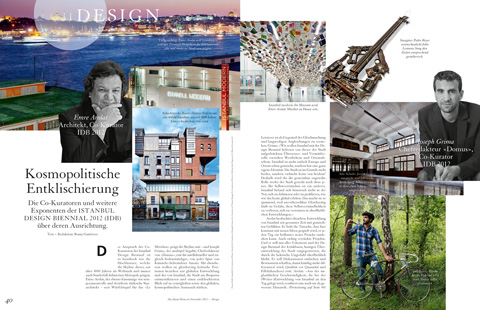
Since November, the home magazine Das Ideale Heim has been appearing in a new look and with a slightly different editorial concept. The architectural aspect is once again more in the foreground.

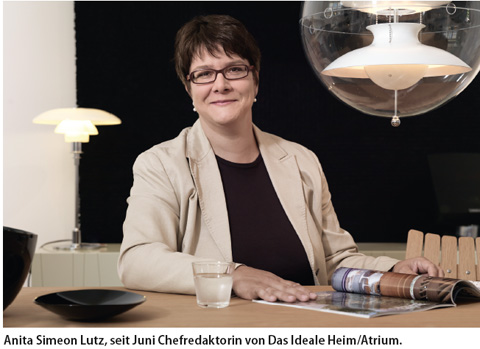
A new layout, a new editor-in-chief, a new - or rather - old name. From now on, the home magazine from Archithema Verlag, which was published for years as "Ideales Heim," will be called "Das Ideale Heim" again, as it once was. While the magazine has returned to its roots in terms of its name, it has said goodbye to the subtitle "Das Schweizer Wohnmagazin" and chosen the addition "Magazin für Architektur, Design und Wohnkultur". Not only because it sounds more modern, but also to emphasize that the topic of architecture is given a higher priority. A rebalancing of content that is primarily due to Editor-in-Chief Anita Simeon Lutz, who took the reins at Das Ideale Heim in June of this year. Simeon, who was editor in charge of the magazine Umbauen + Renovieren at Archithema Verlag a few years ago and most recently ran an architecture firm with partners, wants to emphasize the architectural aspect of the magazine more strongly again than design and art. How do I get hold of a property? How do I furnish it? Readers - primarily builders - are to find answers to these questions.

The content includes portraits of architecturally interesting private buildings, including the architects responsible, tips and news on furnishings and design, and a market overview. Characteristically for a home magazine, advertisers are given a strong presence throughout the magazine. Not only on advertising space, but also in special sections in which design and furnishing objects are presented, as well as in the service section in which suppliers and service providers recommend themselves. Each issue has a thematic focus such as light, condensed building, environmentally conscious planning, color, roof or facade. The annual special issues on topics such as kitchens, bathrooms and gardens are also included in the magazine.

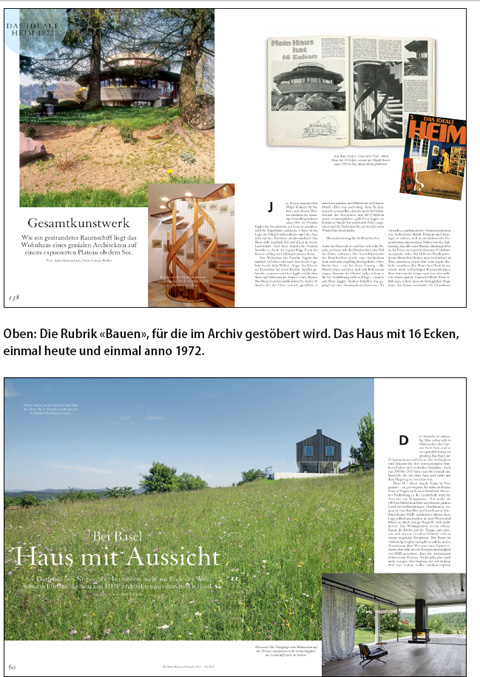
Visually, Das Ideale Heim is more modern and lighter, with many cutouts, interlocking images and more white space. Compared to the previous look, the new one is less rigid, which was the reason for replacing the layout that was only four years old. "The previous layout offered too little flexibility," Simeon explains. "The structures were rigid, with the size of the images and the space of the text predetermined, for example. " The new concept allows the page makers more design freedom. For example, new sections can be created easily if necessary. In the course of the relaunch, the structure of the paper was also changed. Whereas the editorial content was previously collected in the front section, followed by the service section, the journalistic articles are now spread across the magazine. The idea behind this is to ensure that the suspense curve does not drop off after the first part, but that the magazine is interesting for the reader as a whole. "When you flip through the magazine, there's always a peak that follows. Everywhere it has spots where the reader gets stuck," says Simeon, explaining the concept.

Give more weight to the text

Orientation is not necessarily easy due to these innovations and the less clear line of the layout. However, the magazine is mainly designed for the eye. "We're not kidding ourselves. Our magazine is primarily looked at and only secondarily read. Nevertheless, if the reader is interested, he should get background knowledge and not just picture descriptions." The editor-in-chief wants to give more weight to the text. The Ideal Home should become more "journalistic," is the goal. "We want to buy in fewer stories, and instead do more on-site research and production ourselves." Five editors, who share 400 job percentages, are available for this purpose. Das Ideale Heim also wants to celebrate the company's 85-year history. A fact, with which the magazine appearing in an edition of 27 200 copies stands out from the two main competitors space and living (1977 based, edition: 28700) as well as the living revue (1988 based, edition: 20000). In the new issue, this joker is played out, for example, in the "Bauen " section, for which the editors rummage through the archives and track down what happened to the houses portrayed at the time. "We can learn a lot from the old issues. What worked in the past? What didn't? And would it work today?" Incidentally, the copies from earlier times also served as a source of inspiration for the new layout, which was created at the Interkool graphics office in Hamburg. However, Archithema Verlag is aware that it is not enough to simply look back. The current online presence is in need of an overhaul. By next summer, an interactive website with a blog and reports produced especially for online use should be up and running.

Not a trade magazine - but not a "furnishing booklet" either

The architecture prize "Das beste Einfamilienhaus" (The best single-family house) will continue to be offered, with a jury of experts and a jury of readers each selecting a successful building every two years. A matter of reputation and image. "The architecture prize puts us in a respectable corner and secures contacts with experts," explains Simeon. Last but not least, the magazine has to fight time and again against being ridiculed by architects as a "furnishing magazine." Although Das Ideale Heim is not a trade magazine for the architects' guild, it does establish a link between architects, builders and residents by having an editorial team consisting of experts prepare good examples for lay people and provide them with background knowledge. "The architect has to take us seriously. At the latest when the client comes to the architect's office with the magazine."

In order to reach as broad a target group as possible, the magazine focuses not only on construction, but also increasingly on living and furnishing. "Switzerland is the land of tenants. If we want to expand our readership, we have to appeal to them." However, predominantly high-income tenants. Because the design and construction properties portrayed are not exactly inexpensive. "A residential magazine has to cover dreaming and sometimes reach for the stars," Simeon says. "But everyone is allowed to be inspired, even those who don't have the budget."

Isabel Imper

ih02
ih01
ih03
ih04

The Impact Check of Werbewoche

We show how current campaigns are performing with consumers.

In terms of awareness, the Migros ad by Advico Young&Rubicam ranks first, followed by the Swisscom ad by the agency Numéro 10 and the ad for Appenzeller cheese by Contexta. The Appenzeller Käse ad takes first place in the “Uniqueness” category, ahead of the Villiger Cigars ad by Metzgerlehner and the Sonntags-Zeitung ad by Advico Young&Rubicam. In the “Brand Fit” category, the Appenzeller Käse ad also takes first place, ahead of the Volvo ad by Spillmann/Felser/Leo Burnett and the Läckerli Huus ad by Contexta. Appenzeller Käse also wins in the “Likeability” category, ahead of Läckerli Huus and Villiger.

The Impact Check from the November issue of *Werbewoche* (PDF)

Impact Check November 2012: Detailed Results (PDF)

New Key Account Manager at Publicitas Publimag

Marcel Graf has been responsible for the Swiss trade newspaper in German-speaking Switzerland as Key Account Manager at Publicitas Publimag since November 1, 2012. He succeeds Sevil Gür.

On November 1, 2012, Marcel Graf took over as Key Account Manager from Sevil Gür, who left the company at the end of October to take on a new role. Graf is responsible for marketing the Schweizerische Gewerbezeitung in German-speaking Switzerland. This was announced by Publicitas in a press release on Thursday.

The Schweizerische Gewerbezeitung is aimed at managers in the SME sector and provides information on economic, social, financial, political and educational topics.
 

Messages in black and white

Online advertising is seeing the highest growth rates. But good old paper hasn't yet had its day as a medium for highly targeted advertising messages. Here are three examples of how books can be used for marketing.

bleiche

The secret of the brand thriller

Andreas Giger wanted to give the guests at his birthday party in summer 2011 a special souvenir of the Appenzellerland. The social researcher wrote his first crime novel for the occasion. The 166-page novel centers around a fictional story about the myth of Appenzeller cheese. "Eine Leiche in der Bleiche" was first distributed as a private edition. "The positive reactions from those around me encouraged me to send a copy to the Appenzeller Käse variety organization," says Andreas Giger, explaining the continuation of his literary success story. The people in charge at Appenzeller also liked the thriller and had the book printed in an edition of several thousand. Since then, the book has been given as a gift to business partners and loyal guests of Appenzellerland. This in turn led to the renowned regional thriller publisher Emons in Cologne becoming aware of the thriller from Appenzell.
In the meantime, it has been included in the autumn program and "Eine Leiche in der Bleiche" is now available in every bookshop. Andreas Giger, a trained social researcher and "reflector" who also writes books on non-fiction topics such as "The Vision of a Mature Switzerland", has since turned the development of "brand crime novels" into a new line of business: fictional stories based around the myth of a brand. Unlike the cheese thriller, however, where Giger wrote his thriller without a commission from Appenzeller, the terms of a new project would have to be discussed in advance.
More information on: www.gigerheimat.ch

bolliger

Eczema follows the streetcar driver

From now on, visits to the doctor are a pure pleasure again. At least if you visit a family doctor in the city of Zurich. After last year's "Das Geheimnis des Tramführers" (The Secret of the Tram Driver), the second GP novel is now available there, for which Spillmann Felser Leo Burnett was once again able to secure the services of author and actor Patrick Frey. In the second part, Frey tells the story of the life of family doctor Dr. Daniel Bolliger, the ingenious diagnostician from Goldbrunnenplatz, with a great deal of wit and charm. This time, the story revolves around a 42-year-old folk music singer who visits the family doctor's practice because of an attack of eczema and draws Dr. Bolliger into a vortex of despair and secret passion. In addition to suspense and drama, the reader is introduced to the advantages of being a family doctor with a wink and a pinch of self-irony. "The success of the GP novel is based on the fact that we bring the advantages of the GP model closer to people in an entertaining and self-deprecating way. The reader decides to read our message voluntarily and with great pleasure. Of course, this is also because it comes in a package that is unusual, but still suits GPs very well. And, of course, because in Patrick Frey we have been able to attract a well-known author who has put his heart and soul and knowledge into writing exciting, palatable stories," explains Patrick Suter at SFLB. The agency wanted to write a second GP novel "because the patients themselves were constantly asking for a new GP novel". SFLB cannot yet say much about the feedback on the current novel "Das Ekzem war ihr Schicksal". However, a public reading at Sphères was a success: people even had to sit on the stairs and there was a lot of laughter. As at the last reading, the scenes were performed very wittily by Patrick Frey and two fellow actors. From August to September 2011, almost all of the 5,000 copies of the last GP novel "The Secret of the Tram Guide" found their audience via the Zurich GPs' website. During the period in question, the click rate on the site was more than twice as high as in times without literature. The GP novel can be ordered via:
www.hausarzt.ch
 

burgermeister

Massage products as product placement

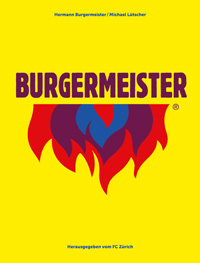
FCZ has relied on the services of Hermann "Hermi" Burgermeister since 1975. The equipment manager and masseur with a lifetime contract has long been a cult figure. "A living legend", as President Ancilla Canepa says. Now, thanks to the support of Perskindol, the Zurich city club has been able to publish a book with a kind of memoir of its good spirit. "Master! Burgermeister!" The book was written by Michael Lütscher, who has already written the FCZ biography "Eine Stadt, ein Verein, eine Geschichte". Lütscher has also made a name for himself as co-editor of a music magazine and background editor at the SonntagsZeitung and as a reporter for Cash. The journalist and non-fiction author regularly gives restaurant tips on the Tages-Anzeiger portal.
 
The man with the Perskindol is here
The book "Burgermeister" was published just in time for Hermann Burgermeister's 65th birthday in October. Despite his retirement age, the FCZ legend is far from thinking of giving up, as he promises in the richly illustrated book. In the book, Lütscher has compiled countless anecdotes and experiences from Burgermeister's many years at the club. The collection also provides a look behind the scenes of top-level football. In addition, prominent current and former companions such as Köbi Kuhn, Lucien Favre, Sven Hotz and Sepp Blatter comment on this exceptional figure in the world of the fast-moving football business. Hermann Burgermeister is also a household name to all FC Zurich fans. They know him from every game: if a player is injured on the pitch, Burgermeister rushes onto the pitch with his bag to administer first aid. Always with him, of course: his Perskindol bag filled with numerous miracle cures. Burgermeister, who always appears on the pitch in a bright yellow Perskindol shirt, symbolizes the soul of FCZ, because he embodies the virtues of the sport: commitment, loyalty, enthusiasm.
Available from the FCZ fan club at Sihlporte.

get_footer();