BMB addresses demanding customers for Stöckli

The new advertising posters from the Swiss ski brand Stöckli Outdoor Sports feature ski stars—sexy and tough—in the style of Hollywood movie posters. With these posters, created by the advertising agency BMB, Stöckli aims to highlight the expertise of its consultants.

After last winter's advertising appearance with top athlete Tina Maze (Werbewoche.ch reports http://www.werbewoche.ch/bmb-kampagne-fuer-stoeckli-swiss-sports-entwickelt), the agency also launched a campaign with ski stars this year. As part of the new additions to the Stöckli-Alpin women's team, the agency focused on Swissness and staged the three charming Swiss speed national skiers Fränzi Aufdenblatten, Nadia Kamer and Fabienne Suter as demanding customers. The counterpart is formed by the men Mike Schmid skicross Olympic champion, freeskier Christian "Minimi" Bieri and extreme skier Dominique Perret, who look challengingly into the camera as uncompromising customers.

If you like the posters, you can win them with a bit of luck. Stöckli is giving away 25 special prints each of the women's and men's posters. Anyone can take part by applying at the following address: Stoeckli.ch/poster

stoeckli1
stoeckli2

Gourmedia restructures management

Growth and development at Gourmedia have led to an expansion and restructuring of the management team. As of January 1, 2013, Anthony Alex, Ralph Lindenmann and Wolfram Meister will form the new management team.

Ralph Lindenmann will continue to focus on customer care, advertising sales and events. The new Gourmedia Managing Director will be Wolfram Meister, who will also remain Editor-in-Chief.
 

"The next big thing in social marketing"

Joiz - "the social TV platform" from Switzerland - was invited to take part in a panel at the internationally renowned Noah Conference in London. For Joiz CEO Alexander Mazzara, the appearance in the company of Google, Facebook and Twitter was more than worthwhile.

WW: What interested Joiz from Switzerland in this international Noah conference?
 Alexander Mazzara: The Noah Conference is one of the most important Internet conferences in the world. One edition takes place in San Francisco in spring, the second in London in late fall. The conference has been running since 2008 and an important topic is the developments in social media, which have also really taken off during this time. All the major players are present at Noah: Facebook, Google, Twitter. But also older companies such as SAP, where social has now become an important part. There are also many smaller start-ups with global operations, such as Badoo. This global dating network is growing at a phenomenal rate of 100,000 new members per day. At the conference, such companies can exchange ideas and at the same time get to know investors, i.e. venture capital and private equity.
 
What was Joiz's contribution?
I was asked if I would like to present our social TV on a panel. The topic was: "The next big thing in social marketing". We were a panel with Facebook, Twitter, Badoo, Google and Joiz. Each company presented its current projects in a 15-minute presentation. I showed how our TV and social worlds work together on one platform and gave insights into our Red Button. Twitter showed how, during the European Football Championship, there was a lot of tweeting during the matches in the participating countries. Facebook presented a lot of advertising. Badoo presented an exciting project. They are building a customized landing page for each individual user. Using all kinds of cookies and lots of intelligent methods from Adtelligence, a German social marketing provider, they determine in advance which profile a user might have. The new developments were then discussed. How will media use change? What are the business models behind it? How can money be earned?
 
What did you learn about advertising in London?
Advertising forms were a major topic. Facebook in particular has shown how forms of advertising are changing and merging with "editorial" content. On the website, Facebook has classic forms of advertising that are also booked very well. But as soon as it goes mobile, the site looks different. Then, of course, the classic display formats no longer work. It's not just Facebook that has this problem, but all media that go mobile. Publishers in Switzerland are also complaining that they have not yet managed to earn money on mobile in the advertising market. Facebook has shown which models they want to work with in the future. The same with Google. Here it was explained how Google+ wants to integrate all advertising and thus find new forms of advertising. In other words, to find an extension from the search area into social media.
 
How has Joiz been received within these new developments?
It was a large group that listened. Very international. I was approached extremely often, even from Russia to South America. A lot of Americans are watching the trend in the USA very closely and see clickable TV commercials as a new model. They are usually faster and more advanced than we are in Europe - but we at Joiz already offer this with the Red Button. That really impressed them. But there were many exciting discussions, after which we can say: Joiz has already come a long way. From Switzerland, you might not have this kind of foresight. That's why this exchange is so exciting.
 
What have you learned from the others?
I think we can confidently say that we are leaders in Europe when it comes to social TV. In the USA, however, the really big broadcasters are also implementing this. CBS and NBC have individual formats that have very similar functions to Joiz. In this sense, everyone agreed that this will be the future. Some will implement it more quickly, others less so. But it is certainly something where Joiz is under a lot of scrutiny in Europe. Facebook and Google will soon be visiting us in Oerlikon with people from London. They want to know how it works - and we want to know what works for them. International exchange is of strategic importance to us because we can learn a lot from it. Maybe not how to make television, but we can all learn a lot about new advertising and revenue models. The world is turning faster and faster in this area - and Joiz is right in the middle of it.
 
Is Joiz a model?
Yes, you can say that.
 
What are current projects?
We are constantly expanding our platform. And at a very fast pace. We also have a lot of projects with advertising partners at the moment, for whom we are creating new formats. Two companies that were on site at Noah want to do something with us - as well as many Swiss companies, of course. We mustn't forget: Joiz is only 18 months old, and we are only really starting to expand here too. There's a lot in the pipeline for the next six months. There will be new formats, for example an interactive quiz where viewers can win from home. It's not the candidate in the studio who can win, but the viewer at home. That has a lot to do with the way we work now.
 
What is your flagship?
We do not yet have any TV figures. The new measurement system will be introduced in Switzerland on January 1. We will then also be part of this panel and will be able to present the first figures. But we already have a lot of direct feedback today. It's certainly the tracks that are live. Our "M-Budget-WG" caused quite a stir. "Living Room" and "Home run", two music shows where we have guests every day. But also "Ovo and Charts" at the weekend, a chart show from 11 am to 2 pm, where we have a community that gets very involved and, for example, announces in advance on Twitter: "Get up, Joiz is coming!"
 
Advertisers in Switzerland are not very brave when it comes to new things like this. They always want to see figures first. How do you experience this?
It's exactly like that, yes. Media agencies form a world of numbers that is very difficult to impress without numbers. But it's not as if we don't have any figures: Online, interactions, reach and Facebook insights - but no TV figures yet. However, we experience something different when we are in contact with customers: commitment, involvement and the quality of contacts count. Of course, the effort required to prove this is somewhat greater than simply evaluating GRP - but the value is also significantly higher. However, courage also always has to do with the fact that the competition is much smaller - and therefore the need to be courageous.
 
How is Joiz positioned?
We are just under 60 people and produce a lot. Especially in the area of branded entertainment, we offer entire integrated campaigns that require a lot of know-how and manpower to implement. Of course, advertising partners can book spots or just a banner with us. But we develop integrated concepts for many clients - very often together with their advertising agency. For Migros with Jung von Matt/Limmat, for example, or with TBWA for Toblerone. Here we develop a concept together with the client and their agency - tailor-made with various components. This often involves interaction between different departments, editorial, sales, marketing and social media. A lot of parties are involved and they have to talk to each other. That's why our employees are very close together, all in one big room. One of our advantages is speed. We sometimes have advertising customers who want something bigger and it has to be live the next day, including editorial content. We can handle that, no problem.
 
 Interview: Andreas Panzeri

joiz01
 

The eye on the point

Using a new method, eye-tracking can also provide cost-effective yet valuable insights online when pre-testing campaigns.

Not only a growing number of competitors, but also the greater variety of communication channels makes it difficult to reach consumers effectively. In this situation, hardly any company can afford to run ineffective advertising anymore. Classic advertising pre-tests are often the solution to minimize flop risks. However, heart and brain function on different levels. Therefore, more implicit research approaches are helpful. Eye tracking by means of an eye camera would be an ideal supplement. However, this is complex and cost-intensive.

Cost effective method thanks to online

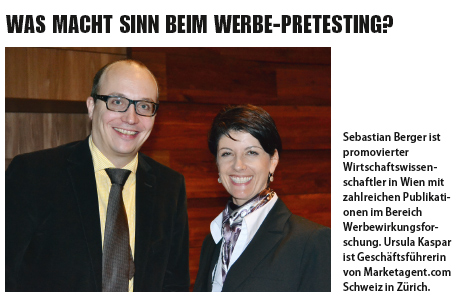
With the help of a new tool, eye tracking can now also be carried out online - at low cost and with a manageable effort. The method is offered in Switzerland by Marketagent. com Zurich. The system was developed in Vienna by the university spin-off company Dr. Berger Consult. Sebastian Berger is a university professor and lecturer at the University of Vienna and Megatrend International University Vienna. Among other international awards, Berger has been nominated twice for the Vienna Future Prize. In 2002, the development of the first online eye tracking methodology "Spotlight-Viewer" began at the Department of Marketing at the University of Vienna as part of a doctoral thesis. Since then, numerous publications and awards have proven the quality of this measurement tool. In 2012, the method was awarded by the editors of the renowned European Journal of Marketing and published in the top US scientific journal "Psychology and Marleting".

Sharp or blurry? That is the answer here

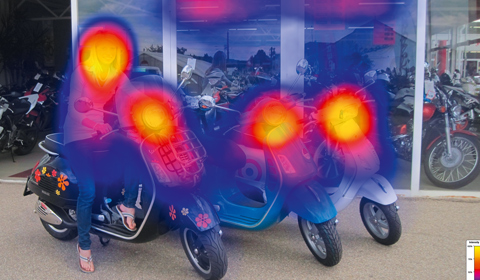
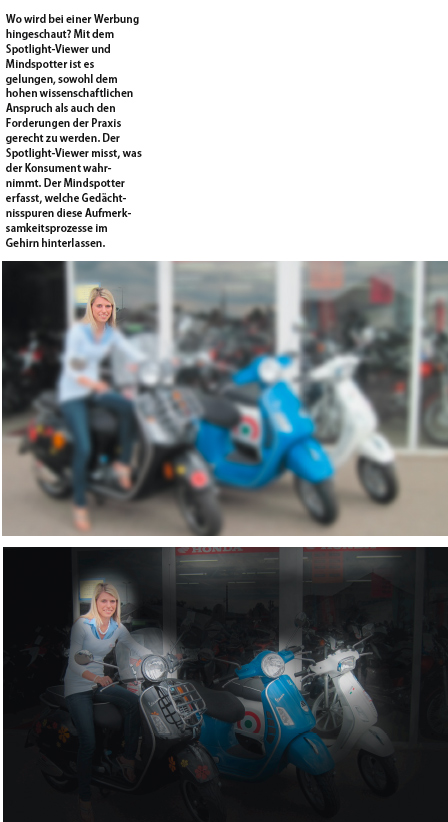
In the online eye tracking patented for university spin-off activities, the centrally sharp and peripherally blurred vision is projected directly onto the computer screen of the test person according to the physiological conditions of the human being. The test persons move the sharp field of vision with the computer mouse to those sections that interest them. On the basis of the viewing history recorded in this way, the advertiser learns what is paid attention to and what is ignored. Online eye tracking is now being used successfully by market research companies and panel providers, advertising and web agencies, media companies and media agencies, and advertising companies. These want to use it to optimize their advertising in terms of its attention-grabbing effect.

Science knows: 95 percent of advertising is not seen. That's why pretests must be conducted as early as the design process to ensure that the target group pays attention to the key advertising elements, in order to minimize the financial risk associated with advertising expenditure. Conventional infrared eye tracking was too expensive for this, "and the results are also distorted due to the artificial laboratory situation," says Sebastian Berger. Similarly, in previous methods, "the recording of mouse tracks and clicks do not form a reliable indicator of attention, because, for example, the mouse arrow rests when the user is reading something". The Spotlight viewer now measures much more accurately what the consumer perceives. This new online gaze registration has the following advantages: Participation takes place in a familiar atmosphere, for example at home.

Large sample numbers and target group comparisons are possible because online eye tracking is fast, simple and cost-effective. Online eye tracking can be easily integrated into existing online surveys and flexibly combined with other instruments such as mindspotters. All visual advertising stimuli such as advertisements, brochures, posters, product arrangements, packaging and websites can be tested. The Mindspotter can also record the memory traces left by these attention processes in the brain using "brain scanning". pan

w01
w02
w03

WW: What does a customer need to know when they want to pretest?
Ursula Kaspar: First you have to know: What do you actually want to achieve with the advertising pretest? Is it to test alternative ideas, is it to determine optimization potential, do you want to filter out the best spot or just learn for the future? If you don't think about this beforehand, you have a fundamental problem.
 
Why does it make sense to test a campaign in advance?
Although the world has turned massively, a study from 2003 that illuminated the mechanisms involved in pretesting is still relevant. Agencies and clients were unanimous in this: with more than 80 percent agreement in each case, they want to "track down potential for optimizing a campaign". In second place in importance, with around half of the agreement, is "finding out the specific impact mechanisms." Support for a "go or no-go" with a campaign was important for around 29 percent of the agencies surveyed. Clients obviously want a bit more certainty here. Of these, 45 percent want to support the decision to continue with a pretest. The will is usually strong, and the intentions are louder. But when it actually comes to implementing the pretest, many hurdles lurk. Often, timing is already a problem, and pretesting is thought of when the spot is about to air. But pretesting should not be an end in itself. If you already know what campaign you want to launch, then it's hardly worth testing. And if a TV spot has already been shot, hardly any changes or improvements will be made. It has been found that more than half of the spots that were tested at a very early stage for their optimization potential later performed exceptionally well in the market, whereas the spots that were only tested at a final stage had a significantly lower success rate.
 
What role do the target groups play?
It is necessary to precisely describe the target group. You can't apply the same scheme to everyone in a test. If a test is to be integrated into an "omnibus" because the budget is tight, one has to ask oneself: Is it really worthwhile to show concrete ideas for a campaign to a general population? Most of the time it is more promising to make socio-demographic or psycho-demographic restrictions or to directly ask the category user.
 
Other stumbling blocks?
If you only want to send one spot into the race, it becomes a bit difficult. If the test shows that the campaign could go down the drain, you have a small problem - because there is probably no alternative in the short term. It may be that one wants to compare differently designed advertising media - mostly because one already prefers a design route. However, the subject's imagination is relatively limited, and so the more elaborated advertising medium often performs better. Direct comparison of advertising media is also difficult, just as when comparing old against new. After all, if a well-known spot is presented that already has a positive effect, it will probably do better in the test than a new concept.

Interview: Andreas Panzeri

"We offer inspiration and a change of perspective"

For the sixth time, creative young people were honored as part of the ADC Young Creatives Award competition. In 2012, Cailler once again served as a prominent sponsor and challenge organizer.

In partnership with the youth channel Joiz, the prizes were presented at the Mascotte in Zurich on November 14. In the competition, teams of two create fictitious campaigns according to the specifications of the main sponsor. In addition to the Film, Outdoor, Cyber and Alternative Media categories, the 18-member jury also awards a special prize sponsored by Goldbach for creative mobile applications. As the winners qualify for the Young Lions Competition in Cannes, participants may not be older than 28 in the following year. According to the rules, it does not matter whether the young creative talent comes from the advertising industry or from university. However, most of the participants are already anchored in agencies.

Werbewoche asked ADC board member Philipp Skrabal about the background to the competition and wanted to know, among other things, what roles the agencies play and what benefits the main sponsor derives from the involvement. The Executive Creative Director and co-owner of the Wirz agency was primarily responsible for the ADC Young Creatives Award for the third time this year.
 
WW: Most of the participants work in the industry. Is the Young Creatives Award even about talent scouting or is it more about which agency employs the best young talent?
Philipp Skrabal: It has nothing to do with the agencies, the works are explicitly submitted by private individuals. We are not interested in having entire agencies take part, as is the case with other competitions. We want to show what young people who are not seen anywhere else can achieve. And that's how we find the talent that we send to Cannes the following year.
 
Nevertheless, the question arises as to how much the agencies are involved in the background.
I can't judge that. My experience shows: The ambition of young people is so great that they want to do it without help. They want to show what they can do - this is more effective if you work independently. Of course, the boss may be asked what he thinks of an idea. At Wirz, opinions are sought - but only at the end, when the product is ready.
 
Do many young, unknown people from outside the industry - students, for example - take part?
This fluctuates and depends heavily on whether lecturers provide information about the competition and encourage participation. In percentage terms, however, it is actually a rather small proportion. Too small, for our taste. 30 percent would be desirable and realistic.
 
Do they have any chance at all?
Especially in the film sector, where craftsmanship is also important, people from outside the agency would have good chances. In the other categories, professional proximity is probably an advantage.
 
Keyword Joiz: What do you expect from the collaboration?
Our primary aim is to arouse curiosity about our industry. To do this, you have to offer young creatives a stage - Joiz is ideal for this. If just one viewer thinks that this could be a career for them, it's already been worthwhile. What's more, it is certainly exciting for the participants to sit on the Joiz sofa for once. If only for the recognition in their social environment.
 
What happens to the winning entries? Will they be used by the sponsor?
Nothing is planned. The main sponsor is primarily involved because it wants to utilize the potential of the uninhibited youngsters. Unlike a pitch, what counts here is an honest, unfiltered opinion. The youthful diversity of ideas is like a change of perspective, an inspiration. It is not impossible that ideas will be implemented. However, the focus is on the 80 or so works that deal with the brand each year. And through a different lens than that of the people who are paid to do it every day.
 
Is the search for the main sponsor easy? After all, well-known brands have always been won over so far ...
The search is difficult. Sponsorship is equated with increased visibility. Despite Joiz and other media appearances, we can't offer that. But we can offer inspiration. A good that is difficult to quantify. The commitment therefore also has something idealistic about it. Fortunately, we have been successful in our search every year and have been able to attract Amnesty International, Migros, McDonald's, Mars, Swisscom and now Cailler. We are already looking for a sponsor for 2013 and interested companies are welcome to get in touch.
 
"Something idealistic" - so it also needs some goodwill on the part of the sponsors, as the benefit cannot be derived directly?
I think you can derive it very directly. This is shown by the exchange with previous sponsors, who have had extremely positive experiences: They were able to learn something about their brand themselves. A pitch quickly costs more money - but political solutions are delivered by agencies that want to win a budget. From this point of view, the commitment is a good deal. But you have to want to take your own brand further. In short, you have to see the value of this tool. Not everyone does.
 
Finally, a completely different question: the award in the form of a hand grenade - is there any negative feedback on this?
(laughs) The brain grenade, exactly. I took over the award in 2010 and the visual appearance has remained unchanged since the first edition. It symbolizes the "impactful" idea. Of course, that can polarize people. But the high recognition value replaces larger advertising campaigns, for which we lack the resources. If the grenade appears in 20 Minuten or in Werbewoche, people know: aha, it's that time again. But if there were any complaints, they probably wouldn't get through to me anyway (laughs). But I think people are relatively painless about it.
 
Interview: Thomas Häusermann

psrk
yca01
 

Eclat included in Europe Design Organization

The European Design Organization has included Eclat in the ranks of the fifty most creative agencies in Europe. This circle of European Design Leaders includes names such as Pentagram, Studio Dumbar, Meta Design and Mutabor.

In the citation, great praise is given to Eclat's independent path. Demetrios Fakinos, Managing Director of the European Design Organisation writes: "In recent years, Eclat's work has been judged by independent and qualified jurors as outstanding, innovative and effective, which sets Eclat apart from the competition. (...) Due to the continuous exceptional quality of the work, there is no doubt that Eclat is an important asset as a provider of design and visual communication, and a partner that every client should trust and work with."

European Design Leaders EDL is a maximum fifty member club. To qualify, agencies must have won one of the following awards during at least three of the last five years: D&AD, Design Lions, European Design Awards, IF Communication Design Award and Red Dot Award: Communication Design.
 

Advertisers make content

In a conversation with Nick Blunden, the head of digital at The Economist, potential solutions emerge that are still rarely pursued here.

The Economist - the brand could trigger envious feelings among many publishers, because unlike many other tradition-heavy publications, it also thrives on the web. On the fringes of a promotional event for advertising customers in Geneva, Werbewoche talked to online boss Nick Blunden about current developments. According to Blunden, advertisers are particularly interested in new advertising opportunities on tablets and so-called integrated content. With tablets, "the demand is far more intense than I expected." Whereas previously it was either about branding or direct response, these previously separate things could now be combined on tablets and "far more sophisticated forms of advertising could be practiced."

Offer companies a platform

However, even the Economist has not yet found a resounding answer to the sharp increase in mobile traffic. "Today, one in five users is on the move," says Blunden, although this figure includes tablets. He adds, "What strikes me is that with mobile, it's often not a shift, it's additional media consumption. That's a big opportunity." He acknowledges that the increase in mobile traffic has meant that stationary hits on the site "are not growing as much as they were before." And for him, it's clear: "We're going to have to reinvent the advertising business again for mobile."

Because banner ads are unlikely to be the right offer on such small screens. He is thinking in advance of sponsored content. This concept is not yet being applied to mobile, but is already being practiced successfully on the Web site. Last year, the Economist won an award in this area for a marketing piece with Philips on sound technology, where Philips was able to publish interesting research results on sound quality online as part of the piece. And currently, he said, there is an innovation section on the website in collaboration with Ernst & Young, where their own content is supplemented with their content. It is "very clear to see what comes from us and what comes from Ernst & Young". That's because they don't write content on behalf of advertisers, but allow their content to appear, clearly separated, alongside their own. "That's very well received." For many large and often very complex companies, he says, it is increasingly difficult to show the world how they are different from their competitors. Online is particularly well suited for this compared to other media genres, he says.

Catching subscribers via social media

The Economist also offers interesting insights into the reader market. Over the past ten years, the print edition has experienced rapid growth rates, mainly thanks to expansion in the U.S. as well as Asia. Slight declines in more mature markets have been offset by "continued good growth opportunities" in other regions, particularly Africa and Asia. In addition, there are 127,000 subscribers worldwide exclusively to the digital channels. The majority of these, he said, are genuine newcomers to The Economist who did not previously have a print subscription. Social media channels are also used to attract them, for example to advertise special subscription offers. "These are our best-performing acquisition channels. With these promotions, we convert more people to subscribers at low cost than through any other channel. That's because the cost of doing so is close to zero." Globally, he says, they certainly get several thousand new subscribers a year through social media. Blunden reports that it takes quite a bit of time to convert social media users into subscribers. Whether print customers can also use the online channels with their subscription or have to pay a surcharge for this varies from region to region. However, the same prices are generally charged for print and/or digital subscriptions. Because a significant proportion of print customers also read the Economist via digital channels, a total of 600,000 apps are used on tablets and smartphones every week.

For non-subscribers, a paywall is in operation on the website, which allows a certain number of articles to be read for free (so-called metered model). This, he said, provides a good opportunity to monetize the audience's attention online. "I don't believe in people not being willing to pay for content online." One only has to look at the success of Apple's iTunes Store to see that people are paying for music or movies. If you place the paywall correctly, the content takes over the marketing, and then it is important to prepare and bundle the content so that people want to buy it. For Blunden, it doesn't make sense to put all content behind a paywall right away, because you would then be forced to spend a lot of money to market these services. In contrast, a far more restrictive model is used for apps. Here, users can read only six articles for free, selected by the editorial team.

Daily news is hard bread

Blunden expects to be in the black with the various digital offerings. He is not certain because the editorial team is not divided into a print and an online editorial team and therefore he does not have to take into account the costs for the journalists. "I feel that even if the costs for the journalists were included, we would still be profitable." It's worth noting that the newsroom is about the same size as Tamedia's bilingual Newsnetz newsroom, with about 80 jobs. The focus, however, is not on daily news, but on daily analysis. Being able to analyze and interpret events in real time is a special and a very unique skill, he says. "And we believe we can do that on a daily basis or in real time. " Because more and more, he said, people are not willing to wait a week to see what the Economist has to say about, say, the presidential debates. Publishers that are active in the area of daily news, without focusing on a specific sector such as the financial markets, are competing with social media as a distribution channel on every occasion. After all, in the area of daily news, anyone can be a journalist today. Blunden therefore assesses their business opportunities this way: "It's tough."

Christoph J. Walther
 

Content&Shape: A beautiful gift

Just in time for the holiday season, Inhalt&Form has launched a new campaign for Migros Photo Service. The campaign is designed to showcase the various ways in which memorable photos can be captured.

The campaign is now running throughout Switzerland in print and online media. Further campaign subjects will follow in 2013.

Responsible at Migros Photo Service: Patrick Marti (store manager melectronics), Janine Rigg (head of market development melectronics), Stefan Weber (product manager melectronics). Responsible for content&form: Serge Riedener (CD), Karin Estermann (AD), Fabian Zahner (text), Simone Wick (AD Multimedia), Katrin Mädler and Jürg Meyer (consulting). Photography: Oliver Nanzig. Styling: Damaris Eigenheer. Dog Trainer: Nicole Hollenstein.

Migros-Photo-1

I like your kidney!

What has been possible in other countries since the beginning of the year is now also available in Switzerland as of November 1: a life event on Facebook where users can identify themselves as organ donors. But does this additional feature on the social network actually help in the search for new donors? By Manuel P. Nappo, Program Director of the CAS in Social Media Management at HWZ and Chief Networking Officer at Centralway. www.about.me/mpn

According to Swisstransplant, the national foundation for organ donation and transplantation, the search for suitable organ donors is still difficult. In collaboration with Facebook, an additional function was now activated in Switzerland on November 1 that has already been used successfully in other countries for several months. Anyone can identify themselves as an organ donor on their personal profile. Just as, for example, the relationship status is adjusted, one can now also make one's own will to donate organs known.

However, this information alone is not sufficient to officially identify oneself as an organ donor. In addition, a donation card must be filled out and printed out on the Swisstransplant Facebook fan page. People should then always carry this card with them. In addition, relatives must be informed about one's will, as they decide in an emergency. The Facebook status is therefore not considered to be an expression of will without a donation card. But what if the relatives do make their decision based on the Facebook entry?

In principle, the action is of course to be welcomed, since it promotes awareness of the issue and stimulates discussions among friends. However, what if the status was only adjusted for fun or due to social pressure and friends and family nevertheless understand it as an expression of will? Of course, it is to be hoped that the decision to donate is a personal one. But how do teenagers deal with this social pressure on Facebook? In Switzerland, people over the age of 16 are medically considered to be of age and can decide for themselves whether to donate their organs. According to SF Tagesschau, significantly more donation cards were ordered just a few days after the campaign was launched. Swisstransplant also recorded six times as many visitors to its website, and its Facebook fan page skyrocketed from 680 to 1300 fans. These figures are of course extremely gratifying and point to a positive trend that has already been confirmed in other countries. However, criticism is also being voiced on the fan page itself. In addition to heated discussions for or against organ donation, some people have difficulty making the settings or filling out the donation card online. In addition, some people from the Italian-speaking part of Switzerland are angry that their language has not been taken into account.

With such a progressive action, one would expect clear engagement and dialogue from Swisstransplant on the social web. However, comments about organ trafficking and other sensitive topics ripple along, with only a brief response from Swisstransplant following 72 comments. A presence on Facebook can by no means be used solely for self-purposes. Anyone who is active in the new media must want to engage in dialog and be open to questions and criticism.
 

Draftfcb/Lowe: Welcome to xDrive Country

This winter, Switzerland will once again be elevated to xDrive Country status: Draftfcb/Lowe Zurich brings potential BMW customers closer to the xDrive all-wheel drive system - by presenting Switzerland as a country of extreme weather conditions.

Snow, ice, rain, mud, hail - even in the most difficult ground conditions, the campaign allows you to explore your home country safely in a BMW. The entire campaign so far includes posters and a new film cut for TV and online advertising.

Responsible at BMW: Mark Backé (Head of Marketing), Miranda Amsler (Senior Manager Advertising), Jan Bolliger (Senior Manager Online). Responsible at Draftfcb/Lowe Zurich: Dennis Lück (Executive Creative Director), Christoff Strukamp, Pierre-André Zumstein (AD), Valeria Koller (Graphics), Maximilian Kortmann, Ricky Bruderer (Text), Roberto Arias, Giselda Gentile, Paula Mata (Consulting). Sound: Jingle Jungle. Film editing and post-production: On Line Video 46. Mobile activities: IQ mobile.


xDrive1
xDrive2

Juso City of Zurich apologize to Tele Züri

The Young Socialists Juso of the City of Zurich retract the accusations of racism against Tele Züri and its editor-in-chief Markus Gilli. The young party apologized to the Zurich-based private broadcaster on Wednesday evening and described the accusations as unfounded.

The Juso hold that "Markus Gilli is not a racist" and they did not want to call him as such, says the statement of the young party. The apology of the JUSO is the result of the hearing before the justice of the peace, said Gilli on request of the news agency SDA. The Juso take note that the "triggering statement" by SVP National Council member Alfred Heer (ZH) was made in a live broadcast and was immediately objected to by National Council member Christa Markwalder (FDP/BE). In addition, "Sonntalk" presenter Markus Gilli had behaved correctly.

The young party had claimed in a communiqué on October 15 that Tele Züri supported racists and that Gilli was part of racism. The occasion was a "Sonntalk" program of the Zurich private channel with the two members of the National Council Alfred Heer and Christa Markwalder. Heer said at the time: "Especially the young North Africans from Tunisia come as asylum seekers with the intention of becoming criminals. They don't care whether they have emergency aid or social welfare."

Tele Züri and editor-in-chief Markus Gilli reacted to accusations of racism made against them by the Juso by filing a lawsuit (Werbewoche.ch reported). The legal representative of the private broadcaster set the young party a deadline to withdraw the media release and to publish a public apology. However, the Juso let the deadline pass. (SDA)
 

Ammarkt: All the power of nature is in ginseng

Ammarkt has developed a new TV commercial for Ginsana. The spot dramatizes the power of the ginseng root as a natural energy provider in Ginsana in an Asian-style.

The customer benefit is to be transported via the well-known, undisputed active ingredient ginseng, which resonates in the product name. In the commercial, the ginseng farmer feels first-hand the healing powers of the root against fatigue, weakness and exhaustion. Ginsana, which bears the same name, is present with its lead product in 29 countries.

Responsible at Ginsana: Elisa Ranieri (Marketing & Communication Manager), Sabrina Consonni (Marketing & Communication). Responsible at Ars Vitae Switzerland: Stefano Airoldi (Marketing and Sales). Responsible at Ammarkt: Ralf Kostgeld (CD), Markus Tränkle, Günter Kasel (text), Jan Walser (AD), Jerry Zimmerli (graphics), Marcel Odermatt, Lucia Burtscher, Sandra Sigrist (consulting). Responsible at Pumpkin Film: Sonja Brand (Producer). Responsible at Snap Film: Michael Kindermann (producer), Götz Hudelmaier (director), Marco Barberi (camera), Manuela Rüegg (production assistant), Hastings Zürich (sound).
 

http://www.youtube.com/watch?v=bxPWjlBcWF8

get_footer();