Echowerk responsible for rebranding of "I was a bottle" with immediate effect

Echowerk has been appointed, effective immediately, as the lead agency responsible for the further development and repositioning of the «I was a bottle» brand identity and is advising the brand on strategy development.

Key_Visual_Iwb_1906

"I was a bottle" is a recycled brand and makes bags, backpacks and accessories from recycled PET bottles and CO2 reduced materials. Francesco Rossi, founder and creative director of "I was a bottle": "We want to surprise our customers with practical and sustainable products. When wearing an 'I was a bottle' accessory, you should carry a positive feeling with you. My passion lies in developing sustainable fabrics with our weavers and designing beautiful products from them. Thanks to the collaboration with Echowerk, I can focus on the essentials."

The young Echowerk team coordinates all activities across all marketing disciplines and brings in specialists from individual areas to coordinate all measures by the end of 2019.

Heimat Zürich launches campaign for Zak, Bank Cler's mobile banking service

The Heimat Zürich agency has launched a campaign for Bank Cler's new mobile banking service. All you need for banking is a smartphone.

zak_2019_ooh_2

Bank Cler launched the app a year ago and had a successful start. Debora Gassmann, Digital Marketing Team Leader at Bank Cler, cites the following reasons: "Zak is free for everyone, so the barriers to trying it out are low. In addition, there are constantly new features and services that simplify the handling of money. Zak brings banking into the digital age."

These features and services are the basis of Heimat Zürich's new campaign. Strategically, the campaign focuses on positioning Zak as a fully-fledged bank for modern everyday life. "Banking now only needs a smartphone" is the new campaign claim that runs through all of Zak's communications. Several TV commercials and online films used throughout Switzerland are core elements of the campaign. With the central idea "Get financial things done when you think of them", concrete applications are promoted. Initially, the two films "Budget planning" and "Saving" will be used, with further films for Zak features to follow. The campaign reaches its target groups via high-reach online channels, social media, TV and posters in all language regions.

Responsible at Bank ClerGregor Eicher (Head of Marketing); Debora Gassmann (Team Leader Digital Marketing). Creative agency: Home Zurich. Media agency: PHD.

Deloitte Millennial Survey 2019: For Swiss Millennials, experience is more important than status

As the 2019 Deloitte Millennial Survey shows, despite growing prosperity and a wide range of opportunities, millennials appear to be skeptical of the world and their own place in it. Constant change leads to uncertainty and a loss of trust; furthermore, Swiss millennials value experience more than status.

2019_Millenial_Survey_Switzerland-1
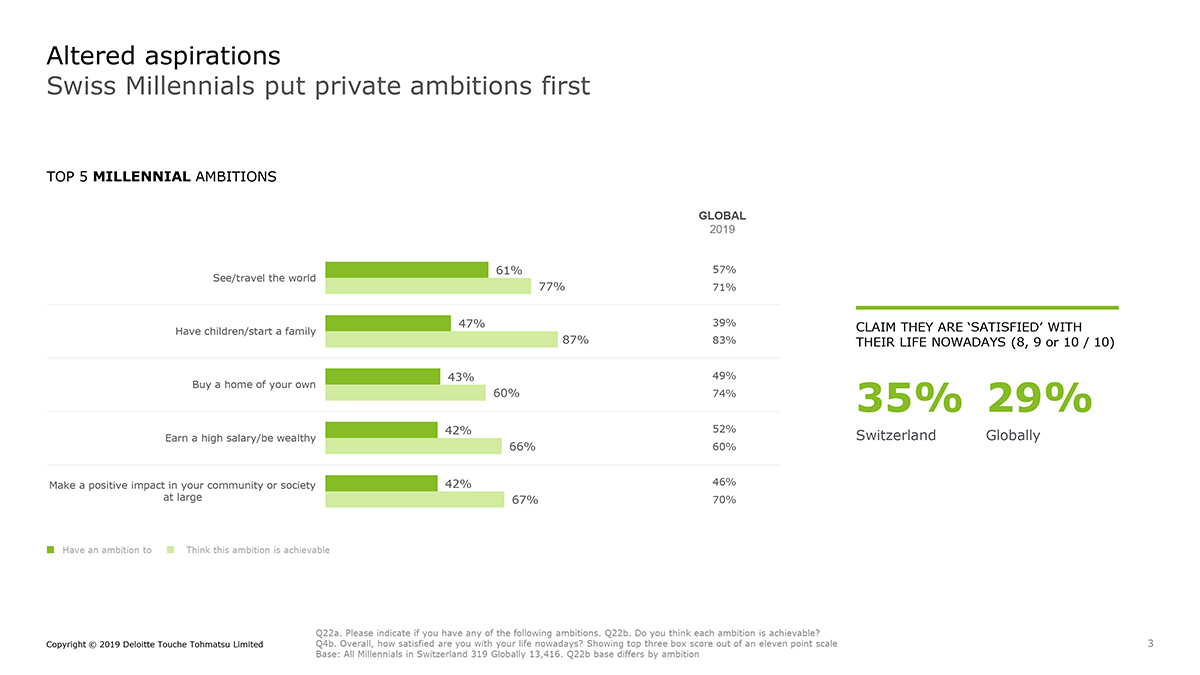
  • Young people value experience more than status: they want to travel first and then perhaps start a family. Owning a home and a high salary are less important. 
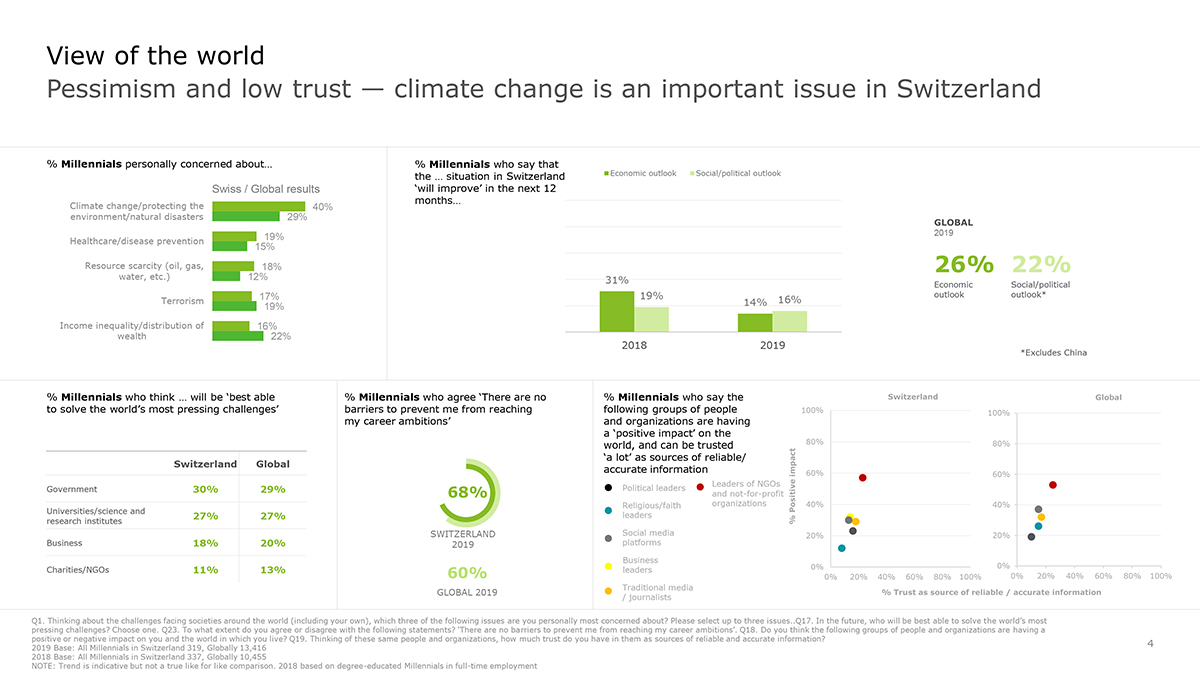
  • Swiss millennials' trust in politics and business is relatively low: only 15 percent see politicians and managers as a reliable source of information. 
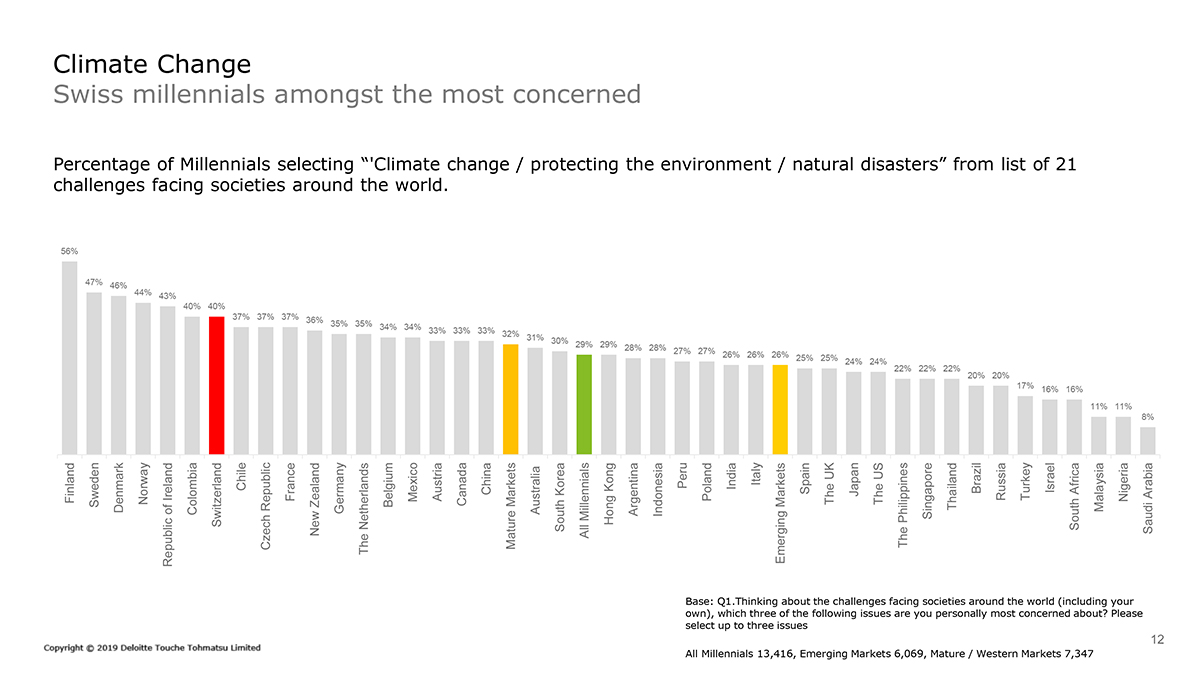
  • 40% cite climate change as one of the three biggest challenges currently facing them. It currently concerns younger people far more than the economy or their identity. 
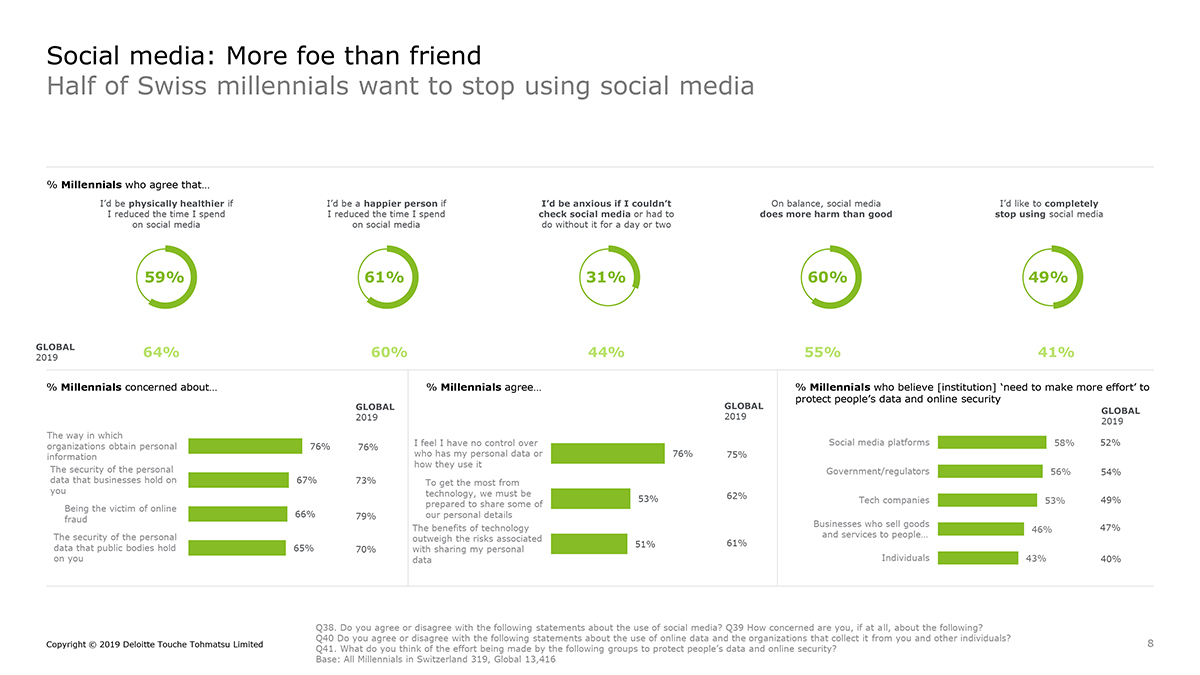
  • Millennials have a difficult relationship with social media: half of them actually want to withdraw from the platforms. Two thirds are concerned about data protection and cyber security. 
  • Swiss companies must adapt to retain millennials as customers and employees: Companies are expected to take a leadership role in society that goes beyond mission statements and brand campaigns.

In the face of ongoing technological and social upheaval, many Millennials are disillusioned with traditional institutions: they are skeptical of corporate goals and less optimistic about economic and social progress. 

"From the global financial crisis a decade ago to the fourth industrial revolution, millennials have grown up during a unique time that has greatly impacted social relationships, trust, privacy, social mobility and work," says Reto Savoia, CEO of Deloitte Switzerland. "This uncertainty is reflected in their critical attitude towards politics, business and leadership in general, as well as their longing for positive social change. As leaders, we must continue to address the issues that resonate most with the younger generation."

It's not all about money

The millennial generation is now in the middle of life and has different ambitions than previous generations: Similar to other developed countries, Swiss millennials currently value experiences more than a high salary. Traveling the world is at the top of the wish list in Switzerland (61%), followed by starting a family (47%). While 52% of respondents globally are attracted by a high salary and prosperity, only 42% in Switzerland are. This difference is probably due to the considerable prosperity in Switzerland, which is reflected in high average wages and low unemployment figures.

"Since most Swiss millennials want to gain a lot of experience and start a family, companies should enable their employees to learn a lot at work and develop new skills. Companies that want to attract young, highly qualified talent should also create flexible working conditions: they need to help employees align their work with their life goals - this is particularly important in Switzerland, where state support for families is low," says Myriam Denk, Partner and Human Capital Lead at Deloitte Switzerland.

Deloitte_Millennials_Switzerland-Results-Overview-3

Limited optimism among Swiss millennials

Although Swiss millennials are generally quite satisfied with their lives, they are less optimistic about the economic future than young people in most other countries. Only 14% (previous year: 31%) believe that the economic situation in Switzerland will improve in the next 12 months, compared to 26% of those surveyed worldwide. A similar picture emerges when it comes to the political mood. Only 16% (previous year: 19%) of Swiss millennials expect the social and political situation to improve in the next 12 months, compared to 22% worldwide.

"Switzerland's already high standard of living is probably one of the main reasons for the cautious optimism. As we are already doing very well, progress is no longer obviously noticeable. Nevertheless, we should not rest on our laurels, but continue to make an effort and avoid complacency," explains Reto Savoia. Among the most optimistic of all the countries surveyed are China, India, Indonesia, Nigeria and the Philippines - all less prosperous, but with high growth rates and rapid development in recent years.

Deloitte_Millennials_Switzerland-Results-Overview-4

Growing concern about climate change

Another possible reason for the subdued mood among Swiss millennials is climate change: 40% of respondents see this as the biggest challenge of our time. This is followed by healthcare, which 19 percent selected as one of the most important concerns out of 21 topics: Traditionally important topics such as unemployment (16 percent), immigration (11 percent) or economic growth (7 percent) lag far behind.

Due to their climate concerns, many millennials in Switzerland are demanding that companies become more aware of how they impact the environment and society - whether positively or negatively. Just under half (43%) of respondents have established or expanded a relationship with a company because they believe that the company's products or services have a positive impact on the environment or society. 

"Climate change was already at the top of millennials' agenda during the survey last December and January - and not just since the start of the school strikes and the intensified media coverage. According to our survey, Swiss millennials are much more concerned about the environment than the economy. This could not only permanently change the political landscape, but also the relationship between companies and consumers," says Myriam Denk.

Deloitte_Millennials_Switzerland-Results-Overview-12

Business leaders with less prestige than politicians

In line with previous surveys, Swiss respondents express little appreciation for political and business leaders. 68% (73% globally) say that political decision-makers do not have a positive influence on the world, while 64% (54% globally) think the same about business decision-makers. In addition, only 16 percent (10 percent worldwide) of Swiss millennials have "a lot of trust" in political decision-makers, while 14 percent (15 percent worldwide) give the same answer when asked about business leaders.

"Decision-makers in business and politics have a bad image among millennials - in Switzerland and worldwide. This is worrying and we need to take it seriously, especially in view of the upcoming vote on a corporate responsibility bill," says Reto Savoia. "Business and political leaders need to communicate better and more with the population. Swiss companies should therefore step up their efforts and systematically provide information about their impact on society, the economy and the environment."

New technology and media landscape

Direct communication appears to be the ideal way to restore trust: After all, many millennials also distrust traditional media and have a contradictory relationship with social media. 48% of respondents say that the press and television have a negative influence on the world. 25 percent say they have "zero trust" in traditional media. These Swiss results largely correspond to the global results.

When asked about their personal use of digital devices and social media, a majority (56%) of Swiss millennials (71% worldwide) say they feel positive about it. However, 61% believe that they would be happier if they spent less time on social media, and 59% believe that they would be physically healthier as a result. A majority of 60 percent also say that social media does more harm than good. 

"In line with other studies, our findings suggest that social media can be addictive. Some technology companies have already recognized this danger and are also aware of the negative effects of their devices and apps. They have taken action and are providing people with technical measures to help them become more aware of their consumption and limit their use. However, millennials themselves also need to learn how to deal with the downsides of digital technology," explains Myriam Denk.

Deloitte_Millennials_Switzerland-Results-Overview-8

Concerns about data protection and cyber security

Millennials also shop online or register on websites to obtain information. However, 76 percent of Swiss millennials surveyed are concerned about how companies collect personal information. 58% believe that social media platforms need to make more efforts to protect data and improve online security. However, 43% believe that individuals themselves must also take more responsibility.

"If companies want to continue to sell products and services to millennials, they need to pay more attention to their reputation, because millennials walk the talk. In addition, the younger generation recognizes the contradictions of digital technologies and is looking for companies to help them deal with them and adapt to a new normal. Retraining and training for the challenges of Industry 4.0 must therefore become a priority," adds Reto Savoia.

The report is based on the views of 13,416 young people aged 24 to 35 from 42 countries. In Switzerland, 319 millennials took part in the survey.

Libra: The most pressing questions about Facebook's digital currency

A few days ago, Facebook unveiled a concept for its new global digital currency, Libra. Experts have since taken a closer look at the concept, so important questions about Libra can now be answered—including potential risks to the financial system and the data of millions of customers.

libra-fragen

When will Libra launch?

The official launch is scheduled for the first half of 2020 (Advertising week reported). But even Facebook managers now admit that many regulatory and legal issues still need to be clarified before then. The old Facebook motto "Move fast and break things" - be fast and break rules and established rules - will not lead to the goal here.


How can Libra be used?

As with other cryptocurrencies, you need a digital wallet. Facebook will launch its own wallet, "Calibra." It will function as a standalone app, but will also be integrated into WhatsApp and Facebook Messenger. Users will be able to buy Libra with classic currencies such as dollars, euros or yen at authorized exchanges - and also sell it.


What benefit do users get from using Libra in the first place?

In the first phase, Libra is aimed primarily at people who want to transfer money across national borders and have been paying horrendous fees for this in the traditional financial system up to now. Another application scenario is the quick transfer of money between friends, for example when splitting a restaurant bill.


Is Libra even a "Facebook currency"?

Facebook has pushed the concept and financed the first phase of development work. However, Libra will be the responsibility of its own consortium, the Libra Association. The association is made up of 28 companies from the tech and financial sectors, including Uber, Paypal, Visa, Mastercard, Vodafone and Spotify. But it also includes nonprofit companies such as Kiva. The organization from the USA organizes the granting of microloans in developing countries.


Will Libra give Facebook insight into financial transactions?

Facebook does indeed notice when money is transferred via Calibra, WhatsApp or Messenger. However, the network promises to keep its users' financial information separate and not to use it for targeted advertising.


And you expect Facebook to believe that?

In fact, there are public doubts about the statement. For example, the German government's data protection commissioner, Ulrich Kelber, warned against Libra. "A corporation that has such huge amounts of data at its disposal should not still have details of our payment behavior," Kelber said to the Cologne city anneziger. Facebook had promised not to combine the transaction data with other data. But: "If we are dependent on Facebook's goodwill, I would advise against relying on it," said Kelber. Even when Facebook and Whatsapp were merged, the company had not kept its promises.


And what do the traditional banks think?

So far, the big banks have held back on making public statements. But there are also financial experts who are already speaking plainly and massively criticizing the push for a digital world currency: "Of course, Facebook has another intention," says Robert Halver of Baader Bank. "If you get data from billions of customers on how they travel on the Internet, what they spend money on, take out loans and so on, then the data octopus we have so far is just a little cuddly animal."


What do Europe's monetary guardians think of so-called cryptocurrencies?

Central bankers already had a clear opinion on the Bitcoin hype: such crypto-tokens are not a real currency, as they lack the control of a central bank or a state, said ECB President Mario Draghi. However, the blockchain technology behind them is "quite promising" because it allows bills to be paid automatically as soon as they are received. Several central banks are experimenting with blockchain - including the Deutsche Bundesbank.


And what does the influential Financial Stablity Board FSB think?

The Financial Stability Board says broader use of new types of crypto assets for retail payments would require close scrutiny by authorities to ensure they are subject to high regulatory standards. "The FSB and standards bodies will monitor risks in a very close and coordinated manner and consider additional multilateral measures as needed." The FSB statement likely put an end to Facebook's hopes that Libra would only be gently regulated.


What makes Libra different from the cryptocurrency Bitcoin?

Bitcoin and Libra differ centrally in several respects. First, Libra is pegged to a basket of established currencies such as the U.S. dollar, euro and yen and hedged by short-term government bonds. This avoids massive price fluctuations like Bitcoin ("stable coin"). Libra also does not use blockchain in the strict sense, but another system of distributed ledgers, a "distributed ledger technology." Libra thus consumes only a fraction of the energy that has to be expended in "mining" Bitcoins.


If Libra will be comparatively stable, why does the Bundesbank criticize the concept anyway?

Bundesbank President Jens Weidmann believes that even cryptocurrencies that are less susceptible to fluctuation pose a risk to consumers: "In particular, there is the question of how the value of stable coins can be guaranteed." If stable coins were to be used on a large scale, they could undermine deposit-taking and the business model of traditional banks, Weidmann warns. That, in turn, could disrupt their payments business and financial market processes.


Can Libra be abused by criminals?

Yes, at least Bundesbank board member Joachim Wuermeling sees this danger: "For example, such platforms must not become a new marketplace to conduct money laundering or terrorist financing," Wuermeling warned in an interview with the Frankfurter Allgemeine Sonntagszeitung FAS. According to Bafin President Felix Hufeld, politicians, supervisors and central banks would be challenged in a wide range of areas - from monetary policy to money laundering - should Libra become established. The fundamental question is: "How can we guarantee the state's ability to control the digital world?


Does Libra's importance extend beyond the financial world?

Yes, that is quite possible. For example, there are two short sentences in the whitepaper that indicate that the project's ambitions go even further than bringing billions of people into the global financial system. "Another goal of the (Libra) Association is to develop and promote an open identity standard. We believe that a decentralized and portable digital identity is a prerequisite for financial inclusion and competition." With 2.4 billion users worldwide, Facebook could succeed where others have failed in introducing a globally accepted digital ID. (SDA/swi)

Wirz launches product campaign for Feldschlösschen subbrands

Wirz has realized a product campaign for Feldschlösschen, focusing on the various sub-brands.

Feldschlösschen-Original_Film_Still

As tastes are known to differ, Feldschlösschen also has various sub-brands. There is the classic "Original", but also "Braufrisch", "Weizen", "Pale Ale" and the refreshing Feldschlösschen "Ice".

In recent years, the brand has been consistently strengthened with the claim "Feldschlösschen connects". Now the focus is to be placed on the intrinsic qualities of the individual beers, with the claim also being used here as a connecting element - both figuratively and literally: The combination of the respective ingredients in the different beers is the subject of six different commercials, which Wirz has staged together with the food and liquid specialists from Marmalade Hamburg. 

In parallel to the films, aesthetic key visuals will express the characteristics of the Feldschlösschen sub-brands. The new appearance will be supported and rounded off by a social media campaign.

Feldschlösschen-ICE_Film_Stills

Responsible at FeldschlösschenRegina Wurz-Janssens (Head of Marketing); Jérôme Rueff (Brand Director). Responsible at WirzLivio Dainese (CCO); Fernando Perez (ECD); Thomas Kurzmeyer (CD); Heinrich Schnorf (AD); Erasmo Palomba (Agency Producer); Isabelle Jubin, Ramon Alder (Consulting). FilmThe Marmelade Visual Engineering, Torsten Eichten (director). Sound design and sound mixingHastings. Music: SpaceTrain.

DOOH division of Goldbach Media to be integrated into Neo Advertising

As part of the consolidation of the advertising sales operations of Goldbach, Tamedia Advertising, and Neo Advertising, Goldbach Media Switzerland’s Digital Out-of-Home division will be transferred to Neo Advertising. All Swiss sales accounts, as well as three employees from Goldbach Media, will transfer to Neo Advertising effective July 1.

goldbach-dooh-neo

Neo Advertising markets digital and analog outdoor advertising space in German-speaking and French-speaking Switzerland and has been 52 percent owned by the Tamedia media group since 2018 (Advertising week reported). Goldbach Media's digital out-of-home business includes various shopping pools in addition to various petrol station pools. Goldbach Media has also been operating its own screens in various Swiss shopping malls such as Shoppi Tivoli, Grüzepark Winterthur and Arena St. Gallen since 2018.

The merger with Goldbach will strengthen Neo Advertising's position in the Swiss market, with almost 20,000 indoor and outdoor advertising spaces at locations such as Geneva Airport, various shopping malls, points of sale and public places in various Swiss cities as well as business and exhibition centers throughout Switzerland. 

"The integration of the Goldbach network will increase Neo Advertising's range of outdoor advertising space and will enable us to improve our position in Swiss shopping centers in particular. We are very pleased to welcome Goldbach Media's DOOH team and their experience. This will strengthen both our Zurich sales and marketing teams," says Christian Vaglio-Giors, CEO of Neo Advertising. 

Michi Frank, CEO of the Goldbach Group and Chairman of the Board of Directors of Neo Advertising, is also looking forward to the collaboration: "A merger of the two business areas within Tamedia is obvious. Together with Neo Advertising, we are optimally positioned and can offer our customers an even greater reach from a single source."

Teil.ch helps in the search for the electricity partner for life

The agency Teil.ch was commissioned by WWZ to develop a communicative guiding idea for the promotion of the new electricity products. The result is a campaign that draws attention to the topic of personal choice of electricity.

01_wwz-energie_plakate

WWZ customers have the opportunity to choose their own electricity and thus influence the environment and costs. In order to draw attention to the topic, several eye-catchers were developed that depict the choice of electricity as a partner choice in a funny way.

The subjects were implemented in the form of product-specific folders, a poster campaign, social media and e-commerce measures, and also on the Landing pagewhich forms the core of the campaign. Interested parties can use the page primarily to find out about the added value of the electricity products. For a clear user guidance, quickly comprehensible sections were created, accompanied by images and animated illustrations. The aim is to sensitize users and to encourage them to put together their own electricity product using a configurator. For an additional incentive to visit the site, a competition was launched.

04_wwz-energie_folder

Responsible at WWZ: Andreas Fürling (Head of Marketing); Julia Thalmann (Senior Online Marketing Manager); Michael Hurni (Senior Marketing Manager). Responsible at Teil.ch: Martin Zeiter (Head of Creation); Alain Zeiter (Consulting); Monika Pfister (Graphics); Patricia Glauser (Web); Tanja Seufert (Text).

Away from mass-produced goods: Consumers are increasingly focusing on individual value

Datatrans and the University of Applied Sciences Northwestern Switzerland present the latest trends in online sales in the E-Commerce Report Switzerland 2019. Consumers are showing themselves to be saturated by the mass of industrial goods and are focusing on offers with complementary services and individual value. In the future, it will not be the manufacturers who determine what is bought, but the customers what the distribution should deliver to them.

e-commerce-pixabay1

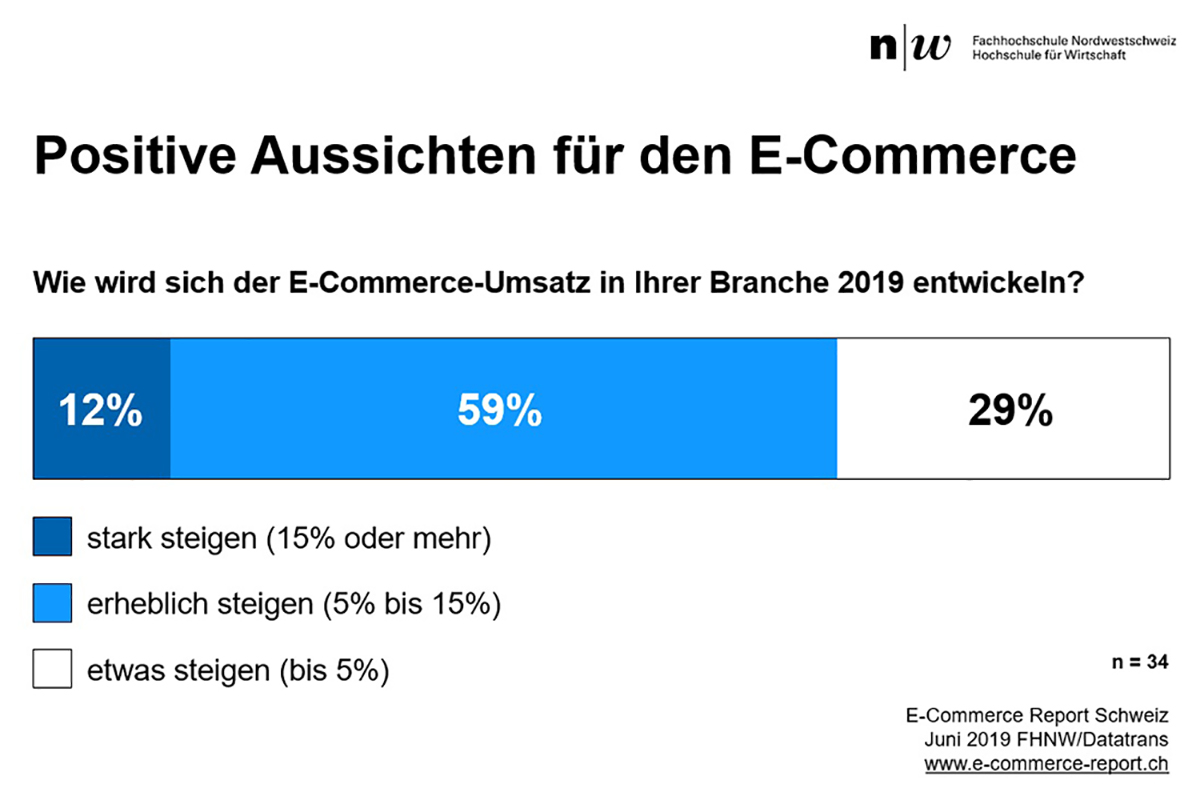
Strong consumption on the internet continues: In 2018, the Swiss made online purchases worth almost 10 billion Swiss francs. This represents a 10 percent increase in e-commerce volume. All study participants expect growth in 2019 as well.

Studie2019_Grafik1

Foreign platforms grow disproportionately

At 16 percent, the value of orders placed with foreign online platforms has increased significantly. In the last five years, foreign providers have developed more than twice as fast as domestic providers. Today, the foreign share in online retailing is 22 percent. Disproportionate growth is also expected in 2019.

From linear distribution chain to customer centricity

Traditionally, the consumer goods industry was organized as a value chain that starts with the manufacturer and ends with the consumer via wholesalers and retailers. Digital platforms such as online marketplaces, social media, and search engines have dissolved the old role pattern and now position themselves with useful services between retailers and consumers. As a result, the customer is now at the center. Digital platforms are his companions - and only then do the providers come up with the actual service.

Retail declines in favor of a new networked world of offerings

Due to the constant availability of offers on the Internet, regional retail is losing importance. A reduction of stores and sales space has already begun in Switzerland. All levels of distribution are under pressure. As a result, a new networked world of offerings is emerging, with diverse opportunities for collaboration.

The customer is online - brands follow suit

In order to reach their customers online at the most important touchpoints, brands must become more involved on the Internet. Self-provided services shape the brand profile and provide valuable information about customers and their purchasing behavior. However, own B2C online stores remain primarily a marketing tool and will account for only a small share of brands' sales in 2025.

Retail stores can distinguish themselves with virtual assortment

Instead of large sales areas, retailers want to distinguish themselves in the future with smaller, intensively managed stores. Virtual assortments are one approach: In addition to the products available in the store, there are also those that can be ordered directly on site in additional colors and sizes.

If you want to profit from growth, you have to invest continuously

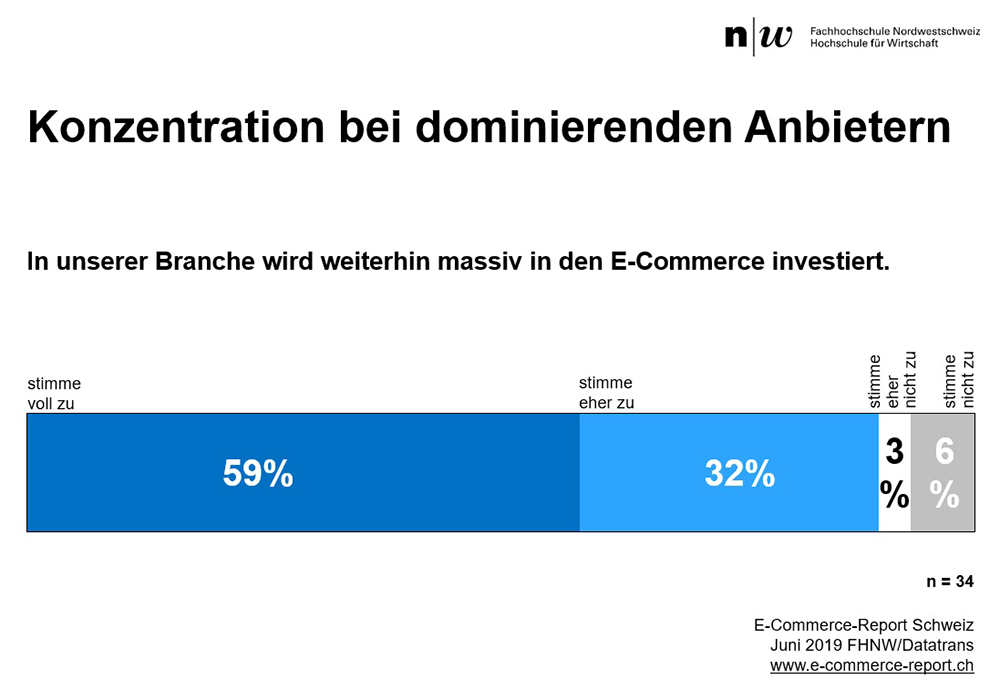
E-commerce remains a very dynamic and competitive business and continues to promise great growth. In order to keep up, companies must constantly expand their services and make processes even more efficient. E-commerce requires continuous investment in IT and logistics. They look for the freestyle in measures around personalization and relationship management.

Studie2019_Grafik2

Smart mobile solutions increase conversion

Purchasing via smartphone is becoming increasingly popular. To increase their conversion in the mobile segment as well, companies are targeting their marketing at smartphone use. Especially for regular purchases, mobile solutions with stored payment data are a simple and customer-engaging measure. The smart public transport tickets from Fairtiq and SBB Easy Ride or the cashierless kiosk "avec box" from Valora show the way.

Growth trend in e-commerce also stable over the coming years

The expectations of the study panel on the growth of e-commerce in the coming years are high: a good two-thirds of the companies surveyed expect e-commerce sales in their industry to have increased by 50 percent or more by 2025. No one expects stagnation or a decline.

To the E-Commerce Report: 

Since 2009, the E-Commerce Report Switzerland has been investigating the status, changes and trends in sales to end consumers - as the only study series from the perspective of the providers. The survey is realized by Datatrans and the University of Applied Sciences Northwestern Switzerland FHNW. 

Method:

  • Long-term study, repeated annually, since 2009 
  • Empirical, primarily qualitative 
  • Survey: Expert interviews and questionnaire 
  • Survey period: January 9 to April 23, 2019 

Participants:

  • 35 potentially market-shaping online and multichannel providers of consumer goods and services in Switzerland with an e-commerce volume of almost 4 billion Swiss francs
  • Selection criteria: Several years of track record in e-commerce, importance in the industry, degree of novelty of the business model. 

City of Zurich further expands digital out-of-home offering

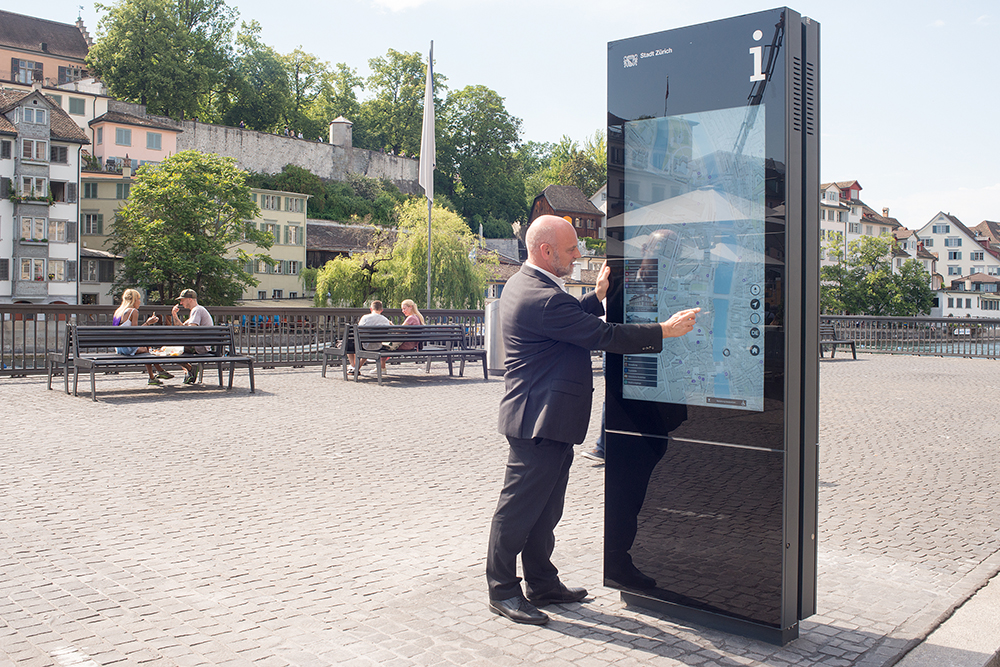
The city of Zurich now has 15 new interactive «city maps» that offer a wide range of features for residents and tourists and replace the 50 traditional paper maps. They were designed and implemented by Clear Channel and the City of Zurich.

190627_02_cityplan_am_limmatquai

Directions, weather forecasts and an extensive selection of destinations can be called up on the city maps. They are also combined with digital advertising systems on the back, which are marketed by Clear Channel.

The city plans were inaugurated on Thursday by City Councillor André Odermatt and contribute to the City of Zurich's Smart City strategies. Thanks to the use of natural electricity from Ewz and other measures, the city plans also pay attention to resource efficiency.

Wide range of services beyond the city map

The city maps are operated via a touchscreen and have several maps that make it easier to find your way around the city. Further information on the city's history, as well as the weather, public transport and the latest news from the city complete the offer. Thanks to fast updating, multilingualism, extensive accessibility, USB charging sockets, public WLAN in the immediate vicinity and a connection to the Ewz fiber optic network, the city maps offer a wide range of possible uses for a broad target group.

They not only complement the public space, but also use the technical possibilities to extend the functionality beyond the pure city map. With the combination of urban geodata and the catalogs of Zürich Tourism, a wide selection of map views, sights and culinary and cultural offers can be called up in the city maps. "With the new city maps, we are taking a valuable step towards the Smart City and creating a whole new way for people to access our city," says City Councillor André Odermatt.

Conception and financing of the city plans

In 2018, the city of Zurich issued a public tender for the creation and maintenance of the city maps and the operation of the advertising systems. Clear Channel, which already operates digital city maps in other Swiss cities, and the City of Zurich then designed the city maps. The digital advertising installations combined with the city maps on the back will be marketed by Clear Channel until 2023. This not only finances the digital city maps, but also generates additional revenue for the city of Zurich.

190627_01_andre_odermatt_limmatqaui

Y&R Wunderman Seeks Crypto Currency Jedis for PostFinance

The job market is changing rapidly in the banking sector as well. Old jobs are disappearing, and new ones are emerging. The agency Y&R Wunderman has launched a recruitment campaign for PostFinance in which the Swiss bank is seeking people with a pioneering spirit.

yr-postfinance-01

Y&R Wunderman dramatizes PostFinance's forward-thinking attitude with fictional job titles that could well await us in the future. These include Artificial Intelligence Storyteller, Crypto Currency Jedi or Head of Robotic Workforce. The goal was to fill PostFinance's interest pool with potential candidates as a first step. In this way, PostFinance wants to attract applicants who want an innovative employer where they can help shape the future with fresh and unconventional ideas and see digitalization as an opportunity.

yr-postfinance-02

With the headlines, PostFinance wants to differentiate itself from conventional recruitment communication and arouse curiosity. In addition, the concept allowed a high degree of flexibility, as the job titles could be personalized to different job categories. 

The agency has also developed new Instagram content. In it, PostFinance pioneers provide insights into their working world in a surprising and entertaining way. In various Insta-stories, pioneering projects are presented, the topic of work-life balance is addressed, or a working day is presented in thirty seconds.

yr-pf-04

Responsible at PostFinanceMarco Serratore (conception); Rémy Spicher, Pascal Frey (realization); Taru Koch, Patricia Linder (HR marketing). Responsible at Y&R Wunderman: Swen Morath (CCO); Benjamin Franken (CD); Michael Gallmann, Stephanie Belvedere (AD); Natasa Maricic, Christian Schirmer (text); Deike Bauerkämper (strategy); Romaine Brunner (consulting); Marlon Perini (programming).

Art.I.Schock realizes performance for three Winterthur festivals

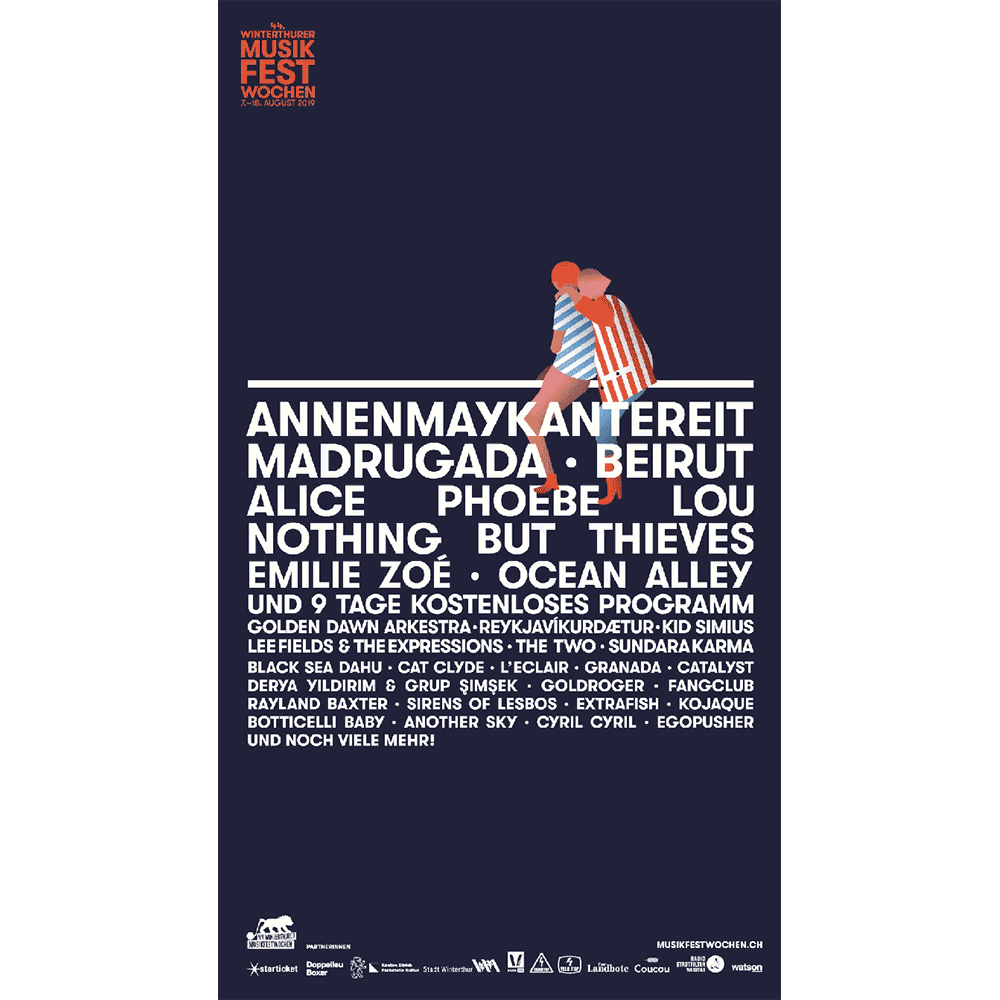
The agency Art.I.Schock realizes the appearance for three Winterthur festivals this summer: The Musikfestwochen, the literature series Lauschig and the Afro-Pfingsten received new looks for their editions this year.

Medienmitteilung_artischock_20190625_afropfingsten_banner

The agency has been responsible for the Music Festival Weeks and Afro-Pfingsten for some time. The young literature and spoken word series Lauschig also relies on Art.I.Schock. The agency designed three corporate identities individually tailored to the events, as well as posters, flyers and program magazines, and also online presences, giveaways and other items.

In 2019, the annually changing artwork of the Winterthur Music Festival is based on the old town as the setting for the concerts. The two illustrated subjects depict typical, recurring scenes in Winterthur. The images, patterns and choice of colors are intended to represent the interplay between day and night, loud and quiet, music and social life inherent in the Musikfestwochen.

The completely renewed appearance of Lauschig interprets the summer night ambience that awaits literature enthusiasts at the open-air readings.

The Afro-Pfingsten, which took place at the beginning of June, attracts tens of thousands of guests to Winterthur's old town every year. The visual appearance takes up the colorful, diverse and varied hustle and bustle and should awaken early anticipation of African culture.

Medienmitteilung_artischock_20190625_MFW_animation_mond

Responsible at Winterthurer MusikfestwochenLaura Bösiger. Responsible for Lauschig: Ramona Früh. Responsible at Afro-Pfingsten: Karin Gubler. Responsible for Art.I.SchockUrs Akeret, Danja Imhof, David Egg (consulting, project management); Linda Meli, Petra Hilber, Sam Loosli, Pamela Mocettini (graphics/illustration). Websolution Music Festival: Premiummedia. Trailer music festival weeks: Alba De Zanet.

"Slices of Life": The House launches image campaign for Swiss Life

Nine out of ten Swiss parents would prefer to work part-time. For young families, the part-time model is becoming particularly relevant due to their life circumstances and raises many questions as they adjust to a reduced workload. With «Slices of Life,» The House is launching an image campaign for Swiss Life that offers insights into the lives of such families through still and moving images and provides answers using tools such as the part-time calculator.

Swiss_Life_Teilzeit_Family_1

All measures link to four landing pages where questions on topics such as home ownership, risk protection or savings potential in connection with part-time work are answered.
At the heart of the campaign is the new part-time working calculator developed by Swiss Life, which can be used to simulate and optimize existing or planned part-time working models. For families, the calculator is a first step towards finding the right part-time model and more financial confidence for a self-determined life.

The campaign was developed by The House and Swiss Life in co-creation mode. It is a further development of the umbrella brand campaign "Jedem sein selbstbestimmtes Leben", for which Ruf Lanz is still responsible. The campaign was launched on June 17 with a highly relevant go-live promo for the target group on the topic of external childcare - one of the major challenges for young families who are considering part-time work. There are KITA hours worth 25,000 francs to be won. 

The starting point for the content strategy is the study conducted by Swiss Life on the topic of part-time work. The results were further elaborated on during a Family Weekend in the form of interviews and group discussions. This resulted in further content for native ads, blogs and social media for the owned channels, which will be incorporated into the communication during the campaign.

The House is responsible for the paid media strategy and operations across the various channels. The media campaign advertises the young families in the launch phase with large-scale video sitebar ads on various target group hotspots and networks throughout Switzerland in addition to thematically diverse online and social media formats.

Downstream, by the end of the year, the campaign will be transformed into a sophisticated always-on strategy based around affine topic and quality placements in online media and social networks as well as relevant partnerships and content integrations with selected family portals.

Swiss_Life_Teilzeit_Family_4

Responsible at Swiss Life: The Swiss Life teams. Responsible at The House: Grischa Rubinick (Executive Creative Director); Sascha Borsai (Creative Director); Roger Dobmann (Senior Art Director); Mateja Aleksic (Digital Art Director); Alia Malash (Junior Copywriter); Nico Podgorny (Director Consulting); Nadine Vasella (Senior Consultant); Nahuel Morales (Consultant); Stephan Suter (Media Director); Verena Hofmann, Nikolina Caleta, Luzian Storrer, Daniel Nussbaumer (Senior Media Consultant); Sara Meister (Senior Quality Manager); Andreas Jorgella (Strategy & Business Development); Sebahat Derdiyok (Agency Producing & Art Buying). Film and photographyRandy Tischler.

get_footer();