Media chief of the Office of the Attorney General of Switzerland moves to SBB

André Marty, head of media relations at the Office of the Attorney General of Switzerland, is moving to Swiss Federal Railways (SBB). There, he will take over as head of communications for passenger services.

Medienchef der Bundesanwaltschaft wechselt zu den SBB
André Marty will be the new head of passenger communications at SBB. (Image: Keystone/Peter Schneider)

An SBB spokesman confirmed in the SonntagsZeitung the change. Marty had prevailed as "the most suitable candidate in an open job advertisement," it said.

Proceedings against Marty

Marty will leave the Office of the Attorney General of Switzerland in the coming months, the Office of the Attorney General of Switzerland told the Keystone-SDA news agency on Saturday. It had become known on Friday that special prosecutor Stefan Keller was investigating Marty.

Keller opened criminal proceedings against Marty in the wake of allegations surrounding investigations into world football's governing body Fifa, according to the Tages-Anzeiger made public. Keller told the Keystone-SDA news agency only that he could not provide any information on the status of the proceedings at the moment for tactical investigative reasons. No statement was available from Marty.

In 2017, according to the newspaper, Marty was allegedly present at a controversial meeting between then-Federal Prosecutor Michael Lauber and Fifa President Gianni Infantino during ongoing investigations by the Office of the Attorney General of Switzerland into Fifa. According to earlier statements, however, none of those involved could remember this meeting.

In June 2020, the supervisory authority over the Office of the Attorney General of Switzerland appointed Keller as extraordinary public prosecutor to investigate criminal charges against Lauber, Fifa President Infantino and other individuals in connection with alleged inconsistencies in the Fifa investigations. The accusation is abuse of office or incitement to abuse of office.

New job from autumn

At SBB, Marty will take over as head of passenger traffic communications as of September 1. A company spokesperson confirmed to the Keystone-SDA news agency a corresponding article by the SonntagsZeitung. It was known that criminal proceedings were underway against Marty, it said.

Of course, they had thought about it, but the presumption of innocence applied, the SBB media office said. (SDA)

What does "adjusting screw" actually mean?

Benno Maggi explains in his column "What does... actually mean?" terms from the field of marketing and communication. This time he shares his thoughts on the term "adjusting screw".

Was bedeutet eigentlich... «Stellschraube»?

While people in the industry are predominantly throwing around digital buzzwords, a term that dates back to a time when everything was still analog has recently made its way into consulting workshops in particular: the adjusting screw. Especially in the historic industrial country of Switzerland, it is worth taking a closer look at the increasing popularity of this word.

The set screw differs from the common screw in that it is used to adjust, regulate, fix, or secure distances, things, or changes, and is not just a threaded, headed bolt that is screwed into something and used to fasten or connect something. So far, so clear.

Industrialization of the consulting service

If all this is still too concrete for you, you might find it helpful to consider that today, even in Switzerland, we are no longer in an industrial society but, as we know, in a postindustrial one. Due to technological progress, knowledge and information are the main sources of economic value creation in this society, and no longer primarily labor and capital resources. As a result, the communications industry in particular has experienced an incredible boom: today, communication often seems more important than production. Malicious tongues claim that this is why there is more talk than action, or in good Swiss German, "me glafered, statt glifered.

In order to refute this accusation, those who primarily do the first then like to use a term that implies the second. "What are our levers?" they ask the group in a shirt-sleeved manner, catering to everyone's slightly nostalgic need for something tangible. They don't have to be nails with heads and they don't have to be solutions for good - hopefully we are all agile by now - but they do have to be as concrete as a thread that allows us to regulate what needs to be regulated. But instead of serving to set, define, or secure processes, most consultants who use the word seem more like people who want to drive screws into the wall with a hammer. But even that can have its effect: Bam!


* Benno Maggi is co-founder and CEO of Partner & Partner. He has been eavesdropping on the industry for over 30 years, discovering words and terms for us that can either be used for small talk, pomposity, excitement, playing Scrabble, or just because.

Partnership with Ringier Sports extended: Swisscom remains sponsor of the Super League

Swisscom has been a sponsor of the Super League for nine years. It is now extending this commitment—and thus its partnership with Ringier Sports—for another four years, effective July 1, 2021.

Since the 2012/2013 season, Swisscom has been one of the sponsors of the highest division in Swiss club football, which will be called Credit Suisse Super League from next season. The company is now extending this commitment as official sponsor: Swisscom and Ringier Sports, exclusive marketer of the Swiss Football League (SFL) for the central advertising rights, have signed an extension of the contract for a further four years until the end of the 2024/2025 season, Ringier writes in a statement.

"We are delighted that our successful partnership with Swisscom is entering its third round with this contract extension. The company is sending out a strong signal at a challenging time for many and, with this commitment, will continue to provide substantial support for Swiss club football in the years to come," said a delighted Martin Blaser, CEO of Ringier Sports.

Press Council reprimands Ringier publications for surreptitious advertising

The Press Council has reprimanded the online platform Blick.ch and the magazine *Schweizer Illustrierte*, both part of the Ringier Group, for failing to clearly distinguish between paid and editorial content. The magazine published a series paid for by farmers without disclosing this fact. The online platform ran campaign propaganda without labeling it as advertising.

The case concerned an article in the run-up to the March 7 vote on electronic identity. As the Press Council stated on Friday, the reference to blick.ch "in cooperation with ..." is not sufficient because the article was published in the usual appearance.

Thus, the voting propaganda of the Digital Switzerland business association did not sufficiently stand out from the editorial content. The reference was also easy to read over, so that the article was not clearly declared as advertising.

Only the third and final version met the requirements, as the Press Council writes. The clear sentence stating that it was political advertising with the author's line "This is a paid contribution, presented by ..." created the necessary transparency.

Surreptitious advertising for farmers

Also the Swiss Illustrated violated the requirement to separate paid and editorial content. Between April and June 2020, the magazine published a four-part series of reports on farms as part of the "More Switzerland in the Plate" campaign.

This was financed by Agro-Marketing Suisse, the marketing company of the farmers' organizations. According to the Press Council, the financing was not disclosed. The first report stated that it was produced in collaboration with Swiss farmers.

Only in the last article, however, did it say "in collaboration with Agro-Marketing Suisse and the Swiss Farmers' Union", which is not enough according to the rebuke. In order not to mislead the readership, the cooperation must be clearly declared as commercial and paid in each individual article.

Concerns about Native Advertising

The Council also recalls that the obligation to label advertising also applies to social media. For example, it found the reference "sponsored" on a Facebook page to be insufficient. Instead, the Press Council recommends the clear labeling "Paid advertising partnership.

In general, the Press Council is concerned about the spread of so-called native advertising, i.e. advertising in the "familiar environment" of a publication that hardly differs from the editorial content. Newspaper publishers are under pressure to generate advertising revenue.

But commercial articles in the guise of editorial copy would do them a disservice. They show "a lack of respect for the readership and undermine the credibility of journalism," the council writes. (SDA)

Sunrise and UPC are legally united in Sunrise UPC GmbH

Following the merger of Sunrise and UPC and the delisting of Sunrise shares from the SIX Swiss Exchange, the two telecommunications providers are also being brought together under a single legal umbrella: Sunrise Communications AG and UPC Schweiz GmbH are being legally merged into Sunrise UPC GmbH.

The new legal company name will be used in official corporate correspondence as of Saturday, Sunrise UPC announced in a communiqué on Friday. Nothing will change for customers. The products and offers will also remain the same. The brands "Sunrise" and "UPC" will remain in place until further notice.

UPC owner Liberty Global acquired Sunrise last year for CHF 6.8 billion. In the fall, the Swiss Federal Competition Commission (Comco) approved the takeover without conditions or requirements. In the course of the merger, a total of around 600 jobs will be eliminated by the end of next year. This corresponds to around 13.5 percent of the 3350 full-time positions. (SDA)

Retail sales rise sharply in March

Swiss retailers sold significantly more in March compared with the same month a year ago. This is mainly due to the low sales figure in March 2020, when the first COVID-19 containment measures were implemented.

Retail sales in Switzerland rose in March by 21.5 percent year-on-year after adjustment for calendar effects, the Federal Statistical Office FSO announced on Friday on the basis of provisional figures. Adjusted for prices, i.e. in real terms, the increase was slightly higher at 22.6 percent.

The figures for the previous month also look similarly strong. Seasonally adjusted, sales rose by 21.9 percent in nominal terms compared with February 2021, and adjusted for price effects (in real terms) they climbed by 22.1 percent.

All sectors posted strong growth, led by household appliances, textiles, DIY and home furnishings with a nominal increase of 88.5 percent. This was followed by "information and communication technology equipment" (+33.8%).

However, "other goods (clothing, pharmacies, watches and jewelry)" were also strong, up 30.7 percent. "Publishing products, sports equipment and toys" (+29.7%) and "Market stalls, mail order and internet trade" (+24.5%) also posted strong gains. (SDA)

Swisscom acquires JLS Digital from Renaissance Investment Foundation

Swisscom is acquiring JLS Digital from Renaissance Anlagestiftung. The telecommunications group announced in a press release on Friday that this move will expand its expertise in the area of customer experience for business customers.

A Swisscom spokesperson said on request that the parties had agreed not to disclose the purchase price. JLS is the market-leading digital signature, mobile and web agency. The core competencies of JLS lie in the conception, development and operation of digital customer experiences and interactive advertising and information systems. For example, he said, the company is active in the field of augmented reality or in app development for simplifying companies' interactions with their customers.

Through the acquisition, Swisscom is taking over a team of more than 90 digital experts and a customer portfolio with 80 companies from the banking, retail and insurance sectors. The competencies of JLS Digital and Swisscom subsidiary Open Web Technology would complement each other from a geographic, industry and technical perspective, it said.

JLS Digital, with locations in Zurich, Bern and Lucerne, will remain an independent company with its own management, which will remain unchanged. The board of directors, on the other hand, will be re-staffed with Swisscom representatives in the coming weeks, the telecom group wrote. (SDA)

Mediafisch wins production contract for "Mini Chuchi, dini Chuchi

Zurich-based TV production company Mediafisch has won the production contract for the new SRF early evening documentary series «Mini Chuchi, dini Chuchi». The format will go on air for the first time at the end of August.

On Wednesday, SRF communicated the successor format of "Mini Schwiz, dini Schwiz". In "Mini Chuchi, dini Chuchi" five candidates cook their favorite dish every week. The focus is not on entire menus, but on individual recipes that the contestants have discovered themselves or that have been passed down through the generations. Each week has a specific theme. The SRF program will be broadcast on SRF 1 from Monday, August 30, 2021.

"Mini Schwiz, dini Schwiz" as well as its predecessor format "Mini Beiz, dini Beiz" have been produced by the German production company ITV since 2014. Zurich-based film production company Mediafisch entered the pitch for the successor - and came out on top, bringing production of the "Mini Chuchi, dini Chuchi" format back to Switzerland.

Mediafisch brings many years of experience and a great deal of know-how to the food sector. In recent years, the production company has realized programs such as "LandLiebeTV," "Foodventure," "Beef Club," "Die Promi Griller" and "Wein Battle. "We are happy to now also be able to co-develop and produce the new, daily SRF cooking format," says Marc Görtz, Managing Director and partner of Mediafisch.

TBWA\Vido announces Gocamping.ch 1 year anniversary

The recently founded video unit of TBWA\Zurich has produced an animated film for the young camping platform Gocamping.ch. Following the approach "inexpensive and effective", a film was produced to promote and profile the startup in a broad target group.


Gocamping.ch was launched a year ago and is now venturing into neighboring Germany. The film has been specially earmarked for this purpose, which is intended to help the platform quickly become known via TV and online channels.

The platform has established itself in this short time as a comprehensive and detailed camping platform. The online portal brings campers and operators together online in an uncomplicated way and enables every campsite to make its tent and pitch sites available online quickly, easily and free of charge and to book them if required.

The end of third-party cookies: three-quarters of publishers unsure about alternatives

There is a sense of uncertainty surrounding the end of third-party cookies. According to a study by Teads, three-quarters of publishers are unsure about possible alternatives. First-party data and contextual targeting represent the industry’s best hopes.

Publishers are aware that the end of third-party cookies will present them with major challenges in the near future. However, only a few publishers are testing specific new solutions for user tracking and personalized online advertising. It is also unclear which technologies can best compensate for the loss of third-party cookies. These are the key findings of a survey conducted by the media platform Teads, in which over 450 publishers worldwide took part.

In Germany, Austria and Switzerland, around 60% of publishers surveyed said: "I understand the impact of the abolition of third-party cookies, but I am unsure about new solutions." 14 percent say they cannot assess how the changes will affect their business. Only a quarter of publishers say they have a clear understanding of all the new initiatives in the industry and their advantages and disadvantages. Internationally, the answers are similar.

Only 14 percent have a concrete action plan

When it comes to testing and implementing new tracking solutions, the results are even more alarming: only 14% of respondents in German-speaking countries state that they have drawn up an action plan and are testing cookie-free alternatives. 27 percent refer to special resources and teams that are currently focusing on this challenge. Just under 30 percent state that they keep up to date by reading the press. Just as many want to tackle the issue in the second half of the year.

"This survey highlights the lack of clarity publishers face when it comes to the end of the cookie. Despite being the most likely to be affected by the impact on revenue streams, many publishers are relying on unclear and often confusing updates from tech giants. Quality journalism has never been more in demand and we have seen a huge demand from brands looking to support premium publishers in all markets around the world. New forward-thinking targeting solutions are and will be an essential part of the advertising ecosystem. It is important to seriously and consistently address the topic now and to test and develop solutions for the post-cookie era together with strong partners," warns Omar Piras, Head of Publishing at Teads, in view of the survey results. "However, there are a number of promising alternatives available to implement effective advertising playout and successful targeting with high reach in the future."

Publishers also recognize this opportunity: 48% see the possibility of differentiating themselves from the competition through 1st party data and the quality of their content. 27% see the elimination of third-party cookies as progress for user data protection and are confident that they will find new alternatives to ensure the continuity of their services. However, just under a third of those surveyed - with multiple answers possible - said they expected a decline in advertising revenue. Around a fifth state that they are unable to assess the impact.

First-party data and contextual targeting before sandbox and universal IDs

When asked about specific alternatives, around 60 percent of respondents want to rely on first-party data or contextual targeting. 45 percent mentioned the Privacy Sandbox developed by Google and 38 percent universal ID solutions. According to 45 percent of respondents, they have a strategy to increase the use of logins. More than half of publishers see the potential disruption to the user experience as the biggest challenge with this approach. 36 percent cite the impact on loyalty and traffic and 30 percent the technical implementation and management of logins.

From the publishers' perspective, partners are also called upon to develop alternatives. Around 70 percent of respondents stated that they would ask existing or future partners about their cookieless solutions. Almost 60 percent also expect support in testing the solutions, while around half would like training and information. 45% would like new tools to be provided for their directly sold campaigns.


The media platform Teads surveyed digital experts from 452 publisher partners worldwide from the end of March to the beginning of April 2021 on the challenges and solutions in connection with the imminent discontinuation of third-party cookies. The figures in this report relate to the DACH region.

There's still room for improvement: Four facts about internal communication

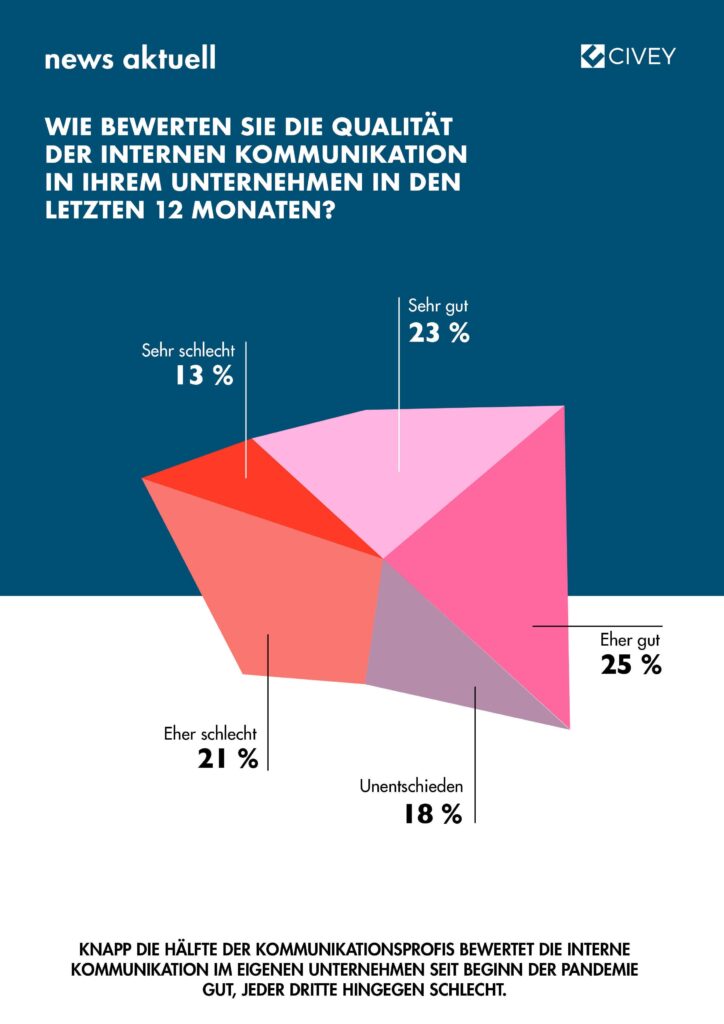
Internal communication is on the right track, but there is still room for improvement: One in two communications professionals rates the company’s internal communication as good since the start of the pandemic, while one in three rates it as poor, according to a survey by News Aktuell.

News Aktuell

When asked about the quality of internal communications in their own company, 25 percent of the survey participants rated this discipline as rather good and 23 percent as very good. In contrast, 21 percent of respondents rated the quality of their own internal communications as rather poor, and 13 percent as very poor. Women tend to be more critical in their assessment: 17 percent give a very poor grade, compared with 10 percent of men.

Every second communications professional gives internal communications a good grade since the start of the pandemic, while every third gives it a poor grade. (Source: News Aktuell)

Most common channels: Intranet behind e-mails and staff meetings

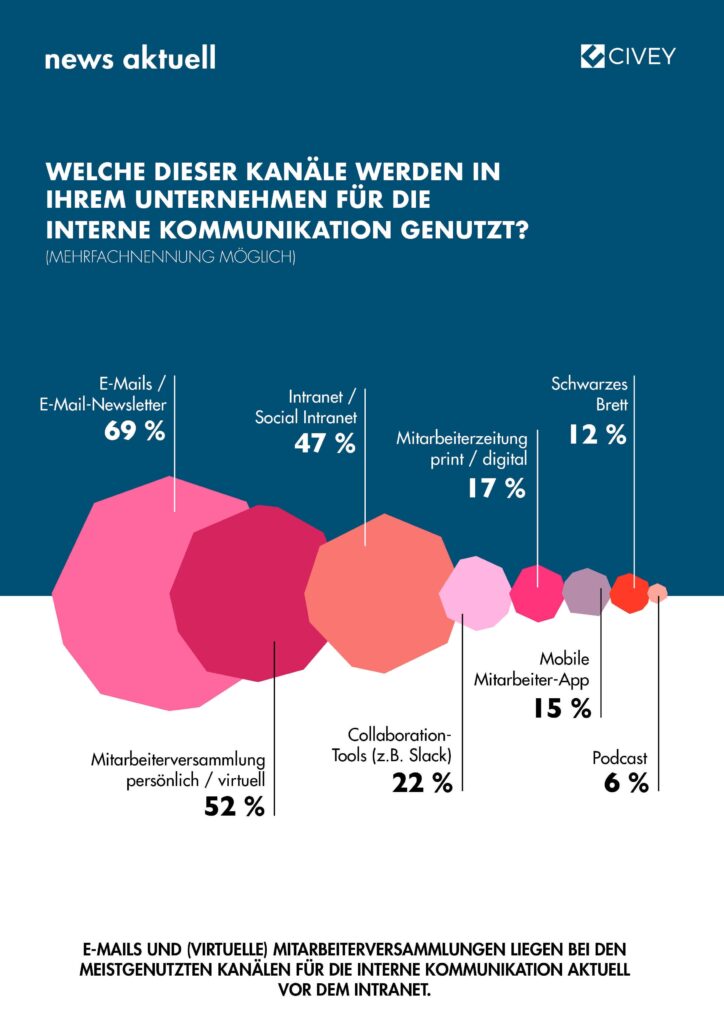
E-mail or e-mail newsletters are currently the most frequently used channel for internal communication: 69 percent of respondents use this classic instrument to reach employees. The employee meeting is in second place: for more than half of the survey participants, the company informs its workforce about what is happening via personal or virtual meetings (52 percent). Only in third place is the intranet or social intranet (47 percent). In contrast, new digital channels such as mobile employee apps (15 percent) or internal podcasts (6 percent) are rarely used.

(Source: News aktuell)

Most common formats: Management updates and spontaneous virtual exchanges

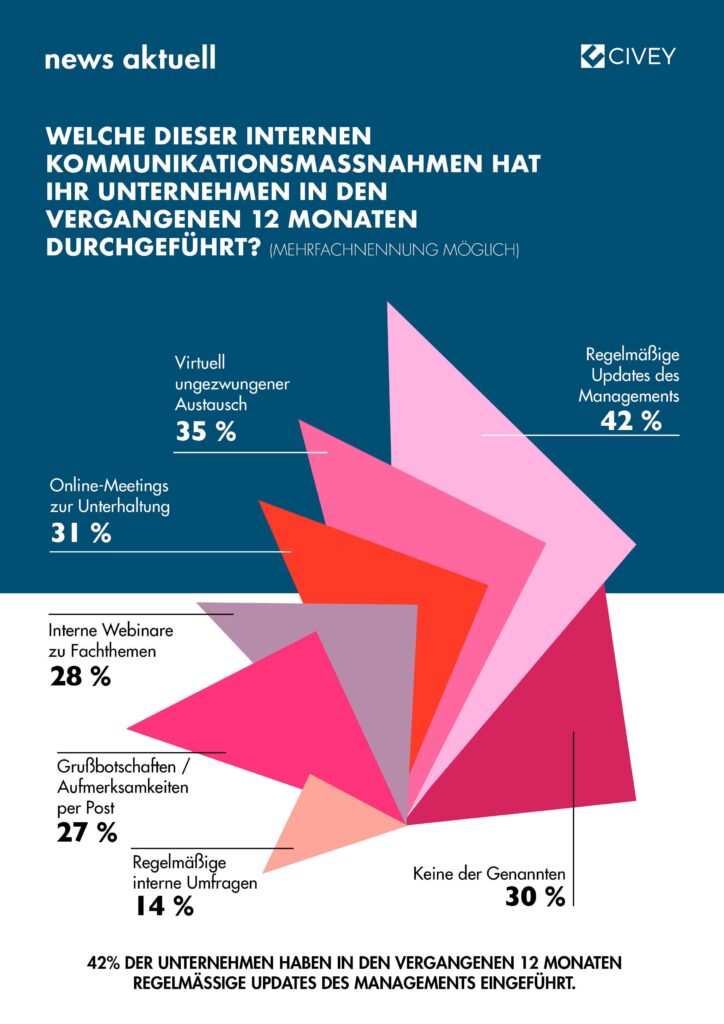
The most frequently used format of internal communication in the past twelve months was the management update: In 42 percent of the companies, the management regularly informed their employees about new developments. One in three companies has relied on informal exchanges: 35 percent of the survey participants said that internal communications had initiated informal virtual meetings such as coffee or lunch breaks.

Virtual entertainment formats were offered almost as frequently in the past twelve months: 31 percent of companies held online meetings on topics such as nutrition, fitness, book or movie recommendations. Regular internal surveys, on the other hand, were used less frequently (14 percent). 30 percent of respondents stated that none of the above measures had been implemented in their company.

(Source: News aktuell)

Lack of strategy as the biggest challenge

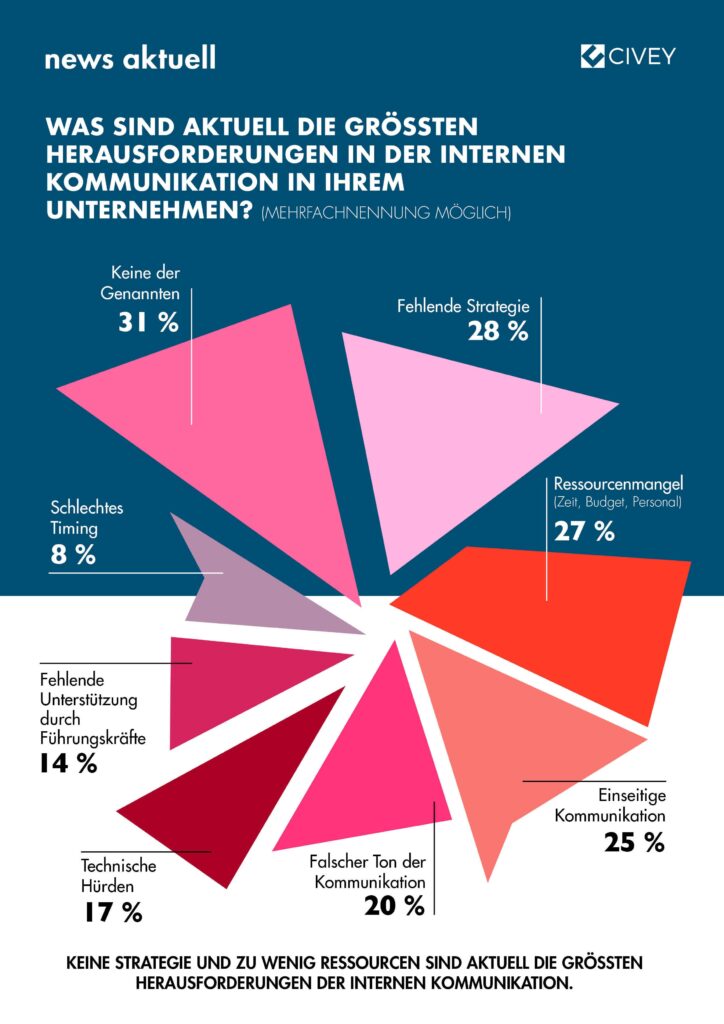
A lack of strategy is currently the biggest challenge in internal communications. 28 percent of respondents believe that communicating haphazardly without setting goals and evaluating success is one of the biggest hurdles to communicating with employees. Almost as challenging is a lack of resources. 27 percent blame too little time, budget or personnel for the failure of internal communication.

One in four respondents also sees a danger in one-sided communication (25 percent), and one in five believes that the wrong tone in communication is problematic (20 percent). Technical hurdles are cited by 17 percent, and a lack of support from managers by 14 percent. In contrast, 31 percent of respondents have no challenges or challenges other than those mentioned.

(Source: News aktuell)

At the Online survey the dpa subsidiary News Current and the Berlin-based opinion research startup Civey 500 professionals from communications, marketing and media took part. The survey took place from March 25 to April 8, 2021. Multiple answers were possible for the questions "Which of these channels are used for internal communication in your company?", "Which of these internal communication measures has your company implemented in the past 12 months?" and "What are currently the biggest challenges in internal communication in your company?"

Environmental protection: good storytelling can have disadvantages

Storytelling with emotional narratives rather than dry scientific facts: According to a study in the journal *One Earth*, this is a more effective way to motivate people to take action for the environment and against climate change. However, there’s a catch: While this approach works well with liberals, good storytelling can actually turn conservatives off—and may therefore not be the best strategy for communicating about environmental protection.

According to the study, people who had heard a stirring story about environmental pollution in which a man died then spent more on environmentally friendly products than when they simply heard scientific facts about water pollution. However, the majority of people in the study were Democratic, i.e. liberal - and with such people, good storytelling on environmental issues is likely to open doors, explains study co-author Paul J. Ferraro, an expert on environmental policy at Johns Hopkins University.

"For those who are not already inclined to take environmental action, stories may make things worse," but Ferraro warns. This is supported by an experiment with just over 1,200 participants that the team conducted at an agricultural event in Delaware. To help people understand the problem of nutrient pollution, they were shown either a video with scientific facts or the story of a man who died after eating contaminated shellfish. Then the team offered inexpensive products to minimize negative consequences of stormwater runoff in their own backyards.

A deep chasm opens up

Overall, study participants were more willing to spend money on them after hearing the story of the deceased. However, this was because liberals were 17 percent more likely to want to buy the products. Conservatives, on the other hand, were 14 percent less likely to want to spend money. In their case, the emotional story was therefore rather bad for promoting the will to make a personal commitment to environmental protection.

This divide was surprising to him, Ferraro said. That's because he normally observes little behavioral difference between Democrats and Republicans on issues like energy conservation. So the researchers hope their findings will spur further work on how climate change and environmental issues should best be communicated and why certain stories seem to appeal positively only to liberals. (pte)

get_footer();