Automated data integration creates trust

The study «Marketing Analytics State of Play 2022» by Adverity, a provider of marketing analytics platforms, highlights priorities and challenges in data-driven marketing.

Adverity einem AnbieterCookies save information about users to enable easier and faster use of websites - but according to the GDPR, this is not in the interest of user privacy. The imminent abolition of third-party cookies is therefore creating a lot of buzz: companies will soon be reliant on first-party cookies and will have to develop new competencies and strategies in order to be able to offer their customers personalized content. Only by means of transparency in both communication and the range of goods offered can companies build trust with their customers and ultimately thus obtain valuable first- and zero-party data - and build long-term customer loyalty.

Personalized offers and target group targeting

Companies face the challenge of managing and analyzing their own data and creating personalized content from it. It is therefore not surprising that, according to a study by Adverity, provider of a marketing analytics platform, the biggest challenge for companies in 2022 will be campaign reporting - while the focus of strategic priorities will be on target group building and the provision of personalized content. The survey also shows that respondents who say they see their strengths in campaign reporting tend to provide better personalized content and have an easier time building audiences - and are three times more likely to do so than the comparison group that rated their campaign reporting as needing improvement.

At the same time, respondents who give high priority to campaign reporting are about twice as likely to see their own strengths also in the areas of personalized content and audience building and targeting. As a result, it is fair to say that strong campaign reporting helps to strengthen content personalization and audience building.

Manual data reporting is time-consuming and error-prone

But what are the hallmarks of strong campaign reporting? There are two ways to integrate data into reporting: Manual and automated. Manual data integration is both time-consuming and labor-intensive, and prone to errors and inaccuracies. Alarmingly, 41 percent of respondents in particular said that it is precisely this manual integration that poses a significant challenge. As a result, marketers do not trust their own data - which in turn means that efficient data-driven decision-making on marketing strategies can hardly take place.

Automating data integration, on the other hand, provides undeniably accurate data, saves resources, and puts the insights of brand diagnostics, campaign planning, and reporting front and center. In addition, decisions can be made efficiently and, most importantly, based on valid data: Marketing managers can see at a glance which measures should be pushed further and which may not. This not only improves the success of their campaigns, but also strengthens their position within the company.

Data integration platforms can help restore trust in marketing and improve relationships within the organization and with customers. Unbiased and coherent marketing data provides a real solution when it comes to addressing emerging industry challenges. They also provide material benefits, such as better visibility into marketing spend and ROI, which are critical to understanding and targeting key audiences. This assessment is especially important as the use of third-party cookies becomes increasingly less important across all major browsers and companies rely on first- and zero-party data.


Read the full report Marketing Analytics State of Play 2022: Challenges and Priorities. on the Adverity website.

David Schärer is "Advertiser of the Year 2021/22

The jury and online voting have decided: David Schärer, co-founder of Rod Kommunikation, is "Advertiser of the Year 2021/22." The communications professional succeeds Martin Walthert, CMO at Digitec Galaxus. The "Egon" was presented to the advertiser at an intimate award night on Tuesday evening aboard the MS Wadin on Lake Zurich.

Werber des Jahres
It worked out for the fourth nomination: David Schärer holds the "Egon" in his hands. (Image: Chris Reist)

"Swiss master in generating attention" and "string puller" is what he is called, and he describes himself as a "spin doctor": In an election that was exciting right up to the last second, David Schärer, founding partner of Rod Kommunikation, prevailed over fellow nominees Andrea Bison, Thjnk Zurich, and Maurizio Rugghia, Sir Mary.

The advertiser has already been nominated for the most important personal award in the Swiss creative industry in 2012, 2017 and 2019, but has so far narrowly failed to win the race. Now, for the fourth time, the Basel native has finally been rewarded.

Intimate award ceremony with protection concept

The new "Advertiser of the Year" was able to receive his well-deserved "Egon" statue on November 30 at an intimate award ceremony on Lake Zurich in front of nearly 50 personalities from the creative industry. His predecessor, "Advertiser of the Year 2020" Martin Walthert, paid tribute to him with a laudatory speech. The laudation by BAG project colleague Adrian Kammer, who could not be present himself, was read out on behalf of the editor-in-chief Anna Kohler: "In your youth, you were a punk. I think the punk in you is still alive. Of course, it has grown up. But he is still a mover and a shaker."

Punk at heart

Fascinated at a young age by legendary campaigns such as "Stop Aids," Schärer began training at the School of Design and thus found his way into communications. After a stint as PR manager at Jung von Matt Limmat, where he met his later agency partners, he founded Rod Kommunikation in 2007, together with Regular Bührer and Oliver Fennel. At the end of 2019, Rod Kommunikation becomes part of the Farner agency - Schärer, Bührer and Pablo Koerfer, in the meantime managing director, become partners.

The pandemic campaign

Rod Kommunikation has created many defining campaigns over the past 14 years. But probably the biggest project will follow in spring 2020: the pandemic campaign for the Federal Office of Public Health (FOPH) - a Herculean task that requires a lot of tact and thick skin at the same time. One and a half years and many sub-campaigns later, it can be said: The agency has done a great job. And Schärer was always at the forefront. Kammer from the FOPH agrees. The newly crowned "Advertiser of the Year" would have gotten the best possible out of every tax franc invested, even if he didn't always make it easy for the client. "Again and again, you confront, probe, drill deeper. Yes, dear David, you deserve the title 'Advertiser of the Year' also thanks to your courage to be an imposition at times," said the BAG campaign manager in his laudation.

More links:

  • The portrait on the nomination of David Schärer can be found at here.
  • You can find the portrait of the freshly elected "Advertiser of the Year here.
  • The list of all previous "Advertisers of the Year" can be found at here.
  • The "Off The Record" podcast featuring this year's nominees can be found at. here.
  • Interview with David Schärer on the acquisition of Rod by Farner (November 2019) can be found at here.
The award ceremony took place on board the MS Wadin on Lake Zurich. (Pictures: Chris Reist)
Certificate check at the entrance: The event was carried out according to the protective regulations of the BAG. The crew and the organizers have been additionally tested in advance.
Ahoy, sailors: Anna Kohler and Johannes Hapig from Werbewoche m&k guided through the evening.
Lisa Oribasi and Ball-Zee provided the musical background for the evening.
Talk with the "Advertiser of the Year 2020" Martin Walthert.
Johannes Hapig presents the Egon to David Schärer.


About the Award:

Werbewoche has been awarding the "Advertiser of the Year" since 1977. Since 2001, the winner has received the "Egon" designed by Zurich artist Max Grüter. The three candidates were nominated by the jury of experts. The final decision as to who won the title was then made 50 percent by the readers of Werbewoche.ch via online voting and 50 percent by the jury. Each jury member was allowed to cast one vote. m&k Werbewoche itself, as the organizer of the award, abstained from voting.

The expert jury:

The "Advertiser of the Year" expert jury is made up of former "Advertisers of the Year", representatives from French-speaking Switzerland, nominees from previous years and also personalities from science and the media. The 2021 jury members (in alphabetical order):

  • Alexander Jaggy (Thjnk Zurich)
  • Anja Janoschka (HLSU)
  • Daniel Zuberbühler (Sir Mary)
  • Dennis Lück (Brinkertlück Creatives)
  • Gabriel Mauron (Havas Genève)
  • Livio Dainese (Wirz)
  • Martin Walthert (Digitec Galaxus)
  • Matthias Kiess (TBWA\Zurich)
  • Michael Kamm (Agence Trio)
  • Peter Brönnimann (Freelance Creative)
  • Petra Dreyfus (Wirz)
  • Regula Bührer Fecker (Rod Communication)
  • Roman Geiser (Farner Consulting)
  • Thomas Wildberger (Prophet)

Radio Energy and Scount launch a Christmas scavenger hunt

In partnership with Radio Energy, the shopping app Scount is launching a scavenger hunt in Zurich. Using AR, participants can win gift cards and cash hidden throughout the city.

Radio EnergyTechnologies such as augmented reality have created new ways to play games. In the long-hyped app "Pokémon GO," for example, players could use AR to catch Pokémons as if they were actually standing in front of the user.

The shopping app "Scount" uses AR technology to show users suitable deals in their environment. Users can see at a glance whether there are offers or entertainment options in the vicinity that match their personal interests.

Radio Energy is now using this technology for a digital scavenger hunt at Christmas time. On Saturday, prizes will be digitally hidden all over the city of Zurich, which can be snatched using the AR function of the Scount app. Participants can find various prizes worth a total of 10,000 francs in cash and over 35,000 francs in vouchers. Companies such as Chicorée, Metro Boutique, Pathé Cinemas, Beldona and Qualipet are among those taking part.

Via the Instagram account of Scount participants will receive regular hints on this day about where the big prizes are hidden. All you need to participate is the Scount app.

Franz&René shows for Groupe Mutuel how simple the premium calculator is

At the end of the year, insurers’ premium campaigns compete for both new and existing customers. For Groupe Mutuel, Franz&René designed twelve geolocated ad concepts that contrast complicated calculations with the insurance company’s simple premium calculation.

Franz&RenéThe campaign subjects are intended to arouse the interest of the target groups by drawing on elements that are appropriate to the respective cantons. Is the size of a Habsburg empire easy to measure? The strength of a Bernese bear? Or the amount of soap needed to clean the Prime Tower? These are calculations that are much more complicated than the three clicks it takes to find out your premium at Groupe Mutuel.

The multi-theme digital campaign was geolocated and displays the premium for each region as well as the corresponding "local" theme.

The campaign ran on seven display formats, native advertising and social media, and was also implemented on DOOH for some strategic cantons.


Responsible at Groupe Mutuel: Stephane Andenmatten (Deputy Director, Head of Communication & Branding), Jean-Philippe Pignat (Head of Marketing), Bernard Riquier (Experience Owner Acquisition - Customer Lifecycle Marketing), Tiziana D'Onofrio (Head of Customer Lifecycle Marketing). Responsible for Franz&René: Valérie Pecalvel (Strategic Direction), Luciano Gerber (Client Service Direction), Vincent Eichenberger (Client Service Direction & Digital), Yoann Cosson (Creative Direction), Gianluca Terzini (Art Direction), Sven Jungo (Graphic Designer & Production Manager). Production & Media: 3Traits (Illustration & Motion Design), Incubeta (Web Development), Mediatonic (Media Planning).

Davos Klosters promotes the guest program from the guest's point of view

Up close and in the thick of the action: The destination Davos Klosters promotes its winter guest program with a new video. Thanks to the "point of view" perspective, viewers are virtually live in the action. The film was produced by Moviemaint from Chur.

Davos Klosters bewirbt das Gästeprogramm aus Gästesicht
(Image: Destination Davos Klosters/Matthias Paintner)

Skiing a carving turn on the freshly groomed slopes, hiking through the snow-covered landscape with a torch in hand, or hurtling headfirst down into the valley on an airboard. These are some of the quickly edited scenes in the new promotional video for the winter guest program of the Davos Klosters destination. The aim is for guests to get to know the destination of Davos Klosters from a different perspective - literally.

In the new promotional video, everything was filmed completely from the guest's point of view. What viewers see, they would experience just as with their own eyes on site. The video is available on YouTube, on the Website as well as on the social media channels of Davos Klosters. The company's own communications department was responsible for the lead and concept. The film was produced by Moviemaint from Chur.

SFJ postpones "Specialized Journalism Switzerland" conference until spring 2022

The Swiss Association of Professional Journalists (SFJ) has decided to postpone the conference scheduled for Thursday until spring 2022. The 2021 SFJ Awards ceremony will not take place.

SFJ verschiebt Tagung «Fachjournalismus Schweiz» auf Frühling 2022
(Image: Fachjournalismus.ch)

Due to the current tense epidemiological situation, the organizers of the "Fachjournalismus Schweiz" conference have decided to postpone the event, which was scheduled for this Thursday, until spring 2022. The association regrets this decision and the short-term cancellation very much, as it says in a message of Tuesday. The program would have been extremely exciting and informative.

The organizers will try to transfer the program to the new date as much as possible. The new date will be communicated as soon as possible.

In this context, the organizers cancel the SFJ Award 2021. The prize will still be awarded - the winners will be contacted individually by the association and informed about their result and the prize they won.

Frank Bodin takes over as Chairman of the Board of Directors of the Furrerhugi Group

Effective immediately, Frank Bodin is the new Chairman of the Board of Furrerhugi.holding, Furrerhugi's agency group. He takes over from Ulrich Gygi, who is stepping down after four years as Chairman of the Board of Directors.

Frank Bodin

Ulrich Gygi was Director of the Swiss Federal Finance Administration, Group CEO of Swiss Post and then Chairman of the Board of Directors of SBB until 2016. With his vast experience at the interfaces of business, administration and politics, he has made a significant contribution to professionalizing the management of the Furrerhugi Group, the Group writes in a statement.

Frank Bodin has been a member of the Board of Directors of Furrerhugi.holding and Furrerhugi since 2019. As one of Switzerland's most renowned advertisers and a profound expert on the agency landscape, he is an important strategic input provider for the agency group, the statement continues. Bodin was Chairman & CEO of Euro RSCG and Havas, respectively, from 2001 to 2018. He also brings a great deal of international agency experience to the table. Among other things, he is President of ADC Switzerland and a member of the Advisory Board of the Center for Communication at the Hochschule für Wirtschaft Zürich HWZ.

KSP for VW: When head meets heart

Volkswagen is forging ahead with its electromobility offensive. In the current campaign, KSP presents the ID.4 GTX, probably the most versatile member of the ID. family, for the car manufacturer.

KSP für VW

The new ID.4 GTX is as sporty as a GTI, as comfortable as an SUV and as sustainable as an ID. The claim "For head and heart" in the TV commercial is intended to make this clear. The film visualizes how we are all driven by two forces - head and heart. And when these meet, the best things come into being. Like the all-electric ID.4 GTX with all-wheel drive.

The visual language is also based on this contrast and shows the E-SUV in the middle of a wintry mountain landscape.

The campaign includes TV, OOH, DOOH and social media. In addition, retailer advertising media will be used.


Responsible at AMAG Import, Volkswagen: Melanie Felder (Team Leader Marketing Communication), Tanja Schärer (Marketing Communication Manager), Fabienne Burri (Trade Marketing Manager). Responsible at KSP: Alba Rau (Art Direction), Stephanie Waldvogel (Content Creation, Editing), Céline Goldschmid (Graphics), Barbara Sarras (Text), Andrea Heller, Nina Wildhaber, Aline Herzog (Consulting), Daniel Krieg (Strategy and Creative Direction), Jingle Jungle (Voice Recording and Sound Mixing), SLGH Zurich (Final Production Film), Ansichtsache (Image Editing), MediaCom (Media), Swiss Online Publishing (Social Media).

SRF: Michael Gerber becomes TV correspondent for Great Britain

There is a change in SRF's TV correspondent position in the United Kingdom. Michael Gerber, 51, will become the new correspondent for the United Kingdom and Ireland. He succeeds Henriette Engbersen, who is returning to Switzerland.

Michael GerberAfter training as a primary and secondary school teacher, Michael Gerber completed a master's degree in history, political science and journalism and communication at the Universities of Bern and Fribourg. After graduating in 1998, he began his journalistic career as regional and domestic editor at the Bernese Newspaper. In 2001, he moved to the news magazine Factswhere he worked as editor of the Federal House of Representatives.

Michael Gerber has been working for SRF since 2003: at the beginning for the news program "10vor10", from 2007 he was on assignment for four years as West Switzerland correspondent, and from 2011 to 2017 as TV correspondent in France.

Since his return to Switzerland, Michael Gerber has worked as an editor and coordinator of current affairs for the TV foreign editorial team, supervised several series for "10vor10" and SRF News Digital as a producer, was responsible for TV coverage of the federal elections in Germany at the end of September 2021, among other things, and most recently reported as a special correspondent from the World Climate Conference in Glasgow.

Now he is moving to the UK in spring 2022 to replace Henriette Engbersen, who is returning to Switzerland. "I'm excited about this new challenge - with many big issues in a diverse country: What next after Brexit? How do England, Scotland, Northern Ireland and Wales go into the future - together or separately? And what will the future of the United Kingdom and the Commonwealth of Nations look like when Queen Elizabeth II retires? Many exciting topics that I'm looking forward to," Gerber was quoted as saying in an SRF press release.

Swisscom wins mobile network test ahead of Sunrise UPC and Salt

Swisscom has won the test for the best mobile network for the fourth time in a row. By a few points, Swisscom finished ahead of Sunrise UPC and Salt in the annual survey conducted by the consulting firm Umlaut together with the German industry magazine Connect. And Swisscom is also right out in front internationally.

Swisscom

With 976 (PY 960) and Sunrise UPC with 966 (PY 955) out of a possible 1000 points, Swisscom received the rating "excellent" for its mobile network. The smallest of the three Swiss providers tested, Salt, received the rating "very good" with 930 points, as Connect reported on Tuesday night.

The fact that the ranking remained stable for the fourth time in a row proves "that all providers are making equal efforts to improve further," Connect author Hannes Rügheimer is quoted as saying in the press release. He is convinced that without constant work on the network infrastructure, it would hardly be possible to simply maintain the previous year's level.

"Competition at the highest level"

In voice telephony via "Voice over LTE", Swisscom and Sunrise once again improved on the previous year and almost achieved the full score. Salt maintained its performance from the previous year with slightly fewer points. The competition in this category was "at the highest level," it says. Even on connecting roads or in trains, the reliability of voice telephony only dropped slightly.

In the data category, Swisscom is also ahead by a small margin. The smallest provider, Salt, is in third place, but at a product level that would have been enough to win the respective category in Germany outside the major cities," the report continues. The performance on connecting roads is encouraging: drivers have excellent connections while driving, which is important for the increasingly widespread networked technologies in cars.

In addition, all three providers would be "at the highest level" in the analysis of 5G results. Salt has made strong gains in 5G over the past year, and Swisscom and Sunrise UPC offer the latest mobile communications generation not only in the cities, but also over a large area outside the cities. Sunrise UPC is the only provider in the DACH region to even exceed the 90 percent mark for 5G downloads in major cities, it says.

International winner

Swisscom and Sunrise UPC outperform the competition from Germany and Austria with the results presented. Swisscom achieved the highest score of this year's test season in the entire DACH region.

Despite its third place in the Swiss comparison, Salt is only just behind second-placed Vodaphone in Germany and on a par with second-placed A1 in Austria.

Umlaut and Connect tested the three categories of voice, data and user performance. Between October 21 and 30, they drove along a test route in four test vehicles, each equipped with two smartphones from each network operator. One cell phone per car took the voice measurements, a second the data measurements. The cell phones were set to "5G preferred. Over a distance of 6400 kilometers, they drove through 29 large cities and 21 small towns.

In addition, a team conducted measurements on foot in eight cities. They went into areas with a lot of public traffic, such as train stations, public transport, airport terminals and cafés. (SDA)

Efficient marketing needs (data) curiosity

If you want to create innovation, you have to ask the right questions. Answers to many of these questions can be found in data. That's the core of the Curiosity Forever brand campaign that analytics and AI giant SAS is now rolling out worldwide.

SAS Curiosity ForeverThe central tool for change and optimization: Data analytics and artificial intelligence (AI). However, AI in particular is met with enthusiasm and reservations in equal measure: The assessments range from business drivers to job endangerers.

On average, the media's assessment of AI is quite balanced. This is an initial finding from the newly created "Trust in AI Index" by SAS, which is designed to regularly determine the current opinion climate on AI. The average sentiment score in the first three quarters of 2021 so far is 52 (50 = neutral; 0 = very negative, 100 = very positive). This means that AI is only rated weakly positively in the media. Accordingly, criticism is limited - but euphoria looks different.

With its current brand campaign, SAS aims to create broader adoption for AI and data analytics. The global, multilingual campaign focuses on five industries: Banking, Retail, Industry, Healthcare and Public Administration.

With curiosity to innovation

The motto "Curiosity Forever" is intended to give a face to the corporate vision that has been announced in the strategic course set in recent years. Thus, SAS has already launched an investment program in the amount of one billion US dollars in technology around AI in 2019. In addition, SAS has been investing more than a quarter of its revenue in research and development for many years; in 2020, this figure was 27 percent.

Curiosity about new approaches to solutions and innovations was also demonstrated by the participants at the first global SAS Hackathon: over 100 teams from 31 countries set out to find answers to questions about sustainability and business practice using agile methods, SAS and open source on Microsoft Azure.

Understanding promotes acceptance of AI

An important aspect of the campaign is to make data analysis understandable - even for employees who are not data scientists. For this purpose, a decidedly emotional approach was created on the one hand. On the other hand, SAS supports data literacy - i.e. the well-versed handling of data - with numerous measures in the area of education, among other things with free software for universities, with special e-learning programs such as the Analytics Value Training or with the SAS Academic Programs.

"Curiosity" - a core competence of marketers

Covid has fundamentally changed customer expectations in recent months. In the digital world, fast and personalized interactions are even more important, otherwise the customer is just one click away from a competitor. Marketers therefore need to do even better research into what drives their customers in order to be able to respond to their needs in a timely and targeted manner.

This places special demands on the skills of marketers. Analytical curiosity becomes a core competence. They need to use insights from analysis to understand, interpret, measure and prove their activities and the level of engagement with their customers. Always with the question in mind "What can we do better?".


The answers to marketing questions that AI and analytics can already provide was the topic of this year's SAS Forum Digital End of October. In the SAS Forum Mediathek, interested parties can access information on the past event.


Curiosity@Work study: Curiosity as a key competence in business

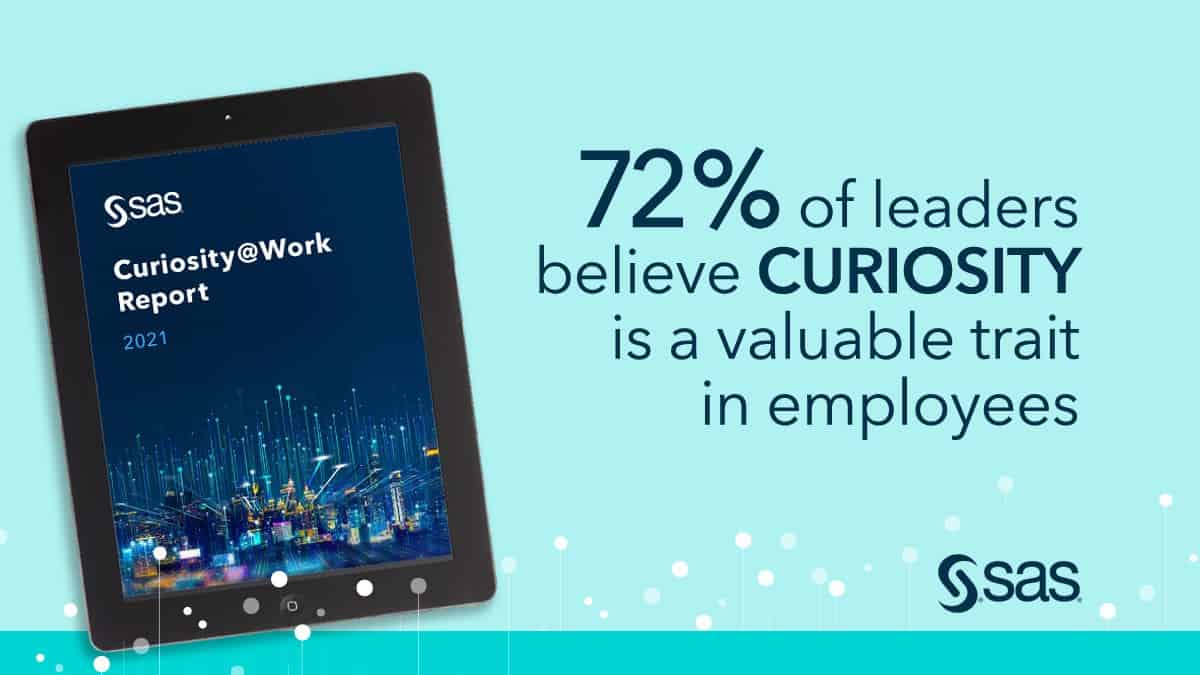
Curiosity is becoming increasingly important for employers and employees. This can now be proven with concrete figures: 72 percent of managers in companies worldwide see curiosity as a very valuable trait in employees, and 59 percent as a real business driver. This is a result of the global Curiosity@Work Report by SAS, for which a total of around 2,000 managers were surveyed. 51 percent of them also believe that this characteristic has become much more relevant in recent years.

One thing is indisputable: Curiosity has enormous potential to counteract current weaknesses in staffing and resources. In each case, more than half of the respondents see the greatest potential for greater efficiency and productivity (62 percent), creative thinking (62 percent), closer collaboration (58 percent) and stronger employee retention and satisfaction (58 percent). The IT department in particular is seen as having a high need for curiosity: 64 percent of respondents confirm this. Research and development (54 percent) and marketing (46 percent) follow only behind. Tasks where curiosity is seen as particularly relevant are developing innovative solutions (62 percent), solving complex problems (55 percent) and analyzing data (52 percent). Curiosity is thus an important prerequisite for gaining data-based insights as a basis for decision-making.

More results under Sas.com/curiosityatwork
"We need to become chief collaboration officers."

Jennifer Chase has been CMO of the analytics and AI company SAS for several months. Marketers, she says, need to completely rethink their role within the company.

Jennifer Chasem&k: Jennifer Chase, you are the new global head of marketing at SAS - and a proven branding expert. That's exciting, because branding hasn't necessarily been a focus at SAS up to now?

Jennifer Chase: First of all, I'm going to change that. I'm going to change that SAS is not the company you think of first when it comes to well-known brands in tech. I believe that in the past, we at SAS have been too modest about who we are. We let our customers' success speak for itself. When I was given the global CMO position, I talked to our founder, Jim Goodnight. We both asked ourselves, "How can we position SAS now and in the future? How can we continue to grow?" Well, we need to raise the profile of our brand. We need to tell our story in a bold way. There are a lot of vendors in the analytics market, but there are also a lot of misconceptions about what we actually do. That's why it's important for SAS to communicate that we not only laid the foundation of modern analytics, but also represent its future.


Is this new approach coming "from within" - or do you also feel driven by competitors in the industry? There are numerous companies that have been placing enormous value on branding for years...

This is primarily internally motivated for us. So far, we have focused very strongly on demand generation in marketing. And we continue to optimize this area to identify buying signals and engage with customers. But: it is a must to now add the level of brand awareness. In doing so, we draw inspiration from B2C companies, among others, which are traditionally somewhat more adept at addressing people and their emotions directly (laughs). As B2B marketers, we still have some catching up to do. We often talk about speed, about feeds, or generally in technical jargon. We had to let that go for once - and communicate a purpose.


For this, you have commissioned a global lead agency for the first time in more than two decades. What was your experience with this?

To be honest, it was quite unusual at the beginning(laughs)! But we found a great partner in McCann. Together we peeled out the core of our work, our daily drive: Curiosity. The curiosity of our company and our people about our customers' problems and challenges, and how we can use data and analytics to solve them. We recognized that this is the big thing SAS has in common with our customers. And so we've leveraged that curiosity for the emotional connection we want to make with our customers. Technology may change over time, but what remains constant is the curiosity of our employees and our customers. Hence the motto of our campaign: "Curiosity forever!"


As a marketing leader, you must also remain curious. How has your work changed in recent years?

I have the impression - and I think quite a few colleagues in B2B marketing share it - that marketing has long been perceived as an "executive body" in many companies. A kind of service that supports the company's strategy with activating measures. In the meantime, however, and I can say this at least for SAS, we help marketing to design the company's strategy. I want to expand on that. One of the "superpowers" of us CMOs must be to become "chief collaboration officers." I spend a lot of time with my colleagues from very different departments to understand what their challenges are. How can I help them, how can we achieve an overarching goal together?


How did you go about strengthening the position of your marketing department internally?

I call this, with a twinkle in my eye, marketing for the marketing (laughs). I can only recommend to each and every CMO to launch an internal "marketing marketing campaign" so that the management level and then the rest of the organization understand what we are doing. This can be done in a few very simple steps: For example, once a week I send a message to the entire executive suite saying what they can expect from the marketing department the following week. This may sound like a bit of a tactic, but how else are we supposed to address our colleagues? Something as simple as a weekly email can solve the problem. Combined with a quarterly email communicating the results of our actions. After all, as marketers, we tend to rely more on performance metrics. How many clicks, how many visitors we bring to the site. How many leads we generate, the sales pipeline, all of that is important ... but you have to put everything in the context of how measures ultimately impact the business. And branding also has a measurable impact - we communicate that clearly, through all levels of the hierarchy. That's how we've changed the parameters in our executive suite, and it's been very effective for us as branders.


Which other departments within your company do you interact with most often? 

I would say the closest relationship that marketing has traditionally had is with sales. Sales and marketing have always been enormously closely linked. But what I'm also noticing more and more is the positive effect of working closely with the CFO. To give you SAS Marketing as an example, I have cultivated this relationship. What CMOs and CFOs have in common is their long-term vision for the business and how to generate revenue in the years ahead. Both want to know: How can we prepare for the future? And at the same time, how can we enable sales to be effective in the here and now?


What does this manifest itself in, for example?

There have been a few situations where I wanted to make large investments. When I went to the CEO with it, I took our CFO with me for support. I had discussed the business case with him beforehand. He helped me strengthen it; supported me in paying enough attention to even very specific details. The marketing ideas I wanted to bring to the CEO automatically became more credible as a result.


The Covid pandemic has provided an incredible boost to digitization. What are the strongest trends coming our way in marketing?

I'm observing several trends right now. One of them is that over the past year and a half, we've seen the biggest consumer or buyer shift in a generation. The way people discover, buy and use products for personal or business use has changed dramatically. And I find it exciting how we as marketers can understand their behavior and needs. We live in a world where almost infinite amounts of data are available. If we stay curious, use the right analytics, we can learn much, much more about consumers. And knowledge will always be a competitive advantage.

Of course, where there is data, it must also be protected. Data protection is of the utmost importance for us, our partners and the end consumers. I am convinced that as marketers in general, and with a tech company in particular, we must not only consider data protection as a legal basis, but define it as the guiding maxim of all our actions.


Can analytics tools be made so simple and accessible that anyone can use them?

Yes, we work on that every day. You know, when you consider that by 2025, it's estimated that up to 70 percent of the workforce will be Millennials - and 2025 isn't that far away anymore (laughs) - then the tools must also finally be adapted. The users of the future will rely on peer reviews when they buy analytics tools for their company; they will demand easy-to-understand interfaces and simple integration more than the generation of users before them. This is why we are targeting this group with the "Curiosity forever!" campaign: it is very creative, fresh and modern, with a video-first strategy.


When will live events be able to become part of the marketing repertoire for you as a CMO again? Or will that no longer be the case for the foreseeable future?

I think live events will come back. But I think they will look different than they did before Covid. 2022 will be a transition year for all of us. There are so many uncertainties that it is a huge challenge to plan a large event with participants on site. As a company, we have already participated in some small events again, done some mini-events. The first thing that should come back is the direct exchange with IT decision-makers - you simply can't guarantee that as well virtually.

However, where we have actually been able to expand our audience thanks to the digital space is in the area of the user base. We don't want to lose that. For example, at our flagship event, the SAS Global Forum, we counted four times as many attendees as we did in the years when the event was live. And we looked closely at the attendees: About a third of them had never attended one of our events before. So we lowered the barrier of travel and cost to the event, and were able to reach a larger audience, which will benefit us in the future.


Curiosity@Work study: Curiosity as a key competence in business

Curiosity is becoming increasingly important for employers and employees. This can now be proven with concrete figures: 72 percent of managers in companies worldwide see curiosity as a very valuable trait in employees, and 59 percent as a real business driver. This is a result of the global Curiosity@Work Report by SAS, for which a total of around 2,000 managers were surveyed. 51 percent of them also believe that this characteristic has become much more relevant in recent years.

One thing is indisputable: Curiosity has enormous potential to counteract current weaknesses in staffing and resources. In each case, more than half of the respondents see the greatest potential for greater efficiency and productivity (62 percent), creative thinking (62 percent), closer collaboration (58 percent) and stronger employee retention and satisfaction (58 percent). The IT department in particular is seen as having a high need for curiosity: 64 percent of respondents confirm this. Research and development (54 percent) and marketing (46 percent) follow only behind. Tasks where curiosity is seen as particularly relevant are developing innovative solutions (62 percent), solving complex problems (55 percent) and analyzing data (52 percent). Curiosity is thus an important prerequisite for gaining data-based insights as a basis for decision-making.

More results under Sas.com/curiosityatwork

get_footer();