Marketing automation without a strategy
As Stephen Covey said in his bestseller: "Begin with the end in mind." We should first be clear about what we want to achieve, what the end result should look like. For example, it makes a difference whether we only want to automate email marketing or whether we also want to dynamically personalize the content of our website or our e-commerce application. We also need to consider in which sales phase we want to automate. For example, is it about shortening the sales cycle in new customer acquisition, or do we want to expand customer loyalty by means of loyalty programs?
Once we are clear about the "what", or the desired outcomes, we should think about the "how", develop a strategy and specify goals. To do this, we need to define a few metrics: Key Results (OKR model) or Key Performance Indicators (KPI), including those that are not only relevant for the marketing department but also contribute to the top line: Turnover and profit. It is important to keep an eye on the bigger picture.
At this point, it is also worth giving some thought to data strategy. Now that first-party data is more important than ever (keywords: Cookie-Geddon and Apple Privacy Update), we should be clear about how existing data - possibly from different departments - can be combined and enriched over time.
The chosen strategy and the desired outcomes also determine the choice of the right technology. It is therefore worth defining a longer-term strategy. This does not mean that it cannot be divided into short, medium and longer-term goals.
The marketing department goes it alone
Marketing automation, as the name suggests, is a marketing discipline. However, this does not mean that you should do everything on your own. Marketing automation requires a rethink of processes, so we should let everyone who has contact with existing and potential customers in on our plans at an early stage and do everything we can to at least get representatives from sales and customer service to join our project team.
Successful implementation also requires professional change management - depending on the size of the company, someone from organizational development may be able to provide support here. It doesn't make things any easier if we bring a representative from the IT department to the table, but it saves a lot of trouble later on when it comes to issues such as data integration, data sovereignty or data security.
It is important to make a few friends in the sales department. After all, these are the first people who will attack the marketing department if they receive no or bad leads. In addition to the quality of the leads, the "lead handover" process is essential for the success or failure of marketing automation.
Feedback loops for further marketing measures are also critical to success. Leads that were hot from a marketing perspective but are not should not simply disappear into sales, but rather belong back in a nurturing program. In the best case, they are nurtured until they are really hot, or, in the worst case, until they are no longer leads.
But be careful: a bad process does not get better if it is automated. It is therefore extremely important that we talk to Sales about common goals and how we want to achieve them together, what the desired customers look like, how the customer data is maintained, and so on. Only if both departments pull together can customers' purchasing decisions be positively influenced in a B2B environment. The situation is certainly different for consumer products that require little explanation.
Lack of segmentation and unclear target groups
Who isn't familiar with the holy trinity of marketing: segmentation, targeting and positioning? We should not simply ignore these when automating marketing. Unless, of course, we are operating in a homogeneous market and our target group is "all companies in Switzerland". Maybe a few people will click on the ad or on one of the links in our e-mail. The only problem is that they might be the very people we don't want and will only generate effort for the sales department.
For any form of marketing, it is important to have a clear idea of potential customers or "buyer personas". Potential customers can be grouped into customer segments, while buyer personas per se define a segment. However, dynamic customer profiles are more suitable for marketing automation than simple customer segments or buyer personas. Customer profiles that are sharpened with every interaction. With modern marketing automation solutions, segments can also be created dynamically.
It is important that every message is as personal as possible ("hyper-personalized"). We therefore also speak of a "segment of one", i.e. a segment consisting of a single customer. In practice, however, we plan campaigns that target coarser segments, for example all customers whose (dynamic) profiles match criteria A and B and who have viewed product X or Y online. Or simply all shopping cart abandoners in the last 48 hours. Even in these cases, however, it is easy to work with text variables and messages can be highly personalized.
Different target groups can also be addressed with different measures and/or via different channels. This is another reason why we should think about segmentation. Depending on the target group, measure and channel, we should definitely also ask ourselves what exactly we want to trigger with our campaign, what exactly we expect from the recipients as the next step and what they need from us in order to move in the desired direction (target behavior). Messages and call-to-action must be dependent on this.
Lack of campaign planning
Modern tools make many things easier, but they do not absolve us from careful campaign planning. Here too, we should start with the goals, with what we want to achieve with a specific campaign. Possible campaign goals could be, for example, to reach the target group
- to encourage them to watch an explanatory video,
- to download "gated" content (studies, whitepapers, tips & tricks),
- to motivate users to disclose their interests and enrich their profile,
- to encourage them to take part in a trial ("Test now for free!"),
- for a webinar or a physical event,
- to request a quotation,
- to entice customers to make additional purchases (up- or cross-selling),
- after a shopping cart abandonment.
Once the goals have been set, we should work on a rough campaign plan, a kind of roadmap. We need to be clear about the individual steps of our campaign up to the desired action on the customer side. Then it's on to the content: Email, forms, landing page, microsite, and so on.
The easier it is to transfer a plan into a practical campaign, the quicker it is ready to go. Good marketing automation tools offer a visual representation of the individual campaign steps in the form of flow charts, which also show dependencies.
Wrong metrics
The idea that generating enough leads is enough is widespread in marketing departments. The only problem is that the sales department takes a completely different view. Sales employees expect leads to be pre-qualified and the chances of closing a deal to be correspondingly high. But what are good quality leads?
KPIs and lead scoring help here. The result (score) is very low, for example, if someone has only opened an email (a possible but rather nonsensical KPI). And slightly higher if the target person has also clicked on a link (another possible KPI). However, the score is only really high if the target person has not only clicked on the link, but has also engaged with the content on the microsite or landing page for over a minute, has also watched an explanatory video, and is not engaging with us or our offer for the first time, but has already shown a high level of engagement in the past, for example by taking part in a webinar. Good software solutions also make it possible to take data from third-party providers into account for lead scoring. In a B2C environment, for example, data on a person's interests, in a B2B environment, for example, data on search behavior in a company (several employees have searched for product Z within the last X days).
When it comes to measuring success, two well-known quotes inevitably come to mind, which are attributed to several authors: "If you can't measure it, you can't manage it!" And: "If you measure it, you can't manage it". The truth probably lies somewhere in between, but in the case of measuring opening and click rates alone, it is more likely to be the second statement. And with what we measure, we also indirectly influence the results - intentionally or unintentionally. The tendency is to optimize the campaign so that the set goals are achieved. But what good are high open rates if nothing comes of it?
In addition to the NPS (Net Promoter Score), which is at the bottom of the funnel, the conversion rates are among the really relevant KPIs. These should be measured at various points, typically from one campaign stage to the next. We should definitely measure the conversions from Marketing Qualified Leads (MQL) to Sales Qualified Leads (SQL) and from SQL to Opportunities (sales projects) and from Opportunities to Wins or successful deals. This is where potential for improvement is usually revealed and marketers can make adjustments.
Touchpoint analyses are also important for marketing automation. It is worth analysing at which digital touchpoints you create the greatest customer benefit and at which you can save money on optimization. Worth reading is this article by Christoph Spengler.
A penchant for perfectionism
You can spend a lot of time planning the perfect campaign. However, it has proven to be a good idea to start small, with a less complex, clear campaign. Mistakes can happen, but that's okay as long as we learn from them. After all, it's better than spending a lot of time and effort striving for the perfect campaign, because the first lessons are only learned very late on and it becomes much more difficult to make adjustments in complex campaign structures.
So let's start by working with simple workflows and learn what works and what doesn't within our target groups (through consistent measurement). Then we optimize and only later build more complex workflows with multiple triggers and lead scoring.
The motto is: Start simple and expand agilely.
Lack of focus on content
You catch mice with bacon, new customers with content. It goes without saying that content is central to any kind of communication. However, in times of over-communication and sensory overload, content is becoming increasingly important. In marketing automation, good content creates a pull effect (pull vs. push) and should therefore be a central component of any campaign planning. We need to ask ourselves which content could create real added value for a buyer persona.
Good content should
- address the pain points of the target group,
- be of high quality and not freely accessible,
- have a news character (vs. old wine in new bottles),
- meet the information behavior of your buyer personas,
- contain the arguments relevant to the campaign objective, and
- be attractively designed.
Content often determines the success or failure of a campaign. As mentioned, it should also take into account the information behavior of the targeted buyer personas. If several personas are targeted, this can also mean that the same content is available in different formats and on different channels - in longer and shorter versions, sometimes more visual (video) and sometimes more text-based (study, white paper), sometimes for reading (article, blog post) and sometimes for listening (podcast).
Cloudy view of the customer journey
We may not be aware of the implications, but as "digital marketers" in particular, we need to address the most important aspects of customer experience management. This includes the customer journey, end-to-end processes across silo boundaries and many other aspects. We must not view marketing automation as a completely isolated discipline within marketing. We need to think in terms of holistic processes that reflect the entire customer experience - from a potential customer's initial interest and purchase to after-sales support and a loyalty program. However, this does not mean that every campaign must necessarily encompass all of these areas. We should simply ask ourselves what impact it could have on the customer experience right and left and, if necessary, involve colleagues from other departments at an early stage - see above.
With a good campaign, we can definitely make a positive contribution to the customer experience. Ideally, we gain "actionable insights" for better personalization of the next campaign or campaign steps. It is also important to enrich customer profiles with newly acquired data, which will provide the entire organization with a clearer picture of potential customers and enable the value proposition to be individually adapted to their needs.
Overestimation of data harmonization
In many organizations, there are not only departmental silos, but also many data silos. From my own experience, I know how difficult it is for sales people, for example, to deal with centralized data collection - to the point of actually boycotting it. The good news is that there are customer data platforms (CDP) that make it possible to pull together data from different pools and harmonize it to a certain extent using AI. Or at least make it usable for marketing automation, provided we have our customers' opt-in. This is also referred to as Customer Intelligence Platforms (CIP). However, just 25 percent of all German companies use a CDP (source: Marketing Tech Monitor 2021; n = 257), and these are almost certainly large medium-sized to large companies. There are no corresponding figures for Switzerland.
Under no circumstances is a lack of data harmonization a reason not to automate for the time being. It usually takes far too long to consolidate and harmonize data. And marketing automation per se, if set up correctly, will also contribute to a qualitative improvement in customer data. Customer profiles are sharpened with every step of a campaign. We cannot avoid a first-party data strategy anyway (Cookie-Geddon, Apple's Privacy Rules).
But what if we have virtually no data on our customers? In this case, we start with what little we have. Product purchases, birthdays or name days, product announcements, company anniversaries, etc. can serve as triggers. There is always an occasion - or a transaction - for a marketing campaign.
The most important thing is that we ensure a uniform 360-degree view of the customer from every single department in our company. We also need to ensure that the data is always up to date. It must be easy to maintain the data at every point of customer contact. Depending on the use case, the data should also be synchronized with the back-office systems (ERP, SCM), preferably in real time. After all, we don't want to advertise a product that has just been purchased.
Much more could be written about data strategies, data management, data security, technology and opt-in strategies, but this is beyond the scope of this article.
Neglect of testing
If you have the courage, you can get started as soon as the campaign has been set up. And then perhaps be surprised that the set goals are not achieved. It is certainly better to carry out a few test runs before the starting shot is fired. This involves checking that campaign strands, links, logic, intervals, etc. work properly by running through different campaign processes with a few colleagues. It quickly becomes clear what works and where improvements need to be made.
The test phase often also reveals whether the planned campaign can achieve the set goals. Of course, there is no guarantee. So if you don't want to put all your eggs in one basket, it's best to try A/B testing. This allows you to experiment with different campaign sequences, content, headlines, image material, etc. Modern marketing automation solutions dynamically shift budgets to what performs better.
Non-compliance with data protection guidelines
Even if the European Union's General Data Protection Regulation (GDPR) and the Federal Act on Data Protection (FADP) in Switzerland are unpleasant topics for creative marketing minds, you should definitely spend some time on them or get good advice - from external experts or your internal compliance department. Even if someone else is ostensibly responsible. While companies in Germany and the European Union are often fined tens of millions of francs, in Switzerland not only legal entities but also natural persons, such as the head of marketing, can be fined up to 250,000 francs if they have acted intentionally.
In any case, at least one person in a marketing department should deal with the topic of data protection, both with the current case law and with the efforts of the EU, Switzerland and, depending on the market, other countries to further protect the privacy of their citizens (ePrivacy Regulation, Privacy Shield, etc.). This must also be done if you opt for a professional software solution that supposedly takes into account all data protection-relevant aspects in the processes. However, this is no guarantee that nothing can go wrong in this case.
Two further tips: Firstly, I would make sure that only employees who have a "need to know" and know how to handle customer data have access to the data. Secondly, I would always create full transparency for existing and potential customers. Customers should understand exactly what data is collected for what purpose, what we intend to do with it and how and where they can manage the data themselves (newsletter subscriptions, opt-ins, etc.). If we create this transparency, customers are also more willing to disclose something about themselves, which helps us to personalize our approach later on.
Preference for best-of-breed solutions
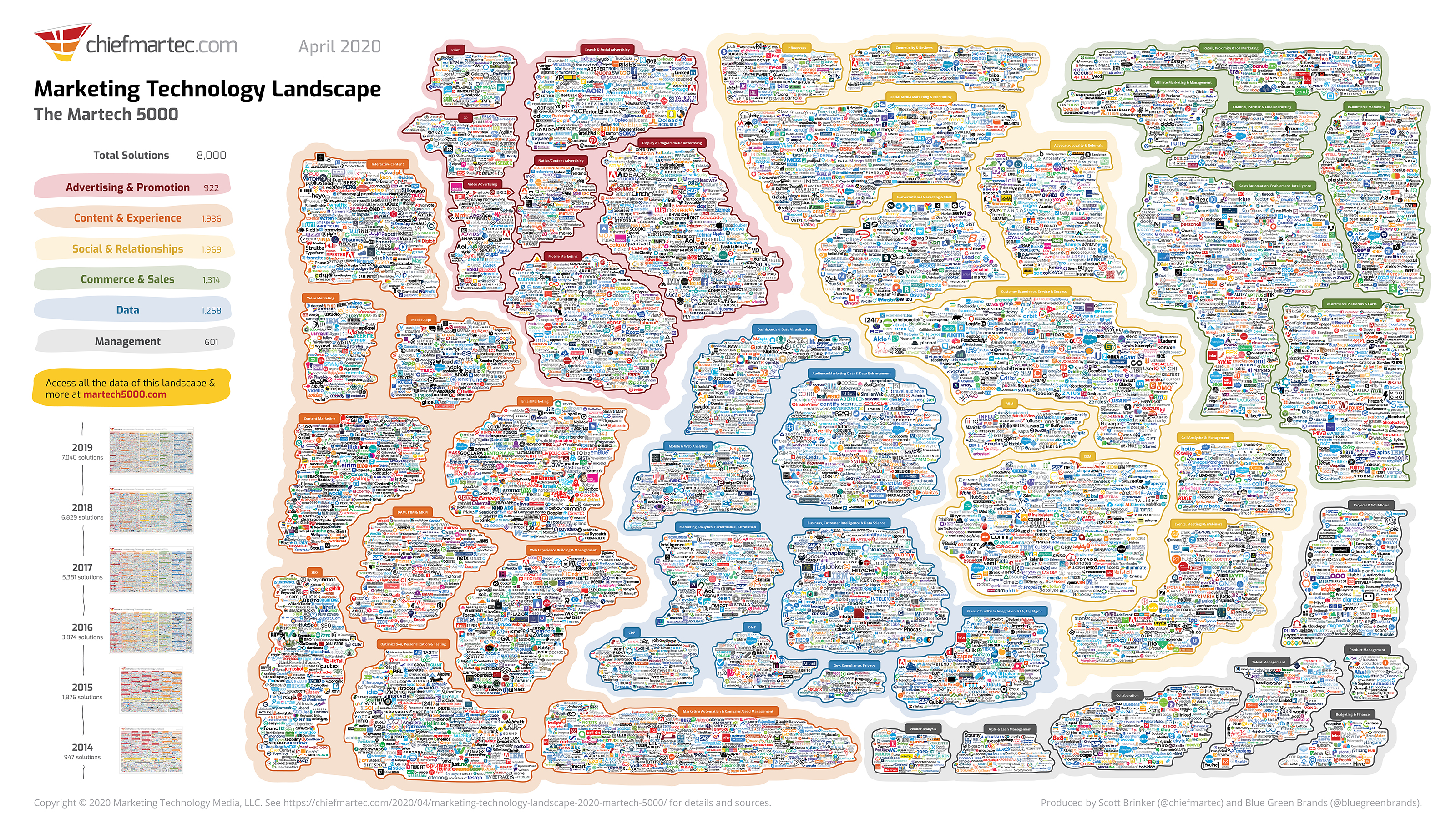
Many a marketing professional gets nauseous when it comes to evaluating the right marketing automation solution. The variety of AdTech and MarTech solutions available on the market is enormous. Scott Brinker of Chiefmartec.com, has been practicing for years to find a Overview The latest one from April 2020 shows around 8,000 solutions from hundreds of manufacturers.
So before you get lost in the jungle of features of possible solutions, you should be clear about what goals you want to achieve - and, based on this, what you want to automate and which functions are required to do so. There is a big difference between using a solution for email automation and personalizing content on websites, for example. It is worth taking a look into the future. All too often, a tool that is well suited to the task at hand is quickly procured, only to realize later that it has reached its limits. You then need a second, and later a third tool, and then inevitably have to struggle with integration.
That's why you should perhaps ask yourself from the outset whether it really should be the best-of-breed tool that satisfies all requirements, or whether it wouldn't make more sense to opt for a platform that can be expanded as required with various fully integrated solutions from the same provider. It is also worth thinking outside the box here. Is there a need for sales or service automation in addition to marketing automation? The chosen solution should at least offer adaptors for the simple integration of third-party applications. Adaptors or open APIs are also important for the integration of existing solutions, such as existing CRM and ERP systems.
Ideally, a good customer data platform (CDP) should be at the heart of any chosen solution (see above). This would ensure that data can be managed effectively, access rights can be assigned and data protection (GDPR or DSG conformity) is guaranteed. In any case, we should create standardized customer profiles on a central platform.
Modern marketing automation tools allow you to easily visualize the sequence of individual campaign steps with graphical elements and drag & drop functionality and to simulate the progress of the campaign with a set of test data. The aforementioned A/B testing with dynamic allocation of budgets is also part of a modern tool. When searching for the right tool, the options for data analysis should not be neglected. Here too, simple solutions with graphical representation and actionable insights should be preferred.
"Last but not least, you should think carefully about who you get involved with. In addition to competent advice and support during the implementation phase, attention should also be paid to subsequent support (availability, channels, self-service, language, costs). And especially with regard to later support, it tends to be worthwhile to rely on a comprehensive marketing cloud from a single provider rather than on various tools from different providers.
Trust in artificial intelligence
Artificial intelligence in marketing automation is both a blessing and a curse. On the one hand, for example, AI-based send time optimization and fatigue analysis in email marketing, i.e. deciding at what time of day and how often to communicate with a target person, lead to better results. On the other hand, algorithm-based programmatic advertising, for example, can lead to the exact opposite if the AI is trained incorrectly or if targets are set incorrectly, for example if high click rates and a low CPM (cost per thousand contacts or cost per mille) are targeted. Apart from the fact that few providers want to see their advertising on porn sites or the sites of extreme groups, the wrong KPIs, for example CPC (cost per click) and conversion rate, can lead to sales being flooded with poor-quality leads. High conversion rate in marketing, low to none in sales. Or nothing arrives in sales at all, even though the marketing department is celebrating high click rates. Quite simply because the ad server plays interstitials on pages where there is little context due to the aforementioned objective (high click rate, low CPM) and these simply want to be clicked away as quickly as possible by annoyed website visitors. For a contextual reference, an interface to the CRM system is a must.
But it is also a curse because many marketers today are dazzled by providers such as Facebook or Google and lack transparency. After all, algorithms are a trade secret. It is therefore important to focus on achieving good end results, i.e. profitable business, and to define corresponding goals.
In any case, it is worth looking at the limits of AI.
* Daniel Renggli has made his career in marketing and sales at technology companies such as IBM, SAP and Microsoft. Most recently, he was responsible for the marketing of Oracle's CX solutions for advertising, marketing, sales and service in six countries, including Germany and Switzerland. He is a federally certified sales manager and holds a Master of Advanced Studies in Marketing and Business Administration from the University of Basel. In addition to marketing automation, his professional interests include the digital transformation of companies, co-creation and customer experience management (CXM). He is active as an author and speaker at events, and is also co-editor of the BeyondCXM podcast.


 PAM won the pitch for the creative budget against two other agencies. "PAM's approach and publicity-heavy thinking convinced us as it builds very well on our current positioning while offering a lot of potential for Smile's further growth," said Joséphine Chamoulaud, Head Marketing & E- Commerce at Smile.
 The financial support for the project was discontinued at the end of November 2021, as the Federal Office for Gender Equality (EGB) announced on Friday in response to a request from the Keystone-SDA news agency. The decision was recorded in an order on Wednesday and communicated to the association.
 A couple of high-spirited guys from Zurich borrow a Pistenbully from the Titlis ski resort to extend their après-ski party to Langstrasse. This is only a stone's throw away from Engelberg. The ride didn't go unnoticed: Witnesses posted videos of the bully on TikTok, Instagram and Reddit on a country road, the Quaibrücke bridge or in a residential neighborhood in Zurich.


 The Jung von Matt Limmat AG agency is now trading as Jung von Matt AG. The AG is responsible for the overarching interaction of all Jung von Matt agencies in Switzerland, the agency writes in a press release.
 Customers could switch from the aging Sunrise TV platform to UPC's modern TV platform. The fact that only one TV platform is now being operated has to do, among other things, with the changes to the ""Common Tariff 12"" (GT12), which will newly regulate the compensation of TV broadcasters for time-shifted TV as of next year, Krause explains.
 Financial stability is fundamentally important for an economy. The Deutsche Bundesbank monitors and assesses potential threats to the stability of the German financial system. It contributes its assessments to national and international bodies and communicates them to the public. In this way, it contributes to financial stability.
 This is the first time an Instagram post has been the subject of a complaint, the UBI wrote on Thursday's decision. "It is accessible: We are now gendering with a colon," SRF News posted about an image on April 14, 2021.
 As every year at the Advent season leads m&k advertisingweek.ch is once again conducting its annual creative ranking in 2021. It shows how Swiss agencies have performed in the most important national and international creative awards. The ranking is published in the first print edition of m&k in the new year and online at Advertisingweek.ch published.
 On Thursday evening, the virtual awards show of the 35th Epica Awards went live from a studio in Paris. TBWA\Zurich and Wirz entered with five and two shortlist entries respectively.