Inspiring young talent in video production and video marketing: Maybaum Film, based in Baden, now offers this opportunity twice a year to nine students during a trial day. It’s a project that’s not entirely without self-interest.
Editorial
-
May 25, 2022
"Skilled workers are still rare in our field, although demand is increasing massively," Maybaum CEO Michel Alraun was quoted as saying in a statement. "I am convinced that we need to inspire the filmmakers of tomorrow now".
That's why Badener Filmproduktion offers twice a year a taster day at. On July 7 and November 10, 2022, students who are in the process of choosing a career can learn about the various phases of a commissioned film production - from the briefing, concept phase, shooting and planning to production, post-production and distribution. In the process, they look over the shoulders of Maybaum's specialists and can also take their first steps themselves.
"We have participated in Future Day so far, but we also receive a lot of other inquiries," says Salomé Brozman from Maybaum Film. "With the taster days, we also want to offer students an opportunity who were not able to attend the Future Day."
Investing sustainably in the future of the contract film industry seems increasingly important in view of rising order volumes and growing demand for moving images. For two years now, Maybaum Film has been relying on an internal training program called MayAcademy. Employees receive targeted support and training from internal and external instructors. Extending this offering to future generations of filmmakers was a logical step for the agency.
Studio Thom Pfister realizes brand refresh for Trianon
Studio Thom Pfister wins Trianon, a company active in the outsourcing of personnel and pension processes, as a new client. A brand refresh was developed for the subsidiary of Mobiliar.
Editorial
-
May 25, 2022
After the content-related brand positioning, Studio Thom Pfister developed a fresh, contemporary overall appearance for Trianon that corresponds to the company's brand essence.
This is already the second rebranding project that Studio Thom Pfister has been commissioned to realize for a Mobiliar subsidiary. Just under two years ago, the agency was commissioned to rebrand Buildigo. This appearance was nominated by the German Brand Award 2022 for their exemplary and exceptional brand management in the category Brand Design.
Responsible at Die Mobiliar: Lorenz Jenni (Head of Brand Leadership & Marketing Communication), Patrick Tharin (Corporate Communications), Philipp Brühlmann (Brand Manager). Responsible at Trianon: Marc Olivier Delevaux (Managin Director), Pascal Dinichert (Director Corporate & Business Development), Benno Halter (Director Pension Services Outsourcing), Jennifer Nasri (Marketing & Communication Manager), Géraldine Delmoitié (Project Manager). Responsible at Studio Thom Pfister: Thom Pfister (Creative Director, Idea/Concept), Ursula Rytz (Consulting), Roland Zenger (Art Director), Daniel Hackiewicz (Graphic Design & Web Development), Kim Wüthrich, Juli Martinelli (Graphic Design).
What the m&k Werbewoche.ch community has to say about pitching
Are pitches still relevant today? In April 2022, m&k Werbewoche.ch launched an industry survey on the topic of pitching. The results show that the topic is divisive—yet a clear trend in opinion is emerging.
Sarah Willi
-
May 22, 2022
When clients advertise mandates - or agencies apply for them - both sides are confronted with a phenomenon that is unique to the marketing and communications industry: Jobs have always been competed for in the form of "pitches". A process that ties up a lot of resources on both the client and contractor side.
m&k advertisingweek.ch wanted to know what its community thinks about pitching. For the current m&k-Anna Kohler also conducted an interview with pitch consultant Roland Sutter and gave the LSA and SWA associations the opportunity to make statements (click here for the Abo+ article).
The survey results in the community show that they have a strong opinion on the topic of pitching - many would like to see a rethink, both on the client side and on the agency side.
Most of those who took part in the survey were from the agency or contractor side, which can be explained by the fact that this side is more affected by the topic. Accordingly, there was a particularly high number of responses stating that pitching is no longer up to date. In contrast, only just under 10 percent of respondents stated that they thought current pitching practices were okay.
(Image: Werbewoche.ch)
A good 70 percent of respondents consider a trial assignment or an agency evaluation after a "chemistry meeting" to be target-oriented alternatives to pitching. In contrast, almost no one considers the awarding of contracts from an "agency roster" to be effective. Almost one in three respondents think that relying on "word of mouth", i.e. the agency's reputation, is a good idea when awarding contracts.
Almost 40 percent of respondents also believe that both parties should communicate openly with each other in order to improve and therefore extend business relationships. This could lead to a client not switching agencies too quickly.
Below we have listed some statements anonymously. As many answers overlap in terms of content, we have limited ourselves to a few particularly meaningful ones.
Agency side, finds pitching outdated
In my opinion, pitches have never been up to date. I used to be a client myself and never pitched. Since I've been self-employed with my own marketing network, I've never taken part in a pitch because I still don't think it makes sense and it causes a lot of effort on both sides.
I think you have to be able to find out in an evaluation and open discussions whether it's a good fit or not. As a client, I've also fallen flat on my face with recommendations. So in my view, the best thing to do is to discuss and evaluate honestly with open cards.
Client:inside page, finds the current pitch procedure in order
As the client, we pay a pitch fee, which does not cover all costs, but does make a contribution. In other industries, pitches or invitations to tender in which advance payments are made are also the norm. What is often forgotten: Most products are produced first, with no guarantee that customers will buy them or that the necessary quantity will be sold to make a profit. No one guarantees the success of a new product. For established companies, this is part of the business risk; for start-ups, this is the biggest hurdle to being able to enter the market at all.
That's why, in my opinion, a lost pitch is part of an agency's business risk. An agency is all about finding the most suitable idea/creation for a specific task. Which cannot be selected without a visual representation. A good reputation or the likeability of the agency does not guarantee me this. If I, as the client, knew exactly what I wanted to realize, I could bypass the agency and work directly with photographers/graphic designers/filmmakers.
Agency side, finds pitching outdated
The agencies themselves are to blame for today's misery. In any other industry, a client would be given the bird in response to a pitch request. Here's a wonderful anecdote:
Why we have got ourselves into this nonsense in advertising is still a mystery to me. Why industry associations don't try to finally put an end to this unfortunate practice is even more of a mystery to me.
agency side, thinks the pitch process is fine
Honest communication of the decision criteria (price vs. "quality") and consistent application in the evaluation are of the utmost importance for both sides. If the quality requirements of marketing are too far removed from the cost-driven requirements of procurement, this will initially lead to frustration on the part of the agency.
In the second step, however, this also leads very quickly and in the long term to frustration for the client, who does not experience the performance - quality, resources, pro-activity, innovation, etc. - from the pitch on a day-to-day basis after the agency adjusts (or has to adjust) to the commercially given framework and adapts the service.
Client:inside page, finds pitching outdated
Work samples, best cases, a meeting to get to know each other and/or a visit to the agency could be enough. Often the really good ideas don't emerge in the short time you have to prepare the pitch.
Agency side, finds pitching outdated
As a small agency, I haven't generally taken part in pitches for years. A lot is now demanded of me and the compensation (if there is any at all) never covers the effort, not even in the slightest. I prefer to put my energy into projects and assignments that I can design and realize from A to Z, which is definitely more fulfilling.
Pitches have degenerated into a crass competition of ideas in which everyone tries to outbid each other in ever more extreme ways. If you're not prepared to produce ideas by the meter for the dustbin, it's better not to take part. Unfortunately, I also had a bad experience years ago: I didn't win the pitch, but then the concept we presented was used anyway, simply implemented by an agency that did it more cheaply. The use of our concept was actually legally prohibited or not part of the pitch, let's not even talk about compensation. We didn't take legal action after all; I'd rather invest this energy in other clients.
Agency side, finds pitching outdated
Just as I don't pitch when I'm looking for a lawyer to advise me, for example, but try to find out what makes him/her tick and whether we can "smell" each other as people in a personal meeting, I think that selecting an agency would also be much more effective.
Less waste of resources (a lot of time, a lot of money - for both sides, by the way), and it avoids the agency starting with a specially put together "pitch team", which the client then only sees sporadically (if at all) in daily business, thus creating false expectations.
Agency side, finds pitching outdated
Pitches are not sustainable - neither for brands nor for agencies.
For clients:
The campaigns that result from a pitch usually only solve a problem superficially and in the short term, if at all. If the campaign is a success, those responsible put it on their CV. If the campaign is a flop, the agency partner is changed so that those responsible can secure their job. The campaign itself is usually shot from the hip and does not pursue a sustainable strategy, which does more harm than good to the brand.
For agencies:
The investment for a pitch has not paid off economically for a long time. Whereas in the past, expenses were compensated with a multi-year mandate, today it is mostly a matter of individual orders. This and the microscopically small budgets that are already being pitched for today ensure that the agencies pay out either way.
The only solution:
Agencies should stop lying to themselves and stop working for free. Because despite the agreement, many agencies still take part in free pitches. And if you are honest, an expense allowance of 2,500 - 5,000 francs is basically a free pitch. This is because the pittance covers at most 10 to 20 percent of the actual expenses.
Agency side, finds pitching outdated
A pitch fee of 5,000 to 10,000 francs should be standard practice as proof of seriousness and compensation for expenses. This also means that only five and not 10 agencies are requested. Limiting offers/PPTs to 40 pages for profile, references and working methods, for example, would make sense so that agencies do not always have to prepare battles with 150+ pages. This also facilitates verification on the company side.
client:inside page, the Pitch procedure in order
Reduce pitch proposals: one proposal instead of several. This reduces the agency's workload and the client can get an idea of the agency's approach and strength of ideas.
Agency side, finds pitching outdated
A pitch process costs the agency a lot of money. The concept is an important asset of the agency and is called up via the pitch at a very low price, if not free of charge. It is therefore more than fair for the client to be well prepared and to allow sufficient time for the evaluation and the process.
Here are a few quick tips:
Number of invited agencies: The number should not exceed 5 agencies. The first evaluation should be carried out via recommendations and web check. A shortlist of 3-5 agencies will then be invited to pitch.
Clear rules: Often only a rough concept is required. But then only the rough concept may be evaluated.
Budget: Specify the budget, this helps the creative process.
Pitch fee: Even if the amount is symbolic, it shows the agencies that the client is serious.
Presentation: The agency must be able to present the ideas.
Briefing: A clear briefing with clear strategic guidelines helps agencies to develop the best possible ideas.
An alternative approach for a target-oriented pitch would be, for example:
Stage 1: Scrutinize the briefing, ask the right questions and further develop the strategy (reduction from five to three agencies)
Stage 2: Concept development based on the revised briefing. Presentation of ideas and feasibility (reduction from three to one winner)
client:inside page, the Pitch procedure in order
As a client with agency experience, I pay a lot of attention to the internal culture of an agency and the way the team works together. The regrettably high turnover at most agencies means extra work for clients, which agencies can reduce by improving their internal culture.
Agency side, finds pitching outdated
In order for successful campaigns to be realized, a much more intensive collaboration between client and agency is required nowadays, regardless of whether it is a creative or media agency. It is therefore crucial that the client-agency team "works" and that they work together on a partnership level. These points can rarely be adequately assessed in a traditional pitch process.
Agency side, finds pitching outdated
Pitchitis" is rampant, with pitches being made for every small and individual project. Unfortunately, clients find enough agencies to play the game. Agencies need to put a stop to this. Through clear guidelines such as a minimum order size and the contractual cooperation period after winning a pitch.
client:inside page, the Pitch procedure in order
Don't pitch budgets, just individual campaigns. Then you can keep the effort much lower (as a client, we only want rough concepts) and it has to be presented by the team that then does the job.
Agency side, finds pitching outdated
Clients make two crucial mistakes when awarding (large) creative pitches.
You leave the match-deciding part entirely to the agency. But to achieve an optimal result, the client's know-how would need to be an integral part of the project. Today's communications world is too complex to simply leave all important strategic and creative decisions to the agency. This leads to agencies making decisions and taking paths that do not lead to the desired results. That's why you usually start all over again after the pitch.
If an agency wants to win the pitch at all costs, then it invests everything; 200% commitment, time and energy. This leads to a massively distorted image of the agency - because after the pitch, normal "everyday life" begins. It has to work well in a standard mode so that the client is happy in the long term. I often find that this is followed by a rude awakening for the client. Possible solution: if you are interested in agency X, then simply do a small project. This provides much more information about the quality of the work and collaboration than a pitch.
Agency side, finds pitching outdated
Too often, everything is subordinated to a pitch and the real, properly paid work is done on the side. So from 6 p.m. until deep into the night.
agency side, thinks the pitch process is fine
Pitches are not wrong per se. However, it is a question of how the pitch is structured. Important: A maximum of three agencies, either just a small test assignment without too much effort or then paid.
Doesn't explicitly align himself with one side, doesn't find pitching contemporary
From the client's point of view: An agency and its concept should not win a pitch, but rather new clients for the client. In other words, what you get from a pitch are actually the wrong concepts.
Out of agency addiction: in the online industry, we abolished pitches a decade ago. I have no idea why advertising agencies still put themselves under so much stress without payment.
Some agencies are openly taking a stand on pitch culture:
In the spring of 2022, Mobiliar is helping to raise awareness about defensive cycling with an online ad and quiz. The national prevention campaign was implemented by Triebhaus Kommunikation.
Editorial
-
May 20, 2022
Cycling enjoys great popularity. Many people get on their bikes not only in their free time, but also on their way to work. While this has a positive effect on the environment and on people's own fitness, it also harbors the potential for accidents. With the national online campaign "Better Prepared", Mobiliar is addressing the highly topical issue of bicycle accident prevention and encouraging cyclists to be better prepared for the journey.
At the center of the prevention campaign is a video clip with two opposing bicycle types as protagonists: a top-equipped female e-biker and a clumsy occasional bicycle rider meet in a neighborhood street and within a few seconds become involved in a fast-paced and humorous story.
The plot twist conveys the message that cyclists - no matter how well equipped - can always be surprised by unexpected dangers. A forward-looking and considerate riding style is just as important for a safe ride.
As a preventive aspect, the quiz on the Campaign website raise awareness for safe cycling in a playful way. The questions are presented by the two bicycle protagonists from the video clip. Those who successfully complete the quiz can win bicycle prizes worth 10,000 Swiss francs in the accompanying raffle.
The video clip will be played out as part of the branding and performance campaign across various online channels, including social media.
Responsible at the Mobiliar: Nicole Bieri (Marketing Communication Manager), Lorenz Jenni (Head of Brand Leadership & Marketing Communication), Caroline Fricker (University Intern Marketing), Michael von Wartburg (Head of Product Manager Personal Insurance), Christian Winterberger (Product Manager Personal Insurance). Responsible at Triebhaus Kommunikation: Adrian Kiener (consulting, project management), Marika Nygren (art direction), Laura Leist (text), Esther Zimmermann (UX design), Alan Maag (photo). Responsible at Mediaschneider: Timo Bendel (Senior Consultant). Responsible at Dynamic Frame: Natascha Vavrina (Director), Dmytro Nedria (Cinematographer), Luzius Fischer (Executive Producer), Alina Benz (Producer), Daniel Loepfe (Post Production).
Farner and Honda test the intelligent driving experience
Farner Consulting realizes the campaign for the latest Honda HR-V e:HEV, which is now available in Switzerland.
Editorial
-
May 20, 2022
The new Honda HR-V e:HEV offers a new kind of driving experience with its hybrid drive. Interested parties can try out how the Honda HR-V feels on our roads directly at their trusted Honda dealer during a free test drive.
Under the motto "Experience Honda HR-V", Farner is raising awareness of the new Honda in a campaign. The films present the hybrid model on the road in Switzerland for the first time. They are used online and address two different target groups and their specific interests.
Sustainability, space and driving pleasure
In the film for young families, the focus is not only on sustainability but also on space and safety in everyday life. In addition to families, the aim is to appeal to modern pragmatists who also value special experiences. In their advertising material, the focus is on the spaciousness of the HR-V and the freedom that the new model will give them.
Responsible at Honda SwitzerlandThierry Leutenegger, Vanessa Favre, Vincent Roch, Anouck Daenzer. Responsible at Farner Consulting: Camille Zuber (project management), Hanja Heuss (creative direction), Pedro Velasquez (art direction), Ennio Cadau, Jan Walser (concept, text), Tjabrina Penazzi, Fabian Sigg (design). Responsible forPolarwind (Production): Director/DOP: Fabian Weber, AL: Alex Biondi, 1st AC: Thomas Hrabovsky, Marius Mahler, 2nd AC / DIT: Cyrill Gsell, Set Design: Atelier Lomann, Gaffers: Raphael Toel, Best Boy: Jakob Wessley, Grip: Nik Delley, Drone/CineCar: Birdviewpictures, Styling: Tatjana Kotoric, H&M: Bassil Vikon, Driver: Oliver Kniel, Editor: Oliver Don, Grading: Florian Wolf, Sound Design: Denis Elmaci, Casting: Laura Rindlisbacher.
Notch becomes part of Digita's
Notch is joining Digitas, a global digital agency. With this move, Notch aims to create a unique offering in Switzerland in the areas of customer experience, e-commerce, platforms, digital campaigns, and CRM. As part of this change, Notch is restructuring its management team, but the name «Notch» will remain the same.
Editorial
-
May 20, 2022
Looking forward to working together: the leaders of Notch and Digitas. (Image: zVg.)
Notch has belonged to Publicis Groupe in Switzerland for two years now (Werbewoche.ch reported). Notch is now igniting the next stage of growth by joining Digitas' international network.
Digitas connects more than 4,000 experts in data, strategy, creation, media and technology in over 50 locations worldwide. The agency was named a Leader in Gartner's Magic Quadrant for Global Marketing Agencies in 2021 for the sixth year in a row.
Notch works with 25 specialists from the areas of strategy, UX design and technology for customers such as CSS, Migrolino, Swatch, Swisscom, Suva, UBS and WWZ. By joining the Digitas network, Notch is now launching a new service offering that seamlessly combines customer experience and technology. "Expanding our offering is the next logical step for us. Our customers benefit from the potential to realize integrated, digital systems with us that enable a brand-appropriate customer experience," Peter van der Touw, Chairman of Notch, was quoted as saying in a press release.
In this context, Notch is reorganizing its management team. Strategy Director Serge Barsotti, Business Director Joas Landis and UX Director Martin Stauch take over the management of the agency. Notch's co-founder Peter van der Touw continues to serve as Chairman.
Valencia and Coop invite you to chill
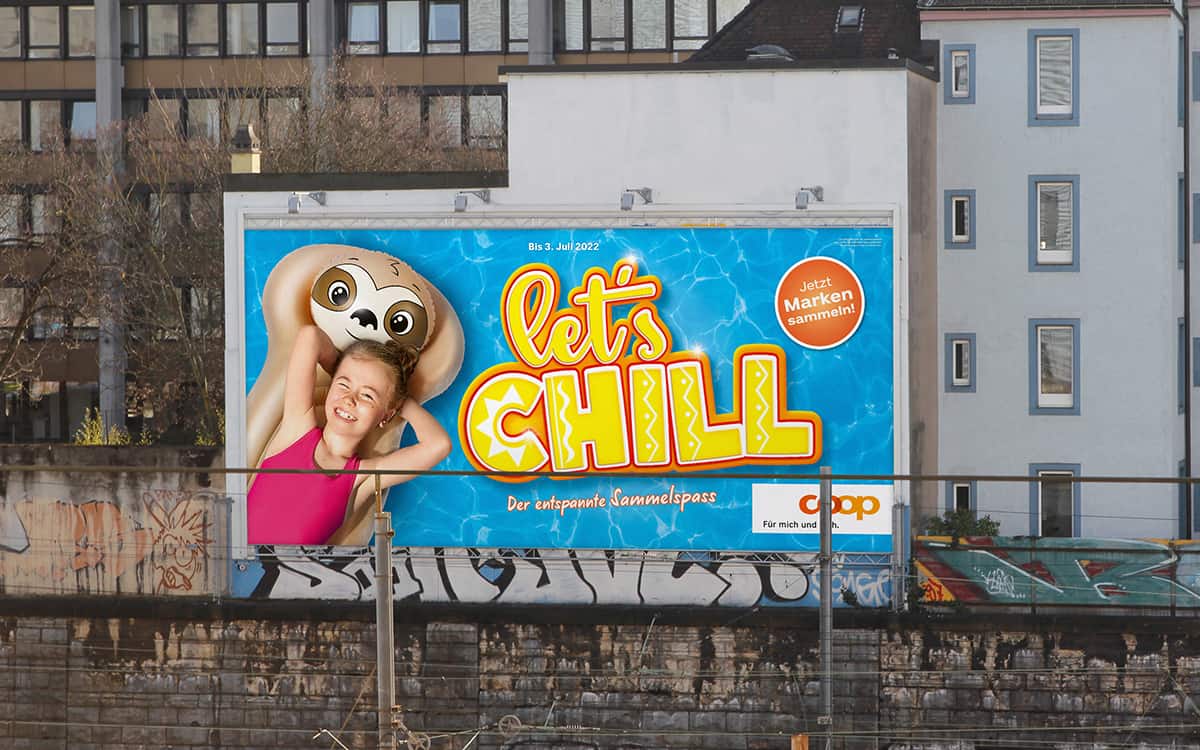
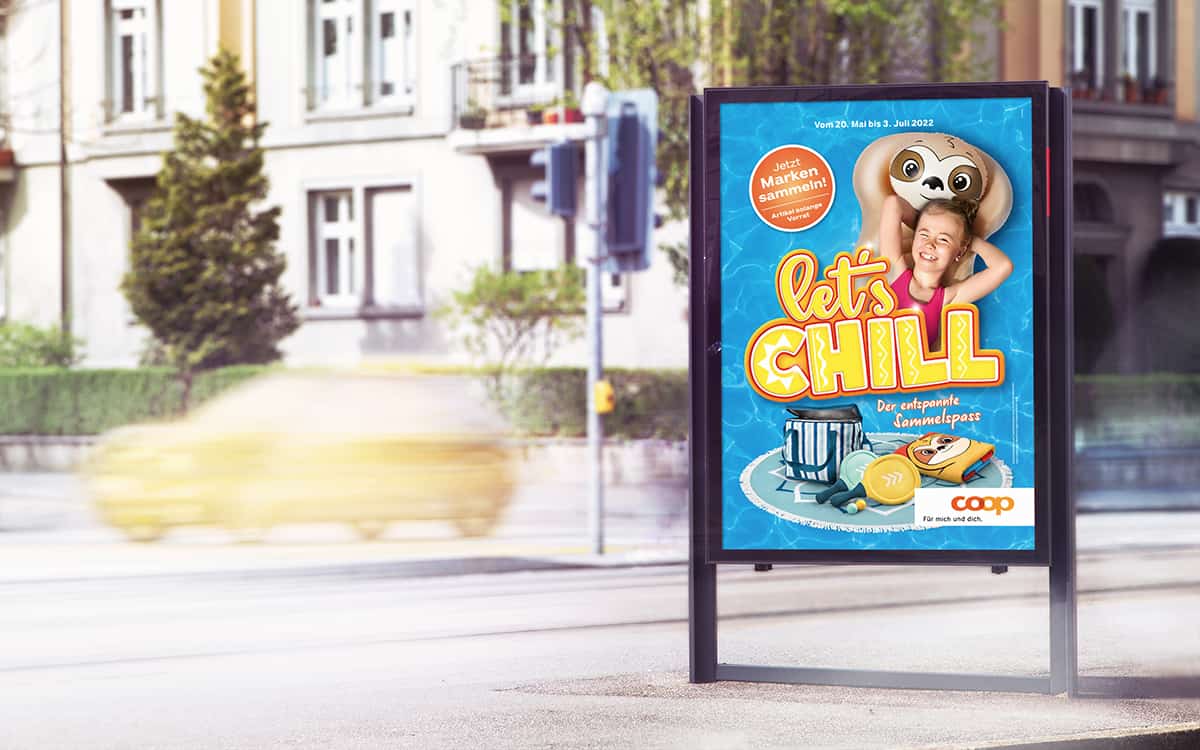
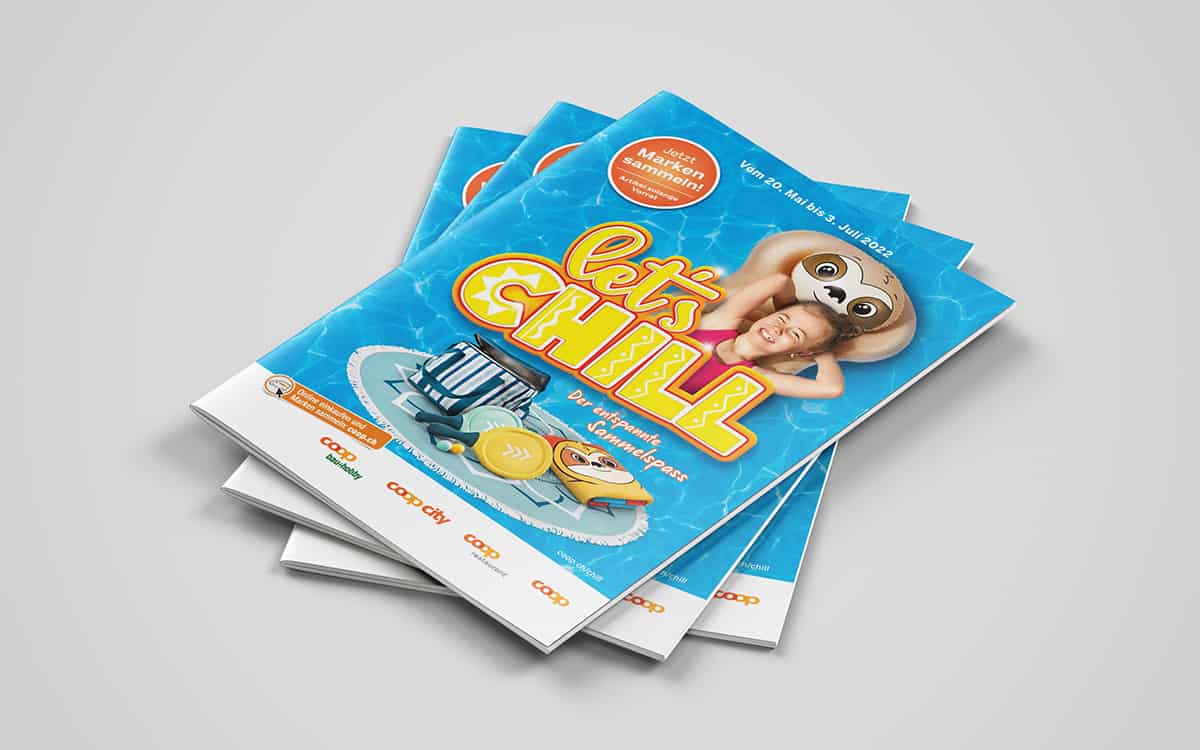
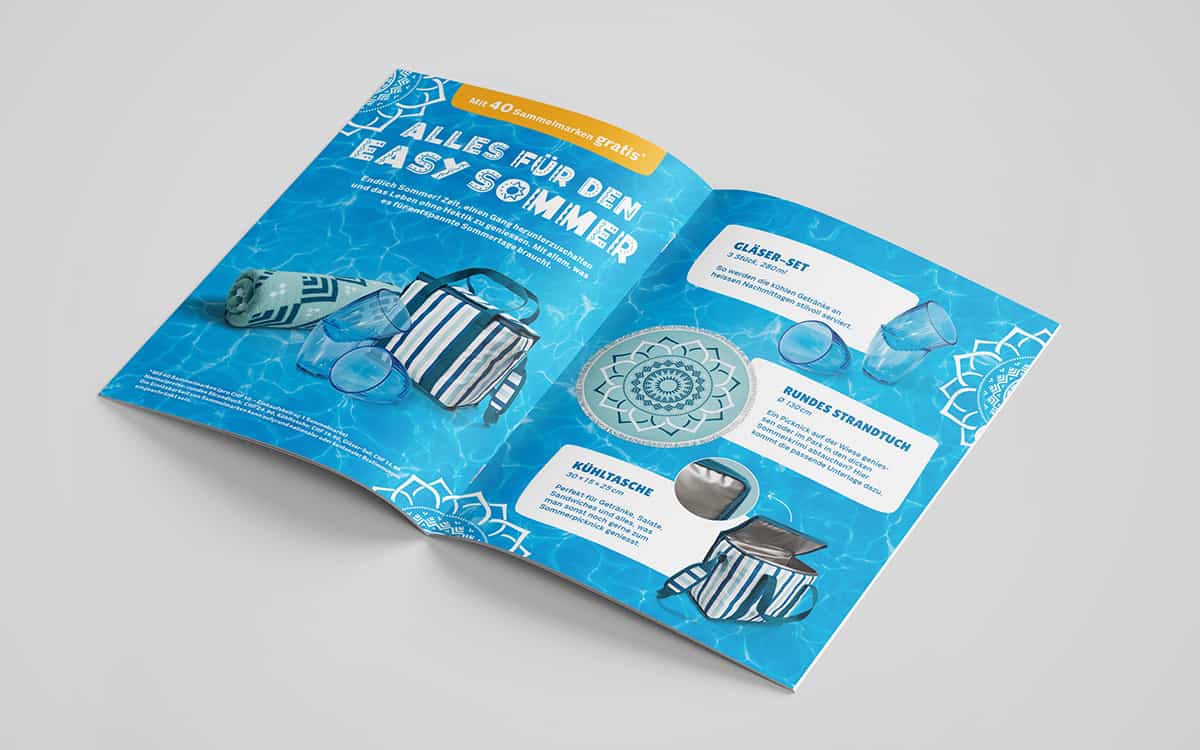
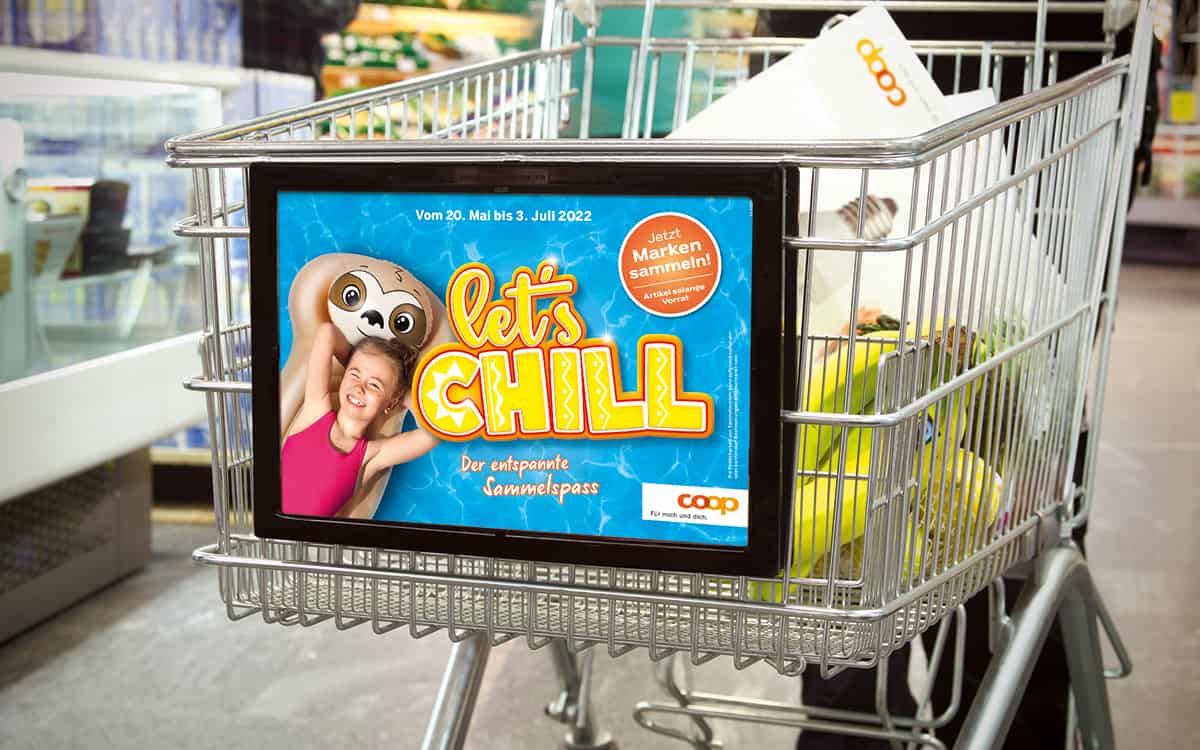
Coop’s current collectible promotion offers leisure items designed to provide relaxation and leisure time during the summer months. Valencia Kommunikation is providing comprehensive communications support for the promotion.
Editorial
-
May 20, 2022
The Swiss summer of 2022 is supposed to be very relaxed - in line with the motto "Let's chill. That's why the promotion's collectibles invite you to take it down a notch while swimming, playing, or picnicking. They include a sloth air mattress, a colorful beach ball set, and a round beach towel with a mandala design.
Valencia designed the appearance of the promotion including a naming that also functions as a call-to-action and conveys in a TV and online motion picture the desire for a trip to the swimming pool with the whole family.
In line with the 360-degree approach, the range of advertising media covers all touchpoints on the customer journey: at home with a TV spot in various formats, online banners and advertisements, on the move with DOOH moving images, posters and various mobile advertising media, and in the stores with various POS advertising media such as 3-D plates and displays.
The "Let's chill" promotion runs from Friday through July 3, 2022, at Coop and various partner formats.
Responsible at Coop: Vanessa Finzer (Head of Advertising), Simon Bohnenblust (Head of Advertising Promotion/Sales Promotion), Gina Anderegg (Project Manager Advertising Promotion/Sales Promotion), Sabine Gnand (Project Manager Advertising Promotion/Sales Promotion), Saara Jeisy (Project Manager Marketing Communication), Joachim von Allmen (Head POS Retail), Simon Flatt (Head of Media), Karin Rieth (Head of Media Classic), Lukas Schmid (Senior Project Manager Digital Media), Florian Lanovic (Head of Social Media & Online Campaigning), Aliza Berndt (Project Manager Social Media / Online Campaigning), Oliver Pursell (Project Manager Social Media), Anja Nowak (Project Manager Online Campaigning). Responsible at Valencia Communication: Tommy Schilling (Creative Director), Iraklis Hungerberg (Senior Account Director), Meret Renggli (Consultant), Lea Bantlin (Trainee Consultant), Sebastian Refardt (Senior Copywriter), Michael Wenk (Art Director), Amadea Waldmann (Graphic Designer), Marco Fritz (Polygraf), Niklas Dunke (Polygraf). Responsible at Shining Film: Stefan Bircher (Producer), Stefan Girtanner (Senior Producer), Jyri Pasanen (Director), Timon Schäppi (Camera), Nicolas Bechtel (Edit), Simon Hardegger (Colorgrading). Responsible at TWmedia: Stephan Küng (Overall Responsibility), Manuela Brunner (Media Planning), Pearl Kathriner (Senior TV Planner), Damiano Vitali (Head of TV), Sven Däschner (Head of Online), Aaron Salzgeber (Digital Campaign Manager), Madeleine Huber-Tröndle (Online Media Planner). Responsible at Hitmill: Fred Herrmann (Composition, Producer), Roman Camenzind (Executive Producer), Noemi Mathis (Project Management). Responsible at Covermedia: Baschi Thommen (audio engineer), Angelina Belintani (production).
Wunderman Thompson for HEKS: Helping begins with looking
Wunderman Thompson's current campaign for HEKS, the relief organization of the Protestant Churches in Switzerland, brings the social problems to Corona into the public eye.
Editorial
-
19 May 2022
The consequences of the Corona pandemic are widening the gap between rich and poor, also in Switzerland. The number of long-term unemployed people has tripled. Precariously employed people and sans papiers have fewer opportunities to earn money. Lonely people have become even lonelier. And all this has gone largely unnoticed by the public. The new campaign for HEKS shines the spotlight on these problems and literally puts them at the center of society.
According to a population survey conducted by HEKS with more than 1000 participants, the respondents think that gastronomy, culture and event industry as well as elderly people and children have suffered the most from the pandemic. The reason may be that the challenges of these populations were very present in the media during the crisis. However, the problems of people on the margins of society are in the "blind spot" of the population because of the lack of touch points and also the lack of media coverage. HEKS' new domestic campaign aims to change this - by making the social consequences of Corona publicly visible and thereby creating solidarity in society.
Spotlight on the social consequences
The campaign shines a spotlight on the problems of people on the fringes of society. And it does so by using a spotlight that exists in the middle of Zurich: The light installation on Heimplatz, where colored light dots scan the surroundings in the evening. At places where the colored points of light move over it, authentic settings were set up that are representative of the problems of those affected. For example, a sparsely furnished kitchen with a refrigerator that often lacks even the most basic necessities. The films bring three touching scenes to the public's attention, as they are currently happening thousands of times throughout Switzerland as a result of the Corona crisis. The urgent message is: Look now and help.
Campaign calls for a closer look
All advertising media lead to the landing page Heks.ch/lookwhere you can find detailed information and personal stories about the respective HEKS projects. Everyone can help to improve the situation of the people affected in Switzerland by making a donation or submitting a petition.
The campaign can now be seen on TV, via online and social media ads, advertisements and posters. In addition, around Refugee Sunday on June 18, 2022, donation flyers, posters, and social media ads will be used to match the campaign.
Responsible at HEKS: Hanspeter Bigler (Head of Communications/Marketing), Brigitte Roth (Head of Marketing/Fundraising), Nina Fink, Andrea Oertli (Domestic Theme Officer). Responsible at Wunderman Thompson: Swen Morath (Co-CEO), Marika Magnuszewska (AD), Julia Staub (Text), Saskia Kremser (Strategy), Stephan Lanz, Nadine Treier (Consulting), Kim Prinzing (DTP). Shining Film AG x Color Film: Laurent Arber, Florian Brunner (production), Hannah Dobbertin (direction), Elia Grunder (camera), Lea Hättenschwiler (set design), Nicolas Bechtel (editing), Simon Hardegger (color grading), Leonardo Sanfilippo (supervision). Photography: Jonathan Heyer.
Swiss Post subsidiary lays off 155 employees
The delivery company Direct Mail Company has laid off 155 employees in the Biel region. The reason for the job cuts at the Swiss Post subsidiary was that it will no longer be distributing the free newspaper Biel/Bienne.
Editorial
-
19 May 2022
The free newspaper Biel/Bienne will no longer be distributed on Tuesdays in the future and will be included in the large circulation of the Bieler Tagblatt. (Archive photo: Keystone/Christian Beutler)
In total, Direct Mail Company (DCM) eliminated 20.5 full-time positions as of Sept. 1, Swiss Post announced Thursday. According to the statement, the employees had been responsible for, among other things, the free newspaper Biel/Bienne distributed. In future, this will no longer be published twice a week and will be added to the large circulation of the Bieler Tagblatt and of the Journal du Jura settled. As a result, the largest order in the region would be lost.
According to the statement, the Swiss Post subsidiary Presto is responsible for the delivery of large print runs. Swiss Post is looking for employment opportunities for the affected employees there. Employees can submit proposals by the beginning of June as part of a consultation process on how the planned job cuts could be avoided, the statement added. (SDA)
Six new board members for Digitalswitzerland
At the Digitalswitzerland General Assembly, six new members were elected to the Board of Directors. With Sascha Zahnd, who was appointed president a year ago, the Board now comprises 23 members. Since the initiative was founded in 2015, more than 240 association members and politically neutral foundation partners have been supporting Switzerland on its path to becoming a leading hub for digital innovation.
Editorial
-
19 May 2022
The candidates proposed for election by a six-member nomination committee received a unanimous vote at the General Meeting. New to the board are CSS CEO Philomena Colatrella, Anna Takihara and Jill Kümin of Google, who share the mandate, Rainer Baumann, COO at Migros Genossenschafts Bund, Adrian Müller of Swico and Sabine Magri, COO UBS Switzerland. They succeed six members who have resigned from the board.
"With the new board members, the transversal knowledge of our board is ideally completed and it is gratifying that we were able to pay attention to diversity in the nomination process," Digitalswitzerland President Sascha Zahnd was quoted as saying in a statement.
Board members Sascha Zahnd, Yvonne Bettkober, Nicole Burth, Marcel Dobler, Thomas Flatt, Ivo Furrer, Peter Grütter, Catrin Hinkel, René Hüsler, Marco Huwiler, Gabriela Keller, Christian Keller, Cédric Moret, Christophe Nicolas, Marcel Stalder, Marc Walder and Anja Wyden Guelpa were re-elected for another one-year term of office.
Strategy Update
The year 2022 marks an important stage of strategy refinement and realignment for Digitalswitzerland. The appointment of the new Managing Director Stefan Metzger in January 2022. underscores the transition to a stronger impact orientation with six focus activities, the release says. The evolution of the strategy, known as Strategy 2025, defines the key success factors that characterize a digital nation, it said. The 2022 priorities focus on the key impact areas: Education, Cybersecurity, E-Health, E-Sustainability, Strengthening Regions and SMEs, and finally Cloud Availability and Infrastructure. Digitalswitzerland focuses on enabling, collaborating and orchestrating joint action on these issues.
"The ongoing impact of the Covid 19 pandemic and rapid digitization have created a new normal that is shaping the way we live. Our strategy welcomes ambiguity and turns it to our advantage. It allows flexibility and freedom of design without losing focus on our areas of impact," Managing Director Stefan Metzger is quoted as saying in the release.
Serviceplan and Nussbaum make plumbers sweat
Hard-training plumbers and sanitary engineers are the heroes of Nussbaum's new online campaign, which promotes its diverse training courses with a wink. Because: Training is everything.
Editorial
-
19 May 2022
Technological progress is also advancing rapidly in the sanitary sector - and the demands on architects, planners, installers and building technicians are becoming increasingly complex. To ensure that everyone can keep up at all times, Nussbaum offers training courses in its customer house "Optinauta" in Trimbach - from drinking water hygiene to heat distribution.
This offer has now been promoted by Serviceplan Suisse with a digital campaign. In an entertaining way, it becomes clear that even in the sanitary industry it is not possible without sweat. If you want to get ahead, you have to work on yourself - and ideally attend Nussbaum's training courses.
Humorous stills and video ads were created in collaboration with photographer Jonathan Heyer. These can now be seen on all target group-relevant channels such as LinkedIn, YouTube and Facebook - and take interested parties directly to the training courses offered on the Nussbaum website. Just like the flyer, in which the sweating protagonists also play the main role.
Responsible at Nussbaum: Daniel Bader (Head of Marketing Communications and PR), Ivana Covella (Team Leader Marketing Communications and PR), Markus Hochuli (Course Moderator), Melanie Aebi (Digital Marketing Manager). Responsible at Serviceplan: Marcin Baba (Executive Creative Director), Michael Kathe (Creative Director), Peter Liptak (Text), Thomas Müller (Art Direction), Edi Walker, Valmire Ahmeti, Nicole Grogg (Consulting), Pam Hügli, Raul Serrat (Overall Responsibility); Jonathan Heyer (Film & Photography), All in Productions (Production).
ComCom extends universal service licence for Swisscom
The Federal Communications Commission ComCom has extended Swisscom's existing universal service license for a further year without any changes. The extension is being made because the Ordinance on the Universal Service is currently being revised.
Editorial
-
19 May 2022
(Iconic image: Unsplash.com)
The Federal Council wants to redefine the scope of the universal service with telecommunications services from 2024, according to a statement on Thursday. The Federal Council opened a public consultation for the revision of the current ordinance in December 2021. Among other things, it proposed to increase the internet speed in the universal service to 80 megabits download and 8 megabits upload per second (Mbit/s). This is eight times as much as has been stipulated to date.
Swisscom has held the current universal service licence since 2018 and it expires at the end of 2022. As the revision of the ordinance has not yet been completed, according to ComCom there is no solid legal basis for a new award of the universal service license. In order to ensure the universal service at all times, it was decided to extend it until the end of 2023.
The new universal service license from 2024 will only be awarded once the Federal Council has decided on the content of the universal service and there is therefore legal certainty, the statement continues. Currently, the universal service includes various services for people with disabilities, Internet access with 10 Mbit/s download and 1 Mbit/s download, a telephone service with one or three numbers, and two free directory listings. (SDA)


 After the content-related brand positioning, Studio Thom Pfister developed a fresh, contemporary overall appearance for Trianon that corresponds to the company's brand essence.


 When clients advertise mandates - or agencies apply for them - both sides are confronted with a phenomenon that is unique to the marketing and communications industry: Jobs have always been competed for in the form of "pitches". A process that ties up a lot of resources on both the client and contractor side.


 The Swiss summer of 2022 is supposed to be very relaxed - in line with the motto "Let's chill. That's why the promotion's collectibles invite you to take it down a notch while swimming, playing, or picnicking. They include a sloth air mattress, a colorful beach ball set, and a round beach towel with a mandala design.


 The candidates proposed for election by a six-member nomination committee received a unanimous vote at the General Meeting. New to the board are CSS CEO Philomena Colatrella, Anna Takihara and Jill Kümin of Google, who share the mandate, Rainer Baumann, COO at Migros Genossenschafts Bund, Adrian Müller of Swico and Sabine Magri, COO UBS Switzerland. They succeed six members who have resigned from the board.
 Technological progress is also advancing rapidly in the sanitary sector - and the demands on architects, planners, installers and building technicians are becoming increasingly complex. To ensure that everyone can keep up at all times, Nussbaum offers training courses in its customer house "Optinauta" in Trimbach - from drinking water hygiene to heat distribution.
