Munich-based digital specialist Sven Loskill and Valais-based creative director Martin Arnold founded the creative agency «Normal» on July 1.
Editorial
-
August 8, 2024
The founding duo of Normal: Martin Arnold (left) and Sven Loskill. (Image: zVg.)
After various successful joint projects, founding the agency was the logical next step, the founders write in a press release. Among other things, they were responsible for the Fairbruary campaign for Fairtrade Germany, which reportedly generated 500 million contacts within one month, or the Awareness campaign for GummiLove responsible.
Especially in economically challenging times, outstanding ideas are a strong lever for successful communication. This is where Normal the greatest added value for its own clients. The new agency offers "the experience and expertise of a large agency in the format of a speedboat", the statement continues. The agency, based in Zurich's Kreis 5 district, works for brands from Switzerland, Germany and Liechtenstein.
Many years of experience and (gaming) skills
Before Normal, Martin Arnold worked for 19 years as a copywriter, creative director and creative director at agencies such as Wirz, Spillmann/Felser/Leo Burnett, Walker, Rod in Zurich and at AKQA in New York. He has worked for brands such as Google, Switzerland Tourism and BAG Love Life, won various international awards and received an entry in the Gunn Report. The former ADC Europe juror cites the successful completion of the video game "Sekiro", which is considered extremely difficult, as a further milestone.
Sven Loskill has spent 25 years as a flash designer, art and creative director helping consumer goods manufacturers, industrial clients, publishers and all German premium car brands to create interactive online highlights. He has worked for Scholz & Friends, InterOne, Fork Unstable Media, Sapient Nitro and Jung von Matt/Next, among others. At the Cannes Lions he has already been awarded in all colors.
Labor Market Compass paints a picture of the mood on the Swiss labor market
Marketagent’s Labor Market Compass highlights what Swiss people value in their professional lives, how, where, and when they would like to work, and how they perceive the mood in the labor market. It also provides a comparative overview across national borders, covering the entire DACH region.
Editorial
-
August 8, 2024
(Graphics: Marketagent)
The fact that the labor market is changing and employers are being called upon to come up with new working models to meet the increased demands of the workforce is hardly news anymore. Marketagent's labor market compass shows where to start. Since the beginning of the year, the digital market and opinion research institute has been surveying employees from Switzerland on the current mood on the labor market, not only taking a close look at domestic employees, but also highlighting preferences from the entire DACH region.
A total of 3,737 employees from the first half of 2024 provide an insight into where their priorities lie in their professional lives and what role the much-cited buzzwords "work-life balance", "home office" or the "four-day week" actually play in their desired scenario.
The formula for the dream job
A good salary, flexible working hours far from full-time, extensive home office - this is roughly what the perfect job could sound like. The latest data from Marketagent shows that in reality, employees' priorities are more diverse than these platitudes.
Does fair pay play a significant role in the job? Yes - in Switzerland and Austria even significantly higher than in Germany (Switzerland: 67% vs. Austria: 65% vs. Germany: 59%). A not insignificant proportion would also be happy with a flexible working time model, with the Swiss in particular standing out with 47% (compared to 42% in Germany and 39% in Austria). But: "A fulfilling working day is multi-faceted. In addition to an attractive salary, a good working atmosphere, flexible working hours, job security and appreciation turn out to be key drivers when looking for a job and leave supposedly decisive framework conditions such as the option to work from home or the much-discussed four-day week far behind at the end of the day," emphasizes Thomas Schwabl, founder of Marketagent Switzerland. "In terms of employee retention and satisfaction, employers are therefore called upon to master the important balancing act between attractive cornerstones and these essential feel-good aspects."
New dynamics in the labor market
The labor market has become noticeably more dynamic in recent years. The public debate about a reduction in working hours has been fueled time and again, and not entirely without reason. After all, the Swiss would like to work an average of 34.5 hours.
"Goodbye to the 40-hour week" is not only the motto in Switzerland, but also in the two neighboring countries. While Austrians would prefer a workload of 33.5 hours, the average for Germans is the lowest in the three-country comparison, with a desired working time of 31.7 hours. If their job allowed it, they would work around 41% of these hours from home. The preferred proportion of remote work is only higher in Switzerland with 44% (vs. 37% in Austria).
Furthermore, work-life balance is increasingly becoming a key issue in today's fast-paced working world. When faced with a direct choice, the majority of Swiss respondents clearly prefer a work-life balance (78%) to a career (22%). Work-life balance is therefore not just a fashionable buzzword, but a fundamental aspect of modern working culture. It is therefore important for employers to enable such a balance without jeopardizing operational goals.
High satisfaction does not prevent job changes
A look at the satisfaction levels in the current job allows employers to breathe a sigh of relief. After all, 78% of Swiss employees state that they are very or fairly satisfied in their job. In Austria and Germany, the figure is even slightly higher at 83% and 79% respectively. However, the fact that companies cannot rest on their laurels and that competition for the most talented people remains high is shown by the high willingness of employees to change jobs. In Switzerland, no less than 41% feel the desire for a career change, even though at 45% they perceive their chances on the labor market far less positively than Germans (67%) and Austrians (64%). However, one reason for this is probably the considerable jump in salary that they expect with a new job, which they put at 31% (compared to 28% in Austria and 25% in Germany). In the "war for talent", it is therefore still important to set the right incentives.
Study Profile
Client: In-house study in Switzerland
Method: Mobile research tool via smartphone app
Survey period: 1.1.2024 - 30.6.2024
Sample size: 638 net interviews
Core target group: Self-employed professionals aged between 18 and 69 from Switzerland
Quota control: Sample representative of the working population I weighted according to the working population in Switzerland
Nau Media becomes majority shareholder in Travelnews
Nau Media is acquiring a majority stake in Travelnews. The online travel and tourism portal will continue to operate as an independent company, according to a press release.
Editorial
-
August 8, 2024
From left to right: Olivier Chuard (Chairman Nau Media), Vanessa Bay (Chairman and Co-Founder of Travelnews) and Yves Kilchenmann (CEO Nau Media). (Pictures: zVg.)
The Travelnews team will continue to work from its own office in Zurich, while the editorial team will remain independent, the statement continues. Marketing, on the other hand, will be handled jointly by the two titles in future in order to combine forces and exploit synergies. The parties have agreed not to disclose the sale price or the terms of the transaction.
"With our start-up mentality, we can Travelnews on the one hand, provide additional spirit for a promising future, and on the other hand, with our experience in the online media sector, ensure the sustainable development of the brand. Travelnews Olivier Chuard, Chairman of the Board of Directors of Nau Media, is quoted in the press release.
Vanessa Bay, Chairman of the Board of Directors and co-founder of Travelnews, is convinced that the partnership with Nau Media could turn the niche portal into a nationally relevant medium: "Nau.ch is the ideal partner to accelerate digital development and implement innovations." She also emphasizes that trust, integrity and long-term relationships with staff, customers and partners are key aspects that are important to Travelnews. "These values are also practiced at Nau.ch," says Bay.
At the end of 2023, Nau.ch launched a series of digital magazines on various topics, including travel (m&k reported). "The travel environment is very popular with both users and customers. Combining the offers in future is a win-win situation for everyone," says Yves Kilchenmann, CEO of Nau Media.
Travelnews went together with the industry portal Travelnews.ch It was launched in 2015 and has since provided news and background information on airlines, hotels, destinations, travel providers, business travel and technology. It is aimed at both industry representatives and travel enthusiasts. The portal reportedly has around 300,000 visitors and around 15,000 newsletter subscriptions.
Short film by On: Dominic Lobalu reaches for the dream of the Olympics
The latest On short film, «To Chase a Dream,» continues the extraordinary story of Dominic Lobalu, a top runner who fled his home country. It was directed by J.M. Harper and Hector Aponysus of Park Pictures.
Editorial
-
August 8, 2024
(Image: On)
As the world awaits the legendary men's 5,000-meter race at the Olympic Games in Paris on Saturday, sports brand On launches "To Chase a Dream", the final episode of the Olympic short film trilogy "Dream Together". The nine-minute film follows the inspiring and emotional journey of Dominic Lobalu, an orphaned refugee from the war-torn region of South Sudan, to his first gold medal at the European Athletics Championships in Rome and his permission to compete at the Olympics.
The short film follows on seamlessly from the plot of the documentary "The Right to Race", which On 2023 released as part of World Refugee Day (m&k reported). The story shows the world-class runner Lobalun's tireless pursuit of his dream, but also the great support he has found from his team and the people of Switzerland.
The film was shot in Lobalu's hometown of St. Gallen and in Rome. The directors combine archive and live competition footage with intimate interviews to capture Lobalu's ambition, drive, charm and humility as the 25-year-old approaches the pinnacle of his sporting dreams - competing at the 2024 Olympic Games in Paris.
"It's no secret that Dominic's life has already been the subject of the 30-minute documentary 'The Right to Race'. Portraying the same person again required a new context and a different visual and thematic approach," explains director J.M. Harper. "The story powerfully illustrates that a top runner is not just about athletic success, but also a deeply personal story of resilience and the support of many people. Our goal was to illuminate the different layers of Dominic and his team's collective dream as his story continues and his dreams come within reach."
The final episode in On's Dream Together series, which celebrates the power of shared dreams in sport, To Chase a Dream follows two films also directed by Harper: Beyond Number One, which explores the world of 22-year-old Polish tennis sensation and world number one Iga Swiatek, and The Heart to Race, which explores the bond between OAC teammates, Kenyan runner Hellen Obiri and Italy's Sinta Vissa.
Directed by: J.M. Harper, Hector Aponysus. Editors: Byron Leon, Gabriela Tessitore. Camera: Jan Mettler. Composer: William Ryan Fritch. Sound Designer/Mixer: Raphaël Ajuelos. Colorist: Ayumi Ashley. Production: Park Pictures London.
Between copyright and the digital revolution: where is the journey heading?
What does the future hold for cultural and creative work in the age of artificial intelligence and a thriving platform economy? The CLTR 2024 public event on November 5 will explore this question.
Partner Content
-
August 8, 2024
The cultural and creative industries are under the influence of rapidly developing technologies. AI and digital platforms appear to be capable of displacing creative work in the future. These changes raise both legal and ethical questions.
Friend and helper or threat?
Many cultural and creative professionals fear that AI threatens their work. Others are open to using AI to create a work of art and see it as a working tool, such as Photoshop. When using AI, both the input and the output must be considered. In terms of input, the question arises as to what extent literature or art can be used to train AI models without consent. Should the consent of the copyright holder be obtained for such use of copyrighted works - and should they have to be compensated?
Although digital platforms can offer easier access to global markets for some, their economic superiority leads to difficulties in exploitation for cultural and creative professionals. What legal framework is needed to ensure that their creative services are rewarded?
Regulation in Switzerland
Clear rules, for example on authorization, licensing, remuneration and transparency, create a regulatory environment in which companies can operate with a high degree of legal certainty. There is a majority consensus that rules are needed - but not on what exactly they should look like.
On November 5, ideas for a legal framework for future developments will be developed at the "CLTR 2024" public event. A balanced discussion will be held with participants from all affected areas. The participants include Speakers Designers, architects, writers, AI artists, scientists, musicians and many more.
The program with information on the speakers and panel guests and the registration link can be found on the website Cltr2024.ch. Tickets are available in the Early Bird category until the end of August.
Flyer4Good: Digital engagement meets analog distribution
With its «Flyer4Good» tool, Kampagnenforum aims to set new standards in flyer distribution. Cost-effective and eco-friendly flyer campaigns enabled by digital sponsorship simplify the entire logistics process and make it possible to reach target audiences in an environmentally friendly way.
Editorial
-
August 8, 2024
Delivering content physically to every desired household is often key for non-profit organizations (NPOs) to spread their messages and gain support. However, many NPOs face the challenge of running effective campaigns with limited budgets - and using digitalization for their analogue purposes. The tool "Flyer4Good" from Campaign Forum wants to start here. According to the information provided, on the one hand it is intended to enable cost-effective and easy-to-implement flyer campaigns for non-profit organizations. On the other hand, it is a flexible participation and engagement tool that allows the public to get involved and actively participate in important issues from anywhere.
"Flyer4Good offers a unique opportunity to combine digital engagement with analog reach," explains Jérôme Strijbis, initiator of Flyer4Good. Marianne Affolter, Co-Managing Director of Kampagnenforum, adds: "The online solution enables NPOs to deploy their resources more effectively while maximizing their analogue reach."
Simple functionality
Supporters can contribute directly to campaigns with just a few clicks and sponsor flyers for their causes, which are then physically distributed to the public directly in their letterboxes. This enables organizations and committed individuals to spread their messages in an efficient, environmentally friendly and cost-effective way without having to deal with the logistical and financial challenges themselves or identify addresses and target areas.
Warner Brothers resorts to billion-euro write-down on TV channel
The media conglomerate Warner Brothers Discovery has taken a billion-dollar write-down due to the decline of the traditional TV business. Viewers and advertising dollars are now flowing to streaming services instead of cable TV.
Editorial
-
August 8, 2024
In the USA, Wall Street reacted with a drop of more than eight percent for the share in after-hours trading at times. Warner wrote down 9.1 billion dollars, the equivalent of 7.82 billion Swiss francs, on its TV channels such as CNN and Discovery. In the USA in particular, advertising revenue from linear TV has been falling for a long time, partly because viewers are migrating from cable TV to streaming. Warner also recently lost lucrative broadcasting rights for the US basketball league NBA.
In streaming, the number of Warner customers rose by 3.6 million to 103.3 million within three months. The Group includes the streaming service "Max" with the "HBO" program.
In view of the write-down, Warner posted a quarterly loss of around ten billion dollars following a loss of 1.24 billion dollars in the same quarter of the previous year. Sales fell by six percent year-on-year to 9.7 billion dollars. The TV channel division contributed just under 5.3 billion dollars - eight percent less than a year ago. (SDA/swi)
Swisscom expands drone network for surveillance
Swisscom is expanding a national drone network for automated flights, particularly for surveillance purposes. The solution, developed in collaboration with Nokia, is intended primarily for police departments and fire departments.
Editorial
-
August 8, 2024
(Iconic image: Unsplash.com)
The Swiss drone network will be available this fall for infrastructure inspections, police operations and the protection of large areas, as the subsidiary Swisscom Broadcast announced on Thursday.
Automated flights beyond visual contact are already widespread in Switzerland today, as Armin Schädeli, media spokesman for Swisscom, told the Keystone-SDA news agency when asked. Swisscom currently carries out around 3000 automated flights per year, and the trend is increasing.
The existing offering will be supplemented with the "Drone-in-a-Box" service. "The 'Drone-in-a-Box' units will improve the broad availability of operationally efficient drone applications for industrial purposes and to ensure public safety," Swisscom Broadcast continues.
According to Armin Schädeli, the service is primarily of interest to police authorities and fire departments. The network is now being set up and talks are being held with blue light organizations.
Swisscom undertakes to comply with the legal framework for the operation of the drone network, including frequency usage and flight safety. Financial details of the collaboration with the Finnish telecommunications group Nokia are not disclosed. (SDA)
Pascal Blank leaves Kuble and founds his own consulting firm
Pascal Blank, former Head of Performance Marketing at Kuble, is launching his own performance marketing consulting firm, «Pascal Blank Consulting.».
Editorial
-
August 8, 2024
(Image: zVg.)
Blank's decision to leave Kuble and found his own company was influenced not only by his desire for a career change, but also by this year's advances in AI tools, which enable even small teams to achieve high output and work efficiently. Blank wrote this in a press release on Thursday.
With Pascal Blank Consulting he now wants to support companies in the planning, implementation and optimization of digital advertising campaigns on social media and search engines. The 33-year-old is also "happy to pass on" his expertise in planning international advertising campaigns, identifying niche target groups and optimizing all steps in the marketing funnel to his clients.
From the fall, he will be teaching a course on "Performance Marketing and AI" at the FHNW in Olten, where students will learn how to use AI tools efficiently for digital advertising campaigns.
Pascal Blank is particularly looking forward to the future collaboration with his partner of many years, Eveline Birrer, who also works as a consultant and designer and recently joined CPLTS as a Creativity Copilot. This collaboration means that, in addition to campaign management, the development of creative can also be offered from a single source.
Further partnerships and mandates are also in the pipeline and will be communicated in the coming weeks, Blank continues.
What does... "ETA" actually mean?
In his column «What Does It Actually Mean…?», Benno Maggi explores terms from the fields of marketing and communications. This time, he discusses the term «ETA.».
Editorial
-
August 7, 2024
Welcome back. The first employees are starting to trickle back into agencies and marketing and communications departments. So everyday life in the industry could start again. Could. Because the first few days after the summer vacations usually consist of getting an overview, deleting emails with missed deadlines and exchanging all kinds of detailed vacation and travel reports.
In short: it's everyday life after the summer vacations. A situation beautifully described at the beginning of the book 39.90 (original title: 99 Francs) by Frédéric Beigbeder. The author had used his experiences from his first day of work as an advertiser at Young & Rubicam in Paris after the summer vacation (which in France, it should be noted, is only the beginning of September) to start a shallow novel. After an endless summer break (grandes vacances), there was no work to be thought of for the first few days, which really surprised the newcomer. Although the book is not exactly required reading for young advertisers, it is still worth reading more than 20 years after it was first published. Perhaps during the next summer vacation.
The charming sister of asap
Summer vacations are an organizational challenge. Not only in France, Italy or Spain, where long summer vacations are a tradition. Even in busy Switzerland, the summer vacations are getting longer and longer. It has become a Herculean task to place a project or order on time during the school vacations, which are staggered across the cantons. Before the vacations, everything is shunted off to the agencies in the feigned ignorance that no one will be working there either. And if the agency doesn't have a query for the client, an absence report is usually sent just one minute after the order is sent. In 2024, the rate of such absence reports was a perceived 80 percent and the few people who still had to cope with everyday work were completely under water for the last few weeks. It's no wonder that this new acronym emerged in dialog between those who stayed at home and those who stayed at work: ETA. It sounds like a cry for solidarity and commitment. But what does it mean?
This does not refer to the separatist Basque nationalist underground organization, which has long terrified the vacation destination of Spain with its attacks. ETA stands for Estimated Time of Arrival. And that sounds a bit like a vacation, even for those at home. "Do you already have an ETA for me?" There could hardly be a more charming way of asking when the long overdue work that was expected before the summer will finally be delivered.
A real blessing, since nobody took "asap" seriously any more. And, it should be noted, it always had a slightly aggressive undertone. The consequence of this over the years was that the "s" in "soon" was usually never made possible. It's more difficult with the charming question about ETA. ETA literally means "estimated time of arrival". The acronym comes from logistics, transportation and aviation. ETA is an indication of the time at which an aircraft, vehicle or delivery item is expected to arrive at its destination. With online trading, the term has also found its way into the offices of customers. Instead of: Deadline asap. Is it now: when do you think the ETA is? This doesn't make getting back to work after the vacations any easier, but at least it's more charming.
Bold relies on the right equation for Emmi
For its visual refresh, Emmi’s Jogurtpur product is once again highlighting its three natural ingredients: yogurt, fruit, and a little sugar. The fresh, new look was created by Bold for the refrigerated aisle.
Editorial
-
August 7, 2024
With three ingredients, Emmi's "Jogurtpur" focuses on naturalness and swears off unnecessary additives. The new communication for the yogurt is intended to show what can be conjured up from the holy trinity of yogurt, fruit and a little sugar.
Just as reduced as the list of ingredients, the all-round refreshed visual appearance focuses on "Jogurtpur" itself. With the product as the hero, it showcases the varieties and their fruity contents. The subjects will be used in future on various below-the-line, POS, print and social media measures.
Responsible at Emmi: Oliver Müller (Brand Management Lead Fresh), Fabienne Schütz (Brand Manager), Nicole Bühlmann (Graphic Designer). Conception and implementation: Bold.
Event Manufaktur supports Schindler Aufzüge on its big 150-year anniversary
Event Manufaktur, based in Wohlen, helped organize Schindler Elevators’ 150th anniversary celebrations. Various events took place at the Schindler Campus in Ebikon throughout the month of June, organized by the agency in collaboration with Schindler.
Editorial
-
August 7, 2024
(Pictures: zVg.)
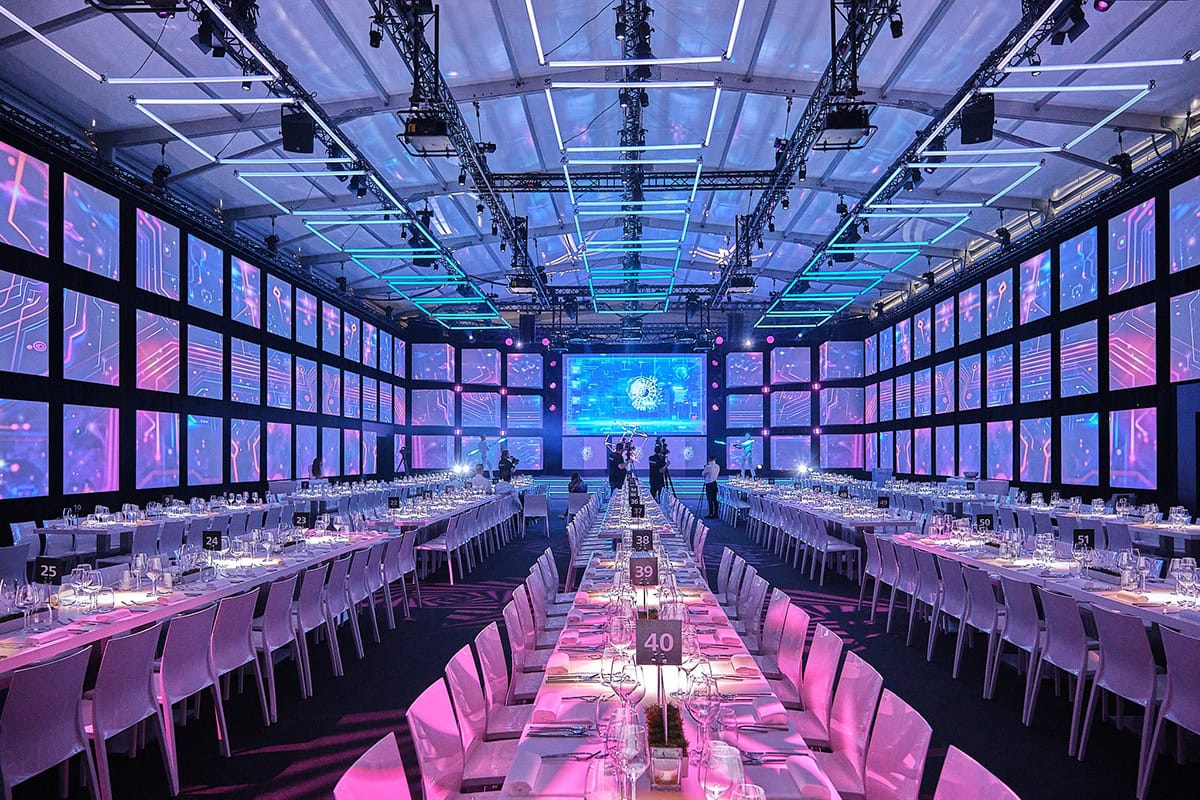
The guiding principle of the anniversary is "We have been moving for 150 years". Nine events were held throughout the month of June with a total of over 3,500 guests, all of which were based on this guiding principle - from breakfast events and conferences to special events for employees.
A 3,660 square meter temporary structure with a 720 square meter picture facade provided the setting for the celebrations. According to Event Manufaktur, the construction alone took over a month to erect.
Inside, guests were treated to an immersive spatial and stage production with 360-degree projections on 192 square projection screens in Bauhaus style, based on the anniversary logo. Actors, artists and performers interacted with the projections and brought Schindler's 150-year history and vision of the future to life in an impressive way.
In addition to sustainability and regionality, the catering concept also focused on a high culinary standard. Among other things, connecting tavolata and flying dinner concepts were implemented to create emotions and contacts.
With the events in June, Schindler once again wanted to prove that the focus is always on people - whether customers, employees or partners.