Zurich Journalism Award 2020: Four outstanding works honored

As part of the 40th Zurich Journalism Prize, authors Carole Koch and Boas Ruh, Thomas Schlittler, Christian Zeier and Daniel Faulhaber were honored for their work on Tuesday evening.

Zürcher Journalistenpreis

The Zurich Journalism Prize was awarded for the fortieth time on Tuesday, but under extraordinary conditions. Due to the Corona crisis, the ceremony, traditionally held in spring, had to be postponed to September (Werbewoche.ch reported). But the ongoing uncertainties surrounding the epidemic prompted organizers to hold the anniversary edition as a digital-only event. Numerous guests joined the live event on Tuesday evening.

Once again this year, a large selection of high-quality works were submitted to the jury. The panel was able to review a total of 170 texts that appeared in Swiss-German media last year.


Climate deniers, disability insurance, Mozambique scandal and erotic fairs

One prize goes to Carole Koch and Boas Ruh. They analyzed in the NZZ on Sundaythe questionable methods used by climate skeptics and lobbyists to attack established climate scientists. The laudatory speech said that such elaborate research exemplifies how important background journalism is for the legitimization of the media as the fourth estate.

Thomas Schlittler also received an award. In a series of articles for the Sunday View The book shows how the disability insurance system tries in a questionable way to push people in need of help into the social welfare system. Schlittler had precisely dissected the IV's defense system, according to the laudation. He triggered several initiatives in parliament.

Christian Zeiter, head of the research team Reflekt, which he co-founded, receives the Zurich Journalism Prize for an article published in the Magazine was published. In it, he explained how Credit Suisse was involved in the biggest financial scandal in Mozambique. With his precise analysis, the journalist gave the affair new political urgency.

The jury awarded the Newcomer Prize to Daniel Faulhaber. He saw himself for Bajour with an alert eye at two erotic trade fairs. He also did so self-critically. The author does not evaluate, but describes. And he does so brilliantly, according to the laudatory speech.

The Zurich Journalism Prize has been awarded since 1981. Each of the main prizes is endowed with 10,000 Swiss francs, and the Newcomer Prize, created in 2018, with 5,000 Swiss francs. Prizes are awarded for complete works as well as outstanding and groundbreaking works, regardless of whether they were distributed via a newspaper, magazine or online channel.

Since this year, the Journalism Prize has been on a new financial footing. The three Zurich media houses NZZ, Ringier and Tamedia are now the sponsors of the foundation. In addition, well-known companies and institutions - including JTI, Google and IKEA - support the event with monetary contributions.

IAB awards first quality certificate for SEO and SEA to Blueglass

BlueGlass Interactive is the first Swiss agency to receive both SEO and SEA quality certifications from the industry association IAB Switzerland.

Blueglass

The certificate defines agency requirements for professionalism and competence in the areas of SEO and SEA, making it easier for companies to find an established and quality-tested agency.

Obtaining quality certification from IAB Switzerland requires the submission of a detailed application dossier. Signed codes of conduct on compliance with defined standards form the basis for certification. Further assessment criteria for the quality certificates are experience, working methods, customer satisfaction and commitment to the market. The submission is subjected to a review and assessed by external auditors. Customer references are also actively sought.

Blueglass

Twitter Launches Search Prompt for World Suicide Prevention Day

As part of World Suicide Prevention Day, Twitter is introducing a search prompt in Switzerland designed to help people experiencing suicidal thoughts and their loved ones.

twitter_prompt schweiz_suizidprävention
To illustrate, here is an example of the action, how the prompt was created in Germany with the Telefonseelsorge as a partner and how it was integrated on Twitter.

September 10 is World Suicide Prevention Day, an initiative of the World Health Organization (WHO) and the International Association for Suicide Prevention (ISAP). Twitter is also committed to this date with the integration of a search prompt in Switzerland, which is displayed directly to the respective user when certain key terms are entered in the Twitter search. In this way, people with suicidal thoughts and their relatives are immediately and directly offered help on a voluntary basis.

The partner organization Tel 143 - Die Dargebotene Hand acts as a contact for those affected and can be reached day and night via telephone and website chat. The Twitter search prompt is played out in German, French and Italian, depending on the user's geographical position within Switzerland, to ensure that the offer of help is easily understood.

A whole series of predefined keywords, which serve as triggers and ensure the display of the Twitter search prompt, has been created in coordination with the partners involved. Examples of these keywords include suicide, anxiety disorder, loneliness, PTSD, or notjustsad. All of the terms mentioned work both as hashtag variants and as standalone terms without hashtags.

In many other countries, the Twitter Search Prompt is already in use on various topics and in collaboration with national and international partners. For example, The Young Feminist Fund is involved as a global partner, while organizations such as FSM are integrated for Germany.

Westiform protects the parliamentarians* with acrylic glass panes

Just in time for the fall session, the Federal Palace is enhancing security at meetings in the Parliament building. Specially designed acrylic glass panels from Westiform—a company that typically specializes in visual communication—are being used.

Westiform

As a hygiene barrier to protect against droplet infections, the Federal Palace relies on virus protection screens. The transparent partition panes are used in meeting rooms as well as in the National Council and Council of States halls. The panes are part of a holistic protection concept developed by GWJ Architektur. They were designed and manufactured by Westiform.

The family-owned company, based in Niederwangen near Bern, is usually active as a provider of illuminated advertising and digital signage solutions, and already converted part of its production at the beginning of the pandemic. In addition to virus protection screens, disinfection steles with or without integrated digital signage screens from Westiform are also in use throughout Switzerland. The Inselspital, for example, relies on a version with a mask dispenser, the SBB has some in use at its headquarters, but also the University of Bern, UBS, AMAG or luxury brands such as Cartier rely on the prevention means of the Bernese SME.

Westiform

Scratch forbidden

Very special requirements applied to the acrylic glass panes that will be used in the Federal Parliament in time for the fall session. Some of the panes are mounted on historical furniture that must not be scratched or damaged. A stable fastening of the panes was particularly difficult under these conditions, as the company writes in a press release. Westiform has developed individual designs for this. In the commission room, the feet of the acrylic glass panes are placed in the recess of the table and connected by a sophisticated suspension technique. In the National Council and Council of States rooms, the panes are attached with edge protection material in order to protect the furniture. Here, the panes can also be folded out to ensure sufficient large protection even in confined spaces.

Westiform

Home-made solutions often provide inadequate protection

"It's crucial to adapt the size of the pane to the application site" says Simone Bächle, Managing Director of Westiform. "Currently, you still see a lot of temporary, partly self-made solutions. Particularly in checkout situations, the panes are often much too deep, so that the customer's head protrudes over the spit shield and thus the effect is gone. In some places, it looks like a construction site in the store," Bächle continues. "People were quick to look for pragmatic solutions and sometimes resorted to construction site tape to cordon off the area. All in the assumption that it was a temporary situation. Now, however, it is becoming increasingly apparent that the safety regulations will not disappear abruptly. Long-term use makes it necessary to switch to stable permanent elements."

Westiform

"How are you?" campaign introduces emotional alphabet

"How are you?" is a campaign by the German-speaking cantons of Switzerland and the Pro Mente Sana Foundation on behalf of Health Promotion Switzerland. To remove the taboo surrounding mental health, an emotional alphabet was brought into focus as part of the current campaign, and an app was launched. Rod is responsible for the idea and implementation of the campaign. The alphabet was created by Foreal.

Wie geht‘s dir?

The "How are you?" campaign  puts the issue of mental health in the public eye and gives it visibility. Most recently, the campaign's sponsor, the "Atlas of Emotions" presented an emotional map. The study showed that the German-speaking Swiss tend to keep their feelings secret. In particular, people do not like to talk about negative feelings; they are hidden from their environment. This shows once again that de-tabooing is urgently needed.

It is well known that mental illnesses in Switzerland are still often treated too late or not at all. This is where "How are you?" comes in. After all, if stresses and strains are discussed at an early stage, help becomes possible and, in the best case, illnesses can be prevented.


Emotional alphabet as support

The campaign is based on the idea that everyone can do something for their own mental health in a more targeted way if they can find more precise answers to the question "How are you?" than "good" or "bad". If you consciously deal with your feelings and can name them - for example, that you feel "empty," "happy," "stressed," or "in love" - you can specifically address negative feelings and get help if necessary.

Noticing positive feelings is also important. Anyone who notices when things are going well and why can use this important resource. At Wie-gehts-dir.ch, the emotional alphabet for feelings from A to Z contains appropriate, empowering tips for taking care of your mental health. The alphabet is intended to help people better name their own emotional state.

Wie geht‘s dir?
The idea and implementation of the campaign came from the pen of Rod Kommunikation.

Novel app raises awareness and provides tips

The novel "How are you?" app has been specifically designed to meet the needs of younger people identified in the "Atlas of Emotions" and is intended to help sharpen awareness of one's own emotional state. In addition, the app provides recommendations tailored to the person's state of mind that help maintain and strengthen positive feelings or endure negative feelings and improve the way they are dealt with.

Wie geht‘s dir?

Responsible at How are you?: Sponsors of the "How are you?" campaign; Norina Schwendener, Nicole Tschanz, David Macalimbon, "How are you?" campaign office. Conception, creation and realization: Rod Communication. Illustrations/animations: Benjamin Simon, Dirk Schuster (Foreal). Implementation App: Konoma. Media Planning: Havas Media.

Three new members on the Gfm foundation board

The Foundation Board of the Swiss Society for Marketing Gfm has elected three new members. Anna Hug, Co-Managing Director Markets at Hug, Veronika Elsener, CMO at Victorinox, and Mariateresa Vacalli, CEO of Bank Cler, strengthen the board.

Stiftungsrat

Anna Hug, Veronika Elsener and Mariateresa Vacalli (from left to right) will serve on the Gfm Foundation Board for at least three years. The Foundation Board awards the "Annual Prize of the Foundation for Marketing in Corporate Management", which recognizes companies for outstanding marketing achievements. The next award ceremony will take place on Tuesday, October 27, 2020.

Veronika Elsener has worked in various positions in the family-owned company Victorinox for over 25 years. Since 2009, she has been responsible for the continuous development of brand management, and today, in her role as Chief Marketing Officer, she is responsible for global brand communication.

Anna Hug worked as Export Market Manager for Création Baumann for ten years before joining Hug in 2010. After holding management positions in Private Label and Development & Innovation, she has been Co-Managing Director Markets at the Lucerne-based company since 2019.

Mariateresa Vacalli has been CEO of Bank Cler since September 2019. After completing her education in operations and production engineering at ETH Zurich, she held various management positions at telecommunications companies and as Chief Digital Officer of the BKB Group.


The current Board of Trustees of Gfm

  • Geri Aebi (Wirz)
  • Nadine Borter (Contexta)
  • Dr. Beat Bühlmann (Swisscom)
  • Veronika Elsener (Victorinox)
  • Anna Hug (Hug)
  • Thomas Landolt (IBM)
  • Thomas P. Meier (Ricola)
  • Prof. Stefan Michel (IMD)
  • Ulrich H. Moser (conavest)
  • Thomas Passen (Ringier Axel Springer)
  • Jeannine Pilloud (Ascom)
  • Dr. Felix Reiff (Bayer)
  • Prof. Dr. Marcus Schögel (HSG)
  • Florian Teuteberg (Digitec Galaxus)
  • Mariateresa Vacalli (Bank Cler)
  • Dr. Dominique von Matt (Gfm)
  • Marc Werner (Galenica)

Mini and Serviceplan Suisse: Where the marmot and the ibex say good night to each other

Mini and Serviceplan Suisse have launched the new Mini Countryman with an adventurous campaign in the Swiss mountains.

Mini und Serviceplan

Everything was a little different this summer: never before have so many Swiss people wanted to spend their summer vacation in the mountains. The search for suitable accommodation was correspondingly difficult. Mini and Serviceplan Suisse took advantage of this to launch the new Mini Countryman - the adventurer among the Minis - in an unusual way: Overnight stays in a tent on the roof of a Mini Countryman were offered at two locations in Valais and Ticino - far away from mass tourism.

Interested parties were able to apply online for 20 minutes and, with a bit of luck, were accepted. The overnight stay also included a return trip in the new Mini Countryman. The winners also received an adventure kit with a spade, a roll of toilet paper and a handy pocket knife.

The campaign was advertised primarily on social media and in cooperation with 20 minutesThe Lifestyle editor Meret Steger traveled to Valais for a night with her companion and documented her magic moments in a photo story.

Responsible at Mini: Timo Di Pardo (Director Mini); Adrian Kwasnitza (Head Marketing Mini); Fabian Schlatter (Communication Mini); Alessia Pezzini (Events & Sponsoring Mini). Responsible at Serviceplan Suisse: Sidonie Bauer, Livia Küpfert (consulting); Tizian Lienhard, Nadja Tandler, Hanning Beland (art direction); Peter Liptak (text); Michael Kathe (creative direction); Marcin Baba (executive creative direction); Pam Hügli, Raul Serrat (overall responsibility); Thomas Buchwalder (photographer); Vizeum (media agency).

Andreas Bosshart strengthens Dream Production consulting

Dream Production is expanding its consulting services in Zurich. Andreas Bosshart will join the agency—which has offices in Zurich and Timisoara, Romania—from Wirz Brand Relations effective September 1, 2020.

Dream Production

Andreas Bosshart brings proven expertise in consulting for web projects. Most recently, he was responsible for the digital offering of Wirz Brand Relations as Senior Consultant and Partner. In the last twelve years at Wirz, he looked after numerous clients, including the University Hospital Zurich, the Swiss Federal Office of Energy, Careum and PostFinance. "I am looking forward to using my experience to support Dream Production in the strategy and conception of innovative solutions for the web," says Andreas Bosshart.

Dream Production has grown strongly in recent years. For Simon Schweingruber, Managing Partner, the addition comes at just the right time: "We are glad to have Andreas on board, an experienced expert who shares our passion for high-quality digital solutions."

Andreas Bosshart studied economics at the University of St. Gallen and lives with his family in Winterthur.

Hashtag campaigns by brands often fizzle out

Three out of four US consumers are not willing to use brand hashtags on social media. They are much more inclined to interact with social media stories, i.e. specific collections of images from brands. This is the result of a survey by Visual Objects.

Marken

User-generated content is important for brands, but hashtag campaigns are not very effective. According to the study, three out of four US consumers would not post a hashtag. Reviews are more likely to be preferred.


"Considering the image of customers"

"Consumers have a vested interest when creating content and interacting with brands. They work on their personal brand on the social web. That's why there are often a lot of free riders, especially with socio-political movements. Brands need to consider the image of their customers when designing hashtag campaigns. If the content is too complex or questionable, users are less likely to engage with it," says Markus Hübner, social media expert and CEO of Brandflow, in an interview with the news portal Press release.

Visual Objects surveyed 401 US consumers about their interactions with brands. 75 percent would not post a hashtag from a brand. In the past three months, only eleven percent have interacted with a hashtag campaign. The most common form of user-generated content is online reviews. 26 percent like to post reviews about brands. A quarter of respondents have read reviews from other users in the past three months.


Social media stories popular

One in five consumers would create a video of how they use a brand product. 40 percent of users prefer to interact with brands via social media stories on platforms such as Instagram, Snapchat and Facebook. 27% also like to watch livestreams and use filters and augmented reality lenses from brands. (pte/swi)

Switzerland Tourism launches a nationwide foliage tracker

September is the time of colors and leaves. With the new leaf tracker from Switzerland Tourism ST, autumn vacations can be planned in line with the state of the foliage color. In addition, work and leisure can be better combined with the new "Bed'n'Bureau" offer.

Schweiz Tourismus

The Leaf tracker is a Switzerland-wide forecast map for autumn coloration of forests. The interactive map is part of the autumn campaign 2020 and shows the current as well as the forecasted leaf coloration throughout Switzerland. The leaf tracker was implemented in collaboration with SRF Meteo.

The four trees maple, birch, beech and larch play an important role here, as they change color particularly beautifully and are most frequently encountered. The foliage tracker shows at a glance where the foliage is currently wearing which color. For these places, the foliage tracker is enriched with suitable vacation ideas. This way, guests can easily plan their excursions and vacations.


Tailored autumn offers

For the most colorful time of the year, ST has put together specific vacation ideas together with its partner regions. Each of these Vacation ideas is designed for three days and consists of offers for day activities (hikes, bike tours, culinary experiences, etc.) in a destination. In addition, there is a suitable restaurant and hotel recommendation.

Those who want to get to know several Swiss destinations can choose one of the new four- to six-day packages on the Grand Tour of Switzerland. These are available around the themes of "City & Culture", "Deluxe", "Nature", "Wellness" or for gourmets the "Culinary" package.


Work and enjoy the autumn

The Corona crisis has permanently changed working habits. Flexible working models such as home office are part of the new working reality. In order to cope with this development, ST is launching in fall 2020 the Offer "Bed'n'Bureau. A stay in nine selected hotels should enable the symbiosis of work and recreation.

Wirz and Swica raise new questions

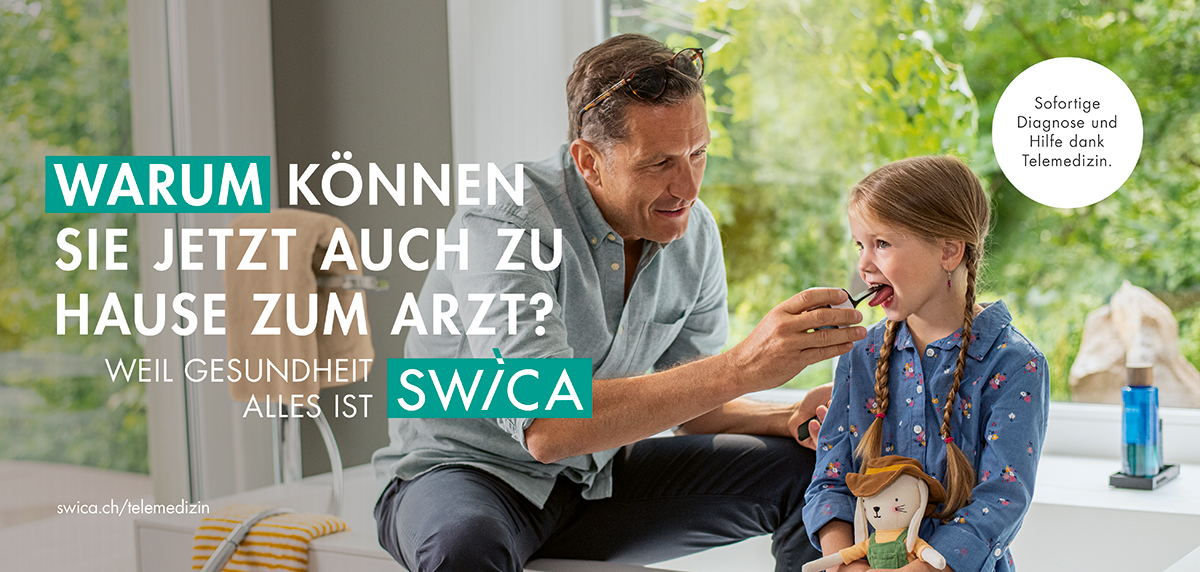
The campaign launched last year by Swica and Wirz is entering its second phase. With new questions and a tried-and-true answer: Because health is everything.

Wirz und Swica

Swica already adopted the claim "Because health is everything" in 2016, but it is only since last year that it has also been the focus of communication where health belongs for most people anyway: at the center.

"Because health is everything" is the answer to all of Swica's questions and actions. And it is precisely these questions that form the core of the campaign. "Why do you score points with us for an active lifestyle?", "Why do we promote what's good for you?" or "Why can you now see your doctor at home?" are just some of the questions featured on the new advertising materials. The answer is always the same: Because health is everything.

Wirz und Swica

Responsible at Swica: Michael Schneider (Head of Marketing); Remo Tanner (Head of Marketing Services); Giovanna Oezdemir (Marketing Services Specialist); Helena Gubernale (Head of Online Marketing); Florence Schelling (Online Marketing Specialist). Responsible at Wirz: Livio Dainese, Caspar Heuss, Fernando Perez, Jannic Mascello, Adrian Busse (creation); Erasmo Palomba, Nadja Kilchhofer (agency producer); Petra Dreyfus, Catrin Bewersdorff, Manuela Bührer, Jelena Vujcic, Luana Tonoli (consulting); Adrian Schräder, Michèle Roten (storyline); Urs Krucker, Martin Frank (strategy); Adrian Huwyler, Björn Bippus-Brender, Angelo Mabellini, Aline Herzog, Nathalie Reichmuth (XLAB); Andrea Bosshard (production); Thomas Peller, Desirée Guzzo, Corinne Räber, Oliver Fäs, Rino Frei (media realization); Sandra Beyer, Jacqueline Chevrolet (proofreading). Film: Camila Zapiola (Pumpkin Film, Director). Postproduction: South-t. Music and sound logo: Tonton. Sound design and sound mixing: Sound studios Z. Photo production: Lasse Bech Martinussen (Photographer, Danielle Stutz Photographers).

This year's campaign again consists of many different advertising media. These include six TV commercials, seven billboard sujets, three radio spots, and a variety of digital measures. In Winterthur, where Swica is headquartered, a newly designed public bus is making its rounds again this year, both inside and out.


Facebook expands fact checker program

Facebook is expanding its fact-checking program in the DACH region with Agence France-Presse (AFP). The news agency, which has been part of the fact-checking program since 2017, will now also review content from Germany, Austria, and Switzerland.

Faktenprüferprogramm

Globally, Facebook works with more than 70 independent fact-checkers covering over 50 languages - including news agencies, media companies and nonprofit organizations. In Germany, AFP is the third partner to check questionable news, images and videos on Facebook and Instagram for their truthfulness and, in case of doubt, add a warning. The cooperation with dpa has been in place since March 2019, and the research agency Correctiv has been checking false news on Facebook since January 2017. In May 2020, Facebook also extended its cooperation with dpa to Austria and Switzerland. For the German-speaking region, AFP is setting up its own fact-checking team with local and multilingual journalists in Berlin.


Stemming the spread of misinformation

Working with independent, external fact-checkers is a key focus of Facebook's three-step "Remove, Reduce, Inform" strategy to combat false news. As soon as a post is classified as false by a fact checker, the post is marked with a corresponding label and its reach on Facebook and Instagram is restricted. In addition, users are shown reliable information on the topic.

From April to June alone, false positives warnings were displayed on about 98 million posts on Facebook related to Covid-19, based on about 7,500 fact-checkers' ratings. Based on the warnings, users ultimately did not view the originally selected content in about 95 percent of the cases.

get_footer();