What can media brands do?

Media companies want to open up new business areas with new ideas. The brands of existing products offer a supposedly good basis for expansion into new markets. But is this the case? The opportunities are certainly there, but there are more pitfalls than in other sectors.

The following section examines the opportunities for media brands to expand into new business areas. Where are the pitfalls that need to be avoided, what dependencies are there and what needs to be taken into account so that the original brand is not damaged and the core business is not jeopardized?

Greater overall range than ever before

The reader base of traditional print products is crumbling and revenues in the advertising market are declining. This is nothing new. The evil Internet? No. What is often forgotten: The overall reach of very many media products is at an all-time high. Thanks to the Internet, media brands are permanently accessible to anyone looking for them, day and night. Not just at the newsstand or via your own letterbox after taking out a subscription, as was previously the case. This potential can be tapped into via the almost infinite advertising space available on paper and on the Internet. This is an excellent prerequisite. It becomes more difficult when it comes to brand management in media companies.

Awareness of brand management

Conscious brand management is a basic prerequisite for expansion. A strong brand is not a product of chance. Ideally, brand management should be at the highest level of the company. This is the only way to ensure a compact brand image. Brand strength must also be measured in the relevant target group at regular intervals and influenced with measures if necessary. Such a set-up is hardly established in Swiss media companies. Quality and independence are often cited as brand values. These are generic buzzwords with no differentiating character. Knowledge of one's own market position is too often based on gut feeling and selective surveys of readers and advertisers. There is a lot of catching up to do here. In addition, media brands have a special starting position. The success of media products is based even more on trust than other goods. This has to do with the ability to assess the quality of the media offering. The perception of products can be classified into three categories: Search goods, experience goods and trust goods. In the case of search goods, the prospective customer is able to assess the quality of performance in advance using measurable criteria. This is not possible with experience goods. Here, the quality can only be assessed after use. And in the case of trust goods, the user cannot conclusively assess the quality even after use. Like a visit to the doctor, for example. Media products are among the experience and trust goods. Their brands play a trust-building role in these two categories. If this trust is violated by careless activities, collateral damage is caused that is difficult to eradicate.

What requirements must the brand fulfill?

A strong brand must be well known and have a suitable image for expansion. The values to be established must be as independent as possible from the original product. If a media brand only stands for a print product that is reliably delivered to the mailbox every day, this is not sufficient for further development. What is needed are overarching values that are not directly linked to the core product. Quality is not an option. It is a product-specific prerequisite. A frequently cited and good example from a completely different industry is Nivea. Beiersdorf has managed to build up a comprehensive range of care products with overarching brand values such as naturalness or harmony from a white cream in a blue tin.

Brand management pays off

Brand management is not primarily a discipline of business administration. But it pays off. "The aim of brand technology is to secure a monopoly position in the consumer's psyche," wrote Hans Domizlaff almost 75 years ago, thus introducing an important psychological aspect of brand management. With effect: strongly anchored brands with a high emotional connection achieve a price premium, a higher margin, through the existing trust. The media company Apple does not earn dream margins because it offers the best products, but because Apple has established a brand identity that buyers can identify with. And that brings us back to business management.

Set goals

If the core business declines year after year, it makes sense to use the new activities primarily to compensate for the loss of revenue. However, the focus does not always have to be on direct sales. It is also conceivable for the new commitment to have a modest monetary objective. In this case, the new brand should have a positive impact on the core brand and thus contribute to its vitalization, which in turn contributes to monetary success. This interaction between existing and new business always arises and must be kept in mind.

Assessing skills correctly

Once the brand has been correctly positioned and the goals have been set, it's time for implementation. Here it is important to sound out the available in-house expertise. But beware: even if the editorial team has a high level of dossier expertise, this should not hide the fact that a big step has to be taken from observer to market player. There are no simple markets. Where there is money to be made, there are already other providers who have not been waiting for another competitor.

If necessary, buying an experienced market player is a better option than a completely new setup. Of course, this is a question of willingness to take risks, willingness to invest, the time horizon set and market knowledge. A third option is to grant a license to a partner who is established in the market. This can minimize the risk. However, the margin is then correspondingly lower than if full responsibility is assumed by the company itself.

Proximity to the core business

When choosing a new field of activity, the brand is once again at the forefront alongside the existing expertise. Even if the values are highly independent of a specific product category, the match perceived by customers between the original brand and the transfer product is of particular relevance on the customer side. Is there a fit?

An extension can only be successful if there is a credible connection between the original brand and the extension product. The brand forms the bracket with its associations. If these are not present, dissonance arises on the customer side. Excessive steps should therefore not be taken. A sustainable development of a new product portfolio takes time and is most easily achieved in a first step by means of complementary offers to the core business.

Distance to advertising customers

The potential for conflict with advertising customers must be taken particularly seriously. If the new business segment is in direct competition with the offerings of important advertisers, the expansion must be called into question. Negative feedback on the core business should be avoided at all costs. It is also not much easier to establish a cooperation with an advertising client. The competitors of the partner involved are likely to see this as an overreach and avoid the core product in future.

Be careful with the choice of communication

One major advantage of media companies is the ample advertising space that is permanently available online and in print, often on a daily basis. The company also usually knows the customer's name and address and can therefore also use direct channels online and offline. Native advertising on the Internet and adverortials in the print titles do not have to be dispensed with. However, it is important to ensure that the measures are clearly recognizable as advertising. PR? The competition can rarely be counted on as a multiplier. Another editorial team is likely to be skeptical of the new activities, which are still at an early stage. And that's right in journalism.

So does the editorial team have to get involved? This is where it gets very tricky. No editorial team in the world should allow itself to be used for a clumsy promotion. This would cause the collateral damage mentioned earlier, damage the brand's reputation and damage reader confidence. But what's wrong with an interesting article on a fiery presentation from an organized congress with a reference to the next event? Internal communication should not be neglected either. If the idea is carried within the organization, employees will give constructive feedback and become involved as ambassadors in their environment.

In the right place at the right time

Timing also plays a role, of course. Business cycles should not be neglected. They can be very different in the new business area than in the core product. It is therefore advisable to focus on fields of activity that are geared towards medium and long-term needs in society, such as security, health and education, rather than trendy trends or even hype. Last but not least, and before making a final decision for or against a commitment, you should also consult your gut feeling. If it is right, if the offer is coherent and the market conditions are ideal, you should go for it. The window of opportunity is not open forever. And then it's a case of sticking with it, just like a story that can be developed. Be patient and persevere. Readjust and accept a healthy degree of risk. That way, the chances are good that the story will come to a good end.

Andreas Häuptli

Unbenannt-9_16

The article is based on the Master's thesis on "Brand-driven development of new business areas for media companies" from the MAS course "Brand and Marketing Management" at the Lucerne University of Applied Sciences and Arts.
 

Christoph Blocher is a new member of Baz Holding

Christoph Blocher has a new seat on the board of directors: He now officially sits on the board of Baz Holding, which owns the Basler Zeitung newspaper.

Christoph Blocher is a member of the Board of Directors of Baz Holding and has joint signature on the board. This is what the Handelszeitung writes on Thursday. Baz Holding is 80 percent owned by Medienvielfalt Holding of Ticino financier Tito Tettamanti and 20 percent by Christoph Blocher's Robinvest. By joining the board of directors, Blocher is now bringing his influence to bear through his new role, he said. This is the first time he has made an official appearance in the Baz environment.
 

The Impact Check of Werbewoche

We show how current campaigns are performing with consumers.

In terms of awareness, the Mobiliar ad by the advertising agency Wirz and the UBS ad by the agency Krieg Schlupp Partner are tied for first place, followed by the Denner ad by the advertising agency Vizner Borel. The Floralp ad by Leo Burnett Switzerland wins in the “Uniqueness” category, well ahead of the Echtzeit ad by Ruf Lanz and the Mobiliar ad. In the “Brand Fit” category, Floralp wins ahead of Mobiliar and the Cerebral poster by the advertising agency Inflagranti. Floralp also tops the “Likeability” category, followed at some distance by Mobiliar and Cerebral.

The Imact Check from *Werbewoche*, October 2013
Detailed Results

Flash and film reviews

«Box Office» on SRF was canceled at the end of June. Now there's a replacement on S1. Starting December 12, the Portmann Group will produce the weekly movie show «Kinowetter» for the new channel.

Every Monday, the weather is again a main topic for film distributors. If it was good - it was bad for the cinema. If the weather was really bad, it was good "cinema weather". Film journalist Philipp Portmann not only listened to these discussions for years. They also gave him an idea. The founder of the Portmann Group, which already provides competent information on cinema for a wide range of media from SRF to Tele Züri to 20 Minuten, bought the domain kinowetter.ch in 2004. A new contact point for film lovers is now being launched around this website.

The cross-media project links cinema and weather by presenting the subject of film together with the latest weather forecasts. The package includes a weekly movie show on the new S1 channel and the website www.kinowetter. ch with all current applications also for mobile. "In the TV show, our presenter presents the most important films of the week and draws attention to the fact that all other upcoming films are presented on the web ", Portmann explains the concept. Conversely, the TV show is promoted on the website.

The Portmann Group has already presented its idea to the film industry in advance and they were enthusiastic. Philipp Portmann, however, does not want the contributions on kinowetter.ch to be understood as PR. "We work with a bottom line. There will be films that do well and those that don't come off so well. But in the process, we also want to strongly involve the users." They will soon be able to rate films themselves online using their cell phones or PCs. The professional critics of "Kinowetter" will give the first rating, which will then be mixed with the ratings of the users, and in the end the overall impression will be the result. "After all, we have to remain credible with the audience if we want to reach and inspire them. "

The project is financed with advertising. Marketing is handled by Publicitas Cinecom, which is now looking for a sponsor for the TV show on S1. "We offer the sponsor a mention at the front, in the middle and at the end of the broadcast, seven seconds. For this, he is mentioned in the new media at the same time." Once a year, there is an event for this, at which the sponsor can invite partners, customers or employees to a preview at the cinema. It should be interesting that one can place advertising on the web in a clearly defined environment. "If you offer a product that is aimed more at a female and young target group, you can have your advertising embedded precisely in such films." With "Kinowetter," S1 and the Portmann Group are filling a gap after SRF discontinued its "Box Office" program in June. "Now that Swiss television has freed up that space, it may definitely bear another longer magazine, " Portmann believes. But he is keen to stress that he has himself campaigned for the preservation of "Box Office" through his role on the board of the Association of Swiss Film Journalists and is in favor of a diverse market. "We wrote a public letter addressed to Roger de Weck as well as to those responsible for culture on television. We are watching very closely in the Film Journalists Association to see what is now to be redone."

SRF has said it wants to move film information to the web. "But I know now, also with my own project, that of course new ideas are needed on the Web so that you don't do 'more of the same' and thus not get noticed at all."

Andreas Panzeri

Unbenannt-8d
 

The curious

Werner Schaeppi is an advertising psychologist, communications consultant, partner at an advertising and PR agency, and co-owner of a market research firm. And above all, he is one thing: curious.

Unbenannt-11_11
Werner Schaeppi is an expert in advertising psychology, marketing communications and public relations and has been working as a communications consultant for over 25 years. He is a founding member of Creafactory, an agency that combines services of classic advertising and PR agencies with visual design and creation. Schaeppi is also founder and co-owner of sister company MRC Research & Consulting. Schaeppi studied social psychology and linguistics at the University of Zurich (Dr. lic. phil.). After his studies he was managing director of the market research institute Ipso-Explora. He then founded the agency Werner Schaeppi Public Relations, which became today's Creafactory in 2001 after a merger with Mark Gilg Projekte. MRC and Creafactory's client base includes Die Post, Zug Stadt, Kanton Zürich, SBB, Credit Suisse, Raiffeisen, Visana, Helsana, Zurich, Siemens, Implenia, Halter, Schindler, Hochparterre, Mars, Danone, Swisscom, Sunrise, Havas Worldwide.

"When I was in China, I made an interesting observation: I found myself continually and involuntarily trying to read the characters in the streets. Even though, of course, I had no chance of understanding even the slightest thing. But after a few days, as if by magic, an inkling crept in of what certain signs might mean. For example, because one and the same sign appeared again and again at certain places, at an intersection, at a shopping center. I realized that it could mean something like the middle or the center. I began to understand without anyone saying anything. Fascinating, right?"

Werner Schaeppi's world is psychology. He is passionate about how we perceive, process information and communicate. Not only privately when traveling, but also professionally. As an advertising psychologist, he researches how the target group reacts to a campaign, how a brand is perceived. He examines the positioning of companies, advises clients on how to increase the impact of their communication or provides clients with insight into the motives of their customers. Schaeppi is involved in research and realization at the same time. On the one hand, he is involved with the market research company MRC Research & Consulting, which he founded in 1991. On the other hand, he is a partner in the advertising and PR agency Creafactory, where he works with graphic designer Sonja Gilg and architect Mark Gilg and a team of twelve people to communicate for politicians, public authorities and SMEs.

MRC and Creafactory run as independent labels. Nevertheless, the companies are closely interwoven - and united under one roof. In the multi-story Bachstein building near the Zug train station, the know-how from research and practice flows together. To this end, the two companies swap employees from time to time. When Creafactory conducts group discussions with involved parties for a construction project, it borrows MRC's market researchers. "They can do that off the top of their heads." If MRC has a real estate research assignment, the researchers bring in Mark Gilg. Schaeppi's interest in advertising and communications was sparked in childhood. His mother worked as a graphic designer for Lindt & Sprüngli and had a studio at home, and his father was a marketing director. "The craft was practically laid in my cradle." While studying social psychology and linguistics, Schaeppi had already accepted small advertising assignments.

Researcher and realizer
After completing his dissertation, he nevertheless ended up not in an agency, but in research. He took over the management of the market research institute Ipso-Explora. For several years, he was mainly involved in communication studies. An exciting experience, according to Schaeppi. Over time, however, he missed the other part of communication, the creative one. He not only wants to discover new things, but also to realize new things. Schaeppi feels that the fact that he can combine both today is ideal. "For me, communication has always been something bidirectional. It has to flow both ways." That means not only sending out, but also capturing what arrives on the other side. So at Creafactory, it can happen that the graphic designer presents his work to the target audience and asks questions. It's a good experience for any professional, says Schaeppi. To learn what works, what doesn't, what is perceived. After all, the untrained layman's eye is not always as taken with the latest design trend as the professional. With its combination of psychology, architecture, design and PR, Creafactory has a special positioning. "We are quite an exotic among agencies," says Schaeppi. Creafactory is often commissioned to implement new corporate presences. For example, from the health insurance company Klug (formerly the company health insurance company of Landis & Gyr). In discussions with customers and in workshops with employees, the company's USP was defined: Individuality. "It's true that every health insurance company claims to be individual. With Klug, however, it's true - for logical reasons: The health insurance company is small and local, and each customer has his or her own personal advisor," Schaeppi reasons.

This aspect was not only implemented visually in the corporate design, but also made tangible in the customer advisory service. "A customer has to notice already in the email or during the first phone call that it is not a standard handling, but an individual consultation." In addition to communication for public authorities, mandates from the construction and real estate industries are an important mainstay of Creafactory. In this area, Schaeppi and Gilg have already handled a number of projects. For example, Creafactory was responsible for the conception and implementation of communication measures for a large construction project of a housing cooperative and acted as an advisor to the cooperative. An aging housing estate in the Baden/Wettingen region had to be demolished and rebuilt. 127 apartments. A delicate touch was required. "We had great respect for the reactions of the residents," explains Christoph Bernet, managing director of Bau- und Siedlungsgenossenschaft Lägern Wohnen. "We were glad to have an experienced consultant at our side who had solutions ready for various scenarios. Werner Schaeppi's suggestions were practical and could be implemented well." The focus was on dialog with the residents.

Creafactory's idea was not to inform them in writing, but to explain to them at an event in small groups the reasons for the demolition of the settlement. All the facts were put on the table, but at the same time it was explained how to proceed. During the discussions, the residents were given the opportunity to voice their concerns and were also able to contribute their ideas and wishes for the new settlement. The residents' input was recorded and fed into the briefing for the architectural competition. "It's a very different mechanism than receiving a letter in the style of ", says Schaeppi.

Sensitivity was also required at the Schindler company, for which Creafactory designed and implemented a political communication campaign. This involved a major real estate project in the community of Ebikon, which required the approval of the population at the ballot box. Creafactory used an open information policy to gain acceptance. The measures ranged from fireside chats and a poster campaign to the formation of an independent pro-committee with proponents who stood up for the project with their faces and names. The mandate required not only analytical skills and know-how in real estate, but above all the ability to deal with residents' opinions and concerns. So it was Werner Schaeppi's psychological background that led Schindler to award the contract to Creafactory, as Stephan Jud, Director of Schindler Management, explains.

Schaeppi attaches great importance to the practical benefits of research. "The focus is always on the question of what the results are for." At MRC, the work is primarily consulting-oriented. For example, MRC clarified for one of the largest Swiss companies whether it could simply swap its traditional name for an English one. Or they check for a financial service provider whether a new sales concept has a chance with consumers. Methodologically, they often resort to group surveys or workshops. "We also do classic market research, 2000 telephone interviews about a detergent. But sometimes ten intensive conversations are more productive," says Schaeppi. The importance of quantitative surveys is also no longer as high today, he says, because many companies already collect data themselves. "Most of our customers are more likely to look for explanations for what they observe."

Understanding the environment
Schaeppi likes to get to the bottom of things. Perhaps his analyses of the "meaning of life," which he published in the book "Braucht das Leben einen Sinn? Although the publication "was written at a time when people typically have a midlife crisis," the trigger was not a personal crisis of meaning, but a job. Schaeppi was to develop the specific appeal for an anti-drug campaign. The client's idea: tell people to do more sports. The psychologist had his doubts: "People who take hard drugs have a different concept of life. You can't pick them up that way. You have to argue from their point of view. And to do that, you first have to find out what function drug use serves in their lives. And to answer that question, you have to know in general what people live for. What do they want out of life? What goals do they have?" That's how the idea of looking at theories of meaning came about. Has the researcher found an answer for himself? "My motivation is to a large extent curiosity." Schaeppi wants to understand his environment. For some time now, he has been dealing with issues surrounding developments in society. How is the Internet changing the area of relationships, the way we live together? How has our living behavior changed?

Research is done not only for the sake of knowledge, but also to gain new orders. After all, social changes always require new products and new services. Schaeppi not only responds to customer inquiries, but also actively approaches companies with suggestions. The psychologist would find it appealing, for example, to advise a political party. "The diffuse party world has a lot to do with the fact that parties are unsettled in their self-discovery process." Strict schools of thought that set the course no longer exist. Whereas parties used to take over the dialog between citizens and the state, today they want to have a direct say - but just not always, only on certain issues. In this new worldview, the parties have not yet found their place, Schaeppi is certain. "Accompanying the parties in the process of self-discovery and then communicating to the target group would be a highly exciting task."

"We can direct our activity however we want. That's great!" Work should always be driven by interest, a philosophy that has strongly influenced Schaeppi at Creafactory and MRC. "Without personal inclination, I would struggle to work for clients - even if it was lucrative," he says. "Our work has a lot to do with desire. That's what makes us strong."

Isabel Imper

Unbenannt-12_12
Unbenannt-12b_0
 

Björn Hering hosts new cooking show on Sat 1

On Thursday, November 7, 2013, at 8:00 p.m., the new TV show «Backen fürs Herz» (Baking for the Heart), hosted by TV producer and presenter Björn Hering, premieres on Sat 1 Switzerland. The show is a mix of a surprise show and a baking show.

The concept of the show: someone bakes for someone else to whom he has long wanted to say "thank you" for something from the heart. There is also room for reunions, marriage proposals or apology stories. The person to be surprised is then surprised with a sweet pastry. And this is baked among other things with assistance from the moderator. That announces the medium enterprise in a message. Björn Hering puts on thus this time the baking apron equal, in order to fulfill desires. He says of the concept: "Baking is a trend, not just for older people. More and more men and young people are daring to use the oven."

"Backen fürs Herz" will run with six episodes starting November 7 at 8:00 p.m. on Sat 1 Switzerland. The repeats run on Mondays at the same time. The show is produced by Media Fish and John Allen. The show is supported by main sponsor Dr. Oetker and co-sponsor Kenwood.
 

//vimeo.com/77122075


Skewered: Who's afraid of the second look?

Anne-Friederike Heinrich, freelancer for Werbewoche, on the pitfalls of publishing.

Trade magazines cost their subscribers a lot of money, sometimes thousands of francs. In return, the well-paying readership relies on the fact that all the information they are served is nailed down, checked at least once, preferably twice. Publications in journals such as Nature or Science open up the academic Olympus to scientists. Because at least two of the experts working for these journals always take the time to check every paper submitted for formal and substantive accuracy. Only those who pass this peer review check will see their article in print.

Many other specialist magazines can only dream of such a procedure. Submitted texts are often simply waved through to the galley proof. Due to a lack of time or because nobody can judge whether what is written is correct anyway. And readers, it is thought, won't notice anyway if not all the details are correct. Apparently, more and more people are paying less and less attention to issues that should actually interest them. The surface is our favorite place to be. Writers and readers alike have become comfortable with it.

A nasty touch to your own nose

Only sometimes we are shaken awake, disturbed, embarrassed. For example, when someone like the American science journalist John Bohannon does a nasty little test on us. And thus proves that not everything that costs a lot of money is really good - and not what you get for free anyway: Bohannon faked a study on the supposedly resounding effect of a lichen extract against cancer cells. As the author of the study, he created an Eritrean doctor who does not exist and - in the interests of fairness - peppered his paper with serious errors such as outrageous data analysis. Bohannon offered his "study" to 304 specialist journals. Over 150 journals printed the fake and Bohannon made his test public in Science (vol. 342, p. 60).

Admittedly, the journals that fell for the scam were predominantly those that do not apply peer review practices. But this is only reassuring at first glance. After all, magazines published by reputable publishers such as Wolters Kluwer, Elsevier or Sage Publications are also among those deceived. In Bohannon's opinion, any editor who was even halfway attentive should have noticed the hair-raising errors in the study. It would have been enough, for example, to do a little research on the Eritrean doctor who wrote the study to realize that he didn't even exist. And to become suspicious.

Writing under pressure

And now? There are the evil journos who didn't check the paper properly. Expecting a sensation, a little of whose glitter shines down on them, they simply wave the bogus crap through. And there is the pressure to always be faster than the competition with the latest news. The lack of time to deal with a topic in depth and stumble across mistakes. The expectation of readers to always get the best for free. The Internet, which seems to make all information freely accessible at all times, is accelerating this trend. How do we get out of this dilemma? Awareness that it is often not enough to "quickly google" something or look it up on Wikipedia would be a start. And then we need time and a budget for skepticism.
 

BSSM in the footsteps of Marilyn Monroe

The Spielzeug Welten Museum Basel has commissioned the BSSM advertising agency to promote the special exhibition «Private Marilyn – The Person Behind the Icon Monroe.» The result is a wide-ranging campaign that is being rolled out worldwide.

The special exhibition will take place at the Toy Worlds Museum Basel from October 19, 2013 to April 6, 2014. The focus is not on the film star, but on the private Marilyn Monroe. A total of 700 original collector's items and personal legacies from Europe's largest private collection will be on display. They are intended to convey the image of the ambitious businesswoman who was behind the façade of the sex symbol. The special exhibition is being promoted nationally and internationally. To this end, the BSSM advertising agency designed advertisements, posters, brochures, internet banners and a radio spot. The agency is also responsible for the entire PR, from media relations to the media aperitif.

Responsible at Spielzeug Welten Museum Basel: Laura Sinanovitch (overall responsibility). Responsible at BSSM: Urs Schneider (creation/CD), Hannes Müller (text/concept), Luca Stancheris (graphics), Sylvia Halbeisen, Cornelia Gabrielli (consulting). Photo: Alfred Eisenstaedt, ©Getty Images.

1.marilyn.bild_

Ogilvy presents Ford as TV star

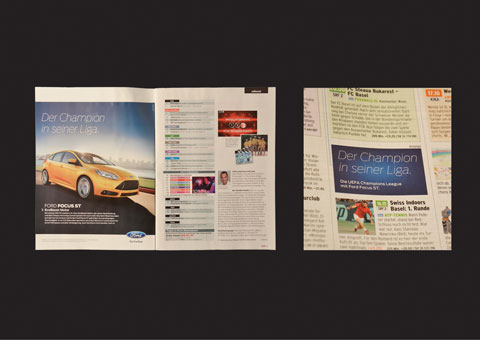
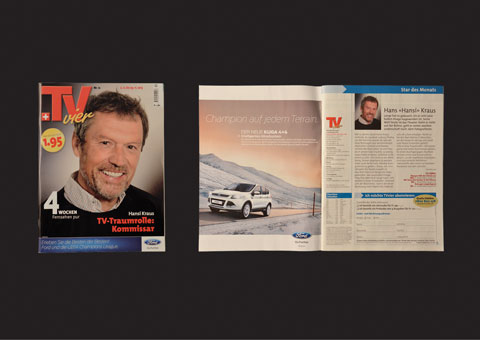
Ford is one of the main TV sponsors of the UEFA Champions League. With this in mind, Ford Switzerland has decided to partner with Axel Springer Verlag and will be featured in numerous TV magazines published by the company in 2013 and 2014.

In titles such as Tele, TV Star, TV2 and TV4, full-page advertisements will be placed, which on the one hand present a current model and on the other hand refer to Ford's involvement in the Uefa Champions League. In addition, the Ford Kuga will be the subject of a reader test, inviting readers to test drive the vehicle and announcing a draw for 2×2 tickets for the Uefa Champions League Final in Lisbon among all participants.

In combination with title strip ads and corresponding ads on the divisional and daily tip pages, this will create a print campaign that Ford hopes will attract a lot of attention from football and TV fans, according to a statement on Wednesday.

Responsible at Ford: David Frey (Director Marketing), Marcello Varallo (Marketing Communications Manager). Responsible at Ogilvy & Mather: Priska Meyer (AD), Marcel Elsener (text), Marco Kappeler (image editing/RedWorks), Sascha Isenschmid (graphics/DTP), Jonathan Schipper, Michela Girola (consulting), Liliane Borer (Media/MindShare).

1.ford_.1
1.ford_.2
1.ford_.3

The 3-D explosion

Winner of the Q-Award 2013 is known

For ten years now, the Swiss Media Association has presented the annual Q-Award for outstanding overall publishing and editorial performance in the field of specialist and specialty media. The Q-Award 2013 went unanimously to the magazine Wandern.ch / Randonner.ch.

You don't have to wear red socks or be a miller to feel pleasure at the sight of this special magazine, according to Thursday's announcement. The Relaunch of Wandern.ch / Ranonner.ch convinces, because it sets also contentwise new accents. Particularly to emphasize the numerous digital offers, above all the very beautifully arranged and helpful Website. For example, 450 hiking suggestions can be found there, which can be printed out free of charge on the national map (1:25,000) or downloaded as a GPS track. The new way of the magazine has led to success within a short time. In the first year, the WEMF/SW-certified circulation increased by 8.2 percent, and the upward trend seems to continue.

1.wandern.ch_
1.wandern.ch2_

Ringier launches corporate iPad app

Ringier presents a digital business card on the iPad: featuring time-lapse videos, animated films, interviews, 360° tours, interactive panoramic photos, and hundreds of images and text pieces.

In eight chapters, the internationally active Swiss media company can be explored in a playful way. With the Ringier app, you can take a journey through the decades of journalism or through the Ringier School of Journalism, hear and see how an event becomes a newspaper headline and how Ringier gained a foothold in Eastern Europe. On the app, you can watch time lapses from the newsroom and from a Gölä concert, navigate through interactive 360° images, learn about Ringier's rules and values, and turn the 3D globe to those countries where Ringier is present to hear a welcome in the respective national language.

The Ringier app offers entertainment and information in the form of videos and animations, time-lapses, 360° images, 3D models, hundreds of images and texts, overviews, and all the companies from Ringier's three pillars: Publishing, Entertainment, and Digital. A 3D navigation, alternative menu navigation, links to Twitter, Facebook and e-mail as well as an app guide are designed to ensure that people do not get lost in the app. The app was produced by Ringier Studios in Zollikon and Saigon.

You can use the tablet app here free download from iTunes to your iPad.
 

get_footer();