Online moving image content is good - classic TV is better

Internet use continues to grow. This is due to the boom in smartphones and tablets and the growing popularity of the Internet among older adults. The Internet is also increasingly being used to watch videos.

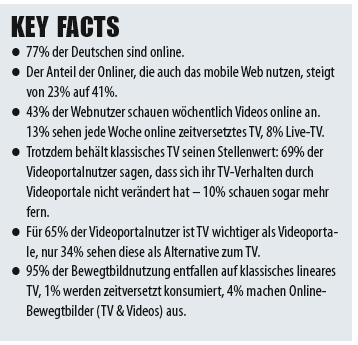
Nevertheless, consumers continue to use and value traditional television the most. These are key findings of the «ARD/ZDF Online Study 2013,» for which Enigma-GfK surveyed 1,800 German consumers aged 14 and older on behalf of the two broadcasters. The study first shows that 54.2 million Germans are online. That represents 77 percent of consumers aged 14 and older—an increase of 800,000 people compared to 2012. While 100 percent of 14- to 19-year-olds and 98 percent of 20- to 29-year-olds show consistently high internet usage, the older generations are experiencing the greatest growth. Among 50- to 59-year-olds, the proportion of internet users rose by 6 percentage points to 83 percent, while among those over 60, the proportion increased by 3 percentage points to 43 percent.

Most Internet users access the Internet via a PC or laptop (96%). However, other devices have also established themselves as alternatives: 45 percent of Internet users use a smartphone to browse the web, and 16 percent go online via a tablet. While a total of 23 percent of Internet users accessed the Internet via mobile devices last year, that figure has now risen to 41 percent. In fact, 21 percent go online via mobile devices every day. Another option for Internet access is the television, which 12 percent now use to go online. As internet usage continues to grow, so does the demand for video content on the web. 74 percent of internet users watch videos online at least occasionally—43 percent do so weekly. Popular options include both time-shifted TV (36%; 13% weekly) and live TV (26%; 8% weekly) as well as video libraries (28%; 9% weekly). People aged 14 to 29 are particularly avid online TV consumers: 49 percent of them occasionally watch time-shifted TV, and 37 percent occasionally watch live TV online.

Mobile devices are also shaping TV viewing habits: 11 percent of mobile users have already used apps from TV stations—6 percent even do so at least once a week. Due to the rapid proliferation of mobile devices, using a second screen while watching TV has also become a habit for many Germans. 31 percent of internet users use a second screen at least once a week while watching TV. Ten percent of internet users engage in parallel activities related to the TV program at least once a week, and 7 percent chat with others via social media about programs currently airing.

How is the growing importance of video streaming sites on the Internet affecting TV viewing? According to the study, TV continues to hold a prominent place in consumers’ lives: 69 percent of Internet users who use video streaming sites say that their TV viewing habits have not changed as a result of these sites. 10 percent say they now watch even more TV. A comparison of traditional TV and video platforms shows that video platform users are more likely to find food for thought on TV (44%) than on the platforms (32%), and they are also more likely to use TV (74%) than video portals (44%) for informational purposes. Similarly, more users find something to relax with in TV programming (49%) than on video streaming platforms (42%). Additionally, 53 percent say they frequently discuss TV shows, while only 34 percent talk about content from video streaming platforms. Furthermore, according to the study, 70 percent of video portal users are glad that their favorite shows have fixed broadcast times on TV. It is therefore not surprising that even 65 percent of video portal users consider traditional TV more important than video portals, and that only 34 percent see video portals as an alternative to TV. Last but not least, media usage time confirms that traditional TV remains the top choice: On average, Germans watch 242 minutes (95%) of traditional linear TV per day, 2 minutes (1%) of time-shifted viewing, and spend 10 minutes (4%) watching moving images (TV shows and videos) online.

Clemens Koob

Unbenannt-9_17
Unbenannt-9b
 

How can a mobile device be hacked?

Video, mobile, and automation are the most important trends in digital advertising—display advertising with banners is a thing of the past.

This fall, Werbewoche once again surveyed leaders in the online advertising industry about the most important trends. All survey participants identified mobile as one of the key trends in the digital advertising market. (The online video trend, which was rated as equally important, will not be discussed further here, as Werbewoche is covering this topic in depth in its current video marketing series.) At the same time, it is acknowledged that the mobile submarket in Switzerland is still small and underdeveloped. For publishers, the conclusion for now is that a mobile user cannot currently be monetized as effectively as a desktop user. Various reasons are cited for this:
 
– Users find ads on mobile devices annoying and reject them.
 
– There is a lack of standardized advertising formats, and the advertising formats currently in use do little to attract attention.
 
– Targeting options are limited; even traditional targeting and capping—limiting the number of ad impressions per user—are technically impossible for some large publishers.
 
– There are only a few metrics, and they are far from sufficient to capture all campaign objectives. Existing metrics are difficult to compare, making conversion tracking challenging.
 
So today, the situation is as Andreas Jorgella, a partner at The House Agency, describes it: «Current mobile advertising offerings were developed by website marketers using traditional thinking and are, for the most part, limited to the smallest display formats.» And he adds: «We are very critical of whether this effectively conveys advertisers» messages and brand attributes in a way that’s tailored to the device.« Despite rapid user growth, there is currently a lack of confidence when it comes to investing in mobile campaigns. Thus, there is general agreement that the media industry is called upon to find widely accepted solutions. And that it will still take some time before the topic of mobile is broadly established among clients and agencies. Potential solutions are also being proposed. For example, Alexander Horrolt, Managing Director of Goldbach Audience, highlights the »Audience First« approach, which prioritizes reaching the desired target audience rather than focusing on the specific channel. As the statement by Stephan Obwegeser, who is responsible for Digital Advertising and Services at Tamedia, shows, such strategies seem to be slowly taking shape in publishing circles: »After all, the challenge lies not primarily in the reduced screen space, but rather in the intelligent «Mecano»—how advertising is intelligently integrated into the content to add value. To achieve this, advertisers, creatives, publishers, and users must work even more closely together.” (see “Mobile: Dominated by Google”)
 
First tests in 2014?

Just as was the case a year ago, opinions on the automation of advertising processes remain divided. While many processes related to online ad placements in the advertising industry are still handled manually today, solutions have been developed that allow the exchange of relevant information between the participating systems to take place automatically. When it comes solely to booking processes, the term “programmatic buying” is used; if pricing processes are also included, the term is “real-time bidding” (RTB). Initially, publishers feared that the auction processes involved in RTB would inevitably lead to a collapse in prices, which is why the three letters “RTB” have been perceived more as a specter than as an opportunity for the future when it comes to premium inventory. And the topic is no less of a concern for media agencies and marketers, because if buyers and sellers can connect directly, their services could become redundant.
 
Clearly, it will take some time before these technical concepts can be understood and evaluated not only by pioneers but also by a broad audience within the industry. However, there are now early signs pointing to a tangible sense of optimism regarding industry-wide implementation. Taken as a whole, the expert statements in the Werbewoche survey suggest that more efficient handling of booking processes will likely be the subject of serious discussion in the coming year. Alexander Horrolt of Goldbach Audience reports: «We’re seeing many publishers engage much more intensively with the subject and make serious efforts to test or introduce automated trading in 2014.» Viktor Zawadzki, CEO of Spree7—a trading platform belonging to Publigroupe—also confirms this trend: «We’re seeing more and more Swiss websites trading their inventory programmatically. TPVs rose by 21 percent between July and September.» These signs point to a solution similar to the one media companies have already established in foreign markets such as France, Denmark, or the Czech Republic—and certainly in the U.S. They have set up their own trading platforms, known as private exchanges, where they can set and control the terms themselves. This allows media agencies to continue negotiating prices bilaterally with publishers, but the booking and delivery process will be automated; a wide variety of booking criteria can also be specified, and individual agencies or clients can be approved or blocked. (See also the article on page 26.)

Remo Baumeler, Head of Digital Advertising at Neue Zürcher Zeitung AG, comments: «I certainly see some positives in this development. For premium providers, however, the open bidding market isn’t the best option; focusing on private marketplaces is the better approach here.» At Tamedia, Stephan Obwegeser echoes this sentiment: «From our perspective, models that prioritize more efficient processing and smarter placement options—rather than primarily seeking a price advantage—have a chance of succeeding.» On the path toward a potential Swiss solution for programmatic buying, a major hurdle will likely be determining which solution providers should be selected and, above all, what trading commissions they should be granted. The focus here is on trading premium inventory. Those who want to sell leftover inventory as profitably as possible can also use existing RTB marketplaces for this purpose, as has been the practice with Google AdSense to date.

Skeptics fear that automated bookings will lead to the loss of face-to-face consultations, during which customers can often be offered more creative and lucrative options. Stephan Suter, CEO and partner at ADKEY GmbH, puts it this way: «The great thing is that in our small country, we can often still be in direct contact with providers, and together we can create the best possible outcome for the customer. The more this is handled by technology, the more of that is lost.» In addition, concerns have been repeatedly raised that any gains in operational efficiency achieved through automated processes are simultaneously lost due to increased complexity. This is because effectively implementing such new systems requires not only investment but also better-trained—and thus more expensive—staff. However, this is precisely where the opportunity lies for agencies, brokers, and marketers: Those who master automated processes can win over customers by relieving them of the burden of dealing with new and more complex systems.

No Letup on the Talent Front

The term «skilled workers» highlights a problem that has been plaguing the online industry for years and will continue to be a source of concern. Arend Hendriks, Country Manager for Advertising & Online at Microsoft Switzerland GmbH, sums it up: «The shortage of young talent in the digital sector could slow our continued growth even in the medium term.» And Catrin Rubenson, CEO at Admazing, quantifies the scale of the problem: «There is a shortage of around 2,000 specialists in the industry.» The courses offered by IAB Switzerland for career changers are widely recognized and welcomed. IAB Switzerland Managing Director Roger Baur reports: “The courses are going very well; this year we’ve once again trained over a hundred people and conducted two courses in collaboration with the agency association BSW.” Next year, the program is set to be expanded to include a course for advanced learners.
 
But that’s not enough, says Hendrik van Dyck, CEO of Adisfaction, who takes it a step further: «From our perspective, the problem isn’t a lack of talent. There’s a lack of time and the ability among experts to pass on their knowledge on a broad scale. This fast-paced industry needs hands-on training from industry experts who share their knowledge to nurture the next generation.» It’s clear to everyone that what has long been neglected cannot be made up in just a few years, and so it will take several more years before such measures have a broad impact on the job market. Yet there are already several voices pointing to a silver lining on the horizon. Take Roger Wassmer, CEO of Zanox Switzerland: «There’s a slight easing in the Swiss market, although good people are still hard to find.»

Billboard Boom

In the traditional display advertising business, there are reports of a boom in large-format display ads. Take Michael Baum, Managing Director of Stailamedia AG, for example: «Our billboard network, for instance, is fully booked through the end of the year.» And Matthias Kern, Head of Display Advertising Sales at Tamedia subsidiary search.ch, reports that the share of large-format campaigns has more than doubled within a year. Consequently, there has been a massive decline in standard advertising formats—a trend that media company representatives do not address—but Michael Baum comments: «Major publishing houses say these formats now account for only three percent of total online revenue.»
 
Other key trends are seen in the areas of search, social, and content—and in how they intersect. Search engine advertising remains a major driver, and Google, the market leader, is setting the tone in mobile and video advertising. Similarly, social media is dominated by Facebook, which is becoming increasingly important in the marketing mix. This is true both as a direct communication channel between brands and their customers and as an effective sales channel. With the launch of Facebook Exchange, Facebook opened itself up primarily to retargeting. To succeed on social media, you need good content, which is why content marketing—and thus native advertising—is becoming increasingly intertwined with social media.

Cross-border: A Blessing or a Curse?

When it comes to price trends, prices are under pressure, but the trends vary widely. This is because online inventory is now available at CPM rates of 50 rappen, 5 francs, or 50 francs. This isn’t always easy to explain to clients when the associated differences in quality—and thus the value for money—aren’t immediately apparent. The distinction between performance-based and traditional advertising activities has become even more pronounced. There is more than enough display inventory, and it doesn’t matter where the traffic comes from. As a result, prices remain under pressure, partly due to competition from international inventory, including that from international agencies« in-house networks. In this context, so-called cross-border traffic is often demonized, even in this survey. But Stephan Suter of Adkey sees it differently: »We simply have to acknowledge that this allows us to achieve high reach and, in some cases, high-quality audience affinities at lower prices.”
 
While prices for standard formats are falling, most customers are still willing to pay a mid-double-digit CPM for high-quality, effective, and simple products featuring premium inventory. This is where the future opportunities for publishers lie, as NZZ-Baumeler confirms: «I am convinced that higher prices will continue to be paid in the online advertising market for high-quality ad placements.» In this area, an alignment with lower foreign rates is not currently foreseeable. The top placements are very stable due to the limited domestic supply. The majority of the available, original premium traffic is controlled by a relatively small number of large publishers who refrain from special offers with steep discounts or clearance sales via real-time advertising. Catrin Rubenson of Admazing comments on this situation as follows: «There is a shared desire here not to put too much pressure on price levels. Given the cost structures relative to the available traffic in a small multilingual country, this is also understandable.»
 
Christoph J. Walther


Mobile: Dominated by Google

While the Swiss advertising industry is still grappling with how to handle advertising on mobile devices, publishers’ arch-enemy has long since established a dominant position in the U.S.: According to estimates by market research firm eMarketer from August, Google accounts for nearly half of all revenue in this sector, while Facebook has captured nearly 10 percent market share just one year after entering the market. Both companies have decisive advantages: They know their users’ preferences inside and out and can therefore tailor advertising messages to be well-received by the audience, as they align with their interests and needs. Furthermore, such advertising messages can be seamlessly integrated into their respective products (for example, based on the user’s location on Google Maps) on small screens. There is no reason to doubt that these advantages will be leveraged just as dominantly in this country as well. Anyone who wants to make money from advertising on mobile devices must also accept that many advertisers have long since found their own way to connect with their customers’ smartphones and tablets: Apps allow for a very rich dialogue with customers, increase customer loyalty, and enable transactions to be processed directly.

And here, too, Google is leading the way: At the end of October, the search engine giant launched «Google App Indexing.» This allows app developers to make their app data available to Google for indexing. When relevant search results appear, a link is displayed that lets users open the corresponding app directly at the appropriate location. If domestic publishers—especially traditional ones—don’t want to fall behind here, they’ll have no choice but to either convince the journalistic “guardians of the holy grail” in their own ranks or ignore them and take the plunge. After all, to ensure that advertising content isn’t perceived as disruptive on small screens, it must be presented in a multimedia format, intelligently integrated with editorial content, and presented on largely equal footing. The buzzwords for this include “native advertising” and “content marketing,” which essentially refer to advertorials. (cjw)

Participants

Werbewoche's digital advertising trend survey is based on the assessments of these industry experts (in alphabetical order):

Michael Baum, Managing Director of Stailamedia AG
Remo Baumeler, Head of Digital Advertising, Neue Zürcher Zeitung AG
Roger Baur, Netprofit & IAB Switzerland
Hendrik van Dyck, Managing Director of Adisfaction GmbH
Alexander Horrolt, Managing Director of Goldbach Audience (Switzerland) AG
Andreas Jorgella, Partner at The House Agency AG
Matthias Kern, Head of Display Advertising Sales at search.ch
Michel Lazecki, CEO of adwebster AG
Stephan Obwegeser, Head of Digital Advertising & Services at Tamedia
Remo Prinz, Partner at Serranetga AG
Catrin Rubenson, CEO of Admazing
Stephan Suter, CEO/Partner, ADKEY GmbH
Pascal Urscheler, Head of Media & Product Management at Publicitas
Roger Wassmer, CEO of Zanox Switzerland
Mike Weber, Head of Strategic Projects at PubliGroupe
Stefan Wirth, CEO of Instanz Tbd Spree7 & Improve Digital

Multi-screen increases reach and impact

An impact study on the qualitative and quantitative performance of multi-screen campaigns confirms that the multi-screen combination of TV and online significantly increases the reach and impact of campaigns.

Together with the Zurich media agency OMD, the marketer Goldbach Audience commissioned the market research institute GFK with the study. The evaluation of a broad FMCG (Fast Moving Consumer Goods) campaign clearly confirms that the multi-screen combination of TV and online increases the reach and impact of advertising campaigns.

The quantitative trends show that the mix of TV and online within a multi-screen campaign for FMCG products achieves a 6.3 percent higher reach ("Incremental Reach" versus "TV only"). The importance of this mix for advertising campaigns is also documented by the fact that almost 20 percent of contacts would not have been reached without online. Due to the precise audience targeting, the campaign has twice as many contacts in the defined target group as in the basic population (NET-Metrix).

Increased spontaneous advertising recall and a 30 percent increase in unaided brand awareness compared to the control group in the moving image mix of TV and video were significant. In addition, it could be proven that online video tends to increase the image parameters. Those who perceive display and video advertising media show higher preference, willingness to buy, liking and recall values than people without contact with the FMCG campaign.
 

Distorted perception due to the "hostile media phenomenon"?

A follow-up to the scandalization of the University of Zurich by the media. By Stephan Russ-Mohl, Head of the European Journalism Observatory at the University of Lugano.

Robert K. Merton's famous dictum about the "unanticipated consequences of action" in society applies to this case: overnight, the German communications researcher Otfried Jarren, who has been a member of the management team at the University of Zurich for years, has become interim rector of Switzerland's largest university. The media researcher has not only his predecessor Andreas Fischer to "thank" for his new position, who threw in the towel prematurely and in anger, but also a media scandal, at the center of which, bizarrely, are Christoph Mörgeli and his colleague Iris Ritzmann. This is remarkable in that the SVP has achieved exactly the opposite of what it wanted to achieve at the university. "The left-wing seed has sprouted," commented Mörgeli in the Tages-Anzeiger newspaper. This is gross nonsense, because Jarren can only be so easily pigeonholed if you yourself, like Mörgeli, are positioned on the far right. Jarren may have spent his time as an assistant at the FU Berlin in the wild 1980s, but he doesn't even have a comparable "left-wing" past to that of Res Strehle, editor-in-chief of the Tagi, who was scandalized by Weltwoche for this reason.

After the SVP, with its provincial barrage against the alleged superiority of German academics at Swiss universities, initially seemed to have had the effect that they were looking for a "Swiss citizen" (and not a native German with a Swiss passport) as Fischer's regular successor, Jarren now unexpectedly had to step into the breach two days before his 60th birthday and temporarily take up the post of the university's top crisis and communications manager. It gets even more bizarre. One day after the change of leadership, everyone who is anyone in German-speaking communication studies came together in Zurich to celebrate Jarren's 60th birthday - with a symposium on "Social Order through the Media" of all things. Media researchers flocked to the front stage to exchange highly abstract and scientific-theoretical views with Jarren on the extent to which communication creates social systems and structures (i.e. ultimately "order") - and how these can be changed and sometimes undermined by communication.

Media create their own reality

On the backstage, the media had just simultaneously and very specifically created social disorder and put the hierarchs of the otherwise rather sedate and also very self-confident university on high alert. Jarren did his best to minimize the damage to the university's reputation as the top crisis manager. He passed his acid test with aplomb and composure, was omnipresent during the conference and the subsequent celebration and - a master of multitasking - simultaneously engaged in dialog with the media and anyone else who wanted to get hold of the new rector. I have never experienced an academic conference at which the presentations were so coincidentally directly related to current events. The media not only depict reality, they also create their own reality and thus new social realities. Hans Matthias Kepplinger, for example, clearly showed in his lecture how the media create social disorder through scandalization, how unpredictable media reporting has become - and that media effects arise not least because actors deal with media reporting or take the expected media response into account in their actions. Viewed from the outside, one may come to the conclusion that the dismissal of Ms. Ritzmann was disproportionate, especially since it has been a principle covered by the "freedom of research and teaching" that researchers at universities can and should talk to journalists without having to obtain permission from the university management every time. However, anyone who has followed the media coverage of this university scandal closely must have gotten the impression that some media outlets were pursuing their own agenda. They did not simply report "what is" as neutrally as possible. However, it is also interesting to note that journalists like to see themselves in the role of "neutral observer", while those affected by the reporting usually perceive it differently. If, as in the case of Mörgeli/Ritzmann, there are even two camps affected by media coverage, it is relatively likely that both sides will perceive the media coverage as rather hostile - an effect that has long been described in research as the "hostile media phenomenon".
 

The day after or why A. did not become a winemaker

Spiked: Zombies celebrate Christmas too

Anne-Friederike Heinrich, a freelance contributor to *Werbewoche*, on gifts for smartphone zombies.

They are part of the street scene: creatures that walk in front of glass doors, stumble off the sidewalk onto the street or run into other people because they find their display more exciting than looking at the world around them. Such smartphone zombies live dangerously, but only rarely does anything happen to them. Apparently, just like drunks and small children, cell phone addicts have their own guardian angels - presumably in the form of an app.

Smartphone zombies have a more intimate relationship with their cell phones than with other people. They give their device a name, cover it with glittering stones, give it a warm cover and polish its display with a special sponge. According to a Forsa survey, young people can't imagine a week without their smartphone and would rather give up television for seven days than their cell phone. And, the demographers' hair stands on end: for 60 percent of all those surveyed by Forsa, the cell phone was more important than their love life; among women, as many as 70 percent said they would rather do without sex than their cell phone. Oooops.

 
Hot gifts

The Christmas season is approaching. And as if gift-giving wasn't hard enough already, because almost everyone has everything, there are usually one or two smartphone zombies among those who expect a gift from us. But what could you give a zombie? With a cell phone case? Already available. An app! And which one? A new glitter stone! Can you fit another one on there? A good idea would be a navigation system that allows you to walk around looking at the display without the risk of accidents. But that would have to be programmed first. Fortunately, a coffee retailer that is now also established in Switzerland and has long been selling more than just fragrant beans is helping us out with gift ideas: you can buy smartphone jewelry plugs there, a "decorative dust cover for the headphone socket". The Züriberg version with glittering stones, the Kindskopf version as an owl or fox. Dusty headphone sockets should be clear THE problem of the future. It is therefore highly recommended to strike.

If you haven't quite finished with analog yet, you can also buy a ballpoint pen (which used to be used to write letters and notes) with a silicone tip from the coffee magnate. The silicone side is designed for fingerprint-free operation of the smartphone, the refill for the analog world. All with glittering stones, of course. But the absolute hit are the touchscreen gloves for CHF 11.95 a pair. Thanks to the touch points on the thumbs and index fingers, you can operate your cell phone, tablet or digital camera even in winter without getting cold paws. The only thing that could be painful is blowing your nose with these things.

/Department Pushes the Limits

Die Zürcher Agentur /Department lanciert für die Skimarke Head einen neuen Claim und den neuesten Blockbuster. Wie gewohnt mit grossem Skistar-Aufgebot.

Zuerst Bode Miller, dann Lindsey Vonn und zuletzt das gesamte Head-Ski-Team inklusive Ted Ligety, Simon Dumont, Jon Olsson und Julia Mancuso – alle standen sie schon für einen von /Departments Head-Filmen vor der Kamera. Auch im neuesten Werbefilm, in dem es um verbotenes Glücksspiel geht, trumpft /Department wiederum mit hochkarätigen Skistars auf. Die illustere Runde setzt sich dieses Mal zusammen aus Aksel Lund Svindal, Ted Ligety, James Heim, PK Hunder, Jon Olsson – und Lindsey Vonn.

Und die Skiprofis lassen sich nicht lumpen. Unaufhörlich wird erhöht, bis sich Medaillen und Pokale auf dem Pokertisch stapeln – getreu dem neuen Claim «What’s Your Limit?». Dieses ist denn prompt erreicht, als nur noch die Ski als Einsatzmöglichkeit übrig bleiben. Dort hört der Spass für die Sportler definitiv auf.

//www.youtube.com/watch?v=D6PkHC-MV5Y

Während die Skistars ihr Limit spielerisch ausloten, tastete sich die Agentur /Department organisatorisch an die Grenzen heran. Herausforderung Nummer 1 beim Dreh, so Ollie Brunschwiler, Executive Creative Director und Partner bei /Department, war die Verfügbarkeit der Spitzenathleten mit ihren vollen Terminkalendern, Herausforderung Nummer 2 das Zusammenbringen der echten (!) Medaillen, Trophäen und Kristallkugeln. Da kam ein anschaulicher Berg zusammen, wie der Spot zeigt.

360°

Der neue Head-Film ist Teil einer gross angelegten Kampagne zur Einführung des neuen Claims. Mit «What’s Your Limit?» soll die neue Kommunikationsplattform von Head-Ski beim globalen Fachpublikum verankert werden. Bei affinen Konsumenten wurde sie bereits zur Vorsaison mit ersten Action-Clips gesät (YouTube.com/headski).

//www.youtube.com/watch?v=u33Gy8Hg648

//www.youtube.com/watch?v=yXlg6PyEVDE

Pünktlich auf den Wintereinbruch folgt mit dem Poker-Spot nun die Hauptoffensive. Der Film ist crossmedial eingebunden. Angegliedert an den Spot ist etwa ein Facebook Game, bei dem man die Skistars herausfordern kann. Ein weiterer Spot mit Lindsey Vonn in der Hauptrolle wird im Januar, im Vorfeld zu den Olympischen Winterspielen 2014 in Sotschi lanciert. (imp)

head1_0
head2_0
head3

Verantwortlich bei Head Ski International: René Harrer (Commercial Director) und Neil Allavena (Global Marketing Manager). Person in charge at /Department: Manuela Tappe, Marianne Sauter, Corinne Pouchon, Nina Zoglauer, Toma Perret, Michael Wenk, Tim Boin, Johannes Eisenhut und Oliver Brunschwiler. Produktion: shining pictures/Department. Marco Lutz, Stefan Bircher. Musik: Beat-Man.
 

Real partnerships!

With «The Golden Dudes,» the Hirschen Group is launching an international alliance of independent, owner-managed strategy and creative partners. The only Swiss «Dude» is the agency Partner & Partner in Winterthur. That’s no coincidence.

There is venison schnitzel, tender as butter and heartily seasoned. "We think it's perfect for today," says Benno Maggi, pleased with the compliments. Once a week, the co-founder of Partner & Partner cooks lunch for his entire crew. Sometimes he is relieved at the stove, which is open to an open-plan office in the agency, by other employees or even clients. "The joint lunch has become a fixed ritual in cultivating our Partner culture," explains Ingrid Brun del Re. She is the communications manager at the agency just behind the train station in Winterthur - and she has an important announcement to make at this deer dinner today: Partner & Partner is the exclusive partner for Switzerland in the newly founded international network "The Golden Dudes". The community of interests was launched by the German agency group "Zum goldenen Hirschen ". This group employs over 400 people at eight locations.

Partner & Partner has been active in Germany for 15 years and has maintained a close partnership with the "golden deer" for several years. Both agencies were founded in 1995, and in both the founders and owners are still involved in the day-to-day business. "For years now, we have been exchanging ideas, projects and the potential of an international alliance. Therefore, our engagement with the 'Dudes' is not the start, but the further development of a successful cooperation," explains Christoph Eschmann, one of the owners of Partner & Partner. In addition to Partner in Switzerland, the alliance has offshoots in most G-20 countries. These include agencies such as Extreme in Paris, Animal Farm Amsterdam, Metal in India and IQ Marketing in Moscow. From now on, all alliance partners want to realize their common ideas and visions with "The Golden Dudes" all over the world, set fresh accents in the communication scene - and conquer the international market together with their clients.

"In the Swiss communications market, clients with international operations in particular often have the problem that they only have large network agencies or self-made solutions to choose from. With the alliance 'The Golden Dudes', Partner & Partner now offers companies with an international focus the chance to reorganize their international communications." Creativity, individually assembled teams, country- and culture-specific solutions, and cost efficiency - these are the guiding principles of the "Golden Dudes," which translates roughly as "best buddies."

The sustainable partner model

"An alliance of agencies that tick in the same way and function like a social network is a perfect fit for Partner & Partner's philosophy. You throw a question around, exchange experiences and knowledge, without money always flowing straight away," explains Christoph Eschmann, who ensures the connections to the international network within the agency in Winterthur. Benno Maggi, meanwhile washing dishes in the kitchen with employees, adds: "Creative crowd sourcing within like-minded international agencies and not petty bourgeois Swiss agency thinking."

Partner & Partner, which now has 27 employees and annual sales of over CHF 4 million, is designed as a "sustainable agency model". After the two founders Benno Maggi and Kaspar Hintermüller, two new partners joined in 2009, and the next generation is already in the starting blocks. "Partner & Partner should really be celebrated as a process. That way, the company can continue to develop, and everyone benefits," says Kaspar Hintermüller. All four of today's partners are managing directors, with equal rights and equal participation. Even in daily business, there are no classic hierarchies and responsibilities like in an old-school agency. "All employees are entrepreneurs or at least think entrepreneurially. This benefits our customers in particular. They don't need creative directors, they need ideas and solutions," says Benno Maggi, although his background may be the closest thing he has to a creative director.

Benno Maggi worked as a director and film producer after his training as a graphic designer. His works have been shown at various festivals in Switzerland and abroad, as well as in Swiss cinemas. In the late 1990s, he completed additional training in strategic marketing and financial management at Stanford Business School. Since 2002, Maggi has been a senior consultant in his agency in addition to his role as managing director.

Common roots at the WoZ

Denise Nick, who has been with the company since 2003 and a partner since 2009, entered the industry with a commercial apprenticeship at the Beobachter publishing house of Curti Medien. She then worked in various editorial departments until her "revolting phase" broke out at some point. Nick became involved with the WoZ, "the only independent newspaper in Switzerland. Although with the best references and experience, she started as an intern "with even less pay than the others ". Nevertheless, she stayed for seven years and eventually became managing editor. She tried to shake up the advertising market and get the business going. "In a media landscape that had changed a lot, we now also agreed at the WoZ: We need marketing and we have to advertise."

For the reorganization, the alternative newspaper was looking for a professional consultant. That was Benno Maggi. Together with him, the WoZ management managed to get marketing up and running internally. "A marketing/advertising department and proper structures were introduced," Nick is still proud of her second "revolution." But she realized she was reaching her limits in this new structure and decided to pursue further education. At Sawi, Denise Nick graduated as a planner as well as head of marketing communications. When Nick wanted more part-time work, also for her children, Partner & Partner was able to offer her a tailor-made solution. Today, she is primarily responsible for the agency's "health corner" with clients such as the Swiss Cancer League and Health Promotion Switzerland, as well as a proven expert in real estate communications with mandates for almost all real estate companies in Switzerland. In addition, Denise Nick is the "boss" in the store and a role model and point of contact for (almost) everyone.

Christoph Eschmann, fourth in the group, has always had something to do with media. "I didn't come to advertising, advertising came to me through its change," he says. Because, "Good advertising today organizes the dialog with the target group directly - without media in the conventional sense in between. And that interests me." For Eschmann, the term media thus also needs to be reconsidered. "It was coined in the age of mass media - when it took an industry to distribute content - that's gone today. The Web is no longer a medium in the classic sense; it's TV, radio and newspaper all in one."
 
 However, the World Wide Web did not yet exist when Christoph Eschmann entered the professional world. But Werbewoche opened the right door for him. "My father brought this trade journal home every time, and I read about media and marketing in it with growing interest. " Curiosity developed into a career that also brought him to the weekly newspaper WoZ via the Schaffhauser Nachrichten and Atelier Binkert. During his further training as a planner and later as Head of Marketing Communications, Christoph Eschmann formed "an efficient learning team" with Denise Nick in each case. He then became CO managing director of the WoZ in May 2003. "I learned and experienced an incredible amount about how organizations work during a period of reorganization and restructuring at WoZ." In 2006, he started at Partner & Partner. There, he consistently drove the agency's digital and mobile focus, with the result that his company is now living the mobile future. The youngest of the bunch and currently still a junior partner is Gianfranco Acocella. The designer grew up in an Italian specialty store. "My nursery was a Harass."

From this perspective, Gianfranco "had his first contact with the industry while putting together countless promotional gift baskets. More concretely, his talent was then nurtured during an apprenticeship at the Thurgauer Zeitung, the vocational diploma in design, and a job in Zurich at Guye & Partner. He then moved to Partner & Partner in 2002. In 2004, the creative wanted to take a year of inspiration and went on a trip around the world. After three more years in Winterthur, the question of additional training arose. Benno Maggi, however, had a more practical idea: his young talent should spend a year at the agency "Zum goldenen Hirschen" for further promotion. So in 2009, Acocella became a guest AD in Berlin. In the German capital, he was first supposed to join the "green team" and help get as many Greens as possible into the Bundestag. But then he was put into the even more stressful pitch team. Here, 13 specialists developed new ideas for competitive presentations day after day. The "Swiss" had four juniors under him and did such a good job that the hip "stags" made him an offer for a permanent change. "But love - not only for Winterthur - led me back again, but I brought the stag with me," smiles today's Junior Partner - and is already looking forward until he too becomes a full partner at Partner & Partner.

Andreas Panzeri

Unbenannt-10_11
Unbenannt-11_13

Head of "SRF mySchool" editorial team leaves SRF

Barbara Krieger has decided to step down as editor-in-chief of «SRF mySchool» and leave the company at the end of May 2014. She has headed the educational programming division of Swiss Radio and Television since March 1, 2011.

Barbara Krieger began her career at Swiss television in 1995 as an editorial assistant and production manager in the popular culture department. She then worked in various roles for Swiss television, including as producer of the youth program "OOPS!", as producer of "Mittagsmagazin" and as author of "DOK" films and docu-soaps. In 2006, Barbara Krieger took over the editorial management of the online platform "SF Wissen", which she set up with a small team.

In March 2011, she switched to "SRF mySchool", the educational program of Swiss radio and television, where she relaunched the topics of media literacy, politics, sexuality and job profiles with films and extensive teaching material. Under her leadership, the "mySchool" website underwent a comprehensive redesign. At the end of May 2014, she will step down as Editorial Director and leave the company, as the media company announced in a press release on Thursday.

To the point: Kindergarten

After the data massacre - as Michael Ringier called the inglorious situation surrounding Mediapulse's disputed TV ratings at the Ringier media orientation in April, in reference to the movie "The Miss Massacre" - I wrote in an editorial: "The unspeakable and unending bickering is irreparably damaging the credibility of media user research and market research in general."

After the publication of the data, calm has returned and even the most incorrigible number fetishists at the agencies and customers have now realized that no comparisons should be made with the old currency and consequently any "weighting factors" are obsolete. The fact that this question came up at all does not exactly speak for the professionalism of the people concerned. But if one knows the background of the demand, one can at least understand the wish: How is the agency supposed to prove that it has purchased better than the dear competition in the previous year, or how can it now be determined that the promised performance parameters have been achieved.

The publication of the new Mach, which has also changed its methodology, went smoothly. Primarily because Wemf prepared the matter better in terms of communication than their colleagues in Bern (sorry Mediapulse!), but then also because the publishers had known the new figures for a long time and were able to come to terms with them. There was no uproar, the new data was accepted.

But anyone who thinks that this means peace reigns is mistaken. In April, AZ publisher Peter Wanner was a bit nonchalant about the circulation figures of the competition in an interview in his own paper. BaZ CEO Bollmann announces possible legal action. Then nothing happens for a long time. Once the actual circulation and readership figures were available, the discussion continued, lively supported by part of the trade press. Martin Wagner, the in-house lawyer of the Basler Zeitung, then writes a major commentary in his own newspaper - also rather unusual - and Peter Wanner feels obliged to issue a counterstatement to an article. Then the hour of Eisenfuss and BaZ CEO Rolf Bollmann strikes. He demands the immediate dismissal of Peter Wanner as a member of Wemf's board of directors and, in the same move, that of Wemf's chairman Jürg Weber. And he threatens legal action if his demands are not met. Unfortunately, I have to repeat myself: Once again, the bickering and coercion is damaging the credibility of market research. Too bad.

Pierre C. Meier, Editor-in-Chief [email protected]
 

Matchmaker and marriage counselor

Roland Sutter, former partner of the agency HESSKISSSULZERSUTTER, is now a consultant. As the Swiss representative of the Roth Observatory International network, he supports companies in all aspects of agency relationships, including pitches and agency evaluation.

Unbenannt-3_10
In brief: Roland Sutter worked for many years at the advertising agency Gisler&Gisler, which later became part of the BBDO Group, most recently as a member of the management board. In 1986, he founded his own agency Sulzer, Sutter with a business partner, which merged to form HESSKISSSULZERSUTTER in 2010. In 2013, Sutter left the agency world and became a Swiss partner of Roth Observatory International, a merger of the consultancy firm The Observatory International (UK) with the consultancy Roth Associates (USA). Clients of the global pitch and management consultancy include companies such as Siemens, Allianz, Ferrero, Tesco and BMW. BMW Switzerland is the first client that Roth Observatory has assisted with agency evaluation in Switzerland.

 
WW: The Swiss agency landscape is relatively straightforward. Why do companies need external consulting?
Roland Sutter: I am convinced that the Swiss market is less manageable than it seems at first glance. There are changes towards digital media and new agencies are becoming increasingly important. What's more, precisely because the landscape seems straightforward, the same "usual suspects" are always found in agency evaluations. We want to counteract this.
 
What services do you offer?
As a management consultancy, we specialize in the optimal use of marketing resources. Our offer is divided into four parts: 1. the selection of agencies, 2. the entire area of remuneration. We are committed to remuneration that satisfies both client and agency in the long term. In addition, we have models for the performance-related remuneration of agencies. This is an area that is still underdeveloped in Switzerland. The third area is called "Optimize ": we optimize structures and processes and repair relationships that are no longer running optimally. The fourth pillar comprises monitoring instruments, for example to measure agency performance.
 
Where is the focus?
Pitch consulting is just one pillar of our portfolio. We are currently advising more and more frequently. Against the backdrop of the digitalization of marketing as a whole (not just brand and product communication), we are helping companies to meet the new demands on their organization. Among other things, this means designing sensible marketing structures and reorganizing the composition of agency portfolios.
 
How do you proceed with the agency evaluation?
We work with a multi-stage process. This begins with the systematic identification and prioritization of the client's selection criteria. From this we derive the procedure for the search. We draw up a so-called "consideration list" of relevant candidates. Chemistry meetings are held on site at the agencies in consultation with the client. Once a shortlist has been drawn up, we accompany the pitch and then, if the client wishes, take over the contract negotiations and put together a suitable fee model. 
 
Your work ends with the pitch?
No, the pitch is followed by so-called "alignment workshops", in which the aim is to define the parameters of a successful collaboration in order to get up to operating temperature as quickly as possible. Regular "health checks" take place as part of a monitoring process. These consist of online and live surveys and serve to quickly identify what is going well and what is not. From this, we then make recommendations to ensure that the relationship remains successful. We are not just a dating agency, but also a marriage counseling service. However, the approach is always à la carte, depending on what the client needs.
 
Today, fee models are often determined by the procurement department. How much influence do you have there?
We have a great deal of experience in designing models that reward top performance and efficiency. For some clients, we even design new remuneration systems for the entire organization in cooperation with the purchasing and marketing departments. The willingness to discuss this is actually quite high.
 
What do you think about royalty-free pitches?
As an agency owner, I have always made a point of not taking part in any free pitches. However, as an advertiser, I didn't really care how much the fee was. It was never enough anyway! And the frustration of losing a pitch is huge, regardless of whether you received 5,000 or 10,000 francs or not.
 
And what is your opinion as a consultant?
I advise clients to follow national customs. In Switzerland, it is customary to pay for pitches. Clients should adhere to this.
 
For which companies does external consulting make sense?
Worldwide, it is primarily large, internationally active companies that rely on the services of Roth Observatory. Banks, insurance companies, manufacturers of branded goods of all kinds, car brands such as BMW, the first customer for whom we also work in Switzerland.
 
For smaller companies, the commitment is unlikely to pay off ...
 In most cases, companies only consider it sensible to engage a consultant once the agency relationship has reached a certain level of complexity. However, Roth Observatory's experience in Germany shows that our services can also be attractive for medium-sized companies. These companies often lack expertise in one or other aspect of the agency relationship.
 
From what budget is it worthwhile?
I don't want to set a budget limit - I don't have enough experience at the moment. The client has to decide on a case-by-case basis whether the advice pays off.
 
How are you remunerated?
We are paid by our clients on a time and material basis. Of course, we receive nothing from agencies in order to be independent.
 
What are the advantages of being part of the Observatory network? You could also have set up your own business as an individual consultant ...
The advantage is that I can use the know-how of the network. I know the Swiss agency scene and have many years of experience in client relationships. Roth Observatory also provides me with numerous tools for selection, remuneration and reviews. For example, I have access to a database with figures on agency remuneration worldwide.
 
How do agencies react to you?
I have only spoken to a few agencies so far. The reactions I have had have been positive. We now have an appointment with the industry association BSW, where we will be available to answer questions. It is important to me that the agencies are informed about our activities.
 
We have also asked around. There were points of criticism that I would now like to confront you with.
Okay, good. "
 
Consultants cause additional costs. This money would be better spent on communication."
That's a very simple statement. Look around at how many client-agency relationships waste resources every day because there is no agreement on goals and expectations. And this goes on for years. How many pitches are made every year that don't lead to the desired results? There are incredible costs involved. We offer practical approaches that pursue agreed objectives in a very focused manner. Feedback from other markets shows us that both Purchasing and Marketing are very satisfied with the results. Of course, there is a cost. However, we assume that the ROI significantly exceeds the costs we incur as consultants.
 
Another point: "Direct communication and collaboration with the customer is made more difficult by a consultant."
That is the complete opposite of what we are striving for. We try to improve cooperation. If something doesn't work, we step in to help. Otherwise, we keep a low profile as far as possible.
 
One accusation concerns the lack of neutrality when choosing an agency. How do you avoid being left out of the circle of "the usual suspects"?
Firstly, by covering as broad a spectrum of agencies as possible and keeping up to date with developments. To do this, we visit as many agencies as possible. Secondly, we carry out new research for every assignment. Thirdly, we don't simply suggest an agency. First, we draw up a consideration list, whittle it down to a shortlist and then invite 3 agencies to a presentation - not 5 or 10, as sometimes happens. But of course, the selection will never be "neutral" in the true sense of the word, but will reflect, to the best of our knowledge and belief, what we consider to be the optimal choice in consultation with the client.
 
Consultants sometimes pull the strings in the background, but do not make themselves known. Do you appear openly to the agencies?
Always. When we are involved, it is clear to agencies right from the start. That creates trust.
 
In Switzerland, there are already individual consultants and consulting firms that are sometimes called in for pitches. How do you rate the competition?
There are a few consultants, but the market is still underdeveloped compared to the rest of Europe. I see our offering as a fairly new service, especially because we have a range of tools in addition to pitch consulting that help companies make better use of their marketing resources. In my view, professionalization helps everyone.
 
Professionalization has already increased on the client side.
This is the case. Nevertheless, many client-agency relationships fail, for example due to a lack of briefing quality or a dysfunctional decision-making culture on the company side.   
 
What does a non-functioning decision-making culture mean?
Advertising used to be a matter for the boss. Today, everything is structured and hierarchical. Company structures are often designed in such a way that it is much easier for employees to say "no" than "yes".
 
What do you mean?
Employees have every authority to say "no" to the agency. As soon as they say "yes", they are held responsible internally. This makes it easier for employees to say "no". Work is often rejected first, it goes to a second round and in the end the client and agency are frustrated that it takes so long and costs so much. Professionalization in the decision-making process could contribute to an improvement.
 
What goals have you set yourself for the next few months?
A sales target is not yet in the foreground. The first goal is awareness: I want people in the industry to know us in a year's time. The second goal is reputation: I want to show with three or four projects that we are doing a good job. And a third goal is to have another partner on board in one to two years' time.

Interview: Isabel Imper


What agencies think of pitch consultants

When it comes to acquiring new customers, Swiss agencies rarely make the acquaintance of external consultants. Most are skeptical - even if opinions differ on the benefits and drawbacks.  
 
The agencies surveyed are largely critical of the external consulting services offered for agency evaluations or pitch support. Many emphasize that the involvement of a consultant makes it more difficult to maintain relationships and communicate with the client, as communication takes place via third parties. It becomes more difficult to get to know the potential client and to gain an understanding of the client's needs. In day-to-day work, the relationship between client and agency is crucial for success. The choice of agency should be made by the client and not outsourced. Many agencies question whether consultants are needed at all in the manageable Swiss agency market. Clients could get an overview themselves. Reference is made here, for example, to the pitch guide of the industry association BSW leading swiss agencies. One agency differentiates: Internationally active corporations may have a certain demand for harmonization of the process across several countries, but for Swiss clients the detour via the pitch consultant is considered rather questionable. The costs and the additional time required for consultants are also questioned. These additional expenses are in most cases disproportionate to the budget, they criticize. The money for interim consultants would be better spent on campaigns. Especially as the consultants are sometimes not worth their money. The consultants do not always shine with industry knowledge, as the survey shows. One agency was invited to a pitch by a consultant, even though its positioning did not fit the profile at all.

More cost pressure from consultants?

Very few believe that the financial conditions for the agency will become tougher with a consultant. The tenor is that cost pressure exists anyway. One explanation is that this is often controlled by the company's internal procurement. So are consultants completely superfluous from the agencies' point of view? No, in certain situations, the agencies do acknowledge that consultants have a right to exist. In the case of very complex, usually global tasks, it can make sense to involve a consulting firm. The same applies if the client lacks the know-how and is unfamiliar with the market, the agencies or the conditions. In such cases, the involvement of a consultant also appears to be worthwhile for the agencies. Cooperation can be improved by an external consultant, for example through greater professionalism in the tender, in the process or in the quality of the briefing.

 
How often do consultants come into play?

The final step is to find out how often consultants are involved in agency evaluations or pitches. In a survey, the German Association of Communications Agencies (GWA) found that external pitch consultants are involved in around one in ten budget tenders (2011). In Switzerland, this figure is likely to be much lower. Reliable data cannot be found at the BSW. The topic is on the pending list, says BSW Managing Director Peter Leutenegger. However, he does not consider the situation to be acute. In the survey conducted by Werbewoche, around a third of the agencies that responded said that they had never acquired clients through a consultancy firm. For the others, the number of cases could be counted on one hand. Only one of the agencies, a web service provider, said that up to a maximum of 20% of their new client pitches were conducted via consultants.

Who are they?

In most cases, the consultants are individual masks who have a good relationship with the client. Former McKinsey consultants or people who used to work in advertising themselves. Other agencies occasionally mentioned international consulting networks - but these are exceptions. And: established Swiss consulting firms (communications and business consulting) are apparently also active in the field of agency evaluation and pitch consulting. Once again, it became clear that many consultants prefer to remain in the background. They do not want their mandates to become public. Agencies that mentioned consultants by name were assured that their names would not be published. In some cases, the consultants even prefer to remain invisible to the agency themselves. In one case, the consultant only revealed himself in the final phase. In two other cases, the agencies only found out by chance that a consultant was involved. This lack of transparency is not exactly conducive to the acceptance of external consultants.

Isabel Imper
 

Eurobest announces Young Talent Programs

To promote young talent, the 2013 Eurobest Festival is hosting two academies—«Young Marketers» and «Young Account Executive»—as well as a «Young Creatives» competition.

The Eurobest Festival, which takes place in Lisbon from 4 to 6 December 2013, is organizing two academies and a competition to promote young creative talent as part of the event. The "Young Marketers Academy", sponsored by McCann, teaches over three days how creativity is applied in marketing strategies and is aimed at people from the fields of advertising, branding, business development, communication, marketing and sales. The three-day "Young Account Executive Academy" is designed to inspire and encourage young executives to create convincing brand communication strategies and to foster their own creativity in the process. In the "Young Creatives" competition, teams of two create campaigns over the course of two days. The best three campaigns will be honored at the award show.

Steve Latham, Eurobest Director Talent & Training: "The programs are a great way to develop your skills. The academies offer an insight into specific areas of the communications industry. While the competition allows young talent to test and showcase their creative flair."

Further information on the academies and the competition is available at here available. Details on registration can be found at Eurobest.com.
 

get_footer();