Swiss Radioworld: Ralf Brachat takes over as manager

Ralf Brachat will become Managing Director of Swiss Radioworld. Bruno Oetterli, who has been leading the company on an interim basis since its founding in July 2013, will resume his duties as Senior Consultant and Delegate of the Board of Directors.

With the signing of federally certified sales manager Ralf Brachat as of March 1, 2014, Swiss Radioworld has succeeded in gaining a proven sales specialist with international experience in the music and entertainment sector, according to a statement. Brachat has held various positions at Warner Music Switzerland since 1999. Since 2004, he has been responsible as Sales Director at Warner for the introduction of the digital business segment, among other things, and has been Co-Managing Director of Warner's Swiss branch since 2008. He is a member of the board of IFPI Switzerland (industry association of Swiss music labels), a member of the professional group Phono-produzierende Schweiz and a member of the board of trustees of the Stiftung Phonoproduzierende.

Together with the two other members of the management team Hans Lackner, Head of Operations / Deputy Managing Director, and Martin Baumgartner, Head of Business Development, as well as a motivated team of radio specialists, Brachat intends to exploit the potential of the radio genre. "Radio was interactive before any other media and is used by all age groups throughout the day. Our job is to make sure that radio gets the piece of the advertising pie that matches its advertising effectiveness. That's my goal for Swiss private radio and swiss radioworld," says Brachat, explaining his plans as Managing Director.
 

Kreienbühl and Vogler: A service is good for the bike

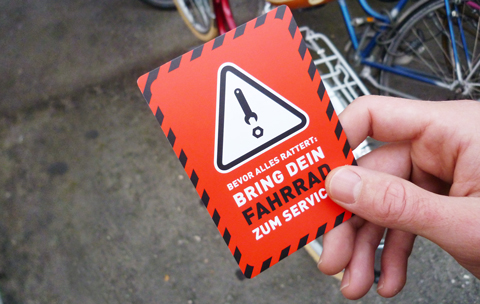
Kreienbühl und Vogler developed a motif and a guerrilla campaign for Bike Zone to remind people of the need for regular bicycle services.

The motif shows that bicycles fare badly when they are neglected in terms of service. The Zurich agency has also developed a guerrilla flyer campaign that will definitely not be overlooked - or overheard. The campaign involves attaching flyers to parked bicycles in such a way that they rattle as you ride off. The new service motif can currently be seen as a poster. According to the press release, the flyers are used at bicycle parking spaces at train stations and schools.

Responsible at Bike Zone: Marco Wieser (owner, management Baden), Roland Moser (owner, management Brugg/Windisch), Antonio Pirotti (owner), Luisa Wieser (marketing and communication). Responsible at Kreienbühl and Vogler: Marco Donada, Reto Vogler, Oli Kreienbühl, Fabian Schiltknecht; Lorenz Wahl (image processing). Photography: Oliver Nanzig.

BZ_Service_plakat
KundV_3_BZ-Ratterflyer_2
KundV_3_BZ-Ratterflyer_3

Newspapers must move away from mass tastes

What should you do when you’re given a newspaper as a gift? We asked the Tagi reporter himself what Constantin Seibt wanted to know from his colleagues at his book launch. In this interview, he explains what «his» newspaper of the future will look like.

To hear the author, the audience did not need to come to the Neumarkt Theater on Tuesday evening. Instead of attending the book vernissage himself, the Tagesanzeiger reporter and author of "Deadline - How to Do Journalism in the 21st Century?" prefer to discuss the future of journalism with colleagues: Michèle Binswanger (Tages-Anzeiger), Daniel Binswanger (Das Magazin), Roger Schawinski (Radio 1), Christof Moser (Schweiz am Sonntag) and Peter Hogenkamp (NZZ).

Not surprisingly: The big breakthrough failed to materialize. THE strategy for the future of journalism was not found - despite red wine. (Maybe it was also because the majority of the participants stuck to the water...). There were, however, some creative suggestions when Seibt asked the guests: "You get a newspaper as a gift. What do you do with it?" 

Daniel Binswanger mentioned as a possible model the French news website Mediapart.fr (exclusively subscription-financed, no advertising). Peter Hogenkamp would prefer to grab a regional newspaper as a media company (monopoly position preferred). And Christof Moser would be banned from editing. The journalists would have to get out again, no one would need to come into the editorial office before 4 p.m. 

Seibt himself would have owed the audience the answer had not an audience member insisted. "I would make a newspaper for different groups." He explains exactly how in the interview.

seibt-2_0

WW: Constantin Seibt, let's say you get a newspaper as a gift. What would you do with it?
CS: I think one way would be to target the newspaper to different groups. One that half and half satisfies a mass audience is increasingly not being bought. First, because in the Internet age, the audience is breaking down into interest groups. Second, because a newspaper subscription is no longer a habit, as it used to be, but a commitment. The necessary intensity only comes from proximity. So you have to get close to the audience, i.e. the different groups.

Let's spin the idea further. What's behind it? 
The basic idea is: Make journalism in the 21st century. And the most successful new media product is television series. In the 20th century, series producers tried to cater to mass tastes: No controversies, no big frivolities, nothing sinister, nothing risky. And often an eternally same plot. The viewer can start at episode 1, then at episode 5, jump back in at episode 30 - everything remains the same. The U.S. pay channel HBO has completely abandoned this concept. It produced complex stories with ongoing plots. Series that also show the night side, in which people die, for example. In "The Sopranos" neurotic mobsters, in "Six Feet Under" a family of gravediggers. HBO banked on this: if something really intrigues people a story, they'll tune in every time. In doing so, the network may have scared away the mass audience, but it maintained a subscriber audience made up of loud minorities of convinced fans. And it became enormously profitable. 

The solution is to move away from mass tastes and target specific audiences?
Yes, because in principle, a city like Zurich functions in exactly the same way. People just officially live in the same city. There's the financial center, Langstrasse, the press scene, the theater scene, the advertising scene, the art scene, the political scene, and so on. That's where their everyday life and ambition is, that's where people really live. 

What does that mean for the newspaper? 
A newspaper would have to work on becoming the authoritative paper for the most diverse milieus. It would have to succeed in bringing the most current news and the smartest debates to the most important milieus. It would have to become a career obstacle for ambitious people if they didn't read it. 

We eliminate the departments and instead make a newspaper for bankers, one for the art scene, one for the red light milieu.
Yes, but all in one newspaper. In extreme cases, the product could consist of a huge local section that frays out into the world. The problem with this is that it should not be provincial. Because today, a city is no longer provincial. For the art scene or bankers, what happens in New York or Shanghai is just as relevant. For the advertising scene, it would also have to report from Cannes, but also what the cracks are up to in Brazil, Belgium or the USA. 

How does the newspaper get the inside scoop? 
The same as today: Through journalists who stay on it. The longer you stay with it, the more you hear. The more you write, the more you know. It's like working your way into the Bundeshaus as a correspondent.

So the role of the journalist would remain the same? 
Of course, there is also an aesthetic aspect. Journalists would have to get away from the uniform news style. And try to write differently depending on the case: sometimes sober, sometimes personal, sometimes polemical. The audience should either love or hate an article. The latter, because you never arouse enthusiasm without the risk of anger.

The newspaper of tomorrow polarizes.
Yes, but not through opinions. If you systematically polarize through opinions, you pretty quickly resort to idiotic arguments. The newspaper of tomorrow polarized through aesthetics: through its layout, the way it was written, the way it looked at things. I think that's the only way to survive. Otherwise, the newspaper does solid work, but work that can be found everywhere on the web.

Is the newspaper still printed?
I am pragmatic on this question. There are practical reasons that speak for it: Every print reader brings in 7 times more than an online reader, and that in turn brings in 7 times more than a smartphone reader. You pay print and distribution costs for that. So do the math. But in the end, print or online doesn't matter for journalism. Text is text. 

How does the newspaper finance itself: through advertising or readers? 
First and foremost, it needs convinced readers: so convinced that they pay. Advertising is increasingly disappearing for information media. 

What's stopping you from building "your" newspaper? 
On the one hand, the concept is still pretty raw. And even with a perfect plan, the conversion is a huge task: Even with minor changes, a newspaper has the turning circle of a tanker. And last but not least, I'd have to win the Euromillion twice in a row. 

You could look for an investor or patron. 
It is indeed fashionable at the moment for broadcast-conscious billionaires to buy media projects. In Switzerland, however, it's Mr. Blocher. And he has slightly different ideas than I do. 

In what way?
Like many older gentlemen, he wants a newspaper to represent his opinion above all else, no matter what. After all, the business model of the Basler Zeitung tends to be that the only person who still reads it with pleasure is its financier

Finally, about your book: "Deadline" is based on your blog of the same name. Why should blog readers buy it anyway? 
The blog is a candy box, the book a piece of ham. In other words, in the blog I try to amaze the reader. In the book, on the other hand, everything is systematic, in order, an argumentation, an aesthetics. The blog is meant to stimulate; you can work with the book. It's the plan behind the blog, so to speak. 

Interview: Isabel Imper


</article

BZ: Michael Hug moves to the politics department

Michael Hug, who has been editor-in-chief of the BZ Berner Zeitung since 2006, will continue to work for the BZ following his previously announced resignation as editor-in-chief.

As of January 1, 2014, Michael Hug will be joining the BZ Berner Zeitung's politics department as a journalist for the Federal Parliament, according to a press release. As an experienced and distinguished writer, he will strengthen the BZ Berner Zeitung news team in view of the planned collaboration with the Zurich regional newspapers. Hug announced his resignation as editor-in-chief for health reasons in June 2013 (Werbewoche.ch reported).

Videostitial: Adello launches new mobile advertising form

The mobile media genre offers video advertising immense potential. Due to technical hurdles, this has been lying fallow until now. According to Adello, the innovative "videostitial" form of advertising is set to change this situation abruptly.

The mobile touchpoint is developing rapidly. In the USA, media usage has been growing exclusively on mobile for four years, with a current growth rate of 67 percent (source: eMarketer). In Switzerland, these figures are even more pronounced; in the 15 - 39 age segment, mobile penetration is over 80 percent. At peak times, the largest Swiss publishers such as 20 Minuten record 90 percent of their total digital usage exclusively from smartphones and tablets. In its latest mobile publication, the independent Swiss authority for Internet usage research "Net-Metrix" reports a traffic growth to over 1.6 billion mobile page impressions over the past 12 months. This corresponds to an annual growth rate of over 85 percent. These figures may be impressive, but they are exceeded once again by the advertising money invested in the mobile touchpoint.

Moving image as a growth driver

Within the mobile media genre, video is the biggest traffic growth driver, which is due to the ever-improving performance of devices, faster wireless connections, and declining subscription costs. Industry leader Zattoo no longer records the majority of Internet TV consumption on the connected TV in the living room or laptop, but on smartphones and tablets. This traffic share is currently 70 percent and growing.

Buzzword "Mobile Video Advertising

It is not only the exploding mobile usage that makes smartphones extremely attractive for video advertising. In addition, the advertising impact is increased enormously thanks to parallel use of the mobile channel: Positive purchase decisions are increased by 72 percent, memorability by 69 percent and willingness to recommend products to others by up to 100 percent (source: Adcolony 2012, Mobile Video Ad Network Rhythm 2012). Until now, the reach potential of video campaigns on the mobile touchpoint was technically very limited. Two hurdles in particular were responsible for this: On the one hand, a "player" that can interpret and play out video file formats is required in the source code for the display of video advertising. Such a player is not available as standard on the high-usage content. On the other hand, it is the mobile operating system (iOS) itself that prevents the video file from starting automatically.

"Videostitial": Pioneer campaign with Freixenet

With the Autostart video-stitial, Adello is expanding its premium rich media innovations for the real time targeting technology "Adctrl" by a strategically important step, according to a statement. The new advertising template fully solves the existing problem and makes it possible for the first time to exploit the full reach potential for mobile video advertising. The partner for the pioneering campaign is Cava producer Freixenet. For the first time, the Spanish brand is bringing its TV spot directly into the daily routine of its target group via publishers such as 20 Minuten, Blick or Newsnet.

In contrast to previous offerings for video advertising, the video-stitial is not limited to the viewport of the moving image alone, but the entire screen is exclusively available for brand communication. This directly benefits the advertising impact; corresponding studies are being planned. All known tracking and targeting options of mobile advertising (geo-location of users, weather, time, end devices, contact frequency control, etc.) can also be applied to the new template of the video-stitial. Vanessa Wimpfheimer, Senior Brand Manager Switzerland and Austria of Freixenet Alpes, sees great potential in the mobile videostitial: "The extension of the high-quality TV spot into the mobile channel is strategically very important for us. However, before the launch of the videostitial, advertising options were limited to standard placements. That is why we are particularly pleased with Adello about the launch of this new type of advertising medium. Initial discussions on this began over a year ago, and the challenges on the technical side were great. We are more than satisfied with the results of the current campaign and, together with Adello, are delighted with the successful work."

The "Videostitial" stands under this link available as a showcase.

Direct call via QR code:

image003_2


Blue Spirit: New online presence created for Ceylor

KSP for VW: Emission-free on the road with Art on Ice

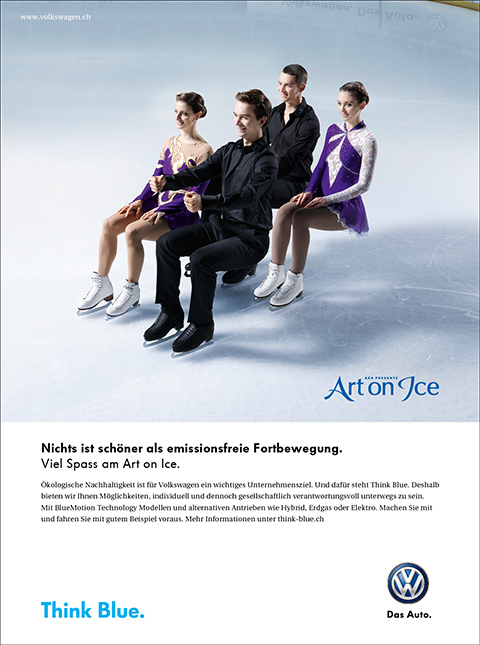
Volkswagen is a partner of Art on Ice. To further publicize this partnership, KSP has developed a motif.

According to the press release, it celebrates emission-free locomotion, which is just as much fun at the Art on Ice as it is in a Volkswagen. Volkswagen has just taken another big step in this direction with the E-Up! and soon the next ones will follow. The created subject shows four Art on Ice skaters driving together across the ice. Choreographed as drivers and passengers of a car. The motif will be used as part of Volkswagen's communication around the Art on Ice events throughout Switzerland.

Responsible at Volkswagen Switzerland: Sandra Grau (Head of Marketing VW PW), Nathalie Mösch (Head of Marketing Communications VW PW), Ivan Ammann (Project Assistant Event Marketing VW PW). Responsible at KSP Krieg Schlupp Partner: Samuel Knaus, Benny Goldstein (creative direction); Christian Stüdi, Mike Mateescu (text); Kevin Zysset (graphics); Rémy Müller, Franziska Saxer (consulting); Oliver Nanzig (photography); Alex Herzog, Red Department (image editing).

131126_VW_ARTONICE


Last but not least: Setting festive priorities

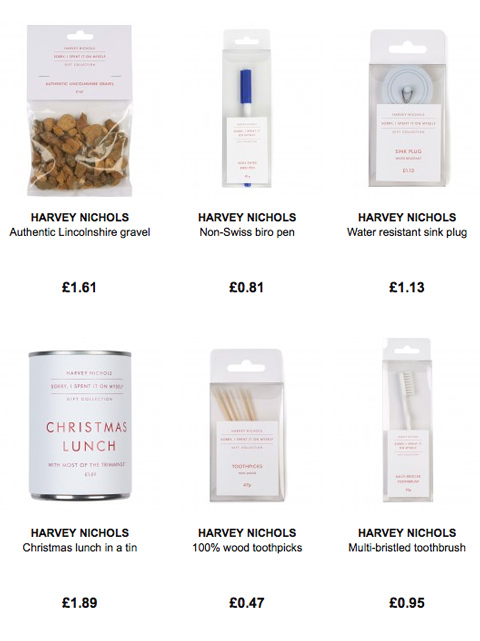
It really gets you in the Christmas spirit: The upscale department store chain Harvey Nichols has launched a particularly budget-friendly gift line so that generous gift-givers can keep more for themselves.

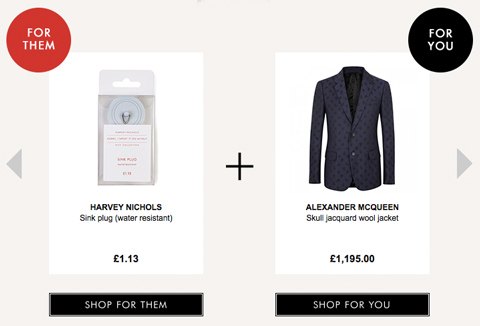
This is also bitterly necessary: the Harvey Harvey Nichols range is geared to an affluent clientele. Designer clothes, luxury accessories - happy those who budget and set priorities accordingly. The "Sorry, I Spent It On Myself" collection provides a remedy. So it can happen that this year there's only a pack of toothpicks for grandma or a (waterproof!) drain plug for uncle. Knowing that you were allowed to dig a little deeper into your own pocket for this, it's quite bearable.

sioms
The gifts are stylishly packaged and clearly recognizable as products of the expensive chain. So no one can really complain. And if you do, you don't look a gift horse in the mouth when the candlelight is festive. How practical! At the most, you have to put up with a somewhat strained atmosphere during the gift-giving ceremony: the mixture of foreign shame, disappointment, and a good face for a bad game is not everyone's cup of tea.

//www.youtube.com/watch?v=ITyeI3YyYw8

The campaign was penned by the agency Adam & Eve DDB London, started two days ago and met with great media interest in England. If you yourself are still looking for a suitable gift for your loved ones - from the heart - you will find under this link all items in the collection. The holidays can come! (hae)

sioms-2

Epica: Two more silver and four bronze awards

Werbewoche has already reported on the three gold winners (Leo Burnett Switzerland, Swissfilmmakers, and Who’s McQueen Pictures). The silver and bronze winners have now also been announced: Wirz, Ruf Lanz, Y&R Group, and Leo Burnett.

Of the total of 3997 entries, 138 had a Swiss sender. 13 Swiss agencies competed for the Epica Awards in Paris. After a sophisticated calculation procedure, the three Swiss gold winners (Werbewoche.ch reported), two silver and four bronze awards have now been added. Silver goes to Ruf Lanz for Delizio Coffee with the film "The Kiss" in the Drinks category, and Wirz Werbung with Marionnaud "Fragrance Pairs" in the B2B Direct category. Bronze is won by Leo Burnett Switzerland with the film "Program Guide" for Tele, Wirz for Christoffel Blindenmission (Media Innovation) and once again Wirz for Tibits "Natural Skylines" (Advertising Photorgaphy). Bronze was also awarded to the Y&R Group with the film "Nurse Merkel" for the Sonntagszeitung. More in the December 6 print edition of Werbewoche. (pan)
 

Coop Rechtsschutz launches customer magazine

The magazine *Core* is designed to provide customers of the insurance company Coop Rechtschutz with an entertaining look into the company, legal topics, and real-life cases.

The magazine, with its unusual format and appearance, aims to stand out from conventional insurance company customer magazines and thus give readers access to the various facets of the law. It provides insights into the inner workings of the company. Real legal cases are described in a striking way and commented on by lawyers, technical terms are explained in a simple way, and employees talk about what they particularly appreciate about their work. Of course, the CEO also has his say and reveals why the company is still called Coop, but is no longer Coop.

Core was developed and produced by the Baldinger & Baldinger agency and Die Magaziner. The advertising-free magazine is published once a year in two languages. The target audience is the partners and customers of Coop Rechtsschutz. The circulation is 10,000 copies. The magazine can be ordered at this link can be read online and downloaded in PDF format.

04_magazin_d

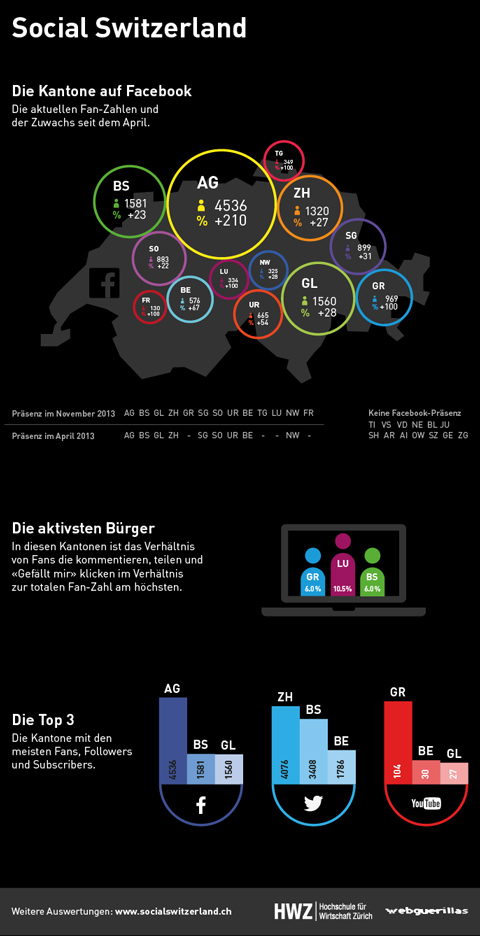
Aargau is the largest Facebook canton

Die Plattform «Social Switzerland», eine Kollaboration der Agentur Webguerillas und der Hochschule für Wirtschaft Zürich, zeigt: Der Kanton Aargau ist auf Facebook der beliebteste, Luzern der aktivste Kanton.

On August 11, 2010, Basel-Stadt launched its Facebook page, making it the first Swiss canton to have an official presence. In the meantime, the "Facebook confederation" comprises 13 cantons, and the trend is rising. While Swiss companies such as Swiss, Migros or Zweifel have more than 100,000 Facebook fans, the figures for the cantonal administrations are limited. For example, 4,536 Facebook users have marked the official website of the canton of Aargau with "Like", followed in second and third place by Basel-Stadt with 1,581 and Glarus with 1,560 fans. The most active Facebook citizens are recorded by the canton of Lucerne, where the ratio between the number of users interacting with updates on the canton's page and the total number of fans is the highest.

These figures are available on the platform of "Social Switzerland"a collaboration between the HWZ Hochschule für Wirtschaft Zürich and the Webguerillas advertising agency. In this current inventory of the social media presence of the Swiss cantons and capitals, the official presences of the administrations on Facebook, Twitter and YouTube are compared and evaluated. Since the launch of the platform in April this year, the "Facebook Confederation" has grown from nine to 13 cantons, according to the statement. On Twitter, 16 Swiss cantons are already present, while on YouTube there are only eight.

131127_web_800px_04

Teaser image: hae

Planet: QR codes put into shape

The Lucerne-based agency Planet has designed new types of QR codes for Gastroimpuls.

QR codes will make the breakthrough. Or will they? The advertising world doesn't agree, but the squares are becoming more and more common. How do you make QR codes look good? Planet thought ahead for Gastroimpuls, a company that sees itself as an impulse generator for the restaurant industry. The task was to link the innovations of Gastroimpuls with the variety offered and not to leave the previous advertising world of "gastronomy solutions for everywhere". Thus, for the first time, Planet modified QR codes and put them into shape. In various forms from the gastronomy sector. Knives, glass, pepper mill and more are now at the center of posters, flyers and advertisements and are directly linked to the appropriate promotions of the items shown.

Responsible at Gastroimpuls: Mario Hunkeler (CEO), Mark Buchecker (Member of the Executive Board). Responsible at Planet: Silvan Kaeser (creative direction), Reto Odermatt and Andreas Stebler (graphics), Beatrix Imhof (consulting).

Planet_Gastroimpuls_3Sujets-1
Planet_Gastroimpuls_3Sujets-2
Planet_Gastroimpuls_3Sujets-3
 

get_footer();