Miss Universal

The Zurich Press and Media Ball is getting a fresh start. Karina Berger and Thomas Russenberger, along with their event agency «Bookings by:,» are behind the relaunch. The modern concept aims to bring together the entire communications industry.

Unbenannt-14_13

The chance came at the last moment. In an interview with SonntagsBlick, a good conversation ensued at the end after the repeated similar questions about her experiences as a "Miss Mommy. The reporter wanted to know what else Karina Berger had up her sleeve. In the future, she and her husband Thomas Russenberger are planning to get more involved in the event business, said the former Miss Switzerland from 1988, Miss Globe International from 1989 and co-organizer of the Miss Switzerland pageant from 1993 to 2014. "The Zurich Press and Media Ball would be a suitable assignment for you. There is currently a call for tenders," the journalist knew. And Karina Berger was immediately interested. The problem, however: "The deadline for the pitch was the day after tomorrow. And we wanted to go on vacation the other day," says Karina Berger, describing this cinematic opening scene for the new Swiss "media night". They then got two days of "extra time," discussing the concept all the way in the car to their house in France, Karina at the wheel, Thomas on the laptop in the passenger seat. After two days in the pampas, they finally decided: "Look for Wi-Fi in the nearby village.
 
On May 10, the result of this pitch win can now be seen at the Kongresshaus. In its 83rd edition, the "Press & Media Ball" will become the new Swiss "Media Night" for the first time. Rainer Maria Salzgeber will guide through the evening. Pepe Lienhard and DJ Luca will ask for a dance. Luck can be tickled with the Swiss Casino Zurich. Likewise with a tombola "with tempting and great prices". The really big prize, however, is promised this year for the first time by the presentation of the "MedienStar" award.

Illustrious names in the committee and jury

Proposals for the award of an "outstanding personality from the Swiss media scene" could be submitted on the platform www.mediennacht.ch. A selected committee acts as the honorary committee. A select committee serves as the honorary committee, on which the current publisher president Hanspeter Lebrument sits as well as Hans Heinrich Coninx as honorary president, Nadja Schildknecht from the Zurich Film Festival, Hans E. Schweickardt, Pietro Supino and Pierin Vincenz. The patronage around Christoph Richterich as president, Franca Siegfried as representative of the ZPV, Dominique Morel, the new president of the Harbour Club, Christian Wick as president of the Zurich Public Relations Society as well as further personalities like Roger Baur as managing director IAB as well as Thomas Russenberger will then determine the "MedienStar" as jury. A glamorous award ceremony is to enrich the renowned ball with a new tradition. At the same time, Berger and Russenberger want to give the event "a contemporary touch" with other new elements. The most important innovation in this departure: in addition to the Zurich Press Association as initiator, the Zurich Public Relations Society, the Chief Communications Officers from the Harbour Club, IAB from the digital world and News Aktuell from the SDA are also partners in the new concept. "We thought about: What is media? It used to be print. Today it's a whole big fan that you can open up with various platforms of communication. Everything is intertwined, and that's why we wanted to go further for the Media Ball," says Karina Berger, explaining the concept behind the relaunch. Next year, she also wants to bring advertisers onto the committee. "Initial talks are already underway."

With the opening of the ball, the previous location at the Dolder Grand has also become too small. In Zurich's Kongresshaus, there is enough space for the expected 600 guests. "Most of the seats are sold out. But there are still a few tickets left," Berger is pleased to report. In the "stroller" category, a deliberate downward price adjustment has been made. "Here we also see growth potential for the coming years." The move to the Kongresshaus was preceded by in-depth research including interviews with previous ball guests. Otherwise, Karina Berger and Thomas Russenberger see it as an advantage that they have never attended this tradition-rich ball themselves. "That gave us more freedom when planning."

History repeats itself

With the goal of being able to insert the "Media Night" into the series of "most popular gala events", Karina Berger and Thomas Russenberger have found the ideal project to promote their event agency "Bookings by:" in a desired direction. Until now, the company has mostly been perceived in the shadow of Miss Switzerland, although Karina Berger has been in the market for more than ten years with her otherwise specialized event agency.

Regular clients include the annual "The Swiss Hairdressing Award", major events were the opening of the new Leder Locher, restaurants such as Lys Assia at the Prime Tower, various fashion shows or a charity event at Kaufleuten with sponsor Jelmoli in favor of children with Down syndrome. Another "really big box" was the completely redesigned Miss Switzerland pageant last summer at the Hallenstadion. "That came from the pen of "Bookings by:"," Karina Berger looks back with pride. And this "look back" goes a little deeper.

"Twenty years will have to do. We have more than succeeded in relaunching the election. Now I want to put the organization in new hands," the mother of the Misses reasons. Because the concept of the new owners with investor Guido Fluri "has progressed faster than expected" and Miss 2014 is already to appear with a changed image, "our task is already over," says Karina Berger, explaining why she only wants to be a spectator at the pageants in the future. She also handed over the marketing of the beautiful and popular ambassadors to a booker ten years ago. Nevertheless, she remained friends with most of the Misses. Even the current Miss Switzerland, Dominique Rinderknecht, regularly asks her "mentor" for advice. At the media night, the communications student will act as a short-haired fairy godmother at the raffle.

"It repeats itself with me that I like to take old things and make something new out of them," muses Karina Berger around these developments. That is the case now with the old press ball, she says. It was the case with the realignment of Miss Switzerland in 2012, and it was already the theme when Karina Berger joined the pageant as co-organizer in 1993. The ex-Miss, who had already been a successful model for five years since her election, became pregnant that year. Her model agency in Zurich at the time had a shortage of bookers at the same time. So Berger stepped in. "I was attracted to the job. During pregnancy, it was a good alternative to not just sitting around at home." Then chance would have it that after three months the Miss Switzerland organization was sold to a new owner. "Christoph Locher was a good acquaintance of mine. He asked me if I wanted to join. After all, with the child, I couldn't go around the world as a model all the time."

Those around her reacted skeptically to the proposal. "Many of my friends were advertisers and photographers. They didn't know what to do with the misses of the time." For Karina Berger, too, the girls looked far too much like "Barbie dolls. She therefore knew: "I have to bring the Missen more into the model look, then we also have a chance of being noticed by the advertising agencies. Which in turn helps to get to the sponsors afterwards. That was the goal." The "makeover" started with little things. Instead of the beauticians from the department store that sponsored the makeover, well-known makeup artists from the fashion business were brought in. "They did makeup in a completely different way. " In the future, Coiffure Valentino, who radically cut off many curls and old braids, took care of the hairstyles. Even the dresses were no longer simply taken over by the sponsor, but selected by a stylist. "This has given the competition a much younger look, fresher and more modern."

As a result of the increased awareness, television got involved in 1995. At first, only the French channel, "because they saw in Geneva what high ratings could be achieved with the Miss France contest. Then, for the election of Melanie Winiger in 1996, all SRG channels were live. In 2012, there was an artistic pause. In 2013, the election was broadcast by Sat.1. Media, sponsors and advertising soon gave the new princesses of Switzerland a joyful welcome and paid them princely wages. "More than a Federal Councillor" has since been earned by public favorites such as Mahara McKay, Fiona Hefti and Christa Rigozzi. "What's exciting for the public is that we've offered the media a new face every year, with a new story and a new starting point. That's also interesting for the sponsors, because they can always start over under the same cover of Miss Switzerland with a fresh wind and a new testimonial that is nevertheless recognized by the public."

Learning by Watching

In Karina Berger's day, the hype was still pretty modest. The fact that she also became "Miss Globe International" in 1989 was almost not noticed in the Swiss press. "For me, however, it was still worth it." In Los Angeles, the most beautiful Swiss woman was invited to the TV show "Star Search." From this casting show with the largest audience rating in the U.S., greats such as Whitney Houston and later Beyoncé or Britney Spears have already emerged. "Fortunately, I never saw my performance," Karina Berger can laugh today about her brief chance to become a world star. "My English was still terrible back then." And anyway. "Actress was never my thing." She also turned down an offer for a production at Zurich's Bernhard Theater, although in retrospect the experience might have been "a fun addition to the resume."

Thanks to the Miss Switzerland title, however, she was also allowed to travel to the Miss Universe and Miss World pageants, "which was a very exciting experience. In addition, there were modeling jobs and photo trips all over the world, with which Karina Berger was "able to live well" for more than five years. A side effect she cleverly used: "When waiting for hours in makeup or on the set, I followed everyone's work very closely." Thus, with "learning by watching," Miss has become a very well-trained event professional. The future clients of her agency "Bookings by:" will appreciate the details.

Andreas Panzeri

Snackable content for small screens

The shift in media consumption toward small smartphone screens is influencing communication. Large-scale campaigns are being replaced by many small micro-campaigns.

New technologies require new content. Large campaigns on small screens - that fits less and less. Many small micro-campaigns are taking their place. This change means a change of pace that challenges everyone. Steve Jobs said in 1997: "In the course of my career, I've realized that the best people are the ones who know about content. And get on your nerves. You put up with them because they're great at content. That's how good products are created. Not through processes. Through content." The success of campaigns therefore depends first and foremost on the quality of the content and the talent of its creators. Three aspects of quality are paramount: social web content must be searchable - in other words, it must be as easy as possible for the user to find. This is because the average web user consults 10.4 online sources on their way to the final purchase decision and starts with a search query in 85 percent of cases.

Searchable content is about the ability to pack in-depth knowledge about behaviors, needs and sensitivities into a story and reach the user at the decisive moment, the so-called pain point. Social web content must be shareable - in other words, it must be of value to the user in terms of being disseminated and shared with other users as easily as possible. After all, shareability is what turns web content into social web content. The competition for content is huge: Facebook alone records 2.7 billion likes every day. And every second website now offers tools for sharing content via social media platforms. The risk of getting lost in the noise is even greater than it is when using traditional broadcast media.

Short attention span requires new recipes

Social web content must be snackable - in other words, it must be consumed as quickly as possible by the user. Snackable content is essential if we want to have any chance at all of bringing ourselves into play as a solution provider for users scrolling past in a hurry. After all, the average attention span that the adult user grants us per snack unit is just 8 seconds. This is due to the total shift of media consumption to small smartphone screens. The social media mobile craze in figures: according to a ComScore study, 98% of all Instagram, 92% of all Pinterest, 86% of all Twitter and 68% of all Facebook accesses now take place via mobile devices. The only exception among the major networks is the business and recruitment network LinkedIn. According to the latest IAB figures, mobile's share of the global online advertising pie has risen from 9 percent (2012) to 17 percent (2013). This is the third highest behind search ads (43 %) and display ads (30 %). According to eMarketer, Google and Facebook dominate within mobile spending, with Google's share shrinking (52.6 % in 2012 vs. 46.8 % in 2014) and Facebook's share increasing (5.4 % vs. 21.7 %). Conclusion: Marketers and their advertisers finally seem to be serious about following the user and are increasingly investing in forms of advertising tailored to small mobile screens and in dynamic social media news feeds. Advertising in small spaces with short attention spans requires new recipes. I call them snack recipes. Let me serve you three of them: Snack recipe adcompression. The TV commercial is still the highest of all advertising sensations.
 
The good news: creative moving image stories also perform well in the new mobile social environment. The bad news: the classic 30-second spot is going to the skip collar. Rumors are circulating about apocalyptic click-through rates. In its neuroscientific study "Making Advertising more of a Science than Art", Nielsen, the leading American moving image marketer, had 70 identical commercials of different lengths tested. The result: in 95 percent of cases, the shortened spots achieved the same or better impact values. Three parameters were measured. Firstly, whether a stimulus met with emotional approval or rejection. Secondly, the extent to which the willingness to remember can be aroused. And thirdly, the attention span at which emotionality and memory occur. Conclusion: brevity is the spice of effectiveness. Endless videos are currently taking the social web by storm. They are recorded directly via a smartphone app and last between two and five seconds. With the Vine app from Twitter, such an endless video can be shot and uploaded in less than a minute. The absolute hit, however, are gifs (Graphic Interchange Format). Several individual images are saved in a file and played as a short animation - a kind of flip book for the social web. There are no limits to creativity. The decisive factor is the quality of the mini-story. Funny entertainment content performs best. But you can also teach users very practical things: Children how to brush their teeth, men how to tie a tie and women how to apply eye shadow.

Tweetability: Twitter cards and newsjacking open up new possibilities

Snack recipe Tweetability. With its 140-character message approach, the short message service Twitter is a driving force when it comes to the development of new short advertising content. We have slowly become accustomed to Vine videos. Now come the Twitter Cards. It is a continuation of the responsive design principle from mobile-responsive to social-responsive. Content from your own web environment can be automatically displayed in tweets in an abbreviated form in real time with little effort. There are various cards. The Gallery Card enables the display of photo galleries, and with the help of the Product Card, every Twitter channel becomes a starting point for sales. This is because the Product Card is designed to display the image, 140-character short description, price and availability of an offer directly from the website in the compactness of a tweet. Twitter cards further increase the importance of social media within the marketing mix. Offers can be taken up more quickly in this snackable form, distributed more easily and at the end the link in the tweet leads to your own website. Provided that the content is designed to be snackable on the website from the outset.

Newsjacking snack recipe. The joy of snacking and announcing news seems to be something we humans were born with. After all, we are social creatures. Brevity is part of the program, as is a certain sensationalism. Accordingly, the often somewhat detailed 0815 news from PR departments usually gets stuck in the newsfeed of the first recipients. One way to brighten up the gray news routine of companies is newsjacking. We inject our own content with news that is making waves on Twitter, Facebook or Reddit. My favorite example - news: "Paris Hilton arrested for cocaine possession." Newsjacking content from a hotel chain: "Paris Hilton banned from Wynn Hotels Las Vegas." Newsjacking requires two things, and both are generally essential for digestible social media advertising: Firstly, open eyes and hearts for the true interests, needs and sensitivities of your own stakeholders. Secondly, quick-wittedness with a little pinch of mischief. Fancy a snack? My tip: if in doubt, popcorn instead of potato chips ;). I look forward to lots of snackables from your practice on my blog www.huerlimanncc.com.
 
Beat Hürlimann

Connected TV: Linear TV is the trump card

Smart TVs are on the rise. They offer a wide range of functions that go beyond the normal TV experience. However, the use of these applications is lagging behind their technical spread.

This is confirmed by a new study conducted by the market researchers at Facit Digital on behalf of the German state media authorities. It shows that connected TV users also use their TV primarily to watch traditional linear TV. Features such as video-on-demand or other apps are used rather rarely and, above all, only selectively. To better understand the behavior of Connected TV users, an ethnographic study was conducted with 25 consumers who own and actually use an Internet-connected TV. The study participants were visited in their own homes to observe their everyday TV use. They were also asked to perform various tasks on the TV, such as searching for the evening program of a TV station, watching last week's "Tatort," selecting a paid movie, or finding current news from the region. Meanwhile, the subjects' behavior and navigation were analyzed. Specific services such as EPG or media libraries were then specifically discussed.

The study makes it clear that traditional linear TV is also extremely important for the Connected TV users surveyed. Simply switching on the TV set, searching for a program using the EPG or, if necessary, zapping through the channels and enjoying the "normal" TV program is an integral part of their everyday use. This preference for the classic TV offering is also a key reason why many consumers own a Connected TV, but often ignore apps and other smart functions. For most consumers, the motto remains: linear TV is the trump card.

The study shows that alternatives to traditional TV - such as accessing paid content or watching their own recordings - are often only considered when consumers cannot find any interesting linear programming on offer. If the TV set is switched on to watch non-linear content, this is often in the context of planned movie nights with family or friends - Connected TV functions such as video-on-demand or own recordings replace the DVD here. The possibilities offered by Connected TV are also appreciated by "series junkies": They enjoy being able to watch episodes at flexible times. With regard to the various functions offered by Connected TV, time shifting is popular. Interestingly, however, it is used less to archive programs and more to make the TV experience more flexible - i.e., to adjust the start time, take breaks or fast-forward. EPGs have also clearly established themselves and are used as a matter of course to find out about the program. It has already become clear that video-on-demand services are also well received by users as a supplement to linear TV. But not all the functions offered by Connected TV are equally popular. For example, social network apps were not used on TV by any of the study participants.

The Internet browser for surfing on the TV set is also considered irrelevant in view of the fact that smartphones or tablets are always within reach and at the same time offer significantly more Internet convenience. A very clear division of labor between the smart TV and the second screen has already emerged in the everyday lives of the study participants: The TV is primarily used for watching TV and for video applications such as video-on-demand, while the tablet and smartphone are used for accompanying tasks, such as researching movies, looking for more detailed information about the TV program or exchanging information with others in social networks.  
 
Clemens Koob

Key Facts

- Connected TV users also use their smart TVs primarily to watch classic linear TV. - Non-linear content is used more as a "backup" when there is no interesting TV program and for specific movie nights with family or friends. They are also popular with series junkies'
- Established functions of Connected TV are time shifting and EPG.
- Smart TV apps that offer moving image content are popular, while other TV apps such as the Internet browser or social media apps are less relevant.
- Their functions are taken over by the second screen - smartphones, tablets and laptops have become established, especially for research and exchanges with others.

Smartphone as style advisor

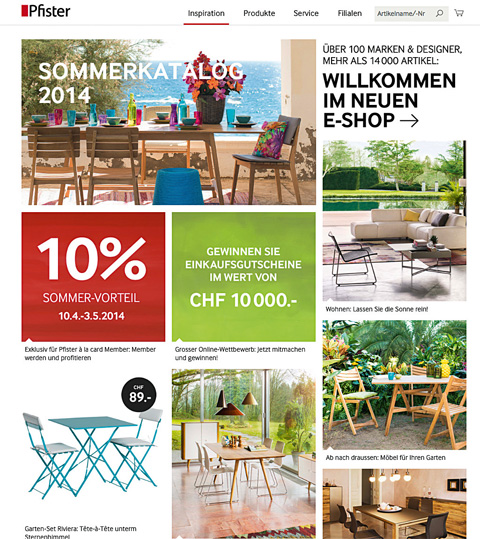
Möbel Pfister has completely revamped its website and, with 14,000 products available, is Switzerland’s largest online retailer in the home furnishings sector. An interview with CMO Carlos Friedrich. 

Unbenannt-1_20
 
WW: You have just come from Milan from the furniture fair. What new things have you seen?
Carlos Friedrich: Trends in furnishings are always difficult to predict. What we can definitely say is that the retro trend is not over yet. There are interesting innovations in glass and marble. In addition, the Scandinavian style is still very much in vogue.
 
Which designers does Möbel Pfister refer to?
We also buy in Milan, our buyers are still at the fair. There it is about textiles and furnishings. But we also have ourselves manufactured and partly we buy directly.
 
Do you also employ your own designers who are looking for a specific "Pfister look"?
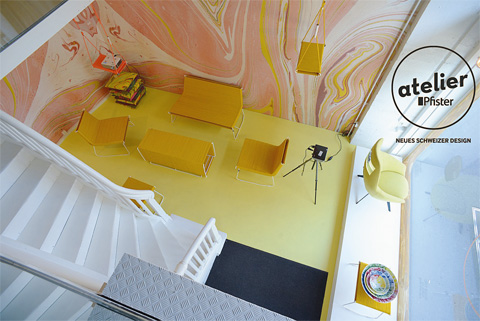
That's what we do with our "Atelier Pfister" line. Young Swiss designers get their chance there. They design furniture and objects on our behalf. For example, Atelier Oï, Claudia Caviezel, This Weber. The project is curated by Alfredo Häberli. He helps us not only design products with these young designers, but actually make them. This is our contribution to the new Swiss interior design.
 
Are customers currently in a good buying mood to refurnish their homes?
The furnishings market is saturated. Demographically, Switzerland is not growing as fast as other countries. But consumer sentiment is positive. In general, it can be said that beautifying one's home is still an important need. And we are trying to inspire more and more people that it is important to feel at home.
 
You were responsible for marketing at Ikea in a rather young furniture store and now at Pfister. Surely not a coincidence. To what extent is "rejuvenation" your task?
Not a rejuvenation. Of course I would like to be able to attract more young people to Pfister, that's true. But the Pfister brand is a traditional brand that stands for quality and service. I certainly won't change that, together with all the partners I have. It's about putting Pfister in the right light and showing that we are a modern and innovative company.
 
How do you experience the market conditions?
In terms of sales, we are number 2 with around 610 million. Ikea is ahead of us in terms of sales. No one comes after us for a relatively long time. Then other competitors with significantly lower sales.
 
Online business is currently causing a stir in the market. Since when has this been an issue for furniture?
It's been interesting for a while. But the question is: What is online? We are just learning that online is more than just an information channel. Pfister has had a website since 1996, and we've been operating a web store since 2007. At that time, Pfister started with 3000 products. Since 2010 we have increased to 10,000 and now we present 14,000 products on our portal. At the same time as the relaunch, we also introduced a responsive design, i.e. one that adapts to all devices.
 
For many couples, shopping together is part of the ritual. Online can't offer that.
That's where you're wrong. Visiting the store is still a very important pillar. When you spend several hundred francs, you also want to be able to touch, feel and compare something. But you can also compare online. At least visually. The prices even easier. You can also see what material properties a chair has. A couple can sit together in front of the screen. You can also make lists and then look at the selected objects in detail in the store.
 
Last year, Pfister doubled its online sales and you have the same goal again for 2014. What can the new website contribute to this?
With the renewal of the website and the further development of the e-commerce channel, the cross-channel strategy is consistently implemented. We worked on this project for several months. It is above all the intuitive and the inspirational that we are trying to present simply. Depending on their preferences, users should be able to decide whether they want to find something relatively quickly or whether they prefer to be inspired. If he is specifically looking for a chair, he should quickly be presented with a selection of chairs. Who wants to be inspired more and look, what there is in the living room so, gets presented on the platform corresponding images with an inspirational pre-selection of the most diverse furnishings. We live today in a society with very many possibilities. Whoever types in "chair" on Google today will find over a million hits. Everyone is overwhelmed. That's where we as the Pfister brand want to provide orientation and communicate our competencies - among other things, by showing which styles go together.
 
Are there comparable models abroad for Pfister's new website or is this a pioneering achievement?
We are relatively far along on the online side. In the furnishings sector, I don't know of anyone who has gone so far and is trying to link several channels. But it has to be said that there are pure online players who are certainly further along in this area. But they only operate in the online channel. What we are looking for is a deliberate combination of different channels. If someone visits the "mattresses" section online, they are automatically invited to make an appointment for a mattress consultation at the nearest Pfister store.

Buying clothes online is likely to become the norm. Will that come to furniture as well?
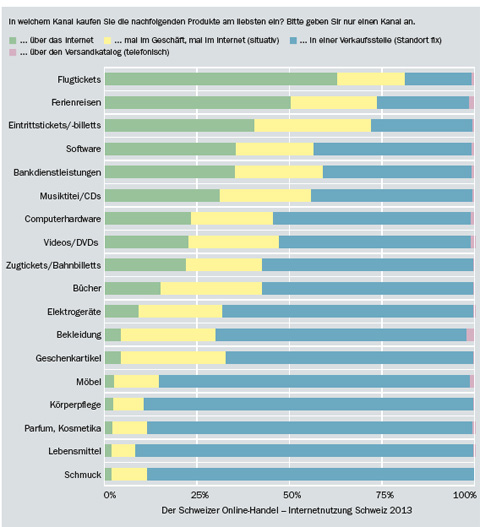
I am convinced that the furniture online market will continue to grow. It is already growing at double-digit or even triple-digit rates, but at a low level at the moment. In my view, however, it will not become any bigger than bricks-and-mortar retail in the furniture sector. The online channel is primarily inspiration and information in the furnishing sector. If you compare it with the fashion business, there is another crucial difference. A blouse can easily be ordered in three colors or different sizes, tried on and returned if necessary. You don't have a wardrobe delivered and assembled twice. That's why trust in the brand is so important in the furnishing sector.
 
How does your online business work logistically?
That is one of our core strengths. Pfister has been doing this for many years. We have our own logistics team with several hundred employees. 160 vehicles that fan out every morning. In each case the driver together with a specialist, so that the furniture can also be assembled. That is a decisive point of differentiation from other competitors. Many delegate this to outside companies and these logistics companies usually only deliver to the front door. Then the customer has to carry the cabinet up to the third floor and assemble it himself.

Unbenannt-4_28
Just launched: Möbel Pfister's new portal with a cleverly functioning online store.

 What will the relationship between stores and online be like in the future?
Today, people talk about the online sector accounting for 1 to 5 percent of the total furnishings market. That is relatively low. Other experts believe that up to 20 percent of the furniture market will be generated online in the future. I am convinced that it will grow. But in the long term, brick-and-mortar retail will still be the mainstay. Especially when it comes to the big things.
 
Will Pfister open more stores?
We have been in Switzerland for over 133 years. We have 20 brick-and-mortar stores and just recently reopened and modernized our 21st and largest store with our webshop. Every customer in Switzerland can reach the physical Pfister stores within 30 minutes.
 
On Rämistrasse in Zurich, there is an "Atelier Pfister" as a pop-up store. An experiment?
The idea of "pop up" means that a store disappears again. "Atelier Pfister" is our avant-garde and young line. Where you can also test what works. For many decades we were only dealers. With Atelier Pfister we are learning to become manufacturers as well.

Unbenannt-2_24
 
What accompanying measures will be used to communicate the offensive with the new online store?
We will promote the new web presence in the first phase by investing more in the online area. We are investing more in digital marketing than in previous years. Digital communication means search engine marketing and SEO marketing. We do this with partners, in digital marketing together with Webrepublic.
 
Is there also a classic campaign?
We work with various agencies when it comes to external communication. For catalogs, we do this with Strebel Juon and rentahess, and we buy other services from independent creatives.
 
How important are catalogs in a digital age?
As a marketing manager, you are always responsible for where investments are made. We try to make our media measurable. For that, we have the ROAS. With that, we analyze advertising spend and measure it for impact. We know what we have in the till on a given day after advertising. The media are planned accordingly. Our four catalogs per year enjoy a very high return on advertising. In other words, the catalog remains an important medium. At the brand level, moving images are particularly well suited for image because they can arouse emotions. For product communication, print measures with several pages are suitable because you can send more information than normally just a poster with one idea. For action communication, media that can be produced relatively quickly and inexpensively are suitable. For us, radio is one of the most suitable media. Basically, we always have to ask critically: Which channels do we invest in during the pre-purchase phase, the purchase phase and the post-purchase phase?
 
Is there a great synergy between catalog and online?
Yes, we try to do that. For us, the catalog is the source. It indirectly controls our range. We work there with our teams to be seasonally relevant. Because we have the privilege of selling over 10,000 products that can be touched, we actually have more of a problem: we have too many products for our advertising. So Pfister has to try to generate styles and shape styles. We do this by also trying to set seasonal themes. We present these with the four catalog issues and then, of course, digitally .
 
You've been with Möbel Pfister for four years. How far have you come with your goals?
We are still on the journey. We are moving the Pfister brand. The online approach with cross-channel communication and cross-channel marketing is in its infancy. The field is being rewritten and we get to be a part of it because we are a multi-channel provider and we are trying to connect these channels. To rejuvenate the brand and find younger target groups, online is of course also an important channel for this.
 
How do you distinguish yourself in the market?
As the Pfister brand, we stand for quality and service. Service includes competent advice and also quality products. In the long term, this is a strength of Pfister that will become even more important. Switzerland is getting older, we have more and more smaller households and prosperity remains high by international standards, and more and more people have less time. That speaks for brands that are service-oriented, but also innovative.
 
Are there online-only retailers in the furniture market?
Home24 has been in Switzerland for a few weeks, Beliani has been around for three years. Zalando's investors are indirectly involved in Westwing and Home24. Zalando has changed the fashion market in Switzerland. I'm curious to see whether Home24 or other pure online players can move the market in Switzerland. The interesting thing is that pure online players are now going the other way. The online provider "fashion for home" has now opened its first stationary stores, for example in Munich. However, they still have to learn how to do stationary merchandising, just as we still have to learn how to sell better online.
 
 Where do you see construction sites?
We have only just begun the journey into digital. Digitization is not that easy because you have several interfaces. It's like building a house, there are also several craftsmen involved. In digitization, we have the web agency that programs and designs, an information management system, plus internal IT, networks and digital communication measures. Bringing all this together on one portal and linking it to other channels is a challenge. Before, it was the cross-media journey. Now it's the cross-channel journey. Advertising tries to connect cross-media. Now we're trying to connect cross-media and also sell.
 
What are your target groups?
Women's perceptions are different from those of men. Men focus more, women like to have the ambience. But there is still little advertising research that shows how women really work. So we've developed a few approaches ourselves. "Images are shots to the brain ", according to Professor Kroeber-Riel. We take that into account in store design. Here we know that women not only react more emotionally, but also perceive more holistically than we men do. The impulse giver for a purchase in the furniture store is the woman. Often, it is also she who clearly decides what to buy.
 
That's why a clever car dealer wanted to put up posters on vacation islands.
A good idea. We will show our presence at the airport and also on the plane, because: When do you have time? Around flying, e-commerce is a wonderful tool. You take these gadgets with you, smartphones and tablets. And then you order something on the way, so you can look forward to coming home again.
 
What are other ideas for the future? Developing means learning. Shortly after I joined, we launched the "Atelier Pfister" app with augmented reality almost four years ago. You could click on a piece of furniture and project it into a photo of your living room. You could change the colors of the sofa, move it across the room. The app isn't perfect, nor is it as in demand as we'd hoped. But it's a gimmick that underscores our role in setting the trends. We only do that for "Atelier Pfister." It would be too expensive for all products. We were a bit too early. But the gimmick gives an image. It shows: We are moving.
 
Interview: Andreas Panzeri

Unbenannt-5_33

On our own behalf: Advertising week during the Easter break

Werbewoche is also there for you during the Easter break: the current print edition is already available to our subscribers as an e-paper.

The next Werbewoche-Newsmail will be published next Tuesday, April 22, 2014. News from the media and communications industry can be found on Advertisingweek.ch again from Easter Monday, March 21.

The editorial team wishes you a happy Easter and good luck in your egg hunt.

ostereier
Photos: hae

Rivella: Andrys Aardema becomes Head of Marketing

Swiss beverage manufacturer Rivella has announced a new addition to its executive management team: Andrys Aardema was appointed the new Head of Marketing for Switzerland, effective April 1, 2014.

The 38-year-old Andrys Aardema is a dual Swiss-Dutch citizen and studied economics at the University of Zurich. He then worked for three years as a consultant for an international consulting company in the field of customer relationship management. In 2005, Andrys Aardema switched to the beverage industry, where he worked for Coca-Cola in various marketing functions until 2013. He held positions in innovation, brand and trade marketing and was most recently Head of Marketing in Vienna.

In Andrys Aardema, Rivella has succeeded in recruiting a proven marketing professional with international industry experience for this strategically important position. Andrys Aardema succeeds Cornelia Marending, who left the company in September 2013.

Publisuisse publishes final figures

Publisuisse announces the final figures for the 2013 financial year. The net profit after tax amounts to approximately two million Swiss francs. Milena Folletti and Beat Grossenbacher were elected as new members of the Board of Directors.

Publisuisse closed the 2013 financial year with net sales of CHF 324 million, as the company announced at the Annual General Meeting on April 16, 2014. Net sales in 2013 comprise CHF 285 million from classic TV advertising (-3 percent year-on-year) and CHF 39 million from other business areas (TV and radio sponsorship and cross-media). According to the statement, the lack of viewers in the first half of the year was responsible for the decline in advertising revenues. Despite a significant increase in sales in the second half of the year, Publisuisse was no longer able to compensate for the financial losses.

The year 2014 is developing positively for Publisuisse: The booking level in the first semester is higher than in the previous year. "One reason for this is certainly the two major sporting events, the Olympics in Sochi and the World Cup in Brazil," says Martin Schneider. "SRG SSR stations are also offering many other programming highlights and new, innovative formats that are enjoying very good demand from both audiences and advertisers," the Publisuisse director continues.

Dino Balestra will step down from the Board of Directors at the end of May 2014, and Daniel Jorio at the end of June 2014. The General Meeting elected Milena Folletti, Head of Programming and Design Radiotelevisione svizzera, and Beat Grossenbacher, designated Director of Finance and Controlling SRG SSR, to the Board of Directors of publisuisse for the remaining term of two years. Milena Folletti will assume the mandate as of June 1, 2014, and Beat Grossenbacher as of July 1, 2014.

Further information on publisuisse's financial year can be found in the Annual Report. The 2013 Annual Report can be downloaded from the Website can be ordered or downloaded from publisuisse.

As of July 2014, the Board of Directors of Publisuisse is composed as follows:

President: Gilles Marchand, Radio Télévision Suisse, Genève
Vice President: Paul Nyffeler, Univest, Basel

Members:
Roger Basler, Franke Washroom Systems, Aarburg
Milena Folletti, Radiotelevisione svizzera, Lugano
Beat Grossenbacher, Finance & Controlling GD SRG SSR, Berne
Nico Issenmann, Issenmann Consulting, Männedorf
Rudolf Matter, Swiss Radio and Television, Zurich

DAB+: 15 new stations in western Switzerland

In French-speaking Switzerland, 15 additional radio stations can now be received digitally via DAB+. Thirteen private radio stations and two SRG stations are benefiting from the new technology. Until now, only the stations of the French-speaking Swiss radio network RTS were available via DAB+.

Of a total of 22 broadcasting stations, 19 were put into operation on Wednesday, announced Romandie Médias, which represents the private radio stations of Western Switzerland, SRG and Swisscom Broadcast. From the Jura to the Valais, Rhône FM, Radio Chablais, LFM, One FM, Rouge FM, Yes FM, Radio Fribourg, RJB, RTN, RFJ and GRRIF as well as the two new stations Vertical Radio and Radiofr.music can now be received.In addition, the two SRG programs Rete Tre from Ticino and SRF 4 News from German-speaking Switzerland are now broadcast via DAB+. (SDA)

Last but not least: Food Porn for advanced

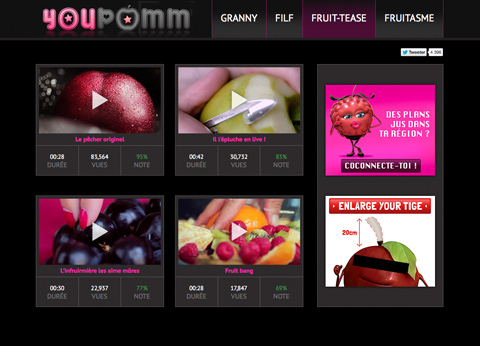
The beverage manufacturer Oasis is launching «Youpomm,» the first porn site for fruits.

The love it humans to the apple has a long tradition. Even Eve accepted the threat of being banned from paradise by consuming the forbidden apple. Later, the English declared the fruit to be a miracle cure for health ("An apple a day keeps the doctor away"). The Beatles, Steve Jobs... all apple fans. The French beverage manufacturer Oasis is now going one step further and launching with Youpomm - in reference to the French word for apple - the first porn portal for fruits and thus promotes its fruit juices. It is nothing less than a thoroughly fruity copy of Youporn, the YouTube of smut films.

Bildschirmfoto-2014-04-16-um-18.10.48

The porn parody created by the French agency Marcel not only looks like the great role model, but also offers "food porn" down to the last detail. If this term was previously understood to mean something else - namely photos of particularly fine-looking food spread on social networks - here it is taken literally. Sensual scenes between man and fruit - underlaid with appropriate genre music and moans. And even the frowned-upon advertising banners of dodgy dating portals have been adapted into the world of fruit ("Des plans jus dans ta region?"). The world of adult porn sites is richer by one attraction. Hot Malm, the portal for disreputable photos of the Ikea Malm bed, has found a worthy successor in Youpomm. (hae)

//www.youtube.com/watch?v=IVHmMTlJ8pg

Frontal: New department, new heads

The Frontal agency in Willisau creates brands, websites and now also content. The web and design agency from Central Switzerland now has a communications department.

Three new employees are joining the 21-strong team in time for the agency's tenth anniversary: Jens Krause (Head of Communications with extensive experience in online communication and project management), Stephanie Günzler (trained journalist, editor and social media manager) and Paula Büeler (specializing in web copy, search engine optimization and content marketing). "Many clients for whom we have created a new website, annual report or brand design are also dependent on professional support when it comes to content," says René Häfliger, Head of Online and agency co-owner. "We can now offer everything from a single source and there is one less interface for the customer." More: www.frontal.ch

FRONTAL-AGENTUR-KOMMUNIKATION_low-2
The new Frontal communications team (from left to right): Paula Büeler, Stephanie Günzler and Jens Krause.
 

Children see fewer food TV commercials

In 2013, approximately 99 percent of the commercials produced by Swiss Pledge members met the criteria of the voluntary code of conduct. Member companies also achieved good results for advertisements in children’s magazines and on brand websites.

The self-pledge aims to restrict the company's own advertising behavior towards children under twelve if defined criteria are not met. Swiss Pledge commissioned the market research company Media Focus with monitoring. All advertising placements were analyzed for compliance with the minimum criteria. In 2013, over 114,000 TV commercials were checked. Of these, 98.7 percent of the TV spots met the criteria of the voluntary commitment. Children's magazines were also reviewed throughout the year. The monitoring covered 83 issues; only two magazines featured an ad that did not comply with the rules, which corresponds to a value of 97.6 percent correct ads. Of the 39 member company brand websites reviewed, 87.2 percent complied with Swiss Pledge requirements, according to the release.

Katja Funk, Media Focus: "Swiss Pledge was met with good results in 2013. By adhering to the voluntary commitment, member companies are committing to responsible advertising practices towards children under the age of 12." Since the launch of Swiss Pledge in 2010, membership has doubled. Today, 13 national and international food manufacturers and foodservice companies are committed to the voluntary initiative. They are: Coca-Cola, Coop, Danone, Intersnack, Kellogg, Mondelēz, Mars, McDonald's, Nestlé, Pepsi, Procter & Gamble*, Unilever and Zweifel Pomy-Chips. The initiative is open to other market participants who commit to meeting the minimum criteria.

Swiss Pledge was positively evaluated in 2011 by the Federal Office of Public Health as part of the national health initiative actionsanté, and is the only program in Europe to date that has been accepted by a national authority.

werbung-kinder


Good marks for Swiss online stores

Categories

Uncategorized
get_footer();