The hardest currency in the (media) world

The slow rollout of a new television ratings system in Switzerland has led to widespread uncertainty about the value of the new TV metrics. From a cross-media perspective, however, it is clear that even under the new measurement system, television remains the most reliable metric in the Swiss media landscape.

Dr. Mirko Marr is Head of Research at Goldbach Media. The research specialist specializing in media distribution, media use and media and advertising impact has held leading positions at Mediapulse, IAB Switzerland, Publicitas and the Institute for Applied Communication Research in Zurich, among others.

A whole range of criteria can be used to assess the hardness of a media currency. For advertising clients and their agencies, however, this judgment depends above all on one question: What is the relationship between the contacts measured by a media currency on the one hand and the contacts actually realized on the other?

Print currency

As part of its survey program, WEMF's joint readership research determines the probability of an individual issue of a print title being read. In the advertising market, this advertising medium contact is regarded as a proxy for the probability of contact with all advertisements placed in the title issue. This equation is based on the implicit assumption of an ideal reader who reads all pages of a print edition and thus comes into contact with all advertisements. The deviation of the real reader from this ideal results in a blurring that can be described as the fundamental deficit of conventional print research, which has not been eliminated even by the recent conversion of the MACH studies. With reference to the fundamental question formulated above, it must therefore be assumed for the print currency, firstly, that the number of advertising media contacts realized is in principle smaller than the number of advertising media contacts measured. Secondly, the extent of this difference results from the degree to which the real reader deviates from the ideal reader or, to put it another way, from the extent of selective title use.

Online currency

In the online world, the research organization NetMetrix claims to represent the currency of the Internet. This claim is realized by continuously measuring the reach of websites. However, in the online channel, where the decoupling of advertising media and advertising media through dynamic and controlled advertising media placement is standard, drawing conclusions from website reach to campaign reach is not only presuppositional, but simply untenable. As a result, agencies only rely on NetMetrix data to a limited extent when planning, controlling and evaluating campaigns, but primarily on counting ad impressions via AdServer. This approach without a detour via a currency research organization is now widely accepted, but faces two key challenges. Firstly, the key figures determined in this way are gross values, the conversion of which to a net level without additional usage research is very demanding. Secondly, a not inconsiderable proportion of the advertising media delivered never appears in the visible area of a user. This differentiation between visible and non-visible contacts has long been demanded by clients and agencies and controlled internally by means of adjusted counting procedures. However, an industry consensus on the extent of the deviations, on a definition of viewability or on accepted certification procedures is only just beginning to emerge.

TV currency

While TV's two most important competitors in the advertising market sell themselves with figures that tend to overestimate the effective campaign contacts, the opposite is true for TV currency. Television research has earned its status as a gold standard not least by claiming to only report those contacts that can be reliably and validly recorded according to the rules of science. Conversely, this means that all non-recordable usage shares are ignored by research and consequently provided to advertisers free of charge.

The new measurement system has not fundamentally changed this situation. It is true that both time-shifted TV usage within the first seven days of the initial broadcast and TV usage via private PCs and laptops are now recorded. At the same time, the following measurement gaps, which already existed in the old research approach, are not closed by the new method either:

- any TV usage via TV sets outside of private households in a professional context or in public usage situations, but also in vacation homes or second homes,
- any TV use via mobile devices (smartphone, tablet),
- any TV usage in households without a traditional TV set (PC-only),
- any TV use via PC or laptop used exclusively or inter alia for professional/business purposes,
- any time-shifted TV usage that takes place more than seven days after the initial broadcast,
- any TV usage in the panel households that mistakenly takes place without personal registration (uncovered viewing).

One can lament this incomplete coverage and justifiably demand that research close the measurement gaps. However, one should take into account the conflict of objectives in which television research finds itself today. On the one hand, it is constantly faced with new measurement requirements due to the dynamic development of TV usage. On the other hand, it is committed to the quality claim of the gold standard of only measuring what is valid and reliably measurable. The new measurement system and the clients behind it have undoubtedly given higher priority to the second requirement. The beneficiaries of this prioritization are the clients. The costs are borne by the broadcasters and marketers. However, this cost-benefit calculation is only a short-term one. In the medium and long term, TV's conservative measurement strategy will pay off and cement its status as the hardest media currency - despite all the justified criticism of the new measurement system's teething troubles.

Mirko Marr
 

Ringier and Axel Springer plan joint venture in Switzerland

The media companies Ringier and Axel Springer are planning to establish another joint venture in which both companies will hold equal stakes. A letter of intent to that effect has already been signed.

On the one hand, all Swiss-German and West Swiss magazine titles of Ringier, including their associated online offerings, as well as the West Swiss newspaper Le Temps, are to be brought into the company, and on the other hand, the company Axel Springer Schweiz, in which the entire Swiss business of Axel Springer is bundled. The company is to operate under the name Ringier Axel Springer Medien Schweiz and have its headquarters in Zurich. Ringier is consolidating the planned company.

With the new company, the partners want to significantly improve their competitiveness in the Swiss reader and advertising market and, in particular, push the digitization of their well-known brands, according to a statement. By joining forces in this way, Ringier and Axel Springer plan to extend their existing, successful partnership in Eastern Europe to the Swiss business as well. Since the founding of Ringier Axel Springer Media in July 2010, which includes the businesses in Eastern Europe, the share of digital business, which was only seven percent at the start of the joint venture, has increased more than fivefold. Currently, the digital share of revenues of the Eastern Europe joint venture is 36 percent.

The designated CEO of the planned joint venture is Michael Voss, and Ralph Büchi, President International of Axel Springer, is to take over as Chairman of the Board of Directors. Michael Voss, currently CEO Publishing and Entertainment of Ringier, would retain his area of responsibility and remain a member of Ringier's Group Executive Board, but relinquish the management of the Blick Group and all board mandates at the digital subsidiaries.

Marc Walder, CEO Ringier and Vice Chairman of the planned joint venture Ringier Axel Springer Medien Schweiz: "This planned shoulder-to-shoulder merger with Axel Springer in Switzerland makes sense both from a journalistic and a business perspective. The complementary portfolios of both companies include excellently positioned publications. Our existing joint venture in Eastern Europe shows how strongly both parties can benefit from such cooperation."

Ralph Büchi, President International, Axel Springer: "The planned Swiss joint venture forms an excellent basis for the long-term successful further development of the strong media brands of Ringier and Axel Springer in German-speaking and French-speaking Switzerland, both for the print titles and the digital offerings."

The details for the final contractual agreement will be worked out in the coming weeks. The transaction is subject to the approval of the supervisory bodies of the two companies and the competition authorities.

The portfolio of the planned joint venture includes the following titles:

Ringier: Schweizer Illustrierte, SI Style, Gault&Millau, GlücksPost, Schweizer LandLiebe, Bolero, BoleroMen, TVtäglich (Ringier share), L'illustré, L'Hebdo, L'HebdoMen, TV8, Edelweiss, Le Temps.

Axel Springer: Beobachter, Beobachter Natur, Tele, TVStar, TV vier, TV2, Handelszeitung, Bilanz, PME Magazine, trade journals (Schweizer Bank, Schweizer Versicherung), Wirtschaftsnetz Online, Amiado Group (Students.ch, Usgang.ch, Partyguide.ch).

The unadvertising figure

For years I have noticed this man-sized and mobile Santa Claus doll with a saxophone. What it wants to tell me as Santa Claus and what it stands for, I still don't know.

What I am concerned with here is the steering or distraction of advertising figures. There are characters that have been invented for advertising purposes. Not all of them can ultimately be identified with the advertised product. A classic is the tiger of Esso or Shell or BP. The slogan was "Put the Tiger in your Tank." Familiar to all, but few could relate this advertising figure to gasoline. This is where the high art of good advertising begins, which unfortunately only exists in a few places today. I hope you all read my motze, then you understand what I mean (to be read under www.tingerbutzmarketing.ch/motz-vonbutz/). Back to the advertising figure, Santa Claus. Actually a pathetic, chubby, old, but friendly man with a whitish beard and, depending on the country, with a sleigh and elk. In certain countries, the poor guy even has to climb down the sooty chimney to bring obedient children a plump stocking or the rod to naughty children. And so the advertisers harness this hero in front of the sales cart.

As mentioned at the beginning, it advertises exactly the same as the tiger, which cannot be assigned to any product. The Chlaus actually stands for nothing positive, except he tells us on December 6 that Christmas is approaching. But this is also evident in the cold and gloomy days. The fact that Coca-Cola has been using this representation since 1931 and has had him drive up in a 40-ton truck in recent years may work with the dumb Americans and the kids.

My theory: An advertising figure should definitely link to a brand or product immediately. The aforementioned Chlaus doll at least has a saxophone with it, which gives it a slightly more original touch and more attention. But "Rent a piano now", as I found out with effort, it does not communicate.

There are only a few good and optimally functioning advertising figures. Good examples are the M&M, which are also entertaining. The purple cow from Milka, the Playboy bunny or Bibendum, which is actually the name of the Michelin man, I assign to the category of "excellent advertising figures" without them embodying the product. But this is also characterized by long-term, consistent application and, of course, exceptional implementation. The cow is purple like the Milka packaging. Bunny equals Bunny. The tire man was created as early as 1899.

Most of the figures that appear in advertising, like our Chlaus, are not meaningful or simply amateurish and ugly. I have already given my opinion on the Thomy mustard tube figures in an earlier Motz. My standout of the last few weeks: clearly the FCB.

Unbenannt-7h

Theophil Butz, graphic designer, advertising agency owner, inspirer and, for more than three years now, also mothballs for Werbewoche readers. Please send any relevant information to [email protected].

The Award Inflation

Markus Ruf on the increasingly bizarre amount of advertising awards, and why "Reduce to the max" would be a smart slogan for awards, too.

As I type this post into my Air Book, I keep getting interrupted by my voicemail: Cristal Award Last Call for Entry - Bling - Telly Award Early Entry Deadline is Dec 12th - Bling - Andy Awards are thrilled to announce the Winners - Bling - Eurobest First Shortlists Released - Bling! There is a real award inflation. If you'd rather think about surprising solutions for your customers than spend all day dealing with submission forms and case movies, you're forced to focus. Ruf Lanz took time off from almost all festivals in 2014 (the fact that we still show up among the top ten in the creative rankings surprises and delights us). We put the resources into an elaborate new website in 2014. At the same time, we asked ourselves once again what the lighthouses are for us as an independent, owner-managed agency in the whole award flood. The result is this shortlist:

1st ADC Switzerland: ADC has evolved from an ensign of the seven upright who took on advertising mediocrity in 1976 to an authority on creativity, with leading minds from the fields of advertising, design, digital media, film and photography. As the only competition in Switzerland, ADC honors outstanding work in all disciplines. Compared to international juries, it also has the advantage that you don't have to explain to the jury who Mörgeli and Jositsch are.

2nd Swiss Poster Award: Switzerland's most important poster competition. Michelangelo is said to have once answered the question of how he managed to carve a lion out of a block of granite: "I simply knock off everything that doesn't look like a lion." The art of omission also applies to the great medium of posters, which today are unfortunately often overflowing with messages, disruptors, logo clutter and QR codes.

3. edi: The prize for advertising, industrial and corporate films honors outstanding Swiss productions. As long as many TV commercials only make consumers want to pee during the commercial break, we need the Edi.

4th Cannes Lions, Clio and One Show: Internationally, the most glamorous awards in this order. However, the glamor also leads to a lot of fake creativity, i.e. to works that are produced with bombastic effort only for these competitions. Those who craft such arty-farty fakes confuse advertising with ego marketing. The real winners are campaigns like those for Harvey Nichols, Nike or Volvo, which achieve outstanding results for real clients with grandiose ideas.

5. epica: Unlike most creative competitions, the works here are not judged by advertisers, but by journalists from the international trade press. A nice confirmation from an unsuspicious side.

Selectively, participation in advertising festivals makes perfect sense. Agencies that win relevant awards for relevant work are a magnet for talented creatives. This also benefits the clients: in the form of particularly pointed and concise advertising. However, the number of competitions that count for the creative ranking could be reduced. "Reduce to the max" would also be a smart slogan for awards.

Markus Ruf is founder, partner and creative director of Ruf Lanz. He was twice Advertiser of the Year

NZZ board of directors does not want a change of position in terms of content

The Board of Directors of the NZZ Media Group has issued its first statement regarding the appointment of a new editor-in-chief at the Neue Zürcher Zeitung. The Board of Directors announced on Thursday that at no point was there any question of a change in the NZZ’s editorial stance.

Against this background, various candidates are being evaluated as successors to Editor-in-Chief Markus Spillmann. One candidate was Markus Somm, editor-in-chief and publisher of the Basler Zeitung, writes Etienne Jornod, chairman of the NZZ board of directors, in a statement. Somm's closeness to Christoph Blocher was known. The board of directors was concerned about the associated problems. Various soundings had drawn a positive picture of Somm's candidacy. However, the process was then broken off: "There were things that didn't fit together, in terms of the matter and the expectations."

The Board of Directors will now evaluate journalists internally and externally for the position of Editor-in-Chief. The NZZ editorial team will also submit its proposals and has sufficient time to do so. The board is looking for a personality with great journalistic competence and civic-liberal opinion leadership, both internally and externally. Committing the NZZ more strongly to a national conservative course had never been under discussion.

NZZ Editor-in-Chief Markus Spillmann is leaving the newspaper at the end of the year. Behind the departure are differing views on how the Group should reorganize its journalistic management in the NZZ business unit. This division includes the Neue Zürcher Zeitung, the NZZ am Sonntag and the online portal Nzz.ch. (SDA)

ACS with a new corporate design

The Automobile Club of Switzerland (ACS) is rolling out a refreshed look at the start of the new year. The website, all brochures, the membership card, and the magazine are being redesigned. The logo, however, remains virtually unchanged.

The ACS is refreshing its image with a view to the upcoming new year on January 1, 2015, as the club announced in a press release on Wednesday. In future, it will give more weight to the image and its language. This corresponds to a uniform color code, reducing the previously dominant black color to a minimum. This will not only make the ACS's appearance more emotional, but also brighter, livelier and more modern, and the website will be completely overhauled both visually and technically. 

The revised corporate design was developed by Casalini in Bern, together with the in-house marketing and communications department. At the start of the new year 2015, the entire ACS presence (print, online and mobile) nationally and in the 19 sections will be converted to the new look. 

acsbild

FC Basel and SC Bern are social media champions

"Social Switzerland" takes a close look at the social media presence of Switzerland's top football and ice hockey clubs. FC Basel has the most fans online, FC Thun the most active Twitter users. In ice hockey, crowd-puller SC Bern is at the top. 

Sports clubs around the world are expanding their social media presence. In Switzerland too, Facebook, Twitter and YouTube have become important tools for fan loyalty and marketing. The online platform Socialswitzerland.ch currently shows the status of the best Swiss football and ice hockey clubs in the world of likes, shares and tweets.

The study examined the Facebook, Twitter and YouTube channels of clubs from the top leagues (Raiffeisen Super League in football and National League A in ice hockey). 

FC Basel: most fans

In terms of absolute numbers, FC Basel is the clear leader with a total of 1.4 million fans. FC Zurich follows in second place with just under 9,000,000, although the huge gap in numbers between the two is astonishing: FC Basel's virtual fan community is 14 times larger than that of FC Zurich. The difference could be due to their greater popularity abroad. "Numerous transfers of FCB players to top European clubs, but also international arrivals from online-savvy countries, such as Kakitani (Japan), are likely to have a significant positive influence on FCB's social media presence," suspects Manuel P. Nappo, Head of the Center for Digital Business at the HWZ. However, it is only possible to make assumptions from the outside, as "only the clubs have more precise data profiles of their social media customers," says Webguerilla's Managing Director Dino Ceccato.

Enjoying interaction at FC Aarau

Although FC Basel has a considerable volume of fans, the interaction rate at the club from north-western Switzerland is rather modest. With a PTA index (people talking about) of just 1.8%, FC Basel is in ninth place. Not so with FC Aarau: with a PTA index of 18%, the online community of the traditional Aargau club demonstrates a high level of engagement on social media channels.

Lots of twittering at FC Thun

Although Twitter is still a wallflower in Switzerland compared to Facebook, there are also interesting observations to be made on this channel. If you look at the "interaction per fan" figure (ratio of the sum of retweets and mentions to the number of followers), you can see that FC Thun triggers a lot of tweeting with an index value of 3.56%. Astonishing here too: FC Basel is in last place with 0.18 percent.

Ice hockey: Linear fan distribution

The distribution of fans in ice hockey is much more even. The ranking of fan numbers shows a flat downward curve: at the top is SC Bern with 50,000, in second place is ZSC with around 40,000, followed by HC Davos, Fribourg Gottéron and Geneva Servette with around 30,000 fans each. What is striking here is the relatively large gap between 5th and 6th place in the ranking: The fan volume of Geneva Servette is almost twice as large as that of EV Zug.

The figures are updated on an ongoing basis and can be viewed on the "Social Switzerland" platform, a collaboration between the HWZ University of Applied Sciences in Business Administration Zurich and Webguerillas. The platform was first launched in 2013 with the social media presence of the Swiss cantons and cantonal capitals on Facebook, Twitter and YouTube. 

SRG.R Prize for Federal Chancellor Casanova

Corina Casanova is being honored for her commitment to the four-language Switzerland and the visibility of the Romansh language within the Federal Administration.

Corina Casanova consistently integrates the fourth national language, both at official and private events and occasions, whether in parliament, in the government, with employees of the federal administration or during her contacts with foreign representatives, according to a press release issued by Rhaeto-Romanic radio and television on Wednesday. 

The SRG.R will be awarded at the SRG SSR Svizra Rumantscha General Assembly on May 29, 2015 in Zurich. The award is endowed with CHF 8,000. However, the Federal Chancellor will forgo the money.

Advertising market grew significantly in November

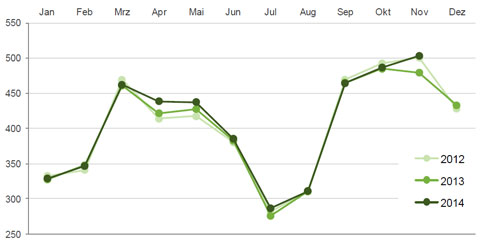
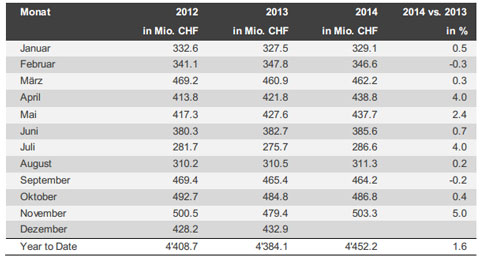
In Switzerland, more money was spent on advertising in November. With advertising spending totaling 503.3 million francs, the market grew by five percent compared with the same month a year earlier.

High-pressure area on the advertising front: November 2015 grows by just under 24 million gross advertising francs year-on-year.

mediafocus1_2
mediafocus3_2

The most advertised was Mondovino.ch - the wine portal of Coop. McDonald's restaurants follow in second place, ahead of UBS e-banking. The other places are occupied by Apple's iPhone 6, Swisscom TV 2.0 and the No vote on the Ecopop initiative. By company, Coop spent the most on advertising. This is followed by Migros, L'Oréal and Swisscom.

mediafocus2_2

There is steady growth in advertising spending in the pharmaceutical industry, according to a Media Focus release on Wednesday. This is probably related to the health megatrend. In a five-year comparison, advertising spending on vitamins, appetite suppressants and diarrhea remedies decreased. On the other hand, cough medicines and drugs against fungal diseases were advertised much more strongly. (SDA)

Media Focus Advertising Market Trend Report 11/2014 (PDF)

Change in the editorial team

In May 2015, Sven Behrisch and Bruno Ziauddin will become editors of *Das Magazin*. 

Sven Behrisch studied philosophy, art history, classical philology and rhetoric in Tübingen, Hamburg and Rome. The 35-year-old also attended the Henri Nannen School of Journalism in Hamburg. After graduating, he worked for the VDG publishing house in Weimar, among others. From 2008 to 2012, Behrisch worked as a freelance journalist for the feature section of Die Zeit and as a freelance author for Das Magazin, Dummy, Neon and Süddeutsche Zeitung.

Bruno Ziauddin studied politics and history in London. The 49-year-old came to journalism via a traineeship at Zürcher Unterländer. He later wrote for Das Magazin, the St. Galler Tagblatt and the magazine of the Süddeutsche Zeitung. Ziauddin worked for Weltwoche from 2002 to 2008, first as a member of the editorial team and then as an author. In 2009, he moved to Annabelle, where he was responsible for reportage and portraits. Ziauddin is also the author of several books and has received several awards, including the Zurich Journalism Prize twice.

With the transfer of Sven Behrisch and Bruno Ziauddin to the editorial team of Das Magazin, Birgit Schmid and Martin Beglinger are taking their leave after many years of collaboration. Beglinger is moving to the Neue Zürcher Zeitung (Werbewoche.ch reported).
 

"Kassensturz" contributions violate personality

In the "Kassensturz" program about an IV clarification office, statements were made that were contrary to the facts and violated personal rights.

The Federal Supreme Court has thus rejected an appeal by "Kassensturz". The subject of a total of three programs broadcast in 2006 were expert opinions from the Medical Assessment Institute (ABI), which serve as a basis for the assessment of benefits by private and social insurance companies. The institute is one of the medical assessment centers (Medas) of the disability insurance.

Kassensturz" had initially accused the head of the ABI of having increased the degree of the insured person's ability to work in the final report without consulting the specialists - to the detriment of the insured person.

According to "Kassensturz", the insurance companies mainly send those affected to appraisal offices that make insurance-friendly decisions. Quality is not an issue, and there is no quality control - neither from the appraisal offices nor from the appraisals. There is no independent review.

And finally, the "Kassensturz" reported in its series of articles that the Institute had changed expert reports on patients "in series".

In the ruling published on Wednesday, the Federal Supreme Court concludes that the last two statements do not correspond to the facts. Only three cases had been documented in which the expert reports had been amended. The expression "in series" gives the impression that there are a large number of cases. This shows the Institute in a false light.

Personality violated

It is also wrong that the expert opinions are not reviewed. This takes place in court proceedings. However, the statement made in the TV report gives the viewer the impression that the institute can and does act as it sees fit.

In these two cases, Swiss Television had therefore violated the personality of the Institute and its director. As already decided by the Basel Court of Appeal as the lower court, one of the contributions must be deleted from the Swiss Television website. The report must also be deleted from the cache of the internet search engines Google and Yahoo. (SDA)
 

Cooperation with Seven One Media extended

Goldbach Media, a subsidiary of the Goldbach Group, announces the early renewal of its contracts with Seven One Media. 

Goldbach Media has been marketing Seven One Media's complete station portfolio in Switzerland since 2011, including the stations Sat 1, Pro Sieben, Kabel Eins, Sixx, Sat 1 Gold and Pro Sieben Maxx. Now, according to Wednesday's announcement, the two parties have agreed to extend their successful collaboration ahead of schedule, renewing their existing contracts for several years.

According to Andrea Haemmerli, Managing Director of Seven One Media, the early contract extension is an expression of trust in the professional marketing team at Goldbach Media. For Alexander Duphorn, CEO Goldbach Media, the station portfolio is characterized by innovative in-house productions and successful international formats: "Pro Sieben Schweiz in particular developed strongly in 2014 and is currently the strongest private station in German-speaking Switzerland. The Pro SiebenSat 1 Group covers all target groups with its individually positioned stations, creating ideal conditions for the future." 

get_footer();