Advertising Week's impact check: Top 10 2014

We present the top ten for 2014 in each category. Marketagent.com has a panel of 38,660 internet users who are willing to participate in surveys and analyzed ten campaigns per month for *Werbewoche*.

Some agencies are flattered by it, others are annoyed. But advertising is not an end in itself. That's why the editors of Werbewoche have a series of ten selected campaigns tested every month. The methods and details of the analysis can be found online on our portal via the web code (right). The values shown in the tables provide answers to four questions:

Awareness: Which of these ads can you remember (unaided)?
Uniqueness: To what extent do these ads stand out from other advertisements?
Brand Fit: To what extent do these ads match the image you have of the respective brands or companies?
Likeability: To what extent do you like the following ads?

The interpretation reveals various forces. Obviously, subjects with a certain "Yay" effect are popular with the audience. Minor's squirrel, a frog as conductor for Zurich Zoo, the teddy bear in the bath for Total, the funny characters for Thomy. The game with excitement also worked for Love Life. A campaign for UBS shows that even a bank can benefit from a little humor. You can also attract attention with creative graphics, as the campaigns for SBB, Floralp and several Migros campaigns show.

Computer-assisted web interviews were used with around 500 net interviews per wave with people aged between 14 and 65.

Top 10 (PDF)

ONLINE
Details on the research question and methodology can be found at www.werbewoche.ch, Webcode Impactcheck.
 

Last but not least: Oh cat tree

Only a few days left until Christmas. If you're not yet in the festive mood, here's a cat video with lots of Christmas trees that's well worth watching.

Some people say that the internet was invented so that people could share their best cat moments. Maybe not the internet, but certainly YouTube. Without cats, the video portal would never have become so powerful that it is now challenging a media system that has been established for decades. Seen in this light, cats are actively involved in media change. When they are not sleeping - which they are known to do for up to 16 hours a day. The remaining eight hours are spent climbing Christmas trees, for example, and sabotaging them. As the following compilation by Tastefullyoffensive.com shows, the latter is more common than you might think.

//www.youtube.com/watch?v=Pj2ceEcpbgg

By the way: Depending on the ornaments, the trees also harbor dangers. Tinsel, for example, contains toxic substances, while other ornaments can cause internal problems if swallowed. Petfinder.ch advises never to leave cats alone with Christmas decorations and trees. Besides, you could then miss an attack worth filming. (hae)

Unbenannt-42
Image: Catsuthecat.com
 

Check with the historian

The NZZ Board of Directors wants a new editor-in-chief. Markus Somm, a Christian-national conservative, turned down the offer. Asking him in the first place was already an act of folly. By Hans Stutz

Christmas is so close' and that's why we're giving the NZZ a gift for once and claiming that it is the intellectual flagship of the Swiss-German bourgeoisie and thus of Switzerland. But will this remain so after the ousting of the previous editor-in-chief Markus Spillmann, also head of journalism? After all, the NZZ Board of Directors has done quite a bit in recent weeks to minimize the paper's journalistic reputation.

The disputes over Spillmann's successor reflect the disagreement over the direction of Swiss domestic politics and its disconnection from the internationally oriented economic world. This is not the first time.

But let's take things one step at a time. Weltwoche publisher Roger Köppel opened the national conservative wish list: The new editor-in-chief must reconcile the bourgeois camp, defuse the neurotic trench warfare. And "bring the SVP and FDP onto a more or less common line against the left". Weeks ago, another Blocher apologist had already called for something similar. At stake is "the future of civic Switzerland," wrote BaZ head and FDP member Markus Somm on All Saints' Day: If the FDP and SVP did not find each other, we would be facing "very difficult times." The two parties would therefore have to enter into list combinations and, after the 2015 elections, be in a position "to determine the composition of the Federal Council by means of their own majority in parliament." Somm can only make this demand because he downplays the differences between the two parties on foreign policy. Specifically: How does Switzerland develop its relationship with international organizations, from the UN to the EU to the European Court of Human Rights? And thus also with international law, not only with mandatory law.

The two right-wing bourgeois editors-in-chief as well as their political foster father are still fighting against the paradigm shift in federal politics. Until the mid-1980s, the motto of all right-wing parties and the national government was "special case" (international trade YES, political integration into international organizations NO), but now the slogan is that Switzerland is a special case like other countries. This means that it is economically integrated into the global economy (especially in the financial and raw materials sectors) and is also politically active in international organizations. This policy is well supported democratically. The national conservatives have lost many referendums on foreign policy in recent decades (UN accession, bilateral treaties, etc.). The fight for EU accession is the last remaining contest. This accession is just as inevitable as the case of freedom from tax evasion. We remember Federal Councillor Rudolf Merz: "You will cut your teeth on banking secrecy".

Bourgeois Switzerland can no longer do otherwise. Since the collapse of "real existing socialism" and since the almost worldwide implementation of neoliberal economic ideas and the corresponding dismantling of national obstacles, the Swiss economic world is also no longer oriented toward national disputes. Even SVP tribune Christoph Blocher has noticed that people read "the NZZ today primarily because of the business section and possibly the foreign section, no longer because of the political reporting. The NZZ board of directors endangered this strong journalistic pillar by flirting with an isolationist like Markus Somm. It was the NZZ correspondents who first warned the board of directors of the "end of the culture of a liberal and cosmopolitan NZZ.

The cost to bourgeois Switzerland of evading international debates with nationalist rabble-rousing has been precisely described by historian Thomas Maissen - once also an NZZ editor - in his book "Verweigerte Erinnerung. Dormant Assets and the Swiss World War Debate 1989-2004" precisely described. He ends: "In order to be competitive worldwide and to be perceived at all, however, the necessary interpretative alternatives must be anchored supra- and transnationally, and that means in the Swiss context: European."

Hans Stutz lives in Lucerne. He is a journalist and cantonal councilor for the Green Party.
 

"Love Life" poster works

Clear Channel conducted a study on the advertising impact of billboards, using the "Love Life" awareness campaign initiated by the Federal Office of Public Health as a case study. Conclusion: Billboards play a significant role in the media mix.

The Love Life campaign received a great deal of attention, and advertising recall is correspondingly high: 80% of respondents remembered seeing the hotly debated campaign on some channel. Of these, the majority, namely 71%, had noticed the advertisement on a poster. Shortly after the campaign was launched, the key performance indicators rose significantly, namely by 35 index points. The campaign was recognized by three quarters of respondents even without the Love Life logo. Due to the Love Life campaign poster, 56% of respondents visited the campaign website. This means for the response: outdoor advertising plays an important role in the media mix.

In addition to the poster, the website was an important part of the campaign, as manifestos could be signed there, among other things. As more than half of the responses came from outdoor advertising, Oliver Schönfeld, Marketing Director Clear Channel, concludes: "The poster made a major contribution to the success of the campaign. "This is because the poster enables a rapid build-up of reach and awareness, as it guarantees a high level of accessibility to the target groups and is present around the clock. According to the current study, it demonstrably has the greatest leverage effect among traditional media when it comes to increasing sales success. Oliver Schönfeld does not accept the fact that omnipresence can also have the opposite effect - namely a decline in attention due to sensory overload: "In principle, the phenomenon of sensory overload occurs much less or not at all in out-of-home advertising than in other media, such as TV advertising. This is referred to as 'reactance'. This is when people are so annoyed by recurring commercials that they begin to reject the commercial (and often the brand behind it). In extreme cases, this can manifest itself in an attitude of protest and a refusal to consume. With outdoor advertising, we have the advantage that our medium is considered 'the least disruptive'. Even if, of course, this is not classic media use, as there is no editorial content. In the case of print advertising, research has shown that the viewer's attention for the advertising message decreases significantly after the same subject has been shown three times, but it is still not annoying. The issue of reactance is therefore a typical TV (or moving image) phenomenon. "

The market research company GfK Switzerland conducted the advertising impact study on behalf of Clear Channel Switzerland. The subject of the study was the Federal Office of Public Health's Love Life campaign, which was created by the Rod Kommunikation agency and Mediaschneider was responsible for media planning. The aim of the study was to analyze the impact of out-of-home with regard to this campaign. A total of 604 people between the ages of 18 and 70 living in German-speaking or French-speaking Switzerland were surveyed. Clear Channel regularly conducts studies in collaboration with advertising clients and independent market research institutes to examine the perception, relevance and acceptance of posters. "Our aim is to use the findings to work with clients and their agencies to make outdoor advertising even more effective," says Schönfeld. uma

tatatUnbenannt-18

Goldbach Group: Withdrawal from Romania

As announced on the occasion of the presentation of the half-year results 2014, Goldbach has withdrawn from Romania as of December 18, 2014 and is handing over the business activities to the existing management.

In recent years, Goldbach Group has played a key role in restructuring Goldbach Media and Goldbach Audience in Romania and bringing them to break-even. After completing this work, the decision was made to sell the two companies to the previous management, as the company writes in a statement. In this way, the continuation and development of the business activities can be carried out efficiently directly from the Romanian market, which is in line with the objectives of both parties. Sales of the two companies were 3.28 million Swiss francs in 2013, and the purchase agreement will come into effect on December 18, 2014. The parties have mutually agreed not to disclose the sales amount.
 

Companies focus on long-lasting consumers

Older adults are considered a consumer group with strong purchasing power that is steadily growing. What steps are companies taking to reach them?

The "Golden Agers" target group has been on everyone's lips for years. Around 1.3 million pensioners currently live in Switzerland. In the next 20 years, their number will rise to around a third of the population in Western European countries, according to the World Health Organization (WHO). In view of the massive increase in the purchasing power of older people, companies can no longer afford to ignore the needs of older consumers. Peter Gross, Professor Emeritus at the University of St. Gallen, puts it in a nutshell: "As the number of long-lived consumers increases, so does their potential as a threat. However, the 72-year-old is convinced that the economy is not yet really ready for long-lived consumers. As part of the lecture series "Age(ing)-fair economy" at the Paulus Academy in Zurich, he speaks of a "demographic delay" on the part of companies. Are companies aware of the future market? What measures are they taking to attract the "golden agers"? A survey in the retail trade shows that a lot is being done.

Packaging in transition

In general, experts agree that the consumption structures and needs of older people are extremely heterogeneous. Milieu, values and lifestyle have a greater influence on (consumer) behavior than age. But even if older people are not necessarily characterized by specific interests, they are still subject to the biological aging process. Eyesight and physical strength, for example, decline at some point. It can be worth taking this into account when designing product packaging. In 1989, around 49,000 people in the UK had to be hospitalized because they had injured themselves when opening packaging with knives or scissors. Older people are particularly affected by bulky packaging. According to studies, they primarily complain about packaging that is difficult to open and illegible descriptions and expiration dates.

Some companies have recognized these needs. In 2013, Coop responded to the demographic change with a comprehensive packaging optimization (the first Swiss retailer to do so, according to its own information). As part of the "Easy to Open" project, Coop commissioned the Fraunhofer Institute in Dresden, which specializes in packaging technology, to develop customer-friendly packaging. Beforehand, the current situation was analyzed together with the Schulthess Clinic in Zurich by filming test subjects with limited hand function when opening packaging and then interviewing them. The packaging marked with the new "Easy to Open" label features easy-to-grip opening tabs and an improved sealing seam along the closure, among other things. Currently, 130-150 charcuterie products carry the "Easy to Open" logo. It is to be launched for a further product group in the course of spring 2015. According to Urs Meier, media spokesperson for Coop, the opening principles for all own brands will be tested step by step. Migros also announced a specific project in response to a request for information, which is a reaction to the demographic change. In cooperation with the Swiss Central Association for the Blind, the company is planning a consumer survey to investigate the effects of visual impairment on the shopping experience: "In this survey, we want to find out what experiences blind and visually impaired people have when shopping at Migros (in-store and online) and how we can provide them with even better support." Migros also cites various guidelines for barrier-free construction, which are "not only about wheelchair accessibility, but also about the needs of senior citizens". In their written statement, both retailers point out that the needs of older people should generally be taken into account in labeling, packaging and store design.

The situation is different for low-cost retailers from Germany. All retailers, including Aldi and Lidl, have adapted their product ranges to meet the needs of older target groups. However, when it comes to packaging design specifically for older people, the two companies currently see no need for action. "So far, there is no need to respond to the possibly changed needs of older people," writes Aldi with regard to product declarations: "This would mean major changes and, last but not least, would also make the products more expensive." Complaints are received "only very occasionally". The same applies to Lidl: older people are more likely to be targeted with items such as "vein cushions, reading aids or large-button telephones". Older people with less purchasing power who shop at low-cost suppliers from Germany cannot (yet) benefit from innovative packaging initiatives or similar.

Common practice in advertising

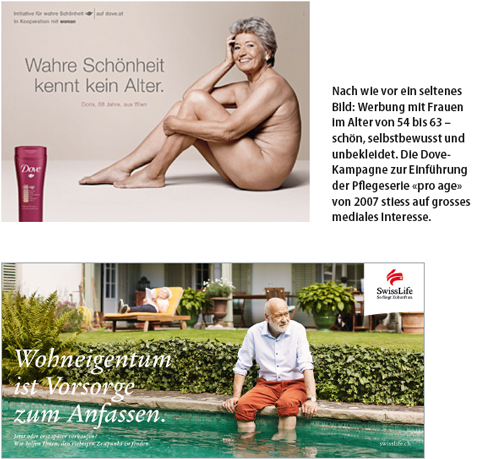
Awareness of older target groups has evidently been gaining ground in the area of advertising for some time now - and this applies to all the companies approached. "Yes, we want to include all age groups - because our target group is the entire Swiss population," writes Migros. "Of course. Older people are important members of our society," says Coop. Aldi is a little more specific: "Advertising must be designed to appeal to the target group. Depending on the message of the advertising message, we also use actors from the older generation in our advertising." Nevertheless, the classic "grandparent role" dominates. It does not necessarily correspond to how older people see themselves.

asdfaf

And the age of the employees?

During his presentation, Peter Gross pointed out another aspect where he sees a need for companies to take action: Up to now, the ageing of the workforce has only been reflected in the customer structure. According to the business lecturer, in order to really be able to act on an equal footing with customers, they should be aligned with the employee structure. Because, as a friend put it after a visit to the bank, "a young person" as an advisor does not meet with the enthusiasm of every older person. There appear to be hardly any strategic objectives in this area. None of the retailers surveyed take the age structure of their employees into account with regard to demographic change, not even those with customer contact. "Friendliness and competence" are at the forefront, according to Aldi, for example, and similarly at the other retailers. Coop sees the issue as a no-brainer: "In principle, the average age of employees in the companies will also increase - in line with the average age of customers." The age structure of the workforce is rarely disclosed in the annual report. Of the retailers contacted, only Migros publishes the age statistics of its employees (although the proportion of employees in the 50-64 age group is lower than the proportion of employees in Switzerland as a whole).

The topic is likely to be particularly explosive for the financial sector. This is because the majority of investment assets are now in the hands of older age groups. Unfortunately, an e-mail inquiry to this effect sent to four Swiss banks went unanswered.

Universal design required

The well-known crux with the 55 plus target group: if there's one thing older people don't like, it's being addressed as older people. For this reason, Migros does not carry "any products that are specifically labeled for a target group of older people" in its range. Research has shown that this is not desired by senior citizens (with the exception of the club school offer). Coop spokesperson Urs Meier points out the benefits of the optimization initiative for all age groups: "We hope that the newly packaged items will provide additional benefits and added value for all our customers - and make everyday life a little easier for the older generation in particular." The developments clearly point in the direction of a so-called universal design that takes into account the needs of as many consumers as possible.

Simone Isliker
 

To the point: Let us be merry and bright

Every year, *Werbewoche* treats its readers to its creative ranking in its final issue before Christmas.

This year, Jung von Matt, Leo Burnett and Publicis Werbeagentur share the podium. Congratulations - in dulci jubilo - to the other seven top agencies as well!

Tomorrow, children, there will be somethingis what some people at and from the NZZ must be thinking. First the "old aunt" closes her printing plant in Schlieren, and then the fuss about the editor-in-chief: Spillmann leaves, Somm doesn't come after all, Blocher has "no appetite for the NZZ. The flagship lurches on the high seas without a captain; a ship comes loaded - and no one wants to sail it ...

Come, O ye faithfulis what one might call out to Der Spiegel. Anyone who still believes that print and online can go hand in hand here should step into the front row. Wolfgang Büchner, the ousted editor-in-chief, has failed in his goal of getting 400 petrified print journalists to join forces with their online colleagues. Regardless of whether Büchner acted cleverly or without tact: He was right about the need to bring print and online closer together. Now, award-winning journalist Klaus Brinkbäumer is taking the reins. The only problem is that anyone who can write can't necessarily run a newspaper. And in the right direction, too.

Last Christmas was the message for "Wetten dass ...?" last Saturday. 9.27 million fans gave the show its final farewell. With that, a format that for so many of my generation stands for cozy, long Saturday evenings in front of the TV, freshly bathed in terrycloth pajamas, says goodbye. Honestly: Haven't you at least once dreamed of becoming the competition king with some absurd bet? Out. Gone.

What does it mean - and above all: What can we do about it? 2014 was a bad year for media professionals: 66 journalists were killed worldwide, 119 were kidnapped, and attacks are becoming increasingly brutal. This is reported by Reporters Without Borders. Journalists are particularly at risk in Syria, Gaza, Ukraine, Iraq and Libya.

Ensemble, my ass Silent night! We celebrate Christmas with friends from Migros. The retailer has landed a super coup with its Christmas charity song. Gilbert Gress and well-coiffed singers such as Luca Hänni, Francine Jordi, Pepe Lienhard, Noëmi Nadelmann, and Pippo Pollina Christmas song their way to No. 1 in the Swiss singles charts - placing Migros there as the first brand ever. A historic step in terms of marketing. Too bad Coop sent its organic song soaring in 2012 without a label.

Wake up, the voice calls us - There is a lot to do in 2015. But now we are allowing ourselves a Christmas break. The next printed Werbewoche will appear on January 16, 2015, and Werbewoche.ch will provide you with fresh news from January 4, 2015. Thank you for your loyalty and Merry Christmas everywhere.

Anne-Friederike Heinrich, Editor-in-Chief
[email protected]
 

APG|SGA strengthens key account management

APG|SGA is expanding its Key Account Management team in Zurich. Starting February 2, 2015, Tony Mandingorra will be responsible for clients from various industries. In addition, the Digital Sales division has been successfully integrated into Key Account Management.

APG|SGA is expanding its key account management team and has hired Tony Mandingorra as a consultant as of February 2, 2015. From 2002 to 2004, the competent expert with many years of out-of-home experience already held this position at APG|SGA and subsequently headed up International Sales. Other positions in his career have included Head of Sales (USA and Western Europe) at Gessner and Head of Acquisitions at Geyst.

As already announced, Beat Sulzer and Patrik Holdener will also be joining APG|SGA's Key Account Management from January 1, 2015. The Digital Sales division, which was previously based in Winterthur, relocated on October 1, 2014 and has been successfully integrated into Key Account Management at the head office in Zurich. Two key account managers, Nurettin Yildirim and Peer Kleinfeldt, are now specifically responsible for working the digital market.

Mexan: Online store for Confiserie Bachmann

Mexan has been providing Confiserie Bachmann with full online support for several years and was able to implement the new online store in its entirety.

The old store solution was replaced by a new, modern Magento store. The static content is maintained via TYPO3 and dynamically linked to Magento. The combination of these two open source products allows the highest possible flexibility and the best of both systems.

confiserie-bachmann-header

The Confiserie Bachmann currently has 17 locations, 15 in central Switzerland and one each in Zurich and Spreitenbach. In addition to the successful local business, the new website is intended to build on the existing success and further expand the existing online business.

confiserie-bachmann-startseite

The new Confiserie Bachmann website is fully responsive and allows you to order all baked goods and cakes on any device at any time. The products can be paid for using the usual means of payment and the delivery of fine cakes, for example, is possible throughout Switzerland. With the new webshop, Confiserie Bachmann has not only the most comprehensive but also the most modern store solution in the industry in Switzerland.

Responsible at Confiserie Bachmann: Matthias Bachmann (Management), Melissa Salihovic (Content Shop), Bernd Rau (Picture Shop). Responsible at Mexan: Elias Emmenegger, Christoph Karlen, Roland Kiser; Thomas Niederberger (overall responsibility).
 

Job portal for agriculture launched

Swiss agriculture has its own job portal for the first time. Agrarjobs.ch, the first professional job portal for the agricultural sector, has been online since the beginning of December. Behind Agrarjobs.ch is a young team from Thurgau - and that is no coincidence.

There are many job portals - but until now, Switzerland has lacked a professional platform for agriculture. Agrarjobs.ch is set to change that: The job platform for the Swiss agricultural sector has been online since December 4. According to the press release, various companies and institutions have already tried out the new platform in the first few days - including big names such as Emmi, Anicom or the Federal Office for Agriculture, but also SMEs such as Speriwa from Niederbipp.

Unbenanagnt-3ag

"About two years ago, we noticed that online job searches in agriculture are still very laborious," says Caspar Eberhard, marketing manager and co-founder of Agrarjobs.ch. "Anyone who wants to look for a job online in the Swiss agricultural sector has to be very patient, because the big portals lump everything together as agriculture. We, on the other hand, offer differentiated subcategories."

This is exactly where Eberhard and his team come in: Agrarjobs.ch is not only intended to be clear and easy to use, but also the first platform to unite all job offers in Swiss agriculture. The portal is therefore aimed at all professions in the agricultural value chain - for example, seed consultants or agricultural machinery mechanics, farmers, cheesemakers, milk technologists or butchers. Anyone with an agricultural background or who wants to work in agriculture and its upstream and downstream operations is in the right place at agrarjobs.ch.

Unbenannt-4bauer

Agrarjobs.ch started with four employees and is based in Wittenwil TG - not entirely by chance. "We come from an agricultural background, which is why proximity to agriculture is important to us," says Jürg Zahnd, CEO and co-founder of Agrarjobs.ch. The trained mechanical engineer ETH grew up in Wittenwil himself and comes from a farming family.

Free beta phase until March 2015

For the time being, the job ads on agrarjobs.ch are free of charge. "We want to gain experience in the start-up phase," explains Jürg Zahnd, "Customer reactions are also important to us. Only in this way can we continuously improve." From March 2015 Agrarjobs.ch will be subject to a charge. The prices are deliberately kept low, says Jürg Zahnd. "A job ad costs 325 francs for two months; if you enter the ad yourself, the price is reduced to 285 francs. This means we are still significantly lower than conventional job portals." No compromises are to be made in terms of quality. Zahnd: "We want to be just as good as the big portals, only cheaper - and with a clear focus on Swiss agriculture."

Leo Burnett promotes special edition of Woz

On December 18, the "Wunsch-Woz" will be published—an issue to which the readers of the weekly newspaper Woz have made a significant contribution. Leo Burnett is handling the campaign.

Over the past few weeks, readers were able to provide input for the articles in the special issue, resulting in around 350 suggestions for the attention of the editorial conference. The last Woz issue of 2014 contains 54 contributions, all of which are based on reader input. The spot also makes it clear that the Wunsch Woz is a joint effort by many people: the music duo Whistler & Hustler composed a piece especially for the film that brings true teamwork to life. The spot will be shown in several art house cinemas in German-speaking Switzerland and distributed via social media.

//vimeo.com/114765580

The campaign can also be seen as an advertisement in the NZZ, the Tages-Anzeiger and the Work newspaper.

Responsible at the weekly newspaper: the collective of the Woz. Responsible at Leo Burnett Switzerland: Pablo Schencke, Johannes Raggio (Creation), Fernando Gort (Consulting), Erasmo Palomba (Art Buying), Whistler & Hustler (Composition), Filmgerberei (Production), Jingle Jungle (Sound)


get_footer();