NZZ Media Solutions commences business activities

At the beginning of the year, NZZ Media Solutions, the new sales organization of the NZZ Media Group, started operations.

The NZZ Media Group is thus once again marketing the print and online media of its companies in Zurich, eastern Switzerland and central Switzerland on the market itself. Previously, it had transferred the advertising business formerly managed by Publicitas to direct marketing. With the new centralized sales organization, NZZ Media Solutions can act autonomously and thus closer to its customers and respond more quickly to the rapid changes in the advertising market, according to the press release.

The following persons manage the business units of NZZ Media Solutions:

Overall management NZZ Media Solutions: Karin Carpentier (Image)

Head of Advertising Market NZZ, Zurich location: ad interim Karin Carpentier (Andy Bürki from 1.2.2015)

Head of Advertising Market Eastern Switzerland, St. Gallen site: Stefan Bai

 Head of Advertising Market Central Switzerland, Lucerne site: Edi Lindegger

Head of Advertising Market Online, locations Zurich, St. Gallen and Lucerne: Remo Baumeler

Head of Sales Operations & Marketing as of 1.2.2015: Petra Zwyssig

A campaign that is not addictive

Whether it’s alcohol or cannabis: When someone is addicted, their mind is consumed by their addiction. This is precisely what the awareness campaign developed by Matter Gretener Lesch for the addiction prevention agencies in the Canton of Zurich highlights.

It is aimed at adolescents and young adults and dispenses entirely with prohibitions and pointed fingers. Instead, it asks in a psychologically clever way: "Do you still have it under control?" And in doing so, triggers a process of reflection that leads to young Zurichers taking the self-test on Addictiontest.ch fill out. This is intended to trigger a change in behavior.

ddd_0
alk

Responsible at the addiction prevention offices in the canton of Zurich: Roland Stähli, Annett Niklaus (Institute of Epidemiology, Biostatistics and Prevention, University of Zurich). Responsible at Matter Gretener Lesch: Daniel Matter (Creative Direction), Dominik Imseng (Text), Laura Haas (Graphics), Verena Knof (Consulting). Photography, image editing and CGI: Carioca Studio/Visualeyes International Zurich. Online implementation: Dotpulse; media planning: Ad.X.
 

Journalistic quality suffers under digitization

The universal availability of journalistic content also has its downsides: the quality of the content is declining. This is the finding of a new expert survey conducted by Publicom.

Already, about half of the consumption of daily information is done online via digital channels. But universal availability is one thing, the other is the quality of the information, and this is declining, as Publicom writes in a press release. Two-thirds of the experts surveyed agree: online information has a quality problem. On the one hand, the error rate is growing because of the need for speed and because more and more players are reacting to events. On the other hand, journalists' orientation toward click rates favors shallow content suitable for the masses. There is no consensus, however, on what the consequences of this development are for media brands. Although a clear majority of experts believe that media brands can significantly increase their brand value on the Net, it is uncertain whether online media can take over the function of leading media today and in the near future. Almost half of those surveyed believe this is possible, while a slight majority are skeptical.

Paid services face uncertain future

The question of financing online information also remains unresolved. Only a quarter of those surveyed believe that paid online services will sooner or later become established. There is hardly any willingness to pay for mainstream news and entertainment in particular. But the experts largely agree that the audience is willing to dig into their pockets for high-quality exclusive content. However, it is less clear how such content should be structured. The experts are most likely to expect willingness to pay for business and financial market information, while there is little hope for international news, sports and tabloid topics.

publicom-2
Figure 1: What are the consequences for content quality of the shift of information offerings to digital channels? (n=21)

publicom-3
Figure 2: Future of paid online information services (n=22)

publicom-4
Figure 3: Willingness to pay for content (n=22)

Under the term Delphinarium, Publicom, a company specializing in media research and consulting, publishes the results of a survey of experts twice a year. The panel includes forty experts from leading media companies as well as representatives from advertising, media journalism, communications science and corporate communications.

Further information on the study at Publicom.ch
 

Webguerillas: Giant parcel unpacked for Swiss

This Christmas, Swiss International Air Lines gave its passengers a special gift. Anyone who tweeted their Christmas message with the hashtag #SWISSMASGREET was treated to a surprise full of swing at Zurich Airport.

A giant gift including a red bow, a Twitterwall and a Tweet-o-Meter: Swiss awaits passengers with this setting at Zurich Airport on December 19, 2014. A simple mechanism makes all the elements work together: Every Christmas tweet with #SWISSMASGREET lowers the temperature in the Tweet-o-Meter. At 0°C, the Christmas magic begins. The present opens and the surrounding audience is surprised with musical and culinary appetizers.

To ensure the greatest possible response on the Twitter wall, the Webguerillas included Swiss Interational Air Lines' online and social media presences for communication. A strategy that proved effective: With a tracking value of 700,000 impressions in just one day, both the client and the agency are more than satisfied. And to ensure that the gift is not only enjoyed at the airport, Swiss thanked its passengers with a Youtube video and wished everyone a hearty "Merry Swissmas".

//www.youtube.com/watch?v=iHOu-QVnCZk

Responsible at Swiss Airlines: Nadja Waldraff (Social Media), Benjamin Fehrenbach (Intern Social Media). Responsible at Webguerillas: Dino Ceccato (overall responsibility), Ryan Daynes (creative director), Gianluca Pirrera, Jan-Hendrik Senf (consulting), Frank Engelhaupt (text), Michael Kindermann (Snapfilm), Frontwork (gift box), Voice Academy Zürich (vocal artists), Spool (Christmas elves).

Leo Burnett Switzerland: Once a gift and back again

Returning items made easy: Leo Burnett Switzerland has created a radio campaign for Swiss Post's pick@home package service.

With pick@home, parcels can be picked up directly from home by the parcel carrier. Or conveniently return them if you are not satisfied with the contents. An advantage that many Swiss people will certainly appreciate, especially at the turn of the year. This is precisely the idea behind the radio spots developed by Leo Burnett Switzerland: people who receive a Christmas gift by mail joyfully read out the enclosed greeting message. And from the moment disappointment about the content sets in, they read the same message just as joyfully backwards.

During the festive season, the spots could be heard on high-reach stations throughout Switzerland.

Responsible at Swiss Post, Postlogistics: Martin Gonzenbach (Head of Marketing Communications). Responsible at Leo Burnett: Axel Eckstein (ECD), Bastian Otter, Mark Stahel (text), Fiona Gottwald (consulting), Suzana Kovacevic (art buying). Responsible at Jingle Jungle: Michael Schwarz (Production).
 

Last but not least: Pornoangelo

Just how offensive were Michelangelo's paintings, really? Very—at least according to Facebook.

Facebook can apparently afford to do without advertisers. Like other American online giants, the largest social network is waging a relentless battle against all things naked and lewd. While all available eyes are turned when it comes to the depiction of brute force and brutality, no quarter is given to naked skin on the other side of the Atlantic.

Eckehard Bamberger also had to realize this. The author of the book "Psalm 1 - The Ways of God and Man" hit a snag when he tried to advertise his pious work on Facebook. The reason: the title page of the book shows Adam as God created him. So naked - ad rejected. Incidentally, Adam's head was altered for symbolic reasons, in case you're wondering whether the great master really did look like that. bungling specially painted.

OBS_20150105_OBS0003

When asked why a historical work by Michelangelo was stuck in the Facebook censorship section, he received this straightforward answer from a Michelle:

Thank you for writing to us. I will be happy to help you.

Your ad has been rejected because the image does not comply with our advertising guidelines. Advertisements may not use overly sexualized images, give the impression of nudity, show a lot of skin or cleavage or unnecessarily focus on certain parts of the body. This also applies to the images on your pages.

Please make the necessary changes and create your posts again. If it is an ad created in the Ads Create Tool, you can edit it in the Ads Manager: Facebook.com/ads/manage

Familiarize yourself with our guidelines on advertising images here:
Facebook.com/help/250509391644213/?ref=cr
Let me know if you need any further assistance.

Yours sincerely

Michelle
Facebook Ads Team
Facebook

Yo! That should leave no more questions unanswered. But on what day did God actually create underpants? This might be necessary for the required changes. (hae)

Minispick launched

Künzler Bachmann Verlag is launching a new magazine for children ages six to nine. The magazine, titled «Minispick,» is now available free of charge at the publisher’s partner companies—Aldi Suisse is the first partner.

As publisher of Spick magazine, St. Gallen-based Künzler Bachmann Verlag has many years of experience in the children's and youth magazine segment. The Minispick is now intended to appeal to a younger readership. The magazine offers a mix of entertainment, knowledge transfer and activities. "We want to be able to convey the values and qualities that Spick has stood for over 30 years to younger children as well," says publisher Max Künzler of the motives behind the launch. Among other things, the children learn more about the world of animals and nature, get to know other countries, solve riddles and can copy experiments. Various competitions also invite active participation, from coloring pictures to their own creations, which can be sent in.

Minispick is distributed free of charge. For this purpose, Künzler Bachmann Verlag was able to win the Swiss discounter Aldi Suisse as a cooperation partner. At the beginning of each month, the small-format, 52-page magazine will be available in Aldi stores in German-speaking and French-speaking Switzerland. "We are pleased to be able to offer the families among our customers exclusive added value with the Minispick," says Philippe Vetterli, media spokesman for Aldi Suisse. The magazine is published eleven times a year with a short summer break. In the near future, the publisher plans to work with additional distribution partners from other industries to expand the number of delivery points.

MiniSPICK_Deutsch


Bye Gray, Hello Wow

Travel provider Kuoni is launching a national campaign under the slogan «Schön abhauen» ("Take off beautifully") to anchor the brand in the minds of travelers during January, when bookings are high. Serranetga is jointly responsible for the concept and realization.

January is traditionally one of the months with the highest bookings for travel providers. Accordingly, top-of-mind positioning among travel enthusiasts is particularly important at this time. With its current "Schön abhauen" campaign, Kuoni, Switzerland's largest and best-known tour operator, aims to whet the public's appetite for vacations and invite potential customers to visit its branch or website.

Bild-15

The campaign takes the everyday stress of many Swiss people as its starting point. A national poster campaign launched yesterday shows dreamlike vacation images paired with headlines such as "Bye bye gray, hello wow" or "Bye alarm clock, hello explorer." With it the travel offerer suggests: If you've had enough of everyday life, you can get away with Kuoni.

Bild-25

The campaign is accompanied by a cross-media promotion with 20min, online and print ads, social media campaigns, and various POS activities. All measures refer to the landing page abhauen.kuoni.ch, where users can add their personal vacation motto to vacation pictures, share them with friends and win attractive prizes.

Bild-35
Bild-45

Click here to go to the landing page: Getaway.kuoni.ch

Responsible at Kuoni: Claudia Herkert (Head of Marketing Switzerland), Sabrina Müller (Head of Marketing Management). Responsible at Serranetga: Maurizio Rugghia (overall responsibility), Florian Beck (ECD), Daniel Zuberbühler (Client Service Director), Florian Bosshard (AD), Thomas Blumer, Matthias Ziegler, Antonia Mayer (text), Julia Miller (screen design), Diego Dirren (programming), Olivia Guler (project management).


Photographer Remo Neuhaus and "his football stars

From January 9 to 13, the Photo15 photography exhibition will be on display at the Maag Event Hall. Among the exhibitors is advertising photographer Remo Neuhaus, who will be showcasing his portraits of soccer players.

In spring 2014, a football match against poverty took place at the Stade de Suisse in Bern. This annual charity highlight was held in Switzerland for the first time. Countless former world-class soccer stars such as Zinédine Zidane, Figo, Ronaldo, Maldini, Elber, Cannavaro, Gullit and many more took part. The world selection plays for a good cause against BSC Young Boys.

Making-of-Aufstellung-remoneuhaus.com7_

Neuhaus' photographic idea: portraits of the world's soccer players. The entire proceeds of around 4,000 Swiss francs were donated by auction to the victims of Typhoon Haiyan in the Philippines. The difficulty: the stars stood in front of the camera for just 30 - 60 seconds. According to Neuhaus, all the footballers took part and helped to raise some money in addition to the game.

//www.youtube.com/watch?v=PT3kIwwTTw8

Making-of-Nedved-remoneuhaus.com2_
Making-of-Gullit-remoneuhaus.com4_

At Photo15, the photographer will show five large-format fine art prints of the footballers. Taken with the medium format camera Pentax 645Z, which brings out the details in particular. Remo Neuhaus specializes in commercial, advertising and portraits and works throughout Switzerland.

Zinedine-remoneuhaus.com-Zidane
Paolo-Maldini-remoneuhaus.com_
Ronaldo-remoneuhaus.com_

Responsible for the project: Remo Neuhaus (initiator and photographer); Marco Herzig (assistant); Jonas Weibel & Raphael Wanner (making of video); Promacx, Bern (image editing).
 

Last but not least: lion fishing

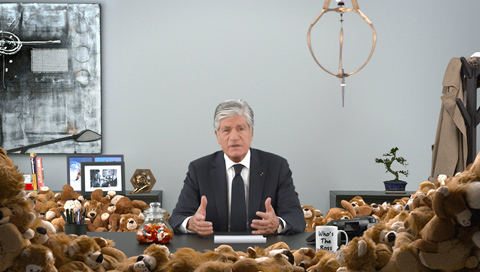
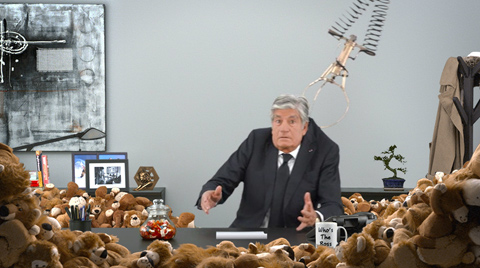
Maurice Lévy, CEO of the Publicis Group, has done it again: He’s delivering his traditional, interactive New Year’s address on YouTube. Viewers are sure to be entertained as they listen this time around, too.

Lévy landed a viral coup with his speech at the end of 2012 (Werbewoche.ch reported). During his long-winded blah-blah speech, the bored audience was allowed to let off steam interactively to their heart's content - always commented on by the raised index finger of the Publicis boss. He used breaks, for example, to polish his Cannes lions or play Pac-Man. Anyone who skipped was reprimanded by Lévy. Unfortunately, the interactive version of the video is no longer online - the New Year's link now leads to this year's version.

In the latest New Year video, Lévy looks back on a mixed Publicis year. The mega-merger between Publicis and Omnicom, which collapsed in May, is one of the main reasons for the year's disappointment. The new group would have been worth 35 billion dollars and would have made the two groups world market leaders.

Bildschirmfoto-2015-01-04-um-15.31.54

Nevertheless, Lévy feels like doing something good - and makes the interactive video "The Very Good Wishes" as a fundraiser for the Make-A-Wish Foundation. The foundation fulfills the wishes of seriously ill children free of charge. During the speech, viewers can play the iconic (and in most cases frustrating) game of grapple and hunt down the Publicis plush lions. To do this, the smartphone is linked to the video via QR code (or by entering goodwish.es/rjzebei in the smartphone browser) and serves as a controller. This works surprisingly well. Even if it is not entirely clear why the controller is both motion-sensitive and works via touchscreen at the same time. And also somewhat sobering: the carefully collected lions have no influence on Publicis' donation behavior. You can simply take part in the collection after the game. This should not diminish the fun of the game - especially as you can also grab anything else in the office. (hae)

Bildschirmfoto-2015-01-03-um-13.07.55

Click here for the lion game: Publicisgroupewishes2015.com

If you don't want to do the whole thing, you can find a demo video here:
 

//www.youtube.com/watch?v=soLj46akF5w

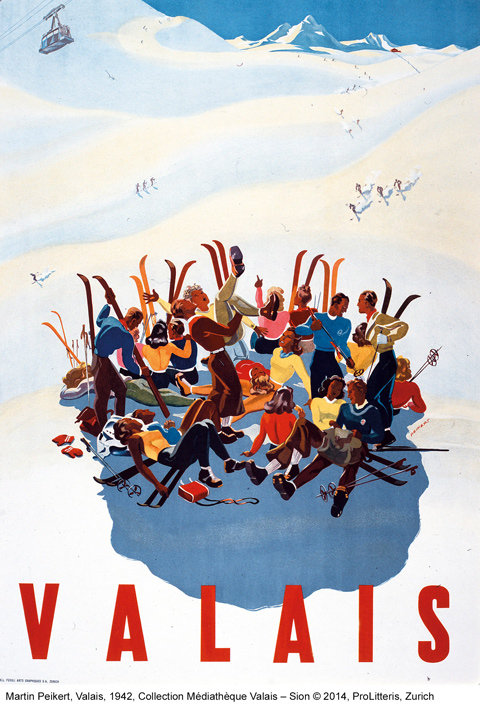
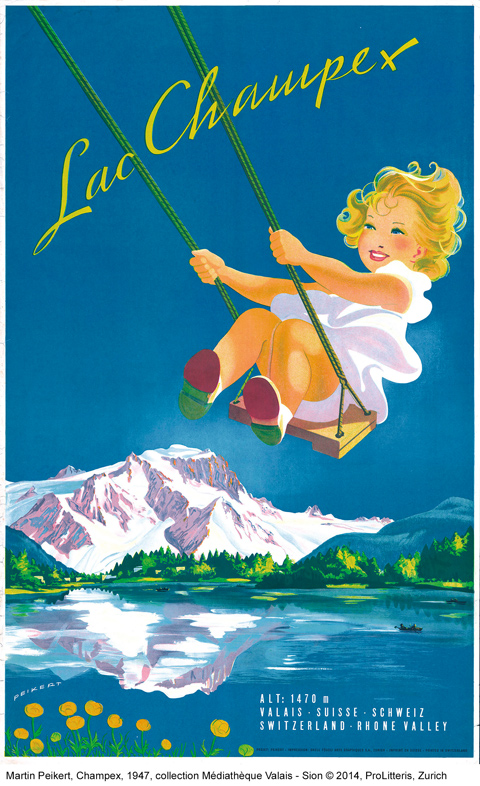
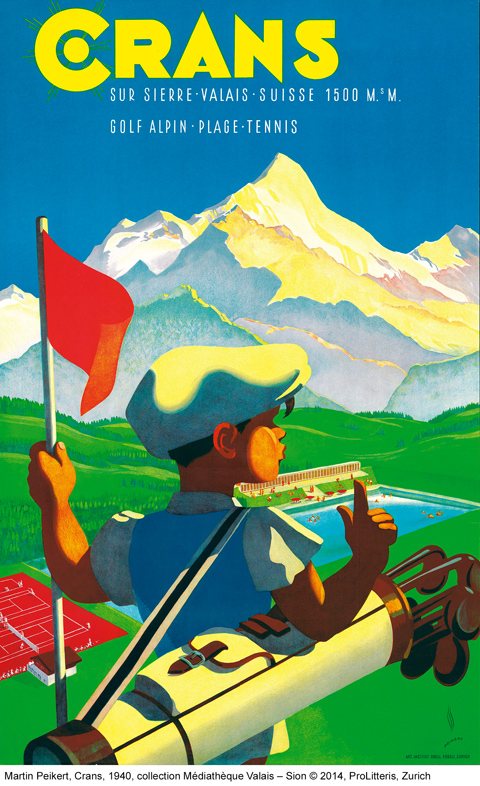
Women and mountains - late appreciation of the posters of Martin Peikert

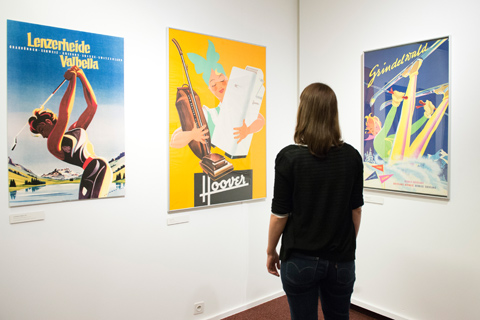
In his posters, women bask in the sun against mountain backdrops. Some of his creations, such as the little devil from Les Diablerets, have survived to this day. Martin Peikert is now receiving a belated tribute in the form of a book and an exhibition in Martigny, Valais.

He drew posters for Pontresina, St. Moritz, Gstaad, Crans-Montana, Villars, Verbier and numerous other tourist destinations, for which prices of over 20'000 francs have been paid at auctions. Nevertheless, his work remained unnoticed for a long time. The son of German immigrants was born on April 5, 1901 in the canton of Zug. At the age of 19, he went on a course at the Geneva School of Art, where, among other things, he learned to draw nudes and graduated with the maximum grade.

He opened his first own studio in Zug in 1927, before moving to the canton of Vaud in 1939. It was not until 1951 that he returned to Zug, where he died in 1975. After entering the advertising industry, Martin Peikert first drew for stores (Globus) and products (Persil). His first tourist poster followed in 1930 for the Interlaken lido. It shows a woman walking along the pool with a water balloon in her arms, with the mountains in the background.

Daring style

He continued this concept in numerous posters: a woman sunbathing in the mountains near Champéry (1938), a woman lying on a sundial in Pontresina (1939), another woman hopping over a snowman in Crans-Montana. This daring style is also found in a poster for Champéry from 1945, which shows a woman in a ski suit leaning against an entire mountain. Peikert places the outline of the woman and the mountain in a sensual context - so sensual that this advertisement would probably not pass muster today. He also draws his son Yan Peikert several times on his posters. Always in the background, he sketches the respective mountain massifs and develops into a master of landscape painting.

232868224
Since November 29, the Mediathek Valais - Martinach has been showing an important retrospective of tourism and advertising posters, including 58 originals created by the Zug graphic artist Martin Peikert between 1930 and 1960. A book and a DVD will be published in parallel with the exhibition (Image: Keystone).

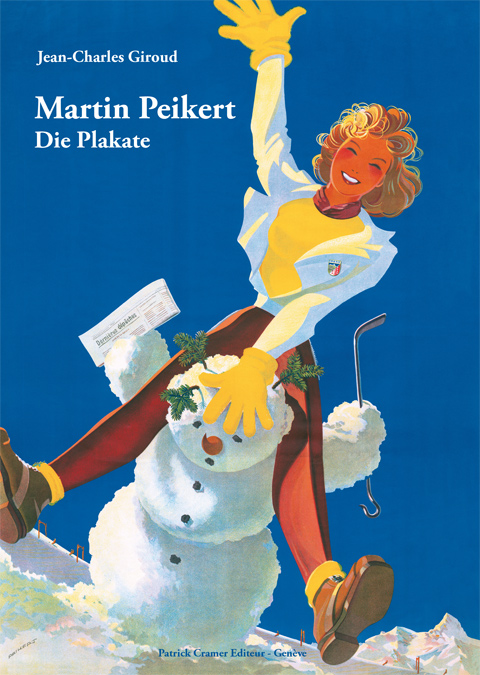
He gives his posters extraordinary life, says Jean-Charles Giroud, former director of the Geneva University Library and historian. He is the author of the book "Martin Peikert. Les Affiches" (208 pages published by Patrick Cramer Editeur), which was produced in collaboration with Peikert's children (see cover above).

couvertures-fra-et-all--livre-Peikert-2

Late recognition

Peikert did not receive too much recognition during his career, says Giroud. This also has to do with the fact that he was a loner professionally and did not leave anything in writing about his profession. In addition, tourism advertising received less attention than advertising for other products or culture. Peikert's style can hardly be classified in the history of Swiss graphic art, Jean-Charles Giroud notes.

mp-1958-1m

Little devil and chocolate cow

Some of his creations have endured to this day and are part of the cultural heritage. For example, Peikert designed a little devil playing a flute for "Les Diablerets" in 1947. It can still be found today in all the logos of the tourist destination. For the chocolate factory from Villars in the canton of Fribourg, he formed a cow from the letters "Villars", which is still known today. The factory erected oversized metal sculptures of this defining logo along the railroad lines, which are now protected.

mp-1947-2m
villars_m

From commerce to culture

Jean-Charles Giroud describes this cultural appreciation of the graphic artist as fundamentally paradoxical: culture is always against advertising. Advertising is often spurned, but sometimes later becomes culture itself and passes into the intangible cultural heritage. Official Switzerland also advocates an appreciation of Swiss graphic design and typography. These are among the eight proposals approved by the Federal Council at the end of October for inclusion in Unesco's World Cultural Heritage list. The historian Jean-Charles Giroud would like to make the Zug artist better known in German-speaking Switzerland. A German edition of his book marks the beginning. Whether there will be further exhibitions after Martigny is still open. (Andreas Stüdli/SDA)

06-DA_6_m
04-CA_258_m
06-CA_105_m

Twitter-Switzerland is at loggerheads

The escalating Twitter feud between a blogger and a journalist is causing a stir in the Swiss social media scene. Following the backlash, a legal battle looms.

The blogger with the pseudonym "Zora Debrunner" has deleted her successful Twitter profile, triggering a considerable shitstorm by Swiss standards under the hashtag #WeWantZoraBack unleashed - hundreds of tweets have called for Debrunner's return since Friday's escalation, and the term appears prominently in Twitter trends in Switzerland. Under the same pseudonym, Zora Debrunner also runs her 2014 Grimme Online Award-nominated Blogin which she writes about her grandmother's dementia.

The reason for the deletion of the Twitter profile is a dispute with journalist Andreas Gossweiler. Gossweiler blogs and tweets himself successfully. In a statement published on Facebook (see below), Zora Debrunner accuses him of harassing, insulting and defaming her "for almost two years". He had spread lies about her and also harassed others close to her. She deleted the profile after Gossweiler published her real name on Twitter: "That went too far for me." She filed a complaint, and others could follow.

To the news portal Watson Gossweiler rejects the accusations. Debrunner's real name could also be found easily via Google, he said, and he had not "outed" her. He accuses Zora Debrunner, who in his eyes is "nationally conservative-minded," of having called him an "asshole" or a "pimple on his nose" in debates. By publishing his real name, he said, he wanted to raise the inhibition threshold for the use of such vocabulary. He describes the statement as a "diatribe" and the accusations as "defamatory". As a result of the story, which caused him a sleepless night, he will stay out of discussions "with national conservative Twitterers" in the future.

Gossweiler is familiar with the issue of pseudonyms on the Internet. Under the name "Bobby California," he debated before and during years in heated discussions on Medienspiegel.ch, among other places, about the future of the media, how a Media Week Portrait 2011 reveals. His identity was exposed when he accidentally used linked profiles on a Blog commented.

Meanwhile, on Sunday evening, Zora Debrunner has expressed herself via Facebook contacted her former Twitter followers and asked them to let the matter rest and to refrain from "actions against individual users". Gossweiler complained on Twitter that someone had sent him "hundreds of pseudo-followers" and that his blog access figures had "exploded". The unintentional, inexpensive purchase of fake followers actually represents a sabotage tool for social media accounts, as they are easy to prove but difficult to explain. The high number of hits on Gossweiler's blog, on the other hand, is hardly surprising in view of the media echo and the considerable shitstorm. (hae)
 

get_footer();