Study examines optimal online display

A red background, a man's face, an animation, and a logo in the lower left corner—is this what the ideal online ad looks like? A study by Rocket Fuel bridges the gap between science and creativity and demonstrates the impact of design on the success of online advertising campaigns.

Rocket Fuel, a technology provider for digital advertising solutions, announced the release of its Guide To Creative Optimization on Thursday. The analysis quantifies the impact of specific design decisions on ad effectiveness. It shows that strategic design decisions can increase conversion rates in some industries by more than 600 percent. The influence of the content of the advertising message was also analyzed for individual sectors.

Almost 40,000 banners from 1,076 advertisers from 16 industries were analyzed for the comprehensive study. In total, there were 23.3 billion ad impressions between November 2013 and June 2014. Rocket Fuel divided the ads into categories to determine which elements are important to generate a reaction from customers or potential customers. Background color, presence of animation, length of animation, call to action, presence of the advertiser's logo, presence of images of people and presence of a special or limited time offer were examined.

"Rocket Fuel's Guide To Creative Optimization offers a rare consolidation of insights from some of the most important industries," says Arthur Ceria, Executive Creative Director and Founder of Creative Feed, a marketing strategy development and implementation company. "It's great to be able to review and use this knowledge internally. But this data is also very valuable for the work of our clients. There are great opportunities at the interface between performance data and creation, and it is extremely rare that a company brings this knowledge together, makes it accessible to others and thus gives us all the opportunity to improve."

"It's important to quantify the role of design in the success or failure of campaigns," says Robert Jones, Research Director at Rocket Fuel. "Using artificial intelligence to deliver the right ad to the right person is only part of the story. Our study shows that a significant part of an ad's performance is down to controllable factors such as background color or logo placement."

Design decisions can multiply the effectiveness of ads

The most important findings of the study include:

● Design for conversions, not click-through rates. Design elements of an ad that are good for the conversion rate often do not lead to a higher click-through rate (and vice versa). For example, in the entertainment industry, static ads had a 45 % higher CTR than animated ads, whereas animated ads had a 380 % higher conversion rate than static ads.

● The color red, male faces, animations and the placement of the logo can increase the performance of the campaign. The background color, the inclusion of animations and faces, the presentation of the product and the placement of the company logo show a significant impact on performance in all industries studied. Certain design decisions correlate strongly with better results, for example:

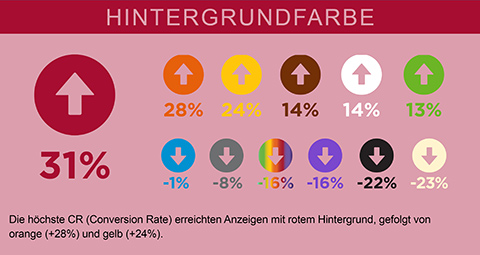
○ Red backgrounds led to an average 31 percent higher conversion rate in all sectors, whereas conversion rates for gray backgrounds decreased by an average of 8 percent.
Infografik-CreativeOptimisation

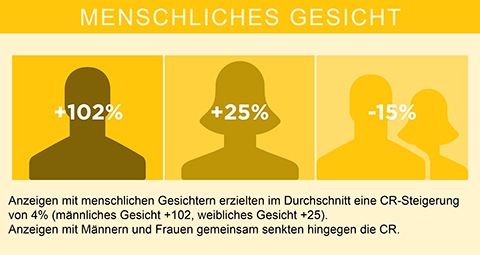
Ads with human faces had an average 4 percent higher conversion rate. Strikingly, male faces achieved an average 102 percent higher conversion rate than female faces.
Infografik-CreativeOptimisation_0

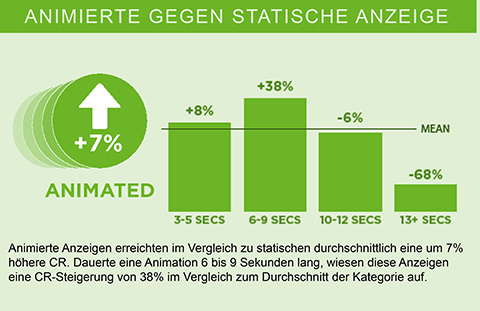
○ Animated ads showed an average 7 percent higher conversion rate in most industries, with ads with animations of 6-9 seconds (including repeat loops) showing the highest rates on average (138 percent higher).
Infografik-CreativeOptimisation_1

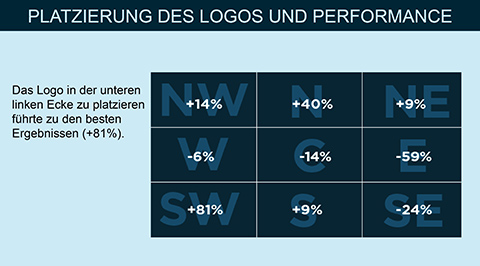
Ads with a logo in the bottom left-hand corner led to 81 percent higher conversion rates on average (compared to other placements).
Infografik-CreativeOptimisation_3

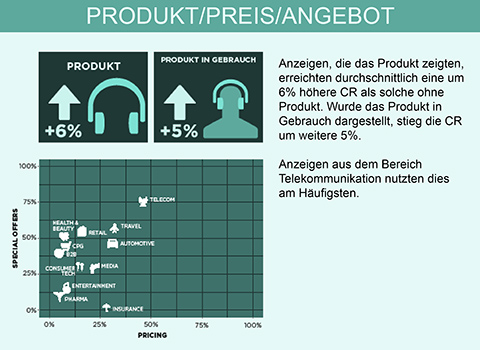
Ads in which the product is shown had on average 6 percent higher conversion rates than those that did not present the product.
Infografik-CreativeOptimisation_2

● The design "mainstream" is not always the most effective. For most design elements, the most popular variants were not always the ones with the best performance. This was particularly evident in the telecoms category, where only 10 percent of ads included an offer for a free phone or tablet, despite ads with such offers being significantly more effective: Compared to the average in this category, they showed a 98 percent higher conversion rate.

Certain advertising messages work particularly well in certain sectors

In addition to the results that are relevant for all industries, various industry-specific elements were also uncovered that have a high impact on conversion, including

● Automotive: Safety is important. Ads had a higher average conversion rate when the message centered around safety (+220 percent compared to fuel efficiency and reliability).

● Entertainment: Gender of the celebrity. Ads featuring male celebrities had an average 670 percent higher conversion rate than ads featuring female celebrities, although ads featuring female celebrities had a similar overall click-through rate on average. This seems to be confirmed by trends - while 52% of entertainment ads featured a celebrity, there was a strong skew within this, with 41% of ads featuring a male celebrity compared to 8% featuring female celebrities.

● Travel: length of the trip. Ads that included the length of the trip in their message showed an average 227 percent higher conversion rate than ads without this information.

● Restaurants: key messages and special offers. The sample included many volume-based offers for restaurants, such as offers for more for the same price (for example, free side dish or two for the price of one). These ads showed average conversion rates that were 284 percent above the industry average, outperforming ads that focused on price or competitor comparison.

"Some will look at the data and conclude that this puts too tight a limit on creation," says Eric Porres, Rocket Fuel CMO. "However, we think the opposite is true. The data shows what has worked well in the past, but doesn't limit what might work in the future. One of the biggest advantages of programmatic media buying is that it allows us to test virtually any idea or hypothesis you can dream up in a cost-effective and fast way under real-world conditions. This opens up new possibilities - and doesn't reduce them."

Further information on the study at Info.rocketfuel.com. Rocket Fuel makes no warranty or guarantee, express or implied, for the study. Reliance on or use of the study results is at your own risk.

ZSPR: Two new members on the board and a new vice president

Ina Gammerdinger and Olivier Burger have joined the Board of the Central Switzerland Public Relations Society (ZSPR). They succeed Mark Vogel and Andreas Renggli. Brigitte Heinrich hands over the office of Vice President to Reto Martinelli.

The members of the Central Switzerland Public Relations Society ZSPR met on April 21, 2015 for the General Assembly at Central Switzerland Television Tele 1 in Maihof in Lucerne. Before the official part of the general meeting, the agenda included a tour of the studios and a talk session with deputy editor-in-chief Adriano Gerussi. According to the press release, the items on the agenda of the Annual General Meeting were all unanimously approved - as were the election of Ina Gammerdinger and Olivier Burger to the Board of Directors and the appointment of Reto Martinelli as Vice President.

Vorstand_ZSPR_2015
From left to right: Brigitte Heinrich, Patrizia Hort, Jasmin Amrein, Olivier Burger, Marc Lustenberger, Ina Gammerdinger, Reto Martinelli, Stefanie Meier. Not in the picture: Lukas Portmann.

Ina Gammerdinger is a PR consultant and qualified social media online marketing manager at the Feldervogel communications agency in Lucerne. She specializes in online public relations and has been linking cross-media, integrated and networked communication concepts for the clients of the Feldervogel full-service agency for almost three years.

Olivier Burger, Head of Communications at the Swiss Museum of Transport, has many years of experience in public relations and corporate communications. He worked as a freelancer and editor in local journalism for ten years and as a project manager and consultant in the PR sector for twelve years. He has been working in corporate communications since 2012.

Reto Martinelli has been on the regional board of the ZSPR for six years and has in-depth knowledge of the industry. He is taking over the Vice-Presidency of the ZSPR from Brigitte Heinrich. Reto Martinelli is Head of Communications at the Association of Swiss Police Officers (VSPB). He brings with him a wealth of experience from previous activities in regional politics.

Brigitte Heinrich remains on the regional board of the ZSPR.


Federal Councillor Leuthard calls for CLA negotiations for media professionals

Media Minister Doris Leuthard is calling on publishers in German-speaking Switzerland and Ticino to negotiate a collective bargaining agreement (CBA) with the media industry unions.

The Federal Council does not intervene directly in such matters. "But I would very much like the publishers to be more open to discussion," said Leuthard in an interview with the newspapers Südostschweiz and Nordwestschweiz on Friday. She hopes that a CLA for media professionals will result in higher journalistic quality. Unlike German-speaking Switzerland, which has been without a contract for eleven years, there is still a CLA in French-speaking Switzerland. "This has a noticeably positive effect on the level of quality," said the media minister. The quality of journalists has "not deteriorated", Leuthard noted. However, they are under great time and cost pressure. "No wonder journalists sometimes write each other off." This type of journalism had "clearly increased" on online channels on Sunday, for example. The media companies need to ask themselves what level of quality they want - after all, the credibility of their products is at stake. (SDA)

Do we need a CLA for media professionals? Take part in our current survey (in the right-hand column).

Image: Keystone

Linkedin expands marketing portfolio

LinkedIn has expanded its marketing product portfolio in Germany, Austria, and Switzerland. At the heart of the expanded LinkedIn Marketing Solutions (LMS) is the LinkedIn Lead Accelerator. *Werbewoche* spoke with Alexandra Kolleth about the details.

Linkedin Lead Accelerator helps sales teams generate qualified leads during long and complex buying processes, addressing the common problem of using contact forms to generate leads. "Especially in the B2B sector, marketers rely on this, says Alexandra Kolleth, Head of Marketing Solutions for German-speaking countries, "even though few website visitors are reached in the long term this way: 95 percent leave no contact information at all (Sirius Decisions Benchmark Study), and of the remaining five percent, only 20 percent open follow-up emails from companies (Marketing Profs, "Email Open and Click-Through Rates: Benchmarks from Vertical")."

LinkedIn-Lead-Accelerator_d

Alexandra Kolleth explains how the Linkedin Lead Accelerator works and what goals you have in mind:

What exactly is the Lead Accelerator designed to achieve?
The Linkedin Lead Accelerator allows the identification of Linkedin members among otherwise anonymous website visitors. These members can then be targeted with relevant ads and content tailored to the user. We wanted to have a product that would allow us to work on the decision chain, especially in B2B or high-priced end-user products. With Lead Accelerator, we can also pick people up over longer periods of time during the buying process with different messaging. We try to keep finding new touchpoints in this decision chain and offer relevant information such as webinars or white papers.

What are the points of contact?
For the communication that we play out, we use our overall portfolio. For example, we can send users emails, place content marketing in the users' stream via so-called Sponsored Updates, place banner ads on the Linkedin site, or we use external advertising sites through which we also control the advertising to the respective identified Linkedin users.

How do you determine which customers advertisers want to target?
In order to determine which of our members advertisers want to target without wastage, we can target what we know of the user's profile: what seniority a user has, how big the company is where they work, what function they hold in the company, but also which groups someone belongs to and which company the user follows. This is followed by product discovery and content development.

Why was this technology developed?
After acquiring the B2B marketing platform Bizo in August 2014, we integrated and extended the technology into LinkedIn Marketing Solutions. AutoFill for filling out forms and an analysis tool are part of the solution.

How did the testing phase for the Lead Accelerator go?
We are now just finishing the testing phase in the DACH region and will actively go on sale on Friday, April 24. One of the customers who have tested the product worldwide is Lenovo. The company was able to reduce the cost per lead by 60 percent.

In German-speaking countries, companies such as BASF, IMD Business School, Lenovo and ABB use marketing solutions from Linkedin.

Interview: Ursina Maurer
 

Mirjam Jäger becomes sports presenter at Blick.ch

Former Swiss freestyle skier Mirjam Jäger is joining Blick.ch as a sports anchor. Starting in June, Jäger will present live coverage and various video formats on the sports platform.

Mirjam Jäger has competed four times at the World Championships (2009, 2011, 2013 and 2015) and once at the Olympic Games (2014). The highlight of her career was the bronze medal in the halfpipe at the World Championships in Kreischberg, Austria, in January of this year. In March 2015, Jäger retired from active competitive sport and from the Swiss Freeski Team national team.

From June, the Zurich native will present various video formats, talk shows and live coverage of sporting events on Blick.ch as the new face of WebTV. Her first appearance will be at the Tour de Suisse on June 13. Mirjam Jäger on her new role: "I'm really looking forward to this exciting task and the challenge of being on the 'other side' with a camera and microphone."

Felix Bingesser, Head of Sport at the Blick Group: "We are delighted that Mirjam Jäger has joined the Blick Group's sports editorial team as a new, fresh face. As a former top athlete, Mirjam knows what she is talking about. With her direct and cheeky manner, she will find her very own approach to Swiss sportspeople. Mirjam Jäger has a passion for sport. And she likes to be around people. Brilliant prerequisites for being a great asset to our team."
 

"How much is too much?"

Together with the Federal Office of Public Health (FOPH), Addiction Switzerland, the Professional Association for Addiction, GREA, Ticinio Addiction, and cantonal partners, Havas Worldwide Zurich is launching an awareness campaign.

The new umbrella brand is intended to encourage people to think about their own consumer behavior and asks, quite simply, "How much is too much?" "Our aim is not to deny people enjoyment and pleasure," says campaign manager Adrian Kammer. "Rather, we want to encourage a responsible approach to alcohol. For your own health, your family and your friends."

After work with colleagues, in the bar with girlfriends or after the match with the team: Alcohol is always present. Precisely because it is an integral and natural part of our lives, it is easy to forget how harmful it can be. It's hard to make a general statement about how much alcohol is okay. That is why a principle should be communicated instead: Those who drink alcoholic beverages do so without harming themselves or others. The campaign's key visual is also derived from this: The shattered glass, representing precious and fragile cargo. The pictogram is intended as a reminder that our health and relationships are also put at risk by a reckless approach to alcohol.

Pictograms also play a central role on the print subjects, the banners and in the TrueView films. Short and simple bills with pictures illustrate in a charming way how one too many glasses can make life difficult for us. Alcohol is not viewed in isolation. Rather, the Pictogram Stories with a wink at typical drinking situations. The text-based ads and banners also take a humorous approach to the small and large dramas surrounding alcohol in everyday life.

In addition, a new Website bring people closer to facts worth knowing. For example, a quiz with numerous short films in the look of the campaign enables a playful approach to serious topics. At the same time, the website creates a bridge to the partners in the cantons and NGOs. These additionally support the campaign with customizable below-the-line measures. In particular, with the Dialog Week, which will take place this year from April 30 to May 9, the partners address the population directly. Events such as cultural and sporting events and information booths in various cantons will address the issue of alcohol consumption.

The campaign will run for three years throughout Switzerland. It will kick off on April 23, 2015.

Responsible at BAG: Adrian Kammer (Head of Campaigns), Claudia Brunner (Head of Project), Petra Baeriswyl (Head of Alcohol Section), Barbara Kull (Communication Alcohol Section). Responsible at Havas Worldwide Zurich: Frank Bodin (overall responsibility), Peter Schaefer (strategy), Michael Kathe (creative direction), Denis Schwarz, Moritz Stillhart (art direction), Yannick Schaller, Mathias Bart, Markus Tränkle (text), Anne-Marie Pappas (graphics and illustration), Cara-Anne Specker, Eliane Stettler (art buying), Claude Eberhard (Digital Creative Direction), Joachim Probst (Online Marketing Consultant), Caroline Ronzani, Nuria Büchi, Amanda Portmann (Consulting), Toni Gadza, Noemi Rubera (d+p), Claude Lüthi (Illustration), William Crook, Roger Zürcher, Martin Brunner (Animation), Jingle Jungle (Setting).

BAG-Alk-A3-Toillettenposter
 

Excellent Swiss press pictures in the National Museum

Switzerland is no island, neither idyll nor museum. This is shown by the winning images of Swiss Press Photo 2015, above all those of Yvain Genevay.

For Le Matin Dimanche, the Swiss Press Photographer of the Year captures the lot of a Syrian refugee family:é The Syrian refugee family Jneid is mourning the loss of their youngest child. Mother Suoha, 22, suffered a stillbirth after being repatriated to Italy by Swiss authorities. The father is making serious accusations against the officials, saying they did not take his wife's poor health seriously.

swisspressfoto2

Eper communicates marketing activities

Eper (L’Entraide Protestante Suisse)—better known in German-speaking Switzerland as Heks (Hilfswerk der Evangelischen Kirchen Schweiz)—has commissioned M&C Saatschi in Geneva to promote its MEM mentoring program.

Indeed, MEM (Mentorat Emploi Migration) is in constant search of volunteers from different professional sectors. These are to help, during a defined period of time, qualified migrants to find a job in their usual field of work and according to their competences.

M&C Saatchi recommended to Eper a radio and digital campaign (Youtube/Google) based on a simple idea: The person you see or hear appears to be doing a job that corresponds to their diplomas in the country of origin. However, this turns out to be a mistake. This juxtaposition gives a strong impact to the message of the existence of the MEM program.

The campaign was also declined on banners and classified ads.

EPER - Hospital from Elias Amari on Vimeo.


Responsible at Eper: Olivier Graz (responsible of the Dept. Communication), Anne-Claude Ger-ber (responsible of the MEM program). Responsible at M&C Saatchi: Olivier Girard (Creative Director), Julien de Preux (Art Director), David von Ritter (Copywriter), François-Louis Noël (Strategic Planning). Radio: Apollo Studios. Film: Elias Amari.


Tele M1 celebrates 20th anniversary

On Wednesday evening, the regional television station Tele M1 celebrated its 20th anniversary at the «Einstein» restaurant in Aarau with about 150 invited guests.

In addition to local celebrities such as musician Pepe Lienhard, high-profile politicians such as Cantonal Councillors Urs Hofmann and Stephan Attiger, Council of States members Christine Egerszegi, Pascale Bruderer and Pirmin Bischof, and National Council members Yvonne Feri, Ruth Humbel, Beat Flach and Bernhard Guhl were among the well-wishers. On the occasion of the round birthday of the regional broadcaster, the highest Aargauer on a political level, Grand Council President Markus Dieth, also did the honors and held a laudatory speech. The evening was hosted by Tanja Gutmann.

Editor-in-chief Stephan Gassner, who began his career as a video journalist at Tele M1 in 1999, welcomed the guests with a look behind the scenes and back to the beginnings of the station. The two Tele M1 pioneers Heinz Lang (former editor-in-chief) and Hans-Ruedi Hottiger (former managing director), together with co-founder and former entertainment director Dani Nieth, entertained the guests present with witty anecdotes from 20 years of regional television.

Peter Wanner, founder of Tele M1 and current Chairman of the Board of Directors of AZ Medien, took the opportunity to give the guests a glimpse of the development from the founding days to today's TV station family of AZ Medien. Another highlight of the evening was the performance of Swiss soul singer Seven, who presented his new album "BackFunkLoveSoul" at the subsequent apéro riche.
 

High expenses depress Facebook's profits

Facebook continues to grow rapidly. Sales and user numbers of the world's largest online network increased significantly in the first quarter. However, profits fell due to high investment costs and expenses for new developments.

At 509 million dollars, profits were around a fifth lower than in the same period last year, as the US company announced on Wednesday. 1.44 billion users now visit Facebook at least once a month. That is 13 percent more than at the end of the year.

Sales, mainly advertising revenue, grew by 42% to 3.5 billion dollars. However, the strong dollar weighed on the balance sheet. Without this effect, the increase would have been 49 percent according to Facebook. Despite the high figures, Facebook recorded its lowest growth in a single quarter for two years.

In the current quarter, the network expects revenues to be reduced by ten percent due to the strong US currency.

Mobile strong

The proportion of revenue from advertising displayed on mobile devices such as smartphones and tablet PCs rose from 59% to 73%. Almost 800 million members now access the service from smartphones and tablets every day.

Operating expenditure rose by around 80 percent and research and development by 133 percent. Facebook incurred expansion costs for the WhatsApp messaging service, the Instagram photo service and the data glasses manufacturer Oculus Rift, among others.

Company founder Mark Zuckerberg had already announced that he would spend billions on expanding the business. The latest figures therefore came as little surprise. Facebook almost met analysts' forecasts in terms of revenue and slightly exceeded them in terms of profit. Nevertheless, the share price fell by just under two percent in after-hours trading. (SDA)


Burkhardt bookbindery becomes Bubu

Effective immediately, the Burkhardt Bookbinding Shop—already widely known as «Bubu»—is changing its name to Bubu.

Bubu offers the same services as before, but with a focus on its strengths: pioneering in the development of media products, expertise in haptic communication and the ability to integrate industrial, artisanal and digital production. In the new logo, the familiar book wings disappear and the term "bind" becomes central, symbolized by the bridge between the two "bu". In addition, the two "bu" guarantee that the proven expertise of the "Buchbinderei" and the sustainability concept of the family company "Burkhardt" will be carried forward.

In line with the name change, a new Website designed.
 

Last but not least: Lying scandal around blogger

Many cancer patients hung on her every word: Now, under mounting public pressure, an Australian health blogger has revealed herself to be a liar.

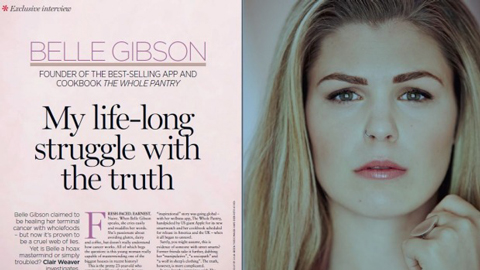
Belle Gibson made a splash since 2013 with her app "The Whole Pantry," which was hailed as the first app on health, wellness and nutrition. In her blog posts, the 23-year-old always assured that she had beaten her brain tumor with the help of a special diet and lifestyle. But she never suffered from this serious disease, as she now meekly admitted publicly.

gibson1
(Image: Theage.com.au)

Gibson's rise was so rapid that, according to media reports, her app was even selected by the U.S. company Apple for its new smartwatch Apple Watch. The young mother's fall is all the deeper now: in an interview with Women's Weekly magazine, she admitted to having lied about her entire story of suffering and recovery from the start. "None of it is true," Gibson said in the interview, titled "My Long Struggle with the Truth." She said she thought it was "best" to come clean about everything and now hopes people will say, "It's fine, she's only human." Gibson's hopes, meanwhile, appear to be only partially realized, as she has received hate mail and death threats since her confession, according to her own words. As to her motivation for building such a web of lies, she said only that she had a difficult childhood. An expert told Women's Weekly, possibly Gibson suffers from Munchausen syndrome. This is a mental illness in which sufferers feign symptoms and illnesses, sometimes even by self-harm, in order to deceive those around them and doctors.

gibson2
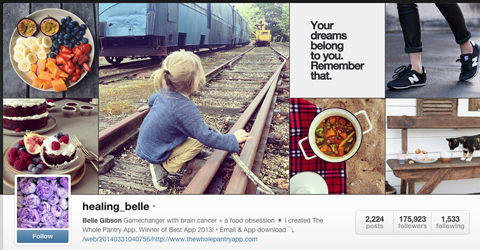
Gibson's Instagram page before it was removed (Image: Mashable.com)

The president of the Cancer Association of Victoria, Todd Harper, warned patients not to rely on therapies that sounded too good to be effective, in light of Gibson's scintillating health advice. Health officials plan to investigate the case further. Doubts about Gibson's integrity had arisen last month when it was revealed that she had not passed on donations equivalent to 222'000 francs from publication income to charitable organizations as promised. Gibson had also published a successful book on the subject, which was also withdrawn from sale by her publisher in March as the scandal slowly became public.

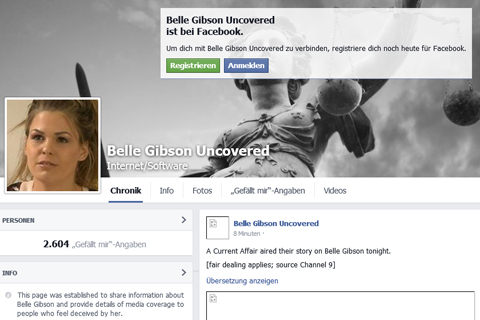
After this App lie could spread so fast, now also the uncovering in all its information and media-technical facets can be pursued already likewise; via Facebook. (SDA/uma)

gibson3


get_footer();