BSW criticizes Media Research Group ranking

The BSW Leading Swiss Agencies association distances itself from the advertising and media agency rankings published by the Media Research Group and, in a statement, casts doubt on the credibility of the survey.

BSW Leading Swiss Agencies had already decided in 2013 to end its collaboration with Media-Research Group and to work with the scientifically proven FCI of the University of St. Gallen, according to the press release issued on Friday. It now appears that the decision was the right one. The results would not stand up to direct comparison with the agency study conducted by the Research Center for Customer Insights at the University of St. Gallen among over 1,300 communication managers from 500 companies.

"The two overall rankings of media and advertising agencies published by the Media Research Group are not justifiable. If answers from clients who only know agencies from hearsay are mixed with those who work with them and processed into a ranking, this is not correct. A ranking just for the sake of publicity is not helpful."

BSW Leading Swiss Agencies deliberately refrains from a qualitative ranking of its member agencies, but provides them with the individual research results as a management tool.

The ranking published by the Media Research Group on Wednesday

Leo Burnett: International campaign for Emmentaler with Michelle Hunziker

To gain ground in the highly competitive European cheese market, Leo Burnett has launched an international campaign for Emmentaler. Michelle Hunziker was chosen as the campaign's spokesperson.

emmenthaler

The cheese markets in Europe are largely saturated and therefore highly competitive. Under the generic name Emmentaler, supermarket shelves are flooded with cheap large-hole cheeses. As a result, the original Swiss Emmentaler AOP has suffered a decline in sales over the last 10 years. A new transnational communication campaign is intended to give the brand a new boost and sustainably increase its desirability. The campaign developed by Leo Burnett pursues a clear premium strategy that emphasizes the uniqueness of the cheese in terms of origin, quality and taste. This not only justifies the sometimes considerable price difference to me-too Emmentaler cheeses, but also charges Emmentaler AOP with emotional value.

Emmentaler_Hunziker_Print

The face of the new campaign is none other than Michelle Hunziker. She grew up very close to the Emmental and is well known in Switzerland, Italy and Germany, the product's main markets. Specially commissioned market research confirms the enormous level of awareness of 82 to 97 percent in the target group of 35 to 65-year-olds with medium to higher incomes. The popularity and product fit parameters are also well above the benchmark for celebrity endorsement.

Emmentaler_Hunziker_PR

The campaign will be presented with an elaborate PR event in Milan and will be launched in Italy and Germany at the end of April with a TV commercial and comprehensive POS, event and online measures. The above-the-line communication focuses on special moments when the best choice has obviously been made. The TV commercial shows an indecisive Michelle in front of her closet and an even more determined Michelle in front of her fridge. With her characteristic nonchalance, she states: "It's really easy to decide. My Emmentaler must come from Switzerland. Just like me."

Sustainable platform

The new premium image does not break with the previous claim "The Swiss Original". Instead, the insight "Only the best is served at special moments" provides the necessary impetus to better exploit the potential of the traditional brand.

As in the past, Emmentaler AOP will continue to rely on more than one brand ambassador in the future. In Switzerland, these are Matthias Sempach and Sonia Kälin. And Michelle Hunziker will initially ensure in Italy and Germany that exclusivity and naturalness need not be a contradiction in terms. Michelle Hunziker's internal impact is no less strong than with the general public. Her internal speeches caused euphoria among the country managers and sales representatives even before the actual start of the campaign.

Republica continues for BFU motorcycle campaign

"Better eye contact than sheet metal contact": At the start of the motorcycle season, Republica is continuing the national FMS and BFU campaign to prevent motorcycle accidents.

Using existing and new measures, bikers are made responsible and careless motorists are targeted.

Spring marks the start of the motorcycling season. And with it the time for motorcycle accidents. Last year, the Swiss Motorcyclists' Federation (FMS) and the Swiss Council for Accident Prevention (bfu) launched a national prevention campaign to reduce collisions - designed and implemented by Republica. The Bern-based agency has now continued the campaign with proven and new measures.

bfu_StayinAlive15_F4_RZ_DRUCK

The campaign continues to communicate survival strategies for motorcyclists under the overarching motto "Stayin' Alive". Due to their narrow silhouette, motorcyclists are often overlooked in traffic and "shot down" through no fault of their own. The only way to prevent accidents is to think for motorists and ride defensively. Without losing the fun of riding altogether.

StayinAlive5_Plakate
StayinAlive_Web_DRUCK

The prevention messages are conveyed with a TV commercial, various posters, the "Biker Guide", which is already in its second edition, and the company's own Online- and social media appearances. New this year are entertaining viral videos that take aim at careless drivers. In addition, "Stayin' Alive" is represented with a stand at numerous biker events. The first wave of the campaign has been running since the beginning of spring, with another planned for the second half of 2015.

Responsible at FMS: Walter Wobmann (Central President), Claude Clément (Vice-President). Responsible at the BFU: Peter Matthys (Head of Campaigns/Marketing), Claudia Bucher (Head of Campaigns). Responsible at Republica: Mike Krüll (creative direction), Andreas Szentkuti, Yves Kamber (text), Lara Klopper (art direction), Tom Wyss, Linda Berger (consulting), Bala Trachsel (overall responsibility), Top Fuel (film production), Eliane Clerc (photography).
 

Basel West: Coop brochure "freshly" implemented

With a newly designed brochure, Coop informs customers about the proper handling of food on its way from the store to the plate. Basel West is responsible for the medium.

How should food be stored so that it stays fresh for as long as possible? What should be taken into account during preparation? How can leftovers be used to avoid food waste? And how can pests be kept out? The brochure is aimed at private households, schools and public institutions, which can quickly find out about the optimum storage conditions for different foods thanks to a standardized grid of tables.

Coop_Titel_0
Coop_Auftakt
Coop_Haltbarkeit
Coop_Resten
Coop_Sicherheit

Responsible at Coop, Basel: Jörg Ledermann (Head of Communications/Quality/Sustainability), Barbara Irniger Furtwängler (Head of Public Relations). Editorial: Eva Kaufmann. Content: Silvio Raggini (Head of Quality Center), Andreas Dörr (Head of Food Quality Assurance). Responsible at Basel West Corporate Communications, Basel: Markus Siegenthaler (consulting), Manuel Bürli (design), Sinia Brugger (lithography). Photography: Daniel Aeschlimann, Zurich, Heiner H. Schmitt Jr, Basel. Photostyling: Monika Hansen, Zurich. Print: W. Gassmann, Biel.
 

Adrian Plachesi new "7vor7" editorial director

Effective July 1, 2015, Adrian Plachesi will take over as editor-in-chief of the news magazine «7vor7.» He will replace Jan Krattiger, who has been serving as interim editor-in-chief and is leaving Telebasel at his own request to take on new challenges in Germany.

"It is with a heavy heart that I am leaving Telebasel and my editorial colleagues at "7vor7". We have grown into a great team over the past few months and there is a positive spirit of optimism," commented the Basel native on his decision in a statement.

As Telebasel presenter, editor and head of the background program "Telebasel Report", Adrian Plachesi has many years of experience in local journalism. "Telebasel has never changed as much in the last 22 years as it has now. That's why it's the best time to take on responsibility. We want to be the best news program in the region," says the 27-year-old, looking forward to his new role at Telebasel.

New Head of Communications at the Basel Department of Health

Anne Tschudin will assume the position of Head of Communications at the Basel-Stadt Department of Health effective August 1, 2015, taking over the duties of Jürg Diezig, who is retiring at the end of July.

The Government Council has approved the appointment of Anne Tschudin as the new Head of Communications at the Basel-Stadt Health Department. She will take up this position on August 1, 2015, replacing Jürg Diezig, who will be leaving the Department of Health at the end of July 2015 due to his retirement.

Anne Tschudin, born in 1969, is a federally certified PR consultant and completed her communications training in 2011 with an Executive Master's degree in Business Administration. She has over twenty years of communications experience, including eight years as Head of Corporate Communications at health insurer Sympany in Basel. Tschudin currently works as Clinic Manager Surgery at the Cantonal Hospital Baselland in Liestal.
 

Little trust in journalists and advertising

The «European Trusted Brands 2015» study also shows which professional groups and institutions people trust. Journalists and advertising score modestly—even in Switzerland.

Firefighters enjoy virtually unrestricted trust - and not just in Switzerland: They achieve the highest trust score in all seven countries among the 24 professions surveyed. In Switzerland, 92 percent of respondents expressed "very high" or "fairly high" trust in firefighters. They are followed by pilots (91 percent) and nurses (90 percent). Pharmacists (88 percent) and doctors (87 percent) are also trusted very highly in this country.

The least trusted are real estate agents (14 percent), soccer players (16 percent), politicians and car salesmen (18 percent each), call center employees (20 percent) and financial advisors (27 percent). Call center employees, however, do relatively well in Switzerland - the average of all the countries surveyed is 14 percent, while in Finland and Germany the figure is only 4 and 5 percent respectively.

Not quite as bad, but also in the bottom third, is the professional group of journalists. Only 28 percent of respondents consider media professionals to be trustworthy. The same figure was found in Austria, Romania and Russia.

  Dead. CH D FIN AUT POR ROM RUS
Fire department 91% 92% 92% 98% 94% 80% 92% 89%
Pilots 87% 91% 82% 95% 89% 80% 89% 80%
Pharmacist 82% 88% 82% 97% 92% 74% 77% 62%
Nursing Professionals 80% 90% 88% 95% 90% 78% 55% 62%
Doctors 79% 87% 81% 92% 87% 76% 73% 55%
Craftsman 78% 82% 68% 94% 78% 63% 79% 85%
Farmers 77% 79% 67% 84% 82% 74% 74% 81%
Teacher 73% 71% 61% 89% 64% 71% 73% 81%
Policemen 65% 79% 75% 91% 79% 62% 41% 30%
Army Officers 58% 62% 42% 74% 41% 46% 66% 75%
Metereologists 56% 58% 52% 73% 56% 58% 60% 33%
Judge 51% 58% 55% 70% 65% 33% 41% 35%
Priest / Parish priest 50% 47% 39% 69% 46% 44% 46% 56%
Cab driver 48% 52% 49% 79% 51% 27% 29% 48%
Lawyers 46% 54% 47% 55% 56% 22% 33% 55%
Tour operator 37% 50% 26% 61% 42% 24% 38% 20%
Journalists 30% 28% 26% 34% 28% 35% 28% 28%
Union leader 24% 31% 26% 32% 30% 16% 13% 23%
Financial advisor 23% 27% 15% 29% 22% 13% 26% 31%
Football player 18% 16% 17% 27% 14% 12% 10% 28%
Car salesman 16% 18% 10% 23% 17% 7% 17% 18%
Call Center Services 14% 20% 5% 4% 11% 15% 8% 37%
Real estate agent 14% 14% 6% 31% 9% 9% 15% 15%
Politicians 9% 18% 12% 9% 10% 3% 2% 10%

Institutions: Bringing up the rear: the advertising industry

The advertising industry enjoys even less trust in Switzerland - even if the relationship of Mr. and Mrs. Swiss to their institutions remains intact on the whole. Radio enjoys the most trust (75 percent), followed by the police (72 percent) and marriage (69 percent). Almost two-thirds (63 percent) still trust television, while more than half still trust the legal system (58 percent) and environmental organizations (54 percent). Advertising brings up the rear with just 13 percent. That is even 6 percent less than the much-maligned European Union (19 percent). The fact that advertising is not seen as objective, factual sales advice à la "Kassensturz," but rather as information that must always be received critically and with a healthy dose of mistrust, is hardly surprising on balance. (hae)
 

Radio 75%
Police 72%
Marriage 69%
Television 63%
Legal system 58%
Environmental organizations 54%
Officials 49%
Press 47%
Government 46%
Banks 45%
Church 39%
Unions 39%
International companies 33%
Internet 27%
Politicians 20%
European Union 19%
Advertising industry 13%

Mediapulse: Switzerland loves radio and TV

At its annual conference in Bern, Mediapulse presented a positive set of financial statements for the past financial year and the latest figures for radio and television. Both media continue to be very popular with the Swiss.

After a turbulent 2013, Mediapulse can look back on a calmer 2014 financial year. This is reflected not least in the pleasing annual financial statements of the independent research institution for radio and TV usage: The company generated an operating result before interest and taxes of CHF 617,000 and a corporate profit of CHF 554,000. The positive result allows for provisions and thus secures future investments in the two measurement systems.

A look at Mediapulse's development plans shows how important this financial backing is. The radio measurement system is to be fundamentally renewed in the next two years, and the next major development step is already being planned for the television measurement system.

Radio and television still top

The data from Mediapulse's two measurement panels show that the importance of radio and television remains high, even in times of increasing media competition. Radio remains the mass medium of choice in 2014. Every day, almost nine out of ten Swiss (87%) switch on a radio set and consume an average of 104 minutes of radio programs . Even in the youngest age group of 15-24 year olds, radio reaches around three out of four people every day (73%).

The population spends even more time watching television. An average of 134 minutes a day with a daily reach of 65 percent . This means that TV consumption not only stabilized last year, but is actually rising slightly. Viewers are increasingly taking control of the program themselves: In the fourth quarter of 2014, 8.4 percent of TV consumption in Switzerland was already time-shifted.
 

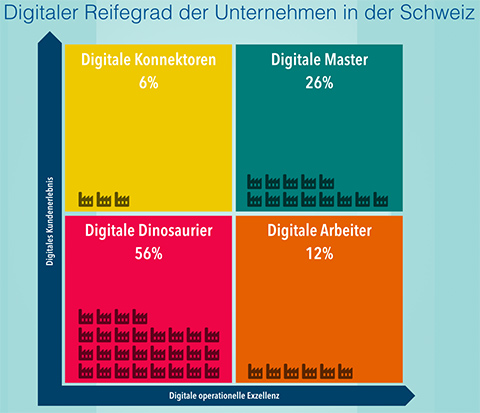
Over 50 percent of Swiss companies are digital dinosaurs

An HWZ study concludes that more than half of the companies and organizations in Switzerland lack digital expertise. At the same time, 74 percent of companies believe that digitalization is having a major impact on their industry.

Dino

The study was conducted as part of a master's thesis at the HWZ University of Applied Sciences in Business Administration Zurich. "Swiss companies still seem to lack digital know-how at both management and employee level," says Sven Ruoss, Head of CAS Social Media Management at the HWZ, summarizing the results of his study.

DigitalCH15-Dinos

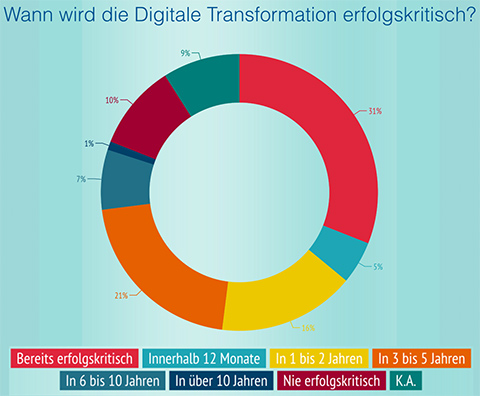
"This is despite the fact that 74% of the companies surveyed assume that digitalization will have a major or very major impact on their industry." For half of Swiss companies, this will be critical to success by 2017.

DigitalCH15-Lead

Lack of know-how at management level and lack of financial resources

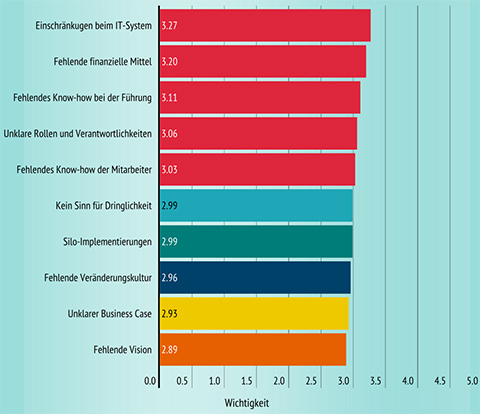
Swiss companies are mainly challenged by the digital transformation due to limitations in the IT system, a lack of financial resources and a lack of expertise at management level.

DigitalCH15-Challenge
The most important challenges of the digital transformation

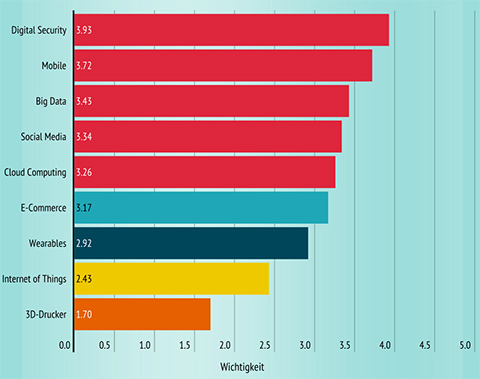
"A rethink is urgently needed, as no industry can escape digital development. A sensible use of digital possibilities can significantly increase customer loyalty and usually leads to an increase in efficiency in all areas," says Manuel P. Nappo, Head of the Center for Digital Business at the HWZ. The study identifies "digital security" and the areas of "mobile", "big data", "social media" and "cloud computing" as pioneering technologies. Product and service enhancements, an improved customer experience and increased productivity are listed as the most important reasons for companies to undergo digital transformation.

DigitalCH15-Techs
The most important digital technologies

About the study/master's thesis:

463 people took part in the study/survey. Of these, 77 % were male and 23 % were female. 62 % of the respondents are in management, 33 % have no management function and 5 % are self-employed. Further summarized information: Digital transformation in Switzerland
#DigitalCH15

High voltage: Spring campaign for Züger

Online ads drive Axel Springer

Digital classified ads are becoming a key revenue driver for Axel Springer. In the first quarter of 2015, the German media group (Bild, Die Welt) derived more than 60 percent of its revenue and 70 percent of its operating profit from its digital operations.

The strongest growth was again recorded by classified ads such as job ads and real estate ads, as Axel Springer announced in Berlin on Thursday. Group revenues rose by 12.7 percent to 780.6 million euros, while operating profit (EBITDA) increased only slightly by 1.2 percent to 119.8 million euros. Consolidated net profit fell by 34.4 percent to 43 million euros. The previous year's higher result was mainly due to one-off income from the sale of shares. Due to the internationalization of the digital business, Springer already generates around half of its revenues outside of Germany, said CEO Mathias Döpfner. Classified ad revenues increased by 58.5 percent to 176.2 million euros, while operating profit (EBITDA) rose by almost 47 percent to just under 71 million euros. Revenues from paid offerings remained almost stable at 348.7 million euros. Bild reached more than 260,000 digital subscribers in Germany, while the figure for Welt was 64,000. According to Döpfner, the question of the industry's fate is no longer how to defend paper circulation, but how to earn money with journalism online. (SDA)

Last but not least: safety distance

Thanks to the latest tech bells and whistles, Volkswagen drivers reliably maintain a safe distance from the car in front of them. Just as good—if not better—is the campaign promoting it.

Adaptive cruise control ensures (among other things) that the necessary safety distance is automatically maintained. In other words, cruise control takes the vehicle in front into account, allowing the driver to cruise even more relaxed. And if the distance suddenly becomes too small, the systems can intervene in various ways. For the drivers of "state-of-the-art" models, this has probably long been cold coffee, while the drivers of real older cars are still struggling with cumbersome concepts such as concentration, vehicle control and braking readiness.

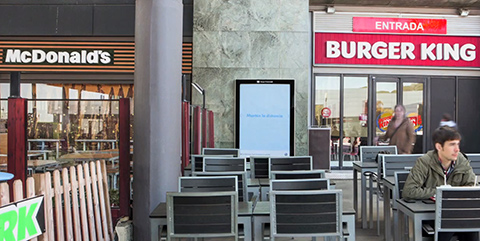
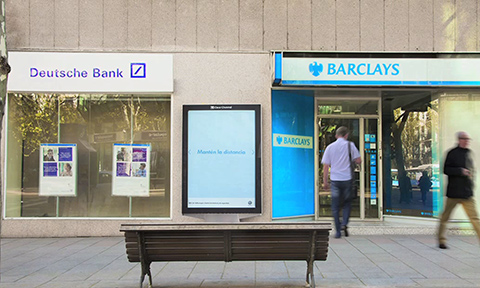
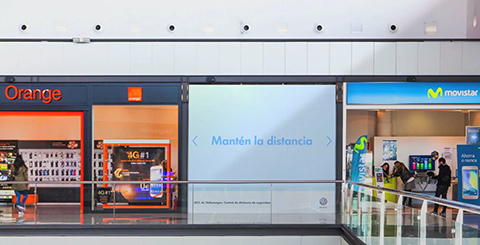
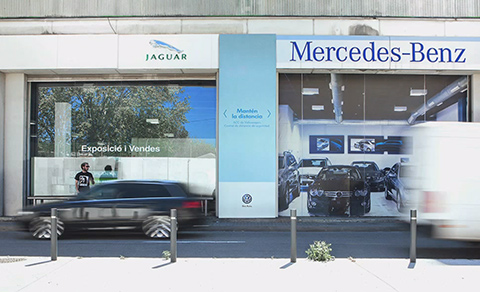
Certainly a good idea on balance. But DDB Barcelona had an even better one: To promote VW technology, the agency took the safety distance literally and developed a beautiful media idea from it. This simple poster...

Bildschirmfoto-2015-05-07-um-17.56.11

...only developed its effect through the places where it was hung/installed: Directly between neighboring competitors. A little distance never hurts. Even if it is surprisingly small in some of the examples below. Almost as small as on the highway. (hae)

Bildschirmfoto-2015-05-07-um-17.56.57
Bildschirmfoto-2015-05-07-um-17.57.23
Bildschirmfoto-2015-05-07-um-17.57.16
Bildschirmfoto-2015-05-07-um-17.57.34

get_footer();