Flop of the week: The end for the hidden camera

In a ruling last week, the Federal Supreme Court upheld the convictions against Ueli Haldimann, editor-in-chief of Swiss Television, and three others responsible for covert filming by the program «Kassensturz.» After several experts had already criticized the court’s ruling, Haldimann himself spoke out on Sunday.

In a ruling last week, the Federal Supreme Court confirmed the guilty verdicts against the editor-in-chief of Swiss Television, Ueli Haldimann, and three others responsible for secretly filming "Kassensturz".
After several experts had already criticized the court's ruling, Haldimann also spoke out personally on Sunday. In his blog, he writes that the ruling could have far-reaching consequences. "The hidden camera, which is used all over the world by the leading medium of television as the last resort of investigative journalism, so to speak, is being criminalized on Swiss territory." It is absurd, criticizes Haldimann.
At least the rather anti-media ruling has the advantage that the media industry is finally beginning to realize that the ongoing court proceedings regarding hidden cameras are about fundamental issues, namely the question of whether undercover research is permissible under certain conditions, the SF editor-in-chief continued. The Blick headlined on Friday: "The touts, touts and pawn catchers rejoice." "Now 'not only television has a problem', as print journalists are also no longer allowed to secretly record fraudsters on tape," Haldimann quotes the newspaper as saying.
The Federal Court's anti-media ruling is a slap in the face for all those journalists who do hard research and don't simply parrot what they read.

Press Council rejects complaint against Ticino newspapers

The three daily newspapers Corriere del Ticino, Giornale del Popolo and La Regione Ticino have not given special treatment to the electronics chain Media Markt. This was decided by the Swiss Press Council following a complaint by the Ticino association of electronics consumer specialists ASEC.

The three daily newspapers Corriere del Ticino, Giornale del Popolo and La Regione Ticino have not given special treatment to the electronics chain Media Markt. This was decided by the Swiss Press Council following a complaint by the Ticino association of electronics consumer specialists ASEC.
The ASEC accused the three Ticino newspapers of violating editorial independence because they had given Media Markt the opportunity to respond to critical letters to the editor about Media Markt advertising. The association also suspected preferential treatment because the company places numerous advertisements in the print media.
The Press Council will not take up the ASEC's complaint, the body announced in a communiqué on Wednesday. The mere suspicion is not sufficient to accuse the newspapers of violating editorial independence.

Peter Schibli appointed new director of Swissinfo

Swissinfo has a new director. Following a recommendation from the Swissinfo Committee, the SRG Board of Directors appointed Peter Schibli as director of the international news and information platform on Wednesday.

Swissinfo has a new director. At the suggestion of the Swissinfo Committee, the SRG Board of Directors elected Peter Schibli as Director of the international news and information platform on Wednesday. Schibli, Director ad interim of Swissinfo since August 4, 2008, succeeds Beat Witschi. The latter decided at the beginning of the year to leave the company at the end of August 2008 to take up new challenges abroad.
The 52-year-old Peter Schibli has been working for Swissinfo since March 2007. He was initially a member of the editorial board and then editor-in-chief from January 1, 2008. In August 2008 he became Director ad interim. He previously worked for over 20 years at the Basler Zeitung, first as domestic editor, then as foreign correspondent, and later as head of the online editorial team and multimedia manager.

"Flashing banners are annoying"

Planetactive analyzed the future for digital marketing in Switzerland at an info event.

Under the title "Digital Marketing Compass 08", the Zurich branch of Planetactive looked for "new opportunities for brand & business" in digital marketing. As with other recent studies, the experts agreed: The importance of digital media in Switzerland is continuously increasing. On average, Swiss Internet users already spend more than 3.5 hours a day in front of a screen. Newly heard at Planetactive: 44 percent of this time is spent surfing foreign websites. "So smart media planning would actually have to include advertising on these foreign portals," opined Martin Sinning, Managing Director Planetactive of Zurich and Vienna. Since it is well known that banners can be placed with pinpoint accuracy, it would be as easy as it is affordable to advertise a Zurich restaurant business on Spiegel Online as well. It is not known which Swiss companies are already pouring how much money into foreign websites. But it is probably not a little. But let's take it one step at a time.
The Internet as a leading medium
In order to present relevant data on digital media use in our country, Planetactive conducted a study in Switzerland together with the market research institute Skopos. This showed that the Internet has already become the leading medium in many important target groups. The younger the consumers, the "more extreme their disinterest in print". The researchers were surprised at the importance of newsletters. They are used by 52 percent of statistically relevant Internet users, while communities play a role for only 36 percent, or blogs for 16 percent, for example.
Internet TV is used by 13 percent. "But that doesn't mean that 13 percent of people have already swapped their old TV for a computer. Streaming is also included in the figure," Sinning clarified on the otherwise clear trend. In the case of online games, the study shows that users who use such games spend 46 minutes a day online.
And who will lose out if digital information consumption continues to rise in the future? Here, the study wanted to "predict" for the next 18 months that usage will continue to increase, but only in a flattening curve. 78 percent are of the opinion that the increase will be at the expense of the other media, print, radio, television. Print was named as the loser most often - by 47 percent. All the age groups surveyed agreed on this.
Acceptance of advertising in digital media
One in two respondents in the Skopos study by Planetactive said that "advertising in digital media has already had an effect" on them, i.e. that they have already obtained more detailed information and generally become aware of products as a result. Around a third are even tempted to interact. While more than half of the respondents "tend not to be bothered" or even "not at all bothered" by advertising on the individual advertising media, advertising on cell phones is virtually not accepted at all. Advertising on cell phones "will therefore decline." Layers on the web as well as cell phone advertising generate the greatest reactance, which is why interest in them is not particularly high. Advertising in newsletters and mailings, on the other hand, is perceived as "interesting. Only here do the majority of respondents tend to agree that they have "already bought something advertised. In summary, the experts thus had to state: The figures on the impact of advertising in digital marketing are "sobering". Before one acts here in the sense of the advertisement and does not only take note of it, still other creativities must be invented. Of the already existing forms, flashing banners are "the most annoying". Concrete product information interests for it most effectively.
Andreas Panzeri

Free newspaper .ch published with a new layout for the first time

The free newspaper .ch was published for the first time on Wednesday with its new design. The paper has taken on a more «tabloid-like» feel overall and makes heavy use of the colors red and orange. About a year after its first issue, the publishers are responding to low readership numbers and the failure of home delivery with this redesign.

On Wednesday, the commuter newspaper .ch appeared for the first time in a new and colorful design. The changeover to a new layout was announced around two weeks ago at the Departure of Sacha Wigdorovits has been announced as Delegate of the Board of Directors. The newspaper has become more "tabloid" overall and focuses in particular on the colors red and orange.
The previous departmental structure will be dispensed with in the new issue; the first ten pages of the Wednesday edition will run under "News", followed by the regional section (either Zurich, Bern, Basel, Lucerne or St. Gallen, depending on the location) as well as people and lifestyle pages. As before, the sports section runs from the last page towards the middle of the magazine. The content mixes soft and hard topics. For example, the latest figures on the so-called working poor in Switzerland can be found alongside a short report by TV chef Jamie Oliver.
.ch is also to be "consistently geared towards commuters", as the newspaper makers announced at the beginning of October. For example, an article on the "Service" page highlights the SBB's "Park and Rail" tariffs. As announced, the newspaper is now only distributed via newspaper boxes at stations and stops as well as via colporteurs. Home delivery has been discontinued. With an additional 650 locations, the number of boxes is to be increased to 2000 by the end of the year. This is expected to significantly increase the number of readers.
The new start will be financed by increasing the share capital of Media Punkt AG from CHF 10 million to CHF 18 million. However, the decision will only be taken at an extraordinary general meeting on October 28. The current Delegate of the Board of Directors, Sacha Wigdorovits, who made a significant contribution to the development of the newspaper as its initiator, will retire from his position at the end of October. .ch was first published in the fall of 2007.

img081022_ch

Striking...

Now in its fourth edition, Absolut Vodka is dressing its bottles in a new gift sleeve for the winter. This year, the bottles are adorned with 3,238 shimmering red sequins. Webewoche also took note of an advertising campaign by the Wapico agency at the Vedis Eye Center in Bern.

Passersby were wide-eyed
To promote the open house at the Vedis Eye Center in Bern, the Wapico agency set up two giant balloons last Saturday and had staff hand out flyers. Half-page ads featuring eye-themed designs were also created to announce the event.
1290582418_img081022_vedis

Red, Hot, and Stylish
Now in its fourth edition, Absolut Vodka is dressing up its bottles in a new gift sleeve for the winter. This year, the bottles are adorned with 3,238 shimmering red sequins. A zipper on the back ensures that the vodka can still be enjoyed. Absolut Masquerade is available in 76 countries worldwide, and in Switzerland, these limited-edition, glittering bottles can be found in select supermarkets.

1290582418_img081022_vodka
img081022_vodka2

To the point: A found meal

The economic crisis is intensifying worldwide and is also affecting people in Switzerland. When public sentiment is running high, it’s a goldmine for the tabloids.

The economic crisis is getting worse all over the world and is also affecting people in Switzerland. When people's emotions are boiling, it's a feast for the tabloids. A tabloid can do a number of things in such a situation: It can simply keep the indignation boiling or add fuel to the fire to further fan the people's anger. Another tried and tested method is to ask readers to comment directly and to give them the opportunity to express their outrage by letter, fax or e-mail, or to contact the accused directly by means of a pre-printed letter. This is to be done via the editorial office, because after all, one wants to keep the reins in one's own hands.
Blick is playing the whole keyboard with great relish these days. With ever new lurid titles, the story is spun on without end. Since we can't assume that all our readers read Blick, here are a few tidbits: "Bonuses back, Mr. Ospel," "Ospel disappears - anger grows," "When will you pay back your bonuses, Mr. Ospel?", "Money, Marcel!", "UBS and bonuses - it's okay to laugh," "Kurer had to grovel in room 235.
And of course it hails letters to the editor. The people's voice loves it clear and unambiguous. A quote from the gutter: "From now on, the Kronenhalle is off limits. For you, only McDonald's is allowed", "If you don't pay back your bonuses, we'll feed you on a crocodile farm", "All I can say is: Fie!" or "Mr. Ospel, you are the nightmare of the Swiss". From Wollerau, Ospel's place of residence, it sounds, "You are a disgrace to our community." Another writes "Boni back or emigrate".
Such journalistic behavior can be called a campaign. Blick editor-in-chief Bernhard Weissberg sees things differently. For him, the whole affair is not a campaign, but - as he reports in his "Scheff Blog" - a "campaign for decency. It doesn't get any more hypocritical than that.
Why not stand by it? Blick has returned to its roots and celebrates the classic tabloid style. No more of the emancipated tabloid that Ringier's chief ideologue Frank A. Meyer propagated for years and parroted by everyone, and that no one really knew what it was supposed to be. Now the two-handed sword is being used again and the lowest drawer is being opened.
But is it really a departure from Frank A. Meyer's ideas of a contemporary boulevard? In style, perhaps, but certainly not in substance. Citoyen Meyer can look proudly at his adepts from his Berlin villa. After all, the current mudslinging is about the fight of good against evil. An action for more decency. You can hear it.
Pierre C. Meier, Editor-in-Chief
[email protected]

Proud Mary: Putting the stork on the chain

To ensure that the stork doesn't bring any babies on the 2nd World Contraception Day, the Proud Mary agency chained him up. The image of the chained bird was intended to draw attention to the open house at gynecologists' offices.

On September 26, 2008, the 2nd World Contraception Day took place, an international campaign on the topics of contraception and sexual knowledge. In order to draw the attention of mainly young women to the "Gynaecologists' Open Day", which was organized by Bayer Schering Pharma in Switzerland, proud Mary used posters and flyers to put the classic Kinderbringer on the chain.
Client: Bayer Schering Pharma Switzerland. Agency: Proud Mary Communication for Women.

1290582420_img081021_weltverhuetung
1290582420_img081021_weltverhuetung1

Euro RSCG: Peugeot sent into the desert

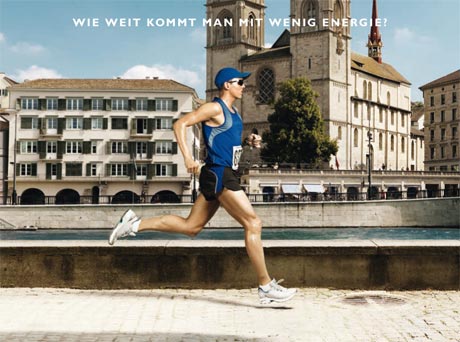
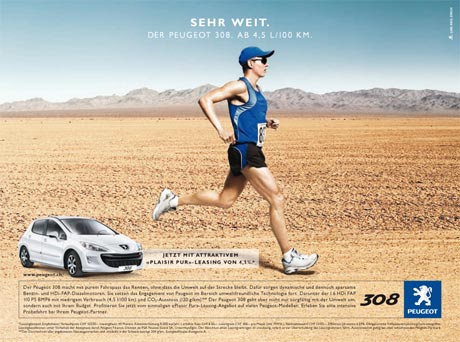
The Zurich-based agency Euro RSCG has launched a large-scale promotional campaign for Peugeot. The message, «Go far on little,» is intended to highlight the low fuel consumption of the Peugeot 207 and 308 models.

The Zurich agency Euro RSCG has realized a large-scale promotional campaign for Peugeot that draws attention to the low fuel consumption values of the Peugeot 207 and 308 models. In addition, the "Plaisir Pur" promotional package was put together to entice customers with advantageous leasing rates.
A TV commercial symbolizes the frugal energy consumption of cars: a marathon runner in the desert runs past a helper who holds out a cup of water to him. But instead of grabbing the whole cup, the runner just dips his finger in and puts it in his mouth.
>To the spot
In print, the message "Go far with little" was implemented as a follow-up ad. On the first page, the runner starts in the local area. If you turn the page, the runner has made it to the desert. As this was a national campaign, the runner was photographed at various locations, in Zurich, Lugano and Geneva, with the respective city landmarks in the background.
The campaign has already started and includes daily newspapers, Sunday press, magazines, TV, radio, Internet, POS and direct marketing.

Responsible at Peugeot: Aymeric Duval (Marketing Director), Marcus Brugger (Head of Advertising & Promotion), Marion Pfäffli (Advertising Manager), Lukas Vasvary (Trade Marketing). Responsible at Euro RSCG: Frank Bodin (overall responsibility), Jürg Aemmer (CD), Nemi Gajic (text), Marietta Albinus (art direction), Caroline Webb (art buying), Regine Cavicchioli (graphics), Niklaus Huwyler, Christine Leitl, Fiona Gottwald (consulting), Gian Paul Lozza (photography), Red Department (image processing).

1290582422_img081021_peugeot_1
1290582422_img081021_peugeot_2

Creative Factory: Two new orders with Kambly and Gain

The Creative Factory has secured two new accounts. The European branding agency will support Kambly and the independent alliance Gain with brand management and communications.

The Creative Factory has won two new mandates with Kambly and Gain. The European branding agency will draw up a balance sheet for the Swiss biscuit manufacturer and develop communication strategies to highlight the company's innovative development. Kambly's identity is also to be strengthened with a strong emotional brand connection for consumers.
The European agency will also support the independent alliance Gain (Global Alliance for Improved Nutrition) in profiling its identity and developing a new program for it in the fight against malnutrition. Within this framework, communication strategies will be defined to attract public and private partners worldwide to participate financially or technically in the four-year, 800 million dollar program.

Last but not least: Fine humor

What do you do when no one wants to become a police officer anymore? You reach out to the creative industry, and it recruits—just as the textbook says—by targeting specific demographics.

As the Bern cantonal police ran out of cops and wanted to fill the ranks of the police academy again, it launched a provocative recruitment campaign in September that played on prejudices about the police. Apparently a complete success: applications from young people who want to become police officers have increased by over 50 percent, according to the cantonal police on request. They therefore want to advertise again next year. This year's posters were emblazoned with phrases such as: "D'Bulle si schtier.", "Bir Schmier machsch geng ds gliche." or "Tschugger si dumm.". The bottom of the poster then stated that the claims were not true.

KSB/SJ chases away nightmares with children's songs for Finetra

The KSB/SJ agency has created three radio spots for the specialty bedding store Finetra, designed to highlight the benefits of the company’s beds, mattresses, and bedding sets. The spots take listeners on an emotional roller coaster.

The agency KSB/SJ has created three radio spots for the bed specialist Finetra, which are intended to get to the heart of the benefits of the company's beds, mattresses and bed sets. The spots send the listener into a rollercoaster of emotions: the ominous music at the beginning, which evokes classic horror images, gradually turns into a nursery rhyme - and in the end it was all just a bad dream. The comfort of the beds is also emphasized with the cover "Even nightmares find peace there".

Responsible at Finetra: Besim Bulica (owner and managing director). Responsible at KSB/SJ: Andreas Mädler (creative direction), Andy Lusti (text), Marlon Perini (graphics), Marco Serratore (consulting management), Astrid Krauss (consulting), Selmi-Tonstudio (production), Chris Grunder, Renzo Selmi (recording management).

>Spot 1
>Spot 2
>Spot 3

get_footer();