Brüngger Bachmann Dialog provides jury member for the John Caples Award

This year, Daniel Brüngger of the Zurich-based direct marketing agency Brüngger Bachmann Dialog will serve on the international jury of the prestigious John Caples Award. This marks the fourth time Switzerland has been represented by a jury member at the John Caples Award.

This year, Switzerland will be represented on the international jury of the prestigious John Caples Award by Daniel Brüngger of the Zurich-based direct marketing agency Brüngger Bachmann Dialog. He will act as a juror during the competition in New York and compare outstanding work in terms of strategy, creativity and success during all jury days worldwide. Brüngger has already been a jury member of the Swiss Dialog Marketing Award several times.
The John Caples Award jury is made up of 35 direct marketing experts from twelve countries. It is headed by two jury presidents, one each for rounds 1 and 2 and one for round 3. Switzerland is represented at the John Caples for the fourth time by a jury member, alongside the big names in direct marketing such as the USA, Canada, Australia, Great Britain, Spain, Singapore and South Africa.
Alongside Cannes, the John Caples Award in New York is one of the world's most important competitions for off- and online direct marketing. In the past, over 1,000 entries from 50 countries were submitted and judged each year.
Read the big interview with Daniel Brüngger in the new Werbewoche on Thursday.

Agence Trio raises money for the Centre Social Protestant

Agence Trio has won the mandate for the "Appel de mars" fundraising campaign of the Centre Social Protestant (CSP). The CSP is a non-profit organization that is financed by donations.

In competition with three other agencies, Agence Trio, based in Lausanne and Zurich, has won the mandate for the "Appel de mars" campaign of the Centre Social Protestant (CSP). The CSP, which offers legal assistance and life counseling among other things, is active in the cantons of Vaud, Geneva, Neuchâtel and the Bernese Jura. The association has been organizing campaigns for over 15 years to collect the precious donations that finance the salaries of the advisors of the services offered. Trio's creation will be on display next March.

Sunday includes fresh eggs

Wirz visualizes with a campaign how the newspaper Sonntag CH should enrich the most beautiful day of the week.

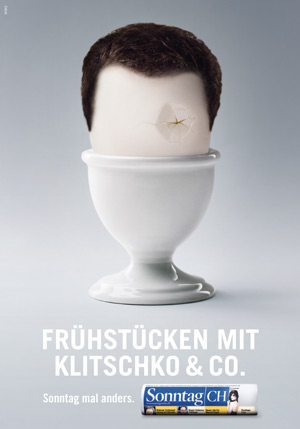
Reduce in the simplest way: That was Wirz's concept for the Sunday newspaper published by Mittellandzeitung. The campaign starts on October 23. For the paper with the pragmatic name Sonntag CH, the team around CD Matthias Freuler and AD Andrea Reinhart wanted to create the most enjoyable reference possible to the "most beautiful day of the week".
On Sundays, most people have more time for a hearty breakfast. And as well as a fresh egg, this naturally includes the right newspaper. This newspaper aims to entertain and inform readers not only in the Mittelland, but also in the enclosure of the previous top dogs with the most important news from society, culture, sport, politics and business. This will be publicized with a "cheerful guessing game", which is intended to attract attention, especially in the Zurich and Bern regions. The hairstyles were styled by Andrea Kummler in real size. The photos were then transplanted onto real egg cups in the computer.
Andreas Panzeri

1290582414_img081022_wirz_sonntag1
1290582414_img081022_wirz_sonntag2
1290582414_img0801022_wirz_sonntag3
1290582414_img081022_wirz_sonntag4

Radio Liechtenstein to receive special grant

The government in Vaduz wants to make a special contribution to the state broadcaster Radio Liechtenstein. This is intended to finance investments in infrastructure. Parliament will now decide on the grant of 458,000 Swiss francs.

The government in Vaduz wants to make a special contribution to the state broadcaster Radio Liechtenstein. This is intended to finance investments in infrastructure. Parliament will now decide on the grant of 458,000 Swiss francs.
The money will be used to renovate two broadcasting studios and improve coverage in the municipality of Balzers with a small transmitter, the Department of Transport and Communications announced on Wednesday. The sponsor, Liechtensteinischer Rundfunk, is unable to raise sufficient funds for the investments.
Also on Wednesday, the government passed the 2009 budget for the radio station to parliament. The budget anticipates expenditure of CHF 3.38 million and income of CHF 1.915 million. Thanks to the state contribution of CHF 1.5 million, the bottom line is a small surplus of CHF 35,000.

Keep up the good work

Werbewoche editor René Worni on quality in print and online.

The following is a small contribution to ease the controversy as to whether print or online journalism can claim quality:
The German media journalist Stefan Niggemeier recently formulated the following thesis at the conference of the German Journalists' Association: "Publishers and broadcasters are currently trying out the Internet to see if they can do it with less journalism." Niggemeier supports his thesis with eight rules: 1. online journalists do not have to be able to write. 2. editing and correcting is optional. 3. every medium on the Internet becomes a tabloid medium 4. relevance is not a criterion. 5. what is easily researched is reported. 6 Editorial and advertising do not have to be separated so precisely. 7. why show a good photo when 100 bad ones will do? 8. clicks always come before quality.
In contrast, the 20 most popular sentences during the newspaper review collected by the Austrian quality paper Standard are: 1.
2. that leaves me perplexed. 3 I enjoyed reading it. 4 I don't understand that ... 5 The reader doesn't understand that ... 6 This graphic is incomprehensible. 7. the article leaves me perplexed. 8. traxler is great again. 9. again no web tip on the whole page. 10. the first paragraph is too long. 11. the sentence goes on for 17 lines. 12. beautiful pictures in sports. 13. wonderful titles in sports. 14. funny picture texts in sport. 15. sport has too little space. 16. we have better/more detailed/... than ... 17. we need an interview. 18. that's boch'n.
19 Why don't we have that? 20. go on!

Media in crisis - that's right!

The interpretative power of the apparatuses dominates over the enlightening power of independent media. Because trust in the competence and sense of proportion of these media is lost, the connections no longer work. Guest commentary by Karl Lüönd, journalist and author.

"Why pump if it's not necessary?" Pascal Couchepin smiled smugly into the camera. There is much to suggest that he already knew at this point that it would be necessary. But the Federal Council's information policy told him to mislead the public.
When it actually happened, the media - from Blick, which relished Ringier's vendetta against Weltwoche, to "Giacobbo/Müller" - initially mocked Weltwoche and its author Gerold Bührer. The weekly newspaper summarized the state of knowledge on its final day, Tuesday, October 14, not unoriginally with a paraphrase of Ben Vautier's provocation at the Expo in Seville. The fact that the Handelszeitung produced an analogous flop - had to, because it too was subject to the same technical constraints and lead times of a weekly newspaper - was not noticed anywhere.
Shit happens - so what? Colleagues would have been wiser to account for two phenomena that prove that the media are also in crisis, and not just since the 68 billion euro news from the combined vaults of the Federal Palace and the National Bank.
Phenomenon 1: Information is organized, channelled and thus domesticated. The interpretative power of the apparatuses dominates over the enlightening power of independent media. Because trust in the competence and sense of proportion of these media has been lost, the connections no longer work properly.
If it is true that at least a hundred people in the Swiss parliament, the Swiss National Bank and UBS have known about the secret for days, it is a great feat of information management (or manipulation) that nothing leaked out prematurely. As editor-in-chief of an important newspaper or television station, I would ask myself: How good or how bad are my relationships, how damaged is my trust capital that nobody warns me - at least in hints - against premature and apodictic assessments on such days? To the tune of: Watch out, that's all I can tell you, but there's something big in the bush ...
I'm not advocating indiscretions, although I've never had anything against them, especially when I could benefit from them. But the way in which the overpowering information machines of the authorities and the banks, including the National Bank, have dealt with the media reflects the fundamental distrust of those in power towards the media. They use us as amplifiers or as useful idiots, but we are actually a nuisance to them. That's why they harass us wherever they can - just look at the decisions on awarding licenses to private radio and TV stations in the near future!
Phenomenon 2: This mistrust is understandable as long as the interpretations published after the explosion report are as erroneous and tendentious as they were. The media herd of mutton quickly agreed that it was a "rescue operation", possibly at the last minute (and not a quick and decisive proactive move, as one might see it). And it was a kind of subsidy (and not a deal - a risky one, perhaps, but a deal nonetheless - with the speculative interest rate of 12.5 percent).
In any case, the whole story was brought to a head with the bonus issue in close cooperation with the state-believing left. Not only the readers understand this, but above all the writers. They blithely demand that valid contracts should now be broken, and just as blithely quote bonus figures as if they had not been largely blocked and now worthless options, but cash.
The media should have the task of differentiating, creating clarity, demonstrating a sense of proportion. Instead, they blithely localized, emotionalized and personalized. The Tages-Anzeiger sent reporters into the teller halls as if there was something to be learned there about the extent of the migration of savers from the big banks to the cantonal and Raiffeisen banks. Blick is already hyperventilating in its use of language. The commanding tone of the last few days can only be increased by the ultimate headline: "Death penalty for Ospel!"
My bet is still on: not even half of our business journalists are able to read a balance sheet, let alone correctly interpret highly complex processes in the banking sector. As long as this is the case, it serves us right if the PR industry's façade cleaners mislead us through and through.

1290582415_img081022_illustration
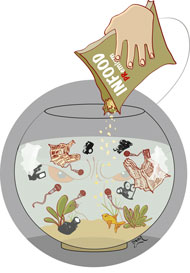
Illustration Davor BakaraI'm not advocating indiscretions, although I've never had anything against them, especially when I've been able to profit from them. But the way in which the overpowering information machines of the authorities and the banks, including the National Bank, have dealt with the media reflects the fundamental distrust of those in power towards the media. They use us as amplifiers or as useful idiots, but we are actually a nuisance to them. That's why they harass us wherever they can - just look at the decisions on awarding licenses to private radio and TV stations in the near future!
Phenomenon 2: This mistrust is understandable as long as the interpretations published after the explosion report are as erroneous and tendentious as they were. The media herd of mutton quickly agreed that it was a "rescue operation", possibly at the last minute (and not a quick and decisive proactive move, as one might see it). And it was a kind of subsidy (and not a deal - a risky one, perhaps, but a deal nonetheless - with the speculative interest rate of 12.5 percent).
In any case, the whole story was brought to a head with the bonus issue in close cooperation with the state-believing left. Not only the readers understand this, but above all the writers. They blithely demand that valid contracts should now be broken, and just as blithely quote bonus figures as if they had not been largely blocked and now worthless options, but cash.
The media should have the task of differentiating, creating clarity, demonstrating a sense of proportion. Instead, they blithely localized, emotionalized and personalized. The Tages-Anzeiger sent reporters into the teller halls as if there was something to be learned there about the extent of the migration of savers from the big banks to the cantonal and Raiffeisen banks. Blick is already hyperventilating in its use of language. The commanding tone of the last few days can only be increased by the ultimate headline: "Death penalty for Ospel!"
My bet is still on: not even half of our business journalists are able to read a balance sheet, let alone correctly interpret highly complex processes in the banking sector. As long as this is the case, it serves us right if the PR industry's façade cleaners mislead us through and through.

1290582415_img081022_illustration
Illustration Davor Bakara

Mobile TV less successful than expected

DVB-H mobile TV, which is broadcast from a TV mast, has been less successful than Swisscom had hoped when it was launched in the spring. The reason for the low demand is the small selection of cell phones that can receive television on the move.

DVB-H mobile TV, which is broadcast from a TV mast, has been less successful than Swisscom had hoped when it was launched in the spring. The reason for the low demand is the small selection of cell phones that can receive television on the move.
Until the end of September, TV reception was only possible with the Nokia N77. There are currently four devices, said Swisscom Broadcast boss Jean-Paul de Weck at the 7th Communications Days on Wednesday.
Swisscom launched mobile TV broadcast from the TV mast in mid-May in order to benefit from the European Football Championship. Live broadcasts are also the most watched programs on cell phones.
DVB-H is limited to the four metropolitan areas of Zurich, Basel, Bern and the Lake Geneva basin. It currently reaches 44.7 percent of the Swiss population and 31 percent in buildings. Swisscom currently has fewer than 5,000 customers who watch television on their cell phones.
In order to boost the DVB-H business, Swisscom is considering additional uses. Other types of end devices, such as navigation systems, USB sticks for PCs, portable DVD players or iPods, would be suitable for mobile television with DVB-H. Traffic information or advertising could also be broadcast via DVB-H, according to de Weck.

No water, no fun ? and no electricity either

Wirz takes a humorous approach to the topic of energy conservation on behalf of the Zurich Cantonal Power Company.

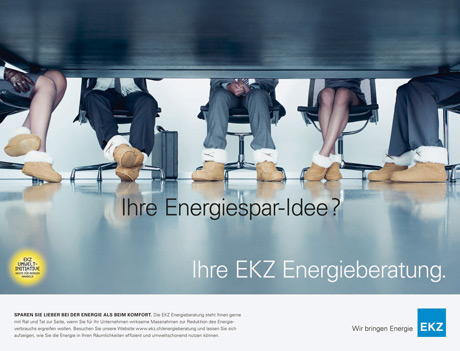
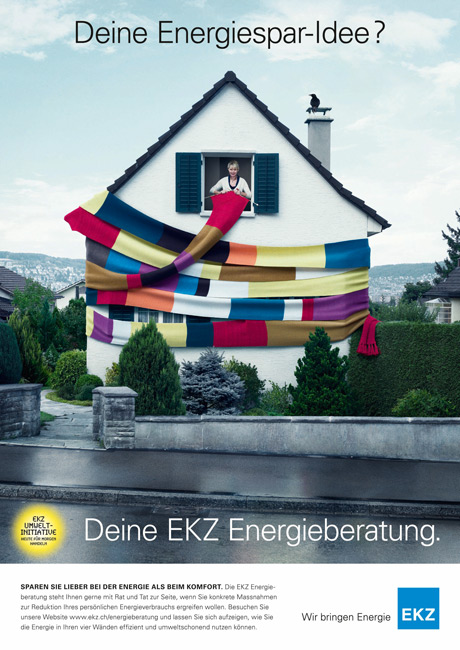
Saving energy has become a fashionable topic. And what you hear again and again is perhaps more likely to be ignored than taken note of over time. That's why Wirz Werbung wanted to take a humorous approach to this serious topic for once. Original savings ideas were created in which the effort and result "are perhaps not in the most comfortable relationship to each other", as CD Thomas Kurzmeyer says.
"No water. No fun" uses a stranded pedalo to dramatize what happens when we run out of water. And warm finks in the office: is this really the best idea for saving energy? The campaign is set to run for three years and will come up with many more such "ideas".
EKZ is committed to the responsible use of natural resources with a variety of measures. It was therefore fitting that Wirz wanted to attract attention with a few pranks in the guerrilla and ambient areas in the run-up to the current print campaign. The advertisers had the EKZ donate bathing islands in various Zurich lakes. These were used to promote the environmentally friendly Aquastrom and to point out that some things are better with water. Pedalos, which were placed throughout the canton in places where such boats had never been seen before, said the same thing.
Andreas Panzeri

1290582414_img081022_wirz_ewz1
1290582414_img081022_wirz_ewz2
img081022_wirz_ewz3

Logitech wins GfM Marketing Award 2008

Logitech won the 2008 GfM Marketing Award for outstanding marketing achievements. The company was specifically recognized for its long-term, profitable growth, which is based on a strong culture of innovation.

Logitech has won the GfM Marketing Award of the Year 2008 for outstanding marketing performance. The Society for Marketing, at whose 67th General Assembly the award was presented, recognized the manufacturer of peripherals for its commercial success in recent years. For more than a quarter of a century, the company has manufactured products that stand for design, quality and innovation, the GfM said.
Special recognition was given at the event, which was held at the Dolder in Zurich, for the company's long-standing and profitable growth, based on a strong culture of innovation. In his acceptance speech, Gerald Quindlen, President and CEO of Logitech, said he was delighted to receive such an important award in Switzerland, where the company's history began 27 years ago.
Logitech's peripherals for PCs and consumer electronics are sold in more than 100 countries. The company, which has Swiss roots, employs over 9,000 people in more than 30 countries, and it achieved annual sales of 2.4 billion US dollars in 2008. The GfM Marketing Prize, worth 20,000 Swiss francs, has been awarded annually since 1984 to personalities and companies that stand out for their outstanding marketing achievements.

1290582415_img081022_logitech
At the award ceremony (from left): Prof. Dr. Manfred Bruhn, President of the GfM Foundation Board, and Gerald Quindlen, President and CEO of Logitech.

New communication concept for the Gottlieb Duttweiler Institute

Categories

Uncategorized

Inform launches Helsana's customer magazine as an e-paper

Inform has redesigned the customer magazine Senso and the newly conceived employee magazine Info to accompany Helsana's new brand identity. An e-paper version of the customer magazine Senso with additional functions and features is new.

Inform has redesigned the customer magazine Senso and the newly conceived employee magazine Info to accompany Helsana's new brand identity. An e-paper version of the customer magazine Senso with additional functions and features is new.
Among other things, customers can click directly on web links on the e-paper, forward or print out individual pages and search for specific content using keywords. Other options include the integration of videos, online surveys and competitions or reading articles aloud.
The cross-media agency Inform is responsible for the redesign and implementation of both corporate publishing projects.

The four sites of youth

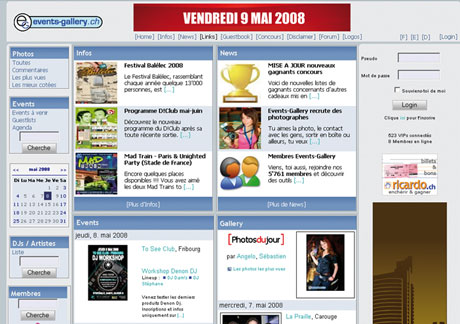
Mediabox has brought together the four portals Students.ch, Partyguide.ch, Outnow.ch, and Events-gallery.ch into a new youth portal.

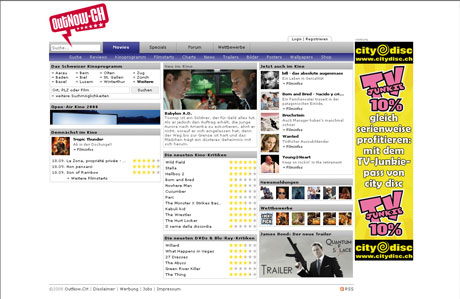
Party, film, cinema, study and music: Mediabox has selected a strong site from each of these youth segments and combined them into its new youth pool. Combined, this results in around one million unique users. In concrete terms, that's over 25,000 visitors a day who visit Outnow.ch to find out about the latest new releases in the areas of film and games. Here you will not only find the cinema program for the whole of Switzerland, but also reviews, charts and trailers.
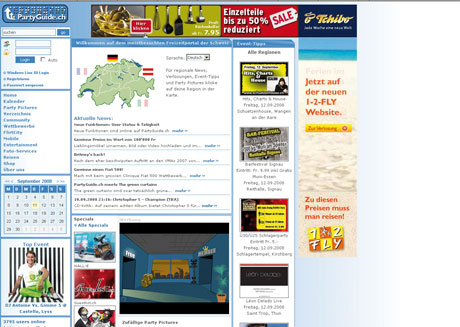
Partyguide.ch, the "oldest and most visited leisure portal in Switzerland", records 128,000 visitors a day. Clubs and event organizers can place their advertising here, for example as a rectangle in the relevant region. All four site operators will continue to market these and other special offers themselves. "However, the pool will certainly be a great help for national and classic campaigns," says Mark Berger from Partyguide.ch. The pool will also be a welcome simplification for clients.
Student food
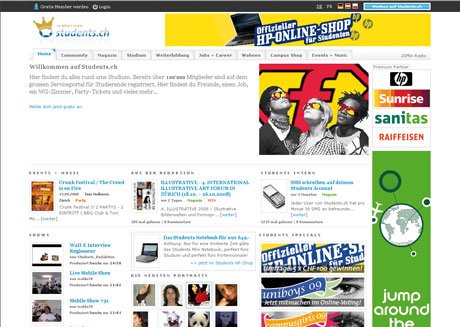
Students.ch first went online in 1998 and is now run by a team of university students. The aim is to provide services and offers that make student life easier. Apartments are exchanged here, tickets are searched for and offers are made for going out. An interesting feature is the jobs section, where various company profiles are posted, for example. The student site has 120,000 unique users per month. Over 100,000 members are already registered in the communities.
With 150,000 visitors, Events-gallery.ch is the leading site in French-speaking Switzerland for the entire party and nightlife scene. As Sandro Proietto explains to Mediabox, 90 percent of the portal's visitors are from French-speaking Switzerland. (pan)
1290582414_img081022_eventsgallery
1290582414_img081022_outnow
1290582414_img081022_partyguide
1290582414_img081022_students
Together is better than alone: the Mediabox youth pool.
get_footer();