Ringier publishes sustainability report

Ringier is the first Swiss media company to publish a sustainability report in accordance with the Global Reporting Initiative standard. In the report, Ringier provides information on its performance in the areas of the environment, society, and the economy.

Ringier publishes a sustainability report in which the media company provides information about its performance in the areas of environment, society and economy. According to the press release, this report is the first to include the entire Ringier Group and was prepared in accordance with the guidelines of the Global Reporting Initiative (GRI).
The report shows that Ringier's services are good and efficient. At many locations, services are even provided that go further than required by the respective local legislation. Ringier recognizes the need for action in various points and has formulated goals for this in the report. For example, the company wants to further reduce energy consumption at the production sites and increase the proportion of recycled fibers in the paper. Ringier already promotes the use of paper with FSC or PEFC certification, i.e. from sustainable forestry. The report will now be followed by the development of a sustainability strategy and a sustainability program, according to the statement.
The Ringier Sustainability Report 2008 is available on www.ringier.com/nachhaltigkeit available for reading. Ringier also provides ongoing information on CSR projects and progress on this webpage. The next Ringier Sustainability Report is planned for 2011. In this way, Ringier will ensure that its actions will continue to be reviewed in accordance with internationally applicable criteria and that the results will be published in a report on the basis of which management decisions will also be reviewed in the future.

Swissinfo with a new public council

Swissinfo, the SRG internet platform for abroad, has a new audience council. The President is former National Councillor Claude Frey, the Vice President is former journalist and communications consultant Renate Hotz.

Swissinfo, the SRG internet platform for abroad, has a new audience council. The President is former National Councillor Claude Frey, the Vice President is former journalist and communications consultant Renate Hotz.
The Audience Council ensures close contact between the program managers and the audience, according to a press release issued on Thursday. In addition, the 12-member committee assesses the offering and the success of the international mandate. It submits suggestions and findings to the SRG Board of Directors.
Swissinfo meets a proven need, the Public Council also announced. The pages in nine languages had increasing user numbers. The international offering is of great importance for the almost 700,000 Swiss abroad. Over 80 percent of them use Swissinfo as a "bridge to their homeland".

Rémy Chételat becomes editor-in-chief of regional newspaper Quotidien Jurassien

The independent regional newspaper Quotidien Jurassien is getting a new editor-in-chief. On Monday, Pierre-André Chapatte will take over from the current deputy editor-in-chief, Rémy Chételat.

The independent regional newspaper Quotidien Jurassien is getting a new editor-in-chief. On Monday, the current deputy Rémy Chételat will replace the previous chief Pierre-André Chapatte, as the SDA reported on Thursday. Chapatte had headed the editorial office for 15 years.
The 45-year-old Chételat was elected by the board of directors of the paper, which is to retain its regional focus. In the canton of Jura, the "QJ" is the leading paper with a daily circulation of 22,000 copies. However, it is also anchored in the district of Moutier (BE).
Chapatte, 64, was the boss for 30 years: 15 years at Pays and, after its merger with Démocrate, just as long at the resulting QJ. He will continue to play the keys for Quotidien Jurassien in the future.

Publicis boosts Christmas business for Ricardo.ch

Christmas is fast approaching, and with it comes the stress of holiday shopping: Publicis has highlighted the benefits of online shopping for Ricardo.ch in a new TV and online campaign.

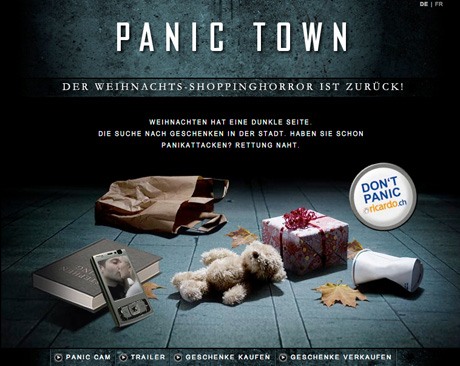
Christmas is fast approaching, and with it the stress of shopping. Once again this year, masses of stressed people will rush into the hustle and bustle of the cities, find no parking spaces, squeeze into overcrowded buses and streetcars and let someone else snatch the perfect gift away from them. The message communicated by Ricardo.ch in a new TV and online campaign created by Publicis is simple: Christmas shopping is pure horror. Ricardo.ch itself represents the pleasant alternative: With over 500,000 items to buy or bid on, the Swiss online department store offers a wider selection than many a big city, according to the agency.
The cross-media teaser campaign promoting the fictional Hollywood film "Panic Town" was launched in mid-November. With a TV spot (a movie trailer), video projections in the biggest cities, various internet banners and DM, the campaign links to a mini page for the movie "Panic Town". Panic Town's pithy credo is also the resolution of the teaser: "This Christmas: Stay at home. Store at home."
Responsible at Ricardo.ch: Marcel Sennhauser (Head of Marketing), Laurent Wendling, (Branding & Advertising Manager), Philipp Breitenmoser (Deputy Head of Marketing). Responsible at Publicis: Martin Denecke, Peter Rettinghausen (CD), Ondrej Maczko (AD), Serge Deville (Text), Barney Rees (Graphics), Tufan Tuna, Derya Derdiyok (Agency Producer), Marion Marxer, Mark Becher, Renée Margelist, Simone Keusch (Consulting). Production: GAP Films Commercial Productions GmbH, Director: Charley Stadler, Producer: Oliver Lössl, Music: Zound Ltd. Online Media: Publicis Modem, AD: Thomas Müller, Cyrill Schneider, Text: Felix Freese, consulting: Remy Burger. Media: Optimedia and Zed digital.

>>Here's the Ricardo spot!

1290582294_img081120_ricardo

Head of the week: With passion

Petra Dreyfus was appointed to the executive board of Wirz Werbung in October. As Client Service Director, she will lead the consulting division and will also serve on the agency’s management team.

You often read in resumes, "I've wanted this since I was a kid." Petra Dreyfus can't help with that. Her fascination with advertising only matured on the job for Wirz's new Client Service Director. But rather quickly and passionately. "The more I knew, the more I wanted to delve into it," Petra Dreyfus muses in retrospect. She wanted to incorporate all the possibilities of advertising into her work as comprehensively as possible. And today she realizes that this attitude fits in perfectly with Wirz's agency philosophy. This is described as "Total Work". In practice, the concept means: at the beginning there is a strategic idea, then the search is on to find the channels through which the mechanics of this idea work best. Finally, this leads to a mix of cross-media and integrated communication. "A complexity I really like," explains Petra Dreyfus, "and one that we were able to exemplify this year in the successful Hopp campaign for Mars." In her new role, she also sees herself as a switchboard between consulting and creation. This involves inspiration and animation. "I have to prepare the briefing in such an interesting way that it creates the best possible platform for the creatives to take off." Petra Dreyfus has a nice image for what should happen when she formulates a good insight together with Planning: "I throw a cocoon into the creative round and back comes the idea in the form of a butterfly."
In that sense, the consultant's job has changed quite a bit, he says. "It used to be that you'd put the brief on the table for the creatives and meet again after three weeks. But fortunately, those days are long gone." Petra Dreyfus wants to use the constellation with her new function even more to animate across the entire agency that this "process of new thinking" comes to play.
There are three consulting teams at Wirz Werbung. Among them, too, the chief consultant wants to expand the dialog even further. "Dreyfus is convinced that "you can always learn something new from each other.
Even before her promotion to the Executive Board, Petra Dreyfus regularly enjoyed training young people and organizing workshops at Wirz. In addition, she has also acted externally for years as an examination expert for marketing communications planners and communications managers. "This contact with schools keeps my eyes open for new developments." Dreyfus herself, in addition to her practical work, has also trained as a communications manager and completed postgraduate studies as a business economist.
Petra Dreyfus first came into contact with advertising during an internship at Lloyds Bank in Geneva. Her later career at Danzas was already more concrete. At this transport company in Basel, Dreyfus worked in the advertising department and was thus also the contact person for advertising agencies. From the client side, she moved to ckdt in 1995. This "advertising boutique" was the largest agency in Basel at the time. Here Dreyfus looked after clients such as Ciba, Bell and the Basellandschaftliche Kantonalbank.
Her promotion to consulting group leader took place at Lowe GGK in Zurich. There she worked for Nestea, Möbel Pfister and Unilever, among others, for almost four years and initiated the first agency-internal planning. She was able to attend Lowe's planning seminars in New York and London and even considered switching to this field entirely. However, the joy of direct client contact and direct involvement with companies and brands probably prevented this. Her flair for strategy, however, earned her membership in the Account Planning Group Switzerland.
Because the passionate advertiser wanted to take a baby break, she worked only as a freelancer for two years. It was therefore "a courageous offer from Wirz that I was able to return to the responsibilities of a consulting group manager in 2005 with an 80 percent job," says Petra Dreyfus happily. This was possible because her husband, a doctor with his own practice in Basel, was also able to be there for the two boys one whole day a week. Conversely, she accommodates her husband by commuting daily from Basel to Zurich. The time on the train is used for brainstorming new ideas and working with the laptop. Even the accounts at Xing or Facebook can be maintained during the journey thanks to the wireless connections. The media woman surfs on these and other portals not only to network and maintain contacts. "You have to stay constantly awake in this scene. If you don't keep up with developments, you're quickly out of the window these days."
Communication, and with it advertising, is changing at breakneck speed. New technologies allow more and more interactions, and these call for increasingly sophisticated psychology. "The possible solutions for communication tasks have multiplied and the target groups have grown along with this process," says Dreyfus, finally finding the answer as to why she still works with so much enthusiasm in advertising today.
Andreas Panzeri

The new management of Wirz Werbung
Under the Wirz umbrella at the foot of the Üetliberg, three companies cover the entire field of marketing and corporate communication. Wirz Werbung (CEO Geri Aebi), Wirz Corporate (CEO Urs Binggeli) and Assai Dialog + Digital (CEO Michel Juhasz). Geri Aebi has been simultaneously responsible as Chairman of the Group since this year.
At 72 years old, Wirz is one of the oldest advertising agencies in Switzerland. "So it's good to have renewal at all levels every now and then," says Aebi. One of those renewals now is the rejuvenation of Wirz Advertising's management team. Petra Dreyfus, who has served as Consulting Group Manager for the past three years, is now Client Service Director and thus comes to the same level in the management as CD Matthias Freuler.
Dreyfus has consulting responsibility. Freuler is Executive CD for creation. Behind them, Thomas Städeli and Geri Aebi have overall responsibility for operational management and individual key accounts, respectively. Städeli comes from a consulting background and is responsible for production and consulting. Aebi started his career in creation and thus has ultimate responsibility for creation and strategy. With Dreyfus and Städeli, the young bosses find their complement with the experience of Aebi and Freuler. "A quartet that complements each other well, both professionally and personally."

1290582304_img081119_gl_wirz
Thomas Städeli, Petra Dreyfus, Geri Aebi, Matthias Freuler (from left).

What are Geri Aebi's expectations for 2009? "After 2008 was a very good year for agencies in general and Wirz in particular, 2009 will certainly be damn tough for the whole industry. We assume that we will not be spared from one or the other budget, which will not get bigger, but smaller. But if everyone who is planning their 2009 budgets in these weeks is already approaching the tasks with scissors in their heads, then a dangerous domino effect will result and intensify for the entire economy. Moreover, since annual budgets are increasingly no longer released in their entirety, but only in bits and pieces according to rolling planning, it can be brutal for agencies and the media, because it is almost impossible to plan in a binding manner. That makes it all the more important that we at Wirz are well positioned in terms of structure and people." Advertising still accounts for "a good 50 percent of total revenue" for the group. In addition, Assai is "developing fantastically in this already booming area," Geri Aebi reveals.
What strategy does the Wirz manager want to use to counter developments in the coming year? "I think it's going to be tough for the whole industry. But I also see positive aspects when it gets more difficult. You have to be even more focused and self-critical. In the boom years, people were often too quick to settle. Now only the best is required, otherwise you're gone."

Free newspaper News: Mittelland edition to be discontinued

One year after the launch of the commuter newspaper News, the Mittelland edition is being discontinued. According to the publishers involved, it has become clear that the advertising market has no need for a separate Mittelland edition. No jobs will be cut.

One year after the launch of the commuter newspaper News, the Mittelland edition is being discontinued. According to the publishers involved, it has become clear that the advertising market has no need for a separate Mittelland edition. No jobs will be cut.
As of December 8, 2008, News will only be published in three regional editions: "News Basler Zeitung" with 55,000 copies, "News Berner Zeitung" with 60,000 copies and "News Tages-Anzeiger" with 185,000 copies. The majority of the circulation of "News Mittelland" will be shifted to these three editions.
According to the press release, supplying the Mittelland region with the three remaining editions is in line with the focus of the Mittelland regions on the three surrounding centers. In addition, the concentration on three editions supports the strategy of the three partners to complement their subscribed daily newspapers.
According to their own statements, the three participating publishers Basler Zeitung Medien, Espace Media and Tamedia are satisfied with the development of News. According to a study commissioned by the partners, the free newspaper reached an average of 283,000 readers between May and July 2008.
According to the press release, the editorial team has now begun further development of the layout. The improvement in reader guidance should be completed by mid-December 2008.
The commuter newspaper News was first published on December 5, 2007. The initial circulation of the four regional editions was 334,000 copies, now it will be 300,000.

Greenpeace lifts voting message from Zurich city dirt

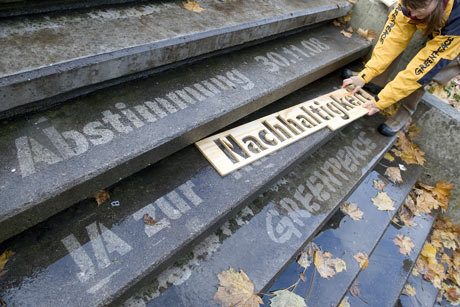
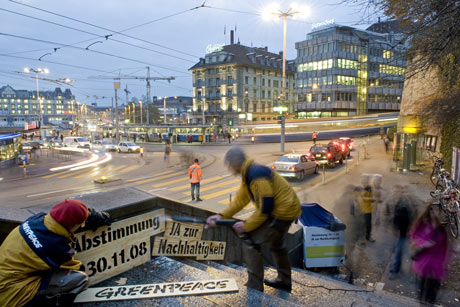
Greenpeace is currently carrying out a unique campaign on the well-kept streets of downtown Zurich. Activists aren’t spray-painting their referendum message on walls and sidewalks. Instead, they’re using high-pressure washers to “clean graffiti”—removing it from the dirt on the streets of Zurich.

Greenpeace is carrying out a special kind of advertising campaign in the well-cleaned streets of downtown Zurich these days. Activists are not spraying their voting message on walls and floors. They are cleaning it out of the dirt of the city of Zurich using high-pressure cleaners as clean graffiti. Their message stands out from the dirt on stairs and walls: "Vote 30.11.08 Yes to sustainability".

1290582298_img081119_botschaft_greenpeace
1290582298_img081119_botsschaft3_greenpeace

Good advice does not have to be expensive

Der Beobachter has launched a new insurance product. TBWA Zurich is providing information about the new offering.

The Beobachter advice center has been providing reliable information and practical advice on everyday legal, financial and life problems for years. Both minor and major legal questions can often be answered through these brief consultations. However, experience shows that some situations require more in-depth advice. This is where Beobachter Assistance comes in: Members receive professional advice and personal support. The costs incurred are covered by Beobachter Assistance up to a maximum amount of CHF 5,000. If the case has to be taken further, there are cost credits for external specialists. Experience has shown that 80 percent of all legal cases can be settled with this offer.
Existing and new Observer members can benefit from this favorable protection of personal rights from January 1, 2009. The cost is CHF 29 per year for all persons in the same household. Unusually, all areas of law are covered, with the exception of intentional offenses. Beobachter Assistance is offered in cooperation with Coop Rechtsschutz.
The new service is advertised with advertisements in the Beobachter as well as third-party advertisements, which communicate more informatively than emotionally. One membership card, however, is made of trust-creating gold.
The third-party advertisements will be placed from November 24. Broad-based public relations is an important element in the launch of the new Beobachter Assistance. This public relations work will be managed by TBWA Zurich in Ingrid Notter's new unit. An important element is an information brochure. This will be sent to all subscribers as an invoice insert. (pan)
img081119_beobachter_tbwa

Last but not least: Cheers to the Slovakian language

In the advertising and communications industry, it is becoming increasingly difficult to understand a word without knowing English. Yet the Americanization of our language continues unabated. The Slovakian Ministry of Culture, on the other hand, now wants to protect the purity of its language with a drastic legislative proposal.

In the advertising and communications industry, it is becoming increasingly difficult to understand a word without knowing English. And "Swiss German used to be spoken in Switzerland" is something you hear more and more often from older generations. But the Americanization of our language continues unabated. The Slovakian Ministry of Culture, on the other hand, now wants to protect the purity of its language with a drastic legislative proposal. Language offenders who break the rules of their mother tongue are to be fined up to 5,000 euros in future. The proposal is to be submitted to parliament in the near future. The ministry's justification for the proposal is the decline in language culture in the media and in the public sphere. Foreign words are used far too often, even if there is a corresponding Slovak word. However, the revised law would also criminalize grammatical and spelling mistakes. According to the proposed law, the prerequisite for punishment is the submission of a written complaint regarding a violation of the language law. However, this can be submitted to the Ministry of Culture by anyone. Slovakian media warned that this proposal would open up wide scope for arbitrary action by the authorities. If the Swiss government were to adopt the Slovakian law proposal, grandpa would probably be talking to his grandson more often again. And our offices would be inundated with far more complaints than the Cablecom hotlines.

Two competitors team up for TV booking

When it comes to TV advertising, Publicitas prefers the booking tool from SRG subsidiary Publisuisse over the one from Goldbach Media. This also sends a signal to the radio market.

Last week, Publicitas Cinecom announced that it will be working with SRG marketer Publisuisse's Publiplan online booking and processing program from summer 2009. This is good news for media agencies in particular, because most of them have been familiar with Publiplan for a long time: They can use it to book all SRG stations and the TeleNewsCombi online. And now they will soon be joined by the three channels that Publicitas markets exclusively: the advertising and program windows of Sat.1 and Kabel eins, as well as the Swiss private channel 3+. Until now, these had to be booked laboriously by fax or e-mail. The fact that Publicitas now also relies on Publiplan not only makes handling easier for the agencies, it also saves them additional installations and time-consuming training. "Publiplan is our first choice," says Tim Dührkoop, Head of Electronic & Interactive at Publicitas. The system covers all booking, billing and reporting aspects of TV advertising that are relevant from the customer's and marketer's point of view.
But it is astonishing that the dwarf among TV marketers is cooperating in this sensitive area with the TV market leader, of all people. Publicitas will not buy a Publiplan license and install the program on its own server, but the data traffic will run entirely through the Publi¬suisse IT system. Won't Publicitas give its main competitor an insight into sensitive customer data and planning strategies? Dührkoop is no stranger to the subject: "Publisuisse has convincingly explained to us and also contractually assured us with hard commitments that the information in the system will not be accessible outside Publisuisse IT, especially of course not for sales and marketing. That's why we came to the conclusion that we could enter into this cooperation."
That looks like a breath of fresh air at Publicitas. Dührkoop confirms: "Because our new team was not involved in the previous trench warfare among TV marketers, we can tackle such issues without blinkers."
He says this knowing full well that there are also alternatives to Publiplan. For example, Goldbach Media subsidiary IP Multimedia, the number two among TV marketers, also uses Media Pro, an online booking tool that is used by several agencies. Says Dührkoop, "We also looked at the IP tool, but based on our own analyses and feedback from the market, we came to the conclusion that Publiplan is significantly better." In terms of price, there was hardly any difference between the two tools. Incidentally, Publicitas had also looked into developing its own. "But that would have been too expensive. Moreover, it would be presumptuous to believe that we could set standards in the TV market today."
Publicitas' decision to use this tool also sends a message to the radio market. There, booking by fax and e-mail is still common practice, although Publi¬suisse subsidiary Mediasense proved this year that Publiplan also works in the radio market. But because the tool comes from SRG, there has been a lack of trust so far (see below). But because Mediasense now wants to reposition itself and withdraw from active radio marketing, the ice seems to be broken - at least at Publicitas. In any case, it cannot be assumed that Publicitas will entrust Publisuisse with the TV data of its leased stations, but will stick to the old mistrust in the less sensitive radio sector. In addition, Publicitas certainly took the needs of the radio market into account when evaluating the TV tool: For itself, but also for the agencies, a single tool for TV and radio makes work easier than two.
In this respect, Publicitas' decision in favor of Publiplan also signals fundamental support for the new radio market organization à la Mediasense. Neither Publisuisse nor Publicitas will confirm this. Both sides say that the tool cooperation now achieved is limited to the TV sector. Nevertheless, Dührkoop wants to send out a message - "namely that we are now approaching such topics very pragmatically.
Markus Knöpfli

Concrete agreements against mistrust
Goldbach Media has so far offered the most resistance to Publiplan as an industry tool in the radio market. In September, Goldbach CEO Klaus Kappeler said he couldn't do anything with closed systems like the SRG tool. "We don't give our customer data to our competitor MediaSense and thus to Publisuisse, do we?" However, Othmar Stadelmann, deputy director of Publisuisse, denies that this is the case. "Otherwise, Publicitas Cinecom would not have secured the proven functions of Publiplan," he says. Among other things, he says, the following measures are contractually guaranteed: Neither the sales department nor any other division or even the Publisuisse management have access to Publicitas customer data. This is reserved solely for three IT specialists and any external specialists known to Publicitas by name. (mk)
Telenewscombi continues - also via Publiplan
The TeleNewsCombi (TNC), the TV advertising pool of eight private stations, will continue in 2009 with its usual composition and broadcast areas. This is despite the new concession award. "Since nothing will change in the first half of 2009 and, in addition, some appeals have been announced, all TNC members agreed to maintain the status quo," says TNC managing director Andrea Haemmerli when asked. Booking opened on November 10, but little has changed in terms of price; the combination rate has merely been adjusted to reflect the performance values. "Advertising in the news environment tends to be cheaper, SwissDate and Lifestyle have been slightly adjusted," she summarizes. TNC will continue to be marketed jointly by Publicitas and Publisuisse and will also remain bookable via Publiplan. (mk)

Free papers on the rise, first figures from News and .ch

Free newspapers continue to record high readership figures. Figures show that Switzerland's seven free newspapers dominate the print market. The two papers News and .ch have now also presented figures for the first time.

Free newspapers continue to record high readership figures. Figures show that Switzerland's seven free newspapers dominate the print market. The two papers News and .ch have now also presented figures for the first time.
From May to July 2008, the commuter newspaper News, published by Basler Zeitung Medien, Espace Media and Tamedia, reached an average of 283,000 readers. The publishers assume that News currently already reaches around 400,000 readers, as the media companies announced on Wednesday. Only a minority of News readers also read one of the three daily newspapers Tages-Anzeiger, Basler Zeitung and Berner Zeitung.
According to a publisher's spokesperson, the free newspaper .ch had a total of 204,000 readers between January and June 2008. Recent feedback from readers on the new layout and distribution system has been positive.
The five German-language editions of 20 Minuten currently have the largest readership of the free press with 1.296 million readers. In French-speaking Switzerland, the free newspaper with three editions has 470,000 readers, according to a Tamedia publishing spokesperson. Le Matin Bleu has 524,000 readers.
According to the latest available figures, Blick am Abend has 291,000 readers. The business and financial newspaper Cash is read by 112,000 people every day. Of these, 85,000 read the print edition and 27,000 the electronic edition.

Peter Hartmeier leaves the Tages-Anzeiger

Editor-in-Chief Peter Hartmeier will step down as head of the *Tages-Anzeiger* sometime in 2009. A successor has not yet been named. The 56-year-old will become publisher of the *Thurgauer Zeitung*, which is also part of Tamedia.

After six years as editor-in-chief, Peter Hartmeier will hand over the reins of the Tages-Anzeiger in the course of 2009. A successor has not yet been appointed. The 56-year-old will become publisher of the Thurgauer Zeitung, which also belongs to Tamedia. Under Hartmeier, the regional editions of the Tages-Anzeiger were launched and the news portal Tagesanzeiger.ch was expanded as part of the news network.
After his position as editor-in-chief, Hartmeier will become publisher of the Thurgauer Zeitung in the newspaper association Nordostschweiz. He is to be elected as the new Chairman of the Board of Huber & Co. in Frauenfeld as early as the next General Meeting. The company belongs to Tamedia. In his role as Chairman of the Board of Huber & Co., Peter Hartmeier will report to Rolf Bollmann, who heads the Media Zurich & Northeastern Switzerland Division.
Further development of the tagi
Before his departure, Peter Hartmeier will work with a steering group to drive forward the further development of the Tages-Anzeiger, Tamedia announced on Wednesday. The aim is to strengthen the Tages-Anzeiger's regional roots and position in Zurich. A new design and the introduction of a compact paper architecture with four newspaper bundles are also being examined. The group is headed by publisher Pietro Supino. Martin Kall, Chairman of the Executive Board, and Rolf Bollmann, Head of the Media Division Zurich & Northeastern Switzerland, are also members of the group.
Peter Hartmeier joined Tamedia in 2001 from the Swiss Press Association and was Head of Corporate Communications at the media company until he took over as Editor-in-Chief of the Tages-Anzeiger in 2002. Prior to that, he worked as foreign editor for Weltwoche from 1979 to 1985. He then moved to the Luzerner Neuesten Nachrichten as deputy editor-in-chief. In 1991, Hartmeier became publisher and co-editor-in-chief of Bilanz.
Longest-serving editor-in-chief since Peter Studer
Hartmeier has led the editorial team of Tamedia's flagship Tages- Anzeiger longer than his four predecessors. After the long-standing TA editor-in-chief Peter Studer, Viktor Schlumpf had taken over as editor-in-chief in 1987 and was removed in 1991 amid protests from the editorial staff. Roger de Weck then moved from Hamburger Zeit to Zurich's Werdstrasse in the summer of 1992. He left the Tages-Anzeiger after just under five years following disagreements with the management.
De Weck's successor, Esther Girsberger, held the Tagi chair for just one and three-quarter years until the fall of 1999. She left as a result of discussions about the journalistic orientation of Tamedia's products, as was said at the time. Philipp Löpfe was then editor-in-chief for two and a half years, making way for Peter Hartmeier in the fall of 2002 and taking on other responsibilities within the Tamedia Group.
get_footer();