Internet continues to score points

In December, advertising pressure on the Internet continued its marked increase, gaining 13 index points, bringing the annual growth for 2008 to 112 index points. The Gemi figures paint a familiar picture: The Internet managed to rise by a full 13 index points to 369 even in the last month of the year.

In December, advertising pressure on the Internet continued its marked increase with a gain of 13 index points, bringing the annual increase for 2008 to 112 index points. The Gemi shows an already familiar picture: the Internet was also able to increase by a full 13 index points to 369 in the last month of the year. The total of e-media remained in the red by one index point in the month under review, while all the media covered remained on a par at 194 index points. Television suffered a drop of 3 index points to 450 in December, while the advertising pressure of radio remained the same at 246 points and teletext rose by one index point to 155. For 2008 as a whole, TV increased by 26 index points, the Internet by 112, teletext by 22, all e-media together by 28 and the total of all media by 6 index points. Radio was the only medium to record a decline, falling by 6 index points.
> To the graphic

Under a good star into a new future

The restructuring of the private radio landscape is off to a promising start: Listeners have never spent as much time listening to stations as they did last year. Reach, on the other hand, is declining.

The hullabaloo surrounding Radio Energy Zurich in November and December has probably benefited the station. Although its reach fell to exactly 200,000 listeners in the second half of 2008 compared to the same period in the previous year, they are clearly listening for longer: The Ringier station, which previously reported a usage time of around 40 minutes a day, is now suddenly being tuned in for 51.9 minutes - a good ten minutes more than before and longer than ever before.
Other stations have also recorded notable jumps in usage: Sunshine is also listened to for a good ten minutes longer (new 49.7), Capital FM is listened to for 14 minutes longer (new 44.7), and Munot has even more than doubled its usage within a year, from 14.8 minutes to 30.9 minutes.
Tension in the Greater Zurich Area
In general, the German-speaking Swiss are listening to the radio more, with listening time increasing by exactly 7 minutes to 123.1 minutes within a year. The growing popularity has been evident for some time, but the big jump is surprising. And that private radio stations are making a particularly strong contribution, despite falling reach. Their market share has increased by 1.6 percentage points to 26.3%, while SRG and foreign broadcasters have lost ground.
> Overview of radios in German- and French-speaking Switzerland and Ticino
The first semester of 2009 will already be exciting, at least in the greater Zurich area, where two new stations will be launched in March. Giuseppe Scaglione's youth radio station and Winterthur's Radio Stadtfilter will inevitably shake up the scene. But Roger Schawinski's Radio 1, whose reach is extremely unstable, is also apparently still looking for its place: while 107,400 people tuned in from mid-March to June 2008, listenership fell to 74,700 in the second half of the year.
Upheavals in French-speaking Switzerland
In western Switzerland, primarily in the new Arc Lémanique region, there is also likely to be upheaval soon. The four stations Lac, One FM, Lausanne FM and Rouge FM now share the same area, which is larger than their current districts. As their licenses are not in dispute, they can now launch their expansion.
However, the reorganization is only partially under a good star. Listening time also increased in French-speaking Switzerland - by 3.8 minutes to 113.1 minutes within a year. At the same time, however, the overall reach of radio as a medium fell significantly. Private radio stations contributed significantly to both the increase in usage and the reduction in reach, which is why their market share only increased by 0.2% to 23.9%. SRG stations, on the other hand, were able to improve in every respect.
Stagnation in Ticino
The picture is similar in Ticino: listening time also increased by 3.6 minutes to 113.5 minutes, with private radio stations increasing disproportionately by more than 4 minutes. However, as they also lost almost 10,000 listeners within a year, they have hardly made any progress in terms of market share. The new licenses will not change much here either: The same radios as before were awarded a license.
Markus Knöpfli

The digitizer

In his new role as Director of Business Development, Nicolas Noth aims to leverage Planetactive's international lead in the Internet sector to further expand the company's presence in the Swiss market.

In Germany, Planetactive is one of the top ten agencies in the digital marketing sector. The company from the Ogilvy network employs over 90 people. The parent company is in Düsseldorf. However, the branch office in Zurich is also playing an increasingly important role. In the Swiss market, there is a lot of catching up to do around marketing on the Internet. To this end, the curves for advertising on the Internet have been trending even higher since the economic crisis began to show itself more precisely every day. "Customers want advertising with measurable success," says Nicolas Noth. Since November 1, he has joined Managing Director Martin Sinning on the management team at the Zurich-based full-service agency for digital marketing. The Director Business Development wants to "further develop the strategic orientation and positioning of the agency as well as the product portfolio". An important part will also be advising clients. "More Swissness" in the management at Planetactive is a welcome side effect here, although the Swiss branch of Planetactive was already founded in November 2000 and has thus been working for Helvetic giants such as Migros, Toblerone, Axa Winterthur or Swisscom for a long time.
Planetactive advertises that the specialized agency is already further ahead than many competitors in the field of Internet. For Nicolas Noth, it is therefore an opportunity to be able to work at the forefront with the momentum of this head start, instead of just "providing development aid on the Internet," as he had to do in previous jobs. Nonetheless, he experienced these antecedents of the digital future as enriching.
The original career dream of today's digital media person was "business journalist with an understanding of the political context. The motivation for such a commitment matured in his parents' home. His father was a filmmaker and co-founder of the legendary Cortesi press office in Biel. In this "inspiring environment" with many people from the media, Nicolas Noth decided to study economics and political science in Bern. By then, however, he was already living in Zurich, and that was not to remain without consequences.

Fascination Eastern Europe
Here, in fact, he found a student job that would soon steer his interests into new worlds. Nicolas Noth was able to gain his first professional experience at Vontobel EC Consulting. At the time, this consulting firm within the bank holding company was primarily involved in setting up the new financial structures in Eastern Europe. As a result of the upheaval, the Czech Republic and Slovakia had to re-finance themselves, create new regional units and thus also new tax autonomies. Vontobel EC Consulting provided the basis for this for the political decision-makers via a mandate from the FDFA's Office for Cooperation with Eastern Europe. "They were looking for specialists from Switzerland to transfer our federalist know-how to the East."
Nicolas Noth first had to type up reports from the consultants, then he was assigned his own research. The working student spent more and more time in Prague and was fascinated by his involvement in the turning point of history. And the studies? "This period was enriching and, of course, very intense, because the Eastern Europe projects expanded more and more," he recalls. To resolve the conflict, Noth coupled his second licentiate thesis with a project in the East. Admittedly, as a Swiss health economist, his professor in Bern was not particularly enthusiastic at the beginning that Noth now wanted to conclude with a paper on "Czech health care reform". In the end, however, he found the result "very interesting". However, Noth had to do the final research for his degree in the East on his own. Vontobel EC Consulting was sold and thus his mandate stopped.
For his professional development, Noth initially continued to look for an area of activity with a focus on Eastern Europe. This led him to Ecoprocess in 1994. At that time, this Swiss agency was looking for and offering strategies on how Swiss companies could expand into the Eastern European market. After an office split, Noth went with one of the partners. They wanted to build something independent. With the project management for the Federal Council's "Energy 2000" action program, the young entrepreneurs quickly had an interesting mandate in their portfolio. In the meantime, however, four years after graduating, the economist wanted to put his skills and valuable experience with financial projects to more precise use.
The manager saw more opportunities to help shape the company at Pragmatica. "This company already suited me very well in terms of its name. Here, the pragmatic approach is to be made the program." When Noth joined the company in 1998, the Zurich-based start-up had eight employees developing solutions for problems at the interface between business and IT for all the major banks and insurance companies. "We acted as an intermediary or translator from the computer scientist to the banks, which were eager to use the new technology," Noth says of those assignments.
Another branch of Pragmatica was the development of web software. At first, the programs were only used to improve the company's own communication. Later, they wanted to commercialize their knowledge, especially with applications for SMEs. Pragmatica enabled access to a company's data from anywhere with a web interface. Things that are taken for granted today, but were revolutionary back then. Pragmatica developed accordingly quickly. The company went public. Eight people became almost a hundred within just three years. In order to be able to find a common language with the increasingly specialized engineers, Noth also completed a postgraduate degree in business informatics during this time.

Newsroom at Ringier
Pragmatica was still successful after the Internet bubble burst. "I meant that after the from 0 to 100 also comes the from 100 to 1,000," Noth comments with slight irony. However, when expansion plans for the competence center he had built up were increasingly truncated due to the overall economic development, Noth remembered that he "originally wanted to be a journalist" and sought a challenge in the media sector in 2004.
"In Ringier, I found an exciting media company that had interested me for a long time and where I could learn a lot." In a newly created position at Zurich's Dufourstrasse, Nicolas Noth became "Creative Manager" for projects, strategy and digital development within the Blick Group, reporting directly to the then Group Division Manager Bernhard Weissberg. With the idea that print and online could be better networked, the creative manager brought the newsroom into play back in 2005. An idea that is now to be realized under Marc Walder by 2010. "A lot of things were probably still too early at that time, because there was also not yet such a strong need," Noth analyzes today. In the first phase of declining circulation figures, he says, the company "still reacted rather helplessly." But as time went on and technology developed, more and more projects became more concrete. Finally, various ideas were bundled together. During this time, Noth, who was studying to become a qualified media manager, was put in charge of Blick Online and later also of the web presence of Heute. He was a member of the management board of the Blick Group. "With portals like these, I was able to live out my love of digital as well as my love of newspapers," says Noth - and this brings up the 360-degree strategies he now wants to implement for advertising clients at Planetactive.

Setting the pace
But before he became active on this planet, the then Chairman of the Board of Directors Thomas Sterchi brought him to Condor Films in mid-2007, where he became Head of Corporate Film & New Media and a member of the Executive Board.
But he had to "realize that film in a traditional house like Condor obeys different principles than the Internet". That's why he was looking for "a way to get back from this side road of film to the digital main road.
And the old ways to the east? "That's no longer an issue since I have a family with two little girls," says Noth. But family is not the reason why he stopped playing music. As a drummer in a punk band, Nicolas Noth toured all over Europe in the eighties. The memory of a gig as the opening act for Iron Maiden in Bucharest still lingers. But as a musician you have to "recognize your limits". And drumming alone in the basement is not his thing. One idea, on the other hand, would be to "buy a digital drum kit" for his two daughters. The girls would have fun. And the father would have a good reason to start again.

Andreas Panzeri

Digital Bang
"We create value" is what Planetactive claims for itself and also relies on technologies developed in-house. With this attitude and the corresponding tools, the agency has made a name for itself as a digital full-service provider. Now Nicolas Noth is to help trigger the "digital bang.

Press TV: New broadcasting slots bring good ratings

Presse TV's programs, which have been airing in new time slots on SF1 and SF Zwei since the beginning of the year, are attracting strong viewership. The company views the shift from a biweekly to a weekly broadcast schedule as particularly positive.

The programs of the publisher's television Presse TV, which have been broadcast in new slots on SF1 and SF Zwei since the beginning of the year, are attracting good viewer numbers. This was announced on Wednesday by the joint venture between NZZ, Ringier, Basler Zeitung and Springer Schweiz. PTV Managing Director Fibo Deutsch is particularly positive about the change from a fortnightly to a weekly broadcasting rhythm. However, the good figures have been achieved not least due to the fact that the viewing figures for repeats on SF Info have also risen steadily.
The individual programs are now no longer "crowded together in a ghetto on Saturday and Sunday evenings on SF Zwei" and hopelessly out-competed by blockbusters on Sundays, but are now precisely tailored to the target audience on both channels, the statement continues. Most people who watch the program "Gesundheitssprechstunde" also watch the subsequent popular programs "Hopp dä Bäse!" or "Samschtig-Jass". Apparently, these programs have an almost identical audience.

La Regione Ticino and Publicitas continue their collaboration

The daily newspaper La Regione Ticino and Publicitas are renewing their partnership. The new five-year contract reaffirms their partnership, which dates back more than a century.

The daily newspaper La Regione Ticino and Publicitas are renewing their collaboration. The new five-year contract confirms the more than one hundred-year partnership, writes Publicitas in a press release on Wednesday. Under the leadership of Fabio Belmelli, the Publicitas team in Ticino will continue to focus its activities on constant regional market development and the intensive promotion of the Ticino daily newspaper in the Swiss advertising market and northern Italy.
La Regione Ticino has increased its readership by a quarter since 2000. According to Mach-Basic 2008-2, the newspaper now reaches 107,000 readers.

Charles Vögele: New Head of Corporate Communications

Effective February 1, 2009, Daniel Bärlocher will assume the role of Head of Corporate Communications and Investor Relations at the Charles Vögele Group. The current holder of the position, Renzo Radice, will remain in his role until early March.

Daniel Bärlocher will take over as Head of Corporate Communications and Investor Relations at the Charles Vögele Group as of February 1, 2009. The previous incumbent, Renzo Radice, will continue to support Bärlocher until the annual media conference on March 3, 2009 and will remain the contact person for media representatives until then.
Daniel Bärlocher holds a degree in business administration from the University of Zurich. After working for several years as a management consultant and auditor at Balmer-Etienne Treuhand, he joined the PR agency Dr. Peter P. Knobel as a consultant in 2001.

Local TV stations are losing reach

A five-year comparison of TV viewership shows that local television stations in German-speaking Switzerland have fallen far behind in terms of performance and must start almost from scratch. This is a poor starting point for the launch of the new local TV regulations.

The positive news first: the German-speaking Swiss population as a whole watched local TV on average half a minute longer in 2008 than in 2004. Among 14 to 49-year-olds, usage even increased by 1.1 minutes. But that is already the end of the good news. According to Mediapulse data, the eight largest stations that are part of Telenewscombi (TNC) have lost a massive amount of reach and market share in a five-year comparison. The TNC now has 117,000 fewer viewers than in 2004, 100,000 of them in the younger target group alone. The TNC market share in 2008 also reached its lowest level in the last five years in both target groups. Yet 2004 was not even the best year for TNC to date: in 2005, the combined station set its reach record with 1.3 million viewers - not to mention without Tele Südostschweiz as a member.
Among the individual stations, the Tamedia stations Tele Züri and Tele Bärn were hit the hardest: they now have a quarter fewer young viewers than in 2004. The other stations did not fare much better. The only ray of hope is Tele Ostschweiz: It was able to gain 13.5 percent of young viewers in 2008, but remains below the best value of 2004.
Ultimately, no one can conclusively explain the losses. Is it because more and more people are switching to satellite instead of cable? Because local TVs cannot be received via satellite, they would lose viewers as a result. However, Swisscable, the association of cable network companies, has not recorded a slump in cable subscriptions, only a slight decrease of 0.8 percent in 2007 - and that for the first time.
The expansion of the TV offering is also cited as an argument for the decline in viewers: A new channel, 3+, has been able to establish itself. The change in media usage among young people also has an influence: they are increasingly consuming TV via the Internet or digital Bluewin TV. However, Mediapulse does not yet report on either form of usage.
The latter is only partially true. Manuel Dähler, CEO of Mediapulse, confirms that internet streaming via Zattoo or Wilmaa, for example, is not yet reported. Bluewin TV, on the other hand, is measured and the usage of local TVs there is also included in the total usage of the respective channel.
Presumably, the industry is therefore primarily challenged in terms of program quality. It remains to be seen whether the fees it will soon receive will bring about a turnaround in this respect. In any case, other developments are in the foreground: the broadcasters, especially the unlicensed Tele Züri, will expand their broadcasting area, in some cases considerably from February onwards, and will eat over each other's fences. New areas such as Upper Valais will be opened up, others such as Central Switzerland will probably be duplicated. However, the expansion of services and technical reach alone will hardly help the industry in the long term. Especially as there is a risk that it will fall out.
The situation is different in French-speaking Switzerland: once all licensed TV stations there are on air, the whole of French-speaking Switzerland can finally be covered by local TV. This will consolidate the scene there. Thanks to larger distribution areas, the individual stations will also be easier to measure. Nevertheless, the explosive development of Geneva's Léman Bleu already shows that investments in programming are paying off and that there is still huge potential in French-speaking Switzerland. The same can be said of the situation in Ticino.

Markus Knöpfli

> To the table: Local TV figures in a five-year comparison (2004-2008)

Advertising pressure increases slightly

The Swiss advertising market continued to grow slightly overall last year thanks to good results at the beginning of the year. Advertising pressure increased by 2.6 percent to CHF 3.95 billion. According to the advertising and media research company Mediafocus, this puts 2008 in the middle of the 10-year analysis.

The Swiss advertising market continued to grow slightly overall last year thanks to good results at the beginning of the year. Advertising pressure increased by 2.6 percent to CHF 3.95 billion. According to the advertising and media research company Mediafocus, this puts 2008 in the middle of the 10-year analysis. Advertising pressure was recorded in the print, television, radio, poster, cinema, teletext and Internet sectors. However, the month of December saw a decline of 1.1 percent. Nevertheless, there were no clear signs of the recession spilling over into the advertising industry. With the third consecutive month of decline, television could be identified as the first victim of dwindling advertising budgets. For the year as a whole, cinemas lost the most ground with a drop of 10 percent. The three biggest advertisers in the last month of 2008 were Coop, Migros and L'Oréal.
> To the graphic

Advertising in red light

Companies invest a lot of money in advertising so that consumers will find their products appealing—and buy them. But the fact that Cablecom, Coop, and Ackermann’s advertising banners have now appeared on porn sites on the Internet was just too much sex appeal.

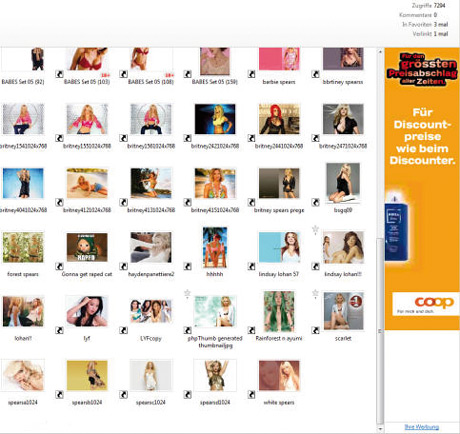
Advertising is not always everything. It can also backfire badly. This is when banners and slogans appear in an environment that casts the advertising company in a false (in this case reddish) light. This has happened several times in recent weeks: Coop, for example, fell out of favor with its advertising banner on the website of the Swiss web host Wuala.com on. Wuala offers its users virtual hard disks, which they can use to exchange data with other users of the website.
Coop and the blonde nudes
It's actually a great service. The catch: as this is user-generated content, illegally copied films and music files or nude photos and porn may also change hands via the platform. For example, Coop was emblazoned in the most beautiful orange next to films of Brit, Babe and Scarlett, naked women in blonde, brown and red. Coop Porno instead of Coop pronto? Embarrassing. The irritated retailer reacted promptly: it was assumed that the commissioned advertising agency would only display the Coop advertisement "in legally impeccable and reputable environments", it said. Said and quickly deleted, the rogue banner.
The advertising agency Coop is talking about is Initiative Media, which in turn has commissioned AdLink Internet Media to market the Coop banners. The outstretched index finger is therefore also directed at AdLink. "We generally only include websites in our network after a detailed check and guarantee our advertising customers that no religious, sexual or political environments or topics are covered," explains Stephan Suter, Managing Director of AdLink Internet Media. "However, the responsibility for the content of the website in question lies with the operator - who must also guarantee AdLink Media all possible content checks. If we ourselves become aware that a website contains illegal or immoral content, we immediately draw the operator's attention to this, stop campaigns and immediately remove the website in question from the AdLink Internet Media network.
media network."
AdLink also acted accordingly with Wuala. "The day before this matter became public, I would have put my hand in the fire for Wuala," says Suter. "Wuala is still in the beta phase and is supported by ETH Zurich. But it is a service with user-generated content. Anyone can post content on such sites within seconds that doesn't belong there."
Of course, Wuala.com is constantly checked for unwanted content such as child pornography. The web host is even supported by the Internet police Kobik (Swiss Coordination Center for Combating Internet Crime). Users can also report suspicious content, which is then immediately checked and deleted if necessary. Nevertheless, if you want to be on the safe side, you should not advertise on websites whose content is created by users, advises Suter. However, companies like to advertise on sites with user-generated content, preferably on the industry giants YouTube or Facebook. This allows them to quickly and cost-effectively address target groups that they would otherwise not reach.
Banner in the penalty area
Like Coop, the Swiss online mail order company Ackermann recently felt embarrassingly exposed: Its advertisement appeared on the website Celeblounge.net, which offers nude videos of stars, among other things. "This placement happened without Ackermann's knowledge," emphasizes Karin Müller, press spokeswoman for Ackermann-Versand. "We immediately contacted our media agencies in Switzerland and Germany and prohibited the placement. We do not want advertising on such sites." Müller does not want to give the names of the agencies responsible for media marketing. But she does reveal how the ad was placed incorrectly: Apparently, an intermediary had placed the mail order company's pop-up next to the porn without permission.
The banner of the telecommunications service provider Cablecom ended up on a no less dubious site: Despite the ban, many Internet portals make copyrighted content available for download, for example films, books or magazines. Anyone who wanted to download an issue of Psychologie heute from one of these sites in recent weeks would see a Cablecom banner at the bottom of the screen - and within clicking distance of the link "Tip: free vibrator & condoms". Wow. Like Coop, Cablecom is retreating to the island of the unsuspecting: a company spokesperson told the free newspaper 20 Minuten last week that they knew nothing about all this: "The registration was made by a partner who has set up an affiliate program himself. Our terms and conditions state that it is forbidden to place Cablecom advertising on sites that show pornographic or racist content. This partner in turn works with an agency that also places advertising on such sites. We have stopped this with immediate effect."
Knowledge does not protect against mistakes
All of the companies affected by the incorrect placements have now emphatically forbidden their media agencies from advertising on dubious websites. It was Coop, Cablecom and Ackermann themselves who booked advertising placements in this form with their agency - with the decision to advertise on sites with user-generated content. Apparently, however, the companies were not aware of the potential problems that this advertising channel could cause. Not even the operator can guarantee content on a user-generated content website one hundred percent of the time, even if they constantly monitor their content and delete unwanted content immediately. Companies should bear this in mind when planning their advertising.
At Coop, the advertising nuisance will probably already be forgotten. Wuala.com, however, is a small fish with 6000 users - compared to other user-made Internet sites such as YouTube or Facebook. The tiny glitch could turn into a big bite for the web host, which could ultimately choke it to death.
One more thought at the end: How dramatic is the misplacement of advertising banners really? Of course, it is not good for a company's image if it becomes known that its advertising is appearing on dubious websites. Accordingly, the companies react sensitively to the cases described. After all, they pay their media marketers to reach the desired target groups via advertising on the right channels. But the average Coop shopper, Cablecom phone user and Ackermann customer probably didn't notice much of the misplaced ads. And people who are in the process of illegally downloading newspapers, magazines or pornographic films from the Internet are also unlikely to be interested in the banners from Coop, Cablecom and Co. that pop up at the same moment. The only tenable accusation that could be made against the media agencies concerned would therefore be: target group missed.
Anne-Friederike Wilhelm
1290582083_img090128_rotlicht2
Coop's now deleted advertising banner on Wuala.com.
1290582083_img090128_rotlichtt1
Die Zeit, Spiegel, Stern and Fibratoren in perfect harmony with Cablecom.

Tages-Anzeiger and NZZ reduce fee budgets

The print media must cut costs: Both the Tages-Anzeiger and the NZZ have recently decided on immediate measures to reduce their operating costs. At the Tagi, freelance fee budgets are being cut by 10 percent, and savings are being made in consulting costs and brand advertising.

The printed press has to make savings: Both the Tages-Anzeiger and the NZZ recently adopted immediate measures to reduce their running costs. At the Tagi, the cuts affect all departments equally. Tamedia spokesman Christoph Zimmer confirmed Tuesday that the newspaper will cut its fee budget by 10 percent in all areas this year, as well as make savings in consulting costs and image advertising. Züritipp has already set lower salaries for its freelancers.
The magazine, news and newsnet not affected (for now)
The cultural department of the Tages-Anzeiger is most likely planning to save the money elsewhere. For example, fewer assignments will probably be handed out to external parties. In addition, the position of arts editor Barbara Basting, who recently moved to DRS2, will not be replaced.
However, the cuts do not affect the magazine (for the time being). The publisher and editorial staff of the Saturday supplement have been independent since 2005 and are no longer part of the Tages-Anzeiger. The magazine belongs to Tamedia's Media Switzerland division, the Tagi to the Zurich & Northeastern Switzerland division. The commuter newspaper News and Newsnetz are also not affected at present.
Line fee at NZZ one-third lower
The NZZ also recently made a cut in its fee budget. Freelancers in the NZZ feuilleton now earn only 1.40 francs per line instead of 2.10 francs. The rates were thus cut by about a third from one day to the next. So if a freelancer writes a fifty-line concert or theater review, he now earns just seventy francs.
It can be assumed that these measures are only the beginning in view of the further decline in subscriber numbers and advertising placements. However, Tamedia is still keeping a low profile with regard to further cost-cutting measures. Nor does it want to say anything concrete about Der Bund: Tamedia will make a decision by the end of the first half of 2009 at the latest. It is still completely open whether the title will be retained or disappear. "We are not ruling out a new title name in principle," Zimmer told Werbewoche. "However, models in which both previous titles continue to exist are still conceivable."
Adrian Schräder

Fonts, Böxli and Printtagging

Web designers and print designers live in different worlds. Yet they both have a lot to learn from each other. Op-ed by Oliver Reichenstein, information architect in Tokyo.

Small fonts are quite popular on the Internet. That's surprising, because web pages are actually there to be read. It's even more surprising when you know that the font size that the web browser specifies (16 pixels) would be wonderfully readable in itself. It looks large when held next to a printed text. But if you compare the font sizes in perspective, the web text matches the print font in reading distance.
The reason web designers use small fonts is both historical and technical: screen fonts were developed at a time when screens were much smaller than they are today. And so they developed correspondingly small fonts. The screen also has a lower resolution than paper.
The task of the designer: solving problems
This gives you very little design freedom, unless you make the reading font smaller. The smaller the font, the easier the task for the designer, the prettier the page. But the designer's job is to solve problems, not win beauty awards.
Even with the Böxli, designers often make it too easy for themselves. If you compare an average website with a professional print page, you can see: Web designers use many more frames and Böxli than print designers.
One example is BBC.com. There, everything - the lead story, the weather, and every teaser - is contained in a Böxli. It is exhausting for the eye to jump from Böxli to Böxli. The fact that the Böxli have Web 2.0 round corners doesn't make things any better.
What web designers can learn from graphic designers
The fact that Böxlerei is just as bad a habit as the small font becomes apparent when one reads up on the typographic rule for lines, which is very obvious even to a non-designer:
1. bring the elements that belong together in terms of content visually close together.
Set elements that do not belong together spatially apart from each other.
3. things that do not belong together but must be brought close together for space reasons are separated by lines so that they can be kept apart.
In other words, you use lines only when there is not enough white space. White space is not a matter of taste, but an element of order. If you draw lines not only to the left and right, but also above and below, and connect these lines, i.e. if you make a box, then this means that what is in the box is something really different from what is happening around the box. Websites that are still and still using Böxli are communicating: There are a lot of things together here that don't really belong together. In other words: this page is a whorehouse.
Why are Böxli nevertheless used so excessively? Böxli are used because it is easier to make a frame around everything than to think of a clear structure. So they are often an indication of a "puffy" information design.
What graphic designers can learn from web designers
The examples Böxli and small font show nicely how web designers can learn from graphic designers. I think graphic designers should also learn from web designers. Because even more astonishing than the small fonts and the Böxli are the often inscrutable information architecture and the unfriendly lead deserts that today's newspapers and magazines still present to us.
The solution to the problem: color-coding keywords. A text with colored keywords can be scanned by the reader in five seconds. It may not look so pretty, but the true beauty of the text is not an aesthetic one; it lies in its readability. If all the texts in this issue were interspersed with keywords, then you could scan every article and quickly check to see if there was anything interesting there.
in it.
In addition, one would then also know which keywords to search for in order to find the text again online and to comment on it. Because keywords have a simple equivalent online: The web designer calls it tagging. Editors would also be delighted with print tags, because color-coded keywords next to the headline, title, lead, and subtitles are sharp hooks to draw the reader into the text. Wouldn't they?

Last but not least: Hella von Sinnen turns 50

Twenty years in show business and still a big mouth: German artist, presenter and entertainer Hella von Sinnen turns 50.

For decades, comedy great Hella von Sinnen has been so present on German-language television that hardly anyone has been able to avoid forming an opinion about her. On February 2, blonde comedy great Kemper will be 50 years old. She has said things like: "That's the beauty of getting older, you get wiser." Have the years tamed the woman with the big mouth? "Of course, it's possible that you feel more like doing wild things when you're 30," she admits.
Back then, in 1988, she made her breakthrough on the still young German private television channel, together with Hugo Egon Balder in the RTL nonsense magazine "Alles nichts oder?!". At least once per show, von Sinnen stalked the camera and performed the "Tschaka-Tschaka" dance, which became her trademark. The feminist caused a sensation in the early 90s with "Weiber von Sinnen": she contrasted the naked breasts from Balder's "Tutti Frutti" with the "first erotic clips for women", chatted with celebrities about sex and infidelities and visited prostitutes.
Looking back, she still doesn't want to talk about breaking a taboo. "We just showed a little naked wiener," she says. She prefers to talk about her current "funny little projects": a book with her favorite Donald Duck stories, an art exhibition with cell phone photos. As a performing artist, she says, she enjoys it when something just hangs quietly on the wall in the evening and doesn't move. As a professional chatterbox, she is still a TV great - and proud of it: "It's not a given that you can be on TV as an entertainer for 20 years."
A few years ago, von Sinnen admitted her fear of getting older.
"When I turned 30, 40, it was terrible," she explained at the time. Faced with her next milestone birthday, she demonstrates composure: "I'm grateful that I can turn 50 and go through life in good health." Where did the change of heart come from? "My wife" - Cornelia Scheel, daughter of a former German president - "was fed up with all this 'pity, pity, a few years older again'," she says. So now she pulls herself together, makes an effort to enjoy every day and remain the old Hella.
(Image: Keystone)
get_footer();