To the point: tact

Two things are extremely repugnant to me. First, the ever-increasing claim of the state, or politicians, to control as many areas of society as possible. And then there is the ever-increasing populism. But let's take it one step at a time.

Two things are extremely repugnant to me. First, the ever-increasing claim of the state, or politicians, to control as many areas of society as possible. And then there is the ever-increasing populism. But let's take it one step at a time.
More and more areas are to come under the control of the state. Advertising bans are being demanded for legally available stimulants. Up to now it has been cigarettes and tobacco, soon it will be fatty and sugary foods. Restrictions in the statements of the automobile manufacturers are demanded in Brussels, one can make bets, until such becomes also in Switzerland the topic. Everything can be sold under the guise of precaution. All it takes is a serious skiing accident by a celebrity, and politicians will be calling for mandatory helmet use. Everything that could be dangerous in any way is tried to be prevented. The citizen must be protected from himself. Prevention becomes care. From the cradle to the grave. Only a few resist this.
Now, however, politicians have discovered a new playing field. The financial industry. There is no doubt that the financial crisis, which has now turned into an economic crisis, was influenced, among many other factors, by false financial incentives on the carpet floors of financial institutions. Greed for more and more - more bonuses, more expansion - was the driving force in the financial industry for years. But beware: everyone played the game. There were very few warners. Why should there have been, things were going well, many were profiting from the stock market hype. The bankers and the economy in general mocked the politicians. In retrospect, this was not exactly a clever tactical move, because the high horse on which certain business leaders were perched was becoming increasingly shaky.
It got even worse: UBS, as a large and proud Swiss bank, had to appear in Bern. Money was needed, help was needed. The government could not leave the financial institution out in the cold. The billions flowed. And the politicians were on the scene again. Since no collateral could be demanded, the politicians called for influence - fortunately in vain. From the left to the right, everyone agreed: control was needed.
The minefield was ready. But there was a lack of insight at UBS. Instead of paying the many normal UBS employees, who do not receive exorbitant salaries, a 13th month's salary instead of a small bonus, for example, by means of new employment contracts, the company stuck to the unfortunate word bonus. It came as it had to: politicians are crying out for control, the people are outraged, and certain media are joining in. An unholy alliance between political control, media outcry and the voice of the people. This could have been avoided. With tact and better communication.
Pierre C. Meier, Editor-in-Chief
[email protected]

Superspot: Microsoft launches horror video

The ADC scale for evaluating advertisements ranges from «World-Class» to «Appalling.» The Microsoft Songsmith commercial falls well below the scale. A «Hiroshima» rating would be appropriate.

In a promotional video released in 2009, Microsoft advertises Songsmith, a new computer program that lets you cobble together your own karaoke tracks. The promo video is simply awful—and to make matters worse, it’s meant to be taken completely seriously. It could easily have come from some bizarre parallel universe where irony hasn’t been invented yet. One nice touch—and the ad is full of nice touches—is that the girl in the video is running the program on a Mac. To really convince you that this is an official ad, you should check it out right now on the Microsoft website.
» Watch the ad

McCann-Erickson: Spreading a sense of freedom for Studio Line

The advertising agency McCann-Erickson has developed a global communications strategy for Studio Line. The goal is to convey the message «Freedom and unlimited possibilities.».

The advertising agency McCann-Erickson has designed a global communication concept for Studio Line with banners, logo, tag'on and advertisements. The message to be conveyed is "freedom and unlimited possibilities". To underline this message, a partnership was entered into with the Crans-Montana Champs Open. The event for snowboard freestylers and freeskiers, which takes place this year from February 4 to 8, is the ideal partner for Studio Line, as both convey the feeling that anything is possible, writes the agency in a press release on Wednesday. Special events are also planned during the snow sports event.

Direct bookers keep up the pace

Not much is happening on the direct-booking front. The only new addition is .ch. And some are still refusing to lay their cards on the table.

Since Tamedia began four years ago to reward media agencies that book directly with Tamedia titles instead of via Publicitas, so-called direct booking compensation (DBE) has become established in the industry. More and more independent publishers joined Tamedia - although these offers were structured differently. A Werbewoche survey now makes it clear: all previous offers remain unchanged this year. The only change: from this year, the free newspaper .ch will also reward its direct booking customers - with a percentage that varies according to volume.
It is still unclear what Weltwoche is doing. "I don't want to comment on this discussion," said publishing director Maike Juchler once again. And the Freiburger Nachrichten also once again avoided giving an answer.
Of the publishers with Publicitas management, NZZ is still the only one that does not grant a DBE, but rather a handling fee (HE) accepted by P. P and NZZ do this so that the NZZ titles are not at a disadvantage compared to the self-directed titles with DBE. The NZZ HE will continue to be one percent and will be paid to customers and agencies whose annual BK/JUP-eligible commercial advertising and insert sales with NZZ titles amount to at least CHF 500,000. It applies to bookings in NZZ, NZZ am Sonntag, Magazin Z, NZZ Campus, Bücher am Sonntag and now also NZZ Chronik, but not to bookings in NZZ Folio and NZZ Online.
The other P-directed publishers, St. Galler Tagblatt, LZ Medien, the publishers of Mittelland-Zeitung and Zürcher Land-Zeitung, the three regional newspapers in Ticino and the Edipresse newspapers, have not yet followed NZZ. However, this could change here and there this year (see box). And in Chur, where the Südostschweiz titles are marketed "in part" by the company itself, the DBE is in any case at the ready. "At Südostschweiz, the generally applicable rates and discounts apply. However, we are keeping a very close eye on developments in the DBE or HE sector," says Susanne Lebrument, Managing Director of SO-Publicitas.
The situation is different in the online sector: Tamedia, which has paid a different DBE for self-marketed websites since 2006, has now standardized this to 15 percent as of 2009 - without a fixed minimum volume. .ch, on the other hand, explicitly treats online customers in the same way as print customers. And Axel Springer Switzerland has "individual solutions for selected customers with large volumes" in the online sector. Other publishers have not yet committed to any such offers.
It is clear that Publicitas is generally not happy about the DBE. Robert Schmidli, CEO of Publicitas, therefore used his appearance at the Dreikönigstagung (Epiphany Conference) to speak into the consciences of in-house publishers. The publishers under fire reacted calmly. "The DBE rewards the additional services provided by the media agencies, so it has no influence whatsoever on any discounting of advertising services," contradicts Tamedia spokesperson Christoph Zimmer. Ringier is also of the opinion that "the DBE has no significant influence on the actual pricing". And even Bruno Hegglin, who was still a member of the Publicitas management board a year ago and is now Head of Advertising Market at Neue Luzerner Zeitung, backs the independent publishers: "In our view, DBE/HE have neither contributed to nor reinforced this development."

Markus Knöpfli

> To the table: Conditions for direct bookers 2009

Several P leases are under discussion
It is possible that the circle of owner-operated publishers and thus DBE providers will soon expand, as at least three large publishers with full Publicitas leases are in the process of restructuring their relationship with P. Edipresse will probably announce as early as February whether it will keep its newspapers under P lease or whether they - like the magazines - will switch to in-house management. The relationship with P is also under review at the entire NZZ Group. The same applies to AZ Medien, which has terminated its contract for Mittelland-Zeitung and Sonntag with P at the end of 2009 as a precautionary measure, as confirmed by spokeswoman Eva Keller. However, since January 1, the regional market development of Aargauer Zeitung (AZ) has once again been handled exclusively by P. The Aargauer Medienhaus scaled back the activities of its Media Factory company in the regional advertising market at the end of last year. Previously, it had acquired ads for AZ in parallel with P. (mk)

Top of the week: Oscar nomination for Swiss short film

This film did not «fall by the wayside,» even though it was rejected by the film funding agency at the time. With more than 50 awards to date—including the 2008 Swiss Film Award, the Grand Prix at the Clermont-Ferrand International Short Film Festival, Best European Short Film, and a Student Oscar—Swiss director Reto Caffi’s short film is now also nominated for a real Oscar.

This film did not "fall by the wayside", even though it failed to win film funding at the time. After winning more than 50 awards to date, including the Swiss Film Award 2008, the Grand Prix at the Clermont-Ferrand International Short Film Festival, Best European Short Film and the Student Oscar, Swiss filmmaker Reto Caffi's short film has now also been nominated for a real Oscar. The story is about a department store detective who spends most of his time in front of the surveillance camera screens, monitoring potential shoplifters as well as an unsuspicious but pretty sales clerk. Thanks to the cameras, he usually makes it onto the same S-Bahn train as her after work - and occasionally gets a smile out of it. Until the day a man accompanies her - and events come thick and fast. A complex epic in mini-format that deals with love and revenge, courage and cowardice as well as guilt and atonement. With a very nuanced Roeland Wiesnekker in the leading role.

Web agency Mitlinks engages new creative

The Zurich-based agency Mitlinks—which specializes in the design and development of online brand identities—has hired Marcel Tanner as its new creative director. Tanner is a trained interaction designer.

The Zurich agency Mitlinks - specializing in the design and development of brand presences on the web - has hired a new creative in Marcel Tanner. Tanner is a trained interaction designer.
His area of responsibility at Mitlinks is to design new application processes as well as the
Visualization of complex GUI's and websites include, the agency writes in a statement Wednesday. A six-month internship at cross-media agency Maxomedia gave him his first hands-on experience as a Flash developer and screen designer. Tanner studied design at the ZHdK, with a focus on interaction design.
With the signing of Tanner, Mitlinks now has 14 employees.

Ziegler Papier: Sustained growth with declining earnings

Ziegler Papier was able to increase its sales by over 8.5 percent to 127 million Swiss francs in the 2008 financial year. The number of employees remained stable at 182.

Ziegler Papier was able to increase its sales by over 8.5 percent to 127 million Swiss francs in the 2008 financial year. Cash flow was less than ten percent of sales, and around three million francs were invested. The number of employees remained stable at 182.
The Swiss market remains important for the company. Around 40 percent of the 72,500 tons of paper (2007: 70,000 tons) were sold in Switzerland. The market position in Europe was further expanded. Exports were mainly to the EU area, with a focus on Germany, England, the Netherlands, Austria and Italy.
The Grellingen-based paper mill writes in a press release that business in Asia and the USA has been scaled back due to currency effects. High energy and raw material costs and the strong Swiss franc had a negative impact on earnings. The manufacturer of inject papers for transactional documents expects a positive earnings trend in 2009 as well as a decline in incoming orders as a result of the economic crisis. The focus will be on new products in the inject area and in the silicone coatings segment.

Profit slump at the New York Times

The New York Times Company, the publishing group behind The New York Times, saw its revenue fall by 11 percent and posted a loss of $58 million for the full year 2008. With a credit line totaling $800 million set to mature by 2011, the company is now under severe pressure.

The US publishing group around the renowned New York Times is feeling the effects of the economic crisis ever more acutely. Due to collapsing advertising revenues, the surplus halved to just under 28 million dollars in the final quarter of 2008. Turnover also fell by eleven percent to 772 million dollars in the last quarter, as the New York Times Company announced on Wednesday. In 2008, the group suffered a loss totaling 58 million dollars due to high write-downs. Turnover for the year as a whole fell by eight percent to 2.9 billion dollars. As recently as 2007, the Group had posted a profit of 230 million dollars.
The traditional group, which also owns the Boston Globe newspaper, needs fresh money because a credit line of 400 million dollars expires in May and a further credit line of the same amount is due in 2011. In view of these problems, the company wants to sell its stake in the sports holding company New England Sports Ventures, which owns the Boston Red Sox baseball club, among others. In addition, the sale of the shares in the recently built publishing building in the heart of New York would bring in 225 million dollars. The Times Group owns 58 percent of the 52-storey skyscraper designed by star architect Renzo Piano.
The publishing house recently received a financial injection of 250 million dollars from Mexican billionaire Carlos Slim. This will enable the 68-year-old businessman to significantly increase his stake in the newspaper company from just under seven percent in the medium term.

From street sweeper to popular hit

Vizner Borel aims to make VW's commercial vehicles a huge hit with a large-scale roadshow

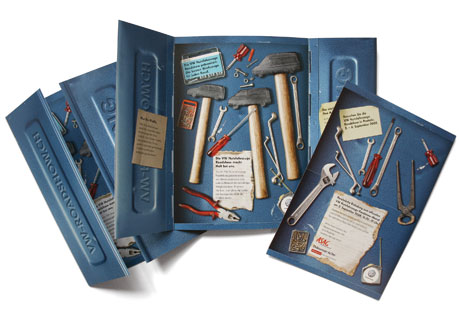
VIzner Borel has designed a roadshow for dealers of VW commercial vehicles. Since last week, VW has been touring Switzerland with its vehicles, for example at Amag in Solothurn and in car dealerships in Oensingen and Frutigen. Under the motto "VW commercial vehicles, the best tools for professionals", interested parties can find out how the Caddy, Crafter and Transporter are equipped, which conversions and superstructures are possible on the individual vehicles and how the vehicles can make the work of tradesmen and the like easier.
Wacky advertising
For the presentation "on the road", Vizner Borel designed and implemented advertisements, mailings, guerrilla measures, a dealer presence and a microsite. At Roadshow.ch, for example, you can keep track of where the roadshow is currently stopping and register for the event.
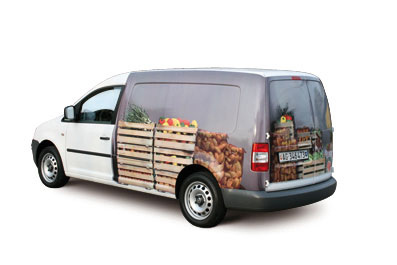
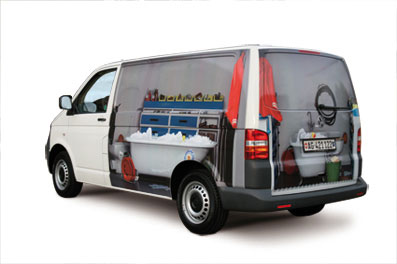
Vizner Borel also dressed the vehicles used as "demonstration vehicles" at the roadshow to show how and with what the vehicle could be loaded: The Caddy transports vegetables, the Crafter packs an entire removal and the van holds everything a plumber needs - including a bathtub already filled with foam water. In this way, commercial vehicle dealers can show their customers what VW's commercial vehicles are capable of.

Anne-Friederike Wilhelm

1290582081_img090128_roadshow1
1290582081_img090128_roadshow2
1290582081_img090128_roadshow3
1290582081_img090128_roadshow4

Psychometer selects the 20 best spots

The Interdata Research Institute has analyzed the formula for success in television commercials.

For its traditional study, Interdata in Lucerne and Linz once again analyzed all TV commercials relevant to us for the 2007/2008 period. The "Psychometer" surveyed 19 dimensions, including the four most important criteria of attention, liking, opinion improvement and incentive to buy. Of the 620 commercials measured, only one managed to fall into the top 20 in all four dimensions. "Fitness center" for doubts comes from the kitchen of AY&R. "Tarzan" from Swissmilk by the Ruf Lanz agency managed three entries. 10 spots achieved a top position in two dimensions. 53 of the still "best" commercials according to Interdata made it in at least one of the four most important dimensions.
The tests were carried out with 120 test subjects, half men and half women aged between 16 and 50. After the block was played once, the test measured spontaneous recall, aided recall, awareness of the commercial before the text, the four resonance values mentioned above and the impression of detail using a list template: likeable, entertaining, interesting, good product presentation, convincing, average, boring, exaggerated.
> Overview of results
Head of research Jos W. Vloemans in Lucerne interprets the basic prerequisite for the "secret of success" as "arousing interest". If you don't have an interesting message, you will fall by the wayside. Commercials that are memorable and strengthen the brand's reputation are also far more entertaining than average. So they work with humor. The wink is preferably combined with sympathetic elements.
Andreas Panzeri

Yahoo in the red due to restructuring

Yahoo was in the red at the end of 2008 due to the restructuring of the Group and write-downs on its international business. The bottom line for the final quarter was a loss of 303 million dollars after a plus of 206 million dollars a year earlier. Turnover fell by one percent to 1.8 billion dollars.

Yahoo was in the red at the end of 2008 due to the restructuring of the Group and write-downs on its international business. The bottom line for the final quarter was a loss of 303 million dollars after a plus of 206 million dollars a year earlier. Turnover fell by one percent to 1.8 billion dollars.
Yahoo CEO Carol Bartz, who has only been in office for two weeks, said on Tuesday evening after the close of the US stock exchange that the company has some work ahead of it. However, she was confident. Yahoo recently cut around ten percent of its jobs and continued to lose ground to its competitor Google in the online search advertising business. In 2008 as a whole, profits fell by more than a third to 424 million dollars. Turnover grew by three percent to 7.2 billion dollars, as Yahoo announced on Tuesday at the company headquarters in Sunnyvale, California.
Yahoo's profit adjusted for special effects amounted to 238 million dollars in the final quarter. It exceeded analysts' expectations, while turnover fell slightly short of them. The share price was up in an initial after-hours reaction. They had already gained 1.5 percent to 11.34 dollars during the course of the day.
For the current quarter, Yahoo expects sales of between 1.53 and 1.73 billion dollars. Operating profit is expected to be between 75 and 85 million dollars, well below experts' expectations.

The beds in the poster hospital are filling up

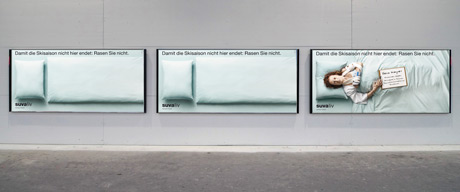
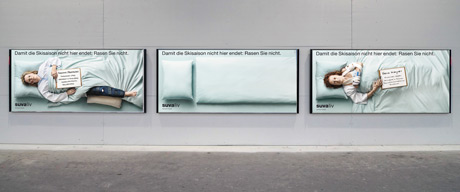
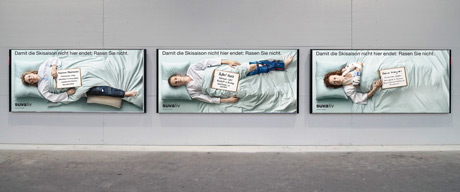
For Suva's new winter sports campaign, Ruf Lanz has transformed billboard spaces into hospital beds as a preventive measure.

It's food for thought that literally hits home - and will hopefully help make speeding accidents a thing of the past. This is how train passengers experienced Ruf Lanz's latest campaign for its client SuvaLiv in recent weeks. The posters were hung up on the platforms of train stations where winter sports enthusiasts were waiting for their trains to Chur, the mountains of central Switzerland or the Bernese Oberland.
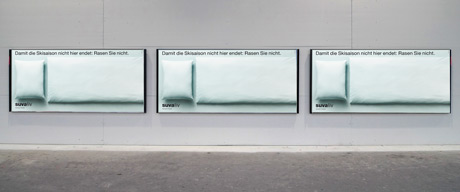
An F12 poster is almost exactly the shape and size of a hospital bed. This similarity gave Ruf Lanz the idea for a correspondingly striking visualization of the statistics. Due to much more active leisure activities than in the past, there are now significantly more non-occupational accidents than occupational accidents in Switzerland. And 32 percent of all sports accidents occur during winter sports. This is no coincidence, as the ski slopes are frequented by everyone from toddlers with bends to downhill cracks at over 100 kilometers per hour. Some winter sports enthusiasts overestimate their abilities - and therefore underestimate the risk. The result is collisions with other winter sports enthusiasts and numerous, sometimes serious accidents. This was dramatically demonstrated to us at the beginning of this season with a German politician and his collision with a woman who died as a result of the accident. Even if the outcome is less serious, accidents involving insured persons often result in very high costs for Suva.
The Suva brand SuvaLiv is committed to increasing recreational safety. In recent years, together with Ruf Lanz, it has already appealed to winter sports enthusiasts to take personal responsibility with several award-winning campaigns. The current campaign uses a three-stage poster display. On January 5, three posters with as yet untouched "hospital beds" were first put up on the busy railroad platforms. As the posters went up, the beds slowly filled up with victims of skiing accidents. These are not models, as is usually the case in advertising. Ruf Lanz used a 20-minute "casting" to find real victims. They were actually victims of ski slashers. Their very personal story of fate can now be found on the posters in a medical report that the unfortunate victims hold over their chests. To ensure that the consequences of their accidents are portrayed correctly, a surgeon was also involved in the shoot with photographer Oliver Nanzig as "art director", alongside Grit Wolany from the agency.
After a good three weeks, all the hospital beds on the billboards are now occupied by such victims of piste racers. The claim now makes sense: "So that the ski season doesn't end here: Don't speed."
Markus Ruf, who as a commuter between Zug and Zurich was able to follow the increasing bed occupancy in his "hospital" on his way to work, was delighted every day by the attentive observations of passers-by. The trick of changing the posters every few days while keeping the same layout meant that no one was able to mindlessly wait for the train in front of the posters. Advertisements or a film, on the other hand, are not feasible with this idea. The further development of the campaign will be managed by Suva's internal PR department. Ruf Lanz then wants to use all the media to promote the other leisure topics of bicycle helmets and fair play in football.
Andreas Panzeri
1290582083_img090128_ruflaz_suva1
1290582083_img090128_ruflanz_suva2
1290582083_img090129_ruflanz_suva3
1290582083_img090129_ruflanz_suva4
get_footer();