Zeta advertises and designs for Charles Muller

Categories

Uncategorized

Die Zeit: Swiss edition boosts retail sales

Six months after the launch of its Swiss edition, the German weekly newspaper Die Zeit is reporting positive results. Single copy sales have increased by more than 50 percent since December 2008, while subscriptions have risen by more than 20 percent.

Six months after the launch of its Swiss edition, the German weekly newspaper Die Zeit is reporting positive results. Single copy sales have increased by more than 50 percent since December 2008, while subscriptions have risen by more than 20 percent. Overall, paid circulation increased from around 6,000 to more than 10,000 copies per issue, as the publisher announced on Tuesday.
Die Zeit is published in Switzerland every week with two extra Swiss pages.
On certain occasions, there are also dedicated Swiss front pages. Peer Teuwsen, most recently Head of Culture at Weltwoche, is responsible for the country pages.

1290581668_img090602_diezeit
The first Swiss edition. (Source: Swissinfo.ch)

Last but not least: Two kinds of advertising criticism

Retiring editors are usually allowed to review their time at the magazine in a kind of résumé. As I am not particularly fond of nostalgic thoughts, I prefer to conclude with two topics that point to the future.

Retiring editors are usually allowed to review their time at the magazine in a kind of résumé. As I am not particularly fond of nostalgic thoughts, I prefer to conclude with two topics that point to the future.

Creativity
Let's start with the content, the much-vaunted creativity in the advertising industry. The hijacking of the term by the so-called creative industry is already so far advanced that many of our contemporaries need to be reminded again and again: Creativity has as little to do with the creative industry as water has to do with the food industry. Creativity is a fundamental characteristic of the homo sapiensnamely to be able to think or create something that was not there before. As the linguist Noam Chomsky always mentions, even formulating a sentence is an extremely creative act.
What am I getting at with this comment? Everyone is creative. It's just that not everyone earns their money by working for companies with their inventions - which, incidentally, are all too often plagiarized. So, dear people, call a spade a spade and say: I work in the advertising industry, or: I work in the product and service propaganda industry, because what's creative about the whole thing is primarily the ways to increase sales, and that's not so creative after all.
Another concern would be that if advertising wants to be creative, it should also remain honest. There is a tendency here to take consumers for fools in a very obvious and irony-free way and in a reversal of the Media Markt claim. For example, the advertising spot of a major distributor that paints an idealized Ballenberg Switzerland in beautiful colors, where the chicken comes by and lays its own egg in the carton on the spot (the fact that it marinates itself and throws it on the grill would probably have been a bit too much). So the portrait is of a Swiss chicken, regardless of the fact that a lot of chicken meat from the same wholesaler comes from Brazil and ... elsewhere. Just one example.
What's more, creative does not necessarily mean inspiring. Grosso modo, 80 percent of advertising is moderately to extremely boring, around one fifth of advertising messages are such that you can even get really upset about them (which admittedly has an invigorating effect), and perhaps one percent - at least - is inspiring every now and then. By inspiring, I mean advertising that is not over-determined, that doesn't just push the much-cited consumer towards the binary decision to buy/not to buy, but that puts something into the world that is still unfinished and that allows new thoughts and ideas to be generated in the minds of those to whom it is addressed. Christian Hänggi summarizes this aptly in his new book: A development that frees the mind or brain of the consumer/citizen in such a way that they can achieve higher mental productivity.
Being creative therefore also means leaving the process open for further creation. A challenge.

Outdoor advertising
Apparently, marketing strategists feel that advertising messages have the right to an appointment with me at any time of day or night, in the city or in the country, on the streetcar or even in the loo. I don't quite see it that way. It makes sense that advertising should take place where it significantly finances something, i.e. in print products, on websites, on television, at football matches, at other commercial events, on the radio, and so on. For me, however, poster advertising in public spaces and on public transport has no right to exist. It hardly generates any financial returns, but occupies entire areas. By way of comparison, outdoor advertising generates an estimated 0.2 per thousand of total revenue for the city of Zurich; in the case of print products, we are talking about 30 to 70 percent. To paraphrase Howard Gossage: outdoor advertising trades in a commodity that does not belong to it: the field of vision of passers-by. And without their consent. And almost for free.
I am not an anti-advertising Taliban, I don't understand bans on advertising for alcohol and tobacco products, for example, and I have nothing against advertising as long as it is not force-fed. As long as I agree to it by buying a newspaper or switching on a television, advertising is fine with me (except for exciting movies), sometimes it is even entertaining. But this is exactly where the problem lies: outdoor advertising is in the middle of my living space, unasked. It is impossible to switch it on or off, and there is no Robinson's list, which, incidentally, an astonishing number of advertisers make use of for their own four walls.
In advertising circles, the right to freedom of expression is increasingly being insisted on again as a defense against advertising bans. However, if this is already being done, then this right to freedom should not only be demanded, but also granted. This would mean that a citizen must also have the right to be free from advertising if he or she does not want it. In addition to freedom of expression, freedom from coercion is also part of a liberal social order. To let Gossage have his say once again: I like outdoor advertising. I just don't think it has a right to be out there.

Cheers and thanks to the people at Werbewoche for two instructive years
Michael Koller
Dialog Marketing Award 2009: Agency at the airport wins eight trophies

Categories

Uncategorized

Tagi: Culture editorial team loses three jobs

From Wednesday through Friday last week, the previously announced layoff meetings took place at the Tages-Anzeiger. In the culture department, the cutbacks resulted in the loss of three positions.

Now that the fog has lifted somewhat over the downsizing battle at the Tages-Anzeiger, the picture of the extent of the job cuts made by the publisher last week between Wednesday and Friday is becoming increasingly clear. The culture editorial department will lose three jobs, a "major bloodletting" according to an internal source. The fee budget for freelancers will also be cut by 25 percent; this is likely to be the case in the other departments as well. Writing fees are not to be reduced, however, but the trend is towards fewer assignments being published. The deadline for the new newspaper concept and layout is still the end of August or beginning of September 2009.

New ombudsman for the Telecommunications Arbitration Board appointed

Oliver Sidler has been appointed the new ombudsman and managing director of Ombudscom, the arbitration board for telecommunications. He succeeds Carol Franklin.

Oliver Sidler has been appointed the new ombudsman and managing director of Ombudscom, the arbitration board for telecommunications. He succeeds Carol Franklin.
Sidler, a lawyer with his own law firm in Zug, is a lecturer in media and telecommunications law at the University of Fribourg. Since the founding of Ombudscom four years ago, Oliver Sidler has been jointly responsible for the establishment and development of this institution as a scientific advisor, according to a press release from Christian Schwarzenegger, Chairman of the Foundation Board.
Ombudscom is the arbitration body in the telecommunications sector and is organized as a foundation. For customers of telecommunications and value-added services, Ombudscom is a neutral and independent body that offers settlement solutions for civil law disputes. The foundation has been mediating between consumers and providers in the telecommunications sector since May 2005. It is responsible for complaints relating to the fixed network, mobile telephony and Internet services.
The founders of Ombudscom are Cablecom, Orange, Sunrise and Swisscom as well as Savass (Swiss Association Value Added Services), the consumer organizations Kf (Konsumentenforum), FRC (Fédération Romande des Consommateurs) and the Associazione Consumatrici della Svizzera italiana). The Ombudscom Foundation guarantees the absolute independence and neutrality of the arbitration board. It is subject to the supervision of OFCOM.
Carol Franklin, Sidler's predecessor, has moved to Postfinance. She has headed the ombudsman's office there since January 1, 2009.

Frontwork: New advertising spaces at Zurich Airport labeled

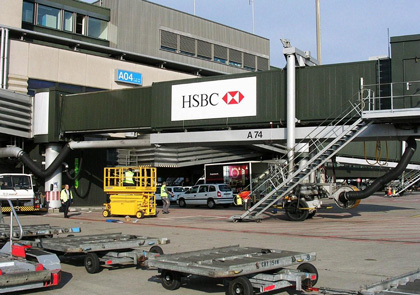
Until now, advertising at the airport has only been available at selected locations. Advertising spaces on passenger boarding bridges and concourses have now been approved. The Frontwork agency developed solutions for the exterior lettering of the boarding bridges.

Until now, advertising at the airport has only been available at selected locations. Advertising spaces on passenger boarding bridges and concourses have now been approved. The Frontwork agency developed solutions for the exterior lettering of the boarding bridges.
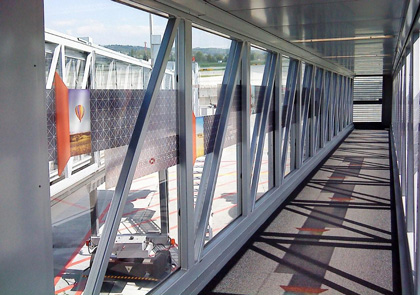
The Wallisellen-based agency Frontwork created a frame for the exterior lettering of the passenger boarding bridges that adheres to the dock thanks to magnets. Screws, drilling or direct gluing were out of the question. The agency riveted the lettered aluminum advertising panels onto the frame. Digital prints were applied to the inside of the metal cladding of the passenger boarding bridges in Dock A. For the glass passerelles in Dock E, the agency developed and produced semi-transparent digital print stickers that are visible day and night.
The Honkong and Shanghai Banking Corporation Limited HSBC has already secured the first spaces.
In order not to interfere with air traffic, the work could only be carried out late in the evening or at night. According to the press release, it took several years for all contracts and permits for the new advertising spaces to be issued. The new spaces are the only advertising spaces on the airport's flight-side area.
1290581673_img090529_werbungamflughafen
1290581673_img090529_werbungamflughafen2

Google Street View: data protectionists demand more rights for those filmed

Anyone who is recognizable in a Google Street View image taken on the street should be able to prevent the images from being published online. This is the demand made by Privatim, the Association of Swiss Data Protection Commissioners.

Anyone who is recognizably photographed on the street for Google Street View should be able to prevent the images from being published on the internet. This is the demand of Privatim, the association of Swiss data protection officers. According to a press release issued by Privatim on Friday, Google must take into account the principles of data protection and individual rights when taking pictures for Google Street View. In contrast to other European countries, this is not yet the case in Switzerland.
Google Switzerland confirmed on Friday that images of streets are currently being taken in major Swiss cities. However, no image has yet been placed on Google Map, as spokesman Matthias Meyer told the SDA news agency. However, the protection of privacy is always a concern for Google. In Street View, a mechanism therefore ensures that faces and license plates of cars are blurred. However, the technology does not always work. Anyone who recognizes their face, house or car on Street View can therefore send Google a message via a link under the image. The images will then either be made unrecognizable or removed from the network.
Google was surprised by Privatim's accusations. The company now wants to hold further talks with the data protection commissioners. The Federal Data Protection Commissioner Hans-Peter Thür has signaled to Google that the recording mechanism is sufficient to respect Swiss law.

SFLB reads the small print for law firm

SFLB has created a new brand identity for the law firm Staiger, Schwald & Partner (SS&P). The agency designed a new logo, stationery templates, a brochure, and an advertising campaign.

SFLB has created a new image for the law firm Staiger, Schwald & Partner SS&P. The agency designed a new logo, subjects for stationery, brochures and an advertising campaign. The campaign addresses various legal topics, such as the small print in pleadings.
The advertising campaign is running in domestic and foreign specialist media as well as in foreign
selected titles in the Swiss financial and business press.
Responsible at Staiger, Schwald & Partner: Gina Maroggi (Marketing), Rolf Schätti (Office Manager), Michael Hamm (Project Manager Partner), Hans-Peter Schwald (Managing Partner). Responsible at Spillmann/Felser/Leo Burnett: Dana Wirz (Art Director), Peter Brönnimann (Text), Martin Spillmann (CD), Dominik Mätzener, Rolf Zimmermann (Consulting). Photos: Julien Vonier, image editing: Nora Fehr
1290581674_img090529_kleingedrucktes
1290581674_img090529_dschungel
img090529_waage

Attilio Meyer strengthens sales team

The Zurich-based company Attilio Meyer continues to expand. Effective June 1, 2009, Martin Hunziker will join the sales team at the family-owned company.

The Zurich-based company Attilio Meyer is expanding further. In order to expand its market presence and strategic orientation with a focus on customer care, the company, which is active in digital printing/advertising technology and illuminated advertising/metal construction, has decided to further strengthen its sales department. The company has recruited Martin Hunziker, who will be working for the family business on a daily basis from June 1, 2009.

Oldest weekly radio magazine in the world

The world's oldest weekly radio magazine is produced and broadcast in Switzerland. It is the program «Voci del Grigioni italiano» on RSI, the radio station of Italian-speaking Switzerland. It was officially recognized as the world’s oldest magazine program through an entry in the Guinness Book of World Records.

The oldest weekly radio magazine in the world is produced and broadcast in Switzerland. This is the "Voci del Grigioni italiano" program of the radio station of Italian-speaking Switzerland RSI. It was officially recognized as the world's oldest magazine by an entry in the Guinness Book of Records, as RSI announced on Friday.
The show first went over the airwaves on October 28, 1939. In the Guinness Book, the age is not given as 70, but as 68. The reason for this is a different name for the weekly magazine during its first two years: "Il Quarto d'ora del Grigioni italiano".
The half-hour magazine can be heard every Friday at 7 pm on the first program of RSI. It deals with current topics from the Italian-speaking southern valleys of Graubünden. The program, which is produced in Chur, has been hosted by radio journalist Alessandro Tini for two years.

Apart: Research team in search of rare species

As part of a new launch of its services, the customer service provider Passion 4 Customs commissioned the Apart agency to develop a longer-term advertising idea and implement it in an initial commercial. The film will be used for a viral web campaign.

As part of a new launch of its services, the customer service provider Passion 4 Customs commissioned the Apart agency to develop a longer-term advertising idea and implement it in an initial commercial. The film will be used for a viral web campaign.
Passion 4 Customers P4C supports customers with problems in the post-sales phase and at the same time helps companies to optimize their customer service. As part of a new launch of its services, P4C commissioned the Apart agency to develop a longer-term advertising idea and implement it in an initial commercial. The film will be used for a viral web campaign. In it, the P4C research team is on the road to track down the rare species of good service employees.
Responsible at Passion 4 Customers: Nathalie Fréchet (CEO). Responsible at Apart Kommunikationsdesign: Marius Deflorin (creation and direction), Tobias Lang (consulting and production management), Manuela Barak (production assistance and styling), Manfred Zazzi (post-production and music).
To the spot
get_footer();