In harmony with nature

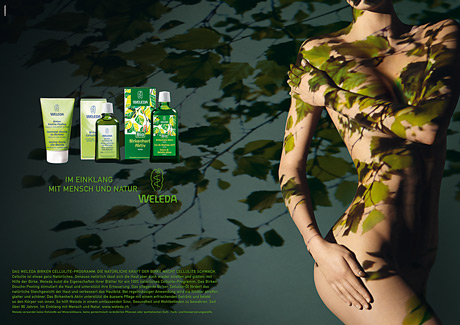
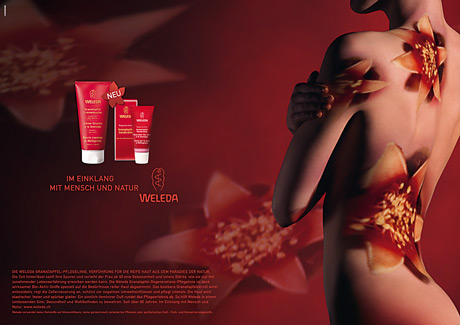
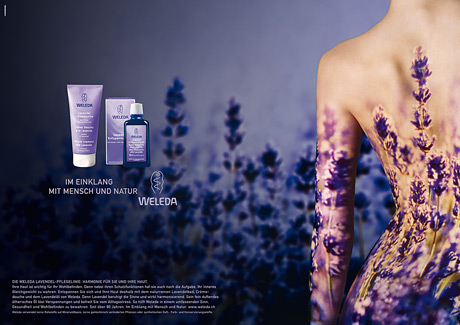
ViznerBorel presents Weleda's new overall appearance.

Natural-based cosmetic products are in vogue. Brands such as Body Shop, Clinique and L'Oréal are competing with each other. The brand most strongly associated with the power of nature is Weleda. The beauty products' flaw: Weleda is quickly pushed into the corner of the "alternatives" when judged superficially. This impression is now to be corrected by ViznerBorel in a new appearance - a little, but of course not completely.
"If you want to see the whole, you have to be prepared to engage with the individual. Those who engage with the individual can see and understand the whole. Weleda can be approached in many different ways." This is how Weleda formulates its philosophy on its homepage. This goes back to an intensive collaboration between Rudolf Steiner and the Dutch doctor Ita Wegman. Wegman opened the first clinical-therapeutic institute in Arlesheim in 1921. In the neighboring community of Dornach, he had founded the School of Spiritual Science. In 1925, the founder of anthroposophy and the holistic doctor worked together on the publication "Fundamentals for an extension of the art of healing according to spiritual scientific knowledge". This became the foundation stone for Weleda.
Today, the company employs over 1,800 people worldwide on all continents. Since its foundation, Weleda has exclusively developed and marketed holistic medicines, dietary supplements and body care products. Weleda focuses on the needs of doctors and patients who ask for anthroposophical products. "In harmony with man and nature" became the guiding principle. The proven claim should now also form the core message in a new overall appearance of Weleda in Switzerland. The contract for this was put out to tender in a major pitch. ViznerBorel won the budget with a strategic and creative presentation. "The implementation of our claim, which still forms the basic idea of our company's philosophy, is very special and successful," says Patricia Pécourt, Head of Advertising and Communication at Weleda, delighted with ViznerBorel's idea. They have projected real images of natural ingredients such as birch or lavender onto the beautiful body of a person. "It was important to us that these subjects were natural and not created on a computer," explains AD Hanna Zimmermann. The new look applies to all cosmetics and care products as well as the over-the-counter area for self-medication. The visual language is used across a wide range of media - from print to cinema, brochures and the Internet to POS.
Andreas Panzeri
1290581659_img090604_weleda1
1290581659_img090604_weleda2
1290581659_img090604_weleda3
1290581659_img090604_weleda4

Striking

Among other things, *Werbewoche* noticed an advertising magnate on stage and the Art Directors Club's new yearbook this time around.

The Passion of the Most Creative
In January, the Art Directors Club honored the outstanding advertising campaigns of the past year. Now, the ADC is presenting the winning entries in its new yearbook. Across 304 pages, the book showcases all the campaigns that were particularly successful last year in terms of strategy, concept, and execution. The book was conceived and designed by Creative Director Bene Abegglen and Art Director Patrick Fawer at Contexta. According to its creators, the book «is about passion, inspiring stories, and people who take risks to achieve great things.» The yearbook is published by Werd Verlag. Until August 31, you can order it there at the subscription price of 118 francs instead of 148 francs at [email protected].

Advertising Baron on Stage
Rolando Baron likes things to be a little out of the ordinary. To present not only his new agency, Büro Baron, but also his ideas for unvarnished and captivating advertising to potential clients, the art history graduate, copywriter, and concept developer took the stage for a week at the Riffraff neighborhood cinema—for a live commercial segment between the ad and the start of the film. Baron’s idea: to use his own brand to demonstrate what a skillful corporate presentation looks like. «A company has to step up and simply say what’s what, even without flashy images,» Baron pointed out shortly before the movie started. At a time when various bubbles are bursting, Baron is making a name for himself through authentic communication. So far, it’s mainly advertisers and the media who have taken notice of his campaign. But Baron firmly expects that clients will soon want to use his help to get their brands talked about as well.

1290581656_img090604_baron

It's not just for the bedroom
Advertising is everywhere—now even on airplanes, in tents, on sailboats, and next to your bed. Starting next week, the new visuals for the «That Can Only Be an Ad» campaign will catch your eye everywhere you look. The idea for the Swiss Press Association’s image campaign came from Bettina Klossner and Laurie Morard. Earlier this year, they won the competition in which the association annually selects the best ad ideas from up-and-coming creatives. The campaign runs through the end of August.

1290581656_img090604_inserat1
1290581656_img090604_inserat4
1290581656_img090604_inserat3
img090604_inserat2

Making brands resonate

Companies refine every detail of their visual identity. But they don’t consider acoustic branding, which could further strengthen their image. Sound designer and corporate sound expert Peter Philippe Weiss believes this is a mistake.

The core message of Peter Philippe Weiss' Basel agency Corporate Sound is "Hear your company expand". His idea: if you not only coordinate the visual, but also the acoustic appearance of your company with your company, products and services, you can present your brand and goods to the market in the best possible way - and this will also be reflected in your sales. Weiss showed how corporate sound works and how to compose it in a presentation for the Swiss Young Professionals at the IAA in Zurich. Weiss and his sound jugglers give companies, brands and products their own sound. They add an acoustic dimension to the visual level served by CDs, logos, commercials and corporate films. "Sounds and music activate very individual ideas, images and feelings in everyone, as if at the touch of a button," says Weiss. "What we see is always outside of us, what we hear we let into us and it becomes part of us. Studies have shown that music increases memory by 80 percent, sympathy by 36 percent and the willingness to buy by 24 percent. That's why companies should consciously shape the acoustic message they disseminate."
Awaken feelings and associations
The power of music and sounds can be used in various areas: strategically as corporate sound for commercials or as an underlay for the word/image brand, atmospherically for the design of rooms, products or trade fair stands and also on the Internet. Even functional sounds can be designed: why not replace the beeping of the heart machine in the operating theater with a sound that differs from the noises of the other devices, for example with a sound related to the beating of the heart? A good example of a successful corporate sound is Deutsche Telekom's "Dididi-Didi". Every child - and every consumer - knows the sound that underpins the magenta-colored T. This sound logo fits the technology theme and rounds off the logo perfectly, says Weiss. Nokia's sound, on the other hand, is well-intentioned but poorly made. Its melody does not convey dynamism, but boredom. Such an audible faux pas is annoying. After all, in the best-case scenario, a sound accompanies a company throughout its life and is not only used in TV and cinema commercials, but also online, at trade fair stands, in buildings, stores and at company events. Weiss: "Even if the melody is modernized after about five to six years: The basic sound remains the same." At least that's how it should be.
Marketing for all the senses
Weiss and his colleagues have developed a corporate sound for ABB, Diners Club and Tissot, for example. "It was important to us that the acoustic message conveys what is typical of the company and its product," explains Weiss. "The business must be audible in the sound." ABB's commercials are therefore underlaid with energetic, metallic tones made up of triads. They stand for the three letters of the company. For Diners Club's corporate sound, the Basel agency combined a digital sound, which stands for swiping a credit card through a card reader, with music that "captures a beautiful moment in sound", as Weiss says. As abstract as this explanation sounds - the sound works. As desired, it awakens images of yachts, golf courses and luxury cars in the listener, as well as all kinds of desires and longings. And these can then be fulfilled with the Diners Club card. At Tissot, a ticking second hand sets the pace for the corporate sound. "However, the transfer of the corporate image or product characteristics into sound must not be too direct," warns Weiss. "Otherwise it becomes flat." It would therefore be fundamentally wrong to surround UBS with sounding coins - and would also no longer correspond to the reality that the big bank and its clients are currently confronted with. Weiss wants to find a unique corporate sound for each of his clients. That is why he not only searches for melodies, but also for sounds, acoustic patterns and symbols and experiments with the materials that his clients produce or process. For the ceramics and bathroom manufacturer Duravit, he has created a sound made of ceramic sounds. The more material the product of the company being advised is, the more rewarding this approach is. But Weiss also asks himself: What does insurance sound like? And finds a solution to this question.
Searching for the right tone
A company soundtrack takes around three to four months of work. In the search for the right tone, Weiss immerses himself in the world of the company, examines its nature, the products or services and, of course, the existing CD. The effort pays off. "For the cost of a large newspaper advertisement, a strategic application is created that can be used for ten years or more," says Weiss. "With an exhibition stand, the sound is the smallest part next to the architecture and lighting."
Corporate sound is not only suitable as background music for TV commercials, as a sound logo or for the atmospheric charge of a trade fair presentation. "There are many sounds in companies that are a declaration of war on the ear, that totally contradict the company's image and therefore damage it," says Weiss. Starting with the digitized little night music in many telephone loops, which dates back to the Stone Age of sound, the sounds of ATMs or elevators are also an attack on the ear. "Imagine a beautiful lobby, completely covered in marble and with elegant furniture," says Weiss. "Then the elevator stops and makes a completely distorted 'Drrrrrrrringg'. Terrible! It destroys the whole effect of the lobby and prevents you from feeling comfortable."
Sound compositions, noises and music create worlds in the mind's eye. This makes sound an important component of brand architecture. Companies that want to breathe life into their brand should quickly fill this free space in their advertising orchestra.
Anne-Friederike Wilhelm

In a nutshell
Peter Philippe Weiss was born in Basel in 1962. He is a trained electronics engineer and violinist and taught himself to play the guitar, electric guitar, keyboard, drums and electric bass. Weiss founded Corporate Sound AG in 1994, making him a pioneer in the field of corporate sound design. With his four-person team and in collaboration with sound and technology partners, he designs acoustic corporate presentations, composes film music, realizes urban sound installations as well as soundscapes for architecture, exhibitions and museums. Corporate Sound works for clients such as ABB, Credit Suisse, Duravit, Swiss Olympic, Swarowski, Coop and IWC.

Euro RSCG realizes the shortest TV spot for Stop AIDS

New commercials for Euro RSCG's "Love Life Stop AIDS" campaign focus on casual sex. If a condom wasn't available, an HIV test may be necessary. Those affected can find more information on a website.

He left before she arrived. This is how one could casually summarize the scenes with which Euro RSCG Zurich, together with the Federal Office of Public Health, has been raising awareness of AIDS since this week. Situations are thematized in which things happen so quickly between two random partners that the overheated parties can no longer find time to think about the tried and tested rubber.
The FOPH's new "Love Life Stop Aids" campaign is now in its fifth year since it was launched by Frank Bodin's crew. "Ging's zu schnell, um an Gummis zu denken?" is the creative realization this season.
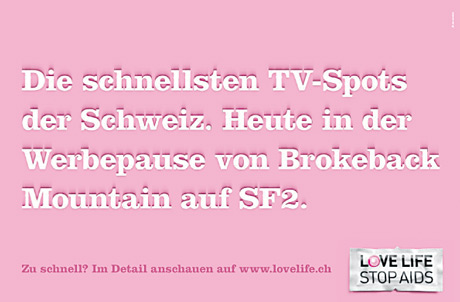
The team led by CD Axel Eckstein has created "the shortest commercials in Switzerland": For just one second, two pairs of eyes are shown meeting in a bar, for example. Then you see the protagonists already in bed. Also for just one second. The spot reaches its climax with a three-second "Did it go too fast ...?" and the good advice to get a check-up as quickly as possible. This is new for this campaign on www.check-your-lovelife.ch has been set up. Anyone who clicks through with honest answers will know whether they should perhaps take an AIDS test now after the quick sex.
> View spots
The risk situations shown are vacation flirtations and sexual adventures under the influence of alcohol. According to statistics, such adventures without a condom are currently most frequently experienced by heterosexuals "in their prime" around the age of 35. This target group should therefore be warned not to simply pass on a possible HIV virus the day after without hesitation. At the same time, the campaign encourages people to always carry a condom with them for unusual situations and to follow the safer sex rules. "We want to draw attention to HIV/Aids prevention and do this with a positive provocation. We communicate without admonishing fingers and without shock images - but with a wink. This is the most credible approach to this topic, as scientific tests have shown," explains Adrian Kammer, Head of Advertising at the Federal Office of Public Health.
The new campaign focuses on television as the main medium. Here, the spots are shown in duplicate due to their brevity. An amazing implementation of the idea can be found on Tilllate.ch, where a mouse click can turn a party photo into a sex scene. Further support is provided by advertisements, posters, promotions and give-aways.
Andreas Panzeri

1290581659_img090604_aids1
1290581659_img090604_aids2
1290581659_img090604_aids3
1290581659_img090604_aids4
1290581659_img090604_aids5

No more "would have, would have, could have"

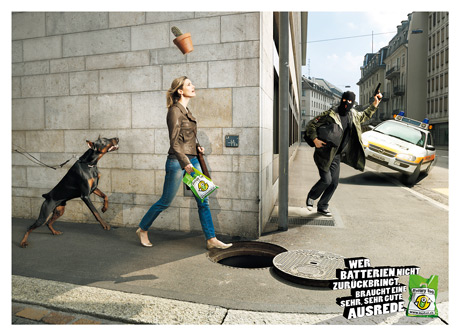
Wirz is looking for lame excuses from environmental offenders on behalf of Inobat.

Because all stores in Switzerland that sell batteries must also take back old batteries, our country has a unique density of over 12,000 collection points. You have to have "a very, very good excuse not to take your old batteries back". Wirz Werbung brought this tongue-in-cheek moral to people last year with two commercials. The idea of the films, which were able to amaze in a cheeky comic style with totally absurd excuses, is now to be adapted for the print medium this year.
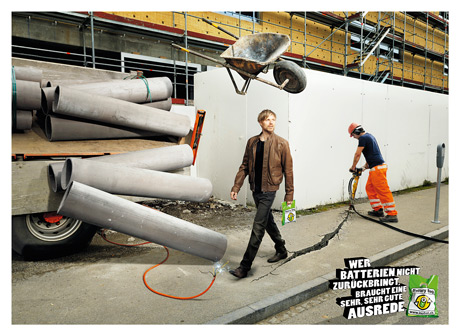
The well-known German photographer Holger Pooten has staged the excuses of two would-be disposers in elaborate pictures. "The pictures work as real eye-catchers," CD Matthias Freuler is convinced. The numerous problems that the protagonists face are so outrageous that they are almost reason enough not to dispose of their old batteries for once.
The subjects were photographed in Zurich. All the details were photographed in one and the same place in a well thought-out staging - but of course in several phases. The puzzle of this "photographic protocol" was then put together on the computer to form a new whole, as the responsible AD Barbara Hartmann and Iwan Rickenbach explain. The resulting photocomic style is not only a continuation of the form of the award-winning films. The campaign has also found the right language "for a young and critical audience, who should not be given the finger," as copywriter Thomas Kurzmeyer knows.
Max Zulliger, Managing Director of the battery disposal advocacy organization Inobat, is delighted with the successful result: "The agency regularly succeeds in getting people involved without moralizing." The campaign idea is designed to run for several years. Similar to the Mobiliar damage sketches from the same agency, the creatives want to encourage the public to think with ever new "excuses" until they finally can no longer come up with their own excuses for disposing of their batteries. pan
1290581660_img090604_inobat1
1290581660_img090604_inobat2

CR Basel promotes new Cornèrcard

CR Basel is launching the new Cornèrcard for Ticino-based Cornèr Bank with a nationwide poster campaign and online banners. According to a press release, the Cornèrcard Visa Easy Travel is a new cash and shopping card that is particularly easy to use.

CR Basel is launching the new Cornèrcard for the Ticino-based Cornèr Bank with a national poster display and Internet banners. Cornèrcard Visa Easy Travel is a new, particularly uncomplicated cash and shopping card, according to the press release. Easy to load with Swiss francs or euros, it is designed to make traveling not only easier, but also safer. Helvetia appears as a travel-friendly and trustworthy campaign icon at well-known destinations.
Responsible at Cornèr Bank AG, Lugano: Stefan Schindler (Corporate Communication), Beat Weidmann (Product Management). Responsible at CR Basel: Daniel Bürgi, Monika Vonstein, Andrea Kurz (consulting), Gabriel Heuberger (CD), Roger Horvath (AD), Philipp Schweizer, Denis Bernhardt (text), Felix Schregenberger (image editing). Media: MC Media, Silvana Maucioni.

New head of the French-language SDA editorial team

Beat Grossenbacher is to become the new deputy editor-in-chief and head of the French-language editorial team at the Swiss News Agency. The 50-year-old succeeds Marc-Henri Jobin, who will become a member of the extended SDA management board.

Beat Grossenbacher is to become the new deputy editor-in-chief and head of the French-language editorial team at the Swiss News Agency. The 50-year-old succeeds Marc-Henri Jobin, who will become a member of the extended SDA management board.
Grossenbacher, editor-in-chief of the Journal du Jura from 2001-2009, will join SDA in the fall of 2009. Before joining the Jura regional newspaper, he was deputy editor-in-chief and head of news at Radio Suisse Romande (RSR). At RSR, he initially worked as a correspondent in Delsberg, while at the same time carrying out this activity for French-speaking Swiss television.
Grossenbacher then worked as a correspondent for the cantons of Jura and Basel before moving to the head office in Lausanne as domestic editor, where he was appointed head of the regional editorial offices. Grossenbacher began his journalistic career with a stint at the Journal du Jura. He later moved to La Liberté in Fribourg as regional editor.
Grossenbacher is a board member of the Editors-in-Chief Conference and a member of the Press Council. He is also a lecturer at the Media Training Center of Western Switzerland
(CRFJ) in Lausanne.

To the point: credibility

On page 38 this week, instead of one top and one flop news story of the week, you will find two tops of the week. Not that we're running out of bad news. What's happening in the media industry at the moment - whether in Switzerland or abroad - would allow entire issues to be filled with bad news.

On page 38 this week, instead of one top and one flop news story of the week, you will find two tops of the week. Not that we're running out of bad news. What is currently happening in the media industry - whether in Switzerland or abroad - would allow us to fill entire issues with bad news. Rather, the two positive reports are intended to send a very small signal. A very little optimism in a thoroughly pessimistic time.
People are lamenting all over the place. The end of the printed newspaper is being prayerfully conjured up. Structural adjustment, market shakeout, cost reduction are becoming the daily mantra of all too many exponents of the media industry. Experts and those who think they are experts give unsolicited advice. Is it advice for survival, for euthanasia, or is it just self-profiling? Let's leave the answer open.
Gavin O'Reilly, president of the World Association of Newspapers (WAN), said last week at the "The Power of the Printed Word" conference in Barcelona: "That all this doom-mongering goes unchallenged is, to me, the most bizarre incident of willful self-mutilation in the entire history of the industry." And further: "Many don't even think about what they're talking about, but simply join the chorus of those who claim that the future is Internet, Internet, Internet, and all but rule out everything else."
It may be that these are just presidential words at an industry event. Words that simply sound good. Skeptics would agree. I don't believe it, because after all, O'Reilly is not only president of WAN, he's also chairman of the board of the Irish media group Independent News and Media. So he's neither a theorist nor a fantasist. He knows what he's talking about. Another quote shows that: "This is not to detract from the serious, indeed very serious, situation, but the fact remains that companies in the other major industries are just as affected as the big media houses."
But if media managers no longer believe in their industry and cast doubt on the role of the media, then things will get fizzling. Allow me to get very personal here. When many - fortunately not all - publishers, radio and TV broadcasters no longer believe in the power of advertising, then it becomes dangerous. How are these industry exponents going to credibly convince their customers that classic advertising works if they themselves do the opposite? They invest in B2B portals, address their customers directly or do nothing at all. At the same time, they complain that their customers don't use traditional advertising or use it less. Where is the credibility in that?
Pierre C. Meier, Editor-in-Chief
[email protected]

Facebook - an experience report

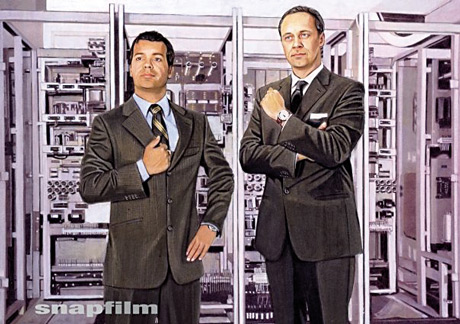
Facebook can also play an important role in the professional world. Op-ed by Michael Kindermann, Snap-Film.

I have been using Facebook for some time now. Very hesitantly at first. I even logged off from time to time. Because status messages like "I'm drinking tea" or "Flying home from a shoot in L.A." and permanently uploaded photos with some impersonal crap become uninteresting in the long run.
Fortunately, Facebook can do much more. On our Facebook page, we can quickly and easily share news, films and other content with our fans and readers. We use the page purely as an information tool, it serves as an entertaining presentation and accompanies our public appearance. Advertising emails to our Facebook friends are absolutely taboo. The information can be collected selectively from us and is not sent to everyone on a scattergun basis. Because only those who adhere to the unwritten laws of Facebook will be successful.
Although you can only reach people slowly with Facebook, as you can only make contacts via confirmed "friends", they can be particularly useful. I have been able to make three new, active customer contacts via our Facebook page that I have been trying to reach for years using traditional methods.
When it comes to use, it should be said that "less is more", because Facebook pages can quickly look cluttered and untidy. After all, I want to present my company and not become a bulletin board. I also make sure that I don't use photos in which other people are too clearly recognizable. Close-ups of my clients and customers during filming are not published without the appropriate permission.
As a modern company in the communications industry, you inevitably have to try out and use new methods. It remains to be seen whether they will bring the desired success and prevail. In any case, we are always getting new fans and my private friends on Facebook also have an insight into my professional life.
We were already a pioneer in Second Life and were the first Swiss film production to present an advanced representation with its own island, a movie theater and playable sample reel. Second Life is somewhat asleep. Now we are the first Swiss film production to have a page on Facebook. Fortunately, our competitors are following us this time.
Visit us on Facebook: www.facebook.com/pages/Zurich-Switzerland/snapfilm/67386928228. Our new music video by C. Gibbs "I Can't Get You Off of My Mind" is currently available.
Michael Kindermann, Snap-Film
1290581660_img090604_snapfilm
Leo Sanfilippo (l.) and Michael Kindermann.

Corporate publishing: Rumpelstiltskin in the mailbox

Speculation about a name only creates suspense in fairy tales. In corporate publishing, knowing right away who you’re dealing with is crucial to success.

Customer magazines have an impact. They create trust and emotionally bind customers to the brand once they have been won over. Provided the magazine appeals to them. This decision only takes a moment when sorting through the mail. The image, format, paper, size, headlines and, of course, the name of the magazine are recorded. The questions "Do I like it? Am I interested? Do I know the sender?" are answered spontaneously with a yes or no from the gut. Within fractions of a second. Intuition processes 11 million sensory perceptions per second, while the conscious mind processes just 40, so hardly anyone will bother to reflect on the decision they have already made.
So what does it take to ensure that as many questions as possible are answered in the affirmative? The first step is to choose the brand as the magazine name. Satisfied customers are very likely to perceive the magazine as a thank you for their choice of brand. Fantasy names, however, make it more difficult to achieve the goal of emotionally binding customers to the brand. In terms of content, they also tempt you to stray into thematic arbitrariness and lose sight of the focus on the main task: namely to communicate the world of the brand. An example: The owner of a renowned watch and jewelry store likes Zieger. That's why he wants to dedicate an article in his magazine to the Glarus specialty. But the realization, a simple product portrait, is more irritating than surprising.
Customer magazines should fulfill the expectations of the brand and its world. Nevertheless, surprises are welcome in the content. A contradiction? No. If the basic concept is well thought out and the focus of the content is on the brand world, it is possible to link topics that seem strange at first glance. In the case of Zieger, for example, the formally attractive Ziegerstöckli could have been integrated into a still life with emerald jewelry. Or the editor of the magazine could have told his customers why he loves Zieger and perhaps even revealed his own Zieger recipes. Et voilà! The connection between the brand and the foreign object would have been successful. Surprising and plausible.
Meeting expectations and at the same time surprising with ideas is just one of the many challenges that a customer magazine poses for its creators. It takes passion, know-how and a lot of work. Or as Wolf Schneider, the teacher of the German language, aptly puts it: "Someone always has to struggle: either the maker or the reader!"
Christa Löpfe-Feldmann
Christa Löpfe-Feldmann is a specialist in media projects and corporate publishing. The former
Annabelle's editor-in-chief is the main lecturer on the "Corporate Publications - print & online" course at Schreibszene Schweiz.

In September 2009, the New diploma course from Schreibszene Schweiz: Corporate publications - print & online. The course is aimed at communication specialists, copywriters and journalists who want to learn corporate journalism in a practical and well-founded manner. It is the only course of study in Switzerland to include practical days in newspaper editorial offices and agencies, with clients and printers in addition to the theoretical part. On site, students exchange ideas with editors-in-chief and agency managers, develop concepts or solve case studies - and thus apply what they have learned in practice.
In addition, the training places just as much emphasis on modern digital corporate publications as on printed corporate media, in the conviction that today only such cross-media concepts guarantee successful, contemporary corporate publishing. www.schreibszene.ch

YouTube launches interface for video playback on large screens

The video platform YouTube has unveiled a new interface designed to allow users to play the site's content on conventional TV sets. The YouTube XL interface is intended to optimize video playback for large screens.

The video portal YouTube has unveiled a new interface designed to enable the site's content to be played on conventional TV sets. The Youtube XL interface is designed to optimize video playback for large screens. It has been specially designed for playing video clips on larger screens and is an extension of the version launched in January of this year.
In contrast to the traditional interface, the new interface has been designed exclusively for playing video material. It is no longer possible to post comments on certain contributions, and all community functions have been removed from the new website.

Radio Energy launches German-language station wagon

In the coming days, Radio Energy will launch the first GSA-wide network for the German-speaking region. GSA stands for Germany, Switzerland, and Austria. The French group operates stations in six metropolitan areas in Germany, as well as in Zurich and Vienna.

Radio Energy will be launching the first comprehensive GSA combination for the German-speaking region in the next few days. GSA stands for Germany, Switzerland and Austria. The French group operates stations in six metropolitan areas in Germany as well as in Zurich and Vienna. Christophe Montague, responsible for the entire international business of the French group and Managing Director Germany, announced to Horizont.net that they plan to launch the first GSA combination in the next few days.
get_footer();