Competitive country bumpkin

Kurt Wettstein sees the current economic situation as an opportunity for smaller agencies.

The agency's trademark is a cow. But it has nothing to do with "Lovely." "When I'm on the phone with clients, they often hear the tinkling of cowbells in the background. And when we were taking photos of our agency for the new website, a cow looked in at the window in almost every shot," quips Kurt Wettstein. So why not just stand by it, but make it a virtue right away: "We're an agency from the country."
In fact, WVC does not correspond to the usual ideas of an advertising and communications agency. It is not at home in an urban boom district, but in the Zurich Oberland. WVC has been around since 1989, but despite its discreet address in Bubikon, its client list includes major international brands such as Kjus, Odlo, Mammut, Toko, Airex, Geberit and the Finance Forum. A certain preference for the sports industry cannot be overlooked. Kurt Wettstein pursues sports as a hobby; while in the past it was windsurfing, paragliding, tennis or sport climbing, today it is mainly skiing and golf. In addition to his fascination for sports, Wettstein also sees an explanation for the sports-related budgets in his philosophy. Namely, he "approaches every task with a sporting spirit." That's when work becomes a hobby.
Kurt Wettstein is a federally certified photographer. After his basic training at the St. Gal¬len School of Applied Arts, he completed an apprenticeship "in one of the best photo studios in eastern Switzerland". Nevertheless, the subsequent job search proved not to be easy. He worked for a while as a nurse in a hospital - "where I learned a lot as a person" - until a job ad lured him to Geneva. There, they were looking for a photographer to design advertising materials for a mail-order company. The move to French-speaking Switzerland became an opportunity for "a picture-perfect career. He continued his education and found his place as a graphic designer as well as an advertising and marketing manager. He adopted the techniques of direct marketing and eventually worked for several years in the management of the internationally oriented mail order company of Great Universal Stores PLC. When with the "commercial success" the creative work moved more and more into the background, the manager wanted to break out of this "world of numbers" again.
For this reason, Kurt Wettstein founded his own advertising agency in Geneva in 1989 with his wife Marlise, focusing on direct marketing. The "one man show" with female management was able to establish itself in French-speaking Switzerland, although Kurt Wettstein could not always completely deny his Swiss-German charm when it came to French. On the other hand, his meticulousness in photography and design were much in demand.
The first major client was Schild-Modeversand. Wettstein worked there for several years as a consultant and designer and also directed large photo shoots abroad. Other mail-order clients in German-speaking Switzerland and Germany prompted him to leave Western Switzerland and set up home in the Zurich Oberland. When the era with mail-order catalogs threatened to pass its zenith, he sought and found his new clients in classical communication.
Création Direct became Wettstein Visual Communications AG and later WVC Communications. Today, WVC's offering is divided into five areas of expertise: Communications, Graphic Design, Production, Internet and Photography with its own photo studio. The agency has been offering its services from Bubikon since 1992. There Kurt Wettstein feels centrally located to reach his clients in Central Switzerland, Zurich or Basel. In the Zurich Oberland, there is no scene, but peaceful grazing cows. "Exactly the right environment to make trees grow into the sky with unusual ideas and convincing implementations," says Kurt Wettstein. In addition, he says, it takes less time to get from Bubikon to the center of Zurich by S-Bahn or highway than it takes to get from one end to the other in the daily traffic jam in the city. "We also travel in Zurich. We just spend the night in the countryside. That's where we can recharge our batteries after soaking up inspiration in the city," Kurt Wettstein says. "And the fact that the majority of end consumers in Switzerland don't live in Zurich's Seefeld is, after all, another argument when discussing customer proximity." An economic side effect: Infrastructure and wages are also significantly more competitive in the countryside than in the metropolis.
It often started with a pitch. For Toko, for example, where WVC completely redesigned the entire packaging design for the care line. Or Mammut, for whom WVC conceived and designed the packaging concept and the sell-in flyer for the new functional sports underwear. Sometimes WVC was allowed to present itself as a non-specialist agency. "I see it as an advantage when we can approach a new product without any preload or design a new task by thinking outside the box with new approaches." This was the case, for example, with Dul-X, where WVC, with no pharmaceutical experience, was able to prevail in a pitch against several "preloaded" agencies. The all-rounder as a specialist for advertising that is constantly becoming more complex?
WVC worked for Odlo International AG for over ten years. During this time, around 1000 different projects were realized. It all started with a customer magazine. The highlight was certainly the rebranding, which was realized internationally in an extensive process.
Long-standing client relationships are the norm at WVC. This year, WVC is already supporting the Finance Forum in its 19th edition. Today, WVC not only does all the communication for the Finance Forum, but also accompanies its expansion to Germany, where the foreign premiere of this financial fair took place these days in Wiesbaden.
Wettstein sees one reason for this success in the broad range of services and the strong identification with the customer. Admittedly, it is not uncommon "in the country" for a small graphics studio to simply ¬"do everything" within the framework of smaller budgets. But WVC evolved from this history into a true ASW full-service agency with today nine permanent and several freelance employees. When the owner realized that the Internet would become more and more important, he hired, for example, an IT and Internet specialist already in the first phase of this dawning era. To this end, at WVC, with its many years of experience in direct marketing and its later conversion to traditional advertising, the "360 degree" theme has not been a newfangled idea, but has grown steadily over the years. "The idea that we want to sell is always at the forefront of our minds." No work for the beaurocrat alone. Instead, direct marketing - coupled with creativity. In this sense, none of the ¬usual trench warfare between DM and classic advertising can be discerned at WVC. Although Wettstein knows from history that the bigger the budgets, the more the specialists were sought. "That's why we don't have budgets in the millions in Bubikon," he reveals. But nowadays, in particular, he can see a turnaround, that people are once again looking for "everything from a single source.
In order to be "ready" for larger budgets, Yves Seiler, an experienced sales and production manager, was recently hired. With this reinforcement, Kurt Wettstein wants to be able to devote himself more to creative tasks. He is happy to leave the commercial tasks of the agency to his wife. Especially in controlling, Marlise Wettstein is "the most important authority" with her experience as a financial expert. And this controlling is not just about bookkeeping. "No work may leave our agency before it has been checked by my wife," explains Wettstein. This demand for pinpoint perfection is also carried through when, for example, Marlise Wettstein has to check a brochure for Geberit in 20 languages. "There she literally compares letter for letter."
Often, the beginning of the collaboration with WVC is a workshop. "The agency needs to know how the client sees himself. What he wants. Where he wants to go." Personal attention to the client is important to Kurt Wettstein, and direct contact between the graphics and Internet staff also guarantees rapid and efficient collaboration.
WVC does not want to grow much more. Although: "If we perhaps increase the budget a bit more, I can finally play golf in the middle of the week again," muses Wettstein. ¬However, he is also aware: "If we get even bigger budgets, then I'll be the first to develop ideas late at night again." But in an area where fox and hare wish each other "good night," you can't miss anything at all during this time. Not even the trends that may have already fallen asleep in Zurich at this hour, despite the city noise.
Andreas Panzeri
1290581657_img090604_marlise_wettstein
Marlise Wettstein.

Experts say: "Benissimo" has had its day

From the fall, the 16-year-old SF Saturday evening show "Benissimo" will be refreshed with a new decor. Experts told Blick am Abend that this could no longer help the show.

From the fall, the 16-year-old SF Saturday evening show "Benissimo" will be refreshed with a new decor. Experts told Blick am Abend that this could no longer help the show.
The big SF show "Benissimo" is getting on in years. For 16 years now, presenter Beni Thurnheer has been looking for winners of millions in his lottery show. The audience has halved compared to the early days: While there were always more than a million viewers in the nineties, today an average of 550,000 people tune in. Beni is particularly lacking in young viewers. Only around 9,300 viewers are between 15 and 24 years old.
Professionals know why: "Today, only entertainment shows with a competitive character still work," Kurt Felix told Pendlerblatt. Roger Schawinski even said that SF should be grateful that the concept with a single idea - winning millions - had lasted so long. A line should now be drawn. A new décor would achieve nothing, Schawinski continued.

Vizner Borel celebrates 20 years of aluminum recycling

The Igora cooperative for aluminum recycling has been committed to collecting and recycling empty aluminum packaging for 20 years. The Zurich agency Vizner Borel created the overall image for the anniversary.

The Igora cooperative for aluminum recycling has been committed to collecting and recycling empty aluminum packaging for 20 years. The Zurich agency Vizner Borel created the overall image for the anniversary.
Together with the beverage and aluminum industry, the cooperative developed a well thought-out, private-sector collection and recycling concept. It is not based on coercion, but on voluntariness. Igora quickly became a powerful organization. Igora's efforts to recycle 100 percent aluminum lead to world-class performance in a country comparison, the agency wrote in a press release on Thursday. With a recycling rate of 90% for aluminum beverage cans, the Swiss and Igora are the leaders in the voluntary collection of aluminum beverage cans.
Vizner Borel designed the overall appearance for the anniversary. From the anniversary identity and the national anniversary campaign to the website and the anniversary event.
Responsible at Igora-Genossenschaft für Aluminium-Recycling: Chairman; Arno Bertozzi, Managing Director; Markus Tavernier, Head of Marketing; Daniel Frischknecht. Responsible at Vizner Borel: Lajos Vizner, Guillaume Borel (overall responsibility), Gian-Maurizio (art direction), Jürg Waeber, Guillaume Borel (text), Patricia Tschumi, Andrea Vizzarro (consulting).

Give me names

As part of its rebranding, the ICT service provider Namics was looking for a brand identity that would reflect its open and flexible corporate culture. The solution is a dynamic, do-it-yourself word mark—the first real-time corporate identity. It was developed by the Zurich-based agency Heads.

Tomorrow is already yesterday. Work is not the same every day, nor does it feel the same every day. Tasks change, the daily mood of employees fluctuates. The web service provider Namics sees this changeability not as a threat, but as an opportunity. "Change and dynamism are part of Namics' culture," says Philipp Lämmlin, founder and partner of the company.
It is typical of Namics that everyone who understands the topic in question works on projects - no matter what position they hold in the company or what tasks they perform. If Namics employees have a question that they cannot answer themselves, they simply post it on the intranet or yammer, as Namics' internal tweeting is called. It doesn't matter whether the answer comes from an IT specialist, a project manager or an apprentice. What matters is that gaps in knowledge are filled as quickly as possible. "Participation is part of Namics' DNA. People who need a uniform and rules of conduct don't feel comfortable with us," says Lämmlin about the special way Namics employees interact with each other.
A brand like a friend
Ideally, a brand's name should be its program. A brand must not only be authentic and fit the company, but also have a clear face so that it is always recognizable in all its uses. But what can the corporate identity of a company look like that changes every day and cultivates this change, in which it is part of the self-image to constantly exchange knowledge on the fly, to be flexible, eager to learn and eager to change? How should the corporate design be so that it captures the creative and spontaneous spirit of the company and offers employees a place to identify with it, while also tangibly conveying this spirit to the outside world? And then the logo must also be usable for business cards, paper, lecture presentations, give-aways, banners and the company's website.
Namics wanted to fulfill all these requirements with its new brand. The only thing missing was the idea. Namics went through several creative brainwashing rounds, internally and with various agencies. But the project stalled. "We sensed that the conventional approach to branding no longer worked for us," explains Susanne Franke, PR manager at Namics. "A classic logo is too rigid, too immobile for Namics and doesn't correspond to our social media culture, in which everyone participates."
Profile without logo
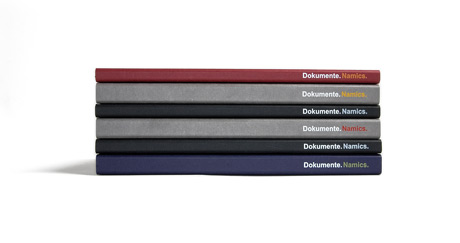
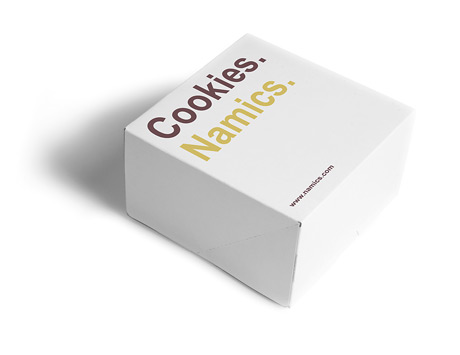
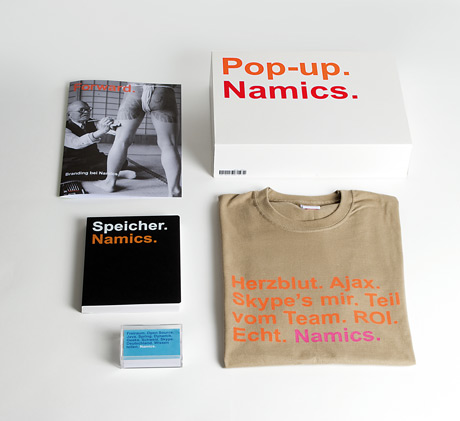
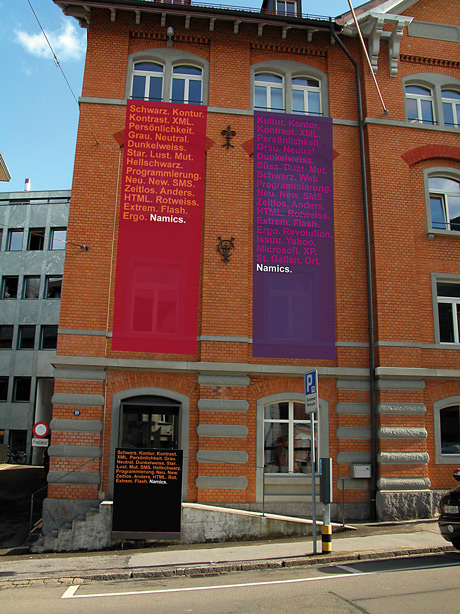
The Zurich agency Heads Corporate Communications finally had the brilliant idea and thus the solution to the problem. It developed a dynamic word mark for Namics that can be changed by every employee on a daily basis, a kind of social application as a brand. And it works like this: The wordmark consists exclusively of typography in the Arial bold font. It is made up of several words or even whole sentences, each separated by a period. Heads has christened these terms "Impuls". Any number of impulses can be strung together; the sequence of words always ends with the company name Namics, followed by a period.
For example, the word mark can be "Substance. Taggen. From a single source. Room to dream, Structured. Knowledge management. Experience. Namics." or "Uff. Marketing. Be there. Rain today. Try it out. Reinvent yourself. Namics.". There are no limits to the imagination of Namics employees when it comes to combining words and short sentences. "The only framework is the 24 colors we have defined that our employees can use for the font and background," says Philipp Lämmlin. This creative leeway allows individuality to unfold, for example in the design of the business cards.
Participation is everything
After Lämmlin and Franke had presented the new corporate identity to the Namics employees, there was resistance from some of them along the lines of "Do we also have to design our own business cards now?". But we had prepared for this eventuality: "We had prepared some ready-made combinations from which everyone could have chosen one," says Franke. "Interestingly, in the end everyone wanted to design their own business card, even those who weren't so keen on the idea beforehand." Some Namics employees have now even created different versions of their card, which they use depending on the area of application. Jürg Stuker, CEO of Namics, is also convinced by the new logo: "Our dynamic word mark is an active contribution to less visual noise, which comes from ever more 'original' and therefore even more nonsensical logos."
Employees can also put together their own logo for presentations or lectures. For a lecture, for example, it could read: "Knowledge management. Impressions. Zurich. Looking forward to feedback. Move. Namics." And for those who are currently preoccupied with the weather and their home renovation work, "Sunshine. Wonderful. Good mood. Knowledge management. Painting the kitchen. Namics.". It is not important that the meaning of the impulses is always immediately apparent to everyone. The flexible brands are primarily intended to raise questions and get people talking to each other. This plan should work.
Impulses in demand
The most exciting aspect is the use of the flexible word mark in digital media, i.e. on the Internet and on the "tripods" developed by Heads, screens on three legs that will welcome visitors to Namics branches in the future. Every Namics employee can also influence these word combinations in real time - although in this case not without restrictions. Certain impulses are defined in the word mark, which are filled from a memory with changing corporate words, for example "guru", "dynamic", "here and now" or "heartbeat". For the other impulses, the ideas and feelings of Namics employees are required: they can send terms to the system via Twitter, Yammer, SMS, Skype or the intranet, which then immediately become part of the dynamic wordmark after a format check. In times of low impulse, i.e. at night or during the lunch break, the employee impulse points are filled with corporate words from the memory. This keeps the brand in constant motion.
Namics activated its word mark on June 3. Since then, all employees have been working on the company image in both senses of the word. "Of course, our employees could also place negative statements or insults in the logo," admits Philipp Lämmlin. "But I can't imagine that happening with us. Common sense is widespread here, we trust and value each other. That is also part of how Namics sees itself. That's why there is no blacklist of forbidden words and no muzzle."
As beautiful as the idea is - the concept of the flexible word-image brand is not suitable for every company. Marco Simonetti, Creative Director of the agency Heads, also emphasizes this. "Only the special corporate culture of Namics makes it possible to put the corporate identity in the hands of the employees." Of course, Namics is a special case. Because the most striking characteristic of the company and its brand image is change. Whether this core value translated into the brand will also achieve recognition and brand identity remains to be seen. It also remains to be seen whether the dynamism of the brand will be maintained after the launch hype. Corporate identity. New. Does it work. Hmmm. Gathering experience. Tense.
Anne-Friederike Wilhelm
In a nutshell
The IT and web service provider Namics was founded in 1995 as a spin-off of the HSG St. Gallen. The company primarily offers its customers services that contribute to the consistency of processes. For example, Namics integrates new and existing IT systems into internal company networks and optimizes websites and stores. The customer focus is on established companies and groups as well as public administrations and organizations. Namics has three branches in Germany and three in Switzerland and employs 280 people. Namics is a Publigroupe company.
1290581659_img090604_namics4
1290581659_img090604_namics1
1290581659_img090604_namics2
1290581659_img090604_namics3
1290581659_img090604_namics5

Radio Central puts new transmitter into operation

The new license allows the Brunnen-based private station Radio Central to extend its broadcasting area to Lucerne North as far as Dagmersellen and the greater Willisau, Wolhusen and Seetal areas. A new transmitter was recently put into operation in Willisau on 94.8 MHz in addition to the existing Lucerne frequency of 100.1 MHz.

The new license allows the Brunnen-based private station Radio Central to extend its broadcasting area to Lucerne North as far as Dagmersellen and the greater Willisau, Wolhusen and Seetal areas. A new transmitter was recently put into operation in Willisau on 94.8 MHz in addition to the existing Lucerne frequency of 100.1 MHz.
With the commissioning of Radio Central's 23rd transmitter, the communities around Willisau are now covered. Further expansion steps in the Wolhusen and Engelberg areas are being planned.

Distribution - innovatively thought through

Using the examples of corporate trailers* and customer magazines, we had a lot of fun exploring the distribution options. The brand-new solution: the Wilmaa aggregation and distribution platform.

Distribution is one of the biggest challenges facing effective corporate publishing today. It needs to be innovative, creative and dramaturgically optimized, both in print and online. Innovation, creation, dramaturgy - these three terms are used here for the distribution of two forms of corporate publishing, the corporate trailer (film, online) and the customer magazine (print) in the B2C sector. Imagine a corporate trailer and the corresponding customer magazine of an innovative Guetsli manufacturer that is dedicated to exquisite indulgence and is seriously committed to a conscious lifestyle and environmentally friendly production.
Innovation in distribution
Basically, there are no patent remedies for innovative distribution in customer publishing - as with content, it is important to define your own path that is right for the geographical culture, the industry and branding culture of the publisher as well as that of the addressees. Our model case in print: The manufacturer does not yet have a customer database. The new Genuss & Guetsli magazine is therefore distributed at "neuralgic points": The magazine is available where people stop for a break and drink coffee. Co-branding with a coffee brand: In their own coffee bars in stores (coffee corners for customers), companies (staff cafeterias) and theaters (break buffets), the magazine is available for the consciously enjoyed sweetness and coffee culture as well as the associated lifestyle. And on the "coffee break" time island, you can of course also try the captivatingly delicious Guetsli, which are available in retail outlets. This distribution of the magazine at the place where the coffee is drunk is also an opportune moment, as explained below with regard to the dramaturgy of the distribution.
To whet the appetite
As for the corporate trailer, this modern instrument of the moving image, it is the first moment that whets the appetite for more background information on the product and the associated lifestyle. The corporate trailer conveys in a concise, emotional and intelligent way what it is all about, namely exquisite indulgence, a chic environment, health, environmentally friendly production - and a magazine that provides a sustainable introduction to this world. However, we are facing a distribution problem with this attractive and meaningful corporate trailer medium. Rita Kovacs, Managing Director of the Swissfilm Association, makes the following distribution considerations: "I would make this B2C corporate trailer available to intermediaries, i.e. those who make up the retailer's environment. Accordingly, you look for topic-specific websites, for example health websites - so you should aim for content-related collaborations. I would also use the corporate trailer specifically for the benefit of sales staff in the retail trade, for example in staff training. And of course I would also use this short film for my own website - this personal use is sometimes forgotten! I would also use the corporate trailer for targeted media work, informing editors bilaterally and in a targeted manner, documenting."
Innovation www.wilmaa.com
For the direct B2C approach, a new option has been available for a few months now to prevent the corporate trailer from disappearing into the "black hole" of the Internet and to bring it to the man and woman in a targeted manner on Internet television: Wilmaa (www.wilmaa.com), the "television set" of the Internet. It is the platform on the Internet where the viewers and consumers are already there. www.wilmaa.com already has 250,000 subscribers in German-speaking Switzerland. And the number is growing every day. Our corporate trailer is now either presented to the early adopters of www.wilmaa.com, who correspond to the Guetsli manufacturer's target group, at launch or on the Wilmaa zero channel. A third option will soon be the presentation of the corporate trailer - as well as the in-depth film documentation - in our own www.wilmaa.com-Genusskanal. The order mechanism for the print magazine is initiated using the "Click & Mail" bubble system, which does not distract the user from watching television and allows them to select something conveniently.
Creation of distribution
Print: The Customer Magazine can be taken from specially designed dispensers in the coffee bars. The Guetsli brand is immediately recognizable and the dispensers are also made of materials that are appealing to the environmentally conscious consumer. The coffee-drinking guest also immediately recognizes that they can take the booklet with them free of charge and then become a subscriber. They are happy to embrace this world, this storytelling of conscious indulgence - because it fits their individualistic lifestyle to a tee.
Corporate trailer: Here too, distribution can only be qualified as creative where it goes hand in hand with creative content. With its speech bubble principle, Wilmaa makes possible what is sought in communication: dialog. The user remains unbothered by these simple, quick options and, apart from ordering the magazine (he will read an e-mail about this later), clicks on competition responses: What should the latest product from the Guetsli manufacturer be called? Which sweetness content do they like, which is too much for them? The consumer influences the creation of the product.
Dramaturgy of distribution
There is the simple dramaturgy of the time sequence. Applied to cross-media interaction: the corporate trailer as an emotional "teaser" and first teaser in terms of content comes at the beginning. In the B2C sector, this can ensure www.wilmaa.com in a new and dialog-enabling way, for example as a short film when the device is switched on or in the zero channel. When presented as "cinema advertising", for example, this dialog option is not available. Number two in the time sequence: The interested consumer receives the magazine, which is published in a deliberately limited edition and only twice a year, in the warm and cold seasons. Number three in the time sequence: the film documentary on the Wilmaa enjoyment channel.
The situational dramaturgy: As mentioned above, it is not only about the right (neuralgic) location, but also about the situation of the potential reader. The coffee bar or the situation of drinking coffee is the right place to familiarize oneself with the background of the Guetsli product, this sweet and sustainable lifestyle. You become and are part of the new sustainable indulgence community of the innovative Guetsli manufacturer.
Finally, one more principle should be mentioned. Dramaturgically, a simple principle applies: a tool must be the flagship in the cross-media mix, for the branding of the company, for the competence. Depending on the industry and target group orientation, print, coupled with the emotional "sucker" of the corporate trailer, is still a very promising way to achieve this. For our Guetsli manufacturer in any case.
Viviane Egli and Thomas Gabathuler
*Definition of corporate trailer: The term "corporate trailer" mentioned here for the first time refers to a journalistically prepared short film of approx. one minute. In the 2009 Factbook of the Forum Corporate Publishing, a separate article ("The fascination of corporate publishing") is dedicated to this new publishing instrument. See also www.primafila-cp.ch.

Information:
Primafila AG, Viviane Egli,
E-mail: [email protected]
Solutionpark AG, Thomas Gabathuler,
E-mail: [email protected]

Small editorial team, big newspaper

The crisis has claimed around 500 editorial jobs in Switzerland so far. "Experts" such as Kurt W. Zimmermann, Res Strehle and Felix E. Müller see these cuts as an opportunity to improve the quality of newspapers. The only question is: how? Guest commentary by Hans Stutz, freelance journalist.

As we have (almost) all had to realize by now, neoliberals have reinvented the economic world in the years since Milton Friedmann and Margaret Thatcher, and Kurt W. Zimmermann is their loudest mouthpiece in Switzerland, at least in the media industry. Or perhaps only in Weltwoche, and then only after Roger Köppel. Be that as it may, the "well-known sports journalist" (Festschrift Golfclub Realp) recently performed a remarkable pirouette of thought in the weekly paper for the annoyed right-wing bourgeoisie when he commented on the abolition of around 500 editorial positions, although Zimmermann only wanted to count up to 250.
According to Zimmermann, there is now hope that "newspapers will become real newspapers again". He continued: "If editorial offices become smaller, newspapers will almost automatically become better." A newspaper has to convey topicality and analyze it intelligently. You can also imagine it as a newspaper with lots of agency reports and some commentary, or at best analysis. In times of crisis, cranks and fortune tellers are booming, one might think.
Res Strehle (Tages-Anzeiger) and Felix E. Müller (NZZ am Sonntag) also advocate the following motto for quality newspapers: less, more precise, more original. So far so plausible. It is unclear whether this is possible with fewer journalists. Journalistic competence requires in-depth knowledge of dossiers and this is not possible without paid work, unless you leave the commentary to some "experts" from interest organizations, such as Avénir Suisse. However, this is only at the expense of journalistic reputation.
As luck would have it, on the very day that Zimmermann publishes his weekly rant, publisher president Hanspeter Lebrument calls for government relief for publishers of - roughly estimated - over half a billion francs in an interview with the Basler Zeitung. The Südostschweiz monopolist is reluctant to use the word "subsidies", instead referring to "framework conditions" and meaning lower value-added taxes, reductions in postal taxes (as was once common practice) and state subsidies for journalism training. Lebrument also reacts defensively; he wants to prevent "a press diversity article" in the constitution.
Up to now, Lebrument's broadsides against state regulations have been one of the highlights of every publishers' congress, although most of the audience knew that Lebrument himself was the uncrowned Swiss champion in the pursuit of subsidies. The publisher president has now announced new publisher proposals. The public service for the diversity of opinion in Switzerland is indeed at risk, but it is unclear whether the existing regional monopolies are the right address to safeguard it. (Who will launch the next newspaper? Perhaps only on the Internet at first?)
What conclusions can we draw from this? Firstly. Neo-liberalism is whistling out of the last hole. No sensible person can complain about this. Secondly. If Lebrument changes ideology, then there really is a need for action, not only in the federal parliament (media article in the constitution), but also at the listed Tamedia group, of course. Although it is laying off around 80 people (Tagi & Der Bund), it reported a profit of CHF 105 million for 2008, of which it paid out over CHF 31 million to shareholders, i.e. withdrew it from the Group. With this money, the redundant employees could contribute to the improvement of the newspapers for several years. If the editorial teams remain larger, the likelihood of a reduction in quality decreases. If we were as uninhibited as Zimmermann, we could even write: If editorial teams get bigger, then quality increases almost automatically. And finally. Thirdly: "A publisher should not expect too much profit," says Lebrument. Where he is right, he is right. He may even have to be satisfied with small losses for a year or two. But that's not possible on the stock market.

Simple, target group-oriented and cost-optimized

Combined offline-online strategies open up immense possibilities for integrated communication.

Publications in corporate communications often grow incoherently. This costs companies money unnecessarily. Yet integrated offline-online concepts have the potential to increase efficiency and save costs. And the target groups thank you with attention - because they receive exactly the information that interests them.
Efficient and precise information
Successful publications bring a brand to life, create trust, speak the language of the target group and meet their interests. What sounds simple often leads to overloaded publications in practice. The wishes and requirements of the various target groups in terms of approach, prior knowledge and user preferences are usually not sufficiently taken into account. Successful corporate communication, on the other hand, provides information efficiently and precisely. This saves companies money and customers time. Innovations in online communication offer immense potential to make things as easy as possible for customers.
Prime example annual report
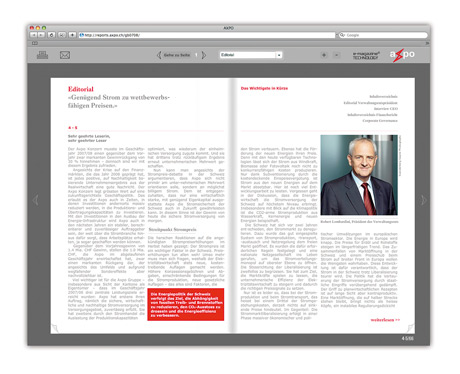
This is also where the Swiss energy company Axpo comes in. The publicly owned company with a socially relevant task is subject to great public interest and the demands for comprehensive and transparent financial communication are high. In addition to the cantons as owners, customers, employees and the financial community, Axpo also wants to address the general public. However, experience has shown that the public disdains traditional business reporting. So it's time for an integrated offline-online concept.
Integrated offline-online concept
In order to meet the needs of the different target groups, Axpo has added a magazine to the annual report as the heart of its financial communications. In it, Axpo conveys the core topics in interesting stories that are prepared according to journalistic criteria. Background information is told using vivid examples, attractively illustrated and divided into reader-friendly snacks. Axpo also relies on an innovative online edition that offers added value to financial journalists and analysts: Instead of a page-turning PDF, the annual report is prepared as an online working tool. The targeted reduction to the core content and the link to downloadable and editable Excel tables create an additional benefit. This allows Axpo to communicate precisely and in a target group-oriented manner via several channels. The target groups receive the information they want, optimally prepared, and reward this with attention, interest and trust.
Dynamic further development
The integrated concept leaves scope for dynamic further development. For example, it is conceivable that the online edition could be enhanced with video and audio formats and, thanks to multimedia communication, a more intensive brand experience. Cost savings are also possible by giving more weight to the online edition and reducing the print circulation. By increasing efficiency in addressing target groups and reducing costs, an integrated offline-online concept pays off twice over.
Gregor Herbst
1290581658_img090604_gb
Online implementation as a working tool for financial analyses.

The Impact Check of Werbewoche

We show how current campaigns are performing with consumers.

In the “Awareness” category, the Swisscom campaign by Erdmannpeisker holds the undisputed No. 1 spot. It is followed by Migros-Restaurant and Ochsner-Sport, both by Wirz. The picture is quite different for the “Uniqueness” criterion: David Gym by Publicis takes the lead here, followed by Sportplausch Wider (Advico Young & Rubicam) and Swisslos (Contexta). The Swisslos campaign ranks first in “Brand Fit,” followed by Migros Restaurant and Ochsner Sport. In terms of likeability, David Gym comes in first, ahead of Swisslos and Migros Restaurant.
> To the results at a glance
> Detailed results

Question and methodology
Method: Computer Assisted Web Interviews (CAWI).
Instrument: Online interviews via the Marketagent.com reSEARCH platform.
Target group: web-active people from German-speaking Switzerland between the ages of 14 and 59.
Sample size: n = 501 net interviews, random selection according to quotas.
Survey period: May 19, 2009–May 27, 2009.
Questions:
At the beginning of today's survey, we showed you a few ads.
Which of these ads do you remember? Please name the advertising companies or the brands advertised. (Awareness)
In your opinion, to what extent do these ads stand out from other advertising in newspapers, magazines and journals? Please rate each from 1 (= does not stand out at all) to 6 (= stands out very much). (Uniqueness)
To what extent do these ads fit the image you have of the respective brands/companies? Please rate each from 1 (= does not fit my image of this brand at all) to 6 (= fits my image of this brand very well). (Brand Fit)
How much do you like the following ads? Please rate each one on a scale from 1 (= I don't like it at all) to 6 (= I like it very much). (Likeability)
The values printed are in each case the top box ratings "stands out very strongly", "fits very well with my image of the brand", "I like it very much".
The remaining values can be found on werbewoche.ch.
Marketagent.com Schweiz AG is a subsidiary of the leading Austrian market research company Marketagent.com online reSEARCH GmbH and the Swiss communications agency Contract Media AG. Its proprietary online access panel currently comprises approximately 20,000 Swiss panelists (plus 178,000 in Germany and Austria). Swiss clients include Coca-Cola, L’Oréal, Nestlé, Parship.ch, and Advico Young & Rubicam, among others.

Also digitally ingenious

Today, companies communicate across all channels—print, online, and mobile. However, only those who take key success factors into account and fully leverage the potential of the various media formats can achieve lasting success in their communications.

We then put it online - or even better: we make a flip page magazine for the Internet. That's what you sometimes hear from communication managers in creative meetings. This idea is anything but absurd. Why not use content multiple times, as a print version and on the Internet? This increases the output, synergies can be used - and even costs can be saved.
However, things are not quite that simple. The use of new media formats can quickly turn into a communicative boomerang. If not adapted to the special laws and potential of digital media, some 1:1 content degenerates into a bore, difficult to read on screen and far too static. A missed opportunity.
Playing to strengths
Only when print and new media can play to their respective strengths and complement each other intelligently can they achieve the desired effect. Optimally orchestrating different communication tools - this task is now part of the core business of successful corporate publishers. They no longer just produce professionally designed publications for their corporate clients, but are increasingly taking on the role of media conductor and innovation-conscious solution provider.
The innovation engine is already running at full speed: new solutions are constantly being developed and implemented that go far beyond the creation of conventional websites and scrollable PDF documents: E-journals, topic portals, microsites, corporate TV, vodcasts and podcasts for cell phones open up completely new worlds of experience and enable unprecedented forms of customer dialog.
Full interaction
Print magazines, corporate books and printed annual reports do not lose their outstanding importance in the digital world - they remain sustainable, valuable media for corporate communication. If anything, they gain additional weight as a push instrument that draws attention to all the additional online media and puts them in the spotlight in the first place. Conversely, digital media expand the performance spectrum of print communication by creating full interaction between reader and medium. They are dialog-oriented, individual and available everywhere. No less important for clients: their success is verifiable. Sophisticated response mechanisms ensure the measurability of the channels used.
The cross-media commitment of communications professionals has long been paying off, even and especially in times of general crisis. According to the CP Barometer of the European Institute for Corporate Publishing, more than two thirds of marketing and communications managers of corporations and large companies see corporate publishing as one of the top instruments in the marketing mix in the future. Media budgets are being reallocated across the board in favor of innovative CP strategies. This is no coincidence, as modern customer media are not only cheaper, but also more targeted than many advertising campaigns with their sometimes immense wastage. Corporate publishing benefits in particular from the fact that many areas of marketing have come to realize that the respective target groups - customers, partners, employees - need to be provided with more content, added value and service. This leads directly to the three success factors of media orchestration:
Success factor 1: Addressing communities
Addressing customers in an even more targeted manner leads to a clear segmentation of communication media. Diversifying existing or new target groups ("communities") in this way is one of the most important advantages in corporate publishing. Long gone are the days when one magazine had to suffice for all and sundry. Today, customers can no longer be lumped together. Instead, corporate messages are now adapted to the requirements, habits and wishes of a wide variety of communities and sent out in targeted communication cascades so that they no longer get lost in the flood of information.
This also applies to employee communication: in addition to the employee magazine, which is aimed at all employees, managers who are often on the move are also reached quickly and specifically with mobile communication via cell phone. And the web is used to address employees directly - for example with a vodcast in which the CEO explains important changes.
Success factor 2: Journalistic storytelling
Content is central to all communication: only those who manage to interest and inspire their customers and employees on all channels do a good job - and this is done most effectively with "good stories". Corporate publishers provide valuable support here. After all, they are professionals at generating strategically relevant content from the corporate world and systematically preparing it for specific target groups. They are the storytellers and know the success factors for effective interaction between print, online and mobile.
The quality of the content ultimately determines success or failure - across all media formats. It is usually no longer enough to simply put a story from the printed magazine online. Online is faster and more up-to-date than print - and the "style" of the articles, the dramaturgy of the presentation, must also be faster. This is where tools such as vodcasts and podcasts come into their own. Without qualified content, internet solutions and mobile communication simply come to nothing. Corporate publishing has an enormous competitive advantage in this field. The leading providers have extensive journalistic expertise, have mastered the media formats and thus successfully build credibility for their clients. Anyone who reads a report on the experiences of a jogging beginner in a customer magazine, for example, wants to receive added value on the web, such as a vodcast in which the runner's progress is commented on by an expert. There must also be an opportunity to enter into a dialog with the expert to ask for personal tips, etc.
Success factor 3: A coherent overall concept
Mastering the new diversity in the media universe - in terms of content and technology - is the basis of the business and therefore indispensable. However, any media solution is only as good as the underlying strategy that helps to implement it. In other words, the first step is to define which marketing or communication objective a medium is intended to achieve in practice. If it is more about image, sophisticated corporate publishing media work out what a company stands for. Executive magazines for top decision-makers in particular, but increasingly also annual reports, are becoming a platform for image-driven storytelling - both in print and online. If the focus is on selling products, intelligent media concepts can provide companies with more turnover in a very concrete way.
Last but not least, multimedia-loaded e-journals can be used to initiate communication that embeds products in emotional worlds of desire and conveys the value of the goods in a completely new, unobtrusive way. Ultimately, this leads to a purchase decision that is simple and convenient for the customer. In turn, meaningful messages are required to strengthen brands - another case for customer magazines or story sites on the Internet. They help to promote branding through journalistic content and thus emotionalize it in the long term.
Elmar zur Bonsen

New Creative Director Editorial Design at Infel
Michael Adams, 44, is responsible for the graphic creation and further development of corporate publishing publications at Infel. After studying communication design, he worked as a graphic designer for advertising agencies and publishing houses before moving into the media industry as a designer and art director (Zeitung zum Sonntag, Freiburg i. Br., Der Tagesspiegel, Berlin, and Basler Zeitung). With the Basler Zeitung he won the "Best Designed Regional Newspaper in Europe" award at the 10th European Newspaper Congress in 2009. Adams is a board member of the Society for News Design/DACH (Regional Director Switzerland), a jury member for "Worlds Best Designed Newspaper" and the "dpa infografik award", Deutsche Presse-Agentur.

1290581658_img090604_adams_michael

Even though companies are increasingly under cost pressure in times of crisis such as these, they prefer to communicate efficiently rather than not at all. And they are relying more than ever on the diverse media offerings of corporate publishing. Figures confirm this trend: as the recently published CP Barometer of the European Institute for Corporate Publishing (EICP) revealed, almost 70 percent of the communication managers surveyed see corporate publishing as an outstanding marketing tool, and a further fifth of company representatives even expect it to become even more important than other communication activities. Over 85 percent of those surveyed also consider corporate publishing to be a very suitable instrument for communicating successfully in times of crisis.

Ringier inaugurates new printing plant

Categories

Uncategorized

To the point, darling

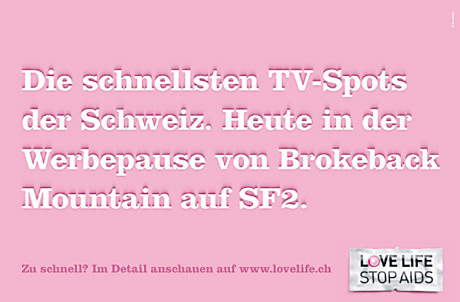
Euro RSCG Zurich has realized the shortest spots in Switzerland for the FOPH.

He left before she arrived. This is how one could casually summarize the scenes with which Euro RSCG Zurich, together with the Federal Office of Public Health, has been raising awareness of AIDS since this week. Situations are thematized in which things happen so quickly between two random partners that the overheated parties can no longer find time to think about the tried and tested rubber.
The FOPH's new "Love Life Stop Aids" campaign is now in its fifth year since it was launched by Frank Bodin's crew. "Ging's zu schnell, um an Gummis zu denken?" is the creative realization this season.
The team led by CD Axel Eckstein has created "the shortest commercials in Switzerland": For just one second, two pairs of eyes are shown meeting in a bar, for example. Then you see the protagonists already in bed. Also for just one second. The spot reaches its climax with a three-second "Did it go too fast ...?" and the good advice to get a check-up as quickly as possible. This is new for this campaign on www.check-your-lovelife.ch has been set up. Anyone who clicks through with honest answers will know whether they should perhaps take an AIDS test now after the quick sex.
> View spots
The risk situations shown are vacation flirtations and sexual adventures under the influence of alcohol. According to statistics, such adventures without a condom are currently most frequently experienced by heterosexuals "in their prime" around the age of 35. This target group should therefore be warned not to simply pass on a possible HIV virus the day after without hesitation. At the same time, the campaign encourages people to always carry a condom with them for unusual situations and to follow the safer sex rules. "We want to draw attention to HIV/Aids prevention and do this with a positive provocation. We communicate without admonishing fingers and without shock images - but with a wink. This is the most credible approach to this topic, as scientific tests have shown," explains Adrian Kammer, Head of Advertising at the Federal Office of Public Health.
The new campaign focuses on television as the main medium. Here, the spots are shown in duplicate due to their brevity. An amazing implementation of the idea can be found on Tilllate.ch, where a mouse click can turn a party photo into a sex scene. Further support is provided by advertisements, posters, promotions and give-aways.
Andreas Panzeri
> Spot Bus
> Spot Frisbee
> Spot costume
> Spot beach bar
> Spot Tennis
1290581660_img090604_aids1
1290581660_img090604_aids2
1290581660_img090604_aids3
1290581660_img090604_aids4
1290581660_img090604_aids5
get_footer();