Sustainable advertising

Wirz wants to stir up the spirit at Bank Sarasin.

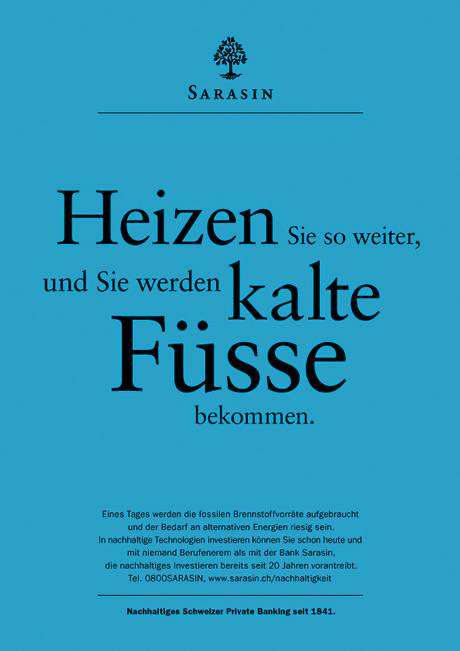
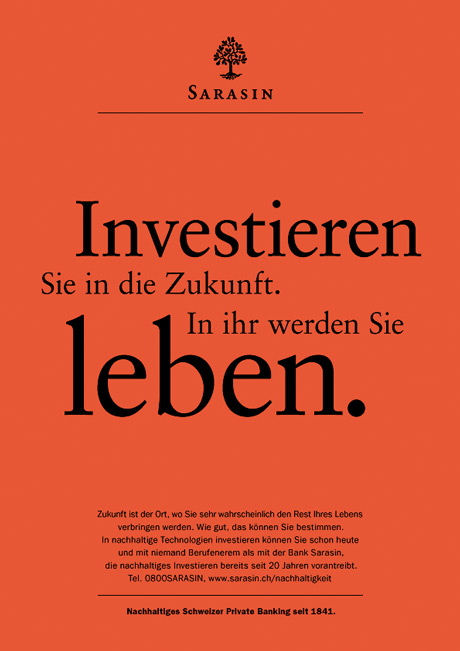
Sustainable investing is the big buzzword today. Bank Sarasin was already cultivating this philosophy at a time when the concept of sustainability did not even exist. Today, "sustainable investing" has become a hackneyed phrase in many places. Not so for Sarasin. The brain teaser campaign by Wirz Werbung conveys credibly and surprisingly to the reader that money can be earned by investing in sustainable companies. The advertisements in smaller formats are placed in the financial and daily press - according to the principle: "The smaller the advertisement, the bigger the idea it communicates should be", as CD Hanspeter Schweizer says.
Problems surrounding the financial market are currently a dominant topic in the media. Against this backdrop, the campaign cleverly exploits the situation by using the advertisements with the pithy statements in the newspaper as a counterweight to the general mood against banks. As "sustainable investing" was actually declared an official policy at Bank Sarasin as early as 1989, the campaign does not run the risk of the bold texts becoming a boomerang. The typo advertisements are designed to stand out among the other financial news by virtue of their color. The brain-stopper in the headline has to encourage people to read the small print. Placement is also cleverly played with.
Andreas Panzeri
1290581660_img090604_sarasin1
1290581660_img090604_sarasin2
1290581660_img090604_sarasin3
1290581660_img090604_sarasin4
img090604_sarasin5

ADC Germany invites tenders for the ADC Summit venue

For the first time in its history, the German Art Directors Club is putting the venue for the ADC Summit up for bid. The largest gathering of the creative and communications industries in Germany, which has traditionally been held in Berlin, could thus take place in another German city in 2010. Also for the first time, the ADC Junior Days will be held concurrently with the ADC Summit next year.

For the first time in its history, the German Art Directors Club is announcing the venue for the ADC Summit. The largest meeting of the creative and communications industry in Germany, which has been held in Berlin without interruption since 1994, could therefore take place in another German city in 2010. Next year, the ADC Junior Days will also be held at the same time as the ADC Summit for the first time.
"With the ADC Summit, we offer the most important and largest platform for creatives and marketing decision-makers in Germany. The festival attracts over 7,000 national and international visitors every year and also provides impetus for the regional economy. With this call for entries, we are giving other cities besides Berlin the opportunity to make their business location even more attractive and to support an innovative industry," said ADC Managing Director Susann Schronen in a press release on Thursday. The Art Directors Club is already in talks with several cities and regions about potential cooperation opportunities, the press release continues.
The competition for young talent is to take place at the same time as the ADC Summit for the first time in 2010. "The Junior Days in Munich have developed fantastically, especially in 2008 students and juniors were able to prove that they go their own way conceptually and formally. It is therefore only logical that we should see and evaluate this quality as part of the main competition and make it accessible to a wider public," says Stephan Vogel, the ADC board member responsible for promoting young talent.

Inspirator Production wins pitch for SF audio branding

Categories

Uncategorized

McCann Erickson develops online game for Romande Energie

McCann Erickson Geneva has developed an online video game for Romande Energie. The entertaining game is designed to reflect the company's commitment to sustainable development.

McCann Erickson Geneva has developed an online video game for Romande Energie. The entertaining game is intended to reflect the Group's commitment to sustainable development. The game, called "Fred L'Aspirator" (Fred Vacuum Cleaner), was designed by Kévin Nave in Flash AS2 and implemented by Cnoté Mobile Solutions in Martigny.
The aim of the game is to help Fred L'Aspirator clean up the festival site. The best players of the week will each receive two tickets for the Paléo Festival, whose long-standing partner is Romande Energie. The attractive game has been online since June 1 and will run until July 12. A Facebook page entitled "Fred l'Aspirator at the Paléo" has also been created.

ProSiebenSat.1 shareholders: Concern about high debt

The debt burden in the billions is causing the shareholders of Germany's largest private TV group ProSiebenSat.1 serious concern. The takeover of the Scandinavian broadcasting chain SBS has resulted in a debt burden of EUR 3.5 billion.

The debt burden in the billions is causing the shareholders of Germany's largest private TV group ProSiebenSat.1 serious concern. The takeover of the Scandinavian broadcasting chain SBS has resulted in a debt burden of EUR 3.5 billion.
"It's certainly no peace of mind," admitted Group CEO Thomas Ebeling at the Annual General Meeting on Thursday. "But it is also no cause for sleepless nights." At the end of March, the company had liquid funds of 509 million euros. "That gives us plenty of room for maneuver," said Ebeling.
The Group wants to gain market share in the difficult environment, said Ebeling. In 2008, the company's revenues with the stations ProSieben, Sat.1, Kabel 1 and N24 fell by 6 percent to EUR 3.05 billion. At the bottom line, ProSiebenSat.1 posted a loss of 129.1 million euros. This year, the company plans to save around EUR 100 million by merging the stations, among other things. To this end, Sat.1, for example, is to be relocated from Berlin to the Group's headquarters in Munich.
At the Annual General Meeting, the company was also given the green light to issue a convertible bond for up to one billion euros and for authorized capital. Ebeling explained that the capital measures were intended to create "the necessary room for maneuver for the best possible design of the financing structure". There had previously been speculation about plans for a capital increase.

Radio 105 launches warm-up program

Radio 105 launched a warm-up program on the FM frequency 105.0 MHz on Thursday. From September 9, the youth radio station's moderated full program will then go out over the airwaves.

Radio 105 launched a warm-up program on the FM frequency 105.0 MHz on Thursday. From September 9, the youth radio station's moderated full program will be broadcast on the airwaves, as the station announced on Thursday.
Over the next three months, Radio 105 wants to get the Zurich audience in the mood for its music program. A "test listener campaign" has also been launched. Young people are being sought to evaluate the new FM program.

Federal Administrative Court allows Logistep to hunt Internet pirates

The Swiss company Logistep may continue to hunt down providers of illegal music and film downloads on the Internet. The Federal Administrative Court has not upheld a ban by the Federal Data Protection Commissioner.

The Swiss company Logistep may continue to hunt down providers of illegal music and film downloads on the Internet. The Federal Administrative Court has not upheld a ban by the Federal Data Protection Commissioner.
According to the judges in Bern, although Logistep's actions are not beyond doubt, they are considered to be the only means in the fight against Internet piracy. The company uses its software to search for specific film or music titles in Internet file-sharing networks (peer-to-peer networks) on behalf of rights holders.
Corresponding offers are downloaded, together with the IP address and other data of the provider. Logistep forwards the information to its domestic and foreign clients, who confront the identified download providers with criminal charges and claims for damages.
In his recommendation of January 2008, the Federal Data Protection and Information Commissioner called on Logistep to cease data processing as long as there was no sufficient legal basis. The company's actions violated the privacy of a large number of people. After Logistep rejected the recommendation, the data protection officer submitted it to the Federal Administrative Court for a ruling, which has now refused to give its blessing to the order. According to the ruling, it is true that personal data is affected and that there is a violation of privacy, albeit not a serious one.
It is also debatable that data is usually obtained secretly and without the knowledge of the persons concerned. Therefore, the principle of recognizability applicable in data protection is likely to be regularly violated.
It is unacceptable for copyright infringements to be tacitly accepted and for the perpetrators to get away scot-free. The interests of the rights holders and the public interest would therefore outweigh the interests of the people whose data is being processed.

The radio resists

In April, all media categories covered by the index recorded a drop in advertising pressure. The total of all media suffered a considerable decline of 4 to 187 index points.

In April, all media categories covered by the index recorded a drop in advertising pressure. The total of all media suffered a considerable decline of 4 to 187 index points. The Internet was also affected this time, dropping 2 index points to 449, while e-media as a whole fell by 4 to 430 index points. Radio as a medium only lost one index point and now stands at 255 index points. Television, on the other hand, is down sharply, with the index falling by 4 to 440 index points. Teletext, on the other hand, got off very lightly, dropping 2 points to 163.
When assessing the Goldbach Index, which has been based on Media Focus data since 1993, it should be noted that the 13 previous months are seasonally smoothed in the short-term analysis of the electronic media radio, TV, online and teletext.
img090604_gemi

Employee magazines optimally implemented

How can you create an employee magazine that really interests employees and that everyone enjoys reading? Philip Meier and Stefanie Funkat give practical tips on how to improve this important internal communication tool.

Despite intranet and e-mail traffic, the importance of the employee magazine in companies is increasing. Inform, motivate, involve - professionally prepared news for employees makes companies more successful. The authors have examined corporate publications from around 500 companies in German-speaking countries and show what is important in internal communication today. Requirements for modern corporate publications are explained with numerous and extensively discussed practical examples. The book offers concrete assistance and suggestions for making employee magazines interesting and varied - and not just for communications experts.
Philip Meier
has been researching the topic of internal communication for 15 years. He is CEO of the branding and communications agency schneiter meier külling AG in Zurich and was previously Head of Corporate Communications & Investor Relations at a large Swiss high-tech company.
Stefanie Funkat
studied communication management and wrote her thesis on "Employee magazines in Switzerland. A representative empirical study with recommendations for optimization".
Bibliography
Philip Meier/Stefanie Funkat.
Employee magazines optimally implemented.
A handbook for the
Practice, Orell Füssli Verlag,
Zurich 2009, 192 pages, hardcover, ISBN 978-3-280-05325-6, Fr. 44.-/€ 29.90, Dietzingerstrasse 3, CH-8036 Zurich,
Tel. +41 44 466 73 85,
Fax +41 44 466 74 12,
[email protected],
www.ofv.ch
1290581657_img090604_mitarbeiterzeitschriften

Advertising print in free fall

Advertising spending plummeted in April amid the poor economic conditions. Advertising volume fell by 18.6 percent year-over-year to 323 million francs.

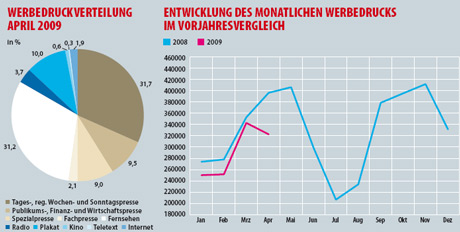
Advertising expenditure really collapsed in April due to the poor economic situation. Advertising expenditure fell by 18.6 percent year-on-year to 323 million francs. Between January and April, revenue fell by a total of 10.3%, which corresponds to a loss of CHF 133 million. Poster advertising recorded the sharpest decline (-20.5 percent), followed by the consumer, financial and business press (-18 percent). The media group with daily newspapers and Sunday and regional weekly press earned 13 percent less between January and April than a year ago.
Only the trade press (+7%) and the Internet media group (+26.1%) stand out positively. However, their share of the overall market trend is very small. The key market of finance slumped by just under 30% in April, while vehicles fell by a good 21%. The only group to grow in April was energy, which rose by a good 13%.
1290581657_img090604_mediafocus

Tops of the week

16 awards in bronze, 8 in silver and 2 in gold: this is the proud result of this year's Dialog Marketing Awards ceremony, which took place last week in a festive setting at the Zurich Kongresshaus. Second top of the week: Radio 105 launches on FM on June 4. Its founder, Giuseppe Scaglione, is as self-confident as ever.

Dialog Marketing Award 2009: Agency at the airport wins eight trophies
16 awards in bronze, 8 in silver and 2 in gold: this is the proud result of this year's Dialog Marketing Awards ceremony, which took place last week in a festive setting at the Zurich Kongresshaus.
The guests were welcomed by Milo Stössel, the newly elected President of the Swiss Direct Marketing Association. The award ceremony featured highlights of varying formats - the surprising dramatization of benefits and the achievement of the highest possible response are challenges that pose high demands in difficult economic times. At the beginning of the evening, jury chairman Guido Wietlisbach therefore spoke of a rather average year, but optimism quickly returned during the presentation of the winners and they were applauded enthusiastically. The winners in the special categories Audience Award (SAP Switzerland and Ogilvy Mather), Innovation Award (Touch¬more GmbH) and Platinum Award (Lufthansa and Wundermann Germany) deserve special respect.
A breath of fresh air for radio
On June 4, Radio 105 launches on FM. Its founder, Giuseppe Scaglione, is as self-confident as ever. In terms of advertising marketing, he has no need to lean on a marketer or the Swiss Radio Pool. "As in the last ten years, we will stand on our own two feet and market our stations (105, RMC, Rock Nation, all web radios, 105TV) ourselves. We have had very good experience with this in recent years," he says when asked. Six people are responsible for marketing Radio 105. Despite his independence, Scaglione does not say no when he is offered spots from other sources. "Of course, we are also open to all existing marketers and are happy to accept their bookings," he says. Whether 105 will ever join the Swiss Radio Pool, he leaves open. "This would not be the case today or tomorrow anyway, as we are currently setting our priorities differently," he says. Of course, the first priority is to achieve the most attractive reach possible. Depending on this, radio advertising and the Swiss Radio Pool will then be shaken up. In any case, the radio scene could do with a breath of fresh air.

With bundled knowledge into the web future

Web 2.0 has barely become part of society when its successor - Web 3.0 - is already making a name for itself.

The Internet - the virtual world of unlimited possibilities. It has long been no secret that all communication and advertising is increasingly shifting to the World Wide Web. With Web 2.0, companies have realized that they must increasingly integrate users into the process and offer them the opportunity to express their opinions and make suggestions on their websites. Nike, for example, allows visitors to create their own sneaker on its website by choosing any model and color. On the website of eyewear manufacturer Ray Ban, customers can log in with a web cam to find the right pair of glasses by measuring their face. Ray Ban then uses the data to present suitable glasses. They can try them on virtually and click through the range of suggested glasses. In contrast to Web 1.0, which users only used for surfing and browsing, Web 2.0 is much more comprehensive. The one-way communication between provider and consumer that once existed in the 1990s is now a thing of the past.
Web 3.0 - a generational change
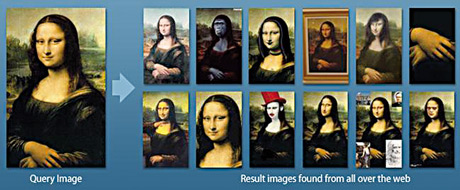
Since the emergence of Web 2.0, the hyper-intelligent versions have been constantly expanded. Today we have arrived at Web 3.0. It is an extension of the WWW and stands for semantic and intelligent searching in 3D worlds and 3D media. This includes, for example, the Tin¬Eye tool, a search engine for images from the company Idée Inc. If you enter an image or a link to an image, TinEye returns all pages in which the image or its modified versions appear. Each image is examined as it is entered and sent through the pattern recognition process. The result is then compared with a database. The search engine's image database currently contains almost five million pictures. Wikitude, a system for T-Mobile G1 cell phones that will already be installed on Google phones, works in a similar way. It is a mixture of GPS orientation, travel guide and panoramic views. By entering the locations of your stay via a dedicated button. A map view appears on which all hits are listed. The immediate surroundings are displayed in map mode, including points that are provided with Wikipedia articles and provide the user with information.
Tim Berners-Lee, the inventor of the World Wide Web, contributed to the creation of Web 3.0. Web 3.0 is about gaining more information for the user by bundling the world's knowledge and gaining new knowledge from it. Today, computers can only reproduce searched terms, but the semantic web goes further. It makes the meaning of information usable for the computer so that data on places, people and objects can be linked together. The semantic web therefore relies more on the meaning and context of the searched terms than simply on networking, as was previously the case in Web 2.0.
Doubts about artificial intelligence
However, not everyone trusts the intelligent web. Scientists speculate that AI (artificial intelligence) will enable machines to recognize errors independently and correct them immediately. Since the further development of the web, voices have been raised that robots and computers could one day control humanity if they have intelligence. For scientists, this would be the fulfillment of their dream; for skeptics, it remains the wishful thinking of mad professors.
Adriana Zilic
1290581657_img090604_web3
Search for one image, find many images: TinEye makes it possible.
get_footer();