Allianz Suisse changes brand name to Elvia

Allianz Suisse is launching a new digital strategy. As part of this strategy, the insurer will rebrand itself as Elvia from February 2016, the subsidiary of the German Allianz Group announced on Monday.

Elvia replaces the previous direct brand Allianz24. At the same time, the offer and conclusion process for insurance products on the Internet is also to be simplified. "A survey showed that customers do not distinguish between the main Allianz brand and Allianz24. This has led to confusion in some cases," says Marketing Director Thomas Wegmann, explaining the rebranding. Meanwhile, Elvia already has a "very high level of recognition" in Switzerland, Wegmann added. For existing Allianz24 customers, nothing will change except for the new name. The product portfolio and pricing will remain unchanged under the Elvia name. (SDA)

Goldschef and Steiner: carriage ride with Denner

Denner hosted romantic horse-drawn carriage rides in Zurich, creating a festive Christmas atmosphere for its customers. The Goldschef and Steiner agency was responsible for the campaign.

Amazed faces and wide eyes on Friday afternoon at the Denner store on Josefstrasse. Four horse-drawn carriages are waiting for customers in front of the store. Angels and Santa Claus invite Denner customers on a Christmas carriage ride through Zurich. Four destinations in the surrounding area were visited with the festively decorated carriages, shortening the journey home for young and old in an unusual way. Goldschef und Steiner realized the sympathetic campaign for Denner to thank customers for their loyalty.

Bild-DENNER_Kutschenprojekt-006
Bild-DENNER-Kutschenprojekt-017

Responsible at Denner: Petra Gayko (Head of Marketing Communications), Sabine Gassmann (Project Manager Marketing Communications). Responsible at Goldschef and Steiner: Pamela Gemperli (project manager). Responsible at Dreiplus: Michi Egger (Head of Dreiplus Montagen), Myriam Assfalg (advertising architect).
 

Tourism regions rely on guests from outside Europe

The tourism outlook for the coming winter season is bleak. Nevertheless, the Bernese Oberland and Central Switzerland are looking ahead with cautious optimism. Their recipe for success is visitors from countries outside the eurozone.

Tourism managers in the Bernese Oberland and Central Switzerland unanimously tell the SDA news agency that the booking situation over the festive period is even slightly better than last year. "Our hotels are up to 80 percent full," says Sibylle Gerardi, Head of Communications at Lucerne-Lake Lucerne Tourism. For Harry John, Tourism Director of the Canton of Bern, the glass is also half full: "We are gaining market share." This cautious optimism is surprising because, like everywhere else, there is a lack of snow in these regions. In addition, the Swiss franc is still very expensive compared to the euro. Both are challenges that are affecting Swiss winter tourism. "Of course, weather and snow conditions are important, because the increasingly short-term bookings, especially after the festive season, only start to rattle in when there is snow in the lowlands," admits John. It is cold enough to make artificial snow on the slopes in the mountain regions. But because there has been no snow in the lowlands so far, guests are not drawn to the ski resorts. What's more, the coming winter season is two weeks shorter than the last one because Easter 2016 is already at the end of March. These are factors that tourism providers can hardly influence.

Important role of marketing

However, they do have an influence on their own marketing and therefore on their own guest structure in the long term. Central Switzerland and the Bernese Oberland, for example, have been focusing on guests from outside the eurozone for years. In addition to Swiss visitors, who account for 50 to 60 percent of overnight stays, tourists from England and the USA are the main visitors to the Oberland, with a share of over 10 percent. And according to John, these international guests are compensating for the decline in guests from Germany and the Benelux countries in the current winter season. This is because winter vacations in Switzerland have become massively more expensive for these two groups of guests due to the weak euro in relation to the strong franc. In the Bernese Oberland, around 12 percent of guests come from Germany. In summer, Central Switzerland already saw an increase in guests from so-called long-distance markets, America and Asia. These have compensated for the declines in individual European markets, says Gerardi. "We expect a similar shift in the medium term for the winter: fewer Europeans, but more guests from the long-distance markets, who will then also increasingly enjoy winter sports." Such a mix is an advantage in the current currency situation, according to both regions.

More difficult situation for Grisons resorts

In Graubünden, on the other hand, where Germans make up the most important foreign guest group with a 20 percent share of overnight stays, tourism experts are expecting a decline in overnight stays for the coming winter season. The booking situation for the festive season is satisfactory, says Myriam Keller, interim head of Graubünden Ferien. But: "From January 2, the booking figures are currently still below expectations." The snow situation will also be important here. But even more so in the coming winter, "the strong franc will hit hard", says Keller. While she expects overnight stays among the Swiss to remain at the previous year's level, the larger destinations in the north of the Grisons "are experiencing major losses, especially with guests from Germany, and in the south of the Grisons more Italians are also staying away."

Over the last five years, the proportion of Germans has already fallen by an average of 23 percent, but since last January, when the Swiss National Bank abandoned the minimum euro exchange rate, the situation has worsened: "Half of this loss comes from this year alone," says Keller. She expects a decline of over 10 percent in the number of guests from abroad this winter. This means that Graubünden will not be able to compensate for the decline in guests from the eurozone with other foreign guests. Keller therefore wants to place an even stronger marketing focus on local guests, who make up the largest group with 60 percent of overnight stays. Those responsible in Valais are keeping mum. They say that the destinations are "mostly satisfied" with the bookings for the Christmas and New Year week. However, Matthias Summermatter from the Valais/Wallis Promotion media service admits that fewer guests from the eurozone in particular are expected due to the strong franc. He does not provide any information on the guest structure or any strategies to compensate for the loss of guests from the eurozone. (SDA)

The Appenzellers are coming

Von Engsberg PR and Event Agency has arrived in Zurich and is opening its doors these days at the «Zum Herkules» building.

Steiner Buff Kommunikation becomes von Engsberg Agency for PR and Events. At the same time as the name change, the agency founded by Daniel Steiner and Roman Buff from Appenzell is pitching its tent in a prime location in Zurich. "We want to be where the bear dances and build long-term client relationships throughout Switzerland," says Daniel Steiner, Managing Director PR.

Daniel_Steiner_1_Web
Daniel Steiner

Roman_Buff_1_Web
Roman Buff

Pat_von_Engsberg_1_Web
Pat from Engsberg

The company is now named after and co-owned by a third Appenzeller: Pat von Engsberg. She is a co-founder and member of the management board of the dialog marketing agency Agentur am Flughafen. "A loose cooperation has turned into a close partnership. With the new agency in Zurich, we are pooling expertise in PR, content marketing and events," says Pat von Engsberg. In addition to the existing office in St. Gallen, von Engsberg is opening its headquarters these days in a prime location in Zurich, in the house "zum Herkules", at Oetenbachgasse 26.

Steiner Buff Kommunikation was founded at the beginning of 2015. The new name and the new appearance now mark the start of the new, focused business strategy. What hasn't changed is the Appenzell passion with which von Engsberg produces talking points that move people.


Alibaba buys traditional newspaper company

The Chinese internet company Alibaba is paying 2.06 billion Hong Kong dollars (261 million Swiss francs) for the Hong Kong newspaper South China Morning Post.

The world's largest online trading platform is taking over the entire media business, the newspaper reported on Monday. The purchase of the 112-year-old Hong Kong newspaper by the Chinese group has raised concerns about the independence of the paper, which has been regarded as a critical "window on China" up to now. Although the new owners claim to want to maintain its independence, they would like to see different reporting to that of Western media. Alibaba Vice Chairman Joseph Tsai criticized media that "see China through a particular lens". "Many journalists who work for Western media are likely to disagree with the government system in China and this colors their perspective of reporting," Tsai said. "We see things differently." Describing Alibaba's perspective as the new owner, he said, "China is important. China is a rising economy. It is the second largest economy in the world." The world should learn more about China, he said. "Reporting should be balanced and fair," Tsai said in an interview. (SDA)

Last but not least: Better than a unicorn

What's the best way to make any Christmas gift for a young, fashion-conscious woman truly stand out? These ads show you how.

She receives a self-painted picture from her sister, a cute puppy from her mother and even a unicorn from her boyfriend. But her grandmother can top it all:

That was the story of last year's Christmas ad for bag brand Mulberry. This year's one surpasses it, but also makes it clear: a Mulberry bag is simply a miracle.

The British agency Adam & Eve DDB was responsible for both commercials. (sis)

Too few reports on Latin Switzerland

In 2014, Publicom conducted a study of SRG radio programs in German-speaking Switzerland on behalf of Bakom. The study shows that while these programs provide balanced and diverse coverage, they do not contribute enough to fostering exchange between the language regions.

SRF radio stations offer a wide range of thematically diverse information. However, they interpret the program mandate differently. Their contribution to the promotion of cultural identity is rated higher than their contribution to exchange between the language regions.

High quality, thematic diversity and balance

Information is one of Radio SRF's core competencies. This is not only reflected in the fact that one of the programs (SRF 4 News) broadcasts almost exclusively information and that other SRF programs (SRF 1, SRF 2 Kultur) give very high priority to information. It is also evident that a great deal of effort is generally put into the formal preparation of this information. The more eloquent programs in particular make an effort to put facts into context and shed light on the background. They also rely on sophisticated journalistic forms, correspondent reports, expert interviews or on-site reports. However, there are differences: SRF 3 and SRF Virus increasingly concentrate information on simple news bulletins that primarily convey facts.

Small contribution to national cohesion

The concession obliges SRG to increase knowledge about the other parts of the country. This is only the case to a very limited extent. The SRF program makers devote by far the most attention to events abroad. National events also receive a great deal of attention. However, with the exception of SRF 4 News and SRF Musikwelle, there is hardly any information on events in French-speaking Switzerland or Ticino in the SRF programs.

Italian-speaking Switzerland in particular is virtually absent from the reality of SRF programs. With the exception of SRF 4 News, the corresponding shares are less than one percent. Systematically, only SRF 4 News, which has introduced a separate broadcasting vehicle for this purpose, actually covers the other language regions. Since 2012, the attention paid to the other language regions has even decreased slightly. The integration concept announced by SRG in 2012 is not (yet) taking effect in the SRF radio sector. 

Broadly represented Swiss music

SRF radio programmes strengthen cultural identity on the one hand by focusing on Swiss culture, but above all through music by providing opportunities to present local music. This is the case in all programs that contain music - albeit to varying degrees. However, it is clear that the inclusion of Swiss music is based on a strategy, especially as the proportion of Swiss music is usually significantly higher than in private commercial programs.

The highest proportion of Swiss music is found in the daily program on SRF Musikwelle, which pays particular attention to Swiss folk music. But SRF Virus also offers Swiss musicians an attractive platform: every third track played is of Swiss origin. It is also striking that the proportion of Swiss music in all programs after 8 p.m. increases significantly.

Overall, it can be said that SRF radio stations have a high, albeit inconsistent, level of performance in the area of cultural identity and probably meet the media policy objectives better than in terms of integration services.
 

Swiss sponsors young Swiss musicians

As part of a sponsorship partnership, Swiss Airlines is releasing the debut album «Desert Tune» by the Danish-Swiss duo Karavann—exclusively at 10,000 meters above sea level.

Together with the producers around Roman Camenzind, Adam & Adam are launching an exclusive premiere for their client Swiss. During December and January, Swiss passengers will be able to enjoy the warm sounds of Karavann, a collective of producers and musicians led by the Dane Tobias Jensen and the Swiss Fabian Imper.

For some time now, Swiss has been making a contribution to promoting the Swiss music scene as part of the "Swiss made" platform. The program changes every three months and new up-and-coming Swiss talents are given the chance to showcase their skills to an international audience.

Adam & Adam Corporate Communications conceptualize and coordinate the young artists and are responsible for PR as well as loading these special channels on the Swiss fleet.

Responsible at Swiss: Christine Ringger (Manager Inflight Entertainment). Responsible at Hit Mill: Roman Camenzind, Fred Herrmann, Tobias Jensen. Responsible at Adam & Adam: Willi Adam. Photography: Heinrich Schnorf
 

Ruf Lanz also makes Guy Parmelin a teenager

Last year, Ruf Lanz was commissioned by the umbrella organization Swiss Youth Parliaments (DSJ) to create a campaign under the motto "Make Swiss politics more youthful" and to restyle the Federal Councilors as young people. Now another subject follows.

Media in all parts of the country picked up on the cheeky campaign with Rasta Doris, hip-hop Ueli and hipster Didi and generated a PR value that exceeded the funds invested many times over (Werbewoche.ch reported). After the election of the new SVP Federal Councilor Guy Parmelin, Ruf Lanz and the youth parliaments reacted quickly and dedicated a subject to him as well.

parmelin

It is to be hoped that the new Federal Councillor will show as much humor as the outgoing Eveline Widmer-Schlumpf. Eveline Widmer-Schlumpf told those responsible with a wink: "The message to put the Federal Councillors in new outfits and to style them as typical young people has been received. As for me, I can completely identify with my 'new outfit'."
 

Ten million saved on investing

Karling is promoting the savings benefits of the Deritrade financial platform on behalf of Bank Vontobel.

Bank Vontobel has launched a financial platform called Deritrade. On this platform, advisors can tailor investment products from other banks and immediately compare proposals from seven providers. Just like on a marketplace, the advisor can select the best product and benefit from better prices thanks to the competition.

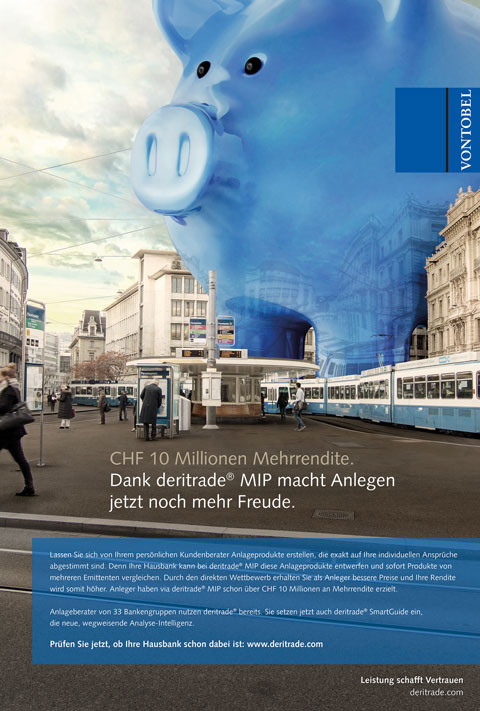
In total, investors have already achieved over CHF 10 million in additional returns since the launch, according to a press release on Friday. Karling dramatizes the savings advantage of Deritrade with a giant piggy bank on Zurich's Paradeplatz.

The single motif will appear immediately in full-page advertisements in newspapers and magazines throughout Switzerland. The motif will also be used on the web, in banners and at trade fairs.

Deritrade_Anzeige_297x440_C
 

Matter Gretener Lesch continues to play Pastorini campaign

All it takes is a few building blocks, and children become architects, streetcar drivers or circus directors. That's the creative thinking behind the campaign for Pastorini toy stores.

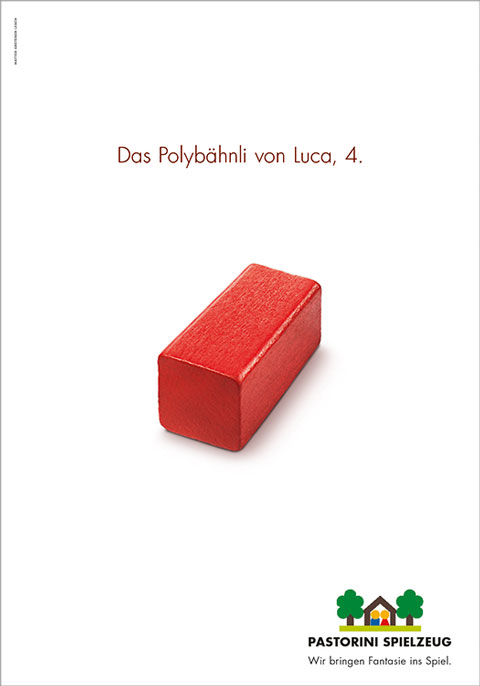
Matter Gretener Lesch was already responsible for last year's Christmas campaign for Pastorini (Werbewoche.ch reported). For the current Christmas display at Zürcher Weinplatz and Schossacher in Dübendorf, the Nudge agency has developed another subject: the Polybähnli of Luca, 4, is a simple red building block. In keeping with the Pastorini claim: We bring fantasy into play.

pastorini

Responsible at Pastorini toys: Christa Pastorini, Felix Schumacher (owner). Responsible at Matter Gretener Lesch: Peter Lesch (strategy), Daniel Matter (creative direction), Dominik Imseng (text), Nathalie Funke (graphics), Verena Knof (consulting); photography: Jonas Kuhn.
 

Service-public media are indispensable, according to Emek

The Media Commission, appointed by the Federal Council, recommends that the SRG continue to be financed through license fees and advertising revenue. However, it calls for greater transparency regarding costs.

Service-public media are indispensable in the opinion of the Federal Media Commission (Emek) - just like the purely private ones. The need for public service media with offerings in the electronic sector clearly exists, writes the Emek in a discussion paper published on Friday.

Minority for advertising ban

The discussion was controversial on individual points, said Emek President Otfried Jarren in response to a question. One of the points of contention in the commission was whether the SRG should also be financed by advertising. The majority of the commission was in favor of the current system and against a ban on advertising.

According to Emek, an exclusively fee-financed and advertising-free public service would have the advantage that the public service content would be consistently aligned with the performance mandate. However, as a result, either the offering would have to be reduced or the fees would have to be increased.

The Emek does not want to hear about the proposal to make SRG a free content provider financed by fees. This idea was introduced into the discussion by the liberal think tank Avenir Suisse. However, Emek fears that such a model would reduce the amount of programming available. In addition, according to Emek, the plurality of information and opinion could suffer as a result.

More transparency

However, the Emek demands more transparency from the SRG. It should report regularly on the specific programming services and their costs. In addition, the SRG should define concrete programming goals for each language region. There should be no political influence, said Jarren. The SRG should decide alone, he said. "But it must continuously and systematically check whether it is also achieving its programming goals."

Emek proposes that an external audit body report publicly every five years on compliance with the program objectives. Even in the case of private media that receive money from the fee pot, the fulfillment of the program mandate must be ensured.

Controversial online advertising ban

The bone of contention remains the SRG's online advertising ban. A majority of Emek members were in favor of retaining the existing online advertising ban for SRG for the next three to five years. Advertising that appears within already distributed programs should also be made available online.

The Emek agrees that public service also includes online activities. "SRG should be able to develop online," said Jarren.

Sufficient money available

Even without online advertising, the Emek believes that SRG has enough money available today. The Emek can therefore imagine measures to limit the overall funding towards the top - also to protect the private sector. "SRG should consolidate and not pursue an expansion strategy," Jarren said.

With its discussion paper, the Emek intervenes in the debate about SRG, which flared up in the context of the vote on the new Radio and Television Act - and which the No Billag initiative submitted on Friday (Werbewoche.ch reported) is likely to heat up again.

The journalists' association Impressum said that the Emek discussion paper was a step in the right direction, but that the objective discussion must continue. Imprint President Christian Campiche warned against a "hasty restructuring" that could unnecessarily endanger the quality and diversity of journalism. (SDA)
 

get_footer();