Author: admin
Bakom: SRG reports too little on other language regions
The SRG's radio and television programs rarely cover other language regions; instead, they focus very heavily on their own region. This is the finding of a study commissioned by the Federal Office of Communications (Bakom).
Television like commercial broadcasters
In the case of TV entertainment, the study criticized the fact that the makers did not orient themselves enough to their own quality standards. They were content to set themselves apart from bad examples from the commercial broadcasters' offerings. As far as TV shows are concerned, the authors even conclude that SRG programs differ little from the commercial and foreign competition. Only in the field of reality TV was there any restraint in comparison with the private competition.
Audience satisfied
The study also includes an audience survey conducted by the Demoscope Institute. It showed that the majority of the audience is fairly or very satisfied with the programs of public and private broadcasters. Radio, with around 70 percent satisfied, fared slightly better than television, with 60 percent. Only 53 percent of respondents were satisfied with the programs on private television.
Satisfaction is most strongly related to the rating of a program's entertainment value. Balance is significantly less important to SRG audiences, but more important than information content. Professionalism has a rather small effect on satisfaction with a program. It is taken for granted, the authors note. Credibility does not play a significant role in satisfaction.
Next report appears in summer
Since 2008, the Federal Office has had programs analyzed by scientific institutes, in accordance with the quality specifications of the Federal Council. Reports on private radio and television stations with performance mandates are published in the summer.
Submission extension for the 30th flap
The submission deadline for the competition has been extended. Entries may still be submitted through March 8, 2010.
> To the registration
Diabetes Foundation announces media prize
The Swiss Diabetes Foundation has announced its media award to the public for the first time. The award is open to media professionals in Switzerland who published a piece (in print or online) on the topic of diabetes mellitus in 2009.
National Council Commission for Device-Independent Radio and TV Fees
In the future, even those who do not own a radio or television set will be required to pay radio and television license fees. This view is shared not only by the Federal Council but also by the National Council's Telecommunications Commission (KVF).
Account: McCann Erickson wins Coca-Cola Switzerland
At the beginning of the year, McCann Erickson was able to secure the overall account of the Coca-Cola Company Switzerland. The brands that will be managed by the Zurich office in the future include Coca-Cola, Coca-Cola Light, Coca-Cola Zero, Fanta, Sprite, Burn, Minute Maid and Nestea.
Responsible at Coca-Cola Switzerland: Flavio Calligaris-Maibach (Managing Director).

New York Times: Planned payment model concretized
The New York Times has announced details of its paid content plans. From next year, the renowned newspaper intends to offer both free and paid content via a freemium model.
The New York Times has been available for free on the web for the past 15 years. "We have enough reach and scale to make this move," Martin Nisentholtz, Senior Vice President Digital Operations at the New York Times, is quoted as saying by the industry service Pressetext. "We hope that the interim model will allow us to remain a very large website and get a second revenue channel."
Press Council: Complaint by the Bernese government rejected
The daily newspaper *Der Bund* did not violate any journalistic obligations with its critical reporting on the plans for the train station in Bern. The Press Council has rejected a complaint to that effect filed by the Bern cantonal government.
In his articles, the journalist accused the Bernese authorities of having ignored criticism of the station project for years and resisting a review of their planning by an independent body until the very end. The Bernese cantonal government, in particular Building Director Barbara Egger (SP), then took the matter to the Press Council. By publishing the articles, the federal government had violated the principle of fairness and truth, distorted or suppressed information and spread anonymous, factually unjustified accusations.
The government council emphasized that Egger had commissioned the external report on his own initiative and not under pressure from the federal authorities. This question cannot be answered unequivocally, writes the Press Council in its deliberations.
Overall, however, the excerpts from the minutes tended to support the journalist's point of view.
Last but not least: Off to the mountains - and the advertising goes with you
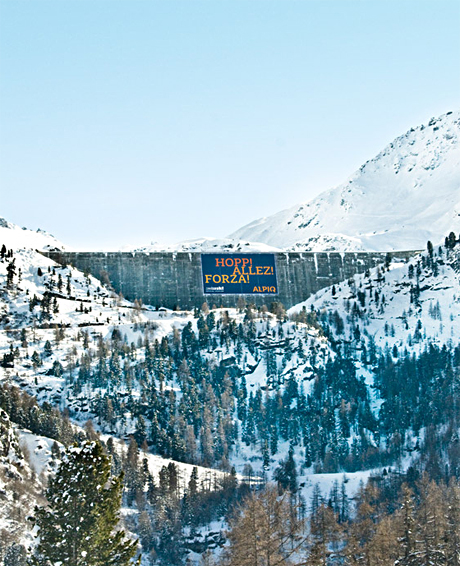
Alpiq has made it into the Guinness Book of World Records with its 63-by-43-meter banner hanging on the dam in the 4 Vallées ski resort. Any active winter sports enthusiast visiting the Valais ski resort these days can hardly miss the «world’s largest poster.» First of all, congratulations—the campaign seems to have thrilled many people. But the sight is also likely to have raised serious doubts—at least for some…
However, the huge poster on the dam wall of Lac de Cleuson - at least that's how the writer felt when she was sitting on one of the chairlifts in the aforementioned ski resort last weekend - didn't quite fit the bill. Admittedly, the concrete wall is not a particular attraction. But while the gray wall somehow blends into the mountain panorama, the same cannot be said of the poster. Malicious tongues would even call it an "eyesore in nature". The hope remains that such actions, as they do involve a certain amount of logistical effort (see video on Fanpower.ch) will remain within limits. Or will such advertising spaces soon be on offer from APG?

20 Minutes to the thousandth
Four years after its launch, 20 Minutes—the French-speaking Swiss counterpart to 20 Minuten—is published today for the 1,000th time. The commuter newspaper in its current form was created in late September 2009 through the merger of the two French-speaking Swiss commuter newspapers, Le Matin Bleu and 20 Minutes.
Lucerne culture magazine under new management
The Lucerne-based culture magazine has a new editor-in-chief. Jonas Wydler, a 28-year-old journalist, will now head the editorial team. He succeeds Michael Gasser, who is leaving the monthly magazine at the end of April. Wydler’s right-hand man will be 21-year-old Ivan Schnyder.
Last but not least: Cablecom - probably the most robust brand in the world
There’s been so much in the news about Cablecom over the past few months: angry customers, customer service issues, customers leaving the cable network operator… In light of this, the results of the latest Reader’s Digest survey seem almost paradoxical. Consumers have named Cablecom the most trustworthy cable network provider in Switzerland.
This should even come as a surprise to the cable network provider, as Cablecom CEO Eric Tveter announced in an interview with the Basler Zeitung newspaper last September: "The customer service problems have severely damaged the brand". Tveter also explained why the company absolutely needed a new name. Is Cablecom now reconsidering the name change? It would be a shame, as the brand enjoys such strong consumer trust!