New Group CIO at Ringier

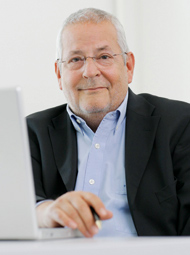
Effective May 1, Joachim Aschoff will assume the role of Group CIO and take charge of corporate IT at the Swiss media group Ringier.

Joachim Aschoff is taking over IT responsibility from Urs Gerhard. The former CIO is leaving the company after six years as Head of Group-wide IT Services. He wants to take on a new challenge, according to Ringier.
Aschoff has been with Zurich Financial Services since 2005, where he will continue to serve as Head of Global Service Management in the financial services provider's Group IT until the end of April. Prior to that, he held various management positions at Swissport, Lufthansa and the former Swissair, among others. There is not yet a successor for him at Zurich Financial Services, Cio.de writes. The new Group CIO will lead a team of about 100 IT employees at the Swiss media group. He will report directly to the Chief Financial Officer and Head of Corporate Center, Samuel Hügli.
In addition, the company is to give all employees access to Google Apps Premier Edition by October 2010. The Google Apps are to replace a total of eight different mail and calendar systems and dozens of mail domains previously in use within the media company.

Marketing Day 2010: The Best of 50 Submissions

On March 9, 2010, the marketing industry will once again gather at the KKL Luzern for Swiss Marketing Day. This year, the focus is on emotions in marketing.

What must companies do to ensure that brands resonate with people? What factors are important and relevant to customers? And why does emotional marketing work well for some companies but hardly at all for others? The industry will find possible answers to these questions at the upcoming Marketing Day on March 9 in Lucerne. International speakers, such as U.S. bestselling author James H. Gilmore, will share new insights and practical ideas with the expected 1,000 attendees at the KKL. Other speakers include Simonetta Carbonaro, professor of Humanistic Marketing and Design Management at the University of Borås in Sweden, and David Bosshart, CEO of the GDI in Rüschlikon since 1999.
As the highlight of the event, Switzerland’s best marketing ideas will then be honored with the Marketing Trophy, and the Audience Award will be presented. The Marketing Trophy is awarded annually to recognize the most innovative and successful marketing ideas in Switzerland. «The Marketing Trophy is the Oscar of Swiss marketers,» says Uwe Tännler, President of Swiss Marketing and Chair of the Organizing Committee for Swiss Marketing Day at the KKL Lucerne. The award is presented by Swiss Marketing, the largest professional organization for marketing and sales in Switzerland. The nominations and winners are selected by a ten-member expert jury chaired by Marco Bernasconi, Managing Director of Wemf for Advertising Media Research.

The best Swiss marketing campaigns are nominated
The nominees for the 2010 Marketing Trophy have been announced. An interdisciplinary jury selected the best Swiss marketing campaigns of the year that is coming to a close from among 50 entries.
Nominees in the Large Companies category: Kuoni (repositioning of the Kuoni and Helvetic brands), Six Multisolutions AG (campaign for mobile vouchers), Volvo (launch campaign for the Volvo XC 60), Phonak (campaign for the Hear the World Foundation), and Service industriels de Genève (launch of the Eau de Genève brand).
Medium-sized company category: Erlebnis Schweiz, Nidau (promotion for corporate events and client functions), and Rugenbräu (campaign for Swiss Highland Single Malt Whiskey Ice Label).
Nominated small businesses: Freshbox (fruit subscription campaign) and Natura Güggeli (overall concept).
In the NPO category: Pro Kloster Einsiedeln Foundation (Klosterplatz.com – Campaign to Renovate Klosterplatz), Switzerland Tourism (Felsenputzer Campaign), Heks (Give Help Campaign).

"Die Werbewoche" on Star TV for the making-of of "Seat Ibiza Ecomotive "

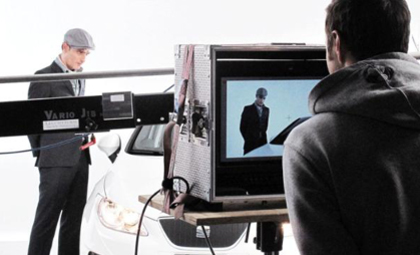
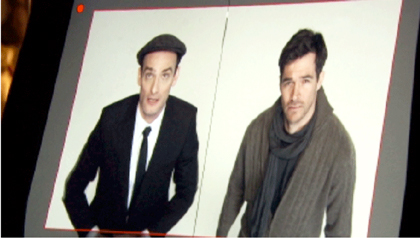
On Thursday, from 19:00, Star TV will be showing the making-of of the new Seat Ibiza Ecomotive.

In the commercial, Swiss Hollywood star and Seat ambassador Anatole Taubmann suddenly has three wishes - which initially makes him a little insecure. Star TV takes a look behind the scenes and shows exclusive images from the shoot. In the "Striking" section, another highlight from this year's Cannes reel is presented and, as usual, the TV spots from the current week are also broadcast.
The advertising week on Star TV: New every Thursday at 19:00 on Star TV and as a stream on www.startv.ch.

1290581058_img100224_startv2
1290581058_img100224_startvseat

Mainland: Cookies for software developers

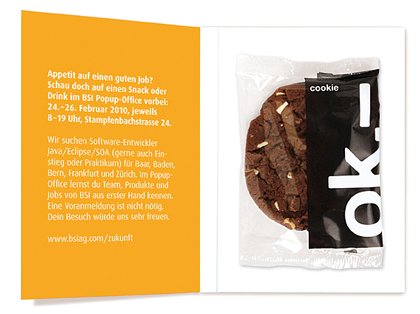
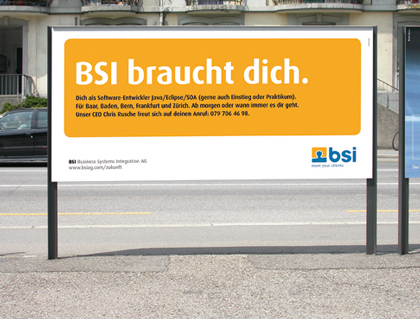
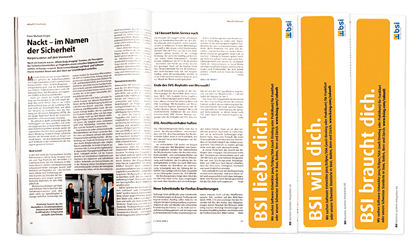
The Festland agency has developed a new recruitment campaign for BSI Business Systems Integration.

In Zurich, the most important recruiting market for BSI, F12 posters in the Zurich commuter network call for applications, including the CEO's cell phone number. A cookie flyer distributed at the ETH invites computer science students to get snacks, drinks and facts at the BSI pop-up office set up especially for this purpose. At this year's ETH Contact Party, BSI will not only be present with a stand, but also with its own advertising zeppelin.
The campaign also includes various activities at other computer science universities as well as advertisements and banners in specialist media and social networks. Last but not least, the careers section of the BSI website has been expanded.
1290581060_img100224_festland1
1290581060_img100224_festland2
1290581060_img100224_festland3
img100224_festland4

Regional companies also lose out

For the regional TV stations in German-speaking Switzerland, 2009 was the second worst year in terms of viewers since 2001, with practically all channels affected by the decline.

Yahoo and Twitter team up

Following Google and Microsoft, Yahoo has now also reached an agreement with the microblogging service Twitter. Twitter's real-time platform is to be fully integrated into the Yahoo network.

Users are to get direct access to their Twitter feeds via various Yahoo websites and offers in the future. This writes Readwriteweb.com on Wednesday. In addition, users will be able to tweet directly from Yahoo. And Twitter updates are to be integrated directly into Yahoo's real-time search. The selection of status updates will be found in areas such as news, entertainment or sports.
Having also recently partnered with Facebook, Yahoo users can now serve multiple platforms simultaneously through their account via the link.

Zeta lets animals speak for Interhome

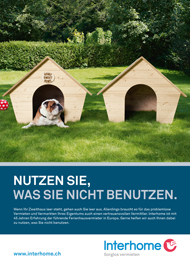
The Zeta agency has developed an international advertising campaign for Interhome in the area of purchasing.

The campaign is aimed directly at house and apartment owners and encourages them to rent out their second home in a charming way. The landlord of vacation homes and apartments is positioned as a competent and trustworthy partner, summed up in the claim "Carefree renting".
The idea: Characteristic animals are representative of the different types of landlords whose
Interhome's environment and offerings: the home-style dog in a family environment, the
The elegant cat in the classic villa, the urban goldfish in the modern city loft and the cheerful
Bird in a rustic chalet. Strikingly realized: In addition to their primary residence, the characters always have a second, empty home, which, however, remains unused. Underneath is the headline "Use what you don't use".
Responsible at Interhome: Walter Buschta (Head of Marketing), Roger Müller (Head of Purchasing), Martin Frank (Brand and Communication Manager), Philipp Grieder (Project Manager Marketing). Responsible at Zeta Zurich: Ibrahim Zbat (CD), Helen Lagger (text/concept). Photos: Fotosolar, Lucerne. Styling: Monica Keller. Image editing: Andy Jossy (KRT, Lucerne).
1290581057_img100224_zeta2
img100224_zeta3

Compresso organizes anniversary celebration for Bühler

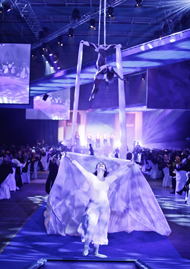
The Zurich agency Compresso was commissioned to organize and implement a major anniversary event for the Bühler machine factory in Uzwil.

The globally active Uzwil-based Bühler machine factory is celebrating its 150th anniversary this year.
anniversary. Compresso.ID event was responsible for the entire organization and implementation of the anniversary celebration. The company's production hall was transformed into an anniversary location for the celebration within 20 hours. The evening was hosted by Cécile Bähler.
1290581062_img100224_compresso2
img100224_compresso3

Bright spots for advertising

Westiform has developed a new LED technology for illuminated lettering. It consumes 80 percent less electricity than neon tubes and emits 80 percent less CO2 - with the same light output. With the new technology, Coop is underlining its commitment to the environment. And saves a lot of money.

ConturaLED is the pride and joy of Alain Schindler, CEO of the illuminated advertising media producer Westiform. The innovative light-emitting electrodes, or LEDs for short, which Westiform has just launched, think for themselves: They light up exclusively when it is dark enough, and only as brightly as is necessary for the perception of the lettering. This saves energy and costs.
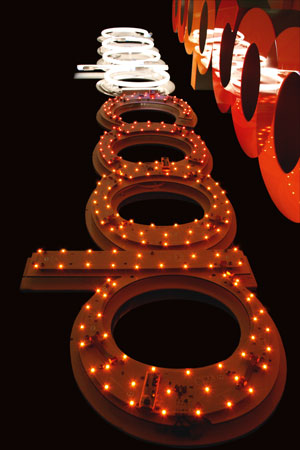
And this is how it works: ConturaLED works with ambient light control, which reacts to the ambient brightness via sensor. In addition, ConturaLED only installs as many electrodes as are really needed to optimally illuminate the lettering: The light points are placed individually along the font contour. This is not possible with conventional LEDs, whose light points are arranged "on a string" as in a chain of lights. Anyone who wants to optimally illuminate an LED lettering with such a chain has to lay one or two unnecessary loops. Inside industry-standard LED illuminated signs, the electrode chains therefore often wind in many curves - and emit more light and consume more power than necessary.
Light moments
"LED alone is nothing special. Even in the first James Bond film, the agent had LEDs in his watch," says Thomas Ondrisek. Ondrisek is a senior development engineer at Westiform. He developed ConturaLED together with his team. "The special thing about ConturaLED is that it follows the outline of the letter and has a light sensor that reacts to brightness. So the lettering is slightly brighter than its surroundings all the time and thus always optimally visible." As dusk falls, the illuminated letters turn on at full brightness and then slowly dim down as it gets darker. That's because the lettering is easy to see in the dark anyway. The same happens at dawn: as it gets brighter, the lettering also gets brighter and brighter until it is no longer visible against the daylight. Then it switches off. Because the loss of light is thus reduced to a minimum, ConturaLED reduces energy consumption and CO2 emissions by up to 80 percent compared with neon signage. ConturaLED's standby power consumption is also minimal.
The individual LEDs are produced in the exact color of their cover material, so at Coop, for example, in dark and light orange. This additionally reduces the light emission and makes the colors appear more intense. In addition, for the first time, the illuminated lettering can be produced exactly according to the colors of the CI/CD, which was only marginally possible with neon lettering. "Our customer can precisely specify the desired color effect of his neon sign," emphasizes Ondrisek. "The coloring of the electrodes and the ambient light control make it possible."
Clean invention
ConturaLED has other positive effects as well: In a normal power supply network, the biggest power peaks occur early in the morning and in the evening, because in the morning many people switch on the light, blow-dry their hair and make coffee at the same time. In the evening, they come home from work, turn on the lights and the stereo, and cook themselves something delicious. It is precisely at these peak times that ConturaLED fixtures consume the least electricity - and thus relieve the strain on the power grid. Because there is virtually no unused light emitted into the environment with ConturaLED, light pollution is noticeably reduced. In addition, such illuminated signs are less attractive to flies, mosquitoes and other creatures. ConturaLED signs therefore also need to be cleaned much less frequently.
Existing neon or LED lettering can be easily converted to ConturaLED. If lettering that is to be equipped with ConturaLED is newly manufactured, it is even possible to save some of the plastic used to produce the letters. This is because the LED system requires less space behind the plastic cladding than neon tubes. So with ConturaLED, even the icing on the cake is right.
Sustainability out of passion
There are many good arguments in favor of ConturaLED, but for Coop, the low energy consumption and the sustainability of the system were the decisive factors in choosing the new technology. Coop has been a customer of Westiform for a long time and is predestined to use ConturaLED. This is because the company made a commitment to the federal government in 2004 to increase its energy efficiency and reduce CO2 emissions. By 2023, Coop wants to be CO2-neutral. ConturaLED fits in perfectly with this strategy. By changing its light sources, Coop is reducing its annual CO2 emissions by 20 tons and its energy requirements by almost two gigawatt hours per year. This is equivalent to the annual electricity consumption of 400 to 600 households. "Our investment in this retrofit is no more expensive than investing in industry-standard LEDs," says Georg Weinhofer, head of Coop's Energy/CO2 department. "But ConturaLED reduces our electricity and maintenance costs. So in the medium and long term, we're driving cheaper, even though we're acting sustainably. That's really unique." Coop's investment should already have paid for itself after around two years, estimates Westiform boss Alain Schindler.
Westiform has just started installing 750 Coop letterings with ConturaLED throughout Switzerland. In the long term, Coop will replace all of its 4250 letterings, some of which are still illuminated with neon, with ConturaLED illuminated letterings.
Schindler and Ondrisek expect that other companies will soon become enthusiastic about ConturaLED: "Sustainability has long been an issue. But if you no longer have to pay extra for environmentally friendly behavior, but can save a little, the cause gains in clout. In the future, companies and agencies should already have the environmental idea in mind when planning a new CI/CD." It probably won't be long before other companies follow Coop's shining example.
Anne-Friederike Wilhelm

Illuminated advertising: hand and mouth work
Would you have known? What lights up on the roofs of Coop, Credit Suisse and Publigroupe is pure handwork. To form each illuminated letter, Westiform makes a wooden model. Plastic parts heated in an oven are then bent around this into the desired shape. The letters are also glued together and sealed by hand. Only in this way can Westiform achieve the high precision for which the company is known. In order to produce the good old neon tubes, which are becoming increasingly rare, but are still needed, Westiform also operates its own glass blowing shop. Here, too, everything is hand-, pardon: mouth-work.
The family-owned company Westiform, headquartered in Niederwangen, is considered a leading company for illuminated advertising throughout Europe. Westiform was founded in 1998 and traces its roots back to the US-based Westinghouse Group. The company is 87 percent family-owned, maintains five production sites and sales companies in Europe and overseas, and employs around 500 full-time staff. www.westiform.ch

1290581063_img100224_leuchtwerbung1
A difference like day and night: The neon sign of
Coop next to the new ConturalLED font. The
Lighting effect is exactly the same.
1290581063_img100224_leuchtwerbung2
Shines in different colors: the Publicitas logo.
1290581063_img100224_leuchtwerbung3
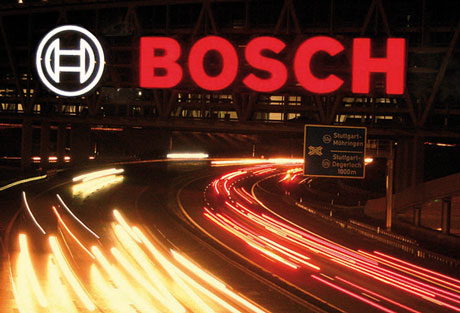
Bosch illuminated font.
On our own account:

The «Advertiser of the Year» award is one of the social highlights on the Swiss advertising agency scene’s calendar. Since 1977, subscribers to *Werbewoche* have been choosing their «king» or “queen.” This year, the title was awarded for the 33rd time.

This year’s awards ceremony, however, was also a first in many respects. For the first time, the event took place at the Lake Side lakeside restaurant. The weather cooperated, and during the cocktail hour, guests enjoyed a wonderful view of Zurich all lit up. As we’ve heard, however, there was at least one guest who, out of sheer habit, headed to the Kaufleuten before happily ending up at Lake Side.
Another first for us was that this marked our first public appearance as *Medien&Medizin Verlag*—in a sense, our launch as a new Swiss publishing house that publishes *Werbewoche* and the *Media Trend Journal*, as well as other medical journals. The launch was a success: We welcomed nearly 200 guests—including many former “Advertiser of the Year” winners who wanted to attend this year’s awards ceremony.
The event began with the presentation of the «Campaign of the Year» award. Readers of *Werbewoche* and viewers of Star TV voted the Maggi campaign featuring Claudio Zuccolini as the winner. It was created by Ringier Media Sales and the Zurich-based advertising agency Publicis.
The five nominees were then featured in a film based on an idea by Andreas Panzeri and directed by him in collaboration with Star TV.
With Regula Fecker, a partner at the Zurich-based agency Rod Kommunikation, a woman made it onto the podium for the first time in ten years. The last woman to be named “Advertiser of the Year” was Danielle Lanz of Ruf Lanz in 1999. Regula Fecker became the sixth female advertiser to be inducted into the Hall of Fame of the 33 Glorious.
Two and a half years after its founding, the Rod agency is regarded as a creative and strategic «hot shop» with 16 employees. Its clients include 20 Minuten, IKEA, Bell, Hotelplan, Médecins Sans Frontières, and Sanitas. As early as 2008, Rod was named «Newcomer Agency of the Year» in the German-speaking world by Ullstein Verlag. The entire agency applauded wildly when Regula Fecker accepted the Egon Trophy from Werbewoche.
The widespread media coverage of the election—with in-depth reports in the *Tages-Anzeiger*, *Blick*, *SonntagsZeitung*, in the Sonntag, the Handelszeitung, the Bilanz, «Glanz&Gloria,» on DRS3, on DRS1, and in many other publications—shows that Werbewoche subscribers, as opinion leaders, represent the Swiss advertising industry. We are proud of this, and it serves as both an incentive and a source of ambition for us to continually improve Werbewoche and make it an even more engaging read for you.
1290581063_img100224_droux
Eleonore E. Droux, publisher.
1290581063_img080827_pierre_c_meier
Pierre C. Meier, Editor-in-Chief
Advertising Week.

Valencia shows family spirit for Coop

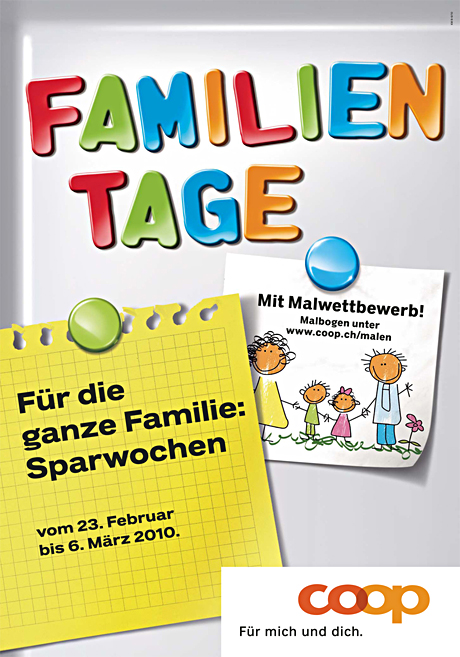
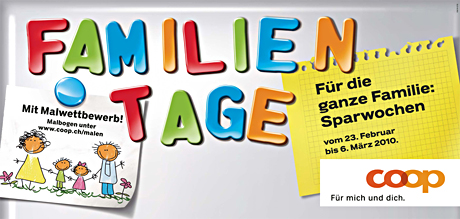
Coop is once again launching its national family campaign. Valencia Kommunikation has once again created the key visual for the «Family Weeks» and designed all advertising materials.

The measures implemented include F12 and F4 posters, hanging frames and rotairs, which can be seen in all Coop stores from February 23 to March 6, 2010.

Responsible at Coop: Lydie Goltdammer-Fourkal (Head of Advertising), Joachim Von Allmen (Head of POS Advertising). Responsible at Valencia Communication: Michael Gerber (CD), Tommy Schilling (Senior AD), Anett Oldenburg (Junior AD), Guillermo Garcia (Text), Serdal Aktas, Beate Ertl (DTP), Sabina Wothe, Jeannine Kaiser (Consulting).

1290581064_img100223_coop1
1290581064_img100223_coop2

Futurecom: On the road as a hacker for Reporters Without Borders

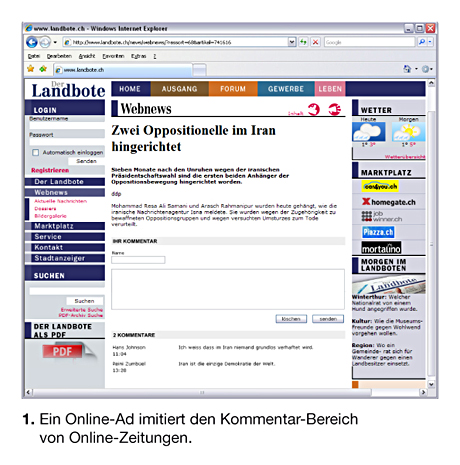
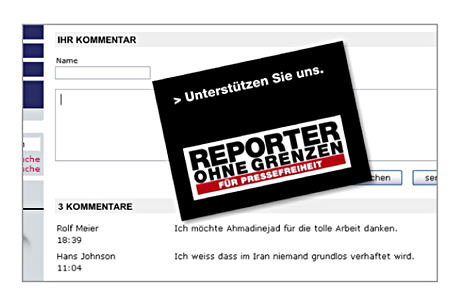
Reporters Without Borders, an organization that fights for greater press freedom worldwide, is raising awareness about Internet censorship through an online campaign. Futurecom has hacked a comment feature for this purpose.

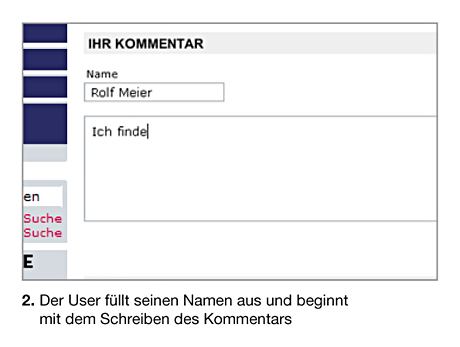
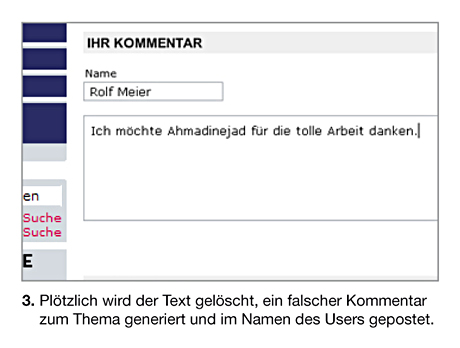
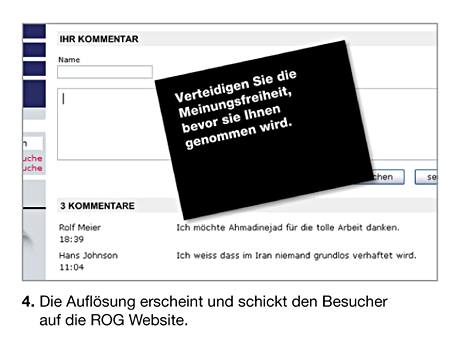
The deprivation of freedom of expression is demonstrated at first hand by taking away the right to free speech. This is done with a camouflaged online ad that imitates the comment field of online publications. After typing a few letters, the cursor is "hijacked" and the entire opinion is deleted. Instead, an automatically generated message is sent in the user's name and published as a completely uncritical comment. The resolution is then intended to show how important freedom of expression is for our society.
The campaign deliberately focuses on the "critics" segment. This refers to the 19 percent of Internet users who actively comment on posts and thus participate in the open Internet dialog (Forrester Research 2006). On March 12, 2010, the International Day against Censorship on the Internet, the banner will be placed widely in online media in German-speaking and French-speaking Switzerland as well as in Ticino. In the run-up to the event, the banner will be placed specifically on Internet newspapers such as the Landbote and blogs.

> Test function

Responsible at Reporters Without Borders: Georg A. Hildebrand (oordination German Switzerland). Responsible at Futurecom: Roger Ruegger (CD), Samuel Textor (text/concept), Michael Gallmann (AD), Christos Margaris (flash programming), Patrick Biner (consulting).

1290581064_img100223_rog
1290581064_img100223_rog2a
1290581064_img100223_rog3
1290581065_img100223_rog4
1290581065_img100223_rog5
get_footer();