Manfred Strobl becomes the new head of OMD Switzerland

Manfred Strobl is to become the new CEO of media agency OMD Switzerland. The 46-year-old succeeds Christof Kaufmann, who is moving to Aegis Media Switzerland on August 1, 2010.

Manfred Strobl has been Executive Managing Director of Optimedia Frankfurt within the VivaKi Group (Publicis) since 2005. Since then, the business economist has worked for HP, Nestlé, Richemont, Kao Brands, Entega, Fidelity and other clients. Strobl began his professional career in 1986 in research and internal consulting, including at Roland Berger and Philip Morris in Munich. He was later responsible for marketing services at the Lancaster Group, where he also set up media planning for the premium cosmetics segment in the mid-1990s. This was followed by the establishment of his own sales office in Frankfurt for the Milchstrasse publishing group.
Manfred Strobl graduated with an MBA and MBI in the Netherlands and the USA in 2000. During this time, he was also involved in an Internet start-up in France and worked on Internet-specific projects at Dell (Texas). He then worked for around four years as a marketing team leader in the pharmaceutical industry (Eli Lilly).
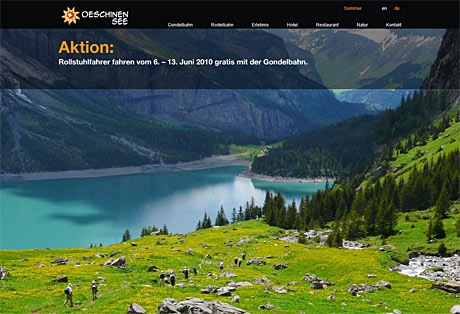

Crime scene: New website for Lake Oeschinen

The Kandersteg Oeschinensee tourist region has had a new online presence since Sunday evening. The Bernese design and communications agency Tatort has relaunched the website.

The aim was to create a contemporary and user-friendly Website The aim was to create a website that makes you want to explore the natural landscapes of the Bernese Oberland on the edge of the Jungfrau-Aletsch UNESCO World Heritage Site. The graphic concept, the design of the site and the Flash intro were created by Tatort. The technical implementation was carried out by Jolimontdesign, Bern.

Responsible at Hotel-Restaurant Oeschinensee, Kandersteg: Christoph Wandfluh. Responsible at Tatort Kommunikation & Design, Bern: Diobe Wyss (idea and creation), Francisco Rojas (CD). Translation: Pam Adams, Kandersteg. Photographs: Christoph Wandfluh.

1290580939_img100504_oeschinensee

Cognita strengthens Board of Directors

The media monitoring firm Cognita has added two new members to its board of directors. The general meeting elected the two internet entrepreneurs, Daniel Grossen and Martin Schlatter Villiger, to the board.

Grossen is the founder and CEO of Scout24 Switzerland. He sold the portal together with the Media Swiss Group to the Ringier publishing house in December 2007. Schlatter Villiger sold his company Minick to Swisscom in December 2006 and is now involved in several start-ups. Both support Cognita in its further market development and will decisively accompany the founding team in strategic questions, as the media watchdog announced on Monday.

Publigroupe: Majority stake in online marketer acquired

Die Inseratevermittlerin Publigroupe übernimmt 75 Prozent an der Schweizer Onlinemarketingagentur Instanz. Die Gründer Andi Hess und Marc Pittner bleiben mit 25 Prozent an der Unternehmensgruppe beteiligt und führen die Agentur zusammen mit der dritten Gründerin Mirjam Gschank auch in Zukunft.

Instanz was founded in 1993 as a communications agency, but since 2005 has increasingly focused on the online performance marketing segment. The company employs 18 people in Zurich. The focus of the group of companies, which also includes Medialution and Affiliate Media, is the optimized use of various online channels (display, search, affiliate marketing).

ROG: "Enemies of press freedom" added to list

To mark World Press Freedom Day, the organization Reporters Without Borders (RSF) sharply criticized the obstruction of journalists in many countries around the world. On Monday, it published a list of the 40 politicians and groups that it believes most severely violate press freedom.

The "press thieves" are presidents, ministers, religious leaders and armed groups, explained the organization in Paris. They use censorship, imprisonment, kidnapping, torture and, in the worst cases, murder to get at journalists. The list includes 17 presidents or prime ministers, such as Chinese head of state Hu Jintao, Russian Prime Minister Vladimir Putin, Libyan ruler Muammar al-Gaddafi and Iranian President Mahmoud Ahmadinejad. Among others, the organization named the Basque ETA and the FARC guerrillas as armed underground organizations. Taliban leader Mullah Omar is also named as a suppressor of press freedom. The Israeli Ministry of Defense and the radical Islamic Hamas are also mentioned in this context.

>To the list

Gutenberg Museum shows controversial posters

Over 60 posters with explosive content can be seen in Freiburg until the end of June: Under the title "Not like this! ", the Gutenberg Museum is showing posters from three centuries that once caused a stir in Switzerland.

On display are "classics" such as the Benetton series from the 1990s - the textile company advertised its clothes with dying AIDS patients and bloody uniforms. The exposed buttocks of the Sloggi advertisement, which was considered sexist, and the naked skin of a campaign for Rifle jeans are also on display. However, the exhibition from May 6 to June 27 also shows posters that once caused red heads and have long since been forgotten. The exhibition organizers announced on Monday that it gives an idea of the morals, mentality and visual culture that prevailed in the respective era. For example, the oldest poster in the exhibition, an affiche for the 1883 national exhibition, fell out of favor due to its graphic design, which was considered antiquated. In 1947, the innkeepers fought against the mineral water slogan "Trink lieber Eptinger" for a completely different reason: they feared a decline in alcohol consumption.

The black sheep of the SVP
Political posters also often caused a stir. Until 1990, a total of ten posters were banned for political reasons - all of them from the left. This changed with the offensive appearance of the SVP from the 1990s onwards. The black sheep on the poster for the deportation initiative caused a particular stir in 2007. The anti-minaret poster at the end of 2009 caused even more of a stir, even earning those responsible from the right-wing camp a reprimand from the UN Human Rights Commission. According to the exhibition organizers, blasphemous posters are a rarity. In the past, however, the alteration of religious images, such as the misuse of Leonardo's "Last Supper" for advertising kitchen appliances, was undesirable.

Anti-Aids campaigns and the church
The Stop AIDS campaigns also repeatedly called Christians onto the scene. In 2003, the Federal Office of Public Health (FOPH) ran the headline: "Greetings, Mr. Pastor, if Rome doesn't like to hear you talk about contraception, why don't you talk about condoms?" The Bishops' Conference demanded that the poster be withdrawn as it mocked religion. After a discussion, the FOPH withdrew the poster. Most of the posters shown in Fribourg come from the poster collection of the Basel School of Design.

Curious About: Conceptual designer founds own agency

Renato Soldenhoff, a concept developer at Rufener Events BSW, took the plunge into self-employment on April 1, 2010. Soldenhoff founded his own company specializing in concept and process design, called Curious About.

Soldenhoff works both online and offline. The 30-year-old accompanies all projects with a project wiki. This gives customers the opportunity to check the current status of the project online at any time and to provide their own input. During his two-year employment with Rufener Events BSW, Renato Soldenhoff worked, for example, for the World Expo 2010, Bacardi-Martini and the Zürcher Verkehrsverbund. He was also responsible for the relaunch of Rufenerevents.ch and introduced an internal agency knowledge platform with the aim of optimizing internal processes. Soldenhoff continues to hold a mandate as concept developer for Rufener Events BSW.

Budget: Rod wins Sinalco

The young Zurich-based communications agency Rod has just announced that it has won an account: as part of an agency evaluation, Rod was able to convince the decision-makers at Ramseier Suisse to award the mandate to Sinalco.

The first fruits of the joint work will be on show from summer 2010, as the agency writes in a press release.

1290580941_img100503_sinalco

Stress raps for new commercial from Coop

Für eine neue Kampagne zum Thema «Biodiversität» setzt Coop erneut auf den Schweizer Musiker Andres Andrekson alias Stress. Ein in Zusammenarbeit mit der Filmproduktionsfirma Combo Entertainment entstandener TV-Werbespot soll dabei zum kritischen Hinterfragen des eigenen Konsums anregen.

The lyrics are about the heartbeat of nature, the last domino that must not fall and the importance of biodiversity. Everything is connected, forms a cycle - like an endless chain of dominoes, so the reasoning. Parallel to this, under Coop.ch/stressmusic has launched an online platform. You can find information about the making of the commercial, the lyrics including translations, and the commercial itself.

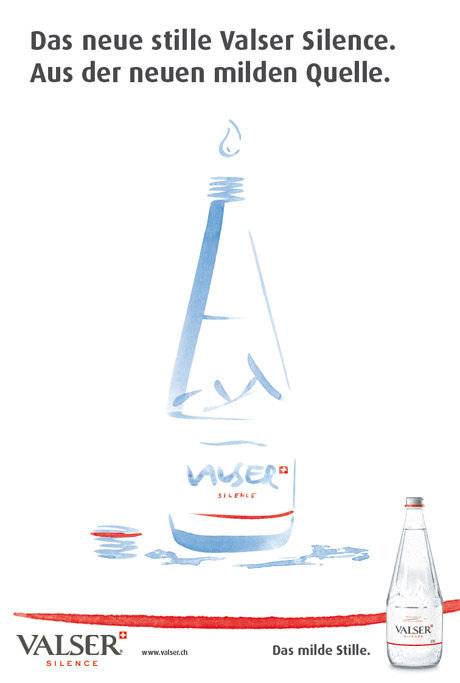
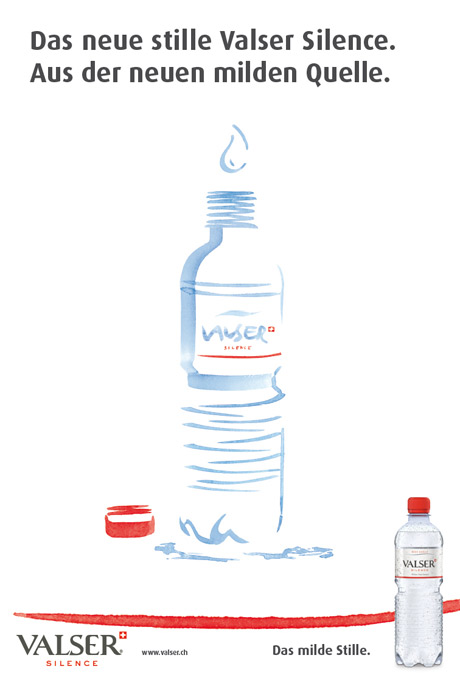
McCann: Celebrating silence for Valser Silence

After winning the pitch from Valser Mineralquellen, McCann Erickson created a campaign for the new Valser Silence. The aim was to create a clear differentiation from the existing product range and to express the mild character of the water.

The new water is presented in print and poster motifs, on POP and online in a flowing and mild realization. The idea: to make the core of the product, water, the core of the advertising. Subsequent implementations that give free rein to the creative basic idea in the areas of fashion, lifestyle and design are already planned.

Responsibility Coca-Cola Switzerland: Joëlle Vock (Brand Manager Water Alpine & Adriatics). Responsible at McCann Erickson: Annika Seidel (Account Director), Thilo Boullion (Planning Director), Silke Wartenberg (Copy writer), Christine Manger (AD).

1290580941_img100503_valser1
1290580941_img100503_valser2

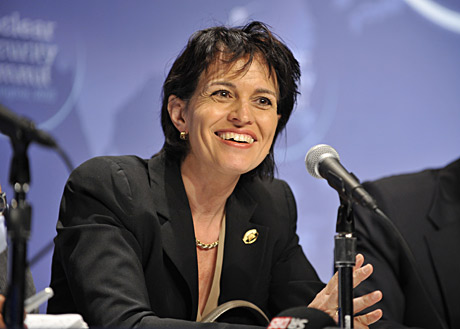
SW: Doris Leuthard is communicator of the month for April

Federal President Doris Leuthard was named “Communicator of the Month” for April by Swiss Advertising (SW). At the summit on nuclear safety in Washington, Leuthard demonstrated that effective communication also involves addressing uncomfortable topics.

This is more difficult and requires more communication skills - and personality, the association said in a communiqué. The President of the Swiss Confederation has made it clear to the USA that the real threat of terrorist misuse of nuclear material does not primarily come from the civilian sector, but from the military. "And there we have no control and no transparency. This is an imbalance that the nuclear powers naturally don't want to tackle." The SW liked the self-confidence with which Doris Leuthard delivered her message. Others, intimidated and awed, would probably have preferred to remain silent rather than bring this imbalance between the nuclear powers and smaller, less powerful states to the table. Courage is also part of good communication. Courage to consistently deliver your message when you consider it to be right - regardless of the position of the addressees.

1290580942_img100502_leuthard
(Image: Keystone)

Still few women in daily news media

Women are underrepresented in the Swiss media—both as journalists and as experts quoted in the news. This is the conclusion reached by the Swiss Conference of Gender Equality Officers (SKG). The organization commissioned an analysis of Swiss daily news from a gender perspective.

In news, women are mainly represented in the topics of education and youth (38%). In contrast, their presence in the business section is "very low" at 10%, writes the SKG. Among the people mentioned in the media, women are still underrepresented at 22%. The majority of women (55%) are quoted in reports on culture, leisure and entertainment. In principle, women are often consulted when it comes to reflecting the voice of the people. However, they are far less represented in the media as experts or authorities.

Differences between language regions
"As far as news producers are concerned, only 34 percent of all reports are written by women," the communiqué states. However, there are differences between the language regions: At 31 percent in French-speaking Switzerland and 44 percent in Ticino, female journalists are more present there than in German-speaking Switzerland (23 percent). Furthermore, women as authorities are less common in German-speaking Switzerland than in Latin-speaking Switzerland.
Since 1995, a worldwide analysis of the daily news from a gender perspective has been carried out every five years. Switzerland is represented for the first time this year with all three language groups. The study is limited to one day and should be seen as a snapshot of media work. In order to delve deeper into the topic, the SKG had an additional 284 news items analyzed, which were written by 332 journalists and in which 802 people were mentioned.

get_footer();