Press Council approves complaint against SDA

The Swiss Press Council has upheld a complaint against the SDA news agency.

The SDA had corrected a report with incorrect information about additional costs for quotas after the adoption of the mass immigration initiative only in its database, but not in the current service. Employer President Valentin Vogt had said in an interview with the NZZ am Sonntag on February 15, 2015, that he expected additional costs for the Swiss economy of CHF 4 billion due to the introduction of quotas as a result of the initiative. However, Vogt was mistaken in his calculation. In fact, the corresponding amount was 400 million francs. SDA confronted Vogt with this error, but did not receive a precise answer. Journalists, for their part, pointed out the error to sda. Therefore, sda subsequently corrected the error in the database. A reader complained to the Press Council that the public had not been informed about the correction. The Press Council now approved this complaint. The SDA had violated the "Declaration of the Duties and Rights of Journalists". (SDA)

UBS launches Internet recommendation service for the rich

UBS is launching an online wealth management recommendation service called Ynome, according to the Handelszeitung.

On Ynome.com, wealthy people can share their experiences with (private) banks, roboadvisors, asset managers or hedge funds and have them evaluated. The Ynome algorithm then determines the most suitable wealth banks for the users. Although the crowdsourcing service Ynome was developed in the Zurich innovation lab of UBS Wealth Management. However, Ynome co-founder Dave Bruno emphasizes that the crowdsource service operates completely independently of the big bank and adds: "In one to two years, we want to break away from the business angel UBS and become an independent company.

Somedia: Digital gazette is a success

Since January 2016, the Graubünden Cantonal Gazette has been published exclusively in digital form. This pioneering project was conceived and implemented by Somedia Production.

After several months of operation, numerous positive reviews, and clear expressions of interest from other cantons, the digital official gazette is considered a major success. Last Thursday, the project leaders met at Somedia’s media center in Chur to mark the conclusion of the project. Among those present were Claudio Riesen, client and Director of the Graubünden State Chancellery; Hanspeter Lebrument, publisher and Chairman of the Board of Directors at Somedia; Andrea Masüger, CEO of Somedia; and the entire Somedia Production project team. Just a few months ago, the Graubünden Official Gazette was published weekly in a limited print run and was distributed only within the canton’s borders. Thanks to the innovation by Somedia Production and the State Chancellery of the Canton of Graubünden, the Official Gazette is now available online at any time and across cantonal borders—and is updated daily.

kantonsamtsblatt
Claudio Riesen (Director of the State Chancellery), Claudio Schäfer (Administrative Assistant for Political Rights and Publications), Gaby Caviezel-Wildhaber (Project Manager, Somedia Production), Hanspeter Lebrument (Publisher and Chairman of the Board of Directors, Somedia) (from left)

For greater efficiency and timeliness

The Digital Official Gazette offers its users a wide range of practical features. Posts are now automatically captured and published daily, ensuring maximum timeliness. The search function allows users to filter published notices and set up time-saving search subscriptions. Users also have access to a data archive dating back to 2001. The new services generated significant interest from the very beginning and have been actively used since their launch. The digital official gazette had over 18,000 users in the first two and a half months; over 3,000 publications were recorded, and nearly 1,500 search subscriptions were created. This result clearly demonstrates the need for this new information platform. Other cantons have also expressed interest in the digital official gazette and are convinced of its potential applications.

The project is considered a complete success

The clients are very satisfied with the result, and the project is considered a complete success by all involved. Hanspeter Lebrument, who is also president of the Swiss Media Association, among other roles, praised the project as an exemplary collaboration between public institutions and the private sector. (pd)
 

The flap: Submission deadline extended to April 4

Works can be submitted to the most important purely German-language competition for commercial films, Die Klappe, until April 4, 2016.

For 36 years, Die Klappe has represented all disciplines of commercial moving image communication and is considered the most important German-language competition for commercial films.

Unbenannt-3_131

It can be used in the following Categories be submitted:

1) TV formats
2) Cinema formats
3) Special Media: Pre Roll, Trailer, TV Idents, Making of
4) Digital formatsVirals, Branded Content & Entertainment, Branded Live Experience, Interactive Film, Best Use in Social Media, Long Format (over 90 seconds in length) & Image Films, VR Strorytelling, Best Influencer Content
5) Celebrity spots
6) Craft: Director Camera Editing Sound Visual Effects
7) International

Companies, agencies and productions can submit entries via the Internet platform Theflap.com. The award ceremony for the 36th Klappe will take place on Thursday, April 14, 2016 at the Kehrwieder Theater in Hamburg. The jury 2016 is composed of commissioners, agencies and other experts (media, direction, film production, post production). This composition ensures the greatest possible objectivity and competence with regard to the evaluation of the individual entries. Chaired by Preethi Mariappan, CCO Razorfish and Christian Rätsch, CEO Saatchi & Saatchi, this year's jury also includes Martin Spillmann, Sonja Brand (Pumpkin Film) and Andreas Panzeri.
 

Zip.ch receives financial injection

A group of investors is injecting 1.5 million Swiss francs to accelerate the development of the online directory Zip.ch. With this funding, the company aims to become a serious competitor to Local.ch and Search.ch.

The company founded in March 2015 Zip.ch aims to gain one third of the traffic of the Swiss online directories within a short time, thanks to its free referencing services dedicated to both individuals and companies. The new version of Zip.ch is scheduled to be launched in June this year. The revenues will come mainly from advertising and premium offers.

all_fr_transp

Businesses and self-employed people can improve their visibility on the Internet and their referencing, since the directory offer is much more extensive than that offered today by the competitor, which enjoys a near monopoly.

After an in-depth market study on online directories and the unsatisfactory offer of historical providers, a group of investors close to the Swiss family office Colombo has decided to contribute to the development of Zip.ch. According to the statement, the group of investors is convinced that Zip.ch will quickly become a reference in the market of Swiss online directories thanks to its revolutionary offers, better adapted to customer expectations.

Alexandre de Senger, founder and CEO of Zip.ch, adds: "By attracting capital investors of this quality, we are significantly increasing our development capacity. We will completely redefine this market by offering a "freemium" model that is much more advantageous for SMEs and finally offers them an alternative to Local.ch and Search.ch."

zip.ch---Alexandre-de-Senger
Alexandre de Senger, Founder and CEO of Zip.ch

Thanks to the capital raise, Zip.ch now has the financial resources to realize its goals and counter Swisscom Directories' dominance of the Swiss online directories market, the statement added. The operators criticize the Decision of the Weko, to have approved the merger of Local.ch and Search.ch in March 2015, for which Swisscom and Tamedia were responsible, even though this had created a dominant market position.

New version soon online

In the next few weeks, a version with a new design and display advertising will go online. Then, this summer, a new version will be launched that will allow users - both individuals and entrepreneurs - to control their data. Thus, they will be able to add a description of their activity for free, choose their headings, indicate opening hours, list the address of their home page or links to their social networks. This is to compete with the powerful competitors. For comparison mentions Zip.chThe company is not aware of the fact that simply adding a company's URL to its competitor Local.ch is charged at 420 francs per year. (pd/hae)

home_iPhone_fr


FCB Zurich strengthens creative leadership

FCB Zurich has acquired numerous new clients in recent months. As a result, the agency has expanded the creative team led by Chief Creative Officer Dennis Lück and established a new management structure.

A total of four CDs will now take on management tasks and create exceptional ideas for existing and new customers, as detailed in a press release.

New on board is Andy LustiCD Text. Andy Lusti, member of ADC Switzerland, formerly CD at Jung von Matt/Limmat, is regarded as an excellent creative and has won numerous national and international awards for his work. His campaigns for Migros, Graubünden Tourism and Volkswagen are particularly noteworthy.

His CD Art Partner is Marcin Baba. Born in Poland and trained as an online designer, he learned his trade at Scholz & Friends Hamburg before moving to Switzerland. Here, several of his works were awarded Cannes Lions. This is another reason why Marcin Baba, who has been with FCB for more than two years now, is being rewarded with the CD title.

The second management team consists of Flavio MeroniCD Art, and Sören Schröder, CD Text. Flavio Meroni, former Senior Art Director at Publicis and then Creative Director and Partner at the agency BCM. Sören Schröder, a communications graduate, trained in Düsseldorf at TBWA and in Hamburg at Scholz & Friends.

Flavio Meroni and Sören Schröder are the team responsible for the work "The Hearing Test Concert" for the hearing aid specialist Neuroth. The work was not only honored nationally with gold at the ADC Switzerland, but also won several international awards. Both have now also received an internal accolade and have been promoted to CDs.

Schroeder_Baba_Meroni_Lusti
Sören Schröder, Marcin Baba, Flavio Meroni, Andy Lusti (from left)

The four creative directors will be supported by additional new colleagues: Sarah Ming, Copy; Fabian Zahner, Senior Copy; Paul Labun, Art Director; Katja SchlosserArt Director. "I am delighted that we have succeeded in strengthening our creative team once again at a high level and that we will soon be able to report on new campaigns for Hero, Helsana, Kägi, Repower and Neuroth," says Cornelia Harder, CEO of FCB Zurich.
 

ADC Switzerland inducts Jean-Remy von Matt into the Hall of Fame

At the ADC Awards Ceremony on Saturday, March 12, 2016, Jean-Remy von Matt was inducted into the ADC Switzerland Hall of Fame.

The founder and head of Jung von Matt was born in Switzerland and has had a unique advertising career in Germany. According to laudator Peter Brönnimann, today he is probably the best-known Swiss advertising export internationally - except perhaps for "Who invented it? Ricola!". But Jean-Remy invented that, too. At the ADC Gala that followed, more than 600 guests celebrated the 40th anniversary of the creative club (Werbewoche.ch reported).

Unbenannt-9_100
 

NZZ Media Group buys Bindexis

The NZZ Media Group expands its portfolio to include the construction information service Bindexis. The Group is thus continuing its growth strategy in the Business Media business area.

The NZZ Media Group acquires all shares in Bindexis Bauinformationen. The information platform for all those directly or indirectly involved in construction becomes part of the Group's Business Media division. In addition to information services, this business unit also includes conferences and trade media. Veit Dengler, CEO of NZZ Media Group, in a statement: "Bindexis fits perfectly with our strategy of further growth in the B2B sector and increasingly exploiting cooperation potential within Business Media."

Founded in 2007, the Bindexis platform is based in Basel. It collects all building permits in Switzerland, enriches them with further information and puts this sales and marketing knowledge on over 60,000 building projects on Bindexis.ch available. For example, providers of construction services and products can apply for work on future construction projects at an early stage. Bindexis CEO Thomas Schoenauer is convinced that Bindexis will be able to better exploit its growth opportunities as part of the NZZ media group: "Integration into the group's technology and marketing processes will enable us to target our customers more effectively and expand our customer base more quickly."

The Bindexis offering complements the existing portfolio of the NZZ Media Group, in particular the offerings of Architonic, the international market-leading online community for architecture and design, and the business information platform Moneyhouse. Stefan Schärer, CEO of Moneyhouse: "Together we can develop additional and improved offerings, such as expanding our newly launched smart data products for SMEs for the construction industry."

Sales of Swiss music labels fell again in 2015

Swiss music labels saw another decline in sales in 2015. The decline in the traditional CD market continued. But even in the digital market, established download services came under pressure from streaming providers.

The approximately 35 music labels affiliated with the industry association IFPI Switzerland generated total revenue of 81.8 million Swiss francs last year. That is 3.5 percent less than the previous year, according to the annual report released on Thursday. Since 2001, the Swiss music market has thus shrunk by 73 percent.

Streaming services are growing significantly

After the digital market (downloads and streaming) had temporarily declined by 3 percent the previous year, it grew again in 2015 by just under 7 percent to 39.9 million francs. This growth was driven by streaming services, which increased by 30 percent to 15.3 million Swiss francs. This more than offset the 4 percent decline in revenue from the download business, which fell to 24.6 million Swiss francs. According to the association, in addition to existing providers such as Spotify and Deezer, Apple also entered the streaming segment as a major player in 2016. The decline in CD sales and other physical media continued. The 12 percent decline in revenue to 42 million Swiss francs follows the general trend of CDs being replaced by online music consumption. The IFPI figures do not include direct imports by CD retailers and consumers from abroad. According to the association, direct imports have risen steadily since 2011 due to the weak euro and currently account for an estimated 30 percent of CD purchases by Swiss consumers. The revival of vinyl records, which has been ongoing for several years, led to a 50 percent increase in sales last year, reaching 2.5 million Swiss francs. According to the press release, vinyl LPs last generated this level of sales in 1993.

Revenue from YouTube and similar platforms is marginal

It is striking that, even in the eleventh year of tracking the digital market, the physical market still held a slight lead. Physical audio media—primarily CDs and LPs—still accounted for about 51 percent of the association members' revenue. The association notes that music labels’ revenue from advertising on YouTube channels has not really taken off. Although music consumption via YouTube is extremely popular in Switzerland as well, revenue from ad-supported video streaming contributed only about 600,000 francs to total revenue—less than one percent.

Successful Swiss Acts

Last year, two Swiss acts—namely Lo&Leduc and Patent Ochsner—made it into the annual Top 10 of the official Swiss album chart. A total of 20 albums by Swiss artists were represented in the Top 100. This figure is slightly lower than in previous years, but this is due to the fact that some of the most successful Swiss artists did not release any albums in 2015. (SDA)

Graphic16 , the fifth: More digital than ever

This weekend, Grafik16, the exhibition of graphic design and visual expression in Switzerland, will take place. It features current works by over 130 national and international graphic designers, illustrators, typographers, visual designers, game designers, and artists.

This year’s special guests at the Maag Halle are California-based artist and creator of BunnyKitty, Dave «Persue» Ross, and German Pop Art legend Jim Avignon, «the world’s fastest painter» and founder of «Cheap Art.» Part of Grafik16 is the special exhibition # Game16. It features works from 3 art colleges, 11 studios, and 53 designers and producers. This is the largest showcase of Swiss game design this year.

From nearly twice as many applications, the curators of Grafik16 have selected 130 graphic designers, illustrators, typographers, visual designers, game designers, and artists. They are showcasing their favorite works from the past 12 months across approximately 2,500 square meters in the industrial halls of Zurich’s Maag Halle. Grafik16 aims—as mandated to the curatorial team—to highlight current trends in graphic design and make the diverse new forms of expression within this time-honored Swiss discipline accessible to a broad audience. These forms of expression include Classic & Crossover Media with graphic design, icon design, typography, corporate identity, vector graphics, illustration, urban and street art, graffiti, as well as digital and new media—including application design, web design, motion graphics design, interaction design, game design, 3D animation, and 3D mapping.

«Our goal is for Grafik16 to provide an overview of graphic art in Switzerland that is both representative and up-to-date. And we succeeded quite well in that in 2016,» says Grafik16 producer Michel Pernet. In addition to the exhibited works, this year’s exhibition will once again feature numerous live painting sessions and performances by well-known artists. The trend: what was once an analog craft is increasingly becoming a digital one.

The exhibition will take place from March 18 to March 20, 2016.

onufszak

Illustrator and designer Sebastian Onufszak is also exhibiting at Grafik16. His works are playful, garish, and almost hurt the eyes. Born in Poland, he is now one of Germany’s most renowned illustrators and designers. His clients include Ford, IKEA, Adidas, Karl Lagerfeld, Ray-Ban, Adobe, McDonald’s, and Pro Sieben. For the latter, he designed the channel layout for Pro Sieben Maxx.

You can read more about Sebastian Onufszak in the next issue Print edition of March 29, 2016 (Person of the Week).

Photo: Adobe, by Sebastian Onufszak
 

Migros Club School: New range of digital business courses

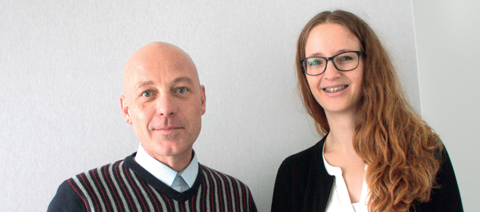
The digital transformation is requiring new skills from an increasing number of professionals—the goal is to make the most of technological opportunities. That’s why Migros Klubschule is now launching a new range of courses. Ursula Brunner and Wolf Kammerlander, heads of the «IT & New Media» division, explain exactly what the new offerings entail in an interview with Werbewoche.

Migros Club School is expanding its practical and networked training courses in the digital field - and is thus responding to the current needs of the world of work. Switzerland's leading private educational institution offers courses and training programs that are at the cutting edge of technology and allow direct transfer into practice. It has been recognized that companies such as Airbnb in tourism or Uber in the transport industry are putting established business models under pressure due to their meteoric rise, says Ursula Brunner, Project Manager "Management & Economy" at Migros Club School. For many companies, finding new solutions and making profitable use of the rapidly developing technology is an existential question. The development of an individual's professional career is also determined by whether the employee's knowledge meets the demands of the digitalized working world.

Werbewoche: Migros Club School is offering a new range of courses. Why exactly now?
Ursula Brunner: The structural changes in various industries due to digitalization were the trigger for us to question our offering. What do we offer and how do we contribute to ensuring that professionals at Migros Club School can prepare themselves specifically for change? The digital transformation is not a temporary phenomenon. It affects society as a whole and the world of work in particular. The change is affecting entire professional areas and the requirements in the world of work are constantly changing.

The offer is called "Digital Business". What does that mean?
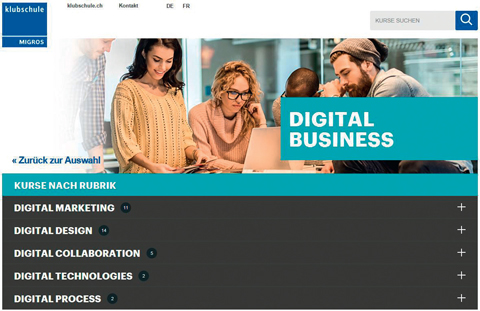
Wolf Kammerlander: Digital business is not a protected term; it can mean many things. The main point is the combination of business and technological expertise. Our aim is to give the whole thing a profile. We have organized the courses within the subject areas of Digital Marketing, Digital Design, Digital Collaboration, Digital Technologies and Digital Process. Our aim is to provide course participants with the digital training they need to be successful in their day-to-day work in the future.
Brunner: For us, the word business clearly stands for professionalism. It is about professional skills and their further development. The term digital, on the other hand, refers to all the technological developments. Digitalization leads to new opportunities and requires new skills. Professionals are increasingly confronted with new work processes. The use of new technologies must be learned.

WW05_010_010

What does the new range of services look like - what training structure will be offered?
Kammerlander: We offer a variety of new training courses in the field of digital business. The offer ranges from courses and advanced courses to shorter units and introductory courses. On the website Klubschule.ch/digitalbusiness we have clearly presented the entire range of products.

How else will the new training opportunities change?
Kammerlander: We are currently analyzing what we already offer in the area of digital business and where we can meet needs even better. This is taking place in our "Management & Business" and "IT & New Media" areas. In "IT & New Media", the expanded offerings focus primarily on technology, such as tools and applications. The "Management & Business" area covers the range of skills and processes.
Brunner: The interfaces between the "IT & New Media" and "Management & Economics" departments were actually the starting point for the whole change. These two departments are overlapping more and more. Since Wolf Kammerlander has been in charge of the web design course and I have been in charge of the online marketing course, we have become increasingly aware of this. Instead of assigning the courses at these interfaces to one of the two departments, we have created a vessel that covers these different areas of expertise.
Kammerlander: The focus is increasingly on topics such as digital marketing and design. On Club school. ch/digitalbusiness this is easily recognizable. New ideas are also constantly being added, which we are examining. However, all offers are categorized in the six subject areas already mentioned.

Where should the Digital Business range of services go in concrete terms?
Kammerlander: We are in the process of launching cross-divisional offers and adapting them to customer needs. We want to equip our customers with skills so that they are prepared for future requirements and can manage their day-to-day work. Even at home, people often use several devices, such as a smartphone and a laptop. This requires assistance with synchronization, for example. In a company, other aspects such as data security need to be taken into account.

Nationally or internationally recognized diplomas are not a priority at Migros Club School. Is this also the case with the new training program?
Brunner: In the marketing sector, many employees already have a specialist title. Digital business is about the question of how digital possibilities can be used sensibly in your own environment: What suits my strategy, my goals and my target group? For this, a degree is less important than professional practice. It is very important to us to enable our customers to apply this directly.
Kammerlander: On the one hand, we offer user courses and basic courses. But we also offer advanced courses and courses leading to the DIPLOMA qualification, which is recognized throughout Switzerland by the Migros Club School. The range is therefore relatively broad as far as the level of training is concerned. But the basic aim is for customers to acquire job-related skills that they can apply directly. Of course, graduates of an e-publishing course are not yet graphic designers, but they are able to design letterheads in accordance with graphic design standards. But even as a graphic designer, you never stop learning. The Adobe Photoshop program alone is constantly changing. Knowledge needs to be constantly developed. We are also already thinking about how we can cover the whole area of e-commerce. In the future, more and more private individuals will want to implement their own ideas as small businesses and offer their products online. In addition, there will be those who have been working in their field for some time and suddenly realize that they are confronted with new digital structures and processes. Digital business should be at the cutting edge. Our range of services is flexible and expandable. In view of our 50 locations throughout Switzerland, we will of course also tailor training courses to regional needs.

What are the advantages of such a range of training courses?
Brunner: Our lecturers are all professionals themselves and can therefore bring experience directly from the relevant industry. The fact that they receive practical know-how directly is a great benefit for our participants. In addition, there is the exchange with other professionals during the course. We are currently seeing this in the Content Marketing course, which started last fall. Our customers really appreciate this exchange - all the more so when they come from different industries and are confronted with similar problems and structures. I experience this myself in my training: it is not only the lecturers who impart knowledge, but often also the participants themselves. We will definitely continue to improve and expand the transfer of practical knowledge. This is also a personal concern of mine. Under no circumstances should we just teach theory. We want our customers to learn how to apply what they have learned directly in their day-to-day work.
Kammerlander: In future, we will definitely not only offer courses that contain between 50 and 150 lessons. The aim is to filter out fundamental digital issues in a company and address them specifically in individual courses - sometimes in shorter units. For example, we might present the specific possibilities and issues in a course without going into depth. One example of this would be the cloud. In an advanced course, we present the various options. Skills in using the tools selected can be developed in further in-depth courses depending on interest. Many people like to learn a lot. As a professional, however, you are often happy to gain new perspectives through compact further training formats ... This gives you the opportunity to decide for yourself which specialization you want to choose. This can also be done in other ways.

The digital market is flooded with tools and software offerings. Which tools does Digital Business focus on, and do you also work with agencies?
Brunner: We offer some training courses in cooperation with agencies. Our seminars on Facebook marketing are conducted by specialists from Hutter Consult GmbH. We run the Google AdWords courses in collaboration with the Webrepublic agency. For longer training courses, such as the Online Marketing Manager, where various lecturers are used, we have the quality of our training checked and certified by the industry association IAB (representative of the digital advertising industry).
Kammerlander: In addition to working with industry associations, we also have partnerships with Swisscom and Hostpoint. This allows us to exploit synergies. We also cooperate with major product manufacturers such as Adobe. Here we have good license offers for our course participants at favourable conditions. I think it is extremely important that we can also make various tools available to our customers. We are also generally open to specific tools. We don't want to reinvent the wheel, but rather follow certain trends. If many customers are interested, we are happy to take this on board. However, it is important to clearly distinguish whether a trend has a certain consistency or whether it has disappeared from the scene after a few months. Selection is not always easy. We are in a constant process of development with our Digital Business range and I am excited to see how things will continue.

Interview: Ursina Maurer

WW05_011_011

Taking advantage of new job opportunities

Since last fall, the Migros Club School has been offering two new courses. The content marketing course enables participants to develop new communication strategies as a supplement or further development of traditional advertising measures. Even companies with smaller budgets can advertise successfully if these strategies are implemented consistently. The "Desktop Publisher with DIPLOMA" course not only teaches in-depth specialist knowledge in graphic design, but also how to use the necessary computer programs Adobe Photoshop, In-Design and Illustrator. The two courses are examples of how skills for digitized work can be acquired through practice-oriented learning. Other courses also provide implementation-oriented specialist knowledge in web design, AdWords campaigns, search engine optimization and working in the cloud. The klubschule.ch/digitalbusiness website offers guidance. Organized by category and learning content, you can find the right training course from the Digital Business overview. The courses are divided into Digital Marketing, Digital Design, Digital Collaboration, Digital Technologies and Digital Process.

New Vice President Europe and Africa at Plantronics

Audio specialist Plantronics announces that Paul Clark has been appointed as the new Vice President and Managing Director for the European and African markets.

Previously, Clark had already managed Plantronics' business in Northern and Eastern Europe, Russia and Sub-Saharan Africa. He succeeds Philip Vanhoutte, who is leaving the company on April 1 after twelve years with Plantronics.

Clark joined Plantronics in 1994 and was promoted to Marketing Director for Europe, Middle East and Africa. During his tenure in this position, he introduced the industry's first international reseller program to the market, launched Plantronics' consumer business in EMEA and helped the company achieve significant growth in the regions. Clark was instrumental in the launch of the Plantronics Connect Partner Program in the Russian and Eastern European markets. He has also held a number of senior sales, product management and marketing roles for both consumer and professional business segments.

Clark holds a First Class Honors Degree in Electronic Engineering and a Business Administration Degree from Durham University. He also studied Strategic Marketing Management at Harvard Business School.


get_footer();