Tanja La Croix with new agency

Tanja La Croix and Blofeld Communication are ending their partnership after two and a half years. Starting March 1, 2012, the artist will be represented by Ferris Bühler Communications, based in Baden.

The change of agency is primarily for strategic reasons, as stated in a press release on Thursday. "The collaboration with Blofeld has helped me enormously. The aim was to increase my popularity through targeted media work. We have more than succeeded", said the DJ. Blofeld Communication took over the strategic positioning and all communication tasks from Tanja La Croix for two and a half years. With the change of agency, the East Swiss DJ wants to concentrate more on marketing herself.
 

Top of the week

NZZ: Sales cooperation with Globus at Bellevue

The NZZ and Globus am Bellevue are launching a new sales cooperation. Since February 11, 2012, customers in the food hall at Globus am Bellevue have also been able to read the Neue Zürcher Zeitung and NZZ am Sonntag digitally. Globus customers can borrow an iPad free of charge and read the NZZ e-paper by handing in an ID card. According to Globus Managing Director Peter Koller, this service is very popular: "A large proportion of our customers have been NZZ readers for years and many of them read it every day in our food hall. They really appreciate the fact that they now also have the opportunity to read it as an e-paper on the iPad. The offer met with great interest during the test phase and we are therefore happy to continue it." According to Markus Will, Head of Reader Market NZZ, the initial test impression confirms the experiences already made with the e-paper: "The desire for digital, time- and location-independent use of our content is increasing and our e-paper meets this need exactly. The cooperation with Globus enables us to make the new digital offerings even better known and experience them live." 

Like: An IPO for innovation

By Manuel P. Nappo, Head of the Social Media Management Unit at HWZ.

What had been suspected for some time became public at the beginning of February: Facebook has filed for an IPO. The proceeds are officially estimated at USD 5 billion. According to experts, the actual sum is likely to be even higher. Not only Mark Zuckerberg, the management and investors will earn money from the IPO, but around 1,000 of the company's employees will also become millionaires in one fell swoop. However, not only individuals will benefit from the IPO. It can be assumed that, as with previous IPOs, the effects will be felt across the entire industry.

Facebook makes a third of its employees millionaires. What happens next? The example of Google, which went public in 2004, shows that employees react very differently. Some remain loyal to the company despite their sudden wealth, others resign and enjoy the luxury of doing nothing, and some leave the company but remain loyal to the industry. In Silicon Valley, there is almost a tradition dating back to the days when Netscape and PayPal made their employees millionaires. Those who get rich in Silicon Valley invest their money there again. Be it with their own start-ups or as an "angel investor". For example, former Google employees have founded numerous start-ups such as Howcast and FriendFeed. The latter has since been bought up by Google. The same applies to a number of other developments that originated from former engineers and have since been bought back. Evan Williams was the one who invested the millions he made really well. He resigned from Google and founded Twitter.

It can be assumed that a similar development will be observed after Facebook's IPO. In any case, you can be sure that the big winners will reinvest the money in other companies and start-ups. Take Jim Breyer, for example. He is an investor in Etsy and Brightcove, among others. Dustin Moskovitz founded Asana back in 2008 and was one of the largest investors in Path, the 150-friends network. Peter Thiel, founder of PayPal, has been investing in promising companies in Silicon Valley for years and supports young students in the development of new business ideas with his fellowship. The Russian Yuri Milner also invests in various tech companies. Twitter, Spotify and Groupon are just a few of them. Before joining Facebook, Mike Schroepfer already had a start-up that was acquired by Sun Microsystems and was the lead developer of Firefox. The creative potential and the financial resources that will be freed up from the approximately 1000 employees are a great opportunity to further boost innovation in the industry.

Not only Facebook employees will be able to benefit. The likely exodus of skilled workers from Facebook will give small start-ups and talented individuals the chance to find employment. With many layoffs - which is to be expected - Facebook will need qualified replacements quickly. This can also be a great opportunity for Facebook to discover innovative technologies and developments and bring new engineers on board. Especially after the IPO, Facebook must endeavor to stay ahead of the competition in order to remain the market leader.

The IPO will possibly be the biggest in web history. Nevertheless, we are likely to be even more excited about the time afterwards. Many new products and ideas will enrich our digital lives and further strengthen the raison d'être of Web 2.0.
 

Top of the week: Good news from "open heart surgery"

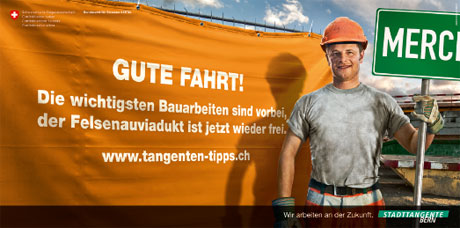
Almost everyone is familiar with this construction site: Bern's city bypass has been undergoing complete renovation since 2008. Tips and tricks on how to avoid traffic jams during this long period were communicated extensively and proactively by the Federal Roads Office Astra via a wide variety of channels. The Erdmannpeisker advertisers, among others, also contributed greatly to this success.

There is no escape. Every day, around 100,000 cars have to be channeled through the bottleneck. The Bern city bypass channels traffic from the A1, A6 and A12 freeways. It is therefore a major artery not only in the Swiss transport network, but also for the many commuters in the catchment area between Bern and Fribourg. Barbara Egger-Jenzer, member of the Bernese government, aptly described the renovation as "open-heart surgery". After 30 years, the renovation work was urgently needed.

With the start of the main work, which lasted from February 2010 to November 2011, only two of the three lanes were available between Neufeld and Wankdorf in the direction of Zurich from March to November. "That was one of the main challenges," explains David Wetter. The head of the Thun branch of the Federal Roads Office Astra was responsible for coordinating the construction work with a budget of 485 million with his team. Communication was also an important task. A comprehensive package of measures was put together together with a joint office for mobility management, the in-house communications department and Erdmannpeisker. The aim of the campaign was to keep traffic jams to a minimum and avoid traffic on the regional road network as far as possible. To achieve this, road users were informed about the current traffic situation and the campaign tried to convince them "that staying on the highway is the best and quickest solution".

tangente

One success factor for the communication surrounding the major construction site was the close and cross-industry cooperation, explain branch manager David Wetter from the Federal Roads Office Astra and CD Gabriel Peisker from the advertising agency Erdmannpeisker.

WW: What was the task?
David Wetter: The major construction site in Bern was communicated comprehensively and proactively by the Federal Roads Office Astra via a wide variety of channels. Together with an office consortium for mobility management and the Erdmannpeisker advertising agency, our in-house Information & Communication department put together a bouquet of measures. One of our main objectives, for example, was to inform over 100,000 drivers a day about the current traffic situation and to convince them that "staying on the highway is the best and quickest solution". 

What was the biggest challenge?
Weather: Our main problem was that we had to close one lane on the A1 near the Felsenau viaduct in the direction of Zurich, which massively reduced capacity at rush hour. There was a great temptation for people to look for a shortcut. Communication had to avoid this. We were able to achieve this by communicating convincingly, offensively and honestly: "Attention, we have this under control. Please don't go into the city. Don't look for shortcuts in the region either, stay on the highway." Taking shortcuts would have meant chaos not only for those driving through, but also for the city of Bern and the region. 

How was the success?
Weather: We did it. We were able to show our "customers" what we do for their safety. People followed our tips. We never had a major traffic jam. Except for the occasional accident. But that was due to force majeure. Another nice side effect of the whole campaign is that we were able to work closely with the canton of Berne and the city to contribute to the shift from private transport to public transport. We were able to make the affected residents and businesses in the vicinity of the construction site aware of what other forms of mobility are available. 

How did you communicate this?
Weather: Our means of communication were posters and regular advertisements in the Berner Zeitung and the Bund as well as in local newspapers. We also placed a large number of radio spots on both of Bern's local radio stations. We were lucky that the majority of the 100,000 vehicles that use this section of road every day come from the Bern region. 

What did you expect to gain from involving an advertising agency?
Wetter: The decisive factor was the thought: How can we get this huge amount of information to our customers in the most effective way? We soon realized that we needed a different vehicle than just conventional communication. We need to build communication on several pillars so that we can get the information close enough to the target audience. We held a two-stage competition. This led to a pitch three years ago, which Erdmannpeisker won. 

How did Erdmannpeisker approach this task?
Gabriel Peisker: It was a first for us. It wasn't just that we had to fill in a budget according to the SIA standard. Architects and engineers have completely different calculation bases. We didn't need concrete for this campaign, and the weight of an idea is difficult to measure. But the whole direction of communication was also new. Everyone has been stuck in a traffic jam at some point and knows: It's a nuisance that we have to communicate here. In other words, the opposite of most advertisements, which usually promote something positive. Of course you can say that the construction site is necessary and that it's better for everyone, but somewhere along the line we quickly realized that this was too thin and also a bit banal. At that moment, we were glad to have mobility management. These specialists gave us a lot of food for thought about what we could communicate positively. Building on these positive aspects, we looked for a communicative umbrella. 

Their ambassador is called "Chrigu the hammer".
Peisker: "Chrigu the hammer" in the print ad is a real construction worker. The photo shoot was definitely more difficult work for him than his job on the building site, and the shoot wasn't quite as easy for us as it would have been with a professional model. But we think it was worth it, because "Chrigu" comes across as a very authentic symbolic figure and is absolutely credible for the problems we have to communicate. We also wanted communication that was very close to Astra. We knew that even if we ended up with a pretty funny realization, it had to match the tonality of Astra. So we came up with the idea of communicating from the heart of the construction site - even if everyone knows that this is a fiction.

You have to address a wide variety of people: How do you find a common language?
Peisker: Our approach was: if we have such a construction worker, then he has his own characteristic language in which he says what's going on in no uncertain terms. Rhymes such as "Just be clever, avoid the traffic jam" are deliberately not highly eloquent, but rather taken from the mouths of the people. And since Adolf Ogi at the latest, we know that you can come across as very likeable and reach a large audience. 

Poetry slam is the language of the young.
Peisker: Slamming is a young art that sometimes involves quite crazy word acrobatics. But in Patrick Savolainen, we have found a Bernese slammer who has really got to grips with this Chrigu. His Chrigu creates the art of telling sometimes almost philosophical architectural stories in very simple words and speech rhythms. This verbal acrobatics is striking on the radio, and we took advantage of this for the radio spots. Wetter: We had to make the most of the budget, and radio was a good solution. We were able to reach our target audience very well with the medium of radio. Erdmannpeisker realized spots that were also placed before large concerts, for example at AC/DC, where we expected a large volume of traffic. 

The commercials have addressed the individual situations?
Peisker: One of the most important elements was the weekly review. Our slammer presented a weekly review every Friday at 5 pm for two years. It was broadcast on both local radio stations in Bern and repeated several times. As "Chrigu the hammer", he slammed what had happened on the construction site and philosophized about the current situation. Astra provided him with input and topics, and he was then completely free to choose the form of the texts. Wetter: We always tried to pack specific messages into the commercials. For example, the speed reduction from 80 km/h to 60 km/h. There are also studies that have proven that you can actually get through the roadworks faster and, above all, more safely at 60. Such messages were packaged in a slam and broadcast over the airwaves at attractive times. 

This was no longer recorded as advertising, but as a program?
Peisker: That's always the idea of a cooperation. You pay something, but you get a multiple of the advertising time - if you're good. 

What other media have you worked with?
Weather: One of the main media was the poster. However, these were not allowed to be hung along the highway. There are strict safety regulations. You have to keep a very low profile to the left and right of the highway because of the risk of distraction. Peisker: It makes sense. So we put up the posters on the back of buses. We also placed advertisements in all relevant publications. We distributed a flyer that communicated the best times to drive away from the critical phases of a traffic jam. 

What role did factory traffic play?
Wetter: We have succeeded in drawing the companies' attention to the fact that they should adjust their transportation and logistics to construction site times. This means not transporting goods between half past six and nine o'clock, when there is the greatest pressure on the construction sites, but when we don't expect any traffic jams. 

How did you know that?
Wetter: We had an analysis with traffic simulations carried out in advance.

What role did editorial messages play in the media?
Wetter: It was a good collaboration with the media. We needed them effectively and they needed us too - a classic win-win situation. Immediately before construction began, we invited all the media to a "point de presse": Certain media then ordered a helicopter to film how dramatic the traffic jam would be. The media were looking for the attractiveness of the construction site and were also hoping for a story with a headline. But there was never a "traffic jam all the way to Zurich". Our predictions came true. 

How was the problem made attractive to the media?
Wetter: Our question was: what media can we use and how do we have to use them? The radio stations also followed the project with great interest and commitment. The editorial offices received the latest traffic reports from us. The Bern city bypass is also a very attractive construction site, which is how we sold it. It was a renovation in conjunction with the construction of a number of new bridges. These were built outside the national highway and then slid into place. A bridge was slid into place on the A1 while traffic was moving. It was a spectacle that naturally provided the media with the best possible coverage. But it was not only interesting for the media, but also for local residents. 

Have you organized events?
Wetter: We have organized various PR campaigns. For example, a joint barbecue with the affected residents, as the construction site caused a lot of noise. We were able to explain the necessity of the construction work very well in dialog with those affected. 

What role did public relations play?
Wetter: There was close cooperation between the parties involved - the City of Bern, the Canton of Bern and Astra. We also coordinated this communication together. We held joint press conferences. Always with the government councillor, the city's building director and us. We also communicated the public transport solutions here. The canton of Bern sponsored multi-ride tickets for public transport. 

Other accompanying actions?
Peisker: We distributed thousands of chewing gums - so-called "traffic jam gums". The message here was: "The taste lasts longer than the traffic jam." And the great thing is: Astra was able to keep this promise and saved us from a crude advertising lie. 

Interview: Andreas Panzeri

tangente2
Since 2008, the Federal Roads Office Astra has been responsible for the
The Federal Roads Office is responsible for the development and maintenance of the motorways. It
has five branches. For the Thun branch, the
Bern city bypass the first major construction site. Branch manager
David Wetter is a civil engineer and business economist.
Gabriel Peisker (r.) is CD at the Biel advertising agency
Erdmannpeisker.


Ron Orp: Cedrick Wolf is the new Head of Sales

Cedrick Wolf has been the new Head of Sales at Ron Orp since March 1, 2012. Previously, he worked at 20 Minuten Online as Key Account Manager for Online & Crossmedia.

According to the press release, Cedrick Wolf has several years of experience in strategic media planning and online marketing. Together with Katja Schuler, who has been part of Ron Orp's sales team since 2010, they will expand their expertise in the conception, planning and realization of holistic online campaigns.

There are now 18 people working for Ron Orp in German-speaking Switzerland. Ron Orp's Mail is published in 15 cities in Switzerland, Germany, Austria, England, the USA and Brazil and sends out over 150,000 newsletters a day.
 

WVC: Cross-media B2B campaign for Axel Springer Switzerland

WVC is now working for Axel Springer Switzerland’s Beobachter, Tele & TV-Star divisions, which publish the magazines *Beobachter*, *Beobachter Extra*, and *Beobachter Natur*, as well as the TV magazines *Tele*, *TV-Star*, *TV2*, and *TV vier*.

The "Outlook 2012" campaign promotes media agencies and marketing and communications departments to place ads in the print and online editions of the TV magazines Tele and TV-Star. WVC realized the campaign cross-medially. On the one hand, a classic mailing was used to draw attention to the various TV highlights of the year. Microsite with iPad raffle. In addition, web banners are placed on various specialist portals.

Responsible at Axel Springer: Sandra Peiti (Head of Advertising Market Observer, Tele & TV Star), Katrin Rüesch (Product Manager Advertising Market Observer, Tele & TV Star).Responsible at WVC: Kurt Wettstein (overall responsibility), Stefan Fleischlin (graphics), Michael Jud (consulting, online communication.

ausblick

Flop of the week

Ant Commercial Temporarily Taken Off the Air

Switzerland Tourism has temporarily removed the ant advertisement featuring Martin Horat from its platform on the advice of the Federal Office for the Environment (FOEN). An animal rights activist had filed a complaint for disturbing the ants. Martin Horat finds this "a joke". He does not understand the measure, said the Muotathal weather prophet on Wednesday at the request of the SDA. The animal rights activists were going too far. "Then you wouldn't be allowed to drive ants out of the house either," said Horat. He has been making forecasts on anthills for a few years now. Back in 2004, Horat sat on an anthill for the filming of "Wetterschmöcker". "The animals are happy when I come." They were very affectionate and climbed up him. The clip was no longer available in the meantime. As reported by the Aargauer Zeitung and Südostschweiz newspapers on Wednesday, Switzerland Tourism took the commercial showing Horat sitting on an anthill off the internet at the FOEN's request. The reason for this was a complaint from a concerned animal rights activist. 

Tanner: On an adventure tour with Max

The Basel-based agency Tanner Communications is accompanying Max, the Lusso lion, on his tour across Switzerland for the second time.

This year, the Adventure Tour will once again go on a voyage of discovery at over 30 locations and is designed to delight children aged six to twelve with attractions and games. The tour is accompanied and announced by cross-media tools such as a specially created online platform Max-adventures.chTV series and TV commercials, classic PR and advertisements, comic sampling and inserts in comic magazines.

Responsible at Unilever Switzerland: Andreas Messerli (Brand Manager Trade Ice Cream), Nicola Pingel (Brand Management Trade Assistant Lusso). Responsible at Tanner Communications: Erich Rava (Branch Manager/Account Director), Mike Neuhaus (Managing Director).
 

Impaled: The sixth power

Deputy Editor-in-Chief Andreas Panzeri on satire, real-life satire, and the media.

The punch line is spot on: "After the sponsor jumps ship - only cheap gags". This was the headline Blick online used this week to take the show "Giacobbo/ Müller" to task. The criticism was prompted by the fact that the popular public success "Late Service public" lost its sponsor in November. Mobiliar, whose "Schadenskizzen" (damage sketches) have provided an already amusing lead-in to Fröilein Da Capo since 2008, plans to invest its estimated CHF 200,000 in a new adventure format "Homerun" in future. This will be broadcast on Sat 1 Switzerland. And thus on a Ringier media product. MobiJeunes" is to be promoted there to a younger target group. This makes perfect sense in terms of media strategy. Nevertheless, the beneficiary Ringier apparently wanted to get a little more out of the deal and make the entire program of the competition the victim of a damage sketch.

"Giacobbo/Müller have no more money for good punchlines because of this loss of sponsorship." In fact, Blick itself has put a funny joke on air with this calculation. However, the onliner does little to convince. Not only because the punchline writers at SRF earn very little. The satire editorial team is nevertheless bombarded with a barrage of advertising copywriters who are desperate to be creative for the "Giacobbo/Müller" show. Of course, the Blick writer knows this too. And perhaps he wanted to apply for the job himself with his punchline "only (still) cheap gags".

However, it could also be interpreted more maliciously: A new campaign is being launched here. Blick.ch has also called on its readers to submit ideas for better satire to accompany the article. A few twitters have already been incorporated into the criticism as discussion starters. "Long-winded and boring", says one user. On the other hand, Frank Baumann still thinks the show is good, even though he "hasn't tuned in for a while". It doesn't matter when it comes to forming an opinion, the main thing is that you have something to say. And that is perhaps the crucial point of this column. People want to have something to say! In the past, the legislature was considered the first power in the state. The second was the executive. For years, newspapers were counted as the third power.

This assessment has become increasingly diluted with the progressive fragmentation of the media. Facebook and Twitter have joined the fray and social media must now be described as an increasingly powerful fourth force. Satire would then be the fifth. But the boundaries are blurred. Günther Jauch talks to his guests on ARD from a dome that is much larger than its architectural model in the Bundestag. Politics is not yet done at Jauch. In this program, however, it receives the consecration of broad acceptance. Of course, the Bild newspaper had to show once again who is the master of the state. Wulff was probably right to leave. But it wasn't the politicians who caused it. And who is in charge in Switzerland is also decided in a medium - the number 1 - with the program "Roger gegen Roger". And this format shows: As a sixth power in the state that should not be underestimated, real satire will increasingly come into play in the current development of the media. 

Ideas workshop brings marketers on board

The production company b&b endemol is establishing a new line of business by increasingly developing formats for online and mobile platforms in addition to its traditional broadcast formats. To strengthen its efforts, the company is partnering with the online specialist mediaBROS.

If you soon see people playing golf in the middle of the city - not holding a club, but an iPhone - it is probably the digital professionals at b&b endemol who are responsible. The company is known for TV entertainment formats such as the game shows "1 against 100", "The Millionaire Trap" and the quiz show "Who Wants to Be a Millionaire". However, as the media changes, the Zurich-based production company is increasingly focusing on new formats - the strategic direction is shifting towards the internet and applications. "I am convinced that we will still be producing TV formats in ten years' time," says Christoph Bürge, Managing Director of b&b endemol. "But we also want to position ourselves on other platforms in order to offer customers electronic content there."

The company demonstrated its expertise in the digital sector back in 2008 when it produced the "M-Cooking" cooking platform for Migros, which was online until the reorganization of marketing in 2009. In weekly video clips, chefs explained in the three national languages how to prepare a three-course meal. The whole thing was designed to be interactive: Inexperienced cooks could click into the video to get additional information - for example, instructions on how to blanch a tomato. Users were also able to put together their own menu, download it as a podcast and print out the corresponding shopping list.

To further strengthen this branch of the company, b&b endemol finally founded its own digital media department at the beginning of 2011. Since then, the b&b endemol digital team has been developing communication and marketing formats for the mobile, social media and web channels under the leadership of Yves Jordi.

In order to find the right customers for its ideas and projects, the Digital Unit has now entered into a strategic collaboration with mediaBROS, an online marketing agency that The production company b&b endemol is building a new foothold by increasingly developing formats for the online and mobile sector in addition to broadcasting formats. To strengthen its position, the company is teaming up with online specialist mediaBROS. Top 2 9 specializes in online remarketing. While b&b endemol digital concentrates on creative and implementation services, the online specialists at mediaBROS take care of marketing. "b&b endemol is a creative workshop that is constantly producing new ideas. In future, we will look at these together and analyze which ideas could be marketable or interesting from the point of view of advertising sponsors or clients," comments Ivano Celia, Managing Director of mediaBROS, on the collaboration.

Apps that inform and entertain
And there are various projects in the pipeline for mediaBROS. One of these is the "City Golf" application mentioned at the beginning, which is to be realized for a customer in the course of this year. "City Golf" is an app that allows you to get to know cities and regions in a fun way. As with conventional golf, the aim here is to hit a ball from a tee-off point into the hole in as few strokes as possible. The player uses the iPhone to go to a specific point for the first tee shot, from where he virtually hits the golf ball towards the first hole in order to reach the next hole. Even though the focus is on playing golf, the app wants more: "It's a very playful way of providing information," says Jordi, commenting on the application. The holes are distributed around places of interest, allowing the player to get to know the area and learn interesting facts and information about the region.

As in the TV sector, b&b endemol also want to tell people stories with their new developments and offer an emotional experience. "People want to be entertained," says Bürge, who was Head of Entertainment at ProSiebenSat.1 before joining b&b endemol. "Not just with games, but also with service apps." Celia agrees: "Entertainment is the supreme discipline." An app should create added value and still be used a month later. There are also a lot of apps that are very creative but are only used by a few people. This is precisely where Celia, who worked with Bürge at TV3, sees the strength of b&b endemol. Thanks to its national and international experience in the broadcasting sector, the production company has the expertise to produce mass-market content.

The "beer idea", an interactive campaign that the digital specialists came up with to offer beverage brands an eye-catching and funny presentation, also ties in with this. Users are provided with a large number of video clips on the subject of beer, which they can string together into a commercial according to their personal preferences and set to music using a simple audio mixer. "We want to draw people's attention to the brand," explains Bürge. "But not in a 30-second spot, a hinge advertisement, but on other platforms." With "Bieridee", users create quirky, funny and unique video spots, which they then post online. On Facebook, YouTube and other social media platforms, the internet community can talk about the campaign and rate each other's videos.

With content like this, b&b endemol is making inroads into the field of digital branding: Brands are brought to life. "I hardly ever create images on Google," says Celia. "As a rule, people only search on Google for what they already know." Entertaining digital content, on the other hand, is a great way to create an image. And he is convinced that this will increasingly be the case in the future.

Isabel Imper

More information on this website: Mediabros.ch/branding.
 

endemol

b&b endemol was founded in 1990 under the name B&B Medien by Hannes Bichsel, then Head of Entertainment at Swiss Television, and Zurich catering professional and event manager Freddy Burger. In 2000, B&B Medien entered into a 50:50 joint venture with the globally active Dutch TV group Endemol. This is how b&b endemol came into being. The core business is the development and production of TV content in the fields of entertainment and infotainment. It produces content and formats from the Endemol catalog (e.g. "Wer Wird Millionär", "1 gegen 100") as well as those specifically tailored to the Swiss market ("Üsi Badi").

Founded in 2009 and based in Dübendorf, the online marketing agency mediaBROS offers integrated solutions in online communication, media planning, digital branding, online performance marketing, SEM (search engine marketing) as well as online-specific workshops and seminars. Under the name "yoondo", the agency provides a network for campaign retargeting and website retargeting. Anyone who places advertisements via this program (e.g. on NZZ, Blick, 20min, Tagesanzeiger etc.) can target users who have previously visited certain websites.
 

Euro RSCG Zurich: Fischer`s Archive reports about One Young World

On 16 pages, the current issue of Fischer's Archive reports on One Young World and all the communication measures that Euro RSCG Zurich launched last year in connection with the event.

In addition to traditional communication, event design, PR and direct marketing measures, Fischer's archive particularly highlights the "Time Change Mind Change" social media campaign. In an interview, Frank Bodin also explains how he came to organize such an event for the whole world and what it means to him.

> Euro RSCG Zurich presents One Young World 2011

City of Lucerne: Employees are allowed to surf Facebook again

Effective immediately, employees of the Lucerne city administration can once again access Twitter, Facebook, and YouTube. The city has lifted its internal ban on social media services. It explained that communication via social media is becoming increasingly important.

The City of Lucerne has been present on social media since April 2011. It gained experience with the new communication channels via Twitter, Facebook, YouTube and, to a lesser extent, Google+ as part of a pilot project.

Because the pilot project was so successful, the City Council has now decided to complete the trial and make social media a permanent part of its communication strategy. At the same time, it decided to put social media on an equal footing with other Internet offerings for employees with immediate effect. As with the telephone, the managers of the City of Lucerne want to ensure that the private use of social media during working hours is kept to a minimum with the help of a controlling system.

The cost of managing the new communication channels amounts to around 20 percent of the workforce. It can be realized without increasing the number of employees, as the workload can be distributed among several people, it is said. (SDA)


get_footer();