Creative Ranking 2012

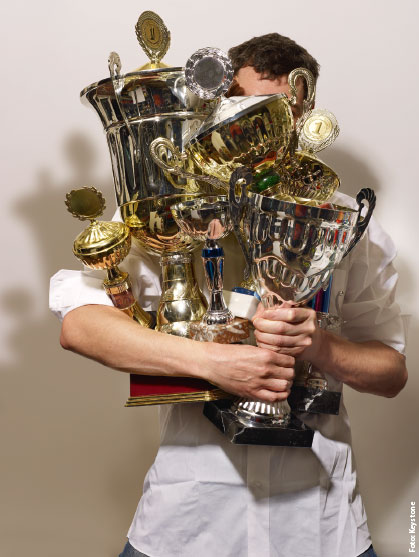
Together with a high-profile delegation from BSW and ADC, *Werbewoche* has agreed on a list for the 2012 Creative Ranking.

(in parentheses the respective weighting factor)

Cannes (5)
Clio (5)
D&AD (5)
One Show (5)
The Cup (5)
ADC*E (4)
Eurobest (3)
ADC Switzerland (3),
Effie (2)

From the awards below, each agency can select two for themselves to also count towards the ranking:

Epica (1)
London International Award (1)
The flap (1)
Spotlight Festival (1)
Swiss Poster Award (1)
Edi (1)
DM Award (1)
Crossmedia Award (1)
Best of Swiss Web (1)

In addition, it was decided that only the highest award given applies if a campaign has won several awards (for several individual subjects) in the same jury category of a competition. Awards for multiple individual subjects in the same campaign and category count as one award. Awards for special prizes such as Clio Healthcare or other sub-competitions do not count towards the ranking.

krea

ONZ ceases operations

The ONZ Obwalden and Nidwalden Zeitung will be published on Friday, March 2, 2012, for the last time as a print edition; after that, the online channels will also be shut down.

The Board of Directors of ONZ Obwalden und Nidwalden Zeitung AG has decided to close the company for economic reasons and to initiate an orderly liquidation, according to a press release issued on Thursday. The 17 employees of ONZ were given notice at the end of February, whereby all contractual obligations will be fulfilled. The employees were informed of this decision by the Board of Directors on Wednesday morning, having already been informed of the company's financial situation in the weeks beforehand.

The closure has become necessary because the commercial development of the newspaper has taken longer than originally anticipated, the statement continues. Although expenditure had always remained within budget, advertising revenue and income from subscriptions had fallen well short of expectations, meaning that ONZ Obwalden und Nidwalden Zeitung AG was facing over-indebtedness. In order to be able to meet all its obligations, the Board of Directors has therefore decided to liquidate ONZ Obwalden und Nidwalden Zeitung AG in an orderly manner. This liquidation would enable the company to meet its obligations to employees, business partners and customers. Subscribers to ONZ would also have the opportunity to request a refund for services not provided in full.

No trend reversal despite numerous measures

The last printed edition of ONZ will be published on Friday, March 2, 2012, after which the online channels will also be switched off. More than 400 ONZ shareholders bought shares worth CHF 3 million within a few weeks at the beginning of 2010 and made the launch of ONZ possible in the first place. The liquidation of the company means that all contributions made will be lost. The fact that the share capital will be exhausted after two years was already stated in the 2010 subscription prospectus. ONZ Obwalden und Nidwalden Zeitung AG will convene an Extraordinary General Meeting at short notice, at which the Board of Directors will propose the dissolution and liquidation of the company.

As there have been no signs of a positive trend reversal on the revenue side despite numerous measures in the areas of marketing, pricing, advertising and personnel, the Board of Directors no longer considers it expedient to continue investing in ONZ, the company said. The Board of Directors deeply regrets that it has not been possible to establish ONZ Obwalden und Nidwalden Zeitung as a long-term journalistic voice and to generate profits for its shareholders with the company.

A publicity success, economic goals not achieved

In journalistic terms, the newspaper has been a success, it continues. In the almost two years of its existence, ONZ has developed into a highly respected voice that has achieved a high level of recognition in Obwalden and Nidwalden and beyond. The newspaper had more than 3,000 subscribers, who followed the reporting twice a week in the printed edition. In addition, ONZ reached more than 30,000 online users every month who used the various channels to find out about what was happening in the two original cantons.

Economically, ONZ was unable to achieve its goals from the outset. According to the business plan, the aim was to gain around 4,000 subscribers in the first financial year and to increase this figure to 8,000 by the third financial year. However, the number of subscribers leveled off at 3,000. Income from advertising was always around a third below expectations. The figures for the Jungfrau Zeitung in the Bernese Oberland, which is published according to the same concept, were used as a benchmark.

Advertising customers had been very hesitant to commit to ONZ right from the start, and the very active sales team had repeatedly been put off placing advertisements until a later date. Obviously, ONZ Obwalden und Nidwalden Zeitung had not succeeded in building up sufficient trust in the market to be able to significantly increase advertising revenues. This was despite the fact that the quality of the product had never been questioned by potential advertisers. In addition, the competition had also reacted well and quickly in the commercial sector, which had made it even more difficult for ONZ to establish itself in the market.


The down-to-earth cosmopolitan

After many years in Zurich and the USA, Ralf Kostgeld has returned to his hometown. Since the end of 2011, the long-time Creative Director of Publicis has been at Ammarkt in St. Gallen. What led the creative, whose work has won over 180 national and international awards, to the strategy agency?

kostgeld

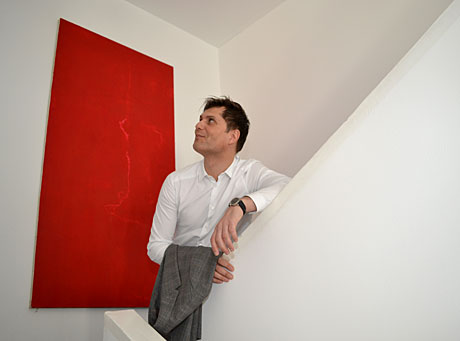
Wearing a white shirt and dark blue jeans, Ralf Kostgeld sits at the meeting table located in the entrance area of the multi-story agency premises in a concrete building near the municipal theater. Although he will often talk about the proximity to his hometown in the course of the next hour, about the feeling of returning to his roots, Kostgeld emphasizes that the location was not a decisive factor for the change to Ammarkt.

After more than a year and a half as a freelancer, Kostgeld wanted to work again in an agency with a larger team. Why did the creative director choose Ammarkt, an agency known for its focus on strategy? "Sure, the normal case would have been to go to a creative agency," says Kostgeld, who looked after major clients like Migros at Publicis. Why not something different, he asked himself. He was interested in the Ammarkt agency, which had won 19 of 21 pitches in recent years, and wanted to know what made it successful. As exciting as he found the focus on strategy, he saw the potential in combining the strategic with compelling creative. This could lead to an interesting partnership, both he and Ammarkt were convinced. Ultimately, St. Gallen's Creative Director brought him on board.

The fact that Kostgeld did not choose the obvious path to a creative agency is characteristic of him. The creative likes to move in marginal areas, as he says himself, wanting to break out when he feels restricted. Already in school, he found it disturbing to have to write an essay according to a predefined procedure. "I wanted to create something new, to use my creativity." When he attended the preliminary course at what was then the School of Applied Arts in St. Gallen, he liked being able to develop freely, and he knew this would become his career. He decided to take the specialist class for graphic arts. Trying things out fascinated him. However, there were too many restrictions for him there, too: "They were very strict." Dogmatic. The Univers typeface was highly praised. Everything was very close to the Bauhaus and the Ulmer School. Kostgeld wanted more, however, and looked away from international and national work. He liked Jean-Etienne Aebi's "Toni in a jar" ad, and knew, "Actually, this has to be it."

After completing his specialist class, Kostgeld moved to Zurich, where he first worked for a smaller agency and later for the international agency network McCann Erickson. His plans to work for McCann abroad also proved difficult. First he had to earn his spurs, he was told. That took him too long. Thanks to a trainee exchange program, he received a visa and a work permit for two years in the U.S., where he first worked as a freelancer, then did advertising and corporate design as an art director at Levinson & Associates in San Francisco, and in the meantime continued his education in languages and film and multimedia. In the process, he realized that focusing on art direction was the right thing to do. He enjoys directing, loves to develop ideas.

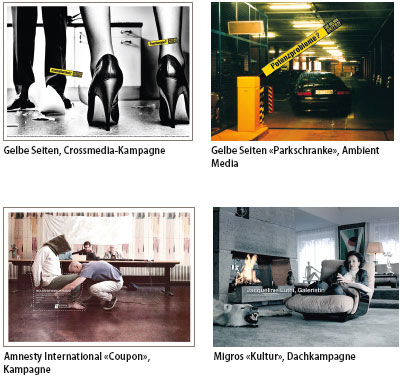
When he was finally approached by Levinson & Associates to join the agency, he was faced with the decision to definitely establish a new existence in the US. "I had a great time in the USA." But he missed Switzerland, his girlfriend at the time and the cultural diversity of Europe. In 1996, he decided to return. Through Claude Martin, then Creative Director of Publicis, he reached the large agency, where he was able to live out his passion for film, cross-media and corporate design in various works. Under the claim "Deeper than you think," he launched a broad-based communications offensive with spots, ads, posters, including guerrilla campaigns with stickers and giveaways to correct Swisscom's high-price image. In a TV commercial, he had Boris Yeltsin and Bill Clinton advertise for the Yellow Pages as an entertainment duo with translation difficulties. And in 2007, a viral campaign he co-developed for Chocolat Frey caused a stir. It began with a video clip of a young couple who claimed to have spotted a unicorn in Val Cama in Ticino. The video spread abruptly on the Internet and was picked up by the media until the advertisers finally revealed the fairy tale to be a campaign. Again and again, Kostgeld ventured into new fields, for example into the topic of "branded entertainment" together with Jean-Etienne Aebi and a team at Publicis that was outstanding for him, when 6-minute blocks were booked for Migros on Swiss television in 2008 for the European soccer championships in order to entertain viewers there with the "fan championships" under the retailer's brand.

There was a caesura in 2009, when the Kunsthaus Zürich asked Topkreative to realize their vision of "100 years of the Kunsthaus" on the occasion of its anniversary. When Kostgeld was awarded the contract, it was the right moment to go independent. "After many years at a large agency, it was balm for the soul to have time for my own projects again," says the creative. "I had a great time at Publicis, great clients." The Kunsthaus project, however, gave him the opportunity to turn inward, work more freely and direct his own films. Working on his film "Chez toi" fulfilled him - personally, too. And although he was attracted to pursuing this line of work further, he felt more at home as a creative director in advertising, the "applied arts." However, Kostgeld likes to incorporate currents from the field of art into communications, as he already showed at Ammarkt in the Alcacyl ad with the steaming cooking pots. Instead of relying on computer animation, he had a Canadian artist paint the feverish faces on the pots with oil.

Kostgeld also wants to expand on his hobbyhorse of film at Ammarkt in the future. And not just in TV commercials. "I think it's a highly exciting time right now," he enthuses. Today, he says, so much is possible: in the online sector, with cross-media or viral campaigns. Just show a teaser as a TV spot and implement the rest online. Or making corporate films where it's no longer clear whether it's a long commercial, a visionary short film or a corporate film.

A good idea or great story alone isn't enough, according to Kostgeld, who is a member of the Art Directors Club and works to improve advertising. "Clients don't want something that's just super creative but doesn't get the job done." Even at Publicis, he found it exciting to advertise for big clients, while other creatives chose clients that were easier to win awards with. "If you're never able to do good work for a big firm that's creative but also works in the marketplace, you've done something wrong." Kostgeld succeeded in this balancing act, for example, with the more than 10-year cross-media campaign for the Yellow Pages, which was both commercially successful and won more than 50 awards internationally.

Bridging the gap between creation, strategy and profitability is now his goal at Ammarkt. Here he feels the proximity to the University of St. Gallen (HSG), to clients and business. CEO Michael Schmid and Heinz Frischknecht (VRP), who founded the agency, also studied at the HSG. HSG marketing professor Torsten Tomczak also sits on the agency's board of directors and occasionally joins in on projects. Ammarkt also attaches great importance to incorporating research findings into its work. While consulting and strategy take a strongly entrepreneurial view, Kostgeld makes sure that customer benefits are implemented in an interesting, creative way. He also wants to raise awareness of what it takes to win a creative award or an Effie. Showing that successful advertising can only come about through good teamwork is just as important to him.

With Kostgeld, not only strategy and creativity come together at Ammarkt, but also down-to-earthness and a cosmopolitan background - two things that are united in himself not only because of the stays abroad. His father, a native of Germany, took Austrian and later Swiss citizenship. His mother is originally Tyrolean. From there, he says, there's a combination of different things inside him: "A mixture ofährschaft and cosmopolitan." Kostgeld has not completely returned to St. Gallen. He still lives in Schlieren near Zurich with his partner. In an emergency - should it take longer - he can fall back on his children's room with his parents in St. Gallen Rosenberg.

Nevertheless, he has a lot to do in Zurich. Individual clients, but above all producers with whom Ammarkt works, are based in the city on the Limmat. And even if the focus is on eastern Switzerland, Ammarkt does not see itself as a purely eastern Swiss agency that exclusively serves local clients. In advertising, much of the focus is on Zurich. Kostgeld's idea is to build up something with the Ammarkt team that carries weight throughout Switzerland. For the future, he would also like to have one or two international mandates.

Kostgeld would also consider the city of St. Gallen itself as a customer, which he feels is seen as being worthy, close to the economy, but not quite as innovative. "I would like St. Gallen to be perceived a little differently." After all, the city in eastern Switzerland offers a lot of interesting things. With the Lokremise, an extraordinary cultural center has been created next to the train station in the former Ringdepot. Companies such as the Akris fashion label, Jakob Schlaepfer textiles, and the HSG are internationally known. Perhaps the city needs to be provoked, tickled, from time to time, he says. "Eastern Switzerland could quietly bring its innovations a little more to the outside world."

Isabel Imper

kostgeld2

Ammarkt
The full-service agency for strategy, marketing and advertising has been independent and owner-managed for over 13 years. It was founded by Heinz Frischknecht (VRP) and Michael Schmid (CEO), who today forms the management team with Marcel Odermatt (CEO), Ralf Kostgeld (CD) and Lucia Burtscher (senior consultant). 32 specialists from classic advertising to social media use their know-how for their customers. With the result that 19 of 21 pitches were won against a total of 54 agencies.

Best of Swiss Web 2012: new record number of participants and serious craftsmanship

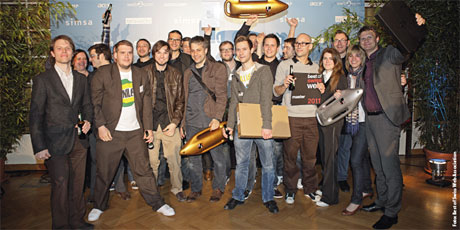
The Swiss web scene is more vibrant than ever. This is evident from the new attendance record set at Best of Swiss Web 2012. While the technical quality was impressive, true standout entries were few and far between. The jury has reached its decision, and the Master candidates have been selected.

With over 400 entries, participation in Best of Swiss Web reached a record high this year. This is a good quarter more than last year and the work of the 84 jury members was correspondingly time-consuming and intensive. At the jury day on February 8, Claudio Dionisio, President of Best of Swiss Web, was delighted with the high level of participation: "The new record number of participants shows the dynamism in the web and mobile market." At the same time, however, he also sees a certain need for action: "The large increase in the mobile and social media sector is not entirely surprising - but it should lead to one or two new categories next year." 

The nine fixed categories varied in popularity among the applicants. The most projects were entered in the Creation (79) and Digital Branding Campaigns (69) categories. The categories Public Affairs (20) and Business Efficiency (28) received the fewest entries. There is a special category again this year: "Silver Surfer: Ctrl, Alt, Delete?" recognizes projects designed for people who were not born with a smartphone. 

68 entries made it onto the shortlist. Although this is only 2 fewer than last year, the ratio of the number of entries to shortlist places has shrunk significantly. While almost 23 percent of all entries made it onto the shortlist in 2011, this year it was just over 17 percent. Does this mean that the judging process was stricter this year, or were the projects less good? If you look at The Swiss web scene is more vibrant than ever before. This can be seen from the new record number of participants in Best of Swiss Web 2012, but the level of craftsmanship was also impressive - the real hits, on the other hand, were few and far between. The jury has made its decision, and the master candidates have been determined. We heard from various quarters that the average quality was quite good. A lot of serious work had been done. The technical quality in particular had now reached a respectable level. However, the proportion of truly outstanding projects - and only those that make it onto the shortlist - is significantly lower than in other years. Daniel Liebhart, one of the gray eminences on the jury, put it this way: "2012 is a year of integration. We had many technically sound projects, but only a few were red hot." 

Less from the "big ones" 

If you draw the circle even tighter and look at the list of master nominees (see PDF), it is noticeable that the dominance of large organizations has decreased somewhat. Last year, this top group was almost entirely made up of large companies or institutions. The role of Migros was striking: it provided no fewer than five of the twelve candidates and was therefore the big pike in the carp pond. 

This year's candidates for the Master's degree are much more heterogeneous in their origins. There are once again three entries from Migros, if you include Ex Libris and its subsidiary Bischofszell Nahrungsmittel AG. Swiss Television and SBB can also be counted among the big names. In addition, the young and wild of the youth channel Joiz also managed to secure a place, as did the road traffic organization Road Cross and Mountain Vision AG with its app for Laax/Flims. What is missing from this year's Master candidates, however, is a pure B2B project. 

Year of tourism? 

It is particularly refreshing that a project like "Holidays without the Internet" by Switzerland Tourism has managed to smuggle itself into the famous dozen. It picks up on the clichés and absurdities of the Web 2.0 hype and is aimed directly at online junkies in the form of an innovative social media campaign. Speaking of tourism: if you absolutely had to have a motto for this year's master nominees, then you could call it the year of tourism. With "Ferien ohne Internet ", Laax & Flims Mobile, Einbündnerung and My Switzerland, four tourism offers have secured starting places for the Master. And with a lot of good will, you could also add the new SBB website to the list. It should also be noted that interactivity on the web continues to grow, the mobile Internet is sprouting up rapidly and gamification is also making headway. 

Something else stood out: Compared to previous years, a remarkable number of traditional advertising agencies were able to come up with interesting projects. This also surprised Claudio Dionisio, who admits that he no longer gave these relics of the old media and communications world much of a chance. "But today, some of them are surprisingly fit in the online world - really agile." 

René Mosbacher 

swissweb
The winner of Best of Swiss Web 2011: Migipedia - on the right with the
Master buoy the then online head of Migros Leila Summa. 


Net-Metrix: Browser landscape becomes increasingly mobile

A year-on-year comparison for January 2012 shows striking shifts in the browser landscape: The share of mobile browsers continues to grow unabated, but Internet Explorer remains the undisputed leader in Switzerland.

Comparing the browser shares of January 2012 and January 2011, the growth of Android and the decline of the protagonists Internet Explorer and Firefox are particularly striking: 3.5 percent of website visits are now made via an Android device (previous year: 1 percent), which corresponds to more than a threefold increase. In contrast, the shares of visits via Internet Explorer (43.9 percent; -7.8 percentage points) and Firefox (19.1 percent; -4.2 percentage points) continue their downward trend. The shares of visits via iApps (9.8 percent) and Mobile Safari (5.6 percent) both doubled compared with January 2011; thus, both mobile browsing via apps and via the iPhone, iPad and iPhone browser continue to grow. Google Chrome is the only stationary browser to show an increase (from 4 to 6.5 percent). At a total of 2.3% (previous year: 3.4%), the share of all other browsers from Opera, Black Berry, Nokia, Samsung and others is unspectacularly low. There is no growth candidate in sight here.

Graph I: Browser distribution in January 2012 and 2011 in comparison

netmetrix1_3

The trend towards a significantly higher share of mobile systems is also evident in the operating systems: The share of class leader Windows dropped from 77.6 to 66.1 percent, which is still clearly enough for the top spot. While Apple's Mac OS remains virtually unchanged at 12 percent, it is clearly outstripped by its own mobile counterpart iOS with 15.7 percent (previous year: 7.9 percent). Thus, in contrast to 2011, more Internet visits were made via iPhone, iPad and iPod overall in January 2012 than via all Mac OS devices. Among the operating systems, Android's share is also growing the most, namely in line with browsing from 1 to 3.5 percent. The surprise guest among the expanders is certainly Linux: With growth from 0.7 to 1.4 percent, the number of visits doubled year-on-year.

Chart II: Operating system distribution in January 2012 and 2011 in comparison

netmetrix2_2


Last but not least: Hot burger, hot chick

The burger in the latest commercial for the restaurant chains Carl’s Jr. and Hardee’s is spicy. So spicy, in fact, that the woman eating it starts to feel hot. So hot, in fact, that she has no choice but to take her clothes off.

The fact that she's in a drive-in movie theater and sitting in a convertible doesn't really seem to bother her. The young man in the car next door, at least, is clearly pleased. Which is understandable in a way. You can also understand - if you have a minimum of empathy - that his girlfriend is not really thrilled by his joy.
 

To the point: You got mail

The Internet and email have become indispensable parts of everyday business communication. 

Even if the Viennese philosophy professor Peter Kampits states culturally pessimistically that the Internet has brought about a dramatic loss of reality and thus a downright cultural decay. And Kampits also knows who the culprit is: e-mail. 

I agree with the professor: the flood of e-mails is the daily crux. Thanks to better and better filters, the flood of unwanted spam mails has decreased drastically. Less and less often you get an email from an illegitimate son of a Nigerian ex-minister who wants to give you a share of his 15 million $ fortune, also the request REAL FIAGRA lands less often in your inbox. But it is not about this kind of mails, it is about the normal daily business mails. The fact that you can delete unwanted mails on the go thanks to the iPhone only makes things a little better.

Sascha Lobo, author, blogger, microblogger and strategy consultant specializing in the Internet and brand communication (that's him with the fiery red shakiri hairdo) takes this as an opportunity to ironically give "17 tips against the flood of mail". His comments on Spiegel online are amusing:

"Sporadically interspersed careless errors indicate a listless or hectic sender and thus reduce the recipient's mail enjoyment, which usually has a favorable effect." I also really liked tip 12: "In the age of the smartphone, you take into account the poor people who have to mail from the road. This can also be exploited at the desk; the impression of a mobile-composed e-mail is achieved by confused errors, consistent lower case and the attached greeting formula 'freundliche grüsse vno unterwegs'. Only very unpleasant people will start a lengthy mail dialogue with a person who is apparently forced to write mails one-handed with a weak battery while walking hastily." I also like: "With each additional mail recipient the probability of a reply mail increases. If it is impossible to avoid including others for political or social reasons, one should put as many recipients as possible in cc. Mails in cc dramatically reduce the perceived obligation to respond."

Today at 14.34 I received one mail. At 15.12 I had seven mails about the same thing. Always cc, direct recipients there were two to three depending on the sender. Then in the last mail the knot was loosened. How was that with the culture decay?

Pierre C. Meier, Editor-in-Chief [email protected]
 

Advertising from Switzerland becomes fashionable

Last summer, the Zurich-based agency Neutral won a Gold Award at ADC Europe for a film it created for Pringle of Scotland. This is a very rare occurrence for Switzerland. For Neutral, it serves as confirmation that it is possible to create international advertising even from Zurich.

The Zurich agency Neutral has been working for the traditional brand Pringle of Scotland for three years. Working very closely with the Managing Director, the creatives from Langstrasse have been able to develop the Scots from a somewhat old-fashioned "knitwear store" into a trendy label in the lifestyle and ready-to-wear sector.

The story began with a job for Puma. Here, too, an old sports brand was to be transformed into a premium lifestyle brand. There was a pitch with English and American agencies. In the end, the winner was Neutral from Switzerland. When Brand Manager Benoit Duverger moved from Puma to Pringle as Director of Global Communications, he took Neutral with him. Since then, Michelle Nicol and Rudolph Schürmann's agency has been involved in the development of product lines and store architecture. And Benoit Duverger has since been promoted to Managing Director. He sums up the collaboration: "Working with the Neutral agency means having a clear focus on content for strategic brand development. This has paid off in the past and continues to do so today for the Puma and Pringle brands. Because no one needs brands without content in 2012."

"As a boring brand in the highlands of Scotland, you never make it into the big fashion magazines with your collection. So you need an attractive hook. We launched editions with artists and institutions and then presented them at suitable events and shows," says Schürmann, explaining the strategy. In this way, an old brand suddenly became cool. Neutral also produces coolness for Bally, here with the BallyLove collection, which is designed by an artist and launched with Art Basel and Art Basel Miami Beach.

Today, Pringle of Scotland is considered the iconic label from the heart of the cashmere industry in Scotland. Since its foundation in 1815, Pringle has revolutionized the fashion industry with the finest cashmere and unprecedented cuts. Since then, technical progress in particular has enabled the fashion house to weave the luxurious fabrics using new manufacturing processes and turn them into innovative outerwear. The fashion designers at Pringle are also considered the forefathers of the twin set. "However, the traditional brand had outlived its life cycle," analyzes Schürmann.

Since then, the Neutral agency has continued to position Pringle in its communications as a traditional Scottish brand - but with new content based on traditional values. For example, the Scottish Oscar winner Tilda Swinton was recruited as a testimonial. Another particularly creative move was the launch of "195 Collaborations" - a series of artist products in collaboration with the Serpentine Gallery. Following the London event and further presentations in Milan, Berlin, Miami and New York, the "195 Collaborations" collection was picked up by leading retailers around the world.

Pringle's current owner family comes from Hong Kong. Many successful Asians meet at Art Basel Miami Beach. Neutral is a partner there and subsequently built a pop-up store with Zurich architects Andreas Fuhrimann and Gabrielle Hächler. "Many fashion brands stage themselves at Art Basel Miami Beach. The PR impact is huge. Then the sales start."

New image films play an important role in Neutral's work for Pringle every year. For the fall/winter 2011 men's collection, Neutral made a film with Zurich artist and cult photographer Walter Pfeiffer. Director Ryan McGinley was responsible for an earlier image film created by Neutral. The premiere of the film marked Pringle's return to London Fashion Week in 2009 after a five-year absence.

Neutral's latest work was the only Swiss entry to win a gold trophy at ADC Europe in 2011. Glasgow-based artist David Shrigley was invited by Neutral and Pringle to create a corporate film. The film artist was chosen because Michelle Nicol had already worked with him years ago as an illustrator "when he was still completely unknown". The premiere of this film took place in January 2011 as part of the Menswear Show in Milan. Shrigley already created the famous Pringle Twinset for the London Fashion Week poster campaign in 2010. The witty drawings have since been used for a T-shirt collection. One of these drawings has even found its way onto the cover of the British magazine Elle. The shirts were launched at the Vogue Fashion Night Out in London. The motifs have also been incorporated into special shop window concepts for retail partners Colette in Paris, Corso Como in Milan and Murkudis in Berlin.

Andreas Panzeri

pringle

It worked out for Switzerland

The "Die Klappe zählt" contest is once again counting toward the *Werbewoche* ranking. SFLB is already reaping the benefits.

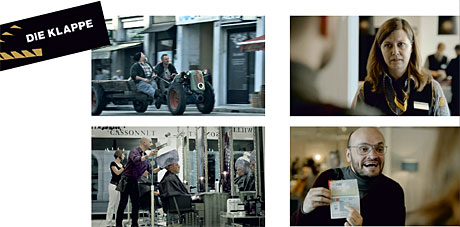
The Swiss Film Prize EDI, the awards from the Spotlight Festival and the awards from the moving image competition Die Klappe are among the awards whose points can once again be counted towards the creative ranking of Werbewoche (see also page 35). A number of Swiss productions have already entered the competition for the 32nd edition of Die Klappe, which took place last weekend in Hamburg. With 207 films, the competition organized by the Communications Association was able to increase its entries once again compared to the previous year. Around 30 jury members from the fields of agencies, film production and media - including Werbewoche - were able to hand out a total of 31 awards for 2012. 9 silver and 22 bronze. They were too "stingy" for gold, although the vintage was "very good". But there was "nothing outstanding". With Spillmann Felser Leo Burnett, Switzerland managed to win two bronze and silver medals. More information on the other award winners such as Hornbach, Constantin Film, Deutsche Bahn and others can be found at Dieklappe.de.

Andreas Panzeri

sflb_0
With the film "More Than Mountains", Spillmann Felser has helped Leo Burnett to
Flap won bronze. SFLB also won silver for the
Idea with 50 percent discount at Micasa, if you enter the right name
has. In this case, several commercials were counted as one campaign.

Great ideas come in the shower

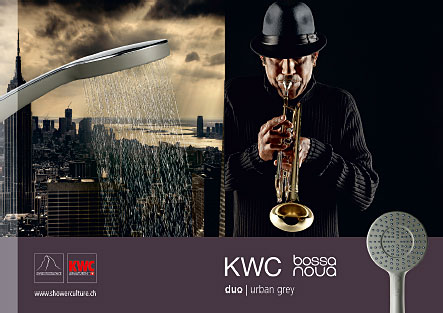
Renzen Communications provided creative support to KWC, Switzerland’s leading faucet manufacturer, in developing a new product line called «Shower Culture» and also executed the international launch campaign.

Today, showers should refresh, relax, wake you up or make you dream, depending on your wishes and needs. The functional and aesthetic requirements of the "bathroom experience" are playing an increasingly important role. With the term "Shower Culture", KWC has created an internationally applicable label together with the communications agency Renzen in Aarau, which combines various KWC products under one umbrella term with brand character. The new range represents bath and shower culture with new materials and sensual colors combined with innovative technology. The new KWC Shower Culture products were presented to a wide audience for the first time at Swissbau Basel in January 2012. An international launch campaign with various measures is now following.

Scientifically supported

Where does a potential buyer make their decisions? Together with KWC and in collaboration with the Branding Institute Wollerau under the direction of Marco Casanova, lecturer in Corporate Brand Management at the University of Berne, Renzen has intensively examined the consequences of limbics with regard to consumer decision-making.

The question was in which aesthetic world (technical terms: dominance, stimulation, balance) a person feels comfortable and at home. The bathroom as a living space: Renzen has accompanied and helped shape the development of KWC Shower Culture from the very beginning. Taking KWC Bossanova as an example, this means that the creative department was involved in every step, from the design of the name lettering and the development of pictograms for the instructions for use and care through to the brochure and packaging design. For the KWC Ely shower head, the Renzen graphic design team played with the basic shapes of the cylinder and ellipse - reminiscent of the design language of the architecture of the Guggenheim Museum in Bilbao. The KWC Bossanova model is designed to bring color and emotion to the shower. Depending on your personal taste, you can choose the "urban gray", "fancy purple", "midnight blue" or "harmonic blue" versions of these hand showers. There are not only different colors, but also a newly developed "ergoSkin" surface made of multi-component silicone, which is particularly skin-friendly.

Andreas Panzeri

renzen

Sawi imparts knowledge for strategic planning

Sawi, in collaboration with BSW and the Account Planning Group Switzerland, has developed a new three-part course. It is designed to provide participants with the basic methodological knowledge needed for successful strategic planning.

According to the press release, the course is aimed at employees of advertising agencies with several years of professional experience in the field of communications consulting. The teaching staff consists of personalities from national and international communications practice.

> More information

Hot, hotter, hottest

This week, the programs previously broadcast on HD Suisse will be integrated into the regular SF lineup. This will make every detail on our screens appear sharper. Does this also allow us to see the world more clearly, as it really is? Not really. A plea for blurriness from a nearsighted person by Josefa Haas, Director of the Media Institute.

haas

We are investing heavily in technology to make our visual world sharper and sharper. The images are indeed impressive. And what is technically possible, people also want to realize for their own benefit. But does a television world that shows us every pore and every hair also make us happier? Presenters made up with silicone show the artificiality of this supposedly sharp reality. It is only through blurring that our visual world becomes alive and real. Because in reality, we rarely see in sharp focus, and this is to our advantage.

"The trees have leaves," was my comment when I came out of the optician's store with my first pair of glasses and looked at the avenue. What had previously appeared to me as large green patches turned out to be a multitude of individual leaves. As a very short-sighted person, the visual aids opened up a new world for me. Glasses were a blessing and at the same time an impractical and unattractive crutch. I therefore largely lived in two worlds, my naturally blurred one and the artificially sharp one.

My blurred vision shows me a world full of color and light. That's why I occasionally treat myself to a walk where all the outlines get lost in fields of color. A starry sky becomes By Josefa Haas, Head of the Media Institute Aufgespiesst Deputy Editor-in-Chief Andreas Panzeri on satire, real satire and the media. The sixth power 10 Opinion a spectacle with huge circles of light. The pictures by painters for whom blurring is the artistic principle show how enriching the blurred view is. It was a special experience to see the world in museums for the first time as it appears to me without glasses. Studies on the Internet confirm that 48 percent of Impressionist painters were short-sighted, including well-known names such as Claude Monet, Edgar Degas, Pierre-Auguste Renoir, Paul Cezanne and Jacob Abraham Camille Pissaro. Monet deliberately chose not to wear glasses because he did not want to see the world so clearly. In his book "The World Trough Blunted Eyes", British ophthalmologist Patrick Trevor-Roper shows how visual defects influenced his art and convey the beauty of Monet's gardens to us.

The blurred gaze also inspires literature. Ingeborg Bachmann, for example, did not just do without glasses out of vanity. In her novel "Manila", Miranda does not always want to experience the world in full focus. Bachmann describes Rome with her short-sighted gaze and thus paints a vivid picture of the city. In addition to the experience of colors and shapes, there is the intensity of sounds and smells.

Film and photography thrive on the deliberate play with blurring. It is always impressive to be confronted with the density of the reproduced image from the beginnings of the analog era. For the French cineaste Jean Renoir, the demand for a perfect depiction of reality went hand in hand with decadence. Who would want to watch a copy of the forest in a movie theater when we can go for a walk in the original, Renoir said. Supposed realism is flat, but scope for interpretation challenges our senses. It is probably no coincidence that in today's digital cinema world, the big winner at the Oscars is a nostalgic silent film.

HDTVForum Switzerland promises a dramatic gain in picture sharpness, detail, plasticity and color fidelity with the greatest progress since color television was introduced in 1954. High-definition television can indeed have a dramatic effect if we are confronted with something we don't want to see so clearly. If our natural sense of sight mercifully blocks out unattractive blemishes and concentrates on the general impression, the sharp images spare us no wrinkles or drops of sweat. The alternative is retouched images in which naturalness is technically enhanced.

The digitalized world makes us believe in perfection. No more information should be withheld from us, no more data lost, no more traces blurred. This crystal-clear digital world is ultimately artificial, manipulated. The claim that we can use it to reproduce reality is a glorification of digitalization. What is forgotten is that it is ultimately us humans who shape our lives with these tools. Technical brilliance requires intellectual and creative brilliance. That's why we are happy about those who cultivate the drama of blurriness even in the world of digital images.
 

get_footer();