The Impact Check of Werbewoche

We show how current campaigns are performing with consumers.

In terms of awareness, the ad for SBB by the advertising agency Maxomedia ranks first, followed by the Swisslos/Swisslotto campaign by Contexta and the ad for Cardinal Blond by the advertising agency Wirz. In the “Uniqueness” category, the ad for the Tages-Anzeiger by the advertising agency Notch Interactive takes first place, ahead of Cardinal Blond and the ad for the Zurich Ballet by Euro RSCG. The PET campaign by Comqed/Metzger Lehner takes first place in the “Brand Fit” category, ahead of the VW ad by the advertising agency KSB and the Swisslos/Swisslotto campaign. In terms of “Likeability,” VW ranks ahead of Cardinal Blond and the Zurich Ballet.

The Impact Check from Werbewoche, September 14, 2012 (PDF)

View the detailed results (PPT)

WEMF eats over the fence of established market research institutes

WEMF is entering a new line of business: Effective immediately, it is offering media companies customized ad hoc studies. In other words, it no longer wants to simply tell media companies where they stand, but also why that is the case.

Should the AG für Medienforschung (WEMF), which currently only conducts research for media currencies, also carry out ad hoc studies for individual press titles, radio or TV stations, websites or cinemas in future? Or are there objections to this? The research organization posed these questions to the media companies in a survey. "The response was extremely good. There were no concerns. On the contrary, the media companies were expressly in favor of us using our expertise from currency research for ad hoc studies," says Wemf Managing Director Marco Bernasconi. So a few weeks ago, the Wemf Board of Directors gave the green light for the opening of the new business area. "This step is also unusual in an international environment: no industry research organization has ever been active in this field before," says Bernasconi.

From copy testing to customer panel outsourcing

It is therefore now possible to commission all forms of ad hoc studies from Wemf, from copy tests to image or national usage studies to comparisons with competitor media. In addition, publishers who already have their own customer panels can outsource their support and surveys to Wemf and have them supplemented by surveys of non-customers. Bernasconi estimates the market potential in Switzerland in this area at around CHF 4 million.

Wemf can "draw from the full"

Bernasconi cites the need of the media companies as the primary reason for the new business. "Until now, we were able to tell publishers where they stood and how they were developing based on the currency. But we were the wrong place to say why consumers behave one way or another," says the Wemf Managing Director. Instead, customers have always had to turn to commercial institutions, with the disadvantage that they had to brief them from scratch and inform them about their own positioning as well as their own market and competitive environment. "We already have all this knowledge in-house. We can draw on the full potential," says Bernasconi.

Currency and ad hoc research separated by personnel

However, Wemf will not set up its own field resources, but will work together with a market research institute (see box "Quality control"). It is also certain that Wemf will not be involved in strategic consulting. "We will only tell customers why a situation is the way it is, but not what should be done or improved. Because we want to remain neutral." The Managing Director does not believe that Wemf could lose credibility because of the new activity. "This was not articulated in any way in the publisher survey," he says. Moreover, Wemf provides a "Chinese wall" between currency and ad hoc research in terms of organization and personnel (see box "Link-Know-how").

Markus Knöpfli

Quality control comes first

Marco Bernasconi does not yet want to disclose the name of the institute with which Wemf will carry out the ad hoc research, as it first has to complete some pilot studies. "We want to be sure that processes, quality and reliability are guaranteed," he says. One thing is clear, however: Link and Demoscope are out of the question, as Wemf is already working with the two institutes on MACH 3. "We deliberately ensure a certain distribution of power with our contractors," explains Bernasconi. (mk)

With link know-how against Link & Co

Shortly before the summer break, Wemf announced that Jella Hoffmann would be joining Wemf as Head of Production from September 2012. "Wemf is delighted to be able to bring Jella Hoffmann into the research department in addition to her well-founded specialist knowledge," wrote Wemf at the time, thereby also hinting at the new business area. Hoffmann, who was responsible for media and online research at Link, will build up ad hoc research as deputy head of research at Wemf - and thus compete against Link & Co. (mk) 

The "schnägg" gets rolling

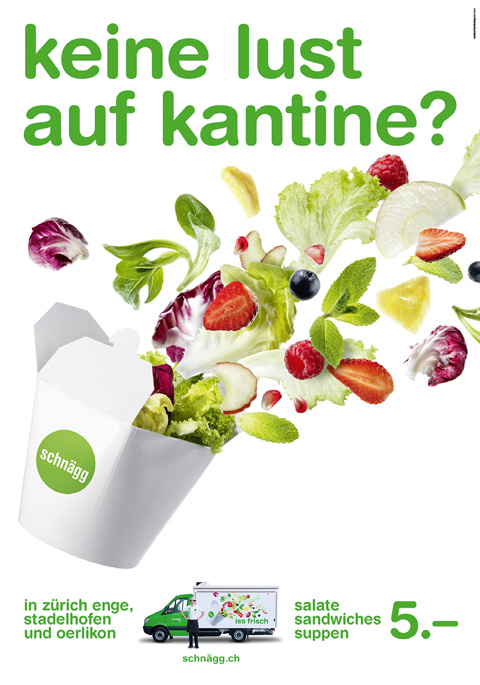
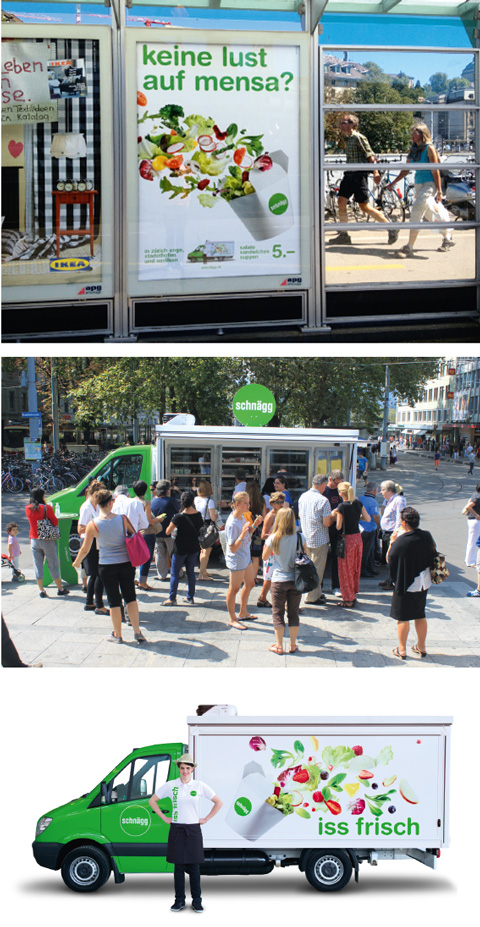
Under the name «schnägg,» fresh salads, soups, and sandwiches are now being sold in Zurich for 5 francs. The name, brand identity, packaging, and marketing were created by Weber Harbeke Partners.

Is it possible to reinvent the contemporary lunch? Fast and cheap already exist, as well as good and expensive. Fast, cheap and still fresh and good, but this form of lunch is still missing, think the inventors of the "schnägg". For all, which pay attention also with the fast food to benefit and freshness, therefore this new Gastrokonzept was developed. Fresh salads, soups and sandwiches for only 5 francs, sold at mobile stands. Behind "schnägg" are the companies Blattwerk Convenience Food and Kellermann. ch, one of the largest salad and vegetable producers in Switzerland. The third-generation family business specializes in convenience salads and produces the "schnägg" products fresh every morning, bright and early. From Ellkon a.d. Thur, the items then arrive in the company's own refrigerated sales truck to two locations in Zurich so far. This guarantees the freshness that is emphasized in the claim "eat fresh". This also implies that it is a new, fresh type of fast food that "makes you fresh".

Besides freshness, sustainability is the second major theme of "schnägg": no meat is used in any of the products, most of the packaging is made of cardboard, and the vehicles are powered and cooled by Kompogas. The brand identity, from the name to the design to the packaging, is by Weber Harbeke Partners. "It's a great pleasure, but also a huge challenge to be able to look after and help shape a brand right from the start," says Managing Partner Giovanni Pucci. But why "schnägg"? Creative Director Thomas Harbeke explains: "It's simple: snails are particularly great salad experts, just like Kellermann.ch AG. As a brand, the word is nice and cheeky and shows how uncomplicated the concept is. We also decided on dialect to emphasize the Swiss origin of the brand. Besides, the products - except for the drinks - all cost just 'en Schnägg'."

In addition to the brand identity and the packaging, the order also includes posters, eBoards as well as the Facebook presence and the Schnägg.ch website, both of which were created in collaboration with the web professionals from Feinheit.

Andreas Panzeri

schnaegg
schnaegg2
 

Facebook only reaches "heavy buyers"

Facebook fan pages are becoming standard for more and more companies. But what benefits do they really offer in terms of marketing communication?

The current study "What's Not to Like?", conducted by a team of researchers from the University of South Australia, makes it clear that fan pages are hardly suitable for attracting potential new customers to a brand and thus giving the brand a growth boost. Facebook fanbases consist primarily of "heavy buyers" who can be reached relatively easily with other communication tools.

Marketing research shows that brands can only achieve sustainable growth if they manage to expand their customer base in the long term. In other words, it is not enough to encourage loyal customers to make repeat purchases; the aim must also be to convert non-customers into new customers and bring occasional customers closer to the brand. Against this background, the question arises as to what contribution fan pages on Facebook can make to growth-oriented marketing communication.

To answer this question, the Australian research team examined the differences between the customer base on the one hand and Facebook fans on the other for two consumer goods brands - a soft drinks brand and a chocolate brand. Data from a representative consumer panel provided information about the customer base. The purchasing habits of Facebook fans were determined by surveying a total of 1520 fans. The respective populations could be divided into four categories: "Heavy buyers" are buyers who have purchased the product four or more times in the last 12 weeks. "Moderate buyers" purchased the item two to three times, "light buyers" once and "non-buyers" never.

The analysis of the customer base of the two consumer goods brands shows that the number of consumers per category decreases with increasing purchase frequency. In plain language, this means that there are very many non-customers overall, fewer "light buyers", even fewer "moderate buyers" and very few "heavy buyers". The analysis of Facebook fans, on the other hand, paints a completely different picture. "Heavy buyers" are very strongly represented here, while consumers with a lower purchase frequency are even rarer. The distribution of Facebook fans is mirror-inverted to the overall customer base. Or to put it simply: Facebook fans are much more likely to be regular buyers than non-customers or occasional customers.

The picture is different for TV. An additional survey of 397 American consumers who had watched the Super Bowl 2012 on TV shows that the structure of TV viewers is very similar to the typical customer base: 13% of TV viewers were "heavy buyers", 11% "moderate buyers", 29% "light buyers" and 47% "non-buyers" of the soft drinks brand. In contrast, 63% of the Facebook fanbase consists of heavy buyers and 24% of moderate buyers. The "light" and "non-buyers" make up only 9 percent and 4 percent of the fan base respectively. The evaluations for the chocolate brand show a similar picture. Facebook fan pages can therefore primarily be used to reach "heavy buyers" - consumers who can also be addressed relatively well with other tools, such as packaging. Consumers who rarely or never buy a brand, on the other hand, cannot be adequately addressed via Facebook. A significant proportion of a brand's current and potential customer base cannot therefore be optimally addressed via Facebook.

Clemens Koob
 

Tickets to win

The second TV 2.0 Summit will take place in Zurich at the end of November. *Werbewoche* is giving away two tickets, each worth 690 francs.

International and national speakers and experts from the TV scene - including Roger de Weck (SRG), Christoph Bauer (AZ Medien), Christian Petit (Swisscom) and Roger Schawinski (Radio 1) - will meet at Zurich's Kaufleuten on November 29 for the second TV 2.0 Summit. They will debate business models, strategies and marketing concepts in the TV business of the future and discuss which TV technologies will prevail in the future. Specialists such as B. Bonin Bough (Head of Global Media and Consumer Engagement at Kraft Foods), Lars Krüger (Project Manager Content ID YouTube) and Vassilis Seferidis (Director of Business Development at Samsung) will also shed light on the topic from their own perspectives.

As a media partner, Werbewoche is giving away two tickets worth CHF 690 each for the event. If you are interested, please send an e-mail by Monday, September 17, with the following details to [email protected]:

  • Name
  • First name
  • Company
  • Function
  • Address
  • e-mail
  • Telephone number.

Further information on the event and the opportunity to register can be found at Tv2summit.ch.


Why Google gives away money

Google generously distributes AdWords vouchers, and the company aggressively promotes AdWords using AdWords itself. Since the target audience has already heard about AdWords success stories, they launch a campaign without much prior knowledge. Does this make sense, or does Google simply benefit from it?

The aggressive new customer acquisition strategy pursues a single goal: the more companies use Ad Words, the tougher the battle for the top positions becomes. Google awards the positions of the ads in the search results by auction. The more companies vie for the top positions, the higher the click price (CPC) and therefore Google's revenue. If the companies are inexperienced or ignorant, the click price even increases disproportionately. Google has published a great deal about how to maximize the success of an AdWords campaign. This information is available to everyone. However, small and medium-sized companies often lack the time to deal with the optimization of an AdWords campaign or the willingness to commission a professional partner to manage the campaign. As a result, these companies make typical beginner's mistakes, which can cost Google a lot of money:
 
- The ad groups and campaigns are not structured, which reduces the optimization options.
 
- The campaign for local companies is not geographically restricted. This results in unnecessary clicks from interested parties who are not in the catchment area. 

- Only one ad text is placed per ad group, so it is not possible to determine the most attractive offer text.  After clicking on the ad, the interested party is redirected to the homepage of the website, where they do not find what they are looking for and bounce. 

- The preset keyword option "largely suitable" is adopted without any thought. The campaign is placed under keywords that do not bring qualified visitors to the website and only generate costs. 

- No exclusive keywords are defined, which in turn means that ads appear under keywords that are not related to the offer.
 
Google offers everyone telephone support for setting up and managing AdWords campaigns. This raises the question of whether a company whose main source of income is AdWords is optimizing the click price to the benefit of advertisers. We observe that Google sets up AdWords campaigns in such a way that a broad target group is reached. However, the optimization possibilities are not really exhausted, rather Google only does the bare minimum. So it's not a good idea to let the dog guard the sausage. An AdWords campaign should pursue the goal of minimizing the click price (CPC) and maximizing the conversion. And it is precisely this goal that is very often not pursued. Instead of optimizing their campaign, companies compensate for the poor quality with higher CPC bids and budgets. It is undisputed that AdWords, when used professionally, is an attractive tool for reaching qualified prospects and selling offers. A company that wants to exploit Google AdWords to the full must concern itself with campaign set-up and management and not just set up a campaign quickly after work. Otherwise it will easily spend several hundred to thousand francs on unnecessary clicks.

Imre Sinka & Martin Caduff

Abstinence from politics

The digitization of the media landscape calls for a new media policy. The industry organizations affected are the first to be called upon to act, but they have no interest in doing so.

Farmers are different: when it comes to agricultural policy, the relevant issues are often followed closely by farmers' committees and the media. However, when it comes to media policy, no such commitment can be discerned in the sectors concerned. And it is about media policy: on the one hand, there is the partial revision of the Radio and Television Act (RTVA), and on the other, the National Council and Council of States have approved the motion "Safeguarding the state and democratic functions of the media" by the National Council's State Policy Committee, thereby ordering the Federal Council to provide "an overall view of the Swiss media landscape from a regional media policy and overall media policy perspective" together with "funding concepts". But even without concrete proposals, it has long been clear that the pressure of the digitalization of the media calls for new framework conditions, for which politics is ultimately responsible. However, there is no sign of a media policy debate, especially one that aims for fundamental reforms. This is also shown by the survey that Werbewoche launched on this topic before the summer vacations. Despite repeated appeals, the response rate was only about half that of other topics. And even in this small sample, the theses put forward for discussion were judged to be clearly controversial - with one exception: the thesis that it is "in the vital interest of the media industry to promote and actively help shape a new media policy" met with general approval.

Passive industry associations

However, anyone who thinks that the industry associations are active in this area is mistaken: the CEOs of Schweizer Medien, bsw leading swiss agencies and the Interessengemeinschaft Elektronische Medien (IGEM) all emphasized that their organizations are deliberately not active in the area of media policy. Peter Leutenegger, Managing Director of bsw leading swiss agencies, made it clear that they do not see it as their own task to actively shape or change the media landscape and are only committed to media diversity so that the needs of a broad public for information, education and entertainment can be met. He sums up the demands on politicians as follows: "What can be sold legally should also be able to be advertised." And IGEM Managing Director Ueli Custer points out that the broad background of IGEM members alone makes it impossible to adopt a common political position. (Other industry organizations, such as the Swiss Advertising Federation, are in a similar position). Meanwhile, Urs F. Meyer, Managing Director of the Swiss Media Publishers Association, reports that the Executive Committee has decided that it is "not appropriate to hold a major debate on media policy at the present time". At last year's retreat, a media policy manifesto was adopted, which is now being revised again, as there are "certain individual aspects" that need to be corrected. With regard to the upcoming media congress, he announced various position statements on current media policy issues. He mentions the fight to ensure that the distortion of competition by the SRG, which is financed by fees, does not increase, the promotion of payment models in the online sector, for example by means of an ancillary copyright, or the promotion of distribution with the post office, where daily and early delivery is concerned. There was also no lack of a media lobby in the new parliament: as Werbewoche pointed out at the beginning of this year, at least 38 of the 246 newly elected federal parliamentarians and 8 members of the Council of States are professionally or otherwise active in the media and communications sector. And there is no shortage of organizations with at least a partial media policy focus. For example, the "Association for Critical Media Use Arbus" has been around for a long time, four years ago the right-wing "Aktion Medienfreiheit" was founded, soon followed by the "Gesellschaft für Medienkritik Schweiz" and the "Verein Medienkritik Schweiz", and the enterprising Zurich professor Kurt Imhof runs a "Medien-Observatorium". They are all doing a little something, but there is no gravitational center that attracts the various forces and bundles their efforts in such a way that resounding concepts emerge that can point the way to the future. The above-mentioned motion by the National Council's Political Affairs Committee offers an opportunity in this respect. Instead of the responsible Federal Office of Communications (Bakom) producing another mountain of paper together with the research guild that it widely supports, practitioners could show politicians the way.

Leading the way in politics

It has happened before: When cable television emerged in the 1970s, satellites were used for program distribution and the call for private radio stations became unmistakable, the media landscape was facing changes that were comparable in scale to those of today. Solutions for new framework conditions were necessary, but could not be found due to differing political and ideological positions in parliament. A commission of experts was therefore appointed in August 1978 to present a possible media article with implementing provisions by 1981. The final report was 700 pages long, but presented majority and minority views on many points. The value of the exercise lay elsewhere: because exponents met directly in the commission meetings, they were able to speak, listen and understand, which had previously not been possible when positions were only defended from a distance. As a result, the various players and their organizations and companies continued to form opinions in the background. And in the fall of 1981, the draft for a broadcasting experiment regulation met with broad approval. It brought about a cautious opening of the SRG monopoly and paved the way for the numerous private radio and television stations we know today. Today, the media policy challenge is greater because the media are converging with digitalization. "Convergence" is the keyword for both SRG and publishers, who are merging editorial teams from different types of media. A media policy that does justice to the dynamic developments surrounding digitization and, above all, wants to enable a vital media industry in Switzerland will also have to be convergent. This will require thoroughly new concepts that go beyond the current structures.

Christoph J. Walther

vergeblich
 

Consistent and naturally organic

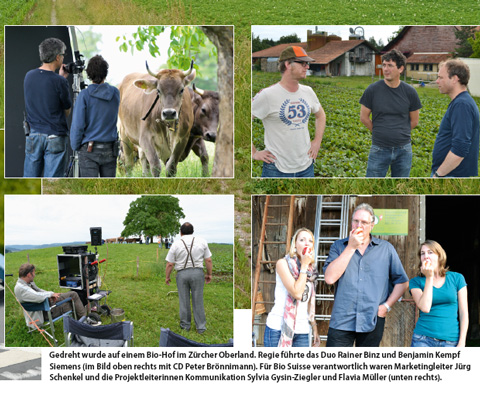
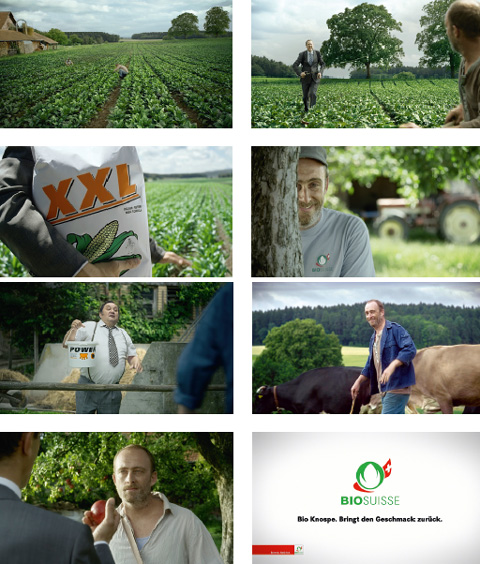
For once, the new campaign for Bio Suisse doesn't focus on a specific product. A commercial by SFLB in collaboration with Solid & Hallerfilm centers on an organic farmer. It uses humor to dramatize his strong conviction and dedication.

Spillmann Felser Leo Burnett has been working for Bio Suisse for several years. Most of this time has been spent advertising organic products. Now the association has commissioned the agency to develop a campaign that focuses on the strict Bio Suisse guidelines and at the same time highlights the passion and extra effort put in by organic farmers. "We want to show consumers how much commitment, love and enthusiasm we put into producing organic products in the countryside," explains Head of Marketing Jürg Schenkel. At the same time, the idea was also intended to pay tribute to the claim "Bring back the taste".

For once, the new campaign for Bio Suisse does not focus on the individual product, but on the organic farmer. More precisely, his conviction and commitment. The fact that Bud products are grown without chemical spraying is communicated both in the TV commercial and in the various advertisements.

Organic food is produced in harmony with nature. This means natural growth, species-appropriate animal husbandry and a strict renunciation of genetic engineering, artificial fertilizers and synthetic chemicals. For once, the new campaign for Bio Suisse does not focus on individual products. A spot by SFLB with Solid & Hallerfilm focuses on an organic farmer. His strong conviction for his spraying agent and turbo feed for high-performance animals is portrayed with humor. However, those who adhere to the strict Bio Suisse guidelines not only have more work to do, but also lower yields than conventional farmers: produce has to be cultivated using organic methods and fields sometimes still have to be weeded by hand. What's more, vegetables grow more slowly without artificial fertilizers and cows that do without turbo feed such as soya and cereals produce less milk. The TV commercial created by SFLB answers the question of what drives organic farmers to passionately pursue their work: Because only products that are created as naturally as possible taste the same.

A story with good taste

In collaboration with Nature and under the direction of the two Swiss directors Rainer Binz and Benjamin Kempf-Siemens, who also work a lot in Germany under the name Regie-Pack, a TV commercial has been created that conveys the message in a charming way: While the organic farmer goes about his daily work on the farm, various representatives offer yield-oriented products. The products on offer range from pesticides to concentrated feed and artificial fertilizers. However, as all the products contradict the organic farmer's convictions, he waves them away with thanks. Finally, when the last representative is unexpectedly handed an organic apple, he gets a taste.

The representative immediately realizes what the organic farmer retains by not using chemicals: the natural taste. To develop the commercial and underpin the concept, Bio Suisse involved six agricultural producers in a working group, as Sylvia Gysin-Ziegler, project manager for communications at the association, explains. These representatives from the green front felt that the film was approved correctly, albeit with the necessary humor, as producer Rudi Haller expresses his satisfaction. A long version of the commercial and the making-of can be seen at bio-suisse.ch. The original spot (33'') and two short versions (22'') have been shown in the TV advertising block since September. Advertisements are being placed in parallel.

Andreas Panzeri

bio01
bio02

Slight shifts

The pecking order in the reader market has remained unchanged since fall 2010. However, both major distributors, Migros and Coop, saw slight overall improvements. This was primarily at the expense of Ringier.

If the reader market is defined as the sum of all contacts of the titles covered by the MTJ (see box "Basic information" on page 3), the concentration in the Swiss publishing industry can be seen very clearly. While the media houses listed in the chart "Development of market shares of major publishers" still accounted for 58.5 percent of all contacts in 2004, this figure has now risen to 69.3 percent. There have been five winners and three losers since 2004. The winners are Tamedia, Axel Springer Switzerland, the major distributors, the NZZ Group and AZ Medien. The development at Tamedia outshines everything else. Thanks to an aggressive acquisition strategy (20 Minuten, Espace Media, Edipresse) and new launches (20 Minuten in western and southern Switzerland), it has more than doubled its market share from 9.8 to 20.5 percent and has been the clear market leader since spring 2011.

Read more about this in the current print edition of Werbewoche.
 

The discreet advisors

When hospitals merge, a business organization is looking for a successor, or a retail company finds itself in a crisis accompanied by a media storm, they’re there. Klaus-Metzler-Eckmann advises executives, companies, and institutions in—more or less—extraordinary situations.

No reception, neither Persian carpets nor USM Haller. What Hans Klaus calls "moderate modesty" is the name of the game at Klaus-Metzler-Eckmann. The utmost discretion and a personal atmosphere are desired here. "When someone comes to us, they have us, our cumulative know-how and experience. The three of us are the company." We are Hans Klaus, Ruth Metzler-Arnold and Daniel Eckmann. Former companions in federal Bern. Klaus assisted the then Federal Councillor Metzler in the Federal Department of Justice and Police (FDJP) as Head of Information and Media Spokesperson. Eckmann was Federal Councillor Kaspar Villiger's delegate for communications in the Defense and Finance Departments. Under the name "Klaus-Metzler-Eckmann. Strategy, Leadership, Communication", the three have come together again. Similar to a law firm, the partners run offices in different locations - in Zurich, Appenzell and Murten. Each has specialized in the area in which they have the greatest wealth of experience. Eckmann, who was Deputy Director General of SRG for a long time and led the convergence program, is the strategist of the trio. The former national handball team goalie is called upon for mergers, among other things. Metzler's specialty is the management part. In addition to her numerous board mandates, the lawyer advises managers, executive boards and boards of directors. Klaus is the communications person and is therefore best described as an agency. Due to his wealth of experience, his focus is on crisis management. Even during his time at Swissair, Klaus simulated crashes and prepared the airline for possible scenarios. During the Swissair SR 111 crash in Halifax, he took on the role of press spokesman. He is the "crisis uncle" among the consultants.

Getting to the bottom of things

In contrast to airlines, which are relatively well prepared for a crash, the companies that end up at Klaus-Metzler-Eckmann in an emergency hardly ever deal with crisis scenarios in advance. A pet food manufacturer who wanted to develop a strategy in case a pet died due to spoiled food is the exception. In most cases, the consultants are only called in when the mess has already been made. For example, when a legal complaint has been filed: When Nikon Switzerland was accused of obstructing parallel imports by the Competition Commission Weko at the end of 2011 and threatened with a fine of 12.5 million Swiss francs, the consultants were called in to avert damage to the company's image. Armed with an external expert opinion that examined the camera market in Switzerland and refuted the facts, Nikon appealed the decision to the Federal Administrative Court. (The proceedings are still pending.) In addition, the camera manufacturer went on the counter-offensive in terms of communication and questioned the Weko's actions. Why was an investigation conducted solely against Nikon? Why was the decision published in the middle of the Christmas season?

Very rarely does Klaus-Metzler-Eckmann only support clients with communication. "There is no communicative solution to a problem that was not resolved before the actual crisis," Klaus is convinced. If a chocolate manufacturer pays cocoa farmers in Africa or Asia lousy wages, the media and NGOs will rightly expose this. In such cases, he advises companies to communicate openly and honestly - and to rectify the problem. The problem itself must be solved. Communication only helps with the solution in terms of transparency. The consultants also help their clients with the strategic solution. They also take a close look at the management aspect. Klaus criticizes the fact that in times of crisis, management is often identical to normal operational management. Ideally, a competent crisis manager should be appointed rather than the CEO. A strong personality who - out of the media's field of fire - takes over crisis management. Someone else is responsible for communication. Of course there should be communication, says Klaus. "But good-weather PR has no place in a crisis."

Just no media hype

In any case, Klaus believes that the mediatization of companies is being pushed too hard: "I maintain that we are facing a paradigm shift in communication. There is a complete overstimulation or 'overprofiling' in politics and business." A company should concentrate on its strategy, its management, its services and its product. A CEO does not have to put himself in the limelight at every opportunity. "Communication is important - but not management profiling. There is no need to expose yourself to the hilt, especially not in the social section of the media."

In any case, the majority of the consultancy's clients are keen to appear in the media as little as possible - most recently with economic problems or, as in the case of Nikon, with a legal dispute. This probably includes the Russian holding company Interros, for which Klaus-Metzler-Eckmann has taken over all European communications. The work was not long in coming. When the dispute between Interros and the Rusal Group, both involved in the largest nickel producer Norilsk Nickel, shifted to Switzerland, media interest was also aroused in this country. (Interros was charged with money laundering, with Hyposwiss, a subsidiary of St. Gallen Cantonal Bank, allegedly serving as the hub). However, as the Office of the Attorney General of Switzerland did not respond to the complaint, the workload for the communications professional was limited. After the case was also confirmed by the Federal Criminal Court in Bellinzona, Klaus announced the good news to 20 Minuten online. And at the end of July, the president and owner of Interros, a Russian oligarch, finally told the NZZ that the case was closed for him. The advisors are not willing to disclose what is currently keeping them on their toes. However, it seems obvious that the consultancy is also involved in the 2014 Winter Olympics in Sochi, for which Interros is investing billions. With his past as communications director at Fifa, for which he organized the 2010 World Cup in South Africa, Klaus should fit the bill. And he describes his relationship with Interros and its management as "something very personal".

Klaus does not deny that relationships are important. But of course Klaus-Metzler-Eckmann do not take on mandates just because of a good relationship. A risk assessment is always carried out, especially with large foreign corporations. If a case seems too risky for just one of the consultants or the company's circumstances are too opaque, they turn it down. "If we are already trying to pull the coal out of the fire for someone, there has to be complete openness and transparency towards us." Klaus, on the other hand, finds it difficult to exclude a client on principle. "Principles are of little use in this job, but we first check every mandate carefully to see whether it is compatible with our ethical and moral principles."

While the consulting firm demands openness and transparency from its clients, they in turn demand discretion. The fact that the name Klaus-Metzler-Eckmann does not usually appear in connection with clients - apart from Nikon and Interros - is part of the credo. Furthermore, the references remain vague: both listed companies and SMEs - from the financial industry, the retail and service sectors - as well as sports institutions and associations in general. According to Klaus, around two thirds of these are long-term mandates lasting more than six months.

Reception in the "London Office"

The international focus is pronounced at Klaus-Metzler-Eckmann. While Eckmann still tends to represent Swiss clients, the proportion of foreign or international groups at Klaus is particularly high at 90 percent. In order to be able to better serve international clients in general, the consultants have had an office in London for a few months now. This is an ideal location, as many companies have their legal teams based in the English capital and the international press has correspondents on site. And - because of our shared past in the Swiss parliament: How many mandates come from this circle? According to Klaus, political mandates are not their main field of activity. "We primarily operate in the world of business, although we also come across political or partly political mandates time and again." In most cases, this involves specific work such as assessing a proposed vote or preparing for certain political projects. Classic lobbying is excluded. We work with partner companies in this area. The proportion of mandates from administration and politics fluctuates between ten and twenty percent, Klaus estimates. Not a single one, said Der Sonntag in a report just under a year ago. "Nobody wants Ruth Metzler as a political advisor," was the headline. Much to Klaus' delight. He sees the article as proof that confidentiality works: "Our basic business is discretion."

Isabel Imper

In a nutshell

Hans Klaus, managing partner, federally certified public relations consultant. Fifa Director of Communications and Public Affairs. Head of Communications and Corporate Social Responsibility at Japan Tobacco International. Head of Information at the Federal Department of Justice and Police and spokesperson for Federal Councillor Ruth Metzler-Arnold. Head of Crisis Communications in Halifax, Canada. Media spokesman for the Swissair Group for seven years.

Ruth Metzler-Arnold, Partner. Lawyer and certified public accountant. Chairman of the Board of Directors of OSEC; member of the Board of Directors of AXA Winterthur Insurance, Bühler Technology Group, Appenzell Ausserrhoden Hospital Association; member of the University Council of the University of St. Gallen. Five years as a member of the Federal Council (Minister of Justice and Police) and three years as a member of the Government Council (Finance Director) of the Canton of Appenzell Innerrhoden. Eight years in audit and consulting at PWC.

Daniel Eckmann, Partner. Lawyer. Lecturer at the University of Bern. Seven years as Deputy Director General and member of the SRG Executive Board. Twelve years as Delegate for Communications for Federal Councillor Kaspar Villiger in the Defense and Finance Departments and as his personal advisor during both presidential terms. Served on international negotiating delegations, the "Airlift" task force for the establishment of the Swiss airline, on crisis teams and the special hostage-taking task force. Advisory board member of the Swiss Olympic Academy.
 

To the point: do good and talk about it

The credibility of the media is an issue not only in Switzerland, but also abroad. Not entirely innocent are the media professionals themselves: Errors by individual publishers or journalists, the ever-increasing mixing of PR and journalism, blatant violations of the "Declaration of the Duties and Rights of Journalists," theft of images and films on the Internet, bashing of colleagues and competitors, and many other unpleasant things are gnawing away at the credibility of the media.

As if that were not enough, media researchers and self-proclaimed media critics never tire of lamenting the constantly declining quality of journalism in countless blogs, pronouncements and interviews.

These lawsuits have a good and a bad side. The good side is that journalists and publishers are perhaps thinking about their work for once. That they might think about whether the constantly repeated cost-cutting measures, in addition to short-term financial "successes," are not threatening the quality of journalism in the medium and long term, and whether the ever-increasing pressure from advertisers is leading to an inedible stew of PR and court reporting.

The bad thing about this is that public criticism, which is justified and important in itself, leads to uncertainty among media consumers and, even worse, to a rejection of the media at some point. Many people today already have the feeling that the media are actually no longer needed to convey information. "Unfiltered, objective" information and background reports can be found free of charge in abundance on the Internet. They think so and never dream of questioning this information. For the adepts of this opinion, only a few topics remain for the media: Gossip, sex, lifestyle and consumer tips.

For two years now, the association Investigativ. ch. According to its statutes, the aim of the association is "to preserve media culture by enhancing the quality of media reporting through professional research and to promote young talent by teaching research techniques. The purpose of the association is also the cultivation of investigative journalism".

It is supported by a number of publishers, SRF, MAZ and the Institute for Applied Media Science. A great thing, but unfortunately it takes place to the exclusion of the public. An interview in the journi magazine Edito is good, but an equally detailed one in Blick or Tages-Anzeiger would be better and would bring more to the media.

Pierre C. Meier, Editor-in-Chief
[email protected]
 

Nose strengthens team

The Nose agency has expanded its Branding & Interior Design division. Bruno Aeberli has joined the team as a senior designer.

Bruno Aeberli joined the agency as Senior Designer on June 1, 2012. He has fifteen years of experience in product design with a focus on development and production. Aeberli studied industrial design at the University of Technology in Sydney, Australia. Prior to joining Nose, he worked for Australian agencies. In Switzerland, he was responsible for the development of office furniture systems and lighting families at Belux and Denz.

get_footer();