Rod: Poster campaign for Radio 24

Rod Kommunikation has created a campaign for Radio 24 that puts the hosts in the spotlight. The campaign features Dominik Widmer, Elena Bernasconi, and Jonathan Schächter.

"The Zurich radio station is living up to its claim and changing with the city, according to a press release. That's why Radio 24 repositioned itself this summer with new figureheads. Dominik Widmer has been hosting the morning show since June. Jonathan "Jontsch" Schächter took over the afternoon and after-work time at Radio 24 at the beginning of September with the newly developed "Abig-Show".

In the coming weeks, poster subjects will be seen in Zurich that are rather unusual for a radio station: the presenters jumping out of the plate. According to the press release, the focus is not on the music program or the information claim. But rather the people. The Radio 24 presenters are so close to the audience, they could be laughing out of breakfast bowls with Fruit Loops, out of a lunch menu with spaghetti vongole or a plate with an opulent dinner. The headlines "Dominik Widmer for breakfast," "Elena Bernasconi for lunch," "Jontsch for dinner" fit the bill. The Rod Kommunikation agency was commissioned to provide communications support for the station's repositioning.

Managing Director Karin Müller: "Elena has been a very popular presenter with the audience for several years now. With Jontsch, a radio man who is a star has been on board since this fall. And Dominik has succeeded in shaping a show in a very short time that enjoys cult status among our listeners. In this way, we want to present the makers as the soul of the station." The "Elena," "Jontsch" and "Dominik" subjects are the start of the campaign, with further measures to follow.

RZ_Radio24_Plakat_F12_Dominik
RZ_Radio24_Plakat_F12_Elena
RZ_Radio24_Plakat_F12_Jontsch
 

Seed wins three film awards in Chicago

At Intercom, held as part of the Chicago International Film Festival, Seed won awards for the Swiss Life corporate film, the Vetropack animated film, and the corporate film for Zürcher Kantonalbank.

The Swiss Life Corporate Movie is awarded a Gold Plaque in the Public Relations category, according to a statement. "Glass Remains Glass" for Vetropack receives a Silver Plaque in the Educational - Youth Audience category. "An Ode to Proximity" for Zürcher Kantonalbank wins a Certificate of Merit in the Public Relations category.

The Swiss Life Corporate Movie combines five clips in a modular approach: An animated film provides the facts, four short films express the brand values.
Direct access to the movies

The animated film "Glass remains glass" for Vetropack conveys everything worth knowing about glass at a rapid pace: from its history to glass production and glass recycling.Direct access to the film

The corporate film "An Ode to Proximity" invites the viewer to explore the topic of proximity in order to get to know how Zürcher Kantonalbank sees itself.
Direct access to the film

PR professionals give euro states poor marks

The survey by the global consultancy network InfiniteLatitude reveals how experienced PR professionals around the world rate the communication of the euro states in the crisis situation. This is perceived as lacking credibility and not solution-oriented.

The participants assessed five key aspects of communication by European governments and authorities during the euro crisis - with sobering results. Around 60 percent of respondents partially or completely disagreed with the assessment that those responsible had communicated the reasons for the crisis effectively. According to a press release, 80 percent of respondents felt that clear and understandable ways out of the crisis had not been presented. 

Lack of perspective

The lack of a concrete vision for the future of Europe is viewed just as critically. Almost 80% of the communication professionals surveyed disagree with the statement that governments and authorities have painted a comprehensible picture of what a future, united Europe should look like after the crisis. The assessments of what the communication has achieved so far are correspondingly cautious; 70% of those surveyed do not believe that it has been possible to gain lasting support from the European public for the rescue measures taken so far.

Creating public support

"Precisely because the subject matter is so complex in detail, a comprehensive, emotional narrative would be important from a communications perspective. All the difficult intermediate steps could then at least be categorized within it," says Ulrich Gartner, owner of Gartner Communications and founder of the global consultancy network InfniteLatitude. "We know from behavioral economics that people never form their opinions in isolation, but always in relation to a framework. Creating this framework for the European discussion would be a classic task for communications."

Low credibility of the authorities

Overall, the individual results lead to considerable skepticism regarding the credibility of the institutions. Only just under three percent of communication professionals agree with the assessment that governments and authorities were highly credible in their communication - compared to around two thirds who disagree with this statement.

Unclear EU future

The survey of communication experts clearly showed that European governments have not yet succeeded in conveying a clear picture of the future of a united Europe after the crisis. The survey showed no significant differences between participants from different geographical and economic areas - i.e. between members of the eurozone, EU members without EU membership or non-EU members.

Some data on the survey:

Participants:
- 111 participants from 23 countries.

Regions:
- 89 participants in Europe, 22 outside Europe.

Within Europe:
- 40 in the euro zone.
- 30 in EU member states outside the eurozone.
- 19 outside the EU and eurozone (Switzerland and Liechtenstein).

Roles:
- 68 participants on the company side, 43 on the agency side.

Conspicuously high seniority of survey participants:
- Around 65 percent of participants on the corporate side report to the first or second management level (CEO, Group Management, Vice President).
- Around 70 percent of participants on the agency side hold the title of CEO, Managing Director or Vice President.
 

Bertelsmann and Pearson merge their publishing houses

A new giant is emerging on the international book market: Europe's largest media group Bertelsmann and the British publishing house Pearson are merging their book publishing companies - Random House and Penguin Group.

Bertelsmann is to hold 53 percent of the shares, Pearson 47 percent, as Bertelsmann announced on Monday. Both parties expect to be able to complete the transaction in the second half of 2013 once the necessary regulatory approvals have been granted. The new company is to be headed by the former Random House CEO Markus Dohle. "With the planned merger, Bertelsmann and Pearson are creating the best possible conditions for the future of their globally recognized publishing houses Random House and Penguin," explained Bertelsmann CEO Thomas Rabe. Books could be published more effectively, in both traditional and digital formats. Rabe spoke of a "milestone" for Bertelsmann.

Random House, with sales of a good 1.7 billion euros in 2011, claims to sell 500 million books a year worldwide. The traditional publisher Penguin, with the famous penguin as its emblem - sales of just under 1.3 billion euros in 2011 - is primarily known for its affordable classic paperbacks. The merger will enable both publishing houses to "publish their books even more effectively, in both traditional and digital formats and for the distribution channels of the future," said Bertelsmann CEO Thomas Rabe. If the antitrust authorities give the green light, the deal is expected to be completed in the second half of 2013. (SDA)
 

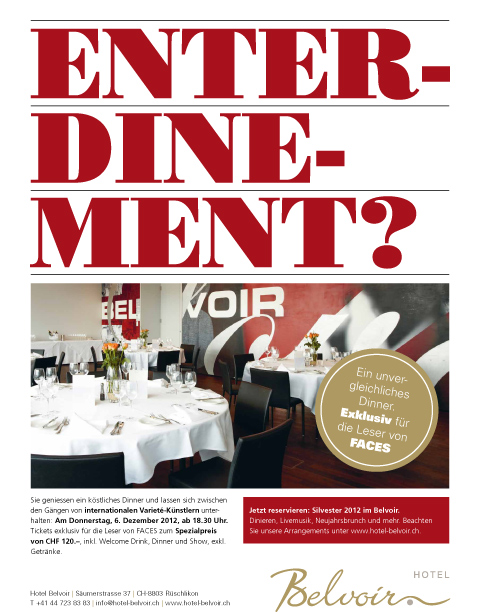
Marti. Seiler. sets the scene for Hotel Belvoir

Marti Seiler has created an advertising campaign for the Hotel Belvoir in Rüschlikon, which was built in 1721. Among other things, the campaign highlights so-called “entertainments.”.

Since April 2011, the newly built hotel has been radiating modern architecture, extravagant design and an innovative hospitality concept in the city on the Limmat, thus tying in with its own roots in a refreshingly youthful way, according to a press release from the agency.

This is staged with an advertising campaign by Marti. Seiler. The centerpiece is a selection of the offers with which the hotel lives up to its past as a house of pleasure. Enterdinements with well-known variety stars take place regularly in the large hall and those in need of relaxation can rent the Belvoir Suite with access to the Wellness, Gym & Beauty for just five hours.

Responsible at Marti. Seiler: Anita Kittel (consultant), Stefan Beck/Thomas Krebs (text) and Sara Massaoudi (graphics).

Low_Ins_BelvoirWettb_230x300
LOW_Ins_BelvoirDine_230x300_ZS_01102012
Low_Ins_Belvoir_Okt12_230x300_4c_d
LOW_Ins_5Std_230x300_ZS_01102012
 

Hipeak BTL: Guerrilla campaign at Zurich's Bellevue for Mexx

Hipeak BTL has launched a promotional campaign to celebrate the opening of a new Mexx boutique. To celebrate the opening of its fifteenth boutique in Switzerland, Hipeak BTL put the «smartness» of Zurich women to the test for Mexx: On a Thursday evening, female passersby had the chance to take part in the Mexx Competition.

The participants had two minutes to run across Bellevue and find the necessary letters and arrange them correctly, which was no easy task due to the many passers-by. The winners were rewarded with a CHF 400 shopping voucher.

A video of the campaign is being used by Mexx to communicate the message of smart fashion and smart customers on social media channels.

The campaign was planned and implemented by Zurich-based below-the-line agency Hipeak BTL.

Responsible at Mexx Switzerland: Roy Mor (Country Manager). Responsible at Hipeak BTL: Daniel Rasumowsky (Managing Partner), Oliver Scherrer (Project Manager); Video Production: CorpMedia, Timo Wäschle (Moderation), Lars Baderscher (Editing).

Tageswoche: Three innovations for the birthday

This year, Tageswoche plans to increase its advertising sales, launch a paid app, and use a daily newsletter to better distribute its online articles and primeurs.

The Basel Tageswoche, which has been in existence for a year, is still struggling in terms of advertising (Werbewoche.ch reported). Five to six paid advertising pages per issue at 5500 Swiss francs are simply not enough. Even during Basel's election campaign for the city's major and governing councils, which lasted until the weekend - there were no more. And even the sparse online ads on Tageswoche.ch still don't yield much, as co-editor Urs Buess admits.

Buess_teaser_0_300x170

Other newspapers in WG 31 Ad growth

In addition, all other newspapers in northwestern Switzerland have increased volumes in the first nine months of this year. The Basler Zeitung (Baz) - including the new Sunday edition - had 11 percent or almost one page more ads per issue than in the same period in 2011. The Basellandschaftliche Zeitung had 9 percent more, Der Sonntag even recorded an increase of 36 percent or five pages, and Blick am Abend and 20 Minuten also took in 1/5 and 1/10 page more per issue respectively.

This should have yielded more for the Tageswoche, which is constantly published with 56 pages. Buess therefore announces a "professionalization of advertising sales" for this year, specifically an increase in the team from the current three to five people. Contract negotiations are still underway, which is why he does not want to name any names. But sales will definitely remain in-house, Buess assures.

Expand online community

A second sore point: despite selling 22'600 copies a week (18,600 of which are subscriptions), the online community has only 6,400 people so far. Why? Buess doesn't really know the answer to that question yet. But he, too, has noticed in conversations that many online articles in TagesWoche are hardly noticed, and the situation is similar for the prime-time articles, which do exist and are sometimes weighty: they often simply go unnoticed. Here, too, a remedy is planned in the near future - with a daily newsletter that is currently still being tested.

And a third innovation is in the pipeline: In the next few weeks, the Tageswoche will launch a pay app that will allow users to read the print edition online as well. The project is at an advanced stage, says Buess. But this is by no means a paywall, because the online articles, which are usually different from those in the print edition, can still be viewed free of charge.

Tageswoche advertisers have different motivations

Werbewoche also asked eight major Tageswoche advertisers why they booked ads in the new paper and how good the response was. Two said they had booked because of relatives or acquaintances who work for the Tageswoche crew. Others wanted to support the new Basel media plant. Thirds responded to a good price offer or simply wanted to try it out. One company even let it slip that it was pushing down the price because a millionaire was behind the Tageswoche.

But the clients also claimed strategic reasons for their bookings. For example, some assume that they can reach an intellectual and rather alternative audience with the Tageswoche. A garage with several branches in WG 31 therefore advertises "rather low-priced eco cars" in the Tageswoche, while it promotes higher-priced vehicles in the BaZ. Sebastian Comment, head of marketing and communications at Basel-based Banque CIC, has also realized that his ads in TagesWoche are more noticeable than elsewhere because of the (still) low volume of ads. Initially, he received some reactions, but later fewer.

Certified conditions provide security

Most advertisers took note of the fact that the Tageswoche now shows a certified circulation. However, the significance of these figures is assessed differently. For Sebastian Comment of Banque CIC, good placement offers are important in addition to circulation - for example on the front page, but this is not possible with TagesWoche. This is another reason why the Baz remains the leading medium for Comment. For watch dealer Hans Spinnler, circulation is also secondary. For his Oris ads, the price/performance ratio of the Tageswoche is right, he says, while the Baz is too expensive for him and the scattering loss of the Basellandschaftliche Zeitung is too high. In contrast, Thomas Zitzer, owner of the Apple dealer Ingeno Data in Basel, Baden and Olten, finds the figures important. "They give me the certainty that my ads have been seen," he says.

Apple dealer made tests and has concrete results

Zitzer's experience is particularly interesting: Because he no longer books in BaZ for fundamental reasons, the Apple dealer initially switched to 20 Minuten - in each case with an ad on the front. A year ago, however, he switched to Tageswoche and places a full-page ad with "interesting Apple products" at least once a month. At the same time, he placed radio spots on Energy Basel. Now and then he made experiments: He provided ads with 10 percent coupons, and in the spots he asked listeners for certain codes in order to benefit from a discount. The result: the spots produced the best response, followed by 20 Minuten and finally TagesWoche. Zitzer's conclusion: He continues to book Energy Basel and TagesWoche - for three reasons: This way he reaches two different target audiences, one rather younger and one rather older. The price-performance ratio is also better with the Tageswoche than with the commuter paper, he says. Not least because he is informed by the Tageswoche's advertising department every time the competition places an ad. "It wants to avoid unnecessary overlaps in this way," says Zitzers, who greatly appreciates this customer service.

Markus Knöpfli

Silverspot Productions: Media Markt lets its pants down for its birthday

On behalf of the Media Markt Zurich network (Dietikon, Dietlikon, Winterthur, and Sihlcity), Silverspot Productions designed and produced a new radio campaign. The campaign, titled «Pants Down,» includes a teaser and three main spots.

Media Markt's new campaign can now be heard on various radio stations.

To the spots

Maxomedia implements campaign with interactive advertising formats

Following a test case with 20 Minuten, Maxomedia has now launched a mobile-centric campaign with new, interactive advertising formats to raise awareness of "SBB MobileTickets". At the center is the SBB app icon, which opens like an exploded sketch.

The key visual is displayed on various platforms not only as a static banner but also using HTML5-based rich media banner formats. Users are encouraged to explore the content of the SBB Mobile App themselves using a scroll function. They are directly involved and thus transformed from passive viewers into discoverers of the core message. If the user wants more information about the services of the SBB Mobile App, they are taken to a responsive mobile landing page. There they will find instructions on how to buy tickets and can register in the SBB Ticket Shop.

In cooperation with 20 Minuten, the various advertising formats were also implemented in a new campaign. When users open the 20 Minuten app, their curiosity is aroused by a prestitial video. This is then resolved on the first news page. There, the user encounters the key visual again in the form of a companion ad.

The campaign is rounded off by various run-of-site banners.

Responsible at SBB: Sabine Deinhofer (E-Commerce Manager, SBB Mobile), David Brunnschweiler (Communications Manager).

Success for SRG SSR at the Prix Europa

This year's Prix Europa festival in Berlin came to a close on Saturday with the awards ceremony. In three of the 16 competition categories, the jury awarded the prize to SRG entries.

In the "TV Iris - best multicultural TV program" category, Fernand Melgar's "Vol Spécial" - the RTS co-production about the deportees in the Frambois prison in Geneva, which has already won several awards - received the prize. In the "Radio Radio Play" category, the jury awarded the prize to the DRS program "Wie ich Fats Domino aus dem Hurrikan Katrina rettete" by David Zane Mairowitz. In the "Online" category, the "diy.fm - Radio à la carte" project by SRG subsidiary tpc ag won out against 21 competing products from all over Europe. diy.fm allows users to put together their own personalized radio channel from the content of all SRG radio channels. SRG writes this in a press release on Presseportal.ch. A total of around 650 radio, TV and online projects were submitted by public service media companies from over 40 European countries.

Roger de Weck new President

The festival's steering committee yesterday elected Roger de Weck, Director General of SRG, as the new President of the Prix Europa. Prix Europa is Europe's largest festival for TV, radio and online productions. It has existed since 1987 and aims to promote the distribution of high-quality European broadcasting productions.

Last but not least: The Nestlé capsule for babies

Nestlé has invented the Nespresso coffee machine for babies. One push of a button and the baby food is steaming on the table - all that's missing is the baby Clooney for the matching commercial.

The BabyNes system consists of a machine and a range of single-dose formula in capsules. According to the Babynes.ch website, these contain the right amount of milk powder for the child's age. The machine even enables precise dosing of each bottle. Capsules, the push of a button, simple preparation by machine: all that's missing now is the Clooney charm to bring the machine to babies.

Christoph Blocher's plans for the Baz

In an interview with the *Sonntagszeitung*, Zurich SVP National Council member Christoph Blocher spoke specifically about his plans for the *Basler Zeitung*. His goal is a «stripped-down *Basler Zeitung*.».

Blocher said he was assuming the risks at the Basel newspaper Baz. The only difference is that Baz is not a newspaper, but "a distressed conglomerate with more than 1,000 employees. This also included "non-operational" properties, printing plants, brokers, advertising intermediaries for third parties and much more. Medienvielfalt Holding wants to keep this daily independent, he said. "The goal is a Basler Zeitung naked, with only editorial staff and an independent publisher," Blocher continued.
 
Blocher supports this goal with investments in real estate: "The company is loss-making, has little liquidity and too much debt," says Blocher. That is why he is buying the real estate that is not necessary for business purposes. In this way, the company gets rid of the bank debts and makes a smaller loss because the high interest burden is eliminated.

Things look less rosy for the print shop. "There is far too much printing capacity in Switzerland," the former Federal Councilor tells the Sonntagszeitung. The Baz printing plant would also either have to operate at full capacity or close down. A decision on this would be made in the spring.

(Image: Keystone)

get_footer();