Züger cream cheese takes over Coop's own Filona brand
The Filona product was launched by Coop two years ago and has been produced by Züger Frischkäse AG in Oberbüren, SG, from the very beginning. The family-owned company has now acquired the trademark rights to Filona from Coop. Starting in mid-April, the brand will be available in the refrigerated section at Coop, Spar, and Volg.
Editorial
-
March 20, 2023
While mozzarella made from Swiss milk had largely established itself in recent years, fresh cheese still mainly comes from abroad. Together with Coop, Züger Frischkäse therefore launched the Filona product under its own brand "Qualité&Prix" in the fall of 2020. According to information, sales have developed well, but the big breakthrough has so far failed to materialize.
To get closer to this goal, the family-owned company in eastern Switzerland will incorporate Filona into its brand line from April 2023 and sell it under the Filona brand from Züger. The acquisition of Filona will allow Züger Frischkäse to sell the product in additional channels and invest in marketing accordingly. No changes are to be made to the products' recipe.
In terms of price, Filona is positioning itself more favorably than the market-leading competitors from abroad and at the same time aims to score points with regionality, Swiss quality, and short transport routes. Both a Nature and a Herb version will be available throughout Switzerland at Coop, Spar and Volg from mid-April 2023.
What the Swiss media are saying about the CS takeover
The major bank UBS has acquired its severely struggling competitor, Credit Suisse. What are the Swiss media saying about this?
Editorial
-
March 20, 2023
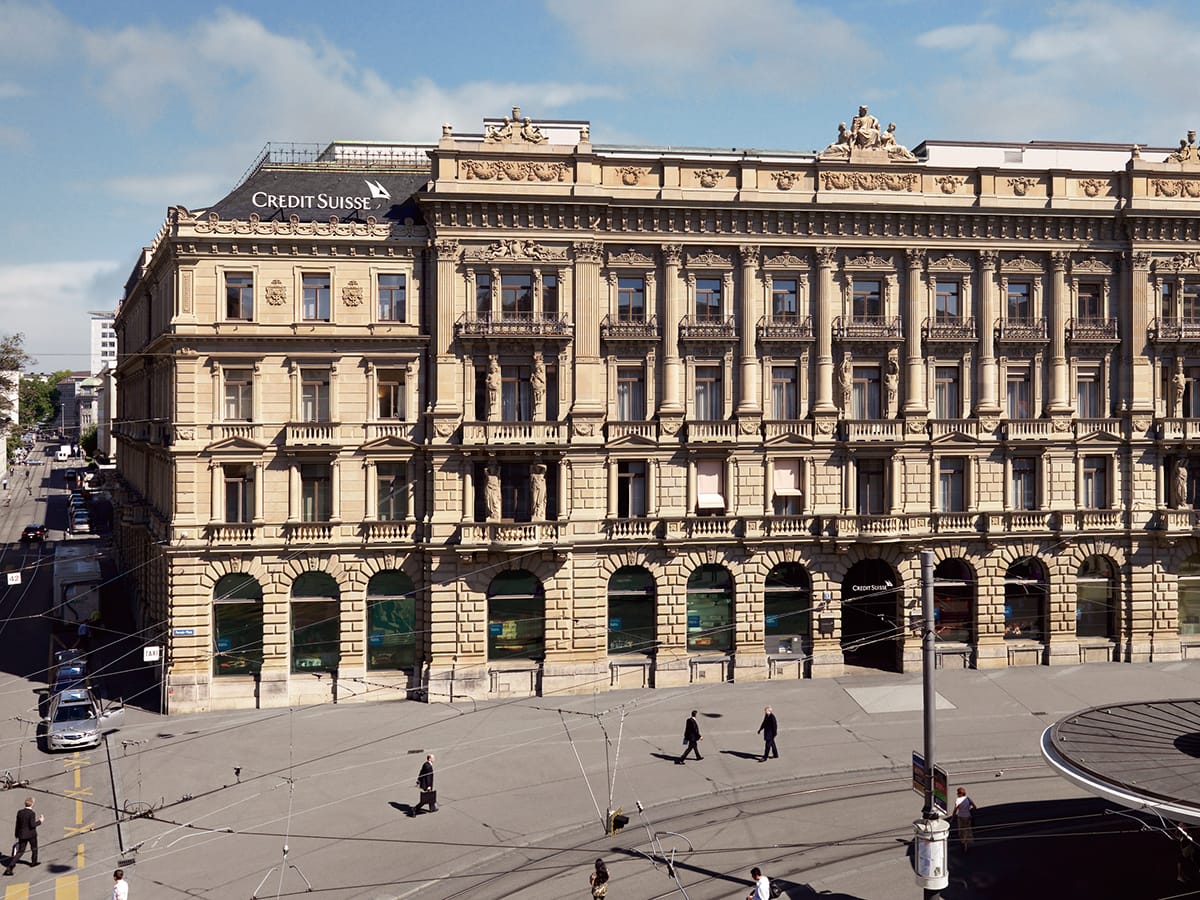
The Credit Suisse building on Zurich's Paradeplatz. (Image: Credit-suisse.com)
Since Sunday evening, the end of Credit Suisse has been sealed: The takeover of Switzerland's second-largest bank came about under pressure from politicians and regulators after CS's situation deteriorated drastically.
The transaction was preceded by marathon negotiations lasting all weekend, involving representatives of the two banks as well as federal councillors, the Swiss National Bank and the Financial Market Authority. This is what the Swiss media have to say about it:
Tamedia: "This takeover is a historic scandal."
For Tamedia, the takeover of Credit Suisse by the big bank UBS is a "historic scandal. The Confederation, Finma and the National Bank had allowed themselves to be taken to the cleaners by UBS. The new mega-bank has the advantages. Taxpayers, customers and employees the disadvantages. The largest Swiss bank is snatching up the 166-year-old Swiss institution Credit Suisse for a purchase price of three billion francs, not even half of Credit Suisse's already low stock market value. The federal government's measures burdened taxpayers with a risk of 9 billion francs. Switzerland's image as a stable financial center has been permanently damaged by the demise of Credit Suisse.
NZZ: "A zombie is gone, but a monster is born".
No one would have thought the failure of Credit Suisse possible just months ago, comments the New Zurich Newspaper. However, this was not an accident. In 2007, the Swiss bank had a stock market value of 100 billion francs, and last Friday 7 billion of that was still left - the same amount as the Vaud Cantonal Bank. Thus, a huge destruction of value had taken place, caused by managers who had negligently underestimated risks and helpless board members who had too often failed to control the bank. The fact that the National Bank and the financial supervisory authority pushed for the takeover of Credit Suisse by UBS had to do with the fear of a Monday stock market panic and pressure from Washington and London, he said. "Switzerland has now gotten rid of a zombie bank, but will wake up on Monday with a monster UBS bank," writes the NZZ.
View: "Financial plan with a colossus".
The Credit Suisse case is also a case of the Swiss financial center, comments the View. Switzerland had been asleep and had watched for far too long as the once proud Escher Bank slid into ruin with its eyes wide open. But "why didn't the authorities intervene sooner when it became increasingly clear that the bank's restructuring plan would not work? And "why were there no alarm signals from other Swiss banks?" "Why did it take pressure from foreign regulators and finance ministries" for the Swiss to carve out a stopgap solution overnight? These are questions that, according to the Viewmust be answered urgently. Because only losers were left behind.
Aargauer newspaper: "Solution catastrophic"
In the end, there was no other choice, comments the Aargauer newspaper. A solution had to be found by Sunday evening - even before the first stock exchanges in Asia opened. Otherwise Credit Suisse would have collapsed on Monday, the Swiss financial system would have been shaken - and with it the global financial system. It could have triggered a conflagration, an international banking crisis. No one in Switzerland wanted to take that risk. "No good solutions can be found under such tremendous pressure, and what was communicated in Bern last night is not just bad, it is catastrophic," the newspaper writes. Credit Suisse is being sacrificed, it says, for greater goals, for the stability of the financial system. UBS is taking over CS at a bargain price of 3 billion francs, and is having the assumed risks compensated by the federal government with a guarantee of 9 billion francs.
Südostschweiz: "Tragic end to a tragedy".
The commentary of the Südostschweiz describes the end of Credit Suisse as tragic and sad. It is tragic, he says, because the bank was actually well positioned in terms of capital and the board of directors and top management had an idea of how CS could get back on a stable footing in two or three years. However, the uncertainties triggered by bank failures in the US, which were later fueled by highly inept statements by CS's major Saudi shareholder Saudi National Bank, had snatched this opportunity away from Credit Suisse. But it would be too easy to blame external circumstances for its collapse. Rather, the end of CS is also the end of a years-long tragedy of management failures and scandals that brought the bank into this predicament in the first place, from which it was unable to extricate itself on its own.
La Liberté: "The unthinkable has happened".
The unthinkable has happened and in a flash, comments the newspaper La Liberté the takeover of CS by the big bank UBS . Credit Suisse had become the victim of a spectacular crisis of confidence last week. The Federal Council had no choice in its measures. The newspaper asks above all about the fate of the employees. Whatever the managers said, the result will be "painful" for them. There will also be a bitter taste for taxpayers, as the Swiss National Bank will have to advance up to 200 billion francs, the newspaper says. (SDA/swi)
Algorithms for tweet recommendations to be disclosed soon
Twitter owner Elon Musk apparently plans to fulfill his promise to ensure greater transparency in tweet recommendations soon. The algorithms used to select posts for individual users are set to be disclosed at the end of March.
Editorial
-
March 19, 2023
This was announced by the tech billionaire on Saturday night. As open source software, they can be analyzed by programmers. On Twitter, tweets can either be displayed in chronological order - or weighted by software that is supposed to pick out interesting and relevant posts for each user. Musk promised some time ago that Twitter would disclose the mechanisms behind this selection.
At the announcement, Musk dampened expectations for the software. He said it was too complex and that even those responsible for the online service could not fully understand it. "People will discover a lot of stupid things," he wrote on Twitter. The transparency will be "incredibly embarrassing" at first, but should quickly lead to better recommendations.
Last month, a U.S. report that Twitter had temporarily increased the reach of Musk's tweets in the "For You" section had put supervisors in Germany on notice. The Bavarian Regulatory Authority for Commercial Broadcasting (BLM) initiated an investigation for a supervisory procedure.
Musk denied that there had been a targeted increase in reach for his posts. It was merely a software error that put replies on an equal footing with tweets in terms of weighting. Users had noticed a conspicuously high number of Musk's reply tweets among the recommended posts. (SDA)
Employer Branding Award for Geyst and Mercedes-Benz
The Zurich-based agency Geyst and Mercedes-Benz Trucks Switzerland have won the 2023 DACH Employer Branding Award in Vienna for an apprenticeship campaign that pulls out all the stops.
Editorial
-
March 17, 2023
With the question "Technology in your blood, the star in your heart?" Mercedes-Benz Trucks Switzerland is addressing young people who want to immerse themselves in the world of big trucks as part of an apprenticeship.
In many industries today, the competition for the greatest talents begins even before the vocational apprenticeship. "That's why we pulled out all the stops together with the Zurich agency Geyst," emphasizes Svenja Lyhs from Mercedes-Benz Trucks Switzerland. Thus, under the name "Next Generation Stars", both an apprentice campaign and a separate brand were developed. With an independent appearance and a language that is clearly aimed at a young audience.
The campaign includes a mobile-first microsite, outdoor advertising, a social media presence tailored to the target group, and other measures. In addition, a show truck advertises training at the company with the star. The truck can be found wherever young people are on the threshold of professional life: In schools, at career fairs, at sporting events or simply on the street.
"The most important thing for us was that the training companies of the Mercedes-Benz Truck dealers accompany and support the campaign with their current trainees," explains Lyhs. The current trainees provided input for the creation and appeared as testimonials in the social media videos.
The award for this "lifeblood project" is now the crown on top, which makes it clear that the campaign is perceived beyond the industry.
The campaign was honored with the Employer Branding Award DACH. The Employer Brands Managers Club and the employer branding agency Symbiosis are behind the award. The award in the category "Personnel Marketing & Recruiting" was presented on Wednesday at a festive gala in the Parkhotel Wien.
Responsible at Mercedes-Benz Trucks Switzerland: Svenja Lyhs. Responsible at Geyst: Johannes Just, Reto Odermatt, Florin Grunder, Oliver Fried, Marina Hafner.
Swiss advertising market: strong tobacco sector in February
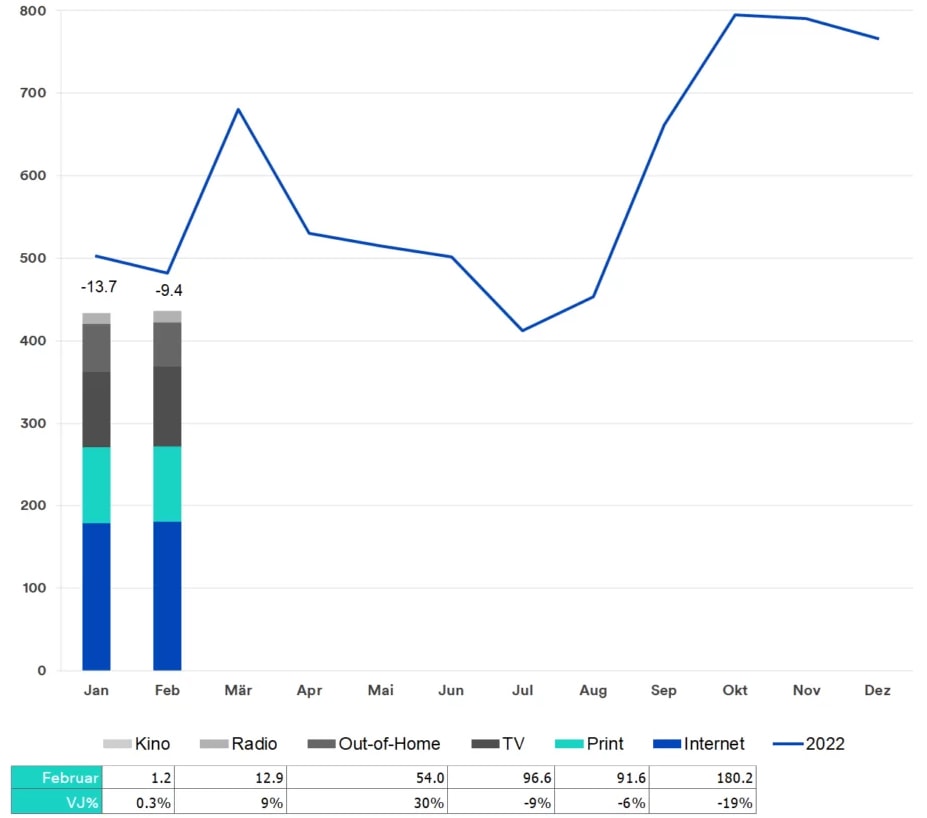
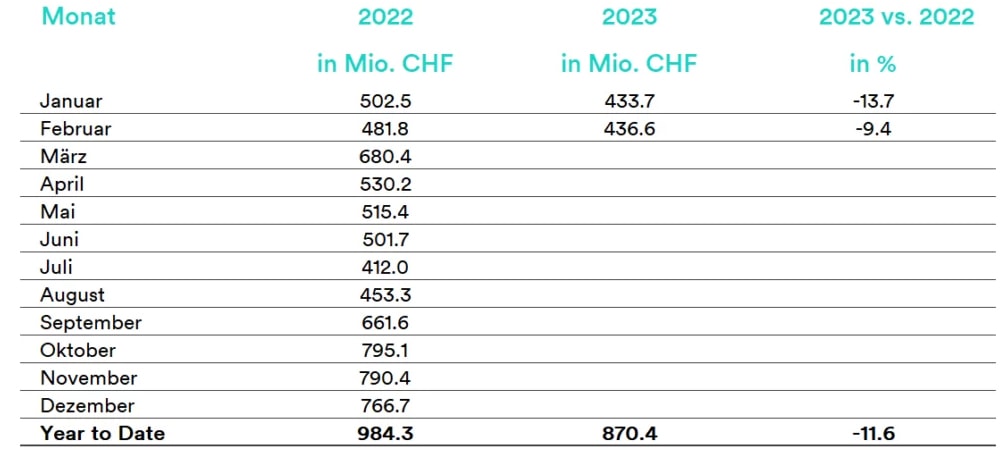
The Swiss advertising market closed February at 436.6 million gross Swiss francs, a year-on-year decrease of 9.4 percent. Compared with the previous month of January, however, gross value print is up slightly at +0.7 percent.
Editorial
-
March 17, 2023
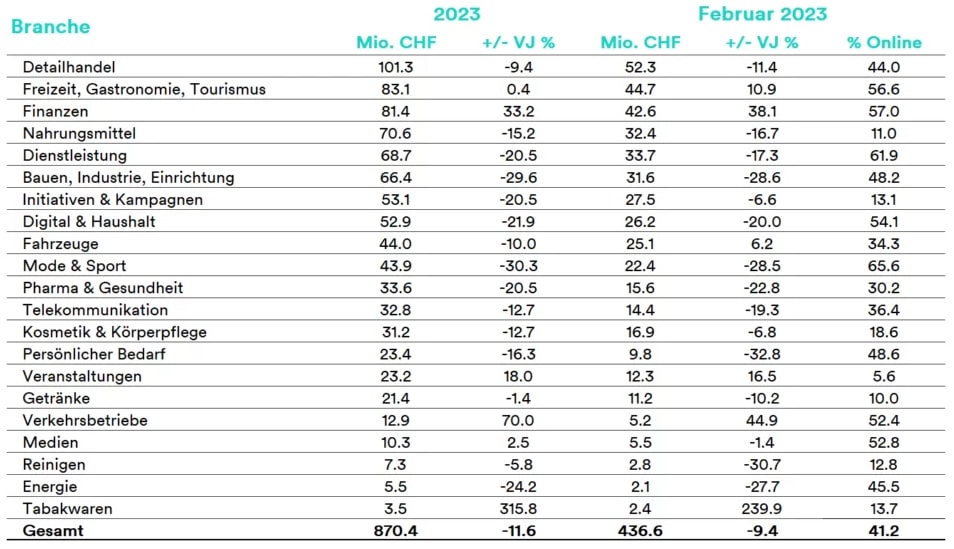
Cumulatively, advertising print was 870.4 million gross words, 11.6 percent below the previous year's figure. The reduction can be attributed to the total of 15 sectors that generated lower gross value print in February. Only six sectors recorded an increase.
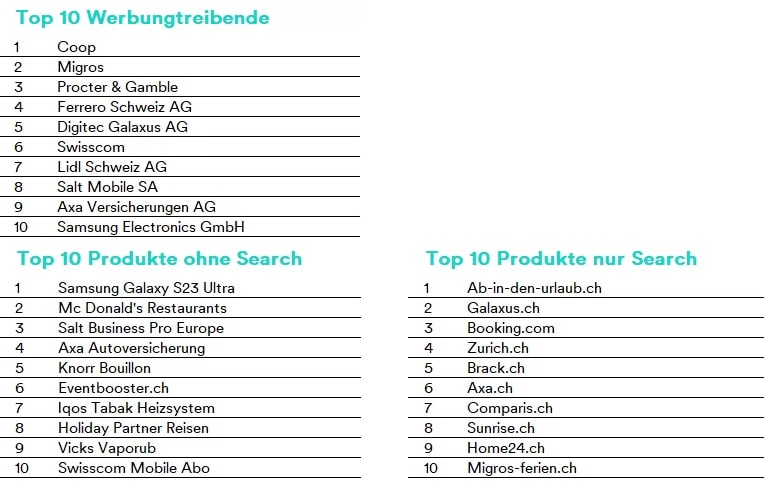
The top advertiser this month is Coop. The most advertised product (without search) is the Samsung Galaxy S23 Ultra.
Advertising print in the overall market: development of advertising print as of February 2023 in millions of gross Swiss francs. (Image: Media Focus)
Tobacco industry records significant increase
At 239.9 percent, the tobacco industry increased its advertising print the most, as in the previous month of January. It was followed by the transport industry, with an increase of 44.9 percent. The financial sector was also among the winners in February, increasing its gross advertising print by 38.1 percent. In addition, the events (+ 16.5%), leisure, tourism, gastronomy (+ 10.9%) and vehicles (+ 6.2%) sectors are following suit.
Overall decline of 9.4 percent in industry comparison
A full 15 sectors recorded a decline in gross value added in February. The personal supplies sector was the hardest hit, with a drop of 32.8 percent. This is followed by the cleaning sector with a decline of 30.7 percent. In addition, the Construction, Industry, Furnishings (-28.6%), Fashion & Sport (-28.4%), Energy (-27.7%), Pharmaceuticals & Health (-22.8%), Digital & Household (-20,0%), Telecommunications (-19.3%), Services (-17.3%), Food (-16.7%), Retail (-11.4%), and Beverages (-10.2%) the gross value print.
Top Advertisers & Products
The top advertisers and most advertised products as well as services (excluding assortment, image advertising and collective categories) in February 2023:
Media mix (classic media) for the month of February 2023
Schwyzer Kantonalbank now also publishes a sustainability report
For the first time, Schwyzer Kantonalbank is publishing a sustainability report alongside its 2022 annual report. In it, SZKB discusses the bank’s sustainability issues, their relevance, and further developments.
Editorial
-
March 17, 2023
The recently published Annual Report 2022 of SZKB contains the detailed information on the past financial year, the strategy, the risk policy and the risk management of the bank. What is new is that this year, for the first time, a sustainability report of Schwyzer Kantonalbank will be published.
Consequence of the Corporate Responsibility Initiative
The indirect counter-proposal to the corporate responsibility initiative, which failed in 2020 due to a majority vote in the Council of States, stipulated that companies with more than 500 employees and meeting other conditions must prepare a report on non-financial matters as of the 2023 financial year. This also includes SZKB.
By publishing sustainability reports, companies are to create transparency about their activities and their goals in the area of sustainability. In the reports, they have the opportunity to present and explain their impact on the environment, society and the economy.
The financial sector has a special responsibility and opportunity to shape sustainability. Through its activities, SZKB has a direct influence on sustainability in the Canton of Schwyz, among its customers and other stakeholders.
Kantonalbank has decided to publish a sustainability report for the 2022 financial year so that reference figures are already available for the 2023 financial year. In its sustainability report, it goes into greater depth on aspects relating to financing, investments, social affairs and employees, as well as operations and procurement. It also covers the topics of corporate management and governance, customer protection, access to financial services, confidentiality of customer data, data security, and local engagement.
Reports available physically and digitally
The online versions of the reports can now be downloaded from the SZKB website at Szkb.ch/reports and downloaded from the website. The reports are also available in all branches of the cantonal bank. In order to conserve resources, SZKB has now only sent printed versions to those individuals and institutions that explicitly requested a print version.
Microsoft brings artificial intelligence to the office
The competition to develop the best solutions based on artificial intelligence (AI) is heating up. Microsoft first significantly enhanced its Bing search engine with AI and declared war on Google. Now the company is stepping up its efforts in office software.
Editorial
-
March 17, 2023
(Image: Microsoft.com)
Microsoft will integrate comprehensive artificial intelligence functions into its most important office programs. This was announced by company CEO Satya Nadella in Redmond on Thursday. With the "Microsoft 365 Copilot", users:inside of Office programs could benefit from the novel AI functions that have been causing a stir in the IT world for months. Office components that will receive a "Copilot" extension include Word for word processing, Outlook for e-mails and calendars, PowerPoint for presentations and Teams for chats.
"Today marks the next big step in the evolution of the way we interact with computers," Nadella said. The group CEO lined up the announcement with the legendary introduction of the graphical user interface by computer scientist Doug Engelbart in 1963 and the debut of the first iPhone in 2007.
Increase in productivity promised
"This will fundamentally change the way we work and unleash a new wave of productivity growth," he said. With the new "copilot for work," Microsoft is giving people more agency and making technology more accessible through the most universal interface - natural language.
For example, Nadella presented a new type of business chat together with Microsoft manager Jared Spataro. This not only works with the data of a public AI language model, but also accesses personal data such as calendar entries, emails, chats as well as other documents of the users. "It lets you do things you've never been able to do before," Spataro promised.
Instructions via voice control
This would allow people to give verbal instructions to the program, such as, "Tell my team how we updated the product strategy." The software would then generate an appropriate status update based on meetings, emails and chats.
In Outlook, users can then ask questions like this one: "Create a summary of the Alpha project emails I missed during my vacation over the past ten days, and list all the questions my team leader asked." In Excel, even complicated data evaluations can be triggered in natural language without having to type syntax of formulas in the spreadsheet.
Attack on AI expertise from Google
With its broad-based AI offensive, Microsoft is attacking Google's previously untouched leading position in the areas of Internet search and online advertising. The integration of the ChatGPT text robot into Bing and the Microsoft Edge browser plays a key role here. With "Microsoft 365 Copilot", the world's largest software group also wants to secure and further expand its supremacy in the area of Office software. (SDA)
Are healthcare brands emotionally engaging their clientele?
There are many vitamin supplement providers in the Swiss healthcare market. As part of a neuromarketing study, Zutt & Partner investigated which of the three best-known brands is most effective at connecting with consumers on an emotional level.
Editorial
-
March 17, 2023
Almost every third Swiss consumes at least one dietary supplement, and vitamin tablets in particular are very popular. The market volume is large and the market is competitive. So it's all the more important to appeal to consumers' emotional preferences and to be the emotional number one.
Zutt & Partner has published a EmoCompass-The study examined three of the best-known food supplement and vitamin brands in Switzerland, "A.Vogel", "Berocca" and "Burgerstein", in terms of their neuromarketing recipes for success.
Knowing that the three brands function differently in rational aspects such as product range, number of products and country coverage, this study focused on the emotional perception of the three brands. The results show how the three brands perform emotionally and in which emotional disciplines they still have room for improvement.
These mood boards of the three health brands were used as research stimuli.
Berocca meets the desire emotion best
When potential consumers are asked about the perfect vitamin tablet for them, their emotional world - including aspects such as naming, images, headlines, advertising messages and packaging - should be one thing above all: inspiring, lively and fresh. This question was not answered verbally by the participants, but by means of coded colors and shapes. If we now compare this wish with the emotional worlds of A.Vogel, Berocca and Burgerstein, Berocca emerges as the clear winner.
At Berocca, the desired emotion "inspiration" plays the most important role, accounting for almost 30 percent of the total brand emotions. With an inspiration share of just under 25 percent, A.Vogel ranks second - Burgerstein comes last with a value of just under 20 percent. Even if Berocca comes off as the winner, it is worth mentioning: The inspiration share is likely to be even higher for all three brands.
Burgerstein triggers the most emotion
In the second emotion discipline, however, things look different: The study also measured how much emotion the three brands triggered in general. In technical jargon, this is referred to as emotion volume.
Burgerstein generates the largest absolute emotion volume in relation, with a total value of over 40. According to Zutt & Partner, this is a remarkable achievement, because highly emotional products such as chocolate or cars do not achieve a much higher value of around 50. By comparison, banks and insurance companies generally achieve a value of around 20.
With an emotion volume of 32.7, A.Vogel again takes second place in this emotion discipline - according to Zutt & Partner, a good but not exhilarating value. Berocca comes off weakest in this direct comparison with a value of 27.1.
A.Vogel has the clearest brand profile
In addition to the desired emotion of inspiration, there are other emotion areas through which the suppliers A.Vogel, Berocca and Burgerstein can differentiate themselves. According to Zutt & Partner, this is enormously important for differentiation reasons. And as the study results show, each of them manages to trigger these additional emotions and thus secure a certain unique selling proposition. A.Vogel masters this emotion discipline particularly well.
The text and image world of A.Vogel radiates - in addition to the inspiration already described - above all friendliness. For the study respondents, the brand appears warm, sweet and gentle. In addition to the sweet and warm colors, family and children's pictures also contribute to this friendly emotion. Because the emotional world of A.Vogel only breaks out into the additional dimension of "friendliness," the brand has the clearest brand profile of all.
Berocca focuses on performance and power in its additional dimension. In its imagery, the brand makes a powerful, dynamic and confident impression on the subjects. The energizing effect is also noticeable through dynamic shapes, silhouettes and fonts. However, because Berocca also triggers some friendliness in addition to the power emotion, it is the brand profile that profiles the weakest or most unclear.
Burgerstein also secures its own Emotions section with its safe and trustworthy - somewhat medical-looking - world. Its texts, images and above all the blue color contribute to the brand being perceived as serious and reassuring. However, the small "emotion excursions" in the direction of friendliness and power contribute to Burgerstein's less clear profile than A.Vogel.
Conclusion: A lot is done right
The EmoCompass study shows that both A.Vogel and Burgerstein and Berocca are doing a lot right in terms of emotionalization. Nevertheless, the three brands could move even more in the market with a further development of their emotion marketing and thus take market shares away from their competitors.
The top priority for all is: Trigger even more inspiration in the emotional brand world to meet the emotional desire even stronger and better.
Generally trigger even more emotion - this is especially true for Berocca and partly also for A.Vogel
Further sharpening our own brand profiling and differentiation - this applies in particular to Berocca and to some extent also to Burgerstein
Zutt & Partner note here that these three principles - desire, emotional volume and clear profiling - are also the be-all and end-all for other healthcare and pharmaceutical companies. Incidentally, measuring and directing emotions is not only worthwhile for over-the-counter medicines in the consumer market. Emotions also play the biggest role with B2B target groups such as doctors and pharmacists, as well as with prescription drugs. It can therefore be worthwhile to measure and effectively manage emotions in these areas as well.
Detailed results, interpretations, further information on the study and initial approaches to solutions are available to interested parties at a Workshops at Zutt & Partner.
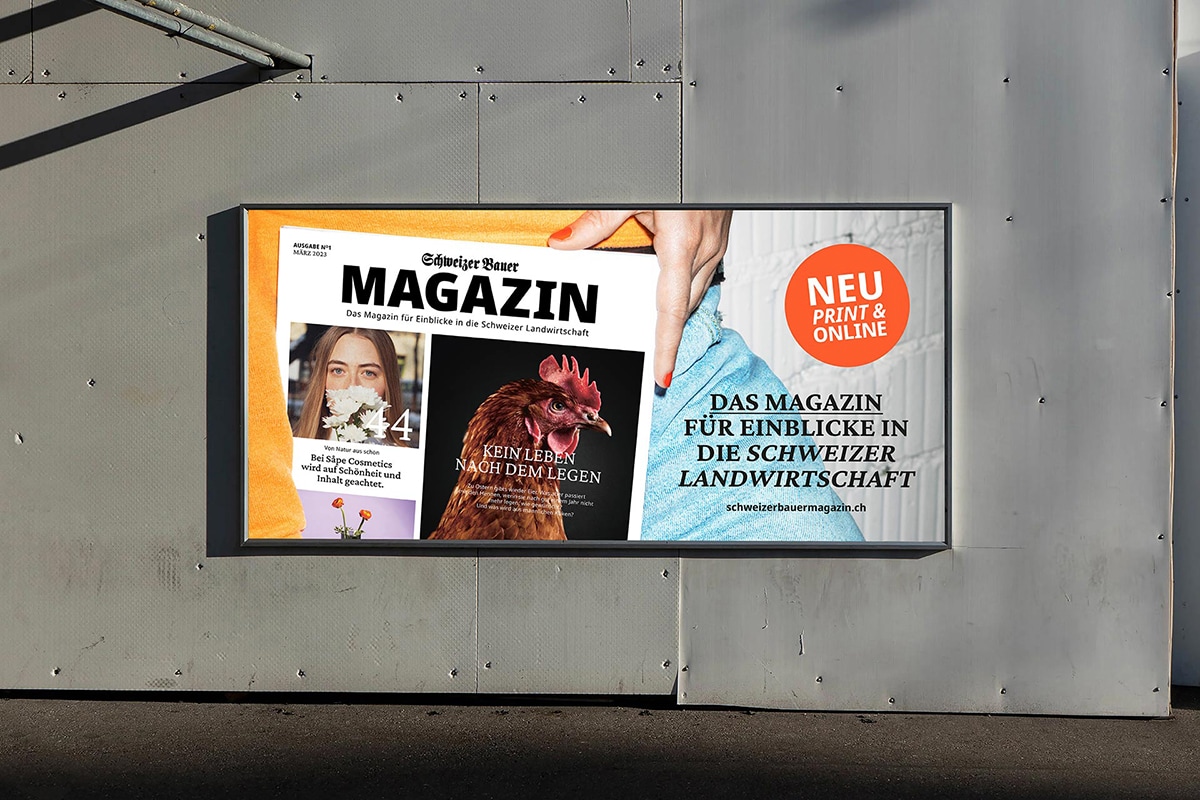
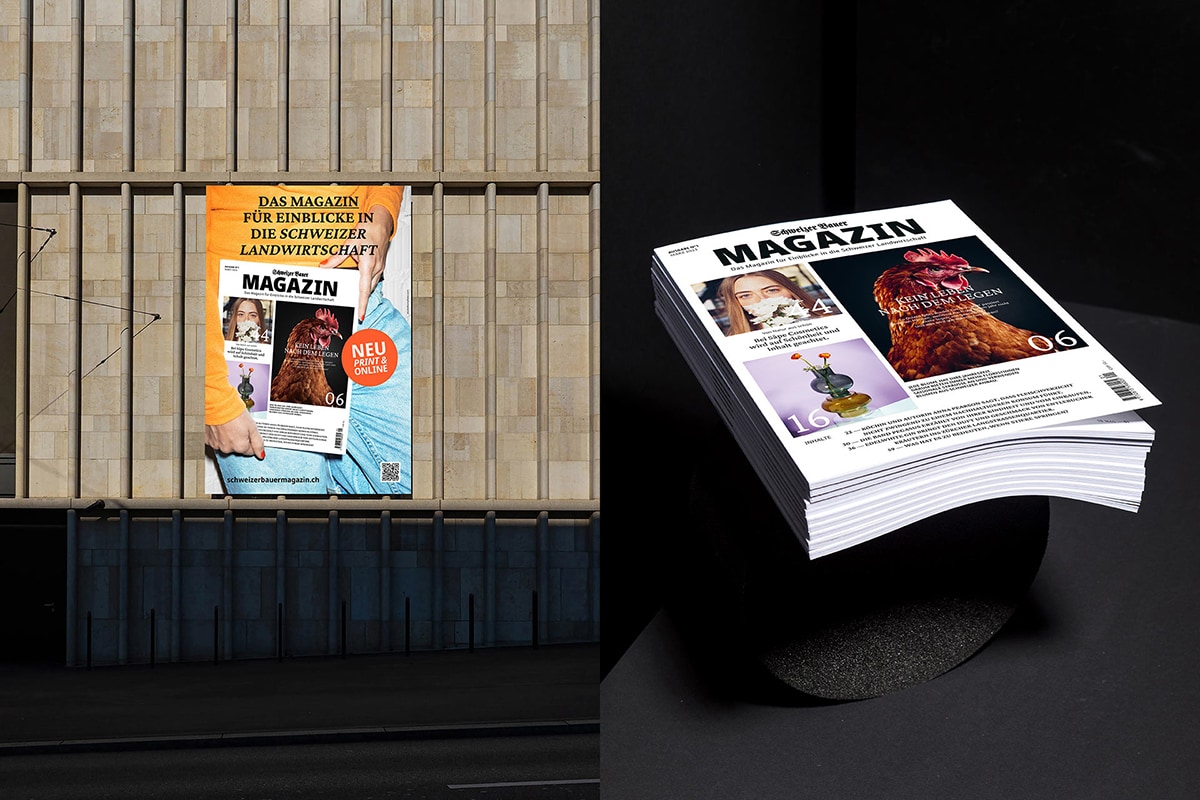
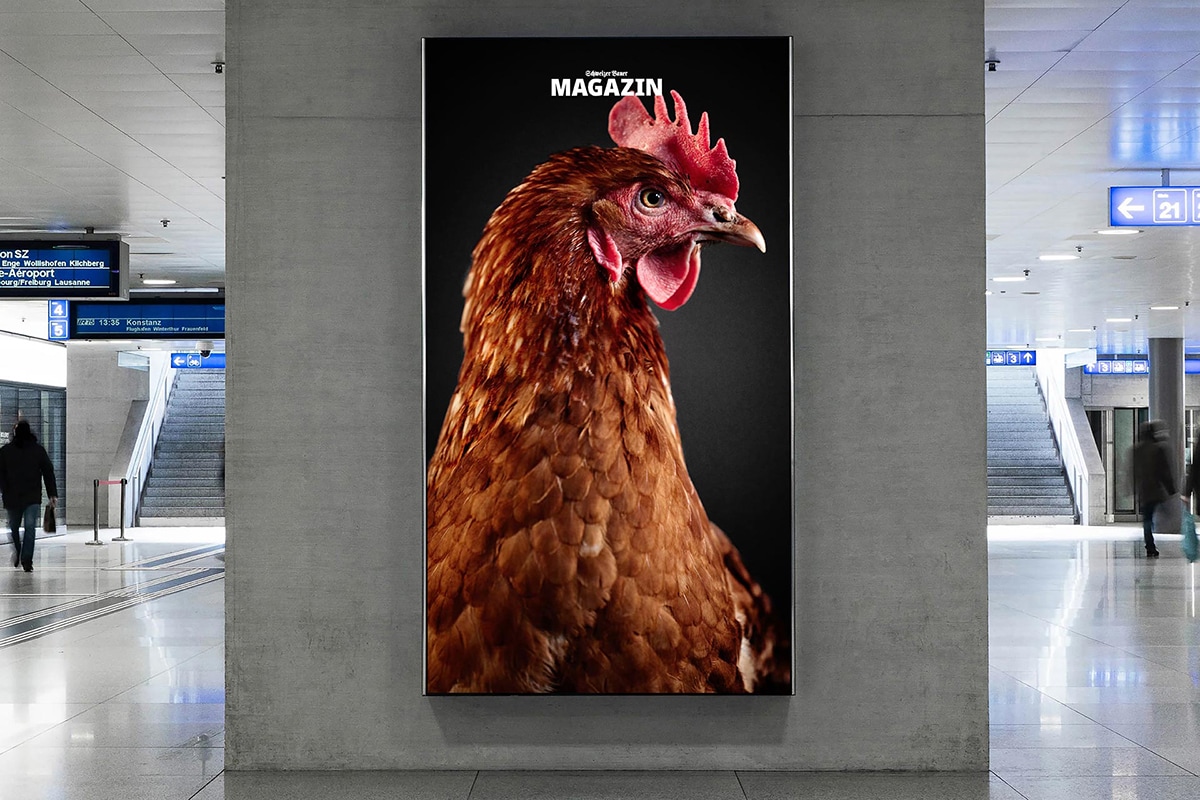
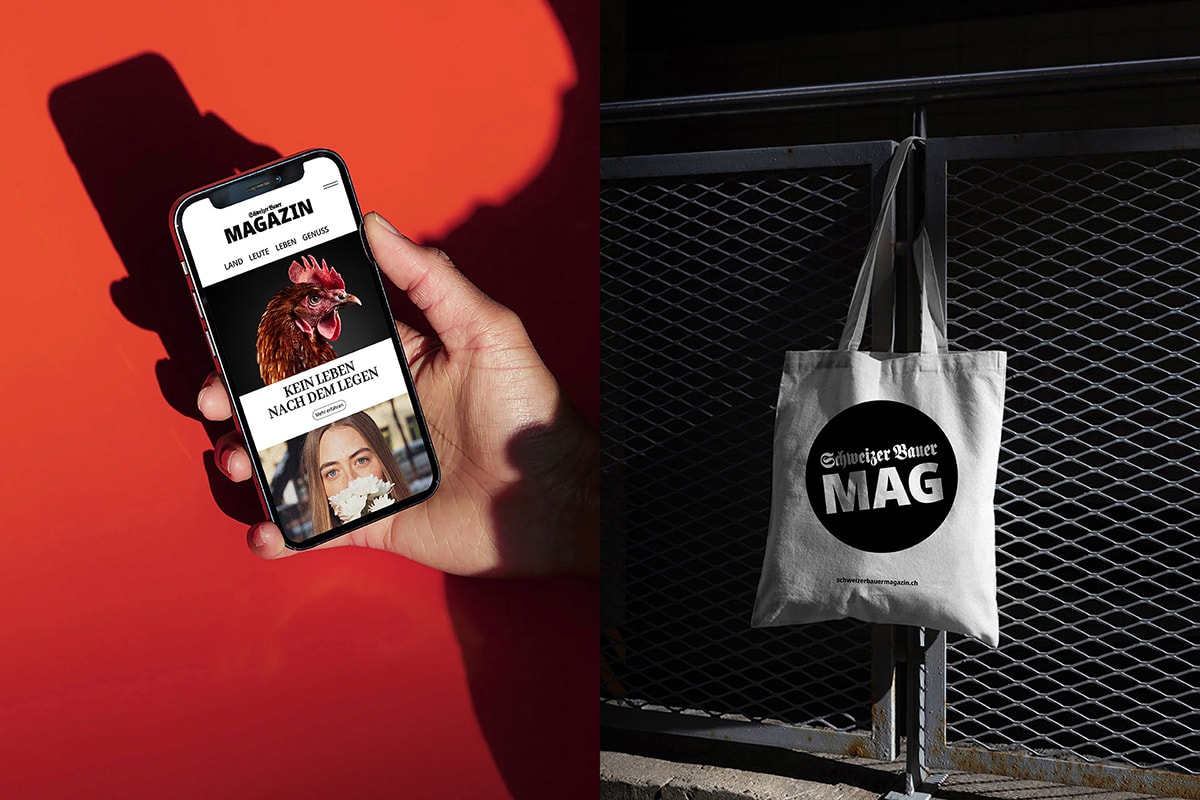
Studio Thom Pfister stages new Swiss Bauer magazine
Schweizer Bauer Verlag is launching *Schweizer Bauer* magazine on Saturday. Studio Thom Pfister developed and implemented the complete branding for the new magazine—including the name, logo, design concept, and visual style.
Editorial
-
March 17, 2023
The contract also included the screen design and programming of the online magazine, a launch event with exhibition and a corresponding media launch campaign.
The result is a refreshing and modern design. According to the agency, the print magazine is one of the first in the world to be produced entirely according to the "Cradle to Cradle Gold Standard". This means that only materials that are safe for the natural/biological cycle are used.
The new magazine thrives on "contrasts" and builds bridges between city and country. Sustainable consumption and knowledge about local producers are to be increased. With stories and pictures under the headings of country, people, life and enjoyment, readers will gain insights into the diversity of Swiss agriculture.
Responsible at Schweizer Bauer: Simon Langenegger (Publishing Director and Managing Director), Therese Krähenbühl-Müller (Editorial Director), Julia Spahr (Editorial Director), Mike Fries (Advertising Sales), Irene Heynen (Advertising Sales), Alexandra Furrer (Advertising Sales). Responsible at Studio Thom Pfister: Thom Pfister (Creative Director, Photo Direction), Roland Zenger (Art Director, Print and Digital), Daniel Hackiewicz (Web Development, Senior Designer), Noemi Bünzli (Graphic Design) Ursula Rytz & Laura Capponi (Consulting, Production and Coordination). Photography, art and animation: Studio Attila Janes. Photography and film: Oli Hallberg. Online Magazine: Studio Thom Pfister, Meier. Media agency: Ceres Media. Printer: Birds.
Google would owe Swiss media 154 million francs
A study has calculated how much money Google and other search engines owe Swiss media outlets: 154 million francs. Currently, Swiss media companies and journalists generally receive nothing.
Editorial
-
March 17, 2023
(Image: VSM)
For search engines, journalistic content is an important factor for their success, according to a study: users rate Google as more complete, of higher quality and more trustworthy when journalistic content is displayed.
The study published on Friday, although commissioned by the Swiss Media Association itself, shows that Google is used more often and more intensively when journalism is involved.
The study also calculated how much money the corporations would have to pay Swiss media houses and media professionals if they were obliged to do so. It is apparently 154 million francs.
A "fair share" of 154 million
The study authors calculated a value contribution of the Swiss media for the "Google ecosystem". In view of the estimated advertising revenues of CHF 1.1 billion - Google does not report these - 154 million would be "a fair share" according to the study.
But Swiss media houses and media professionals would see nothing of this money, because the money would remain within the "Google ecosystem," according to the study. For the study authors, this is clearly "a market failure that needs regulation.
The Publishers Association has been calling for a performance protection right for some time. "The study shows that the ancillary copyright is necessary and urgent," association president Andrea Masüger is quoted as saying in a statement. The work of journalists must be protected from the superiority of the tech giants.
Google: Journalism "almost irrelevant
Google takes note of the study "with interest," the company told Keystone-SDA news agency in response to an inquiry. However, the findings would contradict "previous, neutral studies".
Google mentions in particular the study by Sistrix, an analysis program for website rankings. This study shows that journalistic content is almost irrelevant for Google. Google, on the other hand, increases the reach of publishers with its services and thus provides them with additional revenue.
In total, 8 billion clicks per month would be redirected from Google Search and Google News search results to platforms of European publishers.
Google wants to have its say
The Group announced to Keystone-SDA that it would "contribute to the debate at the appropriate time". This debate will get underway in the near future when the Federal Council submits a proposal for a performance protection right for consultation.
However, such a "Google tax" is controversial in some quarters on the conservative side. The liberal think tank Avenir Suisse has already called the idea "media subsidies through the back door. Money from foreign tech companies would be used to support the domestic media industry.
The Swiss media would benefit from the search engines. After all, their articles get more attention that way. If a user follows the link, there are various ways for publishers to monetize the content, for example through advertising or a paywall.
Such a performance protection right already exists in the EU and other countries. (SDA/swi)
Mainland and OST are looking for the engineers of tomorrow
Switzerland needs more skilled workers, especially in engineering. Universities of applied sciences such as OST open up paths to the future that are both high-quality and practical. Festland is highlighting this in a current campaign.
Editorial
-
March 17, 2023
OST, the largest university of applied sciences in eastern Switzerland, offers a wide range of bachelor's degree programs for future engineers - from computer science to electrical, mechanical, systems and environmental engineering to industrial engineering.
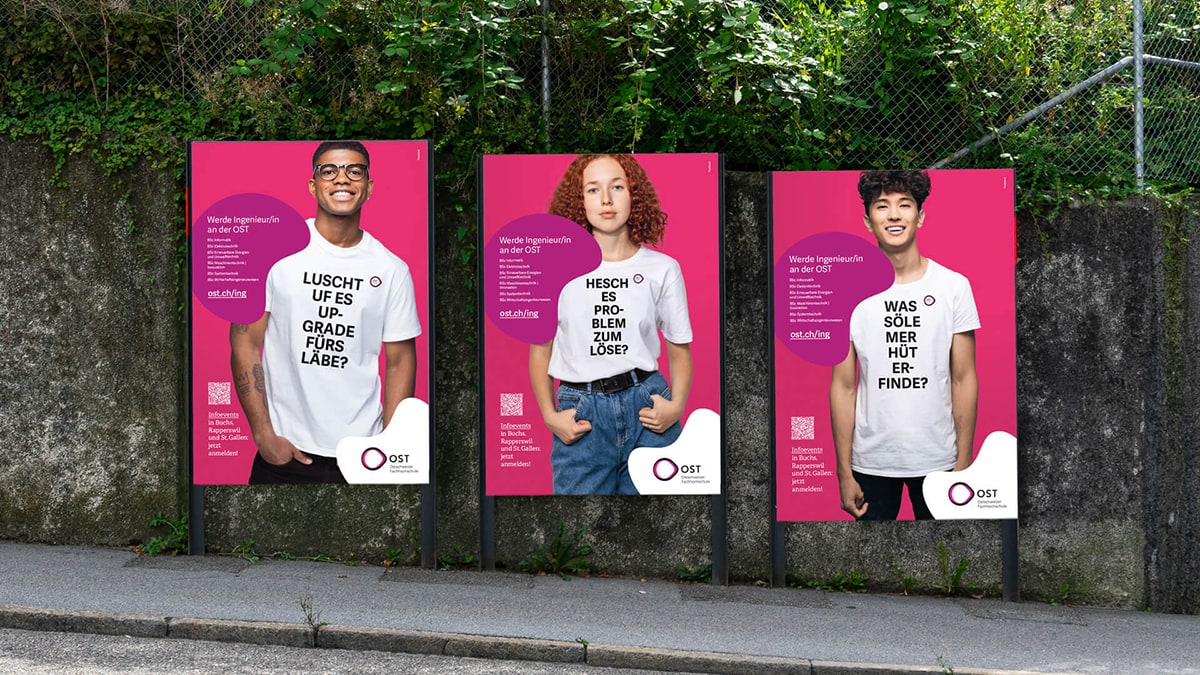
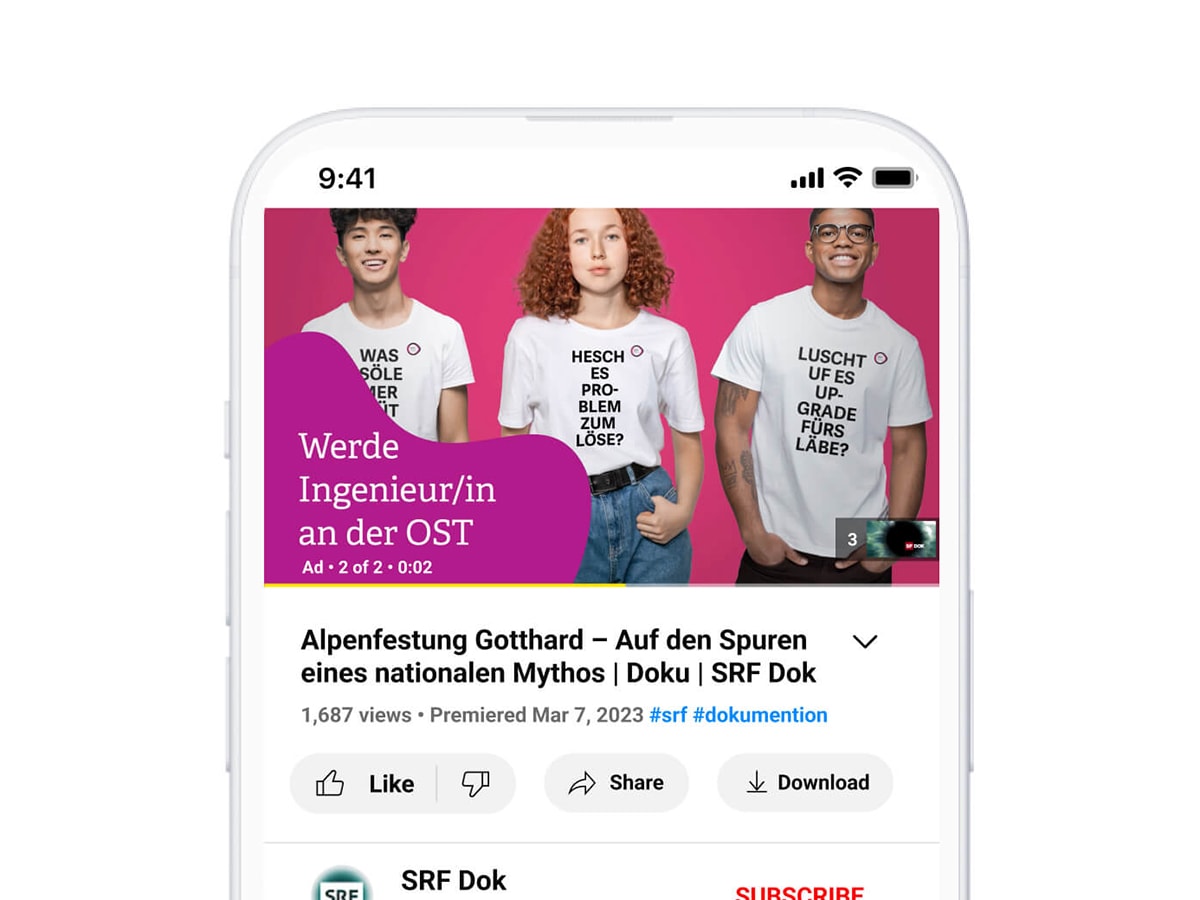
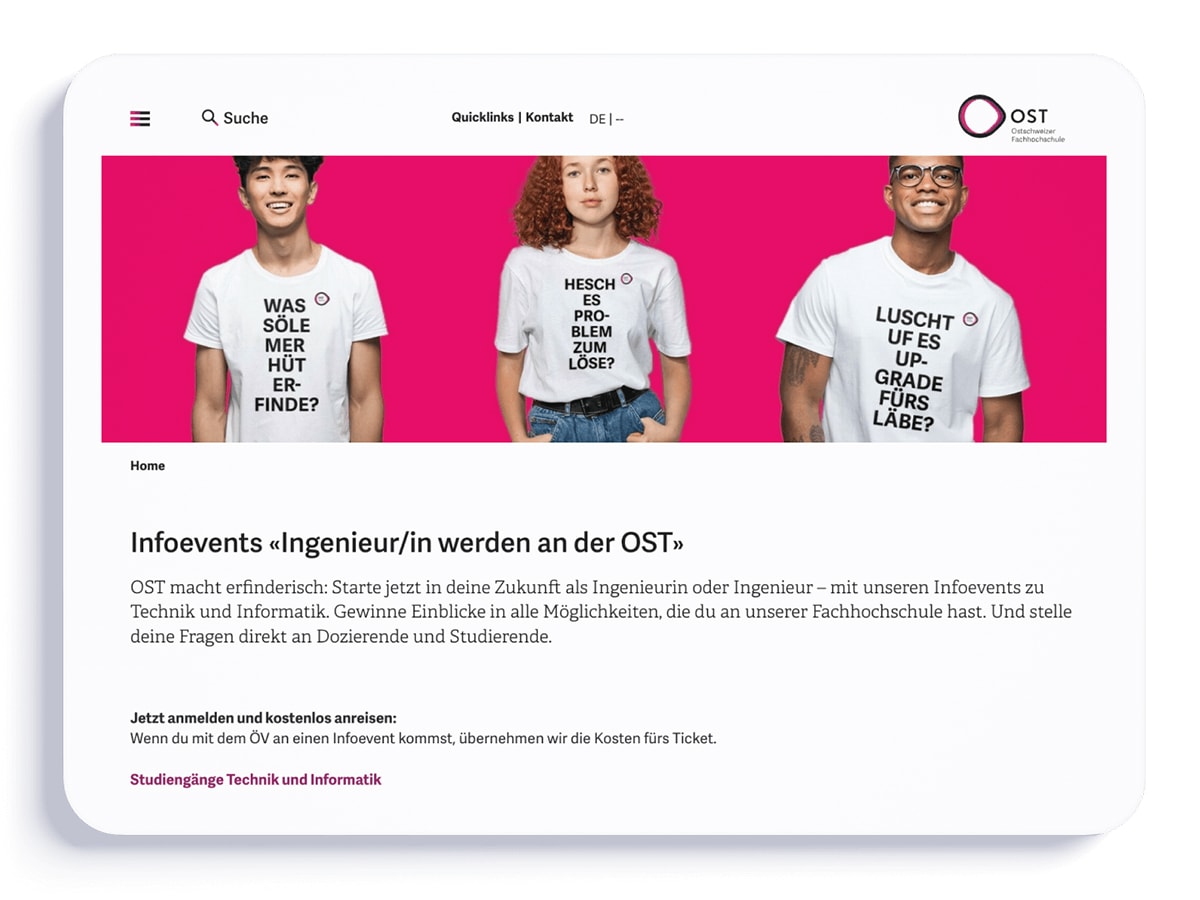
But how do you get young people excited about studying engineering? The campaign that Festland created with OST is designed to address the tech leaders of tomorrow at eye level and in their own language - with representatives of the target group as key visuals and T-shirt headlines as key messages. The dialect and the OST branding anchor the concept in the market region and brand world.
The focus of the media mix is on digital channels with an affinity for the target group, such as Instagram, YouTube and TikTok. Additional visibility will be provided by targeted posters around the OST locations in Buchs, Rapperswil and St.Gallen. With East.ch/ing a new landing page was also created that presents all the offers.
A TikTok star named Surrli
Festland and OST have produced a special subject for TikTok. An engineering student presents the Surrli here in order to play the channel in a media-appropriate way. This spinning top, developed at OST, is programmable and generates an illuminated text when spun. For example: "Become an engineer!"
Responsible at OST: Roland Seeger (Team Leader Campaigns/Website); Carlos Friedrich (Head of Marketing). Responsible agency: Mainland.
Martin Garling becomes Managing Director Switzerland at C Wire
Martin Garling becomes Managing Director Switzerland at C Wire. Lisa Tucci and Patricia Meier Woster also strengthen the Zurich sales team.
Editorial
-
March 15, 2023
Martin Garling becomes Managing Director Switzerland at C Wire, Lisa Tucci (center) and Patricia Meier Woster strengthen the sales team. (Pictures: zVg.)
Zurich-based digital advertising startup C Wire is expanding its Swiss team. Patricia Meier Woster has been supporting the company, founded in 2020, as Sales Director since March. Meier Woster was most recently responsible for international marketing as General Manager at Axel Springer marketer Media Impact in London. She has many years of sales and management experience in advertising sales in an international environment. Before joining Axel Springer, she held management positions at the international advertising marketer Publicitas in New York and London for several years.
Lisa Tucci joins C Wire from Denz Weine as Sales Manager, effective June. Tucci already has diverse expertise in the digital advertising and startup environment. Prior to Denz Weine, she was most recently Team Lead Campaign Management at Capture Media, where she was responsible for customer support and campaign success.
In addition, the previous Sales Director Martin Garling has been appointed Managing Director and will steer the fortunes in Switzerland with immediate effect. "I am enormously looking forward to my new task and the challenge of continuing to work for a rapidly growing start-up. With more than 270 successfully implemented campaigns in 2022, we were able to prove that our sophisticated contextual targeting solution is not only a cookieless alternative, but that campaigns lead to increased attention, engagement and landing page KPI's thanks to delivery in the relevant context", says Garling.


 While mozzarella made from Swiss milk had largely established itself in recent years, fresh cheese still mainly comes from abroad. Together with Coop, Züger Frischkäse therefore launched the Filona product under its own brand "Qualité&Prix" in the fall of 2020. According to information, sales have developed well, but the big breakthrough has so far failed to materialize.
 This was announced by the tech billionaire on Saturday night. As open source software, they can be analyzed by programmers. On Twitter, tweets can either be displayed in chronological order - or weighted by software that is supposed to pick out interesting and relevant posts for each user. Musk promised some time ago that Twitter would disclose the mechanisms behind this selection.
 With the question "Technology in your blood, the star in your heart?" Mercedes-Benz Trucks Switzerland is addressing young people who want to immerse themselves in the world of big trucks as part of an apprenticeship.


 Cumulatively, advertising print was 870.4 million gross words, 11.6 percent below the previous year's figure. The reduction can be attributed to the total of 15 sectors that generated lower gross value print in February. Only six sectors recorded an increase.


 Almost every third Swiss consumes at least one dietary supplement, and vitamin tablets in particular are very popular. The market volume is large and the market is competitive. So it's all the more important to appeal to consumers' emotional preferences and to be the emotional number one.