SDV Award 2024 extends participation deadline until May 10
Outstanding and successful dialogue marketing projects and campaigns can be submitted for the SDV Award until May 10. To be eligible, the projects must have been implemented and published between January 1, 2023, and January 31, 2024.
Editorial
-
April 29, 2024
The 20 categories of the SDV Award are divided into three areas. In addition, some changes have been made compared to the previous year. However, the popular, classic dialog marketing and mailing categories remain unchanged.
We are also looking for work that offers resource-saving, sustainable solutions thanks to smart production, new materials and processing techniques. We are also looking for work in the special category "Creative Use of Data and/or Marketing Automation", where clever marketing automation cases are just as much in demand as successful concepts based on artificial intelligence or powerful algorithms.
Campaigns can still be launched until May 10 on the Website be submitted. SDV and partner association members benefit from reduced participation fees.
Local journalists win "Swiss Press Award"
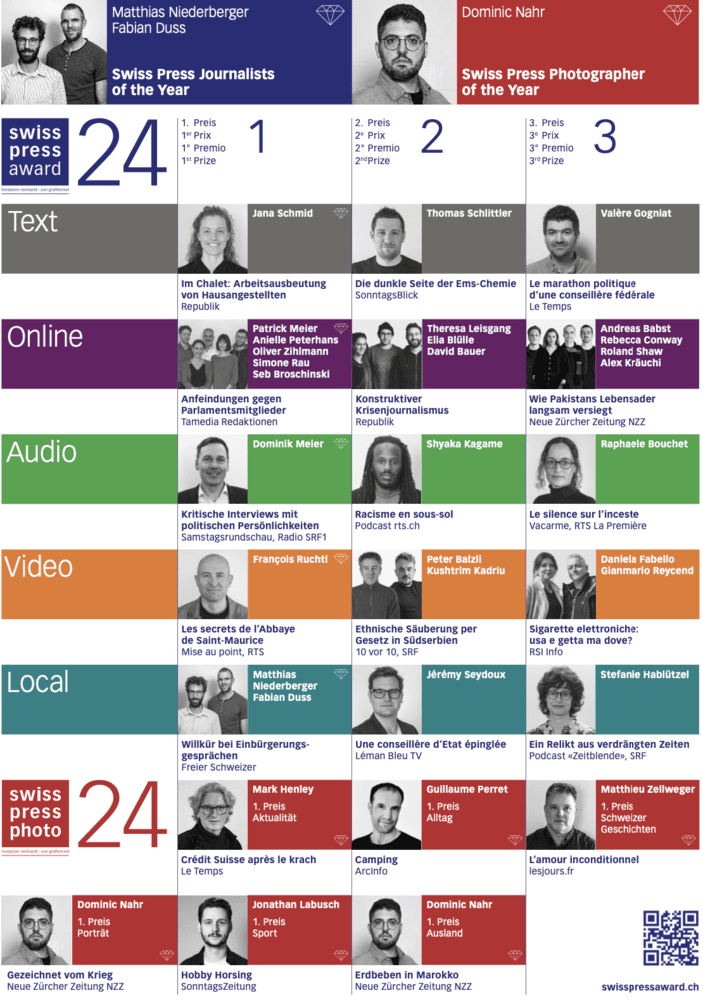
Two local journalists from the canton of Schwyz were honored with the «Swiss Press Award» on Friday. They won the award for an article about arbitrary practices during naturalization interviews, published in the Küssnacht-based local newspaper *Freier Schweizer*.
Editorial
-
April 28, 2024
The two journalists Matthias Niederberger and Fabian Duss also won in the local journalism category, as announced by the Fondation Reinhardt von Graffenried on Friday after the award ceremony in Bern. According to the research, these interviews led to some curious questions, such as the one about the color of cows. The research led to a revision of the list of questions.
The "Swiss Press Photographer of the Year" award went to Dominic Nahr. At the end of March, the foundation had already announced his victory in the "Portrait" category with pictures of people scarred by the war in Ukraine and in the "International" category with a reportage on the earthquake in the Moroccan High Atlas in September 2023. Both series were published in the New Zurich Newspaper published.
Article about the exploitation of domestic workers
The winner in the Text category was Jana Schmid from the online magazine Republic.ch. She had written about the exploitation of Filipino domestic workers by a rich family from Saudi Arabia in Gstaad BE.
In the online category, there were five first place winners from the Tamedia editorial team: Patrick Meier, Anielle Peterhans, Oliver Zihlmann, Simone Rau and Seb Broschinski. They had reported on the hostility towards members of parliament.
Dominik Meier from Radio SRF 1's Samstagsrundschau was awarded the prize in the audio category. He conducted critical interviews with political figures, including Finance Minister Karin Keller-Sutter on the Credit Suisse debacle.
Video about St. Maurice Abbey
François Ruchti won over the jury in the video category. He reported on the St. Maurice Abbey in Valais, where cases of sexual abuse had occurred, on RTS television in French-speaking Switzerland.
The publisher-independent Reinhardt von Graffenried Foundation was established in 2009 with the aim of promoting journalism and press photography in print and online media. The winners of the various categories each receive CHF 15,000, while the journalist and photographer of the year each receive CHF 25,000. (SDA)
What does "contextualize" actually mean?
In his column «What Does It Actually Mean…?», Benno Maggi explores terms from the fields of marketing and communication. This time, he discusses the term «contextualize.».
Benno Maggi
-
April 26, 2024
What a nonsense word. But unfortunately it's being used very often at the moment. The masculine noun context has long since found its way into everyday language. It was already complicated enough. But now this verb - or, to put it in the old-fashioned way, this activity word - is making life difficult because, by definition, it calls for an activity.
Suddenly there is a need or obligation to always interpret a text in context. In other words, looking at information, events or ideas in isolation is no longer enough. No, we have to assess everything in relation to the circumstances in which they occur or to which they refer and the people who convey them. Thank you very much. So the temporal, political, economic, socio-cultural and personal circumstances play an essential role in how we should interpret something. It reads pretty complicated. As if life wasn't already complicated enough, now we have to contextualize everything.
By contextualizing something, we try to understand how it fits into its larger environment and how it is influenced by this environment or exerts influence on it itself. Can we no longer simply take things as they are? Can we no longer simply read and enjoy texts and, in the best case, even understand them? Does everything really have to be contextualized? YES. To use this unspeakable portmanteau word for once.
If you want to take everything into account, you end up with nothing
YES, because otherwise there is a great risk of being misled. If we don't place statements in a larger context, we could be manipulated. Contextualizing helps us to classify something in order to understand it better. For example, it helps if we take into account that not everything we scroll through on social media is true and real. Or if we take into account that the pitch was not lost because of the performance of the many agencies invited, but because the clients already knew who they were going to choose before the presentation, then that doesn't ease the pain, but it contextualizes the disdainful rejection. But if everything is constantly contextualized in meetings with existing clients, if something has to be viewed contextually or if there is even talk of context-sensitive elements, then it all becomes a bit exhausting.
Therefore: NO, because if we are constantly contextualizing, we won't get anywhere. If every idea, every concept, every solution first has to be considered in a larger context, there is a risk that it will be completely talked out of existence and die before it has even grown up. There are always enough ifs and buts around it that can become a game stopper. Instead of constantly contextualizing, perhaps we should reflect a little more. Reflecting refers to the thought process in which we think about our own thoughts, feelings, experiences or actions. That is usually enough. But beware, reflection requires self-awareness and self-criticism. It is about consciously thinking about the past or the present in order to gain insights or develop further. It's hard, but valuable.
Contextualizing, on the other hand, only refers to putting something in its context in order to understand it better. And that then provides this space for excuses for not having to decide something and play it back to the sender.
* Benno Maggi is co-founder and CEO of Partner & Partner. He has been eavesdropping on the industry for over 30 years, discovering words and terms for us that can either be used for small talk, pomposity, excitement, playing Scrabble, or just because.
Tracy Jans as a guest in the podcast by Nicoletta Cimmino and Peter Hossli
Tracy Jans, an American, has been living in Switzerland for 25 years. On the «1776» podcast about the U.S., hosted by Nicoletta Cimmino and Peter Hossli, the wife of Federal Councilor Beat Jans talks about life in two cultures, why she isn’t all that interested in politics—and how she misses casual flirting.
Editorial
-
April 26, 2024
Nicoletta Cimmino, Tracy Jans and Peter Hossli in a podcast discussion (from left to right). (Image: zVg.)
In their podcast "1776", Nicoletta Cimmino and Peter Hossli tackle American topics. The current episode features Federal Councillor Tracy Jans as a guest. "I have the privilege of knowing two places very well," says the American with a Swiss passport. "Both countries have fantastic things - and things that make you think: okay, you could work on that." She feels at home where she lives: "My home is Switzerland."
She misses something American, says Tracy Jans. "I miss those brief conversations with people I don't know." The everyday flirtations on the street, in a café with people you never see again afterwards, but with whom you share a brief moment. "When I talk to people in Switzerland about it, I'm surprised that it's not even on their radar."
Tracy Jans raised her two children in Switzerland and talks about the differences between the education systems in the "1776" podcast. She appreciates the fact that in Swiss schools you don't just learn what's in the books, but also how to swim, ride a bike and eat healthily.
"In the USA, people believe that you can achieve anything if you work hard," says Jans, describing another difference. "Switzerland has a bit more of this 'Nobody Left Behind' philosophy, which I think is wonderful."
She identifies differences in the political system. As soon as a new president comes to power in the USA, changes are made to what the predecessor did. Switzerland is slower, but more stable.
She will vote for Joe Biden in the US presidential elections in the fall. Tracy Jans describes Barack Obama as her favorite president. "He embodied this hope, this Americanness, this feeling that anything is possible."
She herself is "not a political person", emphasizes Tracy Jans. "I don't really like politics. And if I had met Beat and he had been a politician back then, I'm not sure we would have gotten together."
But it would never have occurred to her to keep her husband away from politics. She recognizes the joy that Jans gets from politics. "It gives him a lot of energy and joy." And she knows that he is in the right place. "When you love someone, that's all you want for them."
The biostatistician didn't move to Switzerland because of Beat Jans, but because of a job at Novartis. "I had already met Beat a few times, but we weren't together. And I thought it was a nice coincidence that I had a job offer in a city where I knew a really nice guy."
She is now taking on a new role, says Tracy Jans about the impact of her husband's election to the Federal Council. "We have always supported each other." She now has to be more flexible. "I have to take over some of the things he did at home and give the children the feeling that everything is okay."
The independent USA Podcast "1776" will be presented by Nicoletta Cimmino, journalistic director at Gassmann Mediaand Peter Hossli, Head of the Ringier School of Journalism, produced and moderated. The podcast can be heard on Spotify, Apple Podcast and YouTube.
Consumer protection criticizes Swisscom fee on e-mail accounts
The consumer protection agency has criticized Swisscom's plan to charge fees for some Bluewin email accounts. It says it is incomprehensible that long-time users would be asked to pay.
Editorial
-
April 26, 2024
(Image: Swisscom photo team)
In August 2023, Swisscom emphasized that the prices for subscriptions would remain unchanged until the end of 2024, the Foundation for Consumer Protection wrote on Friday at the request of Keystone-SDA. Email accounts cannot simply be changed so quickly. Changing an email address causes "an enormous amount of work" for each individual person.
The fact that Swisscom customers now have to dig deeper into their wallets for various services is inexplicable. Swisscom has "always been the most expensive provider", but at the same time was able to make a billion-euro deal in Italy, the statement continued.
The introduction of the fee was first discussed by the View reported. When asked on Friday, Swisscom emphasized that "Bluewin E-Mail light" will remain free of charge (1 e-mail address and 1 gigabyte of storage). The webmail offer "Bluewin E-Mail basic" costs CHF 2.90 per month and has been available to new customers since Wednesday.
The changeover for existing customers will be staggered from the end of May. Customers will be automatically switched to the new platform and the new offering based on their previous usage. After receiving the information letter, customers will have three months before they have to pay for the Basic subscription.
Outdated infrastructure
The reason for the fee is the ageing infrastructure on which the Bluewin mail service runs. This must be replaced in order for the service to cover its costs. According to Swisscom, this is not currently the case.
For this reason, Swisscom has decided to migrate Bluewin Mail to the Amazon Web Services cloud. Data storage on AWS will continue to take place in Switzerland. Swisscom did not provide Keystone-SDA with any information on how many users are affected. (SDA)
Snapchat company share price shoots up by a quarter
A significant increase in revenue last quarter has restored Wall Street's confidence in the photo app Snapchat. Shares of its parent company, Snap, jumped by more than a quarter in after-hours trading on Thursday.
Editorial
-
April 26, 2024
Years of restructuring advertising systems finally paid off for the photo app Snapchat. The turnover of the operating company Snap rose by 21% year-on-year to almost 1.19 billion US dollars in the last quarter.
Just three months ago, the share price plummeted by more than 30 percent following the disappointment of the last quarterly figures.
Stricter privacy settings
Snap had once accustomed investors to growth rates of more than 50 percent. But then the growth stopped, partly because of Apple's measures for more privacy on the iPhone. Developers such as Snap now have to explicitly ask users for permission if they want to track their behaviour across various apps and services in order to personalize advertising. Many users rejected this - and this shattered numerous advertising models, including at the Facebook group Meta.
In contrast to Meta, Snap CEO Evan Spiegel was in favor of the Apple changes. However, the Snapchat company struggled for a long time to set up new, efficient processes for online advertising and to significantly increase sales again.
Cost-cutting measures due to red figures
At the same time, Snap remains in the red. In the last quarter, the company posted a loss of 305 million dollars, compared to a loss of 328.7 million dollars a year ago. Snap boss Spiegel has already resorted to cost-cutting measures to counteract this.
The number of daily active users rose from 414 to 422 million within three months. Snapchat once became popular with images that disappeared on their own. The service now also relies on augmented reality, where digital objects are integrated into real environments. Fashion companies, for example, use this technology to let users try on their products virtually on Snapchat.
Snap forecast revenue of between 1.225 and 1.255 billion dollars for the current quarter, which was already at the lower end of the analysts' estimate range. (SDA/swi)
Franz&René and Andros show the history of the Kambundjis
Franz&René, the lead agency for Andros Switzerland since 2021, is designing the image campaign for the fruit-flavored brand on a national level. The campaign features the two athletes, Mujinga and Ditaji Kambundji, in a family setting characterized by sibling love, authenticity, and a passion for the good things in life.
Editorial
-
April 26, 2024
For both Andros and the Kambundjis, there is one set of values that transcends all others: to bring out the best in yourself and to pass on passion and respect. To emphasize these shared values, the campaign tells a family story that delves into the Kambundji sisters' childhood and draws parallels between their passion for overcoming themselves and their love of good things.
The story is told by Mujinga herself as a voice-over in both languages. The campaign was launched on Monday and can be seen on TV, OOH/DOOH and digitally in French-speaking Switzerland and digitally in German-speaking Switzerland.
Responsible at Andros: Rahel Zumwald (Brand Manager), Julien Rameau (Head of Marketing & Communication), Felix Schumacher (Managing Director Andros Switzerland). Responsible at Franz&René: Valérie Pecalvel (Strategic Direction), Luciano Gerber (Client Service Direction), Sascha Michael Schilt (Senior Consultant & Digital), Vincent Eichenberger (Client Service Direction & Digital), Eric Kohler (Art Direction), Stéfanie Flückiger (Graphic Designer), Yannic Sommer (Graphic Designer), Audrey Grossenbacher (Graphic Designer), Clara Bragagnini (Account executive). Direction and photography: Nicola Tröhler. Production: Rocket Film. Media agency: Mediatonic.
Google and Microsoft with significantly higher sales and profits
Google earns billions from advertising on its search engine. AI challengers like Microsoft now want to provide answers instead of links. But the company's business model is robust.
Editorial
-
April 26, 2024
Google's advertising business has so far defied the AI challengers without any problems. In the past quarter, Google's advertising revenue increased by a good 13 percent year-on-year to 61.66 billion dollars (57.49 billion euros). The video subsidiary YouTube contributed a good eight billion dollars - around 21 percent more than in the same quarter of the previous year.
The development of Google's advertising business - especially in web search as the most important source of revenue - is being monitored very closely. A key question is whether attempts by competitors to use artificial intelligence to display direct answers instead of links will leave a mark on the search engine that has dominated the market for years. Some investors are betting on this: the challenger Perplexity AI was valued at more than one billion dollars in a recent financing round.
Optimism at Google
Meanwhile, Google is also trying to improve its own web search with AI functions. For example, search queries can be triggered on Samsung's new top smartphone Galaxy S24 and newer models of Google's own Pixel phones by circling an object or word on the display.
Recently, such offers have been increasingly used, said CEO Sundar Pichai on Thursday. He expressed his conviction that Google would succeed in adapting its business model to the new AI opportunities.
At Google's parent company Alphabet, turnover rose by 15 percent year-on-year to 80.5 billion dollars. Analysts had expected an average of only around 79 billion dollars. Group profit grew to 23.66 billion dollars from just over 15 billion dollars a year earlier.
Growth in the business with software and computing power from the cloud also contributed to this. The division increased its operating profit to 900 million dollars from 191 million dollars in the same quarter of the previous year.
Microsoft increases sales
Rival Microsoft also sent a clear signal that its investments in the cloud and artificial intelligence are paying off. The software giant concluded a pact with the ChatGPT developer OpenAI and is integrating AI functions into more and more of its products on this basis. The need for computing power for artificial intelligence is in turn driving Microsoft's cloud business.
Microsoft increased its turnover by 17 percent year-on-year to just under 62 billion dollars in the third quarter ended March. Profits grew by a fifth to almost 22 billion dollars. Both exceeded experts' expectations. Sales of Microsoft's cloud platform Azure rose by 31 percent.
At Alphabet, turnover from "other bets" - future projects such as self-driving cars or delivery drones - rose from 288 to 495 million dollars. The division's operating loss was reduced from 1.22 billion dollars a year ago to just over one billion dollars.
Shares gain
Alphabet shares jumped by a good eleven percent in after-hours trading. Alphabet announced a dividend of 20 cents per share for the first time - and also held out the prospect of distributions in the future. Microsoft's share price rose by a good four percent. With a market value of around three trillion dollars, Microsoft is currently the most valuable listed company in the world.
Facebook group Meta announced on Wednesday that it wants to become the number one in AI. Facebook founder Mark Zuckerberg's big AI plans will bring the company into greater competition with chatGPT developer OpenAI and other tech heavyweights such as Microsoft, Google and Amazon, who all want to play a leading role in artificial intelligence. (SDA/swi)
Farner wins Webby Award for Greenpeace campaign
Farner's marine conservation campaign | Team Farner for Greenpeace Switzerland was named the international "People's Choice" winner in the Video Ads category at the Webby Awards.
Editorial
-
April 26, 2024
The best digital projects in the world are honored at the annual Webby Awards. Almost 13,000 entries from over 70 countries were submitted for the 28th edition. A total of over 2.2 million votes were collected in the voting. The New York Times this is "The Internet's highest honor".
The Greenpeace campaign film by Farner | Team Farner, produced by Shining Film, won the Webby People's Voice Award 2024 in the Advertising, Media & PR, Video Ads category.
Crisp Hiltl campaign by Ruf Lanz makes it into the Lürzer's Archive
Ruf Lanz was featured in Lürzer’s Archive’s «Food + Drink Special» for its “Vegetarian Sensory Delights” campaign for Hiltl.
Editorial
-
April 26, 2024
Every four months, "Lürzer's Archive" presents the most creative campaigns in global advertising. The strictly curated magazine is published in 68 countries and is regarded as a benchmark by agencies and clients. In the current issue, it also presents the special "The spectrum of taste", with evergreens from the food + drink sector.
In addition to international work for McDonalds, Coca Cola, Magnum, Heinz and Babybel, Ruf Lanz's "Vegetarische Sinnesfreuden" for Hiltl is a Swiss campaign.
The cheeky campaign was conceived for the opening of the Hiltl branch on Zurich's Langstrasse in 2017. Ruf Lanz has been ensuring that the Hiltl brand remains on everyone's lips with crisp campaigns since 2006.
SRG sets out principles for the use of artificial intelligence
The Swiss Radio and Television Corporation (SRG) governs the use of artificial intelligence on its channels according to three general principles. Responsibility for its use always lies with humans. One of these principles is that artificial intelligence can never replace human expertise.
Editorial
-
April 26, 2024
It merely serves as a working tool, the first principle published on X on Thursday also states. Users must check the accuracy of the results generated. The second principle requires transparency when using artificial intelligence (AI). AI-generated content must therefore always be labeled.
The third principle obliges SRG broadcasters to maintain the confidentiality of AI-generated content. In particular, no personal data, copyright-protected content or SRG business secrets may be entered into AI tools that have not been checked and approved. (SDA)
Rod is "Ready!" for the new Love Life campaign
Condoms are no longer the focus of safer sex: according to the FOPH, the emphasis is now on personalized protection and testing recommendations. The accompanying campaign by Rod Komunikation is all about the moments leading up to sex.
Editorial
-
April 25, 2024
Since 1987, the Federal Office of Public Health FOPH has repeatedly caused a stir with its HIV prevention campaign. Now the term "safer sex" is being redefined. Because as different as people have sex, so different are the protection and testing recommendations. And the best way to find out about these is before you have sex - with the newly developed safer sex check.
"Ready!" for safer sex
Because many of the important protective measures do not only come into play during sex, but even before it, the new "Ready!" campaign also takes place largely before sex and shows what people do to prepare for sexual adventures. This also includes the safer sex check.
There is another reason for the focus on the moments before sex: Rod worked with Affective Advisory for the campaign. Their behavioral research analysis shows that there is a so-called "hot state" during sex, in which risk-conscious decisions are no longer made. This finding served as a springboard for the "Ready!" concept; the population is now being made aware of the safer sex check in the "cold state".
In addition, the FOPH and Rod Kommunikation are using the current subjects to circumvent the increasingly strict social media restrictions on showing bare skin.
Ambitious goals
This year, the campaign will be visible on various online channels, social media, OOH and DOOH in order to reach a broad target group. The campaign thus contributes to achieving the objectives of the new national program NAPS with: By 2030, there should be no more new transmissions of HIV and the hepatitis B and C viruses in Switzerland. In addition, the spread of other sexually transmitted infections is to be reduced.
Responsible at BAG: Adrian Kammer (Campaign Manager), Michelle Buchser (Project Manager), Eva Marti (Co-Project Manager). Overall responsibility for conception, creation and realization: Rod Communication. Production: Shining; Ivan Stojilikovic (Director), Aleksandar Košutić (DoP), Markus Müller (Photographer), MassivMusic (Music), Stefan Girtanner (Senior Producer), Nathalie Maibach (Line Producer), Stefan Bircher (Producer).Digital products: BlueGlass. Media: Mediaschneider.